Quantcast

Mailbox Monday #382

Mailbox Monday, created by Marcia at To Be Continued, formerly The Printed Page, has a permanent home at its own blog.

To check out what everyone has received over the last week, visit the blog and check out the links.  Leave yours too.

Also, each week, Leslie, Vicki, and I will share the Books that Caught Our Eye from everyone’s weekly links.

Here’s what I received:

Bukowski in a Sundress by Kim Addonizio for review from Penguin for review.

Kim Addonizio is used to being exposed. As a writer of provocative poems and stories, she has encountered success along with snark: one critic dismissed her as “Charles Bukowski in a sundress.” (“Why not Walt Whitman in a sparkly tutu?” she muses.) Now, in this utterly original memoir in essays, she opens up to chronicle the joys and indignities in the life of a writer wandering through middle age.

Addonizio vividly captures moments of inspiration at the writing desk (or bed) and adventures on the road—from a champagne-and-vodka-fueled one-night stand at a writing conference to sparsely attended readings at remote Midwestern colleges. Her crackling, unfiltered wit brings colorful life to pieces like “What Writers Do All Day,” “How to Fall for a Younger Man,” and “Necrophilia” (that is, sexual attraction to men who are dead inside). And she turns a tender yet still comic eye to her family: her father, who sparked her love of poetry; her mother, a former tennis champion who struggled through Parkinson’s at the end of her life; and her daughter, who at a young age chanced upon some erotica she had written for Penthouse.

At once intimate and outrageous, Addonizio’s memoir radiates all the wit and heartbreak and ever-sexy grittiness that her fans have come to love—and that new readers will not soon forget.

After Alice by Gregory Maguire for review with TLC Book Tours.

When Alice toppled down the rabbit-hole 150 years ago, she found a Wonderland as rife with inconsistent rules and abrasive egos as the world she left behind. But what of that world? How did 1860s Oxford react to Alice’s disappearance?

In this brilliant new work of fiction, Gregory Maguire turns his dazzling imagination to the question of underworlds, undergrounds, underpinnings — and understandings old and new, offering an inventive spin on Carroll’s enduring tale. Ada, a friend of Alice’s mentioned briefly in Alice’s Adventures in Wonderland, is off to visit her friend, but arrives a moment too late — and tumbles down the rabbit hole herself.

Ada brings to Wonderland her own imperfect apprehension of cause and effect as she embarks on an odyssey to find Alice and see her safely home from this surreal world below the world. If Euridyce can ever be returned to the arms of Orpheus, or Lazarus can be raised from the tomb, perhaps Alice can be returned to life. Either way, everything that happens next is After Alice.
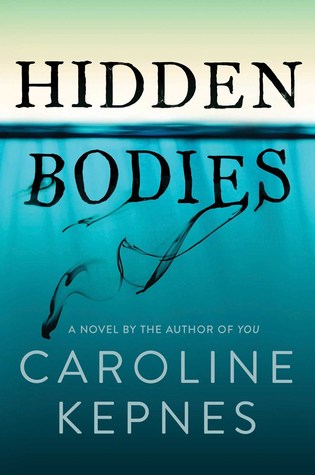
Hidden Bodies by Caroline Kepnes from a friend in Book Club!

Joe Goldberg is no stranger to hiding bodies. In the past ten years, this thirty-something has buried four of them, collateral damage in his quest for love. Now he’s heading west to Los Angeles, the city of second chances, determined to put his past behind him.

In Hollywood, Joe blends in effortlessly with the other young upstarts. He eats guac, works in a bookstore, and flirts with a journalist neighbor. But while others seem fixated on their own reflections, Joe can’t stop looking over his shoulder. The problem with hidden bodies is that they don’t always stay that way. They re-emerge, like dark thoughts, multiplying and threatening to destroy what Joe wants most: true love. And when he finds it in a darkened room in Soho House, he’s more desperate than ever to keep his secrets buried. He doesn’t want to hurt his new girlfriend—he wants to be with her forever. But if she ever finds out what he’s done, he may not have a choice…

The Totally Gnarly, Way Bogus Murder of Muffy McGregor by Teddy Durgin, my friend and colleague, from another friend.

High school is out for the summer of 1986. Unfortunately, mega-popular cheerleader Muffy McGregor won’t live to see the fall. While most people in the small town of Laurel, Maryland, see tragedy in the cheerleader’s gnarly demise, her unpopular classmate, Sam Eckert, sees a most excellent opportunity. In between shifts at his new job at the mall, Sam works with a local P.I. to try and solve Muffy’s murder before the police do so he can finally get in good with the cool crowd. But the suspects are many. Was it Brent, Muffy’s way emotional jock boyfriend? Was it Chet, the super slick record-store manager she was carrying on a not-so-secret affair with? It couldn’t be Sam’s dream girl, Barbara, could it? Or was it someone far more dangerous? Who killed Muffy McGregor? What was the motive? And did it have anything to do with Bobby Ewing in that shower?

What did you receive?

364th Virtual Poetry Circle

Welcome to the 364th Virtual Poetry Circle!

Remember, this is just for fun and is not meant to be stressful.

Keep in mind what Molly Peacock’s book suggested.

Look at a line, a stanza, sentences, and images; describe what you like or don’t like; and offer an opinion. If you missed my review of her book, check it out here.

Today’s poem is from Henry Wadsworth Longfellow:

The Landlord’s Tale. Paul Revere’s Ride

Listen, my children, and you shall hear
Of the midnight ride of Paul Revere,
On the eighteenth of April, in Seventy-five;
Hardly a man is now alive
Who remembers that famous day and year.

He said to his friend, "If the British march
By land or sea from the town to-night,
Hang a lantern aloft in the belfry arch
Of the North Church tower as a signal light,—
One, if by land, and two, if by sea;
And I on the opposite shore will be,
Ready to ride and spread the alarm
Through every Middlesex village and farm,
For the country folk to be up and to arm."
Then he said, "Good night!" and with muffled oar
Silently rowed to the Charlestown shore,
Just as the moon rose over the bay,
Where swinging wide at her moorings lay
The Somerset, British man-of-war;
A phantom ship, with each mast and spar
Across the moon like a prison bar,
And a huge black hulk, that was magnified
By its own reflection in the tide.

Meanwhile, his friend, through alley and street,
Wanders and watches with eager ears,
Till in the silence around him he hears
The muster of men at the barrack door,
The sound of arms, and the tramp of feet,
And the measured tread of the grenadiers,
Marching down to their boats on the shore.

Then he climbed the tower of the Old North Church,
By the wooden stairs, with stealthy tread,
To the belfry-chamber overhead,
And startled the pigeons from their perch
On the sombre rafters, that round him made
Masses and moving shapes of shade, —
By the trembling ladder, steep and tall,
To the highest window in the wall,
Where he paused to listen and look down
A moment on the roofs of the town,
And the moonlight flowing over all.
Beneath, in the churchyard, lay the dead,
In their night-encampment on the hill,
Wrapped in silence so deep and still
That he could hear, like a sentinel's tread,
The watchful night-wind, as it went
Creeping along from tent to tent,
And seeming to whisper, "All is well!"
A moment only he feels the spell
Of the place and the hour, and the secret dread
Of the lonely belfry and the dead;
For suddenly all his thoughts are bent
On a shadowy something far away,
Where the river widens to meet the bay, —
A line of black that bends and floats
On the rising tide, like a bridge of boats.

Meanwhile, impatient to mount and ride,
Booted and spurred, with a heavy stride
On the opposite shore walked Paul Revere.
Now he patted his horse's side,
Now gazed at the landscape far and near,
Then, impetuous, stamped the earth,
And turned and tightened his saddle girth;
But mostly he watched with eager search
The belfry-tower of the Old North Church,
As it rose above the graves on the hill,
Lonely and spectral and sombre and still.
And lo! as he looks, on the belfry's height
A glimmer, and then a gleam of light!
He springs to the saddle, the bridle he turns,
But lingers and gazes, till full on his sight
A second lamp in the belfry burns!
A hurry of hoofs in a village street,
A shape in the moonlight, a bulk in the dark,
And beneath, from the pebbles, in passing, a spark
Struck out by a steed flying fearless and fleet:
That was all! And yet, through the gloom and the light,
The fate of a nation was riding that night;
And the spark struck out by that steed, in his flight,
Kindled the land into flame with its heat.
He has left the village and mounted the steep,
And beneath him, tranquil and broad and deep,
Is the Mystic, meeting the ocean tides;
And under the alders, that skirt its edge,
Now soft on the sand, now loud on the ledge,
Is heard the tramp of his steed as he rides.

It was twelve by the village clock,
When he crossed the bridge into Medford town.
He heard the crowing of the cock,
And the barking of the farmer's dog,
And felt the damp of the river fog,
That rises after the sun goes down.

It was one by the village clock,
When he galloped into Lexington.
He saw the gilded weathercock
Swim in the moonlight as he passed,
And the meeting-house windows, blank and bare,
Gaze at him with a spectral glare,
As if they already stood aghast
At the bloody work they would look upon.

It was two by the village clock,
When he came to the bridge in Concord town.
He heard the bleating of the flock,
And the twitter of birds among the trees,
And felt the breath of the morning breeze
Blowing over the meadows brown.
And one was safe and asleep in his bed
Who at the bridge would be first to fall,
Who that day would be lying dead,
Pierced by a British musket-ball.

You know the rest. In the books you have read,
How the British Regulars fired and fled, —
How the farmers gave them ball for ball,
From behind each fence and farm-yard wall,
Chasing the red-coats down the lane,
Then crossing the fields to emerge again
Under the trees at the turn of the road,
And only pausing to fire and load.

So through the night rode Paul Revere;
And so through the night went his cry of alarm
To every Middlesex village and farm, —
A cry of defiance and not of fear,
A voice in the darkness, a knock at the door,
And a word that shall echo forevermore!
For, borne on the night-wind of the Past,
Through all our history, to the last,
In the hour of darkness and peril and need,
The people will waken and listen to hear
The hurrying hoof-beats of that steed,
And the midnight message of Paul Revere.

What do you think?

My Grandpa Is a Dinosaur by Richard Fairgray, Terry Jones

Source: Sky Pony Press
Hardcover, 32 pgs.
I am an Amazon Affiliate

My Grandpa Is a Dinosaur by Richard Fairgray and Terry Jones is a delightful book for the imagination, a look at how kids often view the adults in their company, even their own grandparents.  Wanda notices things about her grandfather that other people do not seem to notice, like his green skin, his long tail, and his large presence.  As she explains her observations to her family and they fail to come to the same conclusion that she does, she has little choice but to ask her grandpa directly if he is, indeed, a dinosaur.

Whether the book is meant to be a commentary on how children often find their grandparents to be ancient or not, it doesn’t matter.  Wanda is a delightfully inquisitive child who enjoys her grandpa’s company in spite of his appearance and odd behavior.  She enjoys his company even more once the mystery is solved.

My Grandpa Is a Dinosaur by Richard Fairgray and Terry Jones is a cute book about loving our relatives no matter what, and it explores the imagination of young children at the same time.  The book is similar to the Gorillas in Our Midst book, which can be used for children in the early stages of word recognition.

RATING: Quatrain

About the Author:

Richard Fairgray is also an active Podcaster, blogger, and writer/illustrator of picture books. His Morgan series has sold well throughout New Zealand and overseas and his new title Gorillas In Our Midst was released in April worldwide.

Jenny & Her Dog Both Fight Cancer by Jewel Kats, illustrated by Claudia Marie Lenart

Source: Claudia Marie Lenart
Paperback, 38 pgs.
I am an Amazon Affiliate

Jenny & Her Dog Both Fight Cancer by Jewel Kats, illustrated by Claudia Marie Lenart, may not have the happiest of endings, but the story is about compassion, strength, and comfort.  Dolly and Jenny share a bond as strong as the bond she has with her parents.  When her dog is diagnosed with cancer, just as she is, they embark on a difficult journey together.  Through comfort and support, each holds the other up.

Kats’ stories are always about lifting the spirits of those in need; children facing cancer and chemotherapy need strength from others when theirs begins to flag.  She understands this need and the strength that each of us has inside, even as children.  Lenart’s fabric dolls provide a soft background to the story and ensure that young readers are not downcast too much by the heartbreak that is sure to follow.

Jenny & Her Dog Both Fight Cancer by Jewel Kats, illustrated by Claudia Marie Lenart, demonstrates the compassionate person Kats was in real life and her dedication to helping others reach their full potential, whether they are sick, disabled, or just having a bad day.  The world will sorely miss this shining light.

***

Jewel Kats, who inspired the Archie comic book character Harper Lodge and dedicated her life to helping those with disabilities, passed away in January.  In a recent article, her publisher Victor Volkman said, “Even reading the manuscripts could bring tears to my eyes — the sheer pluck of the hero or heroine and nobility of spirit, starting from a situation where most of us would just give up.  One of Jewel’s core beliefs is that all girls can be a princess. Why not? It doesn’t matter what shape you are, what you can or can’t do, what color your skin is or how well you speak. Every girl was a princess in her eyes.”

RATING: Quatrain

****If this story touches you, please consider making a donation in Jewel Kats’ honor at Sick Kids.****

Other Books by This Author Reviewed Here:

About the Author:

Once a teen runaway, Jewel Kats is now a two-time Mom’s Choice Award winner. For six years, Jewel penned a syndicated teen advice column for Scripps Howard News Service (USA) and The Halifax Chronicle Herald. She gained this position through The Young People’s Press. She’s won $20,000 in scholarships from Global Television Network, and women’s book publisher: Harlequin Enterprises. Jewel also interned in the TV studio of Entertainment Tonight Canada. Her books have been featured in Ability Magazine (USA) twice. She’s authored eight books-five are about disabilities. The Museum of disABILITY History celebrated her work with a two-day event. Jewel has appeared as an international magazine cover story four times! Recently, her work was featured in an in-depth article published in “The Toronto Star”. Jewel’s work has also appeared as an evening news segment on WKBW-TV and on the pages of “The Buffalo News”.

The Raven King by Maggie Stiefvater (audio)

Source: Purchased
Audible, 11+ hrs.
I am an Amazon Affiliate

The Raven King by Maggie Stiefvater, narrated by Will Patton, is the fourth installment in the Raven Boys series of books, and it is a looped and twisted journey that could have readers wondering how much time has folded over onto itself.

***Read this series in order. SPOILERS below***

Stiefvater packs this installment with revelations about Blue Sargent, who is from a family of psychics and who has been told most of her life that her kiss will cause the death of her true love. Noah, Adam, Ronan, and Gansey have become a family throughout the trials of the Raven Cycle, and this tight-knit group learns to make room not only for Blue but also Henry.  They know that Gansey is fated to die and that Blue’s kiss will lead to that death, but they continue to make plans and find a way to prevent that from happening.  Amidst these plans, these young people are falling in love and tentatively walking on egg shells around one another until they can bear it no longer.  Stiefvater does a fantastic job of depicting young, tentative love.

Patton as always is a terrific narrator, and readers will never be lost as to which character is speaking and to whom. His acting skills come alive with Stiefvater’s prose, and he breathes life into the swirling magic that surrounds these characters, much of it wrapped up in the dream-forest called Cabeswater.

The Raven King by Maggie Stiefvater, narrated by Will Patton, is a wonderful conclusion to the series, but there is enough of an opening that should she choose, Stiefvater could return to these characters or even just some of them to begin new adventures in magic.

RATING: Quatrain

Other Reviews:

About the Author:

New York Times bestselling author of The Shiver Trilogy, The Raven Cycle, and The Scorpio Races. Artist. Driver of things with wheels. Avid reader. All of Maggie Stiefvater’s life decisions have been based around her inability to be gainfully employed. Talking to yourself, staring into space, and coming to work in your pajamas are frowned upon when you’re a waitress, calligraphy instructor, or technical editor (all of which she’s tried), but are highly prized traits in novelists and artists. She’s made her living as one or the other since she was 22. She now lives an eccentric life in the middle of nowhere, Virginia.

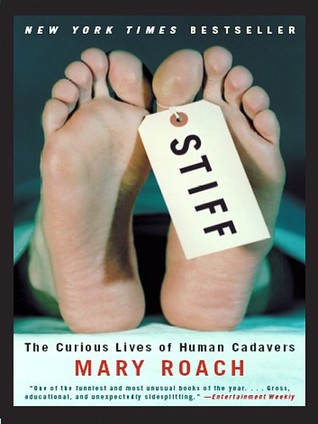
Stiff: The Curious Lives of Human Cadavers by Mary Roach

Source: Purchased
Paperback, 320 pgs.
I am an Amazon Affiliate

Stiff: The Curious Lives of Human Cadavers by Mary Roach, the May book club selection, is not for the faint of heart, as Roach discusses some of the most gruesome experiments and studies in science that involve cadavers.  However, she does pepper her examination of these curious lives with humor that helps to break up the grosser aspects of the book.

“The way I see it, being dead is not terribly far off from being on a cruise ship.  Most of your time is spent lying on your back.  The brain has shut down.  The flesh begins to soften.  Nothing much new happens, and nothing is expected of you.”  (pg. 9)

Through her — what some would call — irreverent humor, Roach explores the role that cadavers have played not only in scientific and medicinal research, but also in auto safety and military ballistics.  Readers may find they need to take breaks from reading as Roach gets very detailed, but others may find that reading straight through is made easier by her asides and funny anecdotes.  Even the people she talks to have to have a sense of humor so they can disconnect from the sadness of lost life, like one surgical student who said she didn’t have a problem working on heads, but she did find it uncomfortable to work on hands because they hold you back.

Stiff: The Curious Lives of Human Cadavers by Mary Roach is a sensational look at the role of cadavers in modern society and in our past, and is often the case, cadavers are not given their due.  These cadavers, which were mostly donated, have given us insight into the human systems, the impacts the body can sustain before dying, and some of the wacky theories that scientists and doctors had about severed head reanimation and more.

RATING: Quatrain

About the Author:

Mary Roach is the author of the New York Times bestsellers STIFF: The Curious Lives of Human Cadavers; GULP: Adventures on the Alimentary Canal, PACKING FOR MARS: The Curious Science of Life in the Void; and BONK: The Curious Coupling of Science and Sex.

Her most recent book, GRUNT: The Curious Science of Humans at War, is out in June 2016.

Mary has written for National Geographic, Wired, Discover, New Scientist, the Journal of Clinical Anatomy, and Outside, among others. She serves as a member of the Mars Institute’s Advisory Board and the Usage Panel of American Heritage Dictionary. Her 2009 TED talk made the organization’s 2011 Twenty Most-Watched To Date list. She was the guest editor of the 2011 Best American Science and Nature Writing, a finalist for the 2014 Royal Society Winton Prize, and a winner of the American Engineering Societies’ Engineering Journalism Award, in a category for which, let’s be honest, she was the sole entrant.

What the Book Club Thought:

Most of us enjoyed the book and its curiosities.  I have no idea why this book sat so long on my bookshelf unread.  A couple others were a bit put off by the author’s tangents, but they also read the book in a once-through fashion.  As I read it in spurts, I didn’t find the tangents to be that off-putting.  One member expressed that the book could have been improved by some editing to make it less wordy and more like the author’s published newspaper/magazine articles.  Mostly, the members found the subject matter fascinating, though one member did mention that the part about animals seemed a little out of place.  Overall, it seemed as though everyone enjoyed this book club selection.

Guest Review: Lonesome Dove by Larry McMurtry

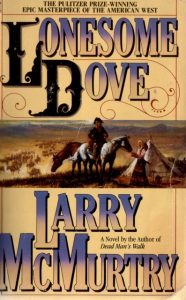
Lonesome Dove by Larry McMurtry
Reviewed by C.H. Armstrong Books & Blog

lonesome-dove-brookline-july-2012When I learned I would have the pleasure of reviewing Larry McMurtry’s Lonesome Dove, I quite literally did a fist pump of victory. Simply stated, this is one of my all-time favorite novels, and one of the very few I would consider reading more than once. For that reason, I’ll not beat around the bush: I enthusiastically give this novel a full 5-star review. If I could give it more than 5-stars, I most certainly would.

So what’s it about?

I asked this question of those who originally recommended it to me, and the answer I received didn’t inspire enthusiastic thoughts: It’s the story about a bunch of old cowboys who go on a cattle drive.

Huh? How is that even remotely interesting? Why would I want to read about a cattle drive?

The answer is this: Just do it. I promise: You won’t be sorry.

Lonesome Dove is about a cattle drive, but it’s more than that. It’s about the strong ties of friendship between two former Texas Rangers, Captain August “Gus” McCrae and Captain Woodrow F. Call, two men who couldn’t be more different. While Call is stoic and serious, McCrae is often seen as more laid back and carefree. But the truth is that the two men, for all of their differences, are like yen and yang or two sides of the same coin. It’s almost a love story without the romance element. They complement each other and, while they seem to have nothing at all in common, they are simply not the same without the other.

Besides the main characters is a series of supporting cast members who round out the story…a 17 year old boy, the son of a prostitute, who suspects that Call might be his father; a young prostitute, Lorie, who just wants to get out of town; and the reprehensible coward, Jake Spoon, who abandons her and leaves her defenseless against the elements and those who would do her harm.

In truth, I sat down to read this book because I wanted to silence someone who insisted I read it…and so I talked my best friend (700 miles away) into reading it with me, just so I would have some company in what I thought would be a grueling read. To my surprise, it was action-packed, funny, heartbreaking, and truly one of the best books I’ve ever read.

Trust me – you don’t want to miss this book. If you read nothing else this year, pick up a copy of Lonesome Dove. You won’t be sorry!

Texas US of Books

Mailbox Monday #381

Mailbox Monday, created by Marcia at To Be Continued, formerly The Printed Page, has a permanent home at its own blog.

To check out what everyone has received over the last week, visit the blog and check out the links.  Leave yours too.

Also, each week, Leslie, Vicki, and I will share the Books that Caught Our Eye from everyone’s weekly links.

Here’s what I received:

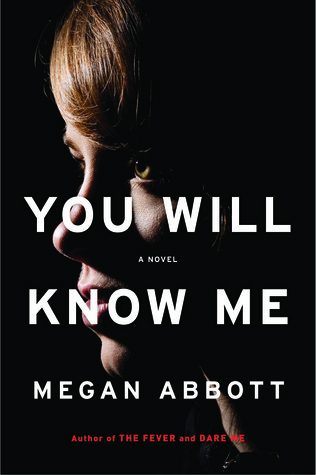
You Will Know Me by Megan Abbott, an unexpected surprise.

Katie and Eric Knox have dedicated their lives to their fifteen-year-old daughter Devon, a gymnastics prodigy and Olympic hopeful. But when a violent death rocks their close-knit gymnastics community just weeks before an all-important competition, everything the Knoxes have worked so hard for feels suddenly at risk. As rumors swirl among the other parents, revealing hidden plots and allegiances, Katie tries frantically to hold her family together while also finding herself drawn, irresistibly, to the crime itself, and the dark corners it threatens to illuminate. From a writer with “exceptional gifts for making nerves jangle and skin crawl,” (Janet Maslin) You Will Know Me is a breathless rollercoaster of a novel about the desperate limits of desire, jealousy, and ambition.

Ming Goes to School by Deirdre Sullivan, illustrated by Maja Löfdahl for review from Sky Pony Press.

Ming goes to school, where she learns to say hello and good-bye. She meets new friends and introduces them to old friends (including her favorite teddy). She builds sandcastles and makes snow angels; she traces, glitters, and glues. She is so fearless that when held at sword point, she even walks the plank! And when she’s playing in the mud, she reaches out and touches the worms with her bare hands. But despite those brave deeds, she isn’t quite ready for the big red slide—not yet.

This is a very sweet story with soft, evocative watercolor illustrations that will help kids to grow comfortable with the idea of starting preschool. Ming is curious and playful and ready for adventure, but even she gets scared of new things sometimes. Kids will relate to her desires and fears and will be excited to see Ming at the top of the slide by the story’s end.

A quiet and reassuring picture book for preschoolers (3-5), this is a wonderful going-to-school story that can be read both at home and in the classroom or childcare center. The illustrations provide a lot of diversity of characters, making this feel like any classroom in any school in the country.

Secrets of Nanreath Hall by Alix Rickloff for review from TLC Book Tours.

Cornwall, 1940. Back in England after the harrowing evacuation at Dunkirk, WWII Red Cross nurse Anna Trenowyth is shocked to learn her adoptive parents Graham and Prue Handley have been killed in an air raid. She desperately needs their advice as she’s been assigned to the military hospital that has set up camp inside her biological mother’s childhood home—Nanreath Hall. Anna was just six years old when her mother, Lady Katherine Trenowyth, died. All she has left are vague memories that tease her with clues she can’t unravel. Anna’s assignment to Nanreath Hall could be the chance for her to finally become acquainted with the family she’s never known—and to unbury the truth and secrets surrounding her past.

Cornwall, 1913. In the luxury of pre-WWI England, Lady Katherine Trenowyth is expected to do nothing more than make a smart marriage and have a respectable life. When Simon Halliday, a bohemian painter, enters her world, Katherine begins to question the future that was so carefully laid out for her. Her choices begin to lead her away from the stability of her home and family toward a wild existence of life, art, and love. But as everything begins to fall apart, Katherine finds herself destitute and alone.

As Anna is drawn into her newfound family’s lives and their tangled loyalties, she discovers herself at the center of old heartbreaks and unbearable tragedies, leaving her to decide if the secrets of the past are too dangerous to unearth…and if the family she’s discovered is one she can keep.

What did you receive?

363rd Virtual Poetry Circle

Welcome to the 363rd Virtual Poetry Circle!

Remember, this is just for fun and is not meant to be stressful.

Keep in mind what Molly Peacock’s book suggested.

Look at a line, a stanza, sentences, and images; describe what you like or don’t like; and offer an opinion. If you missed my review of her book, check it out here.

Today’s poem is from John Koethe:

Sally’s Hair

It’s like living in a light bulb, with the leaves
Like filaments and the sky a shell of thin, transparent glass
Enclosing the late heaven of a summer day, a canopy
Of incandescent blue above the dappled sunlight golden on the grass.

I took the train back from Poughkeepsie to New York
And in the Port Authority, there at the Suburban Transit window,
She asked, “Is this the bus to Princeton?”–which it was.
“Do you know Geoffrey Love?” I said I did. She had the blondest hair,

Which fell across her shoulders, and a dress of almost phosphorescent
blue.
She liked Ayn Rand. We went down to the Village for a drink,
Where I contrived to miss the last bus to New Jersey, and at 3 a.m. we
Walked around and found a cheap hotel I hadn’t enough money for

And fooled around on its dilapidated couch. An early morning bus
(She’d come to see her brother), dinner plans and missed connections
And a message on his door about the Jersey shore. Next day
A summer dormitory room, my roommates gone: “Are you,” she asked,

“A hedonist?” I guessed so. Then she had to catch her plane.
Sally-Sally Roche. She called that night from Florida,
And then I never heard from her again. I wonder where she is now,
Who she is now. That was thirty-seven years ago

And I’m too old to be surprised again. The days are open,
Life conceals no depths, no mysteries, the sky is everywhere,
The leaves are all ablaze with light, the blond light
Of a summer afternoon that made me think again of Sally’s hair.

What do you think?

Guest Post & Giveaway: American Red Cross Heroines by Cat Gardiner, Author of A Moment Forever

oie_QSdo3HpELOL7

If you visited in the last month or so, you’ll have heard of Cat Gardiner, a voice who was new to me in the world of Austen-inspired fiction.  What really drew me to her writing was her love of WWII-era fiction and her thorough research for historical fiction.  She takes research to a whole new level.  She creates playlists for her books, Pinterest boards, and her and her husband often attend and participate in re-enactments!

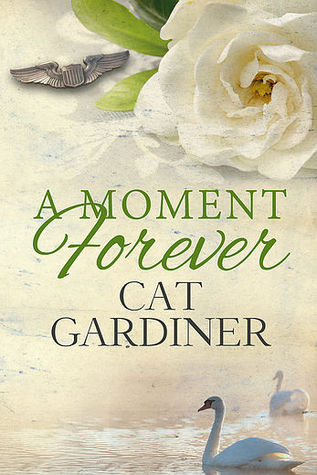
Her latest novel, A Moment Forever, is a sweeping epic in which Juliana Martel is bequeathed a home that looks like a time capsule from 1942 and the mysterious love affair of her great uncle.  Martel embarks on a journalistic journey to uncover the past, which could end up healing herself.

Read more about the book on GoodReads or, better yet, buy it!  It’s sure to be a winner!  It’s available on Kindle or in paperback at Amazon.

Without further ado, please welcome Cat Gardiner.

Hi Serena & Friends! Thank you for inviting me back at Savvy Verse & Wit with my debut WWII romance novel, A Moment Forever (AMF). It’s swell to be here! Some of your readers who know me have recently learned―upon my own outing―my big secret: I’m a WWII Living Historian.

“A what? Is Cat really that old?”

No! I’m a WWII reenactor alongside my husband with the 1 st Infantry Division Reenactment Group out of Bradenton, Florida. He wears the GI combat uniform and I wear the frock and snood ―or hat― depending on the season. Together with the other “boys” of the 1 st I.D, we educate the public at various events and, on occasion, I’ve been seen hanging on my sweetheart’s arm, swooning after 23 years of marriage. I do so love a man in uniform. (In case you’re curious: Visit Here)

When considering this guest article, I, of course, wanted to discuss some relevant theme within AMF, but there were many. So I thought I’d share with you my own 1940s Experience in reenactment and how writing AMF has infused my commitment with new ideas!

This past Memorial Day (AMF’s book birthday,) the third year at a local museum where the 1 st I.D had encamped, and as the norm, I accompanied the men. Nothing more than their informative groupie, looking pretty (I hoped) in the bivouac, I reflected on one of AMF’s main characters and how her wartime service could be one that I could emulate at these events. I absolutely love engaging with the public and sharing with them a little about the home front experience and explaining the various military personal items in the display cases. On occasion, I’m even asked to pose in my vintage apparel and discuss gloves, hats, and handkerchiefs! But at this last event, I really got to thinking, “Can I teach more?” And that was when I considered A Moment Forever as my guide.

You see, Lillian Renner, our heroine’s “Irish Twin” volunteered locally with the American Red Cross’s Motor Corps. However, after training in late 1942 for the newly created Clubmobile service, she left for England and, although the service ended in 1945, she didn’t return back to the states until 1946. Personally, I had never heard of the clubmobile when I began writing the novel in 2013, but as research goes when putting together a saga such as AMF, you follow the lead-and it led me to WWII’s “Doughgirls”. In the following Korean and Vietnam wars, they’d come to be further loved and known as Donut Dollies.

Sitting in that hot canvas tent this past Memorial Day, I thought of Lillian and the other two girls driving their “club on wheels” ―a 2 ½ ton truck―from, at first, airfields and docks in Great Britain, and then four days after D-Day, they began their trek with the troops across Europe. These ARC clubmobilers also served along the very dangerous India/China/Burma front. Wherever the boys were, so were the doughgirls. They traveled behind and received their assignments from the army, serving the troops resting from battle at the frontlines. I could reenact this, I thought. I want to. I have to. If I had lived then, I would have done it! All I need now is a truck, a uniform, and all the qualities those girls had. Bravery being the first and foremost.

“The clubmobile consisted of a good-sized kitchen with a built-in doughnut machine. A primus stove was installed for heating water for coffee, which was prepared in 50-cup urns. On one side of the kitchen area, there was a counter and a large flap which opened out for serving coffee and doughnuts. In the back one-third of the clubmobile, was a lounge with a built-in bench on either side (which could be converted to sleeping bunks, if necessary), a victrola with loud speakers, a large selection of up-to- date music records, and paperback books.” – Official website clubmobiles.org

“The clubmobile consisted of a good-sized kitchen with a built-in doughnut machine. A primus stove was installed for heating water for coffee, which was prepared in 50-cup urns. On one side of the kitchen area, there was a counter and a large flap which opened out for serving coffee and doughnuts. In the back one-third of the clubmobile, was a lounge with a built-in bench on either side (which could be converted to sleeping bunks, if necessary), a victrola with loud speakers, a large selection of up-to- date music records, and paperback books.” – Official website clubmobiles.org

Although the concept of bringing doughnuts to the boys in battle began with the Salvation Army during WWI, in 1942, pretty girls between 25 and 35 years of age, trained with the American Red Cross. In Washington, DC they learned to dance, play poker, shoot the breeze, and make coffee and doughnuts―from a truck. What they couldn’t prepare for was the reality of war when fliers landed, returning from a mission. Nor could these American girls ready themselves for the tears―and yes there were tears―when battle-weary GIs saw in them SO MUCH MORE than just “a” woman from back home. To them, they were home; they represented the girl next door, their sisters, their sweethearts who they missed. The cigarettes and magazines, the music and candy were life savers, but the smiles and compassion, the attentive ears, laughter, and the dances were soul savers. These trailblazing clubmobiler girls were so much more than ARC volunteers offering hot coffee and doughnuts. Everything from the truck was free, but the shoulder she offered was priceless. Resting upon that shoulder was the power to restore the man and his humanity, particularly when the clubmobile was there at POW camp liberations.

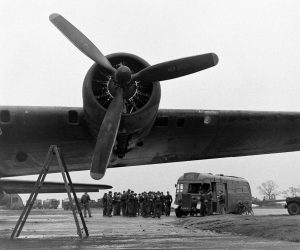
Clubmobile Airfield

Finally recognized by the United States Senate in 2012 for their self-sacrifice and morale boosting efforts, these girls, oftentimes slept in the truck. They wore special field uniforms and if attached to an artillery unit, withstood the shelling. They also endured their own hardships, the homesickness and the heavy hearts they carried into their solitude after a long day of service to our fighting boys.

So, two weeks ago, after pondering these heroes, I told my husband to reach out to a few of his military vehicle collector friends and put out the word: find my wife either a truck we can convert or an actual clubmobile. Of course, I said it tongue and cheek, but he does have such a friend with big, deep pockets who loves this stuff. The guy even has three or four WWII tanks! What’s a little ole’ GMC 2-ton truck for a modern girl wearing a snood?

It’s my dream to be AMF’s Lillian Renner attached to the 1 st Infantry Division, attending reenactments and selling doughnuts to visitors. All proceeds would go to The Honor Flight or another worthy veteran cause. I’d have a uniform specially made and tell the stories of heroic girls such as Captain Elizabeth Richardson (see book: Slinging Doughnuts for the Boys) and tales such as this former volunteer:

I absolutely adored learning about this little-known piece of ARC history, and I’m delighted that Serena has given me an opportunity to tell you about these brave women who served during all the wars. Thank you!

Thanks, Cat, for the wonderful guest post! Readers, that’s not all, enter to win some swag below!

Check out her blog tour:


Giveaway!

DSC03875

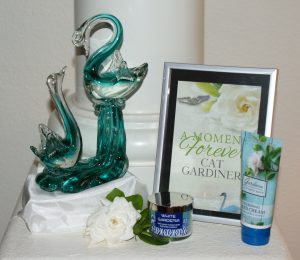
For domestic entries, I’d like to offer a special swag giveaway, which represents key themes within A Moment Forever.

  • An e-book A Moment Forever
  • Glass blown swans statue
  • Bath and Body Works gardenia hand cream
  • Bath and Body Works gardenia scented candle
  • A Moment Forever bookmarkDSC03877

Don’t think we forgot our international commenters!  You’ll be entered to win an ebook of A Moment Forever!

DEADLINE June 30, 2016.

GIVEAWAY IS CLOSED