Quantcast

Mr. Darcy Forever by Victoria Connelly

Mr. Darcy Forever by Victoria Connelly is the third book in the author’s Austen Addicts series (to be published in April by Sourcebooks), though each book can be read as a stand alone.  Sarah and Mia Castle could not be more different, and while they compare themselves to Austen’s famous sisterly pair Marianne and Elinor from Sense & Sensibility, they are far more complicated.  Mia is a wanna-be actress/singer who is struggling to find her niche in her career and who readily sticks her foot in her mouth, while Sarah is suffering from obsessive compulsive disorder (OCD) and can barely eat in restaurants without first examining their cleanliness.  These sisters are like best friends and both love Jane Austen and the yearly festival in Bath, but what happens if a man comes between them?

“But it wasn’t his face Sarah was trying to get a good look at, but the cover of his book.  She was always fascinated by what other people were reading and couldn’t help wanting to know what the handsome stranger was reading.”  (Page 58 ARC)

While both sisters are seeking their very own Mr. Darcy, they end up with a Willoughby and broken hearts.  Sarah and Mia spend three years without speaking, a sisterly relationship that seems irrevocably broken, but Jane Austen comes to the rescue when both cannot resist the Regency period and all of the celebration Bath has to offer.  Can Austen repair this damaged relationship and help them find true love and a happy ending?

Connelly peppers her prose with wit and fun, but she also tackles tough issues when Sarah and Mia fall for the same man.  Her characters react in real ways to the hurts they endure and they react with anger and passion when the situations warrant it.  Readers will be swept away by Mia and Sarah’s story as Connelly alternates between the present when they are not speaking and three years prior when the incident that tears them apart happens.  From the side characters Connelly creates to the reappearances of characters from the previous two novels in the series, she weaves an intricate story that Austen lovers will be unable to put down.

Mr. Darcy Forever by Victoria Connelly is about love and forgiveness between sisters who are swept up in Austen’s fairy tale-like world of happy endings, only to find that the happiness they thought they would have was fleeting.  A more serious, modern Austen that explores the bonds between sisters and the power of the love they share to overcome anything.

About the Author:

Victoria Connelly grew up in Norfolk before attending Worcester College where she studied English Literature. After graduating, she worked her way through a number of jobs before becoming a teacher in North Yorkshire.

In 2000, she got married in a medieval castle in the Yorkshire Dales and moved to London. Five weeks after their wedding, her husband, a television news cameraman, was sent to Israel. Convinced something terrible would happen to him, she came up with the idea for a novel about a young widow who starts seeing angels on her desk at work, but was scared to write it in case she tempted fate. It was only years later that her husband admitted to having a bullet graze his shirt sleeve whilst filming in Israel!

Guest Post: Writing Innovation by Joanne DeMaio & Giveaway

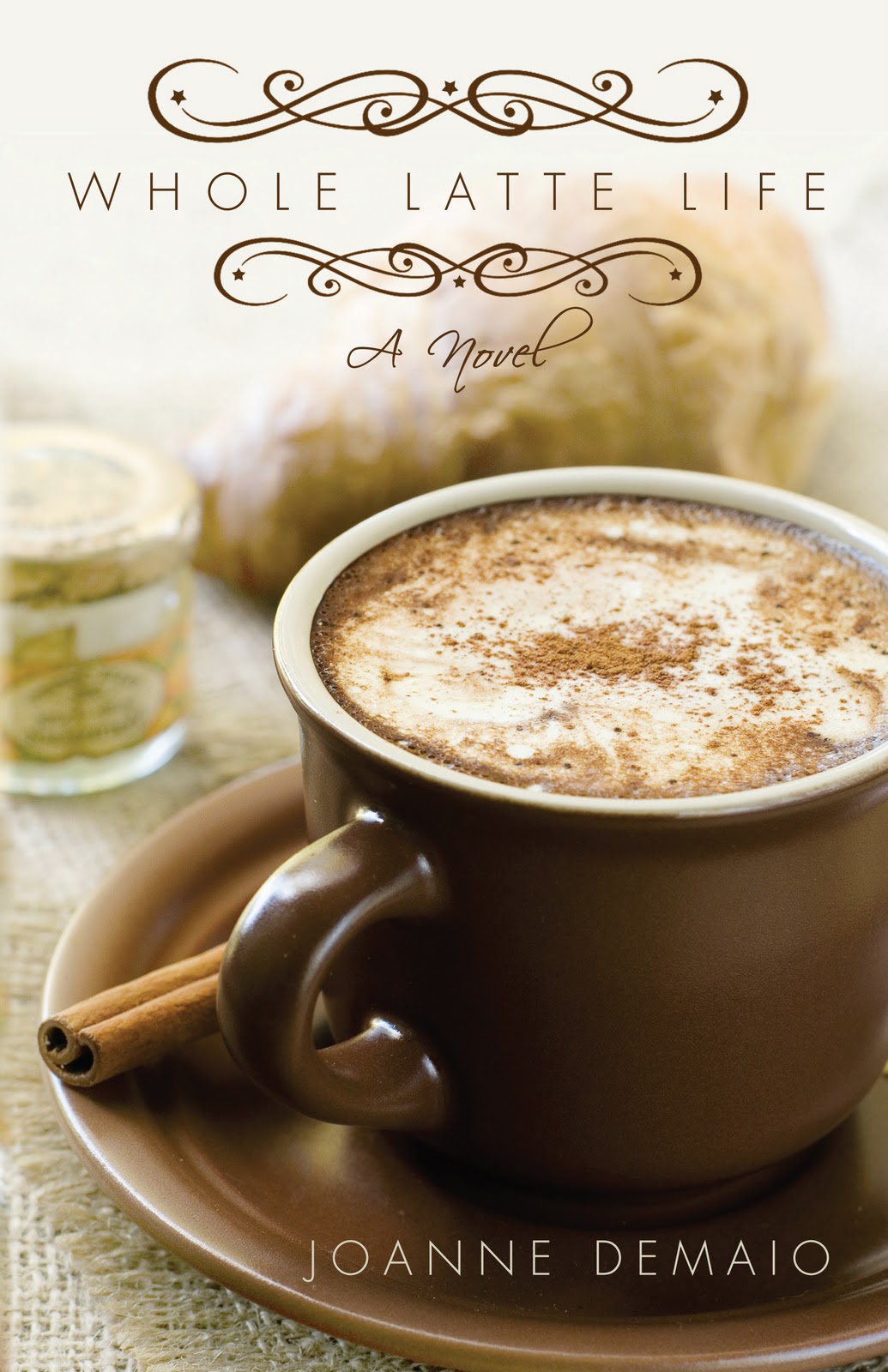
Don’t you just want to dive into that latte right now?  I just adore this cover, it makes my mouth water. 

Whole Latte Life by Joanne DeMaio is a novel that is set in Manhattan and New England, two settings I have a hard time staying away from in books.  But in this novel, there is more than just intercontinental adventure there is a woman willing to take a chance and change her life.  More about the novel from Amazon:

Sara Beth Riley never dreamt she’d walk straight out of her life.  Actually she’d never dreamt a lot of things that had happened this year … From being kidnapped by her own best friend, to throwing her wedding rings into the Hudson River, to calling an old love in France, to getting inked with said best friend, painting the passionate constellation of these choices into permanence.  But mostly, she could never have dreamt what started it all.  How could it be that her mother’s unexpected death, and the grief which lingered painfully long, turned her into the woman she was finally meant to become?

Stay tuned for the giveaway, but for now please give Joanne DeMaio a warm welcome as she shares with us her writing, writing space, and more.

Sometimes a bit of inspiration helps to put an innovative stamp on our writing, something to make it identifiably ours. And that inspiration is all around us …

I came upon this sight on a walk I took between writing sessions. Do you see how the fence builder accommodated this tree trunk? The vertical posts are customized to meet up with the trunk, making it an actual part of the fence. The tree trunk was not removed. The fence did not get placed in front of it, obscuring its view. Instead of letting the trunk present a problem to a creation, the fence artisan let the trunk serve the fence with its beauty. Very innovative!

I enjoy seeing life through the visual like this, and decided to stamp my novel Whole Latte Life with that idea. My main character, Sara Beth, sees situations through her artistically trained eye, based on her education in art history. Shades of light, and sketched ideas, and layers of color all help her to understand situations.

Think of books, or photographs, or paintings, or gardens, or meals that linger in your memory. Maybe you’ve seen a garden of hundreds of sunflowers turning toward the sun. Or you enjoyed an atmospheric meal served in an antique carriage house. Maybe a beautiful painting was created on glass, light shining through the paint. And all stay with you in their innovation.

Some of the best works of art are innovative in their delivery, in their perspective. Remember that when you sit down at your computer keyboard and open up that manuscript file. Bring your own innovative vision to your story, be it fictional or memoir. Look at life on the page through a unique lens. Do you enjoy cooking? Let the meals in your novel help tell your character’s story. Is gardening your thing? Maybe a growing season can frame your storyline.

Consider your interests, and make them your own novel innovation.

Thanks, Joanne, for sharing your advice.

About the Author:

Joanne DeMaio is an author, exploring through her writing the journey to living a fulfilling life. Her debut novel, WHOLE LATTE LIFE, was published in March 2012. In addition, her music essays have appeared in literary journals, celebrating her passion for song, in print. Joanne lives with her family in Connecticut, where the coffee is always brewing, either in her country kitchen or a favorite coffee shop, and the talk is ever flowing over a fresh cup of java.

To enter the giveaway for EITHER 1 paperback (US/Canada) or 1 Kindle ebook (International):

1. Leave a comment about what inspires you.
2. Extra entries for each Twitter, Facebook, and Blog link share you leave in the comments.

Deadline is April 11, 2012, at 11:59PM EST

The Garden of Evening Mists by Tan Twan Eng

The Garden of Evening Mists by Tan Twan Eng is a highly atmospheric novel that oozes mysterious beauty and is set in Malaysia following the retirement of Judge Teoh Yun Ling, a survivor of a brutal Japanese internment camp during WWII when Japan attacked her homeland in China.  Following her survival she comes to Malaysia where she meets the former Japanese Emperor’s gardener Nakamura Aritomo.

Eng uses shifts in time between the present when Malaysia is its own country to when it was under attack from communist guerrillas.  While the nation is struggling to become independent from British rule Ling meets Aritomo and requests his help to make a Japanese garden to honor her sister.

“There has been a storm in the night, and clouds are still marooned on the peaks.  I step down the veranda onto a narrow strip of ceramic tiles, cold and wet beneath my bare soles.”  (Page 11)

Like the narrow path of tiles, Ling has navigated a small space between sanity and insanity when it comes to dealing with what happened to her in the internment camps.  Although she was a judge for more than 12 years seeking justice, she also sought to provide herself with a bit of solace when she sat on the tribunal for Japanese war criminals seeking out kernels of information about the secret camp in the jungle where she and her sister were held prisoner.

Eng is deft in his selection of images and moments like these as he strives to provide a deeper understanding of Ling’s character and the rawness she still feels even though she survived the camp and was released at age 17.  This rawness is prevalent in her reactions to Aritomo when she first meets him and begins gardening at Yugiri, and even in the book’s present, she is still carrying that wariness of the Japanese when she meets with historian Tatsuji.

A deep intimacy is created in Eng’s prose between Aritomo, Ling, and the reader, and through this connection, readers will garner a deeper sense of connection and how it can ultimately lead to a greater understanding of the self and of forgiveness.  Readers will be transported into the Malaysian countryside in the mountains with Ling, Aritomo, and the others, but the journey through the untamed jungle is what will capture their attentions as the mysteries behind Ling’s survival from the internment camp and Aritomo’s departure from the Japanese empire as the Emperor’s gardener are unraveled like so many vines.

The Garden of Evening Mists by Tan Twan Eng has to be one of the best and most well written novels about WWII in the Pacific Theater and how the war impacted not only Malaysians and the British, but also those loyal to the Emperor Hirohito and the politics of a nation caught between two colonizing nations.  Additionally, it easily demonstrates the different ideologies floating about at the time and the aftermath of a major war on the colonies caught in between.  Eng interweaves the past with the present and the not-so-distant past to illuminate the scars that must be overcome by these characters, but only once they begin to see past their own ethnicity and prejudices.  It is a story of love, forgetting, remembering, and healing.

One of the best books I’ve read this year!

About the Author:

Tan Twan Eng is a Malaysian author born in Penang. His first novel The Gift of Rain was published in 2007 and long-listed for the Man Booker Prize that year; it is set in Penang in the years before and during the Japanese occupation of Malaya in World War II and has received critical acclaim around the world.


This is my 20th book for the 2012 New Authors Challenge.

Guest Post: America’s March of Fiscal Folly by Stephen Grimble

As the primary elections are coming to a close and the November presidential election looms large on the political landscape, many Americans are weighing the pros and ultimately more cons associated with each candidate.  Many of us decried the bailouts of the Wall Street banks without so much as an offer of help for foreclosed homeowners, but in truth fiscal discipline is the crux of both financial crises in that banks and homeowners bet too heavily that they would retain their jobs, the market would continue to rise, and the economy would boom for many years to come. 

Fiscal discipline is a lesson even I’m still learning as finances were not openly discussed in my family, except for the “No, you can’t have that.”

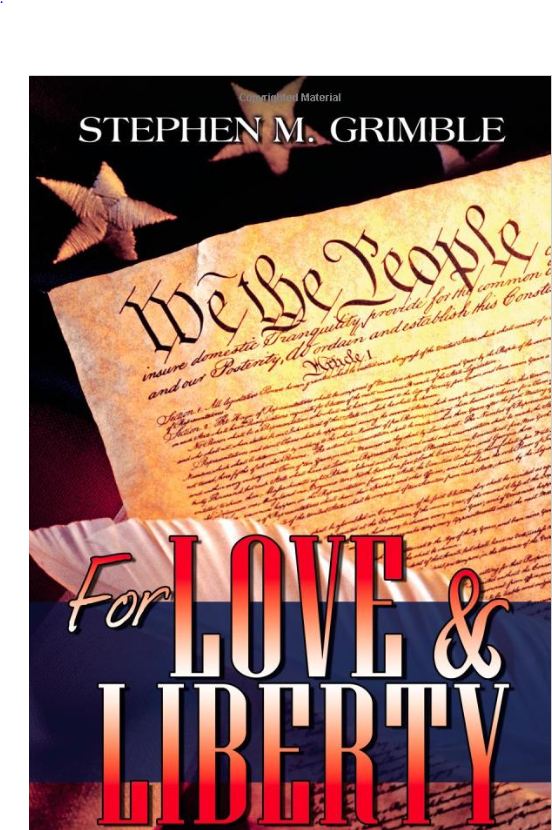
To that end, I’ve got a special guest post from Stephen Grimble, author of For Love & Liberty, that addresses some of these concerns.  First, let’s check out the book:

About the book:

In his provocative, page-turning saga, For Love & Liberty, Stephen M. Grimble skillfully interweaves early American history with a poignant love story. He pays homage to the Founding Fathers’ sacred trust – to secure the blessings of liberty to posterity – through the actions of six distinguished citizens who, out of concern for America’s future, form the Madison Committee, named for the Father of the Constitution, James Madison. Reb McCoy, retired business executive, decorated Vietnam veteran, and philanthropist, agrees to chair the committee, whose charter is to determine what can be done to restore America to its founding principles: limited government, individual liberty, and fiscal solvency.

The Madison Committee proposes seven constitutional amendments known as the Second Bill of Rights, designed to curb the ever-expanding federal government and its runaway spending. Acknowledging that Congress would never approve these amendments, the committee sets out to secure two-thirds of the state legislatures to petition Congress to call a constitutional convention, the first since 1787. The committee realizes it must become actively involved in politics to have any chance of accomplishing its agenda. With his beautiful wife Marlenna’s blessing, McCoy runs for governor of Texas in 2014 and wins. He convinces many fellow governors to urge their state legislatures to petition Congress for a convention. Unanticipated events draw McCoy reluctantly into the 2016 presidential election. By the time the election is decided, more than two-thirds of the states have petitioned Congress to call a constitutional convention, but, fearing the loss of power, it fails to do so. In response to this breach of the Constitution and other usurpations by the federal government, three states seriously consider seceding from the United States and forming a new constitutional republic.

Read how McCoy and his colleagues try to ensure that the current generation of Americans honors the Founders’ challenge to secure the blessings of liberty to posterity. For Love & Liberty is a timely and cautionary tale, full of drama, romance, and a perspective on history rarely found anywhere.

Without further ado, please give Stephen Grimble a warm welcome.

As a recovering business and financial executive, I have long been concerned with the enormous and ever growing federal government deficits, debt, and unfunded entitlement liabilities run up for years by both political parties. In the not too distant future, if America’s fiscal solvency is not restored, the United States will face certain economic collapse.

Founding Father and second U.S. President John Adams once said, “There are two ways to conquer and enslave a country. One is by the sword. The other is by debt.” In America’s long and proud history, she has never been, and likely never will be, conquered by the sword. But unfortunately, we are on the verge of testing Adams’ assertion that a dissolute nation could conquer and enslave its people with debt.

A couple years ago, to refresh my memory, I reread the Constitution’s Preamble, which says in part, “We the People of the United States, in Order to . . . secure the Blessings of Liberty to ourselves and our Posterity, do ordain and establish this Constitution for the United States of America.”

Reflecting on these stirring words, I realized that the Constitution’s Framers were not only challenging themselves, but all future American generations as well, to ensure liberty was never diminished. Sadly, I wondered if my generation would be the first in America’s history to fail to secure liberty’s blessings to posterity. Would my profligate generation, that has permitted government to incur trillions of dollars in debts far in excess of its ability to repay, dishonorably burden generations unborn with the bill? If this were to be my generation’s epitaph, it would severely limit the individual liberty and opportunities to pursue happiness of future Americans that my generation has enjoyed and taken for granted.

In cogitating on this bleak prospect, I was inspired to write my novel, For Love & Liberty, which revolves around a handful of concerned citizens who endeavor to be a catalyst for restoring the constitutional principles of limited government, individual liberty, and fiscal responsibility, thereby securing liberty’s blessings to posterity. My intrepid, fictional protagonists also contemplate the fate of the United States if irresponsible politicians continue on their tragic march of fiscal folly, which inevitably will result in an economic calamity that will shake the nation to its foundation.

In writing For Love & Liberty, I chose the medium of fiction in the hope of attracting readers who may not have the time or inclination to listen to or watch politically oriented programs, but who do enjoy novels that offer history, romance and a provocative story line.  For Love & Liberty is an American political saga for our time, a love letter to America wrapped in a cautionary tale. Freedom Fever — Catch It!

Thanks for sharing your perspective with us, Stephen.

About the Author:

STEPHEN GRIMBLE is a retired executive and a member of SouthWest Writers. He currently resides in Albuquerque, New Mexico, where he continues to call fellow patriots to the founding ideals of the United States Constitution.

Mailbox Monday #170

Mailbox Mondays (click the icon to check out the new blog) has gone on tour since Marcia at A Girl and Her Books, formerly The Printed Page passed the torch. This month’s host is Diary of an Eccentric.

Kristi of The Story Siren continues to sponsor her In My Mailbox meme.

Both of these memes allow bloggers to share what books they receive in the mail or through other means over the past week.

Just be warned that these posts can increase your TBR piles and wish lists.

Here’s what I received this week:

1.  Darkroom by Joshua Graham, which I received from Simon & Schuster as part of Partners in Crime Virtual Tours in May.

2.  The Coldest Night by Robert Olmstead, which I received from Algonquin.

Gone Reading T-Shirt

3. Gone Reading T-Shirt, and you can get your own with my coupon code.

4. The Descendants DVD, which I won from Beth Fish Reads.

What did you receive?

The Yellow House Read-a-Long, Part 3

As part of the 2012 Ireland Reading Challenge, we’re reading The Yellow House by Patricia Falvey.  For the first week, we read pages 1-90, and the second week was for part 2, pages 91-164.

Today, we’re discussing part three, which is for pages 165-238.  This week, we’re asked to talk about the section and ask our own questions.

Please be aware that this discussion could contain spoilers.

 These are some questions I had about this section:

Do you think Owen has a right to ask Eileen for something in return for his kindness and do you think he goes too far asking her to give up her role in the Troubles and commit to volunteer work?

I think its about time Owen sought some reciprocation for all of his generosity and given that all he asks is for her to stop engaging in the violence of the civil disobedience and to help out at the hospital, it’s not a lot to ask.  I think the volunteer work will go a long way to assuaging her guilt and anger, and maybe even begin to open her eyes to the troubles before her people and country.  It also is likely to open her eyes to the suffering of others and that she hasn’t cornered the market on that suffering.

What do you think Owen’s frankness with Eileen about her behavior say about their relationship?

I think that Owen’s ability to be frank with Eileen demonstrates his great regard for her, and dare I say, love.  She’s equally frank, if not harsh, with him, which illustrates the deeper emotional connection that they have, even though neither seems to want to admit it.

Do you think Owen is right that confronting the past can help us heal? Do you think it will help Eileen?  Her family?

I do agree to an extent that revisiting the past and making sense out of it and what it has brought to your life can be cathartic, and in this case, visiting the hospital where her sister is extricated from the family and quarantined is more helpful than Eileen or Owen could have imagined.  I’m still not sure that what transpires in this section will ultimately achieve Eileen’s original dream of reuniting her family at the Yellow House, but it may heal them a bit.

Anna wants to know:

Do you think Frank is justified in abandoning his family and in the treatment of his sister?

No.  I don’t think Frank is justified in abandoning his family and in the treatment of his sister, although I understand that he was disillusioned because he learned that the father he has known all is his life is not his biological father.  On the other hand, he was a very angry man to begin with, which fueled his disappointment and drive to show everyone he could be successful.  I’m particularly angry with Frank in how he tells his sister what to do with regard to Owen and basically forbids her to see him again because it is not good for his business (working both sides of the Cause).  He has absolutely no right to do that; he is not her father and has never been there for her, so how can he expect to have a say in her life — Och, because he’s arrogant, even more so now that he is the owner of the grandfather’s estate.

Do you think finding Lizzie will help Eileen’s mom to heal?

I’m not sure that finding Lizzie will help Eileen’s mom, but anything is possible.  Will finding Lizzie help Eileen?  I think so.  I think Eileen has been looking for some closure and learning that her sister is alive is one way to do that, and she’s even getting some kind of closure with Frank with him talking to her — though he’s still an a**.

What do you think about Owen buying the Yellow House?

I think Owen did it for reasons that he was even unaware of.  Although I think he’s know he’s liked Eileen, I’m not sure he initially bought it for her but for what he says to bring his wife home.  He seems dedicated to his family and keeping them close and the war has changed him in that way, making every moment precious.  I think he now has a better sense of what family should be and wants to capture that.  And I think at the heart of that is Eileen and her family before all the bad things began happening to her — when they were happy in the yellow house and making music.

That’s all for this week.  We’ll be finishing up the book for next week.  Stay tuned.

142nd Virtual Poetry Circle

Welcome to the 142nd Virtual Poetry Circle!

Remember, this is just for fun and is not meant to be stressful.

Keep in mind what Molly Peacock’s books suggested. Look at a line, a stanza, sentences, and images; describe what you like or don’t like; and offer an opinion. If you missed my review of her book, check it out here.

Also, sign up for the 2012 Fearless Poetry Reading Challenge because its simple; you only need to read 1 book of poetry. Please visit the stops on the National Poetry Month Blog Tour from April 2011 and beginning again in April 2012.

Today’s poems is from Li-Young Lee

Black Petal

I never claimed night fathered me.
that was my dead brother talking in his sleep.
I keep him under my pillow, a dear wish
that colors my laughing and crying.

I never said the wind, remembering nothing,
leaves so many rooms unaccounted for,
continual farewell must ransom
the unmistakable fragrance
our human days afford.

It was my brother, little candle in the pulpit,
reading out loud to all of earth
from the book of night.

He died too young to learn his name.
Now he answers to Vacant Boat,
Burning Wing, My Black Petal.

Ask him who his mother is. He'll declare the birds
have eaten the path home, but each of us
joins night's ongoing story
wherever night overtakes him,
the heart astonished to find belonging
and thanks answering thanks. 

Ask if he's hungry or thirsty,
he'll say he's the bread come to pass
and draw you a map
to the twelve secret hips of honey.

Does someone want to know the way to spring?
He'll remind you
the flower was never meant to survive
the fruit's triumph.

He says an apple's most secret cargo
is the enduring odor of a human childhood,
our mother's linen pressed and stored, our father's voice
walking through the rooms.

He says he's forgiven our sister
for playing dead and making him cry
those afternoons we were left alone in the house.

And when clocks frighten me with their long hair,
and when I spy the wind's numerous hands
in the orchard unfastening
first the petals from the buds,
then the perfume from the flesh,

my dead brother ministers to me. His voice
weighs nothing
but the far years between
stars in their massive dying,

and I grow quiet hearing
how many of both of our tomorrows
lie waiting inside it to be born.

What do you think?

Perfect Gifts for Readers Supports a Cause & 25 Percent Off for You

Gone Reading recently contacted me and offered a coupon code for my readers who are looking for just the right gift for their reader friends and family.

The organization, which is based near Washington, D.C., seeks to spread the love of reading to countries across the globe where libraries are few or even non-existent.  Even in the United States, libraries are struggling to stay afloat as state budgets are reduced and some states find themselves running a deficit and in dire need of balancing, which means spending on libraries and other public services are reduced.    As part of their effort to spread the love of reading and literary discussion, Gone Reading offers a number of products for book lovers, and the group “donates 100% of our after-tax profits to provide new funding for libraries and reading-centered non-profits.”

For those interested in helping libraries in the United States, Canada, United Kingdom, and Australia, Gone Reading has an excellent, pilot fundraising program in the works.  If you work with libraries or are a librarian, please feel to contact the group about the effort.

I’ve checked out the products they offer, and there are some great Jane Austen items available for my fellow Janeites, like Anna and those at Austen Blog and Austenprose.  There are games centered on reading, book journals, gorgeous bookplates, posters, and more.  They even sent me my own sample T-shirt:

I hope you’ll all take advantage of an exclusive coupon code for Gone Reading this month for 25% off any item in the Gone Reading store, except for book ends:

SAVVYVERSE25

The code expires on April 21, so get your orders in, and feel free to spread the love to other readers you know.

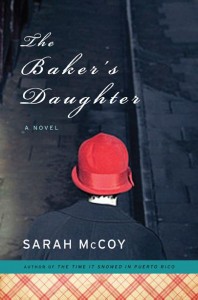
Interview with Sarah McCoy, Author of The Baker’s Daughter

If you haven’t seen reviews for The Baker’s Daughter by Sarah McCoy yet, you must have been living in a cave.  I reviewed this phenomenal historical fiction novel told from the perspectives of two equally strong, but scarred women. 

From my review:  “The recipe for a successful novel is two parts dynamic characters, one part intriguing plot and story lines, and one part clever writing style, and The Baker’s Daughter provides all the nourishment you’ll need.”

I’m particularly confident that this will make this year’s best of list for 2012.

And after meeting Sarah in person, I can honestly say she’s a writer I’ll be adding to that coveted list, whose books I read simply because of who wrote them.  Her personality infuses her stories and her writing, and even in dark tales, her positive attitude and joy for life shine through.

Today, I have a treat for my readers; Sarah agreed to answer a few questions even after traveling the country, attending a book festival, battling the flu, and conducting an online book tour.  I applaud her dedication and want you to give her a warm welcome.

Q: How much does your own life influence your writing? Like are there elements of family and friends in your characters?

A: As an author, you are the conduit through which the story is filtered so, of course, elements of your life (fragments of people, events, places, etc.) are incorporated but never replicated. I gave the analogy of a honeybee in this article on Beyond The Margins and I stand by it. I’m just a story bee buzzing from stem to stem collecting as much as I can to make into honey. Each season is different from the next depending on what’s in bloom along the roadside of my journey.

Q: In The Baker’s Daughter there are some chapters that are from male perspectives. When writing from male and female perspectives, which do you find harder to write and what are some of the main differences between them?

A: This was my first time writing from the male POV and I LOVED it! So much, in fact, that half of the novel I’m currently working on (my third)is from a male protagonist’s perspective. Gender doesn’t factor into the difficulty of writing so much as the character’s inner conflicts and moral complications. For instance, in THE BAKER’S DAUGHTER, one of the male perspectives is Josef, a Nazi officer. It took some work to separate my personal author judgements from my writing. In order to be genuine to Josef’s story line, I had to turn off present-day Sarah McCoy and fully embody what it might’ve been like for a German officer: what moral conflicts did he face; what emotional battles waged within; what governing pressures did he withstand; what cultural forces were at play? I had to do similarly for Elsie and the Schmidts. It’s the human spirit that often flummoxes me most–male and female!

Q: Was The Baker’s Daughter the original title of the book? What other titles were considered and how did you ultimately end up with the current title?

A: In my journal entries for the story, I called it the “Lebkuchen Tale”and the “Garmisch Story” as reference guides, but from the time the first word was typed, THE BAKER’S DAUGHTER has been its title. I was fortunate that my Crown editors and marketing team loved it too.

Q: What are some of your writing habits/obsessions that readers may be surprised to learn about (other than your love of history and tea)?

A: I have so many hidden quirks. I could probably fill ten pages with crazy-writer-lady idiosyncrasies. So for the sake of time, I’ll name one: I sit at my same writing desk without any sound during my writing days. No TV or radio. The phone ringer is turned off. Windows are closed, etc. I’m sealed up in a vacuum. That’s how I write best–in a kind of reality black hole where my imagination fills in all the senses: sound, sight, smell, taste, touch. Some people find this absolutely bizarre. Family members, included. But by the time I sit down to write the story on my laptop, I’ve dreamed on it for months. I’ve journaled. I’ve plotted. I’ve filled up my reservoirs with the pollinated story. I need the silent solitude so my characters can speak clearly, so I can feel the fictional landscape through their senses. Again, as I mentioned in the earlier, I consider myself (Sarah McCoy the author) merely the channel through which the story is processed.

Q: Since Savvy Verse & Wit has a focus on poetry a lot of the time, I like to ask authors about their poetry reading habits. If you read poetry, do you prefer contemporary or classic poetry? Form or free verse? And who are some of your favorite poets or poetry collections? (As a side note, have you checked out the Penguin Anthology of 20th Century American Poetry edited by Rita Dove?) Or why don’t you read poetry?

A: I hate to admit it, but I don’t read hardly enough poetry. I enjoy it, but I’m much more of a narrative reader. I need big, fat paragraphs of description and plot. However, some of my dearest friends are poets. When they read their work aloud, I am mesmerized. It’s as if they’ve cast a spell and I hang on every breath and syllable. If I had to pick my favorite, it’d be Maya Angelou. She is more than a poet. She’s a force of nature.


Thanks, Sarah, for sharing your thoughts with us about writing, your novel, and poetry.

About the Author:

SARAH McCOY is author of the novel, The Time It Snowed in Puerto Rico. She has taught English writing at Old Dominion University and at the University of Texas at El Paso. The daughter of an Army officer, her family was stationed in Germany during her childhood. She calls Virginia home but presently lives with her husband and dog, Gilbert, in El Paso, Texas. The Baker’s Daughter is her second novel. She is currently working on her next.

Website | Blog | Facebook | Twitter | GoodReads

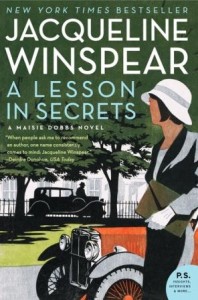
A Lesson in Secrets by Jacqueline Winspear

A Lesson in Secrets by Jacqueline Winspear is the eighth book in the Maisie Dobbs series of cozy mysteries, but can be read as a stand-alone novel.  Set between the end of WWI and the beginnings of WWII, Dobbs is called upon by the British Special Branch to be their eyes and ears inside the College of St. Francis about events that would cause concern to the Crown.  Once installed as a junior lecturer of philosophy, a murder occurs that sets events in motion and tangles Dobbs in yet another mystery.

Dobbs runs her own private investigation agency in London, but she’s called away to a college in Cambridge on special assignment, leaving the office in the capable and reliable hands of Billy Beale.  Beyond the murder mystery and the search for anything that threatens national security, Dobbs is concerned about her father and her friend Sandra, who has just lost her husband in a freak accident.

“She wound down the window and gave a hand signal to indicate that she was pulling over to the side of the road, thus allowing an Austin Seven behind to pass, followed by the motor car that had been shadowing her for at least half an hour.  As soon as they passed, she turned back onto the road again and began to drive as close to the vehicle in front as safety would allow.” (page 3)

Winspear crafts an intricate novel of mystery that resonates with the reader as Dobbs is a strong woman making her way in a man’s world just after the war has ended and women are struggling to maintain their new found freedom.  Dobbs is a strong woman, though scarred, who is intelligent and observant.  Interestingly, Winspear demonstrates how idle gossip can provide just the nugget of information investigators need to close in on a killer.  While Dobbs is kept in the dark about the knowledge held by government officials, she manages to uncover their secrets and those of other government officials who view her as an inconsequential lecturer.

Although there are three or more stories going on at once, Maisie is always central and she juggles so many tasks with ease — almost like she is superhuman.  Pacifism, the treatment of conscientious objectors, and whether someone’s heritage plays a role in their loyalties are just some of the issues addressed in this novel.  A Lesson in Secrets by Jacqueline Winspear raises questions of how much should we idolize our mentors — after all they are just human — and whether we should vilify those that do not see the world in quite the same way that we do.  Moreover, she tackles the power of the written word and its impact on political parties, soldiers, and average citizens, plus how words can inflame already volatile situations.

About the Author:

Jacqueline Winspear was born and raised in the county of Kent, England. Following higher education at the University of London’s Institute of Education, Jacqueline worked in academic publishing, in higher education, and in marketing communications in the UK.

She emigrated to the United States in 1990, and while working in business and as a personal / professional coach, Jacqueline embarked upon a life-long dream to be a writer.  Find out more about Jacqueline at her website, www.jacquelinewinspear.com, and find her on Facebook.

This is my 19th book for the 2012 New Authors Challenge.


This is my 8th book for the WWI Reading Challenge.

The Devil’s Scribe by Alma Katsu

The Devil’s Scribe by Alma Katsu is an e-short story released by Simon & Schuster this month, and it’s the first thing I’ve read on my Kindle!  Can you believe it?!  What prompted me to finally read on the Kindle?!  You’ll never guess, well maybe you will by the end of this unconventional review.

“He fell on the bottle before he took a seat, pouring two fingers of whiskey into his wineglass, streaked with the last of a red he’d consumed.  Now that he’d gotten his invitation, his tentative edge fell away, replaced by relief.”  (from the e-story)

Lanore McIlvrae from The Taker (my review) meets with the one and only Edgar Allan Poe by chance in an expensive Baltimore hotel in 1846 after having been gone from America for the last 20 years.  Poe describes himself as an orphan and a widower able to support himself as the “devil’s scribe,” but Lanny seems passingly interested in his life story and the fact that he’s a writer.  However, in spite of her preoccupation with why she came back to America, she walks with this stranger through the streets of Baltimore, careful not to reveal too much of herself to him.

The story raises the idea of telling strangers secrets as a way to unburden the soul without having to deal with the same consequences one would have to deal with should they tell someone they know intimately or should they tell a family member.  It is reminiscent of the relationship between dying soldiers and/or patients and the priest that comes to hear their sins, though in this situation, Poe cannot offer Lanny absolution.

Even in this short story, Katsu is adept at creating tension and suspense as Lanny and her new companion make their way to Boston.  The story is predictable — though because I’ve already read The Taker — but well written.  Readers who know anything about Edgar Allan Poe should realize where the story is headed, but I’ll not give it away.  I really enjoyed learning more about Lanny and her fears, and it will likely play into Katsu’s next book, The Reckoning.

***Reading on the Kindle***

It wasn’t too bad with a short story.  I actually was surprised how I remained focused, but I’m not sure that I can remain focused for a full length novel.  I may try doing that soon, but for now, I’m still a fan of “real” books.

Star Wars & Philosophy edited by Kevin S. Decker and Jason T. Eberl

Star Wars & Philosophy edited by Kevin S. Decker and Jason T. Eberl is a collection of philosophical essays that draw on the Star Wars movies for examples and the philosophies of St. Augustine, Sartre, and others.  The collection is moderately well done in some parts and blatantly falls short in others, with one particular essay not using secondary sources to back up its arguments at all and leaving readers to beg the question whether Trekkies can write about Star Wars at all.  The essays draw on ancient philosophers as far back as Plato and Aristotle as well as one essay about Eastern philosophies and mythologies.  There are also essays that point to the theories of Kant, Heidegger, and Hegel.

Broken up into four sections — May the Force Be With You: The Philosophical Messages of Star Wars; Try Not — Do or Do Not: Ethics in a Galaxy Far, Far Away; Don’t Call Me a Mindless Philosopher: Alien Technologies and the Metaphysics of the Force; and There’s Always a Bigger Fish: Truth, Faith and a Galactic Society — the collection tackles the hidden philosophies and ethics inherent in the story behind Star Wars and its characters, plus the ethics of future wars and whether droids can be considered people (not humans).  There also are questions about whether everything is preordained or if we have the free will to choose our own paths.  Moreover, religion and moral ambiguity are discussed as well, especially in terms of prophecy and whether one can choose to be moral even if a destiny signifies an opposite action.

In terms of Yoda, when watching the movies, there is a clear Eastern philosophical influence in his manner, his behavior and his teachings, but in the essay “Stoicism in the Stars” by William O. Stephens, the author also makes the case that Yoda is a Stoic and takes on the role of the Sage who never rises to anger and never gives into the desires or seeks out adventure or excitement.  Additionally, Stephens comments on how Stoics often live in agreement with Nature as Yoda does in his hut on Dagobah, and Yoda praises equanimity and peace of mind, which also is characteristic of Buddhists and others who meditate to find peace and separate themselves from ego.  In a way, several essays — even though they focus on Western philosophy — often draw out elements of those philosophies that are found in Eastern philosophy, such as the fluidity of the Force in Star Wars or the fluidity of the future despite prophecies and destinies referred to with regard to the Skywalker family, which is somewhat like the soul or the energy shared by all living things in Eastern philosophy that is reused and recycled in nature (i.e. reincarnation, etc.).

What does this collection offer that is new to someone who was a philosophy major or minor, probably very little, but what was intriguing was some of the history lessons, such as the parallels between the Jedi in Star Wars and the Hwa Rang as leaders of the “military.”  It does provide a great number of secondary resources for readers to check out should they need further explanation of a philosophy without the Star Wars references.  None of the references used were overly surprising in the well done essays, but there were times when references to the movies were inappropriate to the argument being made.  Such was the case in the essay “Send in the Clones:  The Ethics of Future Wars” by Richard Hanley (which cited no secondary sources other than a previous essay in the book) in which Hanley talks about Just War Theory — that is only satisfied by having the right intention, competent authority, just cause, reasonable prospect of success, discrimination, and proportionality — but does not use an example of actual war from the movie.  Rather, Hanley relies on the slaughter of the Sand people by Anakin Skywalker, which he engages in to revenge the killing of his mother by specific Sand people.  Clearly, the vengeful act of Anakin is not warfare and should not be used to demonstrate unjust war.

Star Wars & Philosophy edited by Kevin S. Decker and Jason T. Eberl offers little in the way of new theories about the movies, but does provide fodder for book club discussions and additional contemplation about our world and our selves.

***March Book Club Selection***

We all arrived early it seemed to Novel Places for our March meeting, which could have been a sign we were eager to discuss the book.

This selection was made by one of the males in the group and it did generate a great deal of discussion, even though he was likely the only one who finished the entire collection.  Most of the group picked a few essays to read, while some of us attempted to read more than half.  The essay about whether droids could be considered people generated a great deal of discussion as some of us could see the difference the author was trying to draw between being a “person” and likely being “human.”  Others thought that the argument was not well done, though the example in the essay of a blind woman believing C3P0 was a “man” and not a “droid” just from listening to the movie was telling about how well George Lucas had drawn the character to be human-like.

Another essay generating a great deal of discussion was the one regarding the gray areas of war and of course the use of clones in warfare, though the essay had fallen apart as the arguments were not backed by secondary sources and the author failed to sustain the foundation of his arguments.

Overall, the club would probably say it was a tepid read, but it did generate a great deal of discussion about the world around us, war, and morality.  For that reason, I’d recommend it alone.  I generally think this book would have worked better with two contrasting essays on a given point, such as whether clone armies should be used and whether clone armies should not be used and the reasons for each, because it would have provided a more rounded discussion.  I also think that even though there were Star Wars references illustrating the authors’ points, some essays could have benefited from a little more background and use of secondary sources.

For April, we’re reading A Lesson in Secrets by Jacqueline Winspear.

The Giveaway:

1. Leave a comment about why you’d want to read this book in the comments.

2.  Extra entries for those that Tweet, Facebook, or otherwise spread the word about the giveaway and leave me a link.

Deadline is March 31, 2012. Open Internationally.


This is my 18th book for the 2012 New Authors Challenge.