Quantcast

215th Virtual Poetry Circle

Welcome to the 215th Virtual Poetry Circle!

Remember, this is just for fun and is not meant to be stressful.

Keep in mind what Molly Peacock’s books suggested. Look at a line, a stanza, sentences, and images; describe what you like or don’t like; and offer an opinion. If you missed my review of her book, check it out here.

Also, sign up for the 2013 Dive Into Poetry Challenge because its simple; you only need to read 1 book of poetry. Check out the stops on the 2013 National Poetry Month Blog Tour and the 2012 National Poetry Month Blog Tour.

Today’s poem is from E.E. Cummings, in honor of my 11th wedding anniversary — a poem read at our wedding (also check out this great post on the poet from Insatiable Booksluts):

[i carry your heart with me(i carry it in]

i carry your heart with me(i carry it in
my heart)i am never without it(anywhere
i go you go,my dear;and whatever is done
by only me is your doing,my darling)
                            i fear
no fate(for you are my fate,my sweet)i want
no world(for beautiful you are my world,my true)
and it’s you are whatever a moon has always meant
and whatever a sun will always sing is you

here is the deepest secret nobody knows
(here is the root of the root and the bud of the bud
and the sky of the sky of a tree called life;which grows
higher than soul can hope or mind can hide)
and this is the wonder that's keeping the stars apart

i carry your heart(i carry it in my heart)

What do you think?

The Crooked Branch by Jeanine Cummins

Source: Borrowed from Anna at Diary of an Eccentric
Paperback, 373 pages
I am an Amazon Affiliate

The Crooked Branch by Jeanine Cummins is a dual narrative novel with heroines in present day Queens, N.Y., and County of Mayo, Ireland, during the potato famine when a blight hit all of the crops and the fever was rampant.  Normally, readers either connect with the present day or the historical narrative in books like this, but the eventual entanglement of these narratives reinforces the strength, weaknesses, fears, and courage mothers must face when they are responsible for children.  Majella is a new mother who had certain expectations about motherhood, which are blown to bits in her first emotional months after Emma is born, while Ginny is an Irish potato farmer whose husband ventures to America in the hope that he will send money home to keep his family from being evicted after the blight destroys their crops.

“They didn’t notice that pungent bitterness in the dark, beyond their walls, and turf fires, beyond the milky breath of their sleeping children.  They slept, while that mortal fog stole into their bright, green country, and grew like a merciless stain across the darkened land.  It killed every verdant thing it touched.” (page 2)

Majella considers herself a strong, independent woman with a mother that is less than connected to her own emotions, let along those of her daughter, but when she gives birth to her first child, fears rise up in Majella awful fast.  She’s scrambling for something to hold onto other than her fears and her daughter because holding her too tightly could cause even more harm.  Leo, her husband is supportive but must work and even then, his nerves are fraying with all of his wife’s tears and outbursts.  Her brash and unfiltered commentary on motherhood and her fears is fresh and tangible, and will speak to the hearts of every new mother who has floundered and wondered about how to be a mother.

“I passed out.  The contractions were ferocious because the doctor had turned off my epidural so I could feel them.  As if I was in danger of not feeling the eight-pound child who was attempting to exit my body.  He was a male doctor, and he thought the pain would help me push, which is like the philosophy that waterboarding helps people confess to hiding weapons of mass destruction.” (page 7)

Ginny is another strong woman and she’s forced by their poor circumstances as tenant farmers to take her family’s fate in her own hands after her husband’s letters do not come for months.  As she comes to the estate of Mrs. Alice Springs, she begs for the lives of herself, her children, and her unborn son, seeking employment and safety as the world around them crumbles to Irish dust.  Even though life as a chambermaid is not hellish at the estate, what is is the separation from her children with the knowledge that the crops have gone bad and that they could be starving.  She musters the courage and crafts a plan to save them and herself, at least for a while.

Cummins’ passionate prose brings these women’s struggles to life, making them relate-able in ways that readers will never foresee.  Motherhood is both joyous and full of struggle, and it is life-altering in so many ways, much more so in modern society where women work outside the home and have innumerable choices.  What the author is able to build is an underlying tension between the narratives that pulls the reader forward, hooking them to the very last page when their connections are revealed in full.  What Majella learns about herself and her family will propel her beyond the hormonal mess she has become, and what Ginny has learned as a chambermaid working outside the home, forces her to assume the mantle of decisionmaker at a time when few women did.  The Crooked Branch by Jeanine Cummins is stunning and a powerful read that will open up readers eyes to the emotional and psychological mess that new mothers face, often alone if their husbands and own families are unavailable emotionally.

About the Author:

Jeanine Cummins is the author of the bestselling memoir A Rip in Heaven, which People magazine called: “…a straightforward, expertly paced narrative that reads like a novel.” She lives in New York City.


This is my 3rd book for the Ireland Reading Challenge 2013.


This is my 52nd book for the 2013 New Authors Challenge.

City of Hope by Kate Kerrigan

Source: William Morrow, Harper
Paperback, 400 pages
I am an Amazon Affiliate

City of Hope by Kate Kerrigan is the second novel in the life of Ellie Hogan (if you haven’t read Ellis Island, this review could contain spoilers), a young Irish woman who has traveled to New York City to help save her first love’s mobility and returned home to find her family torn by tragedy.  Beginning in the 1930s, Ellie has settled back into her Irish life without electricity and indoor plumbing, embarking on unconventional business ventures for a woman.  While her family may stand back and allow her to continue with her ambitions, the resentment and angst these businesses bring into their lives simmers beneath the surface.  Ellie is far from the conventional house wife and mother of Ireland, and she knows that she’s the star of her own small town’s gossip, but as long as her life is calm at home, that is all that matters to her.

“However, this morning his blue eyes shone wild with delight.  He looked the same as he had done when I had first fallen in love with him at sixteen.  Fresh and full of the heart of life, like the outdoors — a man made of earth and air.” (page 11 ARC)

While she’s bustling about with her businesses and her life outside the home, the trials of miscarriages and failed births weigh heavily on her and her husband.  Despite the passions she may feel for her husband, they are tainted by his failure to take joy in what she seeks to accomplish and her inability to mourn the losses of her children with her husband at her side.  The wall between them causes fissures in their marriage as they bitingly argue about the little things and the signs of things to come are ignored.  Her three years in New York changed her from the small town girl who wanted merely a husband and family into a woman who wanted the finer things and a better life.

With the lost children spurring her to make the dreams she had in New York a reality in Ireland, Ellie is able to better the lives of the town’s own daughters and wives, prompting these women to rethink their own roles.  Kerrigan takes the time to build up the changes seen in Ellie’s town of Kilmoy, and how those changes are tied to Ellie’s experiences in New York and her own personal devastation at home.  Tragedy strikes her home again, altering Ellie’s course once again and pushing her to run away to America.  In her grief, she reaches out and lifts those around her up, showing them the way to improve themselves, work for their own betterment, and to help others around them.  In many ways, this second book is about redemption and recovery.

City of Hope by Kate Kerrigan is a solid second book in a series, but without having read the first book, readers may find it hard to relate to Ellie’s past and her current situation, particularly her burning desire to run away from Ireland.  However, there are enough hints about the past to guide readers who have picked up the second book.  Ellie is a strong woman who can inspire others to rise above their own poverty and misfortune, but who continues to struggle internally with who she is and wants to be.  Kerrigan’s poise and pacing help readers come to know Ellie as a troubled friend who is still finding her way, even as tragedy strikes and good opportunities present themselves.  There is hope that her journey is nearing a conclusion, and readers will hope that comes with the third book.

About the Author:

Kate Kerrigan is an author living and working in Ireland. Her novels are Recipes for a Perfect Marriage which was shortlisted for Romantic Novel of the Year in 2008 and been translated into 20 languages, The Miracle of Grace, which has been adapted as a film script with funding from the Irish Film Board and Ellis Island, the first of a trilogy which was selected as a TV Book Club Summer Read in Britain and launched in the U.S. with Harper Collins in July 2011. Its sequel City of Hope is published by Pan Macmillan in Britain and scheduled for publication in America by Harper Collins in 2013

This is my 2nd book for the Ireland Reading Challenge 2013.

Mailbox Monday #231

Mailbox Monday (click the icon to check out the new blog) has gone on tour since Marcia at To Be Continued, formerly The Printed Page passed the torch.  August’s host is Bermudaonion The Reading Fever.

The meme allows bloggers to share what books they receive in the mail or through other means over the past week.

Just be warned that these posts can increase your TBR piles and wish lists.

Here’s what I received/bought:

1.  Lake Como by Anita Hughes from the author for review this month.

Hallie Elliot has a perfect life. She is an up-and-coming interior designer in one of San Francisco’s most sought after firms, and has just recently become engaged to Peter, a brilliant young journalist. But when she stumbles upon Peter and her boss in what seems to be a compromising position, her trust in her perfect life is shaken.

So Hallie escapes to Lake Como, Italy to spend time with her half-sister, Portia Tesoro, an Italian blueblood dealing with the scandal of a public estrangement from her cheating husband. While staying in the Tesoro villa, Hallie falls in love with the splendor and beauty of Lake Como, and finds work designing the lakeside estate of a reclusive American tech mogul. The caretaker of this beautiful estate is a handsome man named Angus, and Hallie finds herself drawn to his charm and kindness, despite hints of a dark secret in his past.

2.  Flow: The Life and Times of Philadelphia’s Schuylkill River by Beth Kephart, which I purchased from an Amazon third-party.

From acclaimed writer Beth Kephart, author of A Slant of Sun, comes a short, imaginative telling of the life of the Schuylkill River, which has served as the source of Philadelphia’s water, power, industry, and beauty for the city’s entire life.  Before that, it fed the indigenous people who preceded William Penn, and has since time immemorial shape our region.

3.  The House on Mango Street by Sandra Cisneros, which I purchased at the library.

Acclaimed by critics, beloved by readers of all ages, taught everywhere from inner-city grade schools to universities across the country, and translated all over the world, The House on Mango Street is the remarkable story of Esperanza Cordero.

Told in a series of vignettes – sometimes heartbreaking, sometimes deeply joyous – it is the story of a young Latina girl growing up in Chicago, inventing for herself who and what she will become. Few other books in our time have touched so many readers.

4.  Joyland by Stephen King, which I purchased from the library.

Set in a small-town North Carolina amusement park in 1973, Joyland tells the story of the summer in which college student Devin Jones comes to work as a carny and confronts the legacy of a vicious murder, the fate of a dying child, and the ways both will change his life forever.

What did you receive?

214th Virtual Poetry Circle

Welcome to the 214th Virtual Poetry Circle!

Remember, this is just for fun and is not meant to be stressful.

Keep in mind what Molly Peacock’s books suggested. Look at a line, a stanza, sentences, and images; describe what you like or don’t like; and offer an opinion. If you missed my review of her book, check it out here.

Also, sign up for the 2013 Dive Into Poetry Challenge because its simple; you only need to read 1 book of poetry. Check out the stops on the 2013 National Poetry Month Blog Tour and the 2012 National Poetry Month Blog Tour.

Today’s poem is from Richie Hofmann:

Imperial City

From the outset I hated the city of my ancestors.
I was fearful I’d be put in the dungeon below
the cathedral. The best example of the Romanesque
a guide was saying in German      in English      in French
where are buried eight German kings      four queens
twenty-three bishops      four Holy Roman Emperors
all of whom used this bishopric on the river as the seat
of the kingdom. On the old gate at one end a clock
told an ancient form of time. I sulked along behind
my parents as the guide gave facts about the war
with the Saracens      about the place where the Jews bathed
about the child like me whose father the Peaceful
having already produced an heir by his first marriage
could marry      for love.

What do you think?

Ellis Island by Kate Kerrigan

Source: Harper
Paperback, 351 pages
I am an Amazon Affiliate

Ellis Island by Kate Kerrigan is a historical fiction novel set in the 1920s when Ireland is fighting for Home Rule, and Ellie Hogan makes a bold choice to accept a job in New York City to raise the money her husband needs for an operation.  Ellie is not like the other members of her school group; she dreams of fine things and a life outside her little village of Kilmoy.  Her childhood friend, John, and his family become like a surrogate family for her, showing her the kindness she lacks from her own parents who are so insulated that they forget to hug their daughter and encourage her.  Her friendship soon blossoms into love, a childhood love that becomes a motivation for her to impress, to move beyond the bounds of her family.

“I hated insects, but I wanted to feed the blue tit, and I wanted to impress him.  So I kicked back the rock, picked up a wood louse between my thumb and forefinger and carefully placed it into the bird’s open, hungry beak.  As it swallowed it back, I touched the top of its little head with my finger and felt how small and soft and precious it was.  I looked at John and my heart flooded through.  It was the first time I remember sharing love with somebody.”  (page 8)

Young love can be passionate and sometimes it can be ever-lasting.  Because Ellie has finally shared love with someone, she’s able to lock it away inside herself, stoking its growth even when hundreds of miles separate them.  She makes that hard but necessary choice to leave her Irish home to earn the money John needs after he’s injured while part of the Irish Republican Army.  It is this love she turns to when she worries about what lies ahead in a strange country, and it is what she holds onto when she makes frightening decisions that lead her out of servitude into the life of a career woman.  What had been a year commitment soon turns into something much more, but Ellie is ill-prepared for the challenges and temptations before her.

Kerrigan has done her homework, and it shines in the small town feel of Ellie’s Irish home where everyone knows everyone and their business, and where judgments of families’ past actions still haunt the newest generations.  The harsh realities of fighting for independence from British rule are present as John fights for what he believes.  Her trip to NYC and her experiences with Ellis Island and the immigration process feel real, and readers will be just as awestruck by the city as Ellie is.  More than anything, Kerrigan’s novel is about the search for something just over the horizon, obtaining it, and bringing it back to the family and friends who need it most.

“Ireland was in my heart, but under my feet was America.” (page 128)

Ellis Island by Kate Kerrigan is an immigrant story that requires the deepest of sacrifices and commitments but the growth Ellie experiences make her a better woman, capable of selfless generosity even when she has so little.  She’s grown into a woman her father and mother can be proud of, even though she didn’t go about the way that they would have preferred.

About the Author:

Kate Kerrigan is an author living and working in Ireland. Her novels are Recipes for a Perfect Marriage which was shortlisted for Romantic Novel of the Year in 2008 and been translated into 20 languages, The Miracle of Grace, which has been adapted as a film script with funding from the Irish Film Board and Ellis Island, the first of a trilogy which was selected as a TV Book Club Summer Read in Britain and launched in the U.S. with Harper Collins in July 2011. Its sequel City of Hope is published by Pan Macmillan in Britain and scheduled for publication in America by Harper Collins in 2013.


This is my 1st book for the Ireland Reading Challenge 2013.


This is my 51st book for the 2013 New Authors Challenge.

American Revolution Read-a-Long in September

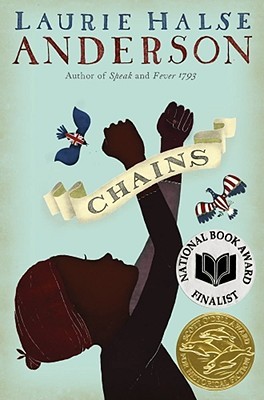
Beginning in September, War Through the Generations will invite readers (participants and non-participants, alike) to join us in a read-a-long of Chains by Laurie Halse Anderson.

Here’s a little more about the book:

As the Revolutionary War begins, thirteen-year-old Isabel wages her own fight…for freedom. Promised freedom upon the death of their owner, she and her sister, Ruth, in a cruel twist of fate become the property of a malicious New York City couple, the Locktons, who have no sympathy for the American Revolution and even less for Ruth and Isabel. When Isabel meets Curzon, a slave with ties to the Patriots, he encourages her to spy on her owners, who know details of British plans for invasion. She is reluctant at first, but when the unthinkable happens to Ruth, Isabel realizes her loyalty is available to the bidder who can provide her with freedom. (GoodReads Summary)

Our discussions will be held on each FRIDAY in September.

If you’d like to join us, sign up here.

Handling the Truth by Beth Kephart

Source: Purchased from Hooray for Books
Paperback, 252 pages
I am an Amazon Affiliate

The best teachers are those that give of themselves freely to their students and their craft, and with reference books available on various ways to write, what to write, and when to write, many will glance at yet another writing reference and dismiss it out of hand. What does that mean? That those people are fools — for Handling the Truth: On the Writing of Memoir by Beth Kephart, released today, is not a reference, it is a memoir about writing memoir (marking a 6th memoir from her). It is a reference guide written from the perspective of a teacher and writer on how to approach a genre riddled with scandal and debunked by naysayers.  Not only does she peel back the layers that can and should be part of memoir creation, but she also peels back her own experiences and perspective to shed light on the hard work memoirists should expect of themselves.

“Teaching memoir is teaching vulnerability is teaching voice is teaching self.”  (page xii)

“Some of the best memoirs are built not from sensate titillations but from the contemplation of universal questions within a framed perspective.” (page 10)

She shares her favorite places, her favorite music, her favorite memoirs, and her students’ work, and she begs that anyone interested in writing memoir do it because the story must be told and is relate-able to someone outside the self.  Writing the genre requires the writer to be as honest with herself as she can be and to fill the gaps in memory with facts from documents or cross-referencing conversations and moments with those that share the memory.  Reading this reference memoir is like getting to know Kephart on a personal level, but it’s also about getting to know the writer inside you — the one that wants to write the book but doesn’t know where to start.  Although this advice is geared toward those who wish to write their own personal histories, there is sage advice for other writers — fiction writers struggling with what tense to put their book in, for example.

On Mark Richard’s memoir House of Prayer No. 2, she says, “He does it because, in this case, the you is more intimate, more forgiving, more moving than the I ever will be.  It enables Richard to say things about himself and his ungodly circumstance that would be otherwise unthinkable.”  (page 46)

Readers and writers will love the explanations, which are peppered with examples from other writers’ memoirs to demonstrate why certain forms and styles are selected, because at Kephart’s core is a dedicated teacher.  It is these dedicated people who write the best reference books because they put more of themselves and more of their passions into writing them, making them innately more engaging and interesting than other reference guides that merely spout out bullet point advice and little else.  Kephart not only references the memoirs she loves, pulling apart the choices authors made in creating them, but also the ways in which she gets students (and now the readers of her book) to think about memoir and their own lives.  Writing exercises that not only focus on early memories, but also the backgrounds of photos (which can be like those fuzzy memories that have little detail) and poems (from some of my favorites like Ted Kooser).

“A way of eating passes away with your mother.  How you held the sugar on your tongue.  How you stirred the crumbled cheese into the oiled broth.  How you savored the sweet grit of flour in the gravy pot, and the thick pink of the beef, and the heated pear with its nutmeg top, and the brownies with the confectioner’s crust.  You will dig through the freezer at your father’s house, mad for one last frozen roll of checkerboard cookie dough, one Tupperware of thick red sauce, one crystallized slice of eggplant parmesan.  You will burn your fingers with the cold.  Your mother’s cooking will be gone.”  (page 92)

But at all costs, she reminds us that “writing is a privilege,” and that privilege should NEVER be taken lightly.  Effectively, she dispels the myths about memoir, explains what memoir is not, and ensures readers and writers look deeper than the memories and events in their lives to uncover the recurring themes, which could provide insight to others and generate empathy, if not understanding and connection.  More importantly, she reminds readers that memoirs by-and-large leave huge chunks of people’s lives off the page, despite the journaling, writing, and researching done into every aspect.  Handling the Truth: On the Writing of Memoir by Beth Kephart is an intelligent, passionate reference that not only guides writers on how to tackle memoir writing, but also inspires them to read the memoirs of others and to learn from, as well as advising them on how to live with openness and curiosity.

***I don’t have too many writing reference books because I only keep the ones that speak to me and offer the best advice, and each of those is chock full of sticky flags, and Kephart’s book is going on that shelf.***

Also, check out how this book made me almost cry when reading it.

About the Author:

Beth Kephart is the author of 10 books, including the National Book Award finalist A Slant of Sun; the Book Sense pick Ghosts in the Garden; the autobiography of Philadelphia’s Schuylkill River, Flow; the acclaimed business fable Zenobia; and the critically acclaimed novels for young adults, Undercover and House of Dance. A third YA novel, Nothing but Ghosts, is due out in June 2009. And a fourth young adult novel, The Heart Is Not a Size, will be released in March 2010. “The Longest Distance,” a short story, appears in the May 2009 HarperTeen anthology, No Such Thing as the Real World.

Kephart is a winner of the Pennsylvania Council on the Arts fiction grant, a National Endowment for the Arts grant, a Leeway grant, a Pew Fellowships in the Arts grant, and the Speakeasy Poetry Prize, among other honors. Kephart’s essays are frequently anthologized, she has judged numerous competitions, and she has taught workshops at many institutions, to all ages. In the fall of 2009, Kephart will teach the advanced nonfiction workshop at the University of Pennsylvania.

Mailbox Monday #230

Mailbox Monday (click the icon to check out the new blog) has gone on tour since Marcia at To Be Continued, formerly The Printed Page passed the torch.  August’s host is Bermudaonion The Reading Fever.

The meme allows bloggers to share what books they receive in the mail or through other means over the past week.

Just be warned that these posts can increase your TBR piles and wish lists.

Here’s what I bought/received:

1.  Solving the World’s Problems by Robert Lee Brewer, which I purchased.

The “World” in Robert Lee Brewer’s Solving the World’s Problems is a slippery world … where chaos always hovers near, where we are (and should be) “splashing around in dark puddles.” And one feels a bit dizzy reading these poems because (while always clear, always full of meaning) they come at reality slantwise so that nothing is quite the same and the reader comes away with a new way of looking at the ordinary objects and events of life. The poems are brim-full of surprises and delights, twists in the language, double-meanings of words, leaps of thought and imagination, interesting line-breaks. There are love and relationship poems, dream poems, poems of life in the modern world. And always the sense (as he writes) of “pulling the world closer to me/leaves falling to the ground/ birds flying south.” I read these once, twice with great enjoyment. I will go back to them often. -Patricia Fargnoli, former Poet Laureate of New Hampshire and author of Then, Something

2.  Pat the Beastie by Henrik Drescher, which I purchased for my daughter’s potty prize box for her good deeds.

A warning: “You should never monkey around with a Beastie!” Once upon a time a little boy and girl named Paul and Judy had a pet called Beastie. Unfortunately, Paul and Judy weren’t very nice to Beastie. In fact—they were downright naughty. They pulled Beastie’s fur and jiggled Beastie’s eyes. They tickled his feet and plucked his boogers. “Always be kind to your pets!” they were reminded again and again—but Paul and Judy never listened.

3.  Camelot’s Court by Robert Dallek, which came from Harper.

Fifty years after John F. Kennedy’s assassination, presidential historian Robert Dallek, whom The New York Times calls “Kennedy’s leading biographer,” delivers a riveting new portrait of this president and his inner circle of advisors—their rivalries, personality clashes, and political battles. In Camelot’s Court, Dallek analyzes the brain trust whose contributions to the successes and failures of Kennedy’s administration—including the Bay of Pigs, civil rights, the Cuban Missile Crisis, and Vietnam—were indelible.

Kennedy purposefully put together a dynamic team of advisors noted for their brilliance and acumen, including Attorney General Robert Kennedy, Secretary of Defense Robert McNamara, Secretary of State Dean Rusk, National Security Advisor McGeorge Bundy, and trusted aides Ted Sorensen and Arthur Schlesinger. Yet the very traits these men shared also created sharp divisions. Far from being unified, this was an uneasy band of rivals whose ambitions and clashing beliefs ignited fiery internal debates.

What did you receive?

213th Virtual Poetry Circle

Welcome to the 213th Virtual Poetry Circle!

Remember, this is just for fun and is not meant to be stressful.

Keep in mind what Molly Peacock’s books suggested. Look at a line, a stanza, sentences, and images; describe what you like or don’t like; and offer an opinion. If you missed my review of her book, check it out here.

Also, sign up for the 2013 Dive Into Poetry Challenge because its simple; you only need to read 1 book of poetry. Check out the stops on the 2013 National Poetry Month Blog Tour and the 2012 National Poetry Month Blog Tour.

Today’s poem is from Robert Polito from Doubles:

What the Dead Know

Air here is like the water
Of an aquarium that’s been lived in for a while—clear and still
                             Beyond the rigors
Of glass; appearing cold (and clear) as spring streams
                             Fed by snow and ice,
But unexpectedly warm to feel, and inviting; side-lit—
                             A vitality of shadows
Once you come into it, and long bars of light
                             Burning like spots,
Remarkable for the absence of dust in their sharp crossfires;
                             Heavy, as crystal
Is heavy, as if to move here would mean pushing against a force
                             Palpable, and strong;
Yet rich with prospects of life, comfortable
                             With the idea of life,
As if, put on its slide, every drop is stocked with wonders,
                             Swarming, about to burst—

                             Beautiful in a way,
One element sustaining another, our message brought home
                             So that the living
Might come to see. Harder to say that without them
                             We are nothing—
Water without air; or to speak of our isolation,
                             Or our special loneliness;
Or say as they look right through us, at their plants,
                             Pictures, books,
Windows, reflections, and blank white walls,
                             That we need them,
To orient ourselves and to tell us who we are;
                             Or that with each look
They are swimming to within our sights; or that we are always casting
                             Wider and wider
And that even now they are fighting to avoid our nets.

What do you think?

Gracianna by Trini Amador

Source: Historical Fiction Virtual Book Tours
Hardcover, 277 pages
I am an Amazon Affiliate

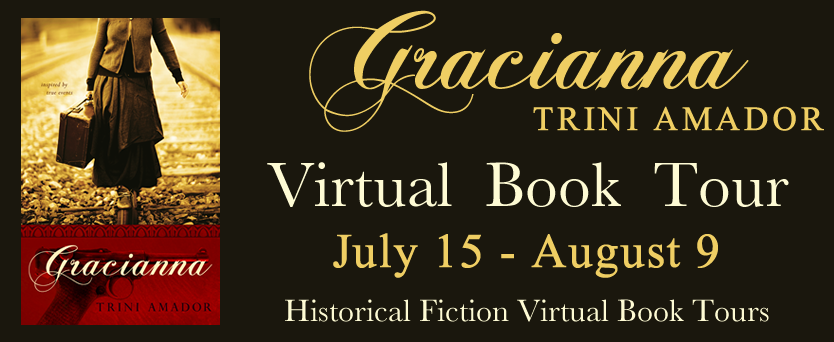
Gracianna by Trini Amador is based on true events of the author’s great-grandmother’s life.  Gracianna is headstrong and determined to achieve her dream of going to America no matter who she leaves behind.  High in the Pyrenees Mountains among her Basque people along northeastern Spain and southwestern France, women tend to be strong, persevering against all odds, while traditionally, men run in fear or have wanderlust.  Amador chooses a third-person, seemingly omniscient narrative in which readers will see and hear the actions and reactions of Gracianna, Constance, and Juan.  Unfortunately, this method lends itself to more telling than showing, leaving the reader at a distance from the characters.

“Once she decided to engage with anyone on a given subject, they would become transfixed by her confidence, and the grasp and depth of her knowledge.  Her sureness came from her strong core.” (page 7)

While the 1940s through WWII is a tumultuous period full of tension and anguish, readers are likely to be pulled in and out of the story as the points of view shift even within chapters between main and minor characters.  From the French Resistance to the concentration camps in Auschwitz, Amador describes the conditions with aplomb, though there are moments where prisoners are asked by newcomers where they have landed in a way that makes it seem like they’ve arrived at a hotel or paradise resort — thus shifting the tone and diminishing the frightening atmosphere readers may expect.

Through the novel, Amador relies on sometimes obvious, and at other times unnecessary headline-like title breaks in the middle of chapters that often foreshadow the action to come.  Readers could find these distracting.  Gracianna is a character that readers want to love and cheer on throughout the novel, but the unusual structure makes that difficult.

In many ways, the author’s style is too focused on Gracianna’s cultural compass and how it guides her actions and decisions, and does little to shed light on her emotional losses and connections with others.  The relationship she has with her sister is tough to get a handle on given the time lapse between when she last sees her in Basque and when Constance shows up in Paris, and her relationship with her husband seems one-sided, as though she is pressured into marriage by the war.  Gracianna by Trini Amador pays homage to the author’s heritage and great-grandmother, weaving a story of fact and fiction that leaves readers looking for more dynamic characters they can connect with.

About the Author:

Trini Amador vividly remembers the day he found a loaded German Luger tucked away in a nightstand while wandering through his great-grandmother’s home in Southern California. He was only four years old at the time, but the memory remained and he knew he had to explore the story behind the gun. This experience sparked a journey towards Gracianna, Amador’s debut novel, inspired by true events and weaving reality with imagination. It’s a tale drawing from real-life family experiences.  Visit him on Facebook and Twitter.

Gracianna Tour Banner FINAL

This is my 50th book for the 2013 New Authors Challenge.

Guest Post & Giveaway: Leanne Lieberman Talks About Author Fan Letters, Books

Lauren Yanofsky Hates the Holocaust by Leanne Lieberman is about a young woman who is caught up in typical teenage drama, but it’s more than that and told with humor.  According to Amazon’s description, “Lauren Yanofsky doesn’t want to be Jewish anymore. Her father, a noted Holocaust historian, keeps giving her Holocaust memoirs to read, and her mother doesn’t understand why Lauren hates the idea of Jewish youth camps and family vacations to Holocaust memorials. But when Lauren sees some of her friends—including Jesse, a cute boy she likes—playing Nazi war games, she is faced with a terrible choice: betray her friends or betray her heritage.”

Today, I’ve got a giveaway and guest post to share with you from the author, Leanne Lieberman.  Please give her a warm welcome.

When I finish a book I love I often think, I must write a letter to compliment the author. However, by the time I sit down to write the letter, I’ve forgotten what I want to say, or I wonder if the author actually cares what I think. Most of the time, I’m just too busy.

To date, I have only written one fan letter. When I was eight I wrote to Sydney Taylor, the author of the “All-of-A-Kind-Family” series. The books were the first chapter books I read on my own. I was delighted with the tales of a Jewish family of five girls growing up on the lower east side of Manhattan at the turn of the last century. The stories describe the girls going to the library, shopping at the market for the Sabbath, saving their penny allowance for a birthday present for their Papa, and helping their Mama clean the front room. At the end of the five books the girls’ Mama is pregnant with another child. I couldn’t believe the author would leave readers in such suspense and not write another book. When my mother suggested I write Sydney Taylor a letter, I was fascinated by the idea that authors were real people you could write to. I remember leaving the dinner table and rushing to my room to find pen and paper. I needed to know if the baby would be a girl or a boy. Was Taylor going to write another book?

I received a letter back a few months later from Ralph Taylor, Sydney Taylor’s husband. He explained that Sydney had passed away, but that the baby was in fact a boy as Taylor’s All-of-A Kind-Series was based on Sydney’s own family. I treasured that letter. I remember showing it to my teacher and the school librarian and gluing it into my Little Twin Stars diary. I even wrote Ralph Taylor a second letter with a picture of my family tree, assuming he would be as interested in my family as I was in his wife’s.

I didn’t think about Sydney Taylor or the All-of-Kind-Family Books for many years until I published my first novel, Gravity about an orthodox Jewish girl who falls in love with another girl in 2008. The novel was reviewed positively by the American Jewish library, and named a Sydney Taylor Notable Book for Teens. Of all the reviews of my books, having my name linked with Sydney Taylor’s gave me the most pleasure. It allowed me to imagine people reading my books the way I had read Taylor’s works: absorbed in her world. It made me feel like an author, the way I had first dreamed of becoming a writer when I read Taylor’s books as a child.

Since publishing Gravity I have pulled my old copies of All-of-A-Kind- Family out of the dusty box at my parents’ house and started reading them to my two sons. Like me, they are delighted to read about children celebrating Passover and other Jewish holidays the way they do. They are also fascinated by the descriptions of Manhattan Jewish life from a long time ago. At the same time I started reading Taylor’s books to my kids I received an email with the subject: “Are you the same Leanne Lieberman?” The same as whom, I wondered. The email was from June Cummins, a professor of children’s literature at the State University of San Diego. Cummins wrote that she had read Gravity and liked it. She also explained that she was writing a biography of Sydney Taylor and had been going through Taylor’s fan letters. She had found a letter from someone named Leanne Lieberman written in 1983. Was I that same Leanne?

Goose bumps ran down my forearms. I had written to Sydney Taylor when I was eight, which was 1983, and as far as I knew, I was the only Leanne Lieberman. Through subsequent emails with Cummins I learned that Taylor, the middle child of five girls, wrote the All-Of-A-Kind-Family stories for her daughter Jo who was an only child. Cummins was staying with Jo at the time, and offered her regards. Cummins had also met Jerry, Jo’s uncle, who was the unborn child at the end of the series that I had originally wanted to know about. Knowing that the All-of-A-Kind Family was based on real people, people who were still alive, made me feel an even greater kinship to the stories. Even though Sydney Taylor had never received my letter, I was part of her story as she was part of mine.

Eventually Cummins offered to send me a copy of my original letter. My writing in 1983 was more legible that it is now, although my spelling has improved. “Dear Sydney,” I wrote, “I have an important question for you.” I have none of the trepidation that the author will be too busy or think my questions unimportant. I cherish the memory of what I was like at eight: curious, obsessed with stories, full of my own childish self-importance, and my overwhelming secret desire to write my own stories. Despite the eighty plus years between Taylor’s books and my own life, I saw myself reflected in Taylor’s stories. Her characters lose their library books, get their ears pierced, celebrate Shabbat, and dream of being on the stage, all things I experienced. My own books also deal with the Jewish experience, but because I write for teens, they explore more difficult questions: how to be gay and Jewish, what to think about the Israeli occupation of Palestine, and in my recently released book, Lauren Yanofsky Hates The Holocaust, how to deal with anti-Semitism and the legacy of the Holocaust. I like to imagine that somewhere there is a young girl reading my books, feeling them resonate in her life, and dreaming of the books she will write too.

Do you write fan letters to authors?

author photoAbout the Author:

Leanne Lieberman is the author of three YA books: Gravity (a Sydney Taylor Notable Book), The Book of Trees and Lauren Yanofsky Hates The Holocaust. She also writes adult fiction and is working on a collection of linked short stories entitled, Open Your Heart. Leanne is a graduate of The University of Windsor’s MA in in Creative Writing. Originally from Vancouver BC, Leanne now lives in Kingston ON with her husband and two sons.

To enter to win a copy, you must be 18 and older and living in the U.S. or Canada. Please leave a comment below with an email. Deadline to enter is 11:59 pm EST Aug. 8, 2013.