Quantcast

On Handling the Truth by Beth Kephart — I’m Still Reading…

I have not finished reading Handling the Truth by Beth Kephart, and I’ll likely not have it completely read until next week.  But I wanted to share something that has never happened before — at least not to me — when reading a book of writing advice/tips.  I nearly cried; yes, cried!

I’m nearing page 100, and there’s a chapter about food and taste.  Kephart talks about how “a way of eating passes with your mother” following the death of her mother — a series of passages that are written beautifully and with deep honesty.  It is not my mother or her cooking that Kephart reminded me of, but that of my nana — funny, as I just shared a book with Kephart in which I talk a little bit about her.  Her cooking was the stuff of legend and unfortunately with her passing 15 years ago — can it be that long — at the age of 82, she took many of her cooking secrets with her.

How did she make that shake-and-bake stuff on chicken — only ever on chicken — taste so much better than when I make it straight from the box?  How did she get those mashed potatoes so buttery and creamy, there wasn’t a lump to be had or a spoonful that didn’t taste heavenly?  And most of all, how did she get those apple pies to not only be equal parts sweet and — not tart — but just a tad spicy, while ensuring the apples were al dente in a thick, creamy apple-y sauce that made your heart melt?  These are things I can never learn, nor can my mother, but these are the foods that rushed into my mind when I read Kephart’s passages.

Creamy seems to be a recurring theme with the foods I remember her making, and perhaps that’s because of her easy-going way with things, no matter how hard they seemed — even as death neared.  Most of all, I miss nana’s quiet support and encouragement, even when my cooking attempts as a young teen went very wrong and my writing attempts were even worse.  I’ve tried many times to recreate her mashed potatoes, her brownies, her oatmeal cookies, but only my attempts at banana muffins — the one recipe we worked on many times together — comes even close to tasting and being as moist as hers.

Perhaps this is what memoir means…and should be.

The News from Spain by Joan Wickersham

Source: Public Library, though Beth Kephart’s review had me seek it out.
Hardcover, 208 pages
I am an Amazon Affiliate

The News from Spain: 7 Variations on a Love Story by Joan Wickersham explores what it means to love in its many forms, and how that emotion can be caught up with and distorted by other emotions and desires.  From the woman whose husband is a serial cheater even as she lays partially paralyzed and dependent upon him to the woman who is drawn again and again to a co-worker who is just out of reach, Wickersham demonstrates the power love has over our bodies and the helplessness we feel as we try to fight off that power.  Each story is titled “The News from Spain,” harkening to the segues used in conversation to divert attention or change the subject from something more personal and deeply wounding, as if calling attention away will make relationships and connections easier to bear or ignore.

“What they had together was pleasant.

But still that word continued to bother her, whenever she thought of it.  The fact that it appeared to be lauding, but the thing that it praised was a limitation.”  (Page 40)

There are characters here who are emotionally detached for a number of reasons, but even they find themselves in the midst of relationships, waffling through the navigation of their emotions.  Each character is seemingly stuck in a pattern of love, and these patterns continue infinitely through time as some of them long separated from these emotional or physical affairs continue to mull them over and remember them either fondly or quizzically.  Wickersham explores what it means to love and be loved, but also what it means to hurt the ones we love, to struggle in the quest for giving and receiving forgiveness, and also what it means to move beyond the hurt and pain to find peace and fondness without the bitterness and regret.

In one story, the narrator talks of unrequited love and the emotions running throughout her body becoming an unruly mob when she tries to rein them in after confessing to the man.  And this frenetic movement within her is reminiscent of those first flushes of love — requited or not — and the passions they inflame, but as she professes to continue to love her husband, readers may begin to wonder if it is love she feels at all for this other man or a want for those feelings of passion to reignite her life.  The News from Spain: 7 Variations on a Love Story by Joan Wickersham is at times an emotional roller coaster and at others a dark comedy on the passions of love, but her characters struggles are brought to life in a way that will leave a lasting impression on readers.

About the Author:

Joan Wickersham was born in New York City and grew up there and in Connecticut. Her new book of fiction, The News from Spain: Seven Variations on a Love Story, will be published by Knopf in October 2012. Her memoir The Suicide Index: Putting My Father’s Death in Order (Harcourt 2008) was a National Book Award Finalist. She is also the author of a novel, The Paper Anniversary.

Please visit her Website and her Facebook page.

This is my 49th book for the 2013 New Authors Challenge.

Mailbox Monday #229

Mailbox Monday (click the icon to check out the new blog) has gone on tour since Marcia at To Be Continued, formerly The Printed Page passed the torch.  July’s host is Book Obsessed.

The meme allows bloggers to share what books they receive in the mail or through other means over the past week.

Just be warned that these posts can increase your TBR piles and wish lists.

Here’s what I snagged at Hooray for Books in Alexandria, Va.:

1.  Handling the Truth: On the Writing of Memoir by Beth Kephart

Writing memoir is a deeply personal, and consequential, undertaking. As the acclaimed author of five memoirs spanning significant turning points in her life, Beth Kephart has been both blessed and bruised by the genre. In Handling the Truth, she thinks out loud about the form—on how it gets made, on what it means to make it, on the searing language of truth, on the thin line between remembering and imagining, and, finally, on the rights of memoirists. Drawing on proven writing lessons and classic examples, on the work of her students and on her own memories of weather, landscape, color, and love, Kephart probes the wrenching and essential questions that lie at the heart of memoir.

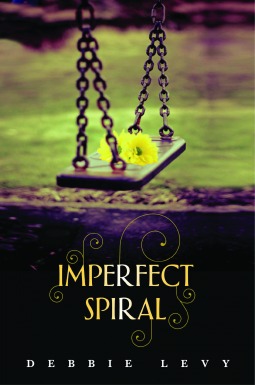
2.  Imperfect Circle by Debbie Levy

Danielle Snyder’s summer job as a babysitter takes a tragic turn when Humphrey, the five-year-old boy she’s watching, runs in front of oncoming traffic to chase down his football. Immediately Danielle is caught up in the machinery of tragedy: police investigations, neighborhood squabbling, and, when the driver of the car that struck Humphrey turns out to be an undocumented alien, outsiders use the accident to further a politically charged immigration debate. Wanting only to mourn Humphrey, the sweet kid she had a surprisingly strong friendship with, Danielle tries to avoid the world around her. Through a new relationship with Justin, a boy she meets at the park, she begins to work through her grief, but as details of the accident emerge, much is not as it seems. It’s time for Danielle to face reality, but when the truth brings so much pain, can she find a way to do right by Humphrey’s memory and forgive herself for his death?

3.  Love the Beastie by Henrik Drescher for Wiggles, which she picked over a monkey puppet — completely amazing both her parents.

Be kind to your pets! That’s the message of Love the Beastie.  Gross, outrageous, but pure fun in a book, Love the Beastie is a pull and poke, spin and play, and cuddle and kiss Valentine for kids and especially kids with pets. Meet Paul and Judy. And meet their pet, Beastie. Paul and Judy used to be so mean to Beastie. They pulled Beastie’s hair, tickled Beastie’s feet. So, Beastie feastied! Good thing Paul and Judy learned their lesson (stuck inside the belly of the Beastie).

Also, the kind Beth Kephart brought me a book from her collection:

4.  Undercover, which she signed.

Like a modern-day Cyrano de Bergerac, Elisa ghostwrites love notes for the boys in her school. But when Elisa falls for Theo Moses, things change fast. Theo asks for verses to court the lovely Lila—a girl known for her beauty, her popularity, and a cutting ability to remind Elisa that she has none of these. At home, Elisa’s father, the one person she feels understands her, has left on an extended business trip. As the days grow shorter, Elisa worries that the increasingly urgent letters she sends her father won’t bring him home. Like the undercover agent she feels she has become, Elisa retreats to a pond in the woods, where her talent for ice-skating gives her the confidence to come out from under cover and take center stage. But when Lila becomes jealous of Theo’s friendship with Elisa, her revenge nearly destroys Elisa’s ice-skating dreams and her plan to reunite her family.

What did you receive?

Hooray! An Event of Successful Fiction and Memoir

IMG_2731Yesterday, we headed down to Alexandria, Va., to attend an event at Hooray for Books with Beth Kephart, whose writing cannot be praised enough, and Debbie Levy, who is as charming in person as I expected.  It has been many years since I’ve been there, but I’ve always loved the waterfront, the Torpedo Factory, and many other things about the shops and restaurants there.  While I did notice some changes, including the movement of Hannelore’s where I got my wedding dress to a side street off of King Street, much of the atmosphere remains the same.  What did we do after the event? We went to our favorite pub, Murphy’s, though after the nauseated morning I had, I did not dare have the Guinness I would have love to have.  And then we took Wiggles around to check out the sights she has never seen.  (pictured here is my favorite tree down by the water).

Due to construction on the lovely George Washington Parkway, I was late to the event and I hate being late!  I abhor it.  My husband kindly dropped me off as he sought parking.  I walked in and was told there were still seats, which was good, though I would have stood for this one.  And stupidly, I became too absorbed in the conversation to take too many photos.  There was talk about memoir and its differences from fiction and autobiography, and how there is still a need for imagination in memoir, but not in making up facts.  We all know those memoirists that have been caught bending or blatantly making up facts — they are not Beth Kephart or Debbie Levy (below Beth on the left and Debbie on the far right).

IMG_2715

There were books galore to be had at the bookstore, and when my husband finally arrived with Wiggles, they sat for a few minutes while the audience — and myself — were engaged in a writing exercise about what friends from our school days would remember about us and what we’d like them to remember — thanks to Debbie Levy.  Earlier we had engaged in a different writing exercise about a first person account of an object, which Beth Kephart dreamt up.  I did share the poem, I will share here at the behest of Beth and Debbie, though I feel it is unfinished.

Ghost in a Book

She was a bean pole
awkward
books hanging from her nose,
from her hands,
in her bag.
Looking down, but
always -- inwardly -- out
to a horizon
beyond four walls,
small town, gossip.
Ready to spring --
jump forward, move
and leave us
wondering if she was here.

I’ve honestly written more poetry than fiction and essay and have never written memoir or nonfiction. It was good to stretch my writing in these exercises, and it was fun to see what others came up with. Some of them were funny and sarcastic, while others were serious. This was a great event for more than one reason — writing exercises, readings, questions and answers — but most of all the genuine awe and support the writers showed for one another, culminating in each buying books from the other’s stacks and signing books to their friends and loved ones. I loved how they bounced questions off of one another and how they interacted. It was like watching two colleagues who have known one another longer than I suspect Beth and Debbie have.

I’ll leave you with my favorite photo from yesterday — thanks to my husband who took the photo — of three lovely ladies.

IMG_2716

212th Virtual Poetry Circle

Welcome to the 212th Virtual Poetry Circle!

Remember, this is just for fun and is not meant to be stressful.

Keep in mind what Molly Peacock’s books suggested. Look at a line, a stanza, sentences, and images; describe what you like or don’t like; and offer an opinion. If you missed my review of her book, check it out here.

Also, sign up for the 2013 Dive Into Poetry Challenge because its simple; you only need to read 1 book of poetry. Check out the stops on the 2013 National Poetry Month Blog Tour and the 2012 National Poetry Month Blog Tour.

Today’s poem is from S/SGT Irvin V. Worden from Korea, The Chosen Place, a view from Old Smokey:

Korea

Korea, the chosen place
Ravished by war, laid to waste
All United Nations there engaged
In another history Page.

Korea, tis not a beauty site
To see by day or by night.
The eye beholds only the gloom
Of a country buried in war's tomb.

Korea, it's been torn up
and torn down;
Marched up
and marched down.

Korea, blood shed, land and mountains
Have been bathed by youthful fountains.
Brave men here have gone to their reward
Perishing 'neath the sword.

Korea, twas not a war they say;
Only a police action day by day,
A testing place
For the human race.

Korea, two ideals clashing
Communism and democracy smashing;
The U.N.'s firm stand
Against the hammer red hand.

Korea, a question of peace there,
A question of peace everywhere
Soon it may be inflamed
Again in blood and war's shame.

Korea, a prayer of the free
That inpeace here we may see
The sword no more to rise
On any land or any skies.

What do you think?

Book News: Hooray for Books!, Indeed

Hooray for Books! is a children’s bookstore in Alexandria, Va., to which I’ve never been.

I haven’t been to a bookstore in Old Town since Olsson’s closed and my husband and I went to our favorite pub, Murphy’s Grand Irish Pub, and their live music fun.  And it was always great to visit the Torpedo Factory.  In fact, my wedding dress was bought at Hannelore’s, which has the best seamstresses in the world, more than 10 years ago.

On Saturday, July 27 at 3:30 p.m., I’ll head down to Virginia with my small family in tow.  Local author Debbie Levy and Pennsylvania-based author Beth Kephart will talk about the fine line between truth and fiction as they discuss their latest books at Hooray for Books in Alexandria, Va.

Debbie Levy will showcase The Year of Goodbyes and Imperfect Spiral, which was just released, and Beth Kephart will talk about her books, Handling the Truth and Small Damages. The authors will read from each book, discuss its creation, and share their thoughts on workshopping the fine line between truth and fiction. For those interested in participating, Kephart says, “We each have an in-store exercise for those who’d like to try their hands at a bit of writing—and to hear our thoughts about their work.”

Levy’s The Year of Goodbyes is a WWII narrative poem based on an actual book created by her own mother, Jutta Salzberg, who lived in Hamburg, Germany, when the Nazi’s took power and began to ramp up their persecution of Jews in 1938. The book is powerful and a great testament to her mother’s memory, her own family’s past, and the hope generated by that remembering, I said in a recent review. Levy’s new book, Imperfect Spiral, is a young adult novel about how tragedy can affect the life of a babysitter, especially when the boy who’s killed is an undocumented immigrant.

Meanwhile, Kephart has had a string of publications in the last year, including Small Damages (new in paperback), Dr. Radway’s Sarsaparilla Resolvent, and Handling the Truth (due out in August). Small Damages is a young adult novel set in Spain about the adult decisions that children sometimes must make for themselves, especially when they find themselves in situations that are beyond their comprehension. Dr. Radway’s Sarsaparilla Resolvent, on the other hand, is an illustrated, historical fiction, young adult novel that brings to life old Philadelphia in a way that contrasts the opportunities and drawbacks of industrialization in the background as one family struggles to survive when their father is jailed. Kephart’s Handling the Truth, on the other hand, is a book for those interested in writing memoir, which will likely reach the heights of Anne Lamott’s Bird by Bird.

I’m ready for this event, are you? What events are on your agenda for the weekend?

Emily & Herman: A Literary Romance by John J. Healey

Source: Arcade Publishing
Hardcover, 238 pages
I am an Amazon Affiliate

Emily & Herman: A Literary Romance by John J. Healey begins with the pretext that the author finds the manuscript among his deceased grandfather’s belongings and that the author’s name has been concealed.  The manuscript is set during the period in which Herman Melville is writing Moby Dick and is enticed by his sometime-mentor Nathaniel Hawthorne to take a trip to Boston and onto New York.  But on the way, which logistically makes no sense, they stop in Amherst to pay a visit to Hawthorne’s friend, the father of Emily and Austin Dickinson.  But the elder children are the only ones at home.  Barely age 20 and far from the hermetic woman she becomes, Emily Dickinson’s imagination is running wild as her esteemed guests propose a journey outside of her home town, an adventure she has a few reservations about, but ultimately decides to go for her brother’s sake, if not her own secretive yearnings to see more of the world.

The Dickinsons having been raised in a stern, Christian home are much more reserved than Melville, who has a reputation for his sea-faring adventures and his amorous encounters with natives.  Hawthorne is slightly less reserved, but still bristles at some of Melville’s more controversial statements about religion and humans’ animal instincts.  Meanwhile, Austin has a secret life outside the home in which he has been sowing his wild oats before committing fully to his soon-to-be betrothed — a more proper fit for the reserved Dickinson family.  Emily, on the other hand, enjoys reading as her escape and her solitude, until she glimpses what life could be outside of her cloistered existence in Amherst.

“‘If I were to answer with honesty, I would say there is wild within all of us, lurking underneath as you say.  It is perhaps our most irksome, mysterious and profound characteristic.'” (page 30)

Based upon the “Master” letters found among Dickinson’s belongings — letters which were never sent — an imagined relationship blooms between Melville and Dickinson.  They match wits on an intellectual level, and Melville finds in her a naive, but thoughtful young woman who is eager to learn and grow beyond what she has been taught.  Despite the changes around them, Dickinson is still confined by the role of a woman and her ruin can come from even just a whiff of scandal — something she is very much aware of even as she speaks most boldly about religion, animal instinct, and more.

The novel’s strength lies in the intellectual connections made over literature and the discussions they have about the world and its machinations.  When Whitman and an escaped slave William Johnson enter their path, even more of the changing world around them is revealed.  While there are some transitional moments that are bumpy, like when William Johnson is first introduced and when the narrative shifts from Hawthorne to Melville and the Dickinsons, the multiple perspectives help to round out the story.

Healey’s novel is graphic about certain sexual encounters, which could be troublesome for some readers — particularly those who do not wish to see Emily Dickinson or any author as objects of desire.  In some ways, perhaps the novel would have been better served had it been told from Dickinson’s point of view, looking backward on her affair with Melville.  The novel raises a number of questions not only about the differences between love freely given and the love codified by marriage vows, but also about how change can be a long, arduous process.  Emily & Herman: A Literary Romance by John J. Healey is more about the world as it changes from one in which strict puritan ideals are the only way to live to one in which slavery is slowly becoming less acceptable.

About the Author:

John J. Healey is the author of the recently published novel EMILY & HERMAN, (Arcade), a love story between Emily Dickinson and Herman Melville. He has been published in the Harvard Review and has directed two documentary films, ‘Federico García Lorca’ and the award-winning ‘The Practice of the Wild’. He lives in the United States and Spain and is currently working on a new work of fiction: ‘riverrun’.

This is my 48th book for the 2013 New Authors Challenge.

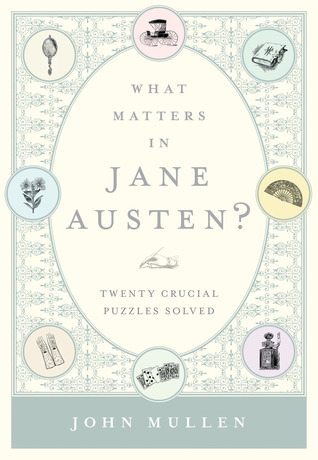
What Matters in Jane Austen? by John Mullan

Source: Public Library
Hardcover, 320 pages
I am an Amazon Affiliate

What Matters in Jane Austen by John Mullan is a detailed look at 12 stylistic techniques and concerns in Jane Austen’s numerous works, including the unfinished The Watsons and Sanditon.  The twelve puzzles Mullan explores range from the importance of age in her books, what characters call one another, and what games characters play to why her plots rely on blunders, what her characters read, and how experimental a novelist she was.  There are moments in the book where Mullan’s examinations become bogged down and overly verbose, but he clearly enjoys picking apart the most innocuous moments in Austen’s novels to support his theories.  Most of the theories he offers and backs up with source material from Austen’s books and letters to family members also are discussed by other scholars, whom he cites.  For aspiring writers, Mullan’s book can be used as a guide for creating those unique moments and nuances in a novel, emulating Austen but adapting it for modern sensibilities.  Although it is not a how-to guide for writers, it does offer some insight into elements of the craft.

“Admission to a bedroom is a rare privilege, for the reader as well as for a character.” (page 29)

“Names are used by Austen, as well as by her characters, as though they are precious material, so we sometimes hear only once, glancingly, what someone’s name is.  Thus the label on the trunk seen by Harriet Smith, directed to Mr. Elton at his hotel in Bath, which names him as Philip (II. v).” (page 46)

“But Austen wants us to think not so much about how characters look, but how they look to each other.  Her sparing use of specification when it comes to looks is striking when looks can be so important.”  (Page 57)

“Meteorology clues us in to the passing of the year.  But it is more than this.  Austen likes to make her plots turn on the weather.  Having arranged her characters and defined their situations, having planned her love stories and hatched the misunderstandings that might impede them, she lets the weather shape events.  It is her way of admitting chance into her narratives.” (page 101)

“The rather few critics who have written on speech in Austen’s fiction have discovered how each of her speakers seems to have their own idiolect — a way of speaking that is individually distinctive.”  (page 132)

Austen is an often underestimated author, especially in light of the writers who dismissed her early on.  Mullan pinpoints the genius of Austen beyond the morays of the time period in which she wrote and the social commentary.  Readers who have read all of Austen’s major works but once are likely to want to read them anew after reading Mullan’s examination.  Even those have read certain Austen books multiple times could find new theories in this book.  It is interesting to see what it means when characters blush, why weather is important, and what seaside resorts mean in Austen’s work.  Mullan also asks whether there is sex in her books.

What Matters in Jane Austen by John Mullan is less about the puzzles of Austen than about her techniques as a writer and creator of fiction.  It was an interesting look at how she stacked up to her contemporaries and offered something more.

About the Author:

John Mullan is a Professor of English at University College London. He specialises in 18th century fiction. He is currently working on the 18th-century section of the new Oxford English Literary History. He also writes a weekly column on contemporary fiction for The Guardian and reviews books for the London Review of Books and New Statesman. He occasionally appears as an 18th-century and contemporary literature expert for BBC Two’s Newsnight Review and BBC Radio 4’s In Our Time. Mullan was a judge for The Best of the Booker in 2008 and for the Man Booker Prize in 2009. He was a Research Fellow at Jesus College, Cambridge and a Lecturer at Fitzwilliam College, Cambridge, before coming to UCL in 1994.

This is my 47th book for the 2013 New Authors Challenge.

Giveaway: Lisa Gardner Beach Bag

LisaGardnerbeachbag
Lisa Gardner is one of my mother’s favorite authors, and in this great giveaway, one lucky reader, age 18 and over living in the United States, could win the following:

  • A Briscoe Designs Beach Bag
  • Beach Towel
  • Signed copies of Catch Me and Touch & Go
  • Lisa Gardner Pen
  • Summer Reading Sampler with previews of Maggie’s Man, MacNamara’s Woman, Brandon’s Bride and Fear Nothing

Charlene Grant believes she is going to die. For the past few years, her childhood friends have been murdered one by one. Same day. Same time. Now she’s the last of her friends alive, and she’s counting down the final four days of her life until January 21. Charlene doesn’t plan on going down without a fight. She has taken up boxing, shooting, and running. She also wants Boston’s top homicide detective, D. D. Warren, to handle the investigation. But as D.D. delves deeper into the case, she starts to question the woman’s story. Instinct tells her that Charlene may not be in any danger at all. If that’s true, the woman must have a secret—one so terrifying that it alone could be the greatest threat of all.

This is my family: Vanished without a trace…

Justin and Libby Denbe have the kind of life that looks good in the pages of a glossy magazine. A beautiful fifteen-year old daughter, Ashlyn. A gorgeous brownstone on a tree-lined street in Boston’s elite Back Bay neighborhood. A great marriage, admired by friends and family. A perfect life. This is what I know: Pain has a flavor… When investigator Tessa Leoni arrives at the crime scene in the Denbes’ home, she finds scuff marks on the floor and Taser confetti in the foyer. The family appears to have been abducted, with only a pile of their most personal possessions remaining behind. No witnesses, no ransom demands, no motive. Just an entire family, vanished without a trace. This is what I fear: The worst is yet to come…

About the Author:

LISA GARDNER is the #1 New York Times bestselling author of fifteen previous novels, including her most recent, Touch & Go. Her Detective D. D. Warren novels include Catch Me, Love You More, and The Neighbor, which won the International Thriller of the Year Award. She lives with her family in New England.

To enter, leave a comment below with what you like to read at the beach. Deadline to enter is July 27, 2013, at 11:59 p.m.

Announcing the 2014 Split This Rock Poetry Festival in D.C.

SAVE THE DATE: March 27-30, 2014

Join me and 16 poets at the 2014 Split this Rock Poetry Festival: Poems of Provocation & Witness

  • Sheila Black
  • Franny Choi
  • Eduardo C. Corral
  • Gayle Danley
  • Natalie Diaz (click for my review)
  • Joy Harjo
  • Maria Melendez Kelson
  • Yusef Komunyakaa (click for my reviews and news about him)
  • Dunya Mikhail
  • Shailja Patel
  • Wang Ping
  • Claudia Rankine
  • Tim Seibles
  • Myra Sklarew
  • Danez Smith
  • Anne Waldman

Where; in Washington, D.C. of course. The hub of politics and protest.

Split This Rock Poetry Festival is DC’s premiere poetry event and the only festival of its kind the country, highlighting poets working at the intersection of the imagination and social change. The festival features readings, workshops, panel discussions, youth programming, activism—opportunities to speak out for justice, build connection and community, and celebrate the many ways poetry can act as an agent for social change. Registration will open in the fall of 2013.

“We are thrilled to bring these exemplary poets from all over the country to DC’s stages,” says Executive Director Sarah Browning. “Poetry can tell hard truths, can challenge and succor us. These poets are visionaries, helping imagine a future based on principles of justice, one that honors the transformative power of the imagination.”

I hope to see you there!

Library Loot #10

Library Loot is a weekly event co-hosted by Claire from The Captive Reader and Marg from The Adventures of an Intrepid Reader that encourages bloggers to share the books they’ve checked out from the library. If you’d like to participate, just write up your post-feel free to steal the button-and link it using the Mr. Linky any time during the week. And of course check out what other participants are getting from their libraries.


1.  Raised from the Ground by José Saramago

First published in 1980, the City of Lisbon Prize–winning Raised from the Ground follows the changing fortunes of the Mau Tempo family—poor landless peasants not unlike Saramago’s own grandparents. Set in Alentejo, a southern province of Portugal known for its vast agricultural estates, the novel charts the lives of the Mau Tempos as national and international events rumble on in the background—the coming of the republic in Portugual, the two world wars, and an attempt on the dictator Salazar’s life. Yet nothing really impinges on the grim reality of the farm laborers’ lives until the first communist stirrings.

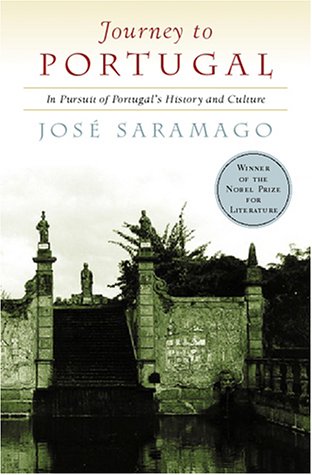
2.  Journey to Portugal by José Saramago

When José Saramago decided to write a book about Portugal, his only desire was that it be unlike all other books on the subject, and in this he has certainly succeeded. Recording the events and observations of a journey across the length and breadth of the country he loves dearly, Saramago brings Portugal to life as only a writer of his brilliance can. Forfeiting the usual sources such as tourist guides and road maps, he scours the country with the eyes and ears of an observer fascinated by the ancient myths and history of his people. Whether it be an inaccessible medieval fortress set on a cliff, a wayside chapel thick with cobwebs, or a grand mansion in the city, the extraordinary places of this land come alive.

And for the little one:

What have you picked up lately?

211th Virtual Poetry Circle

Welcome to the 211th Virtual Poetry Circle!

Remember, this is just for fun and is not meant to be stressful.

Keep in mind what Molly Peacock’s books suggested. Look at a line, a stanza, sentences, and images; describe what you like or don’t like; and offer an opinion. If you missed my review of her book, check it out here.

Also, sign up for the 2013 Dive Into Poetry Challenge because its simple; you only need to read 1 book of poetry. Check out the stops on the 2013 National Poetry Month Blog Tour and the 2012 National Poetry Month Blog Tour.

Today’s poem is from David Raikes, who was a WWII pilot and recently laid to rest:

Let It Be Hushed

Let it be hushed; let the deep ocean close
Upon these dead. Others may laud the parts they played,
Raise monuments of marble in their names.
But we who flew with them and laughed with them,
We other crews who, living side by side,
In outward contacts slowly came to know
Their inmost parts, would rather leave untouched
The wound we healed, the love we buried there.
These men knew moments you have never known,
Nor ever will; we knew those moments too,
And talked of them in whispers late at night;
Such confidence was born of danger shared.
We shared their targets, too; but we came back.
Lightly we talked of it. We packed their kit,
Divided up such common useful things
As cigarettes and chocolate, rations stored
Against a rainy day that never came.
'And they cast lots among them!' Someone said,
'It was a pity that he wore his watch;
It was a good one, twenty pounds he said
He paid for it in Egypt. Now, let's see,
Who's on tonight. Ah, Taffy - you've a good one!
You'd better leave it with me.' And we laughed.
Cold were we? Cold at heart. You get that way.
Sometimes we knew what happened; how they crashed.
It was not always on the other side.
One pranged upon the runway, dipped a wing,
The navigator bought it, and the gunner.
The other two got out, a little shaken.
Bob crashed when doing an air test, just low flying
- At least they think it was, they couldn't say.
The plane was burning fiercely when they found it;
One man thrown clear, still living, but he died
On way to hospital. The loss was ours, -
Because I shared an aeroplane with Bob.
We had to get another D for dog.
And some did not come back. We never knew
Whether they lived - at first just overdue,
Till minutes changed to hours, and still no news.
One went to bed; but roused by later crews,
Asked 'Were they back yet?' and being answered 'No',
Went back to sleep.
One's waking eyes sought out the empty beds,
And 'Damn', you said, 'another kit to pack';
I never liked that part, you never knew
What privacies your sorting might lay bare.
I always tried to leave my kit arranged
In decent tidiness. You never knew.
But that is past. The healing river flows
And washes clean the wound with passing years.
We grieve not now. There was a time for tears,
When Death stood by us, and we dared not weep.
Let the seas close above them, and the dissolving deep.

What do you think?