Quantcast

341st Virtual Poetry Circle

Welcome to the 341st Virtual Poetry Circle!

Remember, this is just for fun and is not meant to be stressful.

Keep in mind what Molly Peacock’s book suggested.

Look at a line, a stanza, sentences, and images; describe what you like or don’t like; and offer an opinion. If you missed my review of her book, check it out here.

This poem is from Mary Oliver:

White-Eyes

In winter
    all the singing is in
         the tops of the trees
             where the wind-bird

with its white eyes
    shoves and pushes
         among the branches.
             Like any of us

he wants to go to sleep,
    but he's restless—
         he has an idea,
             and slowly it unfolds

from under his beating wings
    as long as he stays awake.
         But his big, round music, after all,
             is too breathy to last.

So, it's over.
    In the pine-crown
         he makes his nest,
             he's done all he can.

I don't know the name of this bird,
    I only imagine his glittering beak
         tucked in a white wing
             while the clouds—

which he has summoned
    from the north—
         which he has taught
             to be mild, and silent—

thicken, and begin to fall
    into the world below
         like stars, or the feathers
               of some unimaginable bird

that loves us,
    that is asleep now, and silent—
         that has turned itself
             into snow.

What do you think?
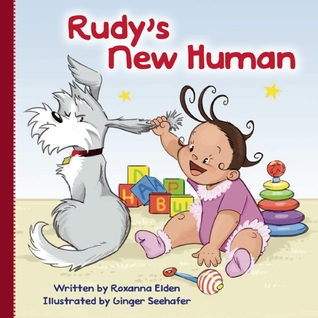
Rudy’s New Human by Roxanna Elden, illustrated by Ginger Seehafer

Source: Sky Pony Press
Hardcover, 32 pgs.
I am an Amazon Affiliate

Rudy’s New Human by Roxanna Elden, illustrated by Ginger Seehafer, is a great way to introduce young kids to the changes that can occur in families as they grow.  This is particularly helpful for an only child who will soon become a sibling.  Rudy has been the smallest member of the family for some time, and he’s used to getting all the attention.  But when a new bundle of joy arrives, there are some adjustments that have to be made.  Rudy needs to learn how to play new games and wait patiently while the new smallest member of the family is taken care of.

Rudy is a cute little dog with some fun facial expressions that will translate well for young kids, as they try to determine what emotion Rudy is feeling and why.  Kids will likely question why Rudy refers to the readers as fellow dogs, but it’s all in fun.  Some of my daughter’s favorite parts were when Rudy smelled the new arrival’s diaper and when he did tricks to get attention, but she also loved that Rudy opened up his heart to let someone new in, learning to be patient, being happy when his name was learned, and sharing in the fun things the new family member could do.

Rudy’s New Human by Roxanna Elden, illustrated by Ginger Seehafer, is a cute picture book that will teach kids about acceptance, patience, and empathy.  This would make a great series of books, given that the narrator is so adorable, and kids seem to love doggies.

About the Author:

Roxanna Elden is a National Board Certified high school teacher currently teaching in Miami. Her book, See Me After Class: Advice for Teachers by Teachers, is widely used as a tool for teacher training and retention. Elden is also professional speaker, providing humor, honesty, and practical advice to teachers and the people who love them.

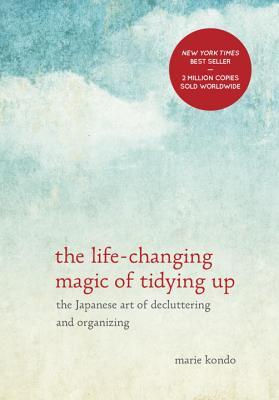
The Life-Changing Magic of Tidying Up by Marie Kondō

Source: Public Library
Hardcover, 224 pgs.
I am an Amazon Affiliate

The Life-Changing Magic of Tidying Up by Marie Kondō, translated by Cathy Hirano, provides a step-by-step process for her KonMari Method of tidying, which she says should bring you joy and possibly lead to other life-changing moments.  The first step is to discard, and when she says discard, she means get rid of everything that does not bring you joy or has no use.  Discarding should be undertaken by category of items not by room, as many homes stash lotions and hair clips and other items in multiple rooms.  These may sound like daunting tasks, but if the entire household participates, it might take less time.  She says the entire process for tidying the house can take up to six months or more.  Crazy!

Sentimental items like letters from loved ones and photos should be kept for last, because these will be the hardest items to part with and sort through.  All of our clothes should be collected from the various places throughout the house — drawers, closets, linen closets, coat closets, etc. — and placed in piles sorted by tops, bottoms, coats, dresses, etc.  Once they are sorted, you should hold them in your hands, and think about whether they bring joy when you wear them.  They also should be examined for any wear that cannot be repaired and tossed if they cannot be repaired.  This is just one example.  Placing everything in one category into a pile on the floor ensures that you visually see how much stuff you have.  I recently did this with clothes on my own and felt much better once everything was sorted and discarded, but I did this without the help of this book.  Once everything that is to be kept is identified, it needs to be put into its place and when used, it must be put back into its rightful place.

Kondō’s method is very detailed and deliberate.  Each item is held to ensure that the person understands what the item is, what its purpose is, and whether it brings joy.  Some clothes, for example, looked great in the store but not on you when they got home — so these should be discarded.  One piece of advice about lounge wear and that women should wear elegant nightwear to bed struck me as an old-fashioned idea, given that I’ve always found those kinds of bedtime wear uncomfortable to sleep in.  But I may be out of the norm on that one, preferring my t-shirts and shorts or t-shirts and flannel pj bottoms.

While readers will see the points she is trying to make — and it may just be the translation — there are times when the book is too repetitive, which can become bothersome.  Also, there is a mindfulness here that may not translate into American culture like it does in Japanese culture.  Thanking items for serving their purpose, caressing items to ensure they are alive before you take them out of storage, that kind of thing might appear a bit wacky to some.

The Life-Changing Magic of Tidying Up by Marie Kondō, translated by Cathy Hirano, has some great ideas about what papers should be saved, how clothes should be folded to maximize space, and how to rethink about the items we keep.  Attachment is something Buddhists talk about letting go of, and in many ways, Kondō is suggesting something similar in they way she focuses on discarding items.

About the Author:

Marie Kondo (近藤 麻理恵) is a Japanese organizing consultant and author. Kondo’s method of organizing is known as the KonMari Method, and one of the main principles is keeping only possessions which “spark joy.”  Kondo’s best-seller The Life-Changing Magic of Tidying Up: The Japanese Art of Decluttering and Organizing has been published in more than 30 countries.  She was listed as one of the world’s 100 most influential people by Time Magazine in 2015.

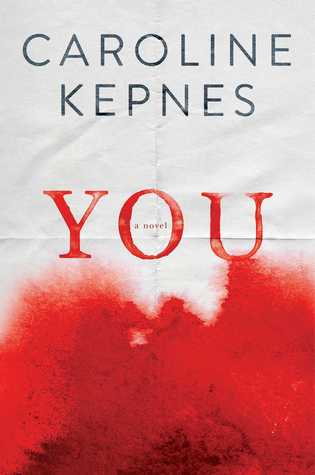
You by Caroline Kepnes

Source: Public Library
Hardcover, 422 pgs.
I am an Amazon Affiliate

You by Caroline Kepnes is creepy, obsessive, and twisted, and Joe Goldberg and Guinevere Beck are certifiable.  This thriller will pull you in and suck you dry, as Beck walks into a bookstore and flirts with the wrong man.  Kepnes has created two downright sinister characters who are perfect for each other and when circumstance brings them together, everyone around them better watch out.  Check your morals at the door with this one; these two are not redeemable, but you can’t help but watch how everything unfolds between them and how it impacts those around them.  Truly one of the unsettling novels out there.  Kepnes’ prose easily draws in the reader, making them wonder who this obsessive man is and why he’s so drawn to this particular girl.

“‘This will sound crazy, but I’m saving it.  For my nursing home list.’
‘You mean bucket list.’
‘Oh, no, that’s totally different.  A nursing home list is a list of things you plan on reading and watching in a nursing home.  A bucket list is more like … visit Nigeria, jump out of an airplane.'” (pg. 8)

Through careful manipulation of social media and a few lucky breaks, this relationship begins to take a life of its own, and while both parties have their demons, it’s clear that they cannot keep away from one another.  Even though you know throughout what will happen in the end, readers will be up late and turning pages in this psychological thriller.  Joe sees himself as a protector, someone charged with saving Beck from predators, but those predators are not who you’d expect them to be.  Meanwhile, Beck loves new things, and this love of wanting and being wanted is something that drives her incessantly.

“‘There’s no such thing as a flying cage, Joseph,’ he said.  ‘The only thing crueler than a cage so small that a bird can’t fly is a cage so large that a bird thinks it can fly.  Only a monster would lock a bird in here and call himself an animal lover.'” (pg. 47)

Joe is her opposite in that he obsesses over old things and continuously covets old books and collects old and broken typewriters.  He’s waiting for social media to overheat and die, he prefers anonymity, but is it only because he feels unworthy or is it because it enables him to stalk and obsess more freely?  He hates pretentious people who live their lives for others and share everything with everyone, but he too is pretentious in that he’s a book snob.  Dan Brown is not a good enough author, and people should be reading Paula Fox, and they should never pretend to read books.

For those who do not like graphic violence or sex, you should stay away.  You by Caroline Kepnes is riveting and disturbing.  What does it mean to be you?  What is your true self and do you share that with everyone or only a special few?  And what if the real you is scary?  Do you share that self with anyone? Lock it up? Or simply let it out?

About the Author:

Caroline Kepnes is the author of You and Hidden Bodies. She splits her time between Los Angeles, California and Cape Cod, Massachusetts.

Find her on Facebook.


Go Set a Watchman by Harper Lee (audio)

Source: Public Library
Audio, 6 CDs
I am an Amazon Affiliate

Go Set a Watchman by Harper Lee, narrated by Reese Witherspoon, was a book that was anticipated by many and vilified by others, and I honestly had no desire to read it because of the hype.  (I only picked up this audio because it was available at the library and I needed a new one.)  Jean Louise Finch, known as Scout in To Kill a Mockingbird, has returned to Maycomb, Ala., and her aging father, Atticus.  As the civil rights movement gains speed and the NAACP continues to push for rights, the South balks at integration and federal government interference.

Witherspoon is the perfect choice in a narrator for the story, and it is not just about her ability to play Southern characters.  She provides the right amount of empathy, emotion, and detachment needed by each of the characters to make them wholly different from one another, and yet still share similar experiences but view them differently.  There are differences between this novel (which is said to be Lee’s first) and the previously published book (TKAM), and those differences can be stark, especially when there are outcomes in the previously published book that go very differently here. Those are things an editor should have attended to before publishing, but are not the main crux of this story.

This is not about the rape case that Atticus defended, this is about us as children and how we generally worship our parents in one way or another, only to be disappointed that they are humans and not gods.  It’s a book about a young girl who worshiped her father, took in everything he said with little examination, and continued to apply it to her daily living.  Scout has held her father to an impossible standard, and when she returns to find him at a council meeting — one in which she would expect him to protest not take part in — her images are shattered, and she is forced to not only reconcile what she thought she knew about her father but what she knew about herself.

Go Set a Watchman by Harper Lee, narrated by Reese Witherspoon, is a novel about finding the courage and strength to change and to help those around you do the same. The south was in the midst of heavy transitions when Scout returns, and while she was “blind” to the hearts of those around her, even when her eyes are opened to their motivations, it is clear she still has a lot to learn.  The end seems to leave things wide open and unresolved in a way, like Scout’s journey is not finished.

About the Author:

Harper Lee, known as Nelle, was born in the Alabama town of Monroeville, the youngest of four children of Amasa Coleman Lee and Frances Cunningham Finch Lee. Her father, a former newspaper editor and proprietor, was a lawyer who served on the state legislature from 1926 to 1938. As a child, Lee was a tomboy and a precocious reader, and enjoyed the friendship of her schoolmate and neighbor, the young Truman Capote.

After graduating from high school in Monroeville, Lee enrolled at the all-female Huntingdon College in Montgomery (1944-45), and then pursued a law degree at the University of Alabama (1945-50), pledging the Chi Omega sorority. While there, she wrote for several student publications and spent a year as editor of the campus humor magazine, “Ramma-Jamma”. Though she did not complete the law degree, she studied for a summer in Oxford, England, before moving to New York in 1950, where she worked as a reservation clerk with Eastern Air Lines and BOAC. Lee continued as a reservation clerk until the late 50s, when she devoted herself to writing. She lived a frugal life, traveling between her cold-water-only apartment in New York to her family home in Alabama to care for her father.

Having written several long stories, Harper Lee located an agent in November 1956. The following month at the East 50th townhouse of her friends Michael Brown and Joy Williams Brown, she received a gift of a year’s wages with a note: “You have one year off from your job to write whatever you please. Merry Christmas.” Within a year, she had a first draft. Working with J. B. Lippincott & Co. editor Tay Hohoff, she completed To Kill a Mockingbird in the summer of 1959. Published July 11, 1960, the novel was an immediate bestseller and won great critical acclaim, including the Pulitzer Prize for Fiction in 1961. It remains a bestseller with more than 30 million copies in print. In 1999, it was voted “Best Novel of the Century” in a poll by the Library Journal.

About the Narrator:

Laura Jeanne Reese Witherspoon, known professionally as Reese Witherspoon, is an American actress and producer. She began her career as a child actress, starring in The Man in the Moon in 1991. Witherspoon quickly established herself as a talented actress in films such as Pleasantville (1998), Election (1999) and Cruel Intentions (1999). While filming Cruel Intentions. Behind the camera, Witherspoon launched her own production company Pacific Standard in 2012, which was behind the 2014 films Gone Girl and Wild. The latter, based on the memoir by Cheryl Strayed, stars Witherspoon as a woman who takes to the road after the death of her mother. Witherspoon has earned raves for the role, receiving Oscar, Golden Globe, and SAG Awards nominations.

Mailbox Monday #358

Mailbox Monday, created by Marcia at To Be Continued, formerly The Printed Page, has a permanent home at its own blog.

To check out what everyone has received over the last week, visit the blog and check out the links.  Leave yours too.

Also, each week, Leslie, Vicki, and I will share the Books that Caught Our Eye from everyone’s weekly links.

Here’s what I received:

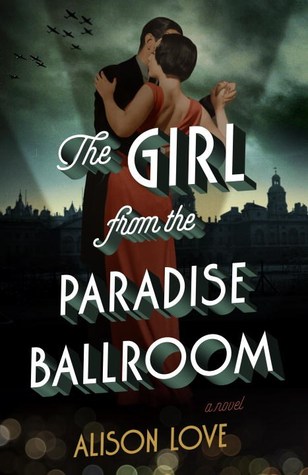
The Girl from the Paradise Ballroom by Alison Love, a win from LibraryThing Early Reviewers.

The first meeting between Antonio and Olivia at the Paradise Ballroom is brief, but electric.  Years later, on the dawn of World War II, when struggling Italian singer Antonio meets the wife of his wealthy new patron, he recognizes her instantly: it is Olivia, the captivating dance hostess he once encountered in the seedy Paradise Ballroom. Olivia fears Antonio will betray the secrets of her past, but little by little they are drawn together, outsiders in a glittering world to which they do not belong. At last, with conflict looming across Europe, the attraction between them becomes impossible to resist–but when Italy declares war on England, the impact threatens to separate them forever.

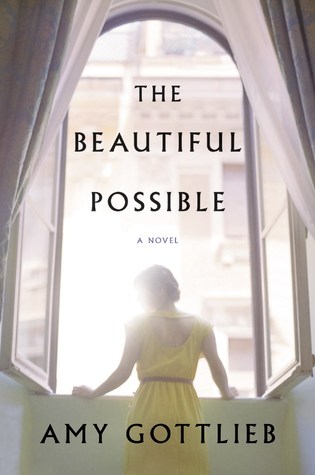
The Beautiful Possible by Amy Gottlieb for a TLC Book Tour in February.

Spanning seventy years and several continents—from a refugee’s shattered dreams in 1938 Berlin, to a discontented American couple in the 1950s, to a young woman’s life in modern-day Jerusalem—this epic, enthralling novel tells the braided love story of three unforgettable characters. In 1946, Walter Westhaus, a German Jew who spent the war years at Tagore’s ashram in India, arrives at the Jewish Theological Seminary in New York City, where he meets Sol Kerem, a promising rabbinical student.

A brilliant nonbeliever, Walter is the perfect foil for Sol’s spiritual questions—and their extraordinary connection is too wonderful not to share with Sol’s free-spirited fiancée Rosalie. Soon Walter and Rosalie are exchanging notes, sketches, and secrets, and begin a transcendent love affair in his attic room, a temple of dusty tomes and whispered poetry.

Months later they shatter their impossible bond, retreating to opposite sides of the country—Walter to pursue an academic career in Berkeley and Rosalie and Sol to lead a congregation in suburban New York. A chance meeting years later reconnects Walter, Sol, and Rosalie—catching three hearts and minds in a complex web of desire, heartbreak, and redemption. With extraordinary empathy and virtuosic skill, The Beautiful Possible considers the hidden boundaries of marriage and faith, and the mysterious ways we negotiate our desires.

This Is the Story of You by Beth Kephart, a happy unexpected surprise that comes out officially in April.

On Haven, a six-mile long, half-mile-wide stretch of barrier island, Mira Banul and her Year-Rounder friends have proudly risen to every challenge. But then a superstorm defies all predictions and devastates the island, upending all logic and stranding Mira’s mother and brother on the mainland. Nothing will ever be the same. A stranger appears in the wreck of Mira’s home. A friend obsessed with vanishing disappears. As the mysteries deepen, Mira must find the strength to carry on—to somehow hold her memories in place while learning to trust a radically reinvented future. Gripping and poetic, This Is the Story of You is about the beauty of nature and the power of family, about finding hope in the wake of tragedy and recovery in the face of overwhelming loss.

What did you receive?

340th Virtual Poetry Circle

Welcome to the 340th Virtual Poetry Circle!

Remember, this is just for fun and is not meant to be stressful.

Keep in mind what Molly Peacock’s book suggested.

Look at a line, a stanza, sentences, and images; describe what you like or don’t like; and offer an opinion. If you missed my review of her book, check it out here.

This poem is from Kenneth Patchen:

The Snow Is Deep on the Ground

The snow is deep on the ground.
Always the light falls
Softly down on the hair of my belovèd.

This is a good world.
The war has failed.
God shall not forget us.
Who made the snow waits where love is.

Only a few go mad.
The sky moves in its whiteness
Like the withered hand of an old king.
God shall not forget us.
Who made the sky knows of our love.

The snow is beautiful on the ground.
And always the lights of heaven glow
Softly down on the hair of my belovèd.

What do you think?

Lost In The Woods: A Photographic Fantasy by Carl R. Sams II and Jean Stoick

Source: Purchased — gift from cousin
Hardcover, 48 pgs.
I am an Amazon Affiliate

Lost in the Woods: A Photographic Fantasy by Carl R. Sams II and Jean Stoick is an adorable story about life in the woods for a fawn left on his own.  A doe must leave her child alone so that danger will not find him, which it won’t because he doesn’t have a scent.  Not only can kids learn about nature and why animals behave how they do, they also can see when it is wise to listen to parents.  The fawn meets a number of other young animals along the way while stretching his legs, and while he does have moments of trepidation, he remembers his mother’s words and remains calm and hides.

My daughter enjoys photographs, particularly ones that are vibrant and have animals.  This is a good book for her because it has a simple story with a lesson, but also eye-catching images that will keep her riveted to the story.  At the back, there are more surprises, as the authors have created a game of find our lost friends, challenging kids to go back through the photographic pages to find animals hidden among the flowers and trees.

Lost in the Woods: A Photographic Fantasy by Carl R. Sams II and Jean Stoick is beautifully rendered.  It’s a wonderful story with sounds and sights to behold, and there are games afoot in the tall grasses for your own young fawns.

About the Authors:

Carl R Sams II and Jean Stoick are professional wildlife photographers from Milford, Michigan. Their images have appeared in hundreds of national and international publications. Honored recipients of the People’s Choice Award for the best of show 11 times at major wildlife exhibits, Carl and Jean were also the first photographers ever to be honored as featured artists at a major wildlife art event.  Find out more about them on their Website.

Dickey Chapelle Under Fire: Photographs by the First American Female War Correspondent Killed in Action by John Garofolo

Source: LibraryThing Early Reviewers
Hardcover, 136 pgs.
I am an Amazon Affiliate

Dickey Chapelle Under Fire: Photographs by the First American Female War Correspondent Killed in Action by John Garofolo, which includes a foreword by former Washington Post war correspondent Jackie Spinner, is dedicated to the brave men and women who serve the United States, which also includes those war correspondents who risk their lives right alongside those with the weapons to uphold freedom.  Their weapons may be different — pens and cameras versus guns and grenades — but both serve their country and the cause of freedom with devotion.  In the foreword, Spinner indicates that when Dickey Chapelle died in Vietnam, she died as a Marine because that’s how the marines who were by her side thought of her.  She started her career young, present at the battles of Iwo Jima and Okinawa in WWII, experiencing the reconstruction of Europe after WWII, and traveling to nations in which rebellions were bloody and devastating before she reached the front lines of the Vietnam War in her 40s.

“I grew up in the heartland of the United States.  I believed that I could do anything I really wanted to do and I still believe it. … But I am going to condition it.  You can do anything you want to do if you want to do it so badly you’ll give up everything else to do it,” Dickey Chapelle said. (Fire in the Wind by Robert Ostroff)

Georgette Louise Meyer, later known as Dickey, was born in Wisconsin and she dreamed of flying.  While she did eventually take flying lessons against her parents’ wishes, she wasn’t that great at it.  She was great at telling stories and seeking out those stories around military installations.  Her passion for stories led her to flunk out of MIT, and while she did return home and later moved to Florida, she soon found herself in New York City at age 18, writing for Transcontinental and Western Air (TWA) in the publicity bureau.  Taking photography lessons on the side with Tony Chapelle led to a new career and husband.  She soon became a war correspondent during WWII so that she could travel with her husband, a WWI veteran who re-enlisted.

“The wreckage resulting from man’s inhumanity to man … was the litany I wrote and the subject I photographed.  And the magnitude of relief devised never matched the magnitude of the suffering caused,” said Chapelle in What’s a Woman Doing Here?

Garofolo has selected and organized Chapelle’s photographs in such a way that they will have readers running the gamut of emotions.  Among the WWII photographs, Chapelle captures not only the immense suffering of a solder caught in a fire during a mine explosion — he was severely burned — but she also highlights some of the happier moments for soldiers, like when they received mail from home or were able to finally shave after gunfire stopped.  The moments when soldiers are smiling or doing mundane activities are those that remind us that these soldiers are people, not machines.  Not all of her work was on the battlefront, Chapelle also found herself drawn to relief work in a variety of countries, and this work still placed her in a great deal of danger, including her own capture by Russians near the Austria-Hungary border.

Dickey Chapelle Under Fire: Photographs by the First American Female War Correspondent Killed in Action by John Garofolo is a book dedicated to the memory of not only Chapelle’s body of work, courage, and dream of flying, but also to the women and men who suffered greatly in wars and conflicts across the globe — whether they were soldiers, nurses, or refugees.  My first book for the Best of 2016 list.

About the Author:

John Garofolo is a former entertainment industry executive and veteran of Operation Iraqi Freedom. A commander in the US Coast Guard Reserve, he has more than twenty-five years of active and reserve military service and taught at the Coast Guard Academy. Thanks to a grant from the Brico Fund through the Milwaukee Press Endowment, he has written a stage adaptation of Dickey Chapelle’s life. John earned a PhD from the University of Southern California School of Cinematic Arts and lives with his wife and daughter in Southern California.


I’m calling this my Nonfiction Book about WWII:

MasterClass: James Patterson Teaches Writing

JamesPattersonMC1MasterClass contacted me about their James Patterson writing course in June 2015.

James Patterson is a best-selling author in the crime, children’s, and other genres, and many critics have said that his books are more plot than characterization in recent years, while others have decried his use of co-authors.  This is a review of the course, not Mr. Patterson’s writing (just so we’re clear).

The course has 22 videos ranging in topics from passion and habit, outlining, first lines, suspense, and his personal story, as well as collaborating with co-authors.  Along with the videos, there are accompanying lesson plan PDFs and a discussion section for the students taking the course.  This allows you to get feedback from other students on the lesson and to share ideas.

There are two versions of the class workbook — one has the full outline for his book Honeymoon, so you can see how he outlines. This was a very helpful document for me because I haven’t written an outline of anything since high school.  This is not your high school outline with Roman numerals, etc.  It is much more detailed, and when he discusses why he outlines, you’ll understand the level of detail and why it is needed.

Patterson also holds office hours in which questions are submitted by students on video, and they answered by the author in the same manner.  He also offers critiques on raw ideas, research assignments, character development, and other topics from students.  The videos and the coursebooks were helpful, and I think his advice about agents, editors, selling books to Hollywood, and other points about writing are well expressed and should provide enough direction for writing students.  He stresses the need for an economy of words, no wasted moments, and clipping out the excess.  He’s amusing and self-deprecating.

MasterClass courses are an affordable $90, but their true worth will be in how dedicated you are to the lessons and the actual work.  One thing to keep in mind as a writer, is that if you are writing about something in science fiction, for instance, Patterson might not be the best mentor/teacher for you.  So, as you look for affordable writing classes to take, think about what kind of feedback and how much help you’ll need.

MasterClass also has offerings in photography, the art of performance, acting, and singing, and these courses are taught by big names like Dustin Hoffman, Usher, Serena Williams, Kevin Spacey, and more. 

Close Quarters by Larry Heinemann

Source: Public Library
Hardcover, 335 pgs.
I am an Amazon Affiliate

Close Quarters by Larry Heinemann provides a stark view of the life of draftees, like Philip Dosier (Flip), and he pulls no punches in his account of this young man’s life in war.  He’s too young at home to buy alcohol or to vote, but in Nam, he can kill, swear, smoke pot, drink, and die for his country all without explanation or understanding.  Troops are to follow orders, and not to question, but in Flip’s case, and those around him, ignoring, circumventing, or blatantly disregarding orders can be a sign of brotherhood or stupidity.  Close quarters is a fine-tuned look at soldiering, the interactions between grunts and officers, and the friendships fired in the kiln of war.

“I can never go home.  I just want to see it.  I won’t say a thing, cross my heart.  I just want to see it one more time.  I want to smell it, touch it ever so lightly, put my ear to it and hear it tap, tap, tap.” (pg. 279)

“When I first came into the platoon, that was what struck me about the tracks.  They were huge and lumbering, stunted animations of some slow and wild thing.  Noisy and fat, grunting cartoons, smelling of thirty-weight oil and gunpowder and beer piss, … And I am filthy all the time.  I feel that grit, that crawl of the skin, something itching all the time, and greasy.” (pg. 280)

As these men run on adrenaline and beer — one to get through the fear and the other to numb the horror — they are unaware that they have changed.  In the lulls between ambushes, missions, and unexpected firefights, these men are like friends who hang out drinking beers and becoming sounding boards.  To become a sounding board for someone else is far easier than dealing with the war’s affect on yourself in some cases, but there are some images that cannot be shaken.

Close Quarters by Larry Heinemann is claustrophobic in its graphic violence, its frank spoken dialogue between male soldiers, and the threat of war that surrounds them all — it’s that unexploded bomb in the next room.  It ranges from lull moments of camaraderie and R&R with a prostitute in Tokyo to the small round hole left in the head of the man next to you.  Heinemann expresses the complexities of war in one soldier’s account, and he examines post-traumatic stress disorder (PTSD) so that readers realize just how real the war still is even when veterans arrive home.

About the Author:

Larry Heinemann (born 1944) is an American novelist born and raised in Chicago. His body of work is primarily concerned with the Vietnam War. Mr. Heinemann served a combat tour in Vietnam from 1967 to 1968 with the 25th Infantry Division, and has described himself as the most ordinary of soldiers. Mr. Heinemann’s military experience is documented in his most recent work, Black Virgin Mountain (2005), his only nonfiction piece. Black Virgin Mountain also chronicles his return trips to Vietnam and his blunt personal and political views concerning the country and the war. He has often referred to his books about Vietnam as an accidental trilogy.

While serving in Vietnam, Mr. Heinemann fought in a battle near the Cambodian border in which filmmaker Oliver Stone also participated. Mr. Heinemann writes of the battle in his first novel, Close Quarters (1977), and in Black Virgin Mountain, and it also forms the basis for the climactic battle scene in Stone’s Platoon.

His fictional prose style is uncompromisingly harsh and honest, and reflects his working class background. His second and critically acclaimed novel is Paco’s Story (1986), which won the 1987 National Book Award for Fiction, topping Toni Morrison’s Beloved in a decision that some thought controversial.[1] At the time, Mr. Heinemann’s only response to the controversy was that the prize, a check for $10,000, was already cashed, and that the Louise Nevelson sculpture, a gift from the National Book Foundation, was not likely to be returned. Paco’s Story relates the quasi-picaresque postwar experiences of its titular protagonist, who is haunted by the ghosts of his dead comrades from the war. These ghosts provide the novel’s narrative voice. The story deals with the role of the American GI as both victim and victimizer. It is interesting to note that ghost stories are common in both American and Vietnamese literature about the war.

His third novel, Cooler by the Lake (1992), departed from the topic of Vietnam and was not very successful, either critically and commercially.

Mailbox Monday #357

Mailbox Monday, created by Marcia at To Be Continued, formerly The Printed Page, has a permanent home at its own blog.

To check out what everyone has received over the last week, visit the blog and check out the links.  Leave yours too.

Also, each week, Leslie, Vicki, and I will share the Books that Caught Our Eye from everyone’s weekly links.

Here’s what I received:

No More Beige Food by Leanne Shirtliffe, illustrated by Ginger Seehafer, for review from Sky Pony Press.

One night Wilma Lee Wu sits down for dinner—in front of some food that might’ve been meat—when she declares she can’t take it: “Please, no more beige food!” She’s tired of the bland and mushy meals her parents make. So Wilma and her little brother venture in search of some neighbors willing to teach them how to cook new food. From Khun Joe’s pad thai to Ms. Azar’s Lebanese kibbe, they learn to make all sorts of tasty dishes. But how will Wilma respond when Monsieur Poutine offers to teach her how to make frog legs?

Rudy’s New Human by Roxanna Elden, illustrated by Tina Kugler, for review from Sky Pony Press.

Rudy loves being top dog in his family of three. When Rudy’s human parents tell him that they are having a baby, Rudy thinks the newest member of the family will be interested in the same games he likes—chewing bones, chasing cats, and playing fetch. But Rudy’s new human is not what he expected! The baby cuts into Rudy’s naptime, gets him in trouble, and, worst of all, steals the spotlight! Will Rudy ever find his place again in his family now that he’s sharing it with the new human?

What did you receive?