Quantcast

Mailbox Monday #364

Mailbox Monday, created by Marcia at To Be Continued, formerly The Printed Page, has a permanent home at its own blog.

To check out what everyone has received over the last week, visit the blog and check out the links.  Leave yours too.

Also, each week, Leslie, Vicki, and I will share the Books that Caught Our Eye from everyone’s weekly links.

Here’s what I received:

Solving for Ex by LeighAnn Kopans was a free Kindle download.

Ashley Price doesn’t have much in life after being bullied so hard she had to leave her old school to live with her aunt and uncle in Pittsburgh. But the camera she borrowed from her best friend and secret crush Brendan, and her off the charts math abilities, make things a lot more bearable. Plus, since Brendan is the captain, making the school Mathletes team should be easy.

But when gorgeous new girl Sofia rolls in and steals Brendan, Ashley’s place on the team, and her fragile foothold on the Mansfield Park Prep social totem pole, it’s on. Sofia is everything Ashley left her old school to escape. The only thing Ashley didn’t count on is Sofia’s sexy twin brother Vincent.

Vincent is not only the hottest boy in school, he’s charming, sweet, and he’s got his eye on Ashley. He’s also not taking no for an answer. There’s no real reason Ashley shouldn’t like Vincent, but with the battle lines being drawn between her and Sofia, Ashley’s not sure which side he’s on. Or which side she wants him to be on.

She does know Sofia is trouble with a capital T, and she’s determined to make Brendan see it.

Four Days in April by Maria Grace free download.

Full of hope and ripe with possibility, beginnings and new beginnings refresh the spirit with optimism and anticipation. Four Days in April.

Two letters. Four Days. Everything changes.

After offering a most disastrous proposal of marriage and receiving a rebuke he will never forget, Fitzwilliam Darcy writes Elizabeth Bennet an equally memorable letter.

What if she answers it with one of her own?

From the award winning author of Given Good Principles, Remember the Past and Mistaking Her Character, Sweet Tea short stories offer the perfect bite to transport readers back to the Regency era for the first days of new love.

The Trouble to Check Her by Maria Grace for review in April.

Running off with Mr. Wickham was a great joke — until everything went arsey-varsey.  That spoilsport Mr. Darcy caught them and packed Lydia off to a hideous boarding school for girls who had lost their virtue.

It would improve her character, he said.

Ridiculous, she said.

Mrs. Drummond, the school’s headmistress, has shocking expectations for the girls. They must share rooms, do chores, attend lessons, and engage in charitable work, no matter how well born they might be. They were even forced to wear mobcaps! Refusal means they may find themselves at the receiving end of Mrs. Drummond’s cane—if they were lucky. The unlucky ones could be dismissed and found a position… as a menial servant.

Everything and everyone at the school is uniformly horrid. Lydia hates them all, except possibly the music master, Mr. Amberson, who seems to have the oddest ideas about her. He might just understand her better than she understands herself.

Can she find a way to live up to his strange expectations, or will she spend the rest of her life as a scullery maid?
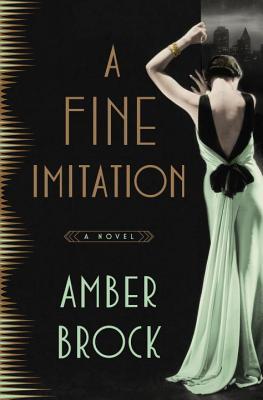
A Fine Imitation by Amber Brock, an unexpected surprise from Crown.

Set in the glamorous 1920s, A Fine Imitation is an intoxicating debut that sweeps readers into a privileged Manhattan socialite’s restless life and the affair with a mysterious painter that upends her world, flashing back to her years at Vassar and the friendship that brought her to the brink of ruin.

Vera Bellington has beauty, pedigree, and a penthouse at The Angelus—the most coveted address on Park Avenue. But behind the sparkling social whirl, Vera is living a life of quiet desperation. Her days are an unbroken loop of empty, champagne-soaked socializing, while her nights are silent and cold, spent waiting alone in her cavernous apartment for a husband who seldom comes home.

Then Emil Hallan arrives at The Angelus to paint a mural above its glittering subterranean pool. The handsome French artist moves into the building, shrouds his work in secrecy, and piques Vera’s curiosity, especially when the painter keeps dodging questions about his past. Is he the man he claims to be? Even as she finds herself increasingly drawn to Hallan’s warmth and passion, Vera can’t supress her suspicions. After all, she has plenty of secrets, too—and some of them involve art forgers like her bold, artistically talented former friend, Bea, who years ago, at Vassar, brought Vera to the brink of catastrophe and social exile.

What did you receive?
346th Virtual Poetry Circle

Welcome to the 346th Virtual Poetry Circle!

Remember, this is just for fun and is not meant to be stressful.

Keep in mind what Molly Peacock’s book suggested.

Look at a line, a stanza, sentences, and images; describe what you like or don’t like; and offer an opinion. If you missed my review of her book, check it out here.

This poem is from Paul Laurence Dunbar, read by Hope Smith:

A Negro Love Song

Seen my lady home las’ night,
Jump back, honey, jump back.
Hel’ huh han’ an’ sque’z it tight,
Jump back, honey, jump back.
Hyeahd huh sigh a little sigh,
Seen a light gleam f’om huh eye,
An’ a smile go flittin’ by —
Jump back, honey, jump back.

Hyeahd de win’ blow thoo de pine,
Jump back, honey, jump back.
Mockin’-bird was singin’ fine,
Jump back, honey, jump back.
An’ my hea’t was beatin’ so,
When I reached my lady’s do’,
Dat I could n’t ba’ to go —
Jump back, honey, jump back.

Put my ahm aroun’ huh wais’,
Jump back, honey, jump back.
Raised huh lips an’ took a tase,
Jump back, honey, jump back.
Love me, honey, love me true?
Love me well ez I love you?
An’ she answe’d, “‘Cose I do”—
Jump back, honey, jump back.

What do you think?

Little Owl’s Day by Divya Srinivasan

Source: Public Library
Hardcover, 32 pgs.
I am an Amazon Affiliate

Little Owl’s Day by Divya Srinivasan is a continuation of the previous owl story, only this time, he’s woken up during the day by a squirrel eating nuts.  The owl cannot get back to sleep, so he decides to explore the woods in the daytime.  While his mother tells him to go back to sleep, of course, he ignores her and head out on his own.  He soon finds in the day that things are very busy and very different than they are at night.

He mistakes butterflies for moths and he notices that the flowers are open, the opposite of how they are at night.  She liked the dragonflies, some of which flew backward, and she liked the turtle when he was sunbathing.  When he sees the bear is awake, they talk about how the bear is never able to show the owl a rainbow and the owl is never able to show the bear the moon.

Little Owl’s Day by Divya Srinivasan is a great sequel to the little owl, and it would be great to see him grow up in a bigger and bigger owl.  While there is little to no conflict in these books, they provide kids with a good sense of how the animal kingdom works during the day and at night.

Rating: Quatrain

About the Author:

Check out Divya Srinivasan‘s website.

Just Kids by Patti Smith (audio)

Source: Public Library
Audiobook, 9 CDs
I am an Amazon Affiliate

Just Kids by Patti Smith, narrated by the author, embraces her naivete and anxiety about her artistic life, particularly her chaotic creative process and her relationship with photographer Robert Mapplethorpe.  As a struggling poet, she finds that she was ill-prepared for feeling true hunger or living on the streets, but through a series of kind acts from strangers and eventually friends, she finds her way.  Moving fluidly between photography, art, music, and poetry, Smith demonstrates what it means to be young and on a journey of self-discovery in the 1960s and 1970s.

This is a very honest memoir about life as an artist, and what it means to have a clear vision of what you want from an artistic life.  Mapplethorpe had a clear vision of what he wanted from his art and pursued it relentlessly and with all of his body, even though he also feared the judgment of others.  Smith, on the other hand, knew she wanted to be a poet, but was unable to see for some time that poetry is malleable and can evolve beyond what is expected.

Rather than assess her relationship with Mapplethorpe, Smith focuses on how their tumultuous relationship allowed them to grow as artists — their reciprocal relationship becomes the crux of what it means to be a muse and to have a muse.  Because Smith is a writer, her observational skills are keenly seen in her memoir.  An early pact that these artists make to one another about being the sober one when the other is not, helps to keep both artists on their ultimate creative paths, even if they diverge from one another.

Just Kids by Patti Smith is seductive.  Smith narrates it as she wrote it, with honesty and unconditional love.  While she makes no assessments about her experiences, readers will see how appreciative she is for her luck and her journey, a journey that is ripe with sadness and pain but also joy and happiness.  The life of an artist is difficult and chaotic, but no less fulfilling for those committed to it body and soul.

***The poems at the end are worth waiting for***

Rating: Cinquain

Photo: © Jesse Dittmar

About the Author:

Patti Smith is a writer, performer, and visual artist. She gained recognition in the 1970s for her revolutionary merging of poetry and rock. She has released twelve albums, including Horses, which has been hailed as one of the top one hundred albums of all time by Rolling Stone.

Please visit her Website.


Other Reviews:

Unleashing Mr. Darcy by Teri Wilson

Source: Public Library
Paperback, 368 pgs
I am an Amazon Affiliate

Unleashing Mr. Darcy by Teri Wilson takes Jane Austen’s Pride & Prejudice and creates a modern version that will have readers laughing and shaking their heads in frustration as Elizabeth Scott enters the prestigious world of dog shows, where Donovan Darcy reigns as judge.  Unlike the young ladies of the classic novel, women are able to carve their own futures and hold jobs; they no longer need to rely on finding a husband to be happy.  Elizabeth Scott, however, is even less interested in marriage given that her mother owns a bridal shop and insists on fixing her up with eligible men.  She’s made her way as a teacher at a private high school until one day a student in her class is suspended from the lacrosse team because of his failing mid-term grade.  While suspended from her job, she enters her new pup in a dog show where she meets the drop-dead gorgeous and brooding Donovan Darcy, as well as the Barrows, a couple from England that shows terriers.

Like Austen’s novel, Darcy is prideful and Lizzy is prejudiced, though given her treatment by her employer, readers will understand where her prejudice against the wealthy comes from.  Wilson’s modern Darcy and Lizzy are at odds for much of the novel, and while their miscommunications could be addressed more quickly, there would be far less enjoyable banter between the two.  Moreover, Darcy does focus a great deal on Lizzy’s appearance as a reason for his attraction, which can be disheartening for those who view Darcy as more attracted to Lizzy’s personality, intelligence, and loyalty to family and friends.  Given that this Darcy is known for his professionalism and restraint, it’s fascinating to see how Lizzy’s presence makes him lose control in a number of ways.

Wilson breaks open the fascinating world of dog shows, and its wonderful to see how the arena is governed and how rules are sometimes circumvented by participants.  One of the best scenes of the novel is when Darcy quotes from the breed standard in the ring, and Lizzy takes it the wrong way entirely.  Unleashing Mr. Darcy by Teri Wilson is a fun read and is much better than the Hallmark movie version (though Darcy in that film is very easy on the eyes).

About the Author:

Teri Wilson is a romance novelist for Harlequin Books and contributing writer at HelloGiggles.com. Her most recent book is ALASKAN SANCTUARY, set on a wolf habitat in Alaska. She’s also the author of UNLEASHING MR. DARCY, now a Hallmark Channel Original Movie premiering January 23, 2016. Teri loves books, travel, animals and dancing every day.  Visit her Website.

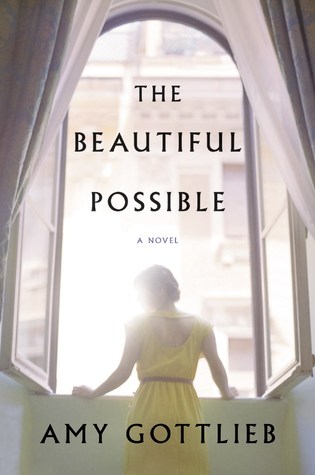
The Beautiful Possible by Amy Gottlieb

tlc tour hostSource: TLC Book Tours
Paperback, 336 pgs.
I am an Amazon Affiliate

The Beautiful Possible by Amy Gottlieb will immerse readers in the religious fervor of Judaism, which is both beautiful in its confinement and infuriating in its inability to be more flexible. Opening with Maya Kerem reminiscing about her parents, the novel seems as though it’s going to be a love story about her parents, but then, readers are introduced to German Jew Walter Westhaus, whose life is shattered one night by the Nazis in 1938.  The tragedy he experiences in his apartment pushes him into blind action, leaving his homeland to board a boat and travel not to Palestine as he and his fiance dreamed but to Bombay, as he follows a man with a brown felt hat.

“They are alone for four days and their recognizable lives become obliterated, irrelevant.  For both of them, this time is not joyful, but necessary.” (pg. 199 ARC)

Despite the complications and the religious context, the story of Walter is one that is familiar, a man who becomes lost in the face of trauma and who wanders to find meaning in what’s left of his life.  The man with the brown felt hat befriends him among the spices and dreams of a different life for Walter.  He begs Walter to come to America and become a scholar of religion and faith.  This is a friendship held at a distance, a connection that allows Walter to meet Sol Kerem and Rosalie Wachs, with whom he will be connected in the most beautiful and impossible ways — creating a deep love and braided life that is beneath the surface of all that they are.

The poetry of the Torah and the other texts examined in Rabbinical school by Walter and Sol mimic the beautiful relationship between Sol, Rosalie, and Walter, an impossible braid that cannot be broken because if it were, all strength would be lost.  While Gottlieb’s characters are each lost in their own way, when they come together, they find the strength and faith they need to keep going, even when they are miles and countries apart.  Like the intertwined relationships of the novel, Gottlieb weaves in religious texts and rituals in a way that is seamless and artistic, making beautiful the impossible.

“…the secret of these weeks will resound in my bones as private music that only I will be able to hear.” (g. 70 ARC)

The Beautiful Possible by Amy Gottlieb is a rapture where decisions are not analyzed but made, and where love is the driving force of faith.  Even in death, a story can live on, unraveling its intricate and closely held secrets for all to behold.  It’s a mystical take on the average lives we lead and how they compare to the dreams of something more that we harbor in locked places.

Rating: Cinquain

About the Author:

Amy Gottlieb’s fiction and poetry have been published in many literary journals and anthologies, and she is the recipient of fellowships from the Bronx Council on the Arts and the Drisha Institute for Jewish Education. She lives in New York City.


I’m calling this my A Fiction Book set during WWII.

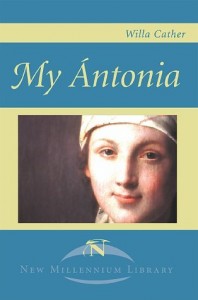
Guest Review: My Ántonia by Willa Cather

USbooksNebraskaFebruary is the second month of the United States of Books (click here for further details).

The United States of Books: the State of Nebraska

Today’s review is from Teri at Sportochick’s Musings.

My Ántonia (Great Plains Trilogy #3) by Willa Cather

MyAntoniaBlurb ~ 

Through Jim Burden’s endearing, smitten voice, we revisit the remarkable vicissitudes of immigrant life in the Nebraska heartland, with all its insistent bonds. Guiding the way are some of literature’s most beguiling characters: the Russian brothers plagued by memories of a fateful sleigh ride, Antonia’s desperately homesick father and self-indulgent mother, and the coy Lena Lingard. Holding the pastoral society’s heart, of course, is the bewitching, free-spirited Antonia.


Review ~ ★ ★ 1/2

This story is narrated in first person by Jim Burden in what I think is a very plain unemotional manner. I honestly had a hard time reading this book and at points kept putting it down. It was puzzling to me that for all of the unusual dramatic events in this book it was for me unemotional. I am not sure if listening to it on Audible and switching off and on with the book impacted my feelings. Though these dramatic events in the book were described in fine detail my mind felt a distance from the writing.

Two characters did stand out. Antonia who was very expressive and Jim’s grandfather for the ways that he dealt with crisis’s, personality issues and his deep integrity. Antonia throughout the book was very emotional and it was obvious to see why quiet Jim liked to be around her and had grown to love her.

I finally connected with the book in the last chapter and a half where it became to me a book worth reading. This part of the book make me feel great sadness for Jim and Antonia and where they were 20 years later. The ending was poignant and still brings tears to my eyes.

This book leaves the readers pondering the what if. What if Jim didn’t go away to college? What if Antonia made a different decision when her first love deceived her? What if Jim had told her he loved her? But the largest question that I had was how did Jim love Antonia? A sister, friend, lover? This book left me feeling sad because if Jim had more gumption his life would of been so different than it was. It also left me pondering on how many people lost out on the best thing of their lives because they were afraid.

Find the Book At Amazon | Barnes & Noble | Goodreads

Mailbox Monday #363

Mailbox Monday, created by Marcia at To Be Continued, formerly The Printed Page, has a permanent home at its own blog.

To check out what everyone has received over the last week, visit the blog and check out the links.  Leave yours too.

Also, each week, Leslie, Vicki, and I will share the Books that Caught Our Eye from everyone’s weekly links.

Here’s what I received from the library sale, two hardcovers for $1 each and the rest paperbacks at 50 cents.

Never by Jorie Graham

Jorie Graham’s collection of poems, Never, primarily addresses concern over our environment in crisis. One of the most challenging poets writing today, Graham is no easy read, but the rewards are well worth the effort. While thematically present, her concern is not exclusively the demise of natural resources and depletion of species, but the philosophical and perceptual difficulty in capturing and depicting a physical world that may be lost, or one that we humans have limited sight of and into. As she notes in “The Taken-Down God”: “We wish to not be erased from the / picture. We wish to picture the erasure. The human earth and its appearance. / The human and its disappearance.”

With a style that is fragmented and somewhat whirling–language dips and darts and asides are taken–Graham stays on point and presents an honest intellect at work, fumbling for an accurate understanding (or description) of the natural world, self-conscious about the limitations of language and perception.

The Best of It by Kay Ryan

Kay Ryan, named the Pulitzer Prize Winner for Poetry 2010, is just the latest in an amazing array of accolades for this wonderfully accessible, widely loved poet. She was appointed the Library of Congress’s sixteenth poet laureate from 2008 to 2010. Salon has compared her poems to “Fabergé eggs, tiny, ingenious devices that inevitably conceal some hidden wonder.” The two hundred poems in Ryan’s The Best of It offer a stunning retrospective of her work, as well as a swath of never-before-published poems of which are sure to appeal equally to longtime fans and general readers.

The Seven Ages by Louise Gluck

The Seven Ages was written during a ten-week period in the summer of 1999.

The fierce, austerely beautiful, and visionary voice that has become Glück’s
trademark speaks in these poems of a life lived in unflinching awareness.
Many of the poems in this collection bear the familiar features of Glück’s
earlier work, returning to themes of nature and the classical narratives
that explain the phenomena of the world around us. Like Ararat, Glück’s
fifth book, this collection explores the hazards and pleasures of the
domestic sphere and the family with an eye to the demonic. As in The Wild
Iris, which won the Pulitzer Prize in 1993, and Vita Nova, imagination
supplants both empiricism and tradition in these poems. Unlike her past
work, many of these poems inhabit the realm of dreams, moving backward in
time to an eidetic, unrecoverable past and ahead to an as-yet unrealized
future. “Earth was given to me in a dream/ In a dream I possessed it.” In
these poems, Glück is wry, dreamlike, idiomatic, undeceived, unrelenting.

This new transparent mode, although charged by the indelible imagery and
exact phrasing her readers will recognize, represents an ecstatic departure
from her previous work.

Epic Song by Pablo Neruda

This book of epic and lyric poems is the first book that any poet — in Cuba or anywhere else — dedicated to the Cuban Revolution and the Caribbean peoples. Ardently alive today, they sing of dignity to the indignant, of hope to the hopeless, of justice in spite of the unjust, of equality in spite of the exploiters, of truth in spite of the liars and of the great, brotherhood of true fighters.

Field Work by Seamus Heaney

“Field Work,” which first appeared in 1979, is a superb collection of lyrics and narrative poems from one of the literary masters of our time. As the critic Dennis Donoghue wrote in “The New York Times Book Review”: “In 1938, not a moment too soon, W. B. Yeats admonished his colleagues: ‘Irish poets, learn your trade.’ Seamus Heaney, born the following year, has learned his trade so well that it is now a second nature wonderfully responsive to his first. And the proof is in “Field Work,” a superb book . . . [This is] a perennial poetry offered at a time when many of us have despaired of seeing such a thing.”
Seamus Heaney received the Nobel Prize in Literature in 1995. His recent translations include “Beowulf” and “Diary of One Who Vanished”; his recent poetry collections include “Opened Ground” and “Electric Light.”
“Field Work,” which first appeared in 1979, is a superb collection of lyrics and narrative poems from one of the literary masters of our time. As the critic Dennis Donoghue wrote in “The New York Times Book Review”: “In 1938, not a moment too soon, W. B. Yeats admonished his colleagues: ‘Irish poets, learn your trade.’ Seamus Heaney, born the following year, has learned his trade so well that it is now a second nature wonderfully responsive to his first. And the proof is in “Field Work,” a superb book . . . [This is] a perennial poetry offered at a time when many of us have despaired of seeing such a thing.”
“Heaney is keyed and pitched unlike any significant poet now at work in the language, anywhere.”–Harold Bloom, “The Times Literary Supplement”
“For all the qualities I list, the most important is song [and] the tune Heaney sings [is] poetry’s tune, resolutions of cherished language.”–Donald Hall, “The Nation”

On the Road by Jack Kerouac

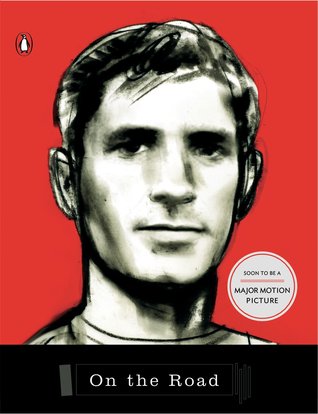
On the Road chronicles Jack Kerouac’s years traveling the North American continent with his friend Neal Cassady, “a sideburned hero of the snowy West.” As “Sal Paradise” and “Dean Moriarty,” the two roam the country in a quest for self-knowledge and experience. Kerouac’s love of America, his compassion for humanity, and his sense of language as jazz combine to make On the Road an inspirational work of lasting importance.

Kerouac’s classic novel of freedom and longing defined what it meant to be “Beat” and has inspired every generation since its initial publication.

The Handmaid’s Tale by Margaret Atwood

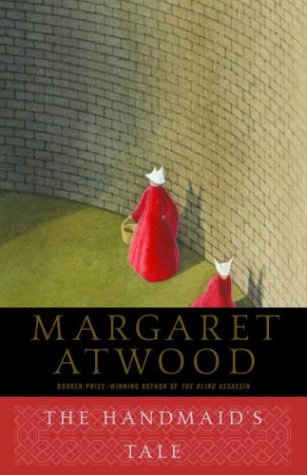
Offred is a Handmaid in the Republic of Gilead. She may leave the home of the Commander and his wife once a day to walk to food markets whose signs are now pictures instead of words because women are no longer allowed to read. She must lie on her back once a month and pray that the Commander makes her pregnant, because in an age of declining births, Offred and the other Handmaids are valued only if their ovaries are viable. Offred can remember the years before, when she lived and made love with her husband, Luke; when she played with and protected her daughter; when she had a job, money of her own, and access to knowledge. But all of that is gone now.

Here’s my review books:

Living Like a Runaway by Lita Ford for review from Dey Street Books.

In this long-awaited, emotionally powerful memoir,  “HEAVY METAL’S LEADING FEMALE ROCKER” (Rolling Stone) opens up about the ’70s and ’80s music scene and her trailblazing life as the lead guitarist of the “pioneering band” (New York Times) the Runaways and her platinum-selling, Grammy-nominated solo career. Hailed as “the mother of all metal” (Los Angeles Times) and “one of the greatest female electric guitar players to ever pick up the instrument” (Elle), Lita Ford bares her soul in Living Like a Runaway.

Normal Norman by Tara Lazar, illustrated by S. Britt, for review from Sterling Children’s Books.

What is “normal?” That’s the question an eager young scientist, narrating her very first book, hopes to answer. Unfortunately, her exceedingly “normal” subject—an orangutan named Norman—turns out to be exceptionally strange. He speaks English, sleeps in a bed, loves his stuffed toy, goes bananas over pizza, and even deep-sea dives! Oh, no: what’s a “normal” scientist to do?

What did you receive?

345th Virtual Poetry Circle

Welcome to the 345th Virtual Poetry Circle!

Remember, this is just for fun and is not meant to be stressful.

Keep in mind what Molly Peacock’s book suggested.

Look at a line, a stanza, sentences, and images; describe what you like or don’t like; and offer an opinion. If you missed my review of her book, check it out here.

This poem is from Gwendolyn Brooks, read by Chris Slaughter:

Riot

A riot is the language of the unheard.
—Martin Luther King

John Cabot, out of Wilma, once a Wycliffe,
all whitebluerose below his golden hair,
wrapped richly in right linen and right wool,
almost forgot his Jaguar and Lake Bluff;
almost forgot Grandtully (which is The
Best Thing That Ever Happened To Scotch); almost
forgot the sculpture at the Richard Gray
and Distelheim; the kidney pie at Maxim’s,
the Grenadine de Boeuf at Maison Henri.

Because the Negroes were coming down the street.

Because the Poor were sweaty and unpretty
(not like Two Dainty Negroes in Winnetka)
and they were coming toward him in rough ranks.
In seas. In windsweep. They were black and loud.
And not detainable. And not discreet.

Gross. Gross. “Que tu es grossier!” John Cabot
itched instantly beneath the nourished white
that told his story of glory to the World.
“Don’t let It touch me! the blackness! Lord!” he whispered
to any handy angel in the sky.
But, in a thrilling announcement, on It drove
and breathed on him: and touched him. In that breath
the fume of pig foot, chitterling and cheap chili,
malign, mocked John. And, in terrific touch, old
averted doubt jerked forward decently,
cried, “Cabot! John! You are a desperate man,
and the desperate die expensively today.”

John Cabot went down in the smoke and fire
and broken glass and blood, and he cried “Lord!
Forgive these nigguhs that know not what they do.”

What do you think?

Little Owl’s Night by Divya Srinivasan

Source: Public Library
Hardcover, 32 pgs.
I am an Amazon Affiliate

Little Owl’s Night by Divya Srinivasan is an adorably illustrated book about the forest at night and all of the animals in it.  As many kids are scared of the dark, this book could be a great teaching tool about what animals are active at night.  Little owl is awake and he goes exploring and saying hello to his fellow night animals.  From bunnies to foxes and hedgehogs, Owl is friendly to everyone as he soars above them.

My daughter liked this book because he followed the animals to find out what they were doing, like the possums.  She didn’t like the skunk much, but we did count the fireflies around the turtle and other animals.  Her favorite pages are where the bunny is sleeping to hide from the fox, and she loved the bats.

Little Owl’s Night by Divya Srinivasan is vibrant and dark at the same time, the darker backgrounds make the animals come alive.  Owl is very friendly, even to animals we consider predators.

Rating: Quatrain

About the Author:

Check out Divya Srinivasan‘s website.

Those Girls by Chevy Stevens (audio)

Source: Public Library
Audiobook, 10 CDs
I am an Amazon Affiliate

Those Girls by Chevy Stevens, narrated by Jorjeana Marie, Emily Woo Zeller, and Nicol Zanzarella, is a dark novel of abuse and its consequences.  The Campbell sisters — Jess, Courtney, and Dani — have lived a downtrodden life in Western Canada, and they try to stay out of the way of their abusive father.  Forced to flee, these teenage girls find a lot more than a life on the run, and the experience they have in small town changes their lives forever.  Stevens has created story that seems sensational and the events a bit convenient, but at its heart there is a strong bond between the sisters that is integral to the story.

There are a lot of frustrating moments in this book, with the girls doing things the reader knows are a bad idea.  Readers will want to slap them silly.  Graphic violence against women can be found in these pages, and a lot of it is tough to take.  Much of the story is told from the point of view of the youngest sister, Jess, who like a true innocent and naive girl, follows her older sisters blindly at times.  She is naive until the worst happens to her, and she has to think like her older sisters to help break them free.  Once free, these girls begin their lives under new names, and readers will think that their story of survival is over … but it isn’t.  Fast-forward 18 years, and the story continues with Skylar, the daughter of one of the girls.

There is a lot of detail in these girls’ movements, particularly as they are going through the abandoned buildings and other locations.  In many ways, the pace of the thriller is bogged down by a lot of these details.  It feels as though the tension is being dragged out on purpose, particularly in the latter half of the novel when Skylar is telling the story.  The older girls are clearly still dealing with PTSD from the trauma, but they also are incredibly naive.  Some of the plot twists are predictable, and the things that the attackers continue to get away with is a little too convenient.

Those Girls by Chevy Stevens, narrated by Jorjeana Marie, Emily Woo Zeller, and Nicol Zanzarella, is a tough read for the graphic violence and the stupidity of the characters, particularly Skylar given what she knows happened to her mother.  This is a little too predictable and sensationalized, but the relationship between the sisters is strong and will hold readers’ interest.  It’s just too bad that Dani’s voice is not heard until the final chapters.

Rating: Couplet

About the Author:

Chevy Stevens grew up on a ranch on Vancouver Island and still calls the island home. For most of her adult life she worked in sales, first as a rep for a giftware company and then as a Realtor. At open houses, waiting between potential buyers, she spent hours scaring herself with thoughts of horrible things that could happen to her. Her most terrifying scenario, which began with being abducted, was the inspiration for STILL MISSING. After six months Chevy sold her house and left real estate so she could finish the book.

Chevy enjoys writing thrillers that allow her to blend her interest in family dynamics with her love of the west coast lifestyle. When she’s not working on her next book, she’s camping and canoeing with her husband and daughter in the local mountains.

Other Reviews:

River House by Sally Keith

Source: Milkweed Editions
Paperback, 96 pgs.
I am an Amazon Affiliate

River House: Poems by Sally Keith is a collection where absence becomes palpable, and it is clear that this is a very personal collection as the narrator’s focal point is the loss of a mother.  Keith lost her mother and this collection will speak to those who are dealing with the depths of grief, or in fact, not dealing with it well.  Grief is one of the most devastating emotions, and it can take months and years to deal with, particularly if the loss is one so central to one’s identity and world.  The river house is a place the family vacationed with their mother, and it’s a place that even being shared with others would not have the same meaning because it was a place filled with the mother who is no longer living.

From 5.

That spring I was in France my mother spent alone
At the house on the river caring for her father who was dying.

At high tide the road in is swallowed, making the house an island.
Hard to describe, but the walls are thin, it isn’t easy getting through storms.

Grief is indeed a storm, with waves of anguish and loss hitting a person at varying intervals, leaving them awash in a sea that is unpredictable and hard to navigate, keeping one’s head up. Within the grief, the narrator is attending workshops and going through the day-to-day of a life without her mother. In “6.,” the poem speaks of life as a journey of “being in another,” and the narrator speaks to Inma about loss, and Inma’s response is that “life is not sad,” leaving the narrator to “feel the effort in her turning.” That effort is twofold, the effort of providing advice Inma knows not to be entirely true and the effort of hiding the grief that can still overwhelm her, even long after the loss has occurred.

Keith’s poems have a powerful quiet, a storm that lies beneath the surface, much like the storm many of us can sense beneath a person’s facade at funerals and wakes — like there is one word that could trigger the worst of it to burst forth in an uncontrollable torrent. In “17.,” the narrator views a collage sent from Inma, pondering how different it is to look at the storm of images, a near disarray made beautiful with life. In many ways, it is the nearest imitation of life that there can be, unlike a single photo or poem that depicts a paused moment of motion.

From 31.

“Between the way things used to be and the way
they were now was a void that couldn’t be crossed.”

River House: Poems by Sally Keith pays homage to the past and recognizes that life continues on past the traumatic moments of our lives. It doesn’t mean that those lives did not matter, it just means that how they mattered is not as visually present as it used to be.

Rating: Cinquain

About the Poet:

Sally Keith is the author of two previous collections of poetry: Design, winner of the 2000 Colorado Prize for Poetry, and Dwelling Song, winner of the University of Georgia’s Contemporary Poetry Series competition. Her poems have appeared in Colorado Review, A Public Space, Gulf Coast, New England Review, and elsewhere. Keith teaches at George Mason University and lives in Washington, DC.