Quantcast

Wild Place by Erica Goss

Wild Place by Erica Goss is a chapbook, published by Finishing Line Press, examining the wild places within ourselves and our interactions with nature.  Wild and untamed, the verse sings the beauty in the blame as humanity encroaches on nature, sometimes leading to its destruction and at other times unveiling the beauty beneath the scars.  Goss has a talent for using few words to create a powerful and vivid image that sends a message to the reader about the wildness of nature and ourselves.  From “This Is a Wild Place” (page 10), “The little junk birds peck at foil,//and I am called away from my body/to forage for my life/out in the open.//” and from “New Colors” (page 16), “in an anonymous/coffee shop/a child waved/to me from//his father’s arms/fingers opening/and closing like/pink fronds//of a sea anemone.//”

Some poems are haunting, like “The Redwoods,” in which she compares the trees to whales sifting krill and how they sing in the windy darkness.  She tackles the fears of aging and clinging to the the past in several poems, including “The Redwoods,” but rather focus on nostalgic rose-colored images of the past, she highlights the splinters that gnaw at our sensibilities and the scars they create and how they shape who we become.  There is a certain wisdom that we all garner as we age, and rather than celebrate it, many times we are too focused on what might have been.
Although the California landscape and other West coast settings play a significant role in her poems, Goss also takes us out of our American element with poems like “Strange Land” and “Woman in the Berlin Airport,” in which she tackles assumptions of Americans about how foreigners act and react and how they see us.  From “Strange Land” (page 24), “America takes practice/mother prepares/our daily lessons//each morning we emigrate/our fermenting lunchboxes/ripe with foreign stink//the war of two languages/leaves us mute in school/speak up, the teacher says//”  Goss tackles the hardships of fitting in when one comes to America from somewhere else and the expectations that places on them and their children, but within the same poem, there is a nod to the past — in this case, WWII — and how it is best left in the past and not brought into the new “shining” future.

Even as Goss uses nature imagery to pull out her themes of aging, fitting in, and moving onward, she also does an excellent job providing breathtaking verse about mechanical objects, such as the airplane in “Leaving Frankfurt.”  Readers will rise and fall with the aircraft as it leaves one city for another and the narrator immerses herself in the experience.  Wild Place by Erica Goss is stunning to the point where readers will not look at the world in the same way; they will be forced to look further, to think harder, to accept more — broadening their perspective and horizons so that they become more conscientious about themselves and the world around them.

Poet Erica Goss

About the Poet:

Erica Goss is the winner of the 2011 Many Mountains Moving Poetry Contest. Her chapbook, Wild Place, was published in 2012 by Finishing Line Press. Her poems, articles and reviews have appeared in many journals, most recently Connotation Press, Hotel Amerika, Pearl, Main Street Rag, Rattle, Eclectica, Blood Lotus, Café Review, Zoland Poetry, Comstock Review, Lake Effect, and Perigee.

She won the first Edwin Markham Poetry Prize in 2007, judged by California’s Poet Laureate Al Young, and was nominated for a Pushcart Prize in 2010. Erica teaches creative writing and humanities in the Bay Area and is a contributing editor for Cerise Press. She holds an MFA from San Jose State University.  If you live in California, please attend one of her local events near you.

***For today’s National Poetry Month blog tour stop, please visit Indie Reader Houston.***


This is the 8th book for my 2012 Fearless Poetry Exploration Reading Challenge.


This is my 26th book for the 2012 New Authors Challenge.
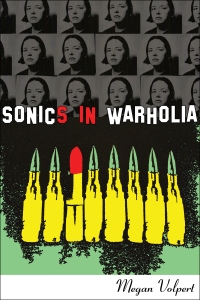
2011 Indie Lit Awards Short-Listed Poetry Review: Sonics in Warholia by Megan Volpert

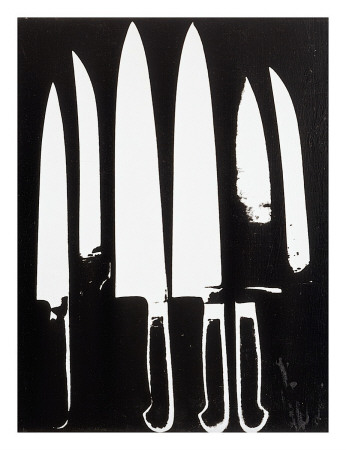
Indie Lit Awards 2011 short-listed poetry title, Sonics in Warholia by Megan Volpert is highly experimental with poetic form meshing together pop culture and prose with lines from songs and other elements many will recognize in a homage to the conundrum that was Andy Warhol (most famous for the Campbell’s Soup Can).  An interesting thing to note is the red “SIN” in the title, as well as the use of “Sonics,” which could be a reference to the garage band, The Sonics, from the 1960s.  The images of Volpert in the background remind readers of Warhol’s famous Marilyn Monroe paintings and the rows of knives.

The collection consists of eight long poems that play on musicality and surrealism, engaging readers in a back-and-forth, push-and-pull of ideas, much like Warhol himself, who remained cryptic about his process and his influences.  In many ways, Volpert’s work resembles that cryptic nature.

From “Portrait of a Mix Tape” (pages 7-12), “. . . Thus, Andy, please/enjoy your 58 years boiled down to fifty-seven minutes and fifty-/one seconds.//” the poem is homage to Andy through lyrics in popular music appearing from the time of his birth to beyond the time of his death to illustrate the influence he had on the narrator and the world, especially the world of pop culture.  In many of the poems, the narrator speaks directly to the ghost of Andy Warhol, but on some occasions readers will be left adrift if they are not as familiar with Warhol or the other images and pop culture events discussed.

“For the Love of Good Machines” (pages 13-19) begins with reference to Warhol’s relationship with Lou Reed as lead lyricist of The Velvet Underground, and again Volpert is combining music with her poetry as she speaks about the internal rhythms of songs vs. their external lack of speed and vice versa in the image of the stationary motorcycle, which she equates to the creativity of the mind — whether among poets, musicians, or artists.  Even though little may be produced outwardly, these creative spirits are always creating inwardly.  An ambitious collection of just eight poems oscillates between sublime and ridiculous, deftly providing a portrait of Warhol and all he gave to the world.  However, the style in which it is written could cause readers to take each poem in small chunks rather than as a whole and require some “googling.”

Sonics in Warholia by Megan Volpert has moments of sheer insanity and surrealism that many readers will either detest or love, and while the form is experimental, it does have poetic qualities of allusion, narration, and imagery that draw out themes and comparisons between all art forms and the often “hidden” quality that they all share — that which makes the affectations of that talent either succeed or fail in the eyes of the public.

Please check out other reviews from the Indie Lit Awards Panelists:

Necromancy Never Pays and her interview with Megan Volpert.

Poet Megan Volpert

About the Poet:

Megan Volpert is a poet and critic from Chicago who has settled in Atlanta with her wife, Mindy. Volpert holds an MFA in Creative Writing from Louisiana State University and is a high school English teacher.

Sonics in Warholia is her fourth collection of poems (Little Rock: Sibling Rivalry Press, 2011). The other three are The Desense of Nonfense and Face Blindness (Buffalo: BlazeVOX Books, 2009 & 2007), and Domestic Transmission (San Antonio: MetroMania Press, 2007). She is currently editing This assignment is so gay: LGBTIQ Poets on the Art of Teaching (Little Rock: Singling Rivalry Press, 2013).

***Today’s National Poetry Month Blog Tour stop is at The Indextrious Reader.***


This is the 7th book for my 2012 Fearless Poetry Exploration Reading Challenge.


This is my 25th book for the 2012 New Authors Challenge.

Listening to Africa by Diana M. Raab

Listening to Africa by Diana M. Raab are the poet’s thoughts on her trip to Africa in 2008.  The poems are not about Africa and the events that happen there, so much as the effect the trip had on Raab and her family.  A trip motivated by death and malignancy, Raab is seeking a spiritual renewal, a way to rejuvenate her flagging will to fight.  She finds what she needs as she watches the village people struggle to clothe and feed themselves by actively pushing their crafts onto tourists and selling themselves to tourist firms as entertainment for the pampered Americans.

From "Amplified Melancholy" (page 8):

. . . and all I can tell you is that
on the tenth anniversary of dad's
passing, the doctors removed

my right breast and five years later
stabbed by a second diagnosis,
bone marrow malignancy,

no cure, just treatment --
the holiday lights sharpened.
Past dripping menorah candles,  . . .

Emotions run the gamut in this collection from fear to nostalgia for the past, and a new understanding of how the past has shaped each of us.  She sees the grandfather in her son in “Your Camera” as he approaches the world behind the viewfinder of a camera.  There is fearsome beauty in Raab’s poems as she explores the wild with her family, even though her trip is controlled.  The beauty of the sunrises and sunsets, the hidden dangers of genteel looking hippos, and the fight for survival among all nature’s creatures.  For example:  “The forces of life and death/are at play like the day I found/my grandmother dead in her bed –//” (from “The Scent of Death” on page 19) and “We are snapped into silence, the comes the roar/of dragon breath and then silence again./The purple scarred panorama lingers//” (from “Balloon Rides” on page 21).

Readers will become steeped in the melancholy and the tentative observations of Africa from which the poet is seeking to draw strength and understanding.  Like the hippo in “Hippos” and in nature, the poet has a deep, hidden strength and history of survival from which to draw from as she fights what ails her, but also the cancers have their own hidden strengths and it is clear there will be a battle of wills.  “Our jeep arrived at sunset//at the edge of their swamp/as their big papa sat and stared/deep into our foreign eyes, long enough//to bring ten more in his company,/as if this army could infiltrate/our veins with fear.  They sat proudly//” (from “Hippos” on page 43) illustrates the duel going on within the poet between the cancer cells staring her down eager to win the battle, and her doing the same as she gathers her inner strength and support systems around her.

Listening to Africa by Diana M. Raab is a wonderful reminder that we each struggle for survival, though we all may not live in the wilds of the jungle.  Raab is a talented poet who takes her memorist talents and weaves them into imagery and verse that creates emotional tension and verse readers can reflect upon and apply to their own lives.

Poet Diana Raab

About the Poet:

Diana M. Raab is a memoirist, essayist and poet. She has a B.S. in Health Administration and Journalism, and an RN degree from Vanier College in Montreal, in addition to an MFA in Nonfiction Writing from Spalding University’s Low-Residency Program.

Diana has been writing from an early age. As a child of two working parents, she spent a lot of time crafting letters and keeping a daily journal. A journaling advocate and educator, Diana teaches creative journaling and memoir in workshops around the country. She frequently speaks and writes about the healing powers of writing.


This is the 6th book for my 2012 Fearless Poetry Exploration Reading Challenge.

***For today’s National Poetry Month blog tour stop, please visit Necromancy Never Pays.***

The Virgin Journals by Travis Laurence Naught

Imagine a life in which everything is viewed from a wheelchair or from the arms of someone moving you from the bed to the chair and back again.  The Virgin Journals by Travis Laurence Naught is that story and more.   Naught was diagnosed as an infant with incurable spinal muscular atrophy, and his poems and prose speak with a frankness that is not only raw but unsettling.  Do we want to truly know what he’s thinking as he sits in his wheelchair and cannot decide to go to war as a soldier or to even have a choice about what he does physically?  His collection reads much like the confessional poets of Sexton and Plath with its brash ambition to tell it like it is without sugar coating, but in many ways it is not as sophisticated in that there are no mysterious images to unravel.  He puts it all out there without pretense and the poems read more like journal entries.

From "All You Need is Touch" (Page 75):

Feeling like a pain in the ass
Is no fun for anyone
But I get by every day
By needing
Basic life functions
From "Big Mouth" (Page 50):

Do not treat me with distrust
For I have not lied
Only told the truth too much

The collection is broken into three sections:  Life, Love, and World.  It is likely to make readers uncomfortable in that the narrator of these poems is constantly frustrated, deprived of human touch/contact, and full of lust.  To truly understand the plight of someone stuck in a wheelchair, these poems can do just that, but the poems appear to be prose broken up into lines and stanzas arbitrarily.  Moreover, there are more poems here that read like stream of consciousness prose and late-night confessions that normally would not see the outside of a drawer.  They are raw and unflinching.

Some poems are more typically poetic than others, but it is clear that writing is an outlet for Naught as he struggles daily with his lack of physical freedom and desire for more out of life. From “Lack of Physicality” to “Movie in Mind,” Naught’s poetic talents shine as he weaves in images to display how we are all human and struggle with our own limitations.  These are the gems of the collection.  Readers may want to dip into the collection over a period of time rather than read it from beginning to end so that they can take in the heavy emotions put forth by the narrator.  The Virgin Journals by Travis Laurence Naught is a good debut from a writer who clearly has more to say and more to explore in terms of poetry and prose.

Poet Travis Laurence Naught

About the Poet:

Travis Laurence Naught is poetry/prose writer … college graduate … former Division 1 college men’s basketball assistant … quadriplegic wheelchair user.  Join him on Facebook and on Twitter.

***For today’s National Poetry Month blog tour stop, go to the bookworm.***


This is the 5th book for my 2012 Fearless Poetry Exploration Reading Challenge.


This is my 24th book for the 2012 New Authors Challenge.

Real Courage by Michael Meyerhofer

Real Courage by Michael Meyerhofer is a chapbook that showcases a unique perspective and use of imagery and comparison.  Much like “BPM 37093” (Page 5), Meyerhofer takes often wildly different images and situations together in comparisons that generate an “aha” from the reader after a momentary question mark hovers over their heads.

A smoldering white dwarf
like our own pyrite-colored sun may be.
Proof that after a solar relationship
ends, like most relationships,
with a fiery, bloating rampage
followed by a crash diet
down to blistered, white-hot corestuff,
the leftover carbon crystallizes
into a two-septillion-ton rock

However, in “The Great Refrain” (Page 19), Meyerhofer plays with the notion of refrain in which lines are repeated in a song-like chorus. Rather, the refrain here is more of a repeated emotional response to how things have changed, seemingly more like a lament. “are the remnants of motor-skiffs/and sun-sails, bronze men hauling//titanium fishing lines, mothers/reading to their infants from books//filled with calculus and poetry./That ages before an ice-pole shifted//”  Readers also will appreciate how Meyerhofer explores ideas contrary to conventional wisdom, like comparisons of dogs to the uncivilized in “Ode to Dogs” (page 22).

Real Courage by Michael Meyerhofer is full of unconventional wisdom and unexpected images and comments that reaches beyond the typical rant or disillusionment with the modern world. There also are more personal poems here that strive to make sense of death and loss, but there are others that uncover the surprising reactions of those in society considered more reserved than the rest of us and those that shun technology. Meyerhofer explores the human condition from an unusual perspective and uses language that does not dare hide his meaning.

Poet Michael Meyerhofer

About the Poet:

Michael Meyerhofer‘s third book, Damnatio Memoriae, won the Brick Road Poetry Book Contest. His previous books are Leaving Iowa (winner of the Liam Rector First Book Award) and Blue Collar Eulogies (Steel Toe Books, finalist for the Grub Street Book Prize).

He has also published five chapbooks: Pure Elysium (winner of the Palettes and Quills Chapbook Contest), The Clay-Shaper’s Husband (winner of the Codhill Press Chapbook Award), Real Courage (winner of the Terminus Magazine and Jeanne Duval Editions Poetry Chapbook Prize), The Right Madness of Beggars (winner of the Uccelli Press 3rd Annual Chapbook Competition), and Cardboard Urn (winner of the Copperdome Chapbook Contest).

He received his BA from the University of Iowa and his MFA from Southern Illinois University Carbondale. He currently teaches poetry, creative writing, and composition at Ball State University in Muncie, IN.


This is my 23rd book for the 2012 New Authors Challenge.


This is the 4th book for my 2012 Fearless Poetry Exploration Reading Challenge.


***For Today’s National Poetry Month Blog Tour stop, hop over to Books, Thoughts, and a Few Adventures…***

The Penguin Anthology of 20th Century American Poetry edited by Rita Dove

The Penguin Anthology of 20th Century American Poetry edited by Rita Dove (listen to her NPR interview, where she talks about the anthology and provides advice for young poets) collects a few poems from some of the great poets at the the height of their craft between 1900 and 2000, and while Dove notes that some of the poets who were starting to emerge in the latter portion of the century may not be included, it is merely because the anthology had to have a cutoff point and those poets may have reached the height of their craft after 2000.

Moreover, her introduction goes on to demonstrate the various turns in social movements throughout the United States and how poets and their poetry fit in with those historic changes, ranging — of course — from the backlash following the U.S. Civil War and the beginnings of WWI to the antiwar protests, the emergence of the feminist movement, and the struggle for civil rights.  Each poet’s bio is included alongside samples of their work.

“. . . and I should have written it right then, before rereading, discovering, misplacing note; before tracking down copyright dates, crunching numbers — in short, before the politics of selection could interfere with my judgment.”  (Page XXIX)

“If I could, I’d make this introduction a fold-out book.  Open to the first page, and up would pop a forest: a triangle of birches labeled Robert Frost, a solitary Great Oak for Wallace Stevens, a patch of quirky sycamores tagged William Carlos Williams, and a Dutch Elm for Hart Crane, with a double lane of poplars for Elizabeth Bishop and a brilliant autumnal maple tree marked Langston Hughes bearing leaves called Harper, Clifton, Soto.”  (Page XXX)

The selection of poems for this collection must have been a tough task, and Rita Dove employed the best tools at her disposal.  She’s spoken frankly in the introduction of the politics behind the selection of poems, particularly regarding a budget that was unable to meet the rights fees for certain poems (i.e. Plath and Ginsberg, who are notably absent from the collection, but not the introduction).  While some can not forgive this decision (i.e. Helen Vendler, whose criticisms have been widely used in college classrooms, including some I’ve attended; please also view Rita Dove’s reply to Vendler’s criticism), some readers can accept the oversight given how widely known and published some of these absent poets are and were.  Dove has even discussed the problem of “rights” in an interview with The Writer’s Chronicle, in which she said that one of the worst offenders was HarperCollins, which owns the rights to Sylvia Plath and Allen Ginsberg (December 2011, pg. 22).  “What I hated most about this unsettling affair was seeing other, less iconic poets held hostage by the very company they had trusted to promote them,” Dove lamented in the interview after discussing how one publishing hose offered poets the option to have their poems included in the anthology if they gave up their share in royalties even though the publishing house would not.

As with any “collection of great works,” the anthology is bound to have its detractors who are dissatisfied with the selections and who lament the absence of their own favorite poets and poems.  Dove says in the introduction, “The impulse driving them all, however, stemmed from the same revelation:  that every person contains a story that, if told well, would resonate within us no matter how strange or unfamiliar the circumstances, bound as we are by the instincts and yearnings of human existence.”  (Page XXXIII)  Readers will find that some of the poems speak more to them than others, but that also is expected in a collection of multiple poets with multiple styles.

Insect by Annie Finch (Page 540):

That hour-glass-backed,
orchard-legged,
heavy-headed will,

paper-folded,
wedge-contorted,
savage--dense to kill--

pulls back on backward-moving,
arching
high legs still,

lowered through a deep, knees-reaching,
feathered down
green will,

antenna-honest,
thread-descending,
carpeted as if with skill,

a focus-changing,
sober-reaching,

tracing, killing will.

There are old favorites from classics like E.E. Cummings to contemporaries like Yusef Komunyakaa. Readers will want to dip in and revisit their old poet friends, but also find the undiscovered gems from the past, present, and future. Ruth Stone, for instance, is a prolific poet, who may not be known by may readers, but her verse is so present and relatable; From “Scars” (page 178): “Sometimes I am on a train/going to a strange city,/and you are outside the window/explaining your suicide,/” Then there are Edgar Lee Masters at the beginning of the century that may be overlooked in favor of Robert Frost and other more well-known poets, despite his prolific career. From “Fiddler Jones” (page 2), “The earth keeps some vibration going/There in your heart, and that is you./And if the people find you can fiddle,/Why, fiddle you must, for all your life.” As the anthology progresses there is a distinct inclusion of more minority and female poets, like Reetika Vazirani and Terrance Hayes.

The Penguin Anthology of 20th Century American Poetry edited by Rita Dove is one perspective on American poetry over the last century, while it touches upon each of the social and poetical movements in the nation, it does skew the reality of the poetic realm a little bit by being unable to include certain icons and including newer poets who may or may not have proved their historical impact on the world of poetry to the satisfaction of everyone.  However, the inclusion of new voices is always a blessing when so much of poetry is consider classic and iconic from Frost’s New Hampshire woods to Ginsburg’s outspoken Howl.  Dove’s anthology is a collection to be dipped into time and again to visit old favorites and delve into the images and verse of new voices who have emerged in the latter part of the 20th century.

Poet Rita Dove

About the Editor:

Rita Dove, born in Ohio, served as Poet Laureate of the United States and Consultant to the Library of Congress from 1993 to 1995 and as Poet Laureate of the Commonwealth of Virginia from 2004 to 2006. She has received numerous literary and academic honors, among them the 1987 Pulitzer Prize in Poetry and, more recently, the 2003 Emily Couric Leadership Award, the 2001 Duke Ellington Lifetime Achievement Award, the 1997 Sara Lee Frontrunner Award, the 1997 Barnes & Noble Writers for Writers Award, the 1996 Heinz Award in the Arts and Humanities and the 1996 National Humanities Medal.


This is the 3rd book for my 2012 Fearless Poetry Exploration Reading Challenge.


***For Today’s National Poetry Month Blog Tour post, hop over to Unabridged Chick***

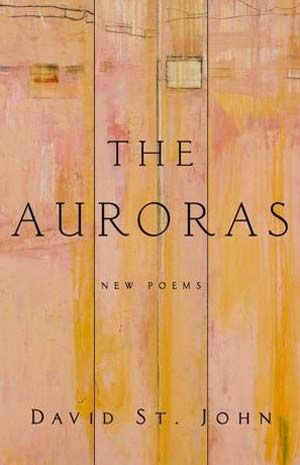
The Auroras by David St. John

The Auroras by David St. John is broken into three distinct sections:  Gypsy Davy, In the High Country, and The Auroras.  In this triptych of poems, “In the High Country” is flanked by the smaller sections “Gypsy Davy” and “The Auroras” but what ties the sections together is not a cohesive story as in Emma Eden Ramos’ Three Women, but a set of emotions ranging from unrest to pain and melancholy.  Both expressions of a poetic triptych are effective, but St. John’s is a little more subtle in its attempts at cohesiveness.

However, within these subtle lines and images, there are real gems, leaving conclusions and epiphanies with the reader, like in “The Aurora of the New Mind” (Page 4):

Still I look a lot like Scott Fitzgerald tonight with my tall
Tumbler of meander & bourbon & mint just clacking my ice
To the noise of the streetcar ratcheting up some surprise

I had been so looking forward to your silence
& what a pity it never arrived

Click for Tour Schedule

But even with these offhand remarks do not end the discourse of the poem; the narrator’s desire for silence is powerful and he has not qualms about uttering it aloud, but is he happy when he receives it or is he unsettled by the granting of that wish? Through subtle images and seemingly forthright comments, the narrator has brought to the surface questions of how when we receive our desires the result may be less adequate than expected. Following that train of thought, “Shopenhauer’s Dog Collar” (Page 14) speaks to the dissatisfying nature of desire fulfilled as Shopenhauer himself did in some of his philosophical works and the disillusionment of that realization in “Three Jade Dice” (Page 8-9):

I wish I could tell you that it's time for coffee
I wish I could tell you that the card table

Carved of onyx & ivory
Supports a life of orgasmic hope & certain prosperity

I wish I could tell you the legs of the piano reach
All the way to the ground as

I wish I could tell you the melody of the forgotten
Is as beautiful as the melody of the desired

“In the High Country” has poems that set the narrator apart from the action of each poem as events and moments — regretful and heartbreaking moments — are witnessed and observed in a helpless state, especially in “From a Bridge” (Page 23), “Waiting” (Page 24), “Human Fields” (Page 32), and “My Friend Says” (Page 34), but in “My Friend Says” the narrator begins to draw comparisons between himself and the subject of the poem or in some cases the “victim” of the events in the poem.

In the final section that mimics the name of the collection, the narrator becomes a mouthpiece of a higher power, speaking to the reader about the glories of the moment and how each is not perishable, but leaves a lasting imprint on the earth even if it is not explicitly seen. But there remains a questioning between the poems, a wondering about what will remain behind once one passes into the next world or simply ceases to exist. There is a reverberation of each person as we pass through the lives of one another, and those “auroras” will live on even after we have passed.

The Auroras by David St. John are at once deceptive in their simplicity and complex in their references to Fitzgerald, Shopenhaur and others, but the arc of the collection is that our beings impact one another and the world around us in even the most unapparent ways. And while we lament the passing of our family, friends, and those who have sought to move on without us to other places and times, their indelible marks remain as do our own.

About the Poet:

Prizewinning poet David St. John is the author of ten collections of poetry, including Study for the World’s Body: New and Selected Poems, which was a finalist for the National Book Award, as well as Where the Angels Come Toward Us, a volume of essays, interviews, and reviews. He is the co-editor, with Cole Swenson, of American Hybrid: A Norton Anthology of New Poetry. He teaches at the University of Southern California and lives in Venice Beach.

***For today’s National Poetry Month Blog Tour stop head over to Diary of an Eccentric.***

Want to win a copy of The Auroras for yourself?  Go enter.

This is the 2nd book for my 2012 Fearless Poetry Exploration Reading Challenge.


This is my 22nd book for the 2012 New Authors Challenge.
The Yellow House by Patricia Falvey & Read-a-Long

The Yellow House by Patricia Falvey, which is her first novel, is an incredible, sweeping novel set in Ireland during the beginning of the nation’s struggle for freedom from Britain, the rise of the IRA, and WWI.  Eileen O’Neill, our heroine, comes from a long line of warriors or so her Da tells her, and she revels in his folklore and his stories about how the O’Neills stole back the yellow house from the Sheridans who had once stole it from them.  The dynamics of the family often mirror the political situation in Ireland as her father is struck down and her mother looses her moorings and drifts.  Eileen’s brother Frank becomes even more angry and distant, mirroring the heightened angst over Ireland’s freedom and the dedication of its people to the Cause.

“Secrets are the cancer of families.  Like tumors, they grow ever larger, and if they are not removed, they suffocate the mind and spirit and spawn madness.  As long as they remain, they cast a shadow on every truth that is uttered, clouding it, constricting it, distorting it.  Secrets hurt the secret keeper as much as the poor souls from whom the secret is kept.  And even once the secret is out, its shadow echoes into the future, the remnants of its memory leaving us vigilant and fearful.”  (Page 241)

A young woman with a dreamer for a father and a mother keeping secrets is bound to get into trouble, and Eileen is no different, especially since she’s such a headstrong and stubborn girl to begin with.  Her family falls apart when times get financially troubling for them and their father, who is a poor farmer, is forced to mortgage their home.  Their mother sets about turning things back and begging for her own family’s forgiveness and pity to save her own family.  As the dominoes begin to fall heavily and quickly around the O’Neill family, some members fall apart, some rise up and hold onto their anger and resentments, and others hold onto their dreams.

“As we strolled along the promenade, I looked down at the gold wedding band on my left hand.  It felt heavy and strange, as if this new identity were crushing me.  I tried to smile.”  (Page 138)

Eileen meets James and is swept away by his passion for a free Ireland and a comeuppance for the Protestants who continue to save all of the jobs for their own kind.  Readers will be swept away by Eileen’s passion and dreams as she struggles against forces beyond her control and even against her husband, whose dreams are no longer her own.  WWI intervenes in the struggle for independence and forces many of the characters to reassess their priorities, including Eileen’s friend, Owen Sheridan, and even Eileen herself as she begins working with the injured soldiers at the hospital.

Reuniting the O’Neill family becomes a driving force in the novel, and Falvey’s prose is at once haunting and steeped in its own lore.  Her characters are flawed, frustrating, and forgivable, but the gem here is the symbolism and the history she weaves into Eileen’s story from the yellow house and the mountain Slieve Mullion to Ireland’s historic struggle for independence.  The Yellow House by Patricia Falvey is excellent.  It will sweep readers off their feet, whisking them off to the Irish countryside, into the workhouse slums, and back again.  Fast-paced, deep, heartbreaking, and romantic — Falvey is a writer to watch light up the shelves with her prose.

Another winner for 2012.

***Here are the final week’s Ireland Reading Challenge read-a-long questions and answers.  These may contain spoilers, so if you don’t want to read them, skip to the giveaway!***

Check out part one, two, and three of the discussions.

Were you as angry as I was when Eileen slept with James while pregnant with Owen’s baby, in order to pass the baby off as his?

I expected it as a “good” Catholic girl in a bind and already plagued by talk of the affair at the mill, etc.  Plus, she’s impetuous and does things without thinking about the consequences until later.

Was Owen’s reaction to that justified, in your opinion?

Yes.

Did you understand why Eileen was so torn about reporting what she knew about James’ plans for the mill?

Yes, but I’m glad she did.  James is her husband, though that matters little, but it does matter that he’s the father of her daughter and no mother wants to have to explain to their child why their da is in jail or dead.

What about her hesitancy to marry Owen?

I agree that she should wait and take some time to sort through those events that hit her boom, boom, boom…from the injury of her brother, seeing Billy killed, and finally reuniting with her sister, plus informing on her husband and nearly shooting James, that’s a lot for a person to process.  I think it showed maturity that she knew she needed more time to think about things and sort it all out, rather than her usual rash decisions that ruled her life.

What did you think of how things ended for the following characters: Frankie, Lizzie, Terrence, Fergus, and, of course, James?

I’m glad that Lizzie and Eileen were reunited and that her return even seemed to perk up their mother.  Terrence must still be living with a lot of guilt, and while I don’t like that Frankie was injured so badly, I think returning him to a happy child is a good ending for him.  He was far to angry, and its tough to come back from that even if you have an epiphany.  Fergus….ah, Fergus…not sure what to say about him.  I like that he was taking matters into his own hands, but I don’t like that he put Eileen in the position she was in.  James got his just desserts.

Were you satisfied with the way things ended for Eileen’s mom?

Yes and no.  Maybe there is hope for her yet.

And, lastly, were you happy with how things ended for Eileen?

Eileen needs to now learn how to be happy and not wallow in self-pity and all of that.  She deserved her happy ending.

About the Author:

Patricia Falvey was born in Newry, County Down, Northern Ireland. She was raised in Northern Ireland and England before immigrating to the U.S. at the age of twenty. She currently divides her time between Dallas, Texas and Northern Ireland.


This is my 2nd book for the 2012 Ireland Reading Challenge.


This is my 9th book for the WWI Reading Challenge.


This is my 21st book for the 2012 New Authors Challenge.
Mr. Darcy Forever by Victoria Connelly

Mr. Darcy Forever by Victoria Connelly is the third book in the author’s Austen Addicts series (to be published in April by Sourcebooks), though each book can be read as a stand alone.  Sarah and Mia Castle could not be more different, and while they compare themselves to Austen’s famous sisterly pair Marianne and Elinor from Sense & Sensibility, they are far more complicated.  Mia is a wanna-be actress/singer who is struggling to find her niche in her career and who readily sticks her foot in her mouth, while Sarah is suffering from obsessive compulsive disorder (OCD) and can barely eat in restaurants without first examining their cleanliness.  These sisters are like best friends and both love Jane Austen and the yearly festival in Bath, but what happens if a man comes between them?

“But it wasn’t his face Sarah was trying to get a good look at, but the cover of his book.  She was always fascinated by what other people were reading and couldn’t help wanting to know what the handsome stranger was reading.”  (Page 58 ARC)

While both sisters are seeking their very own Mr. Darcy, they end up with a Willoughby and broken hearts.  Sarah and Mia spend three years without speaking, a sisterly relationship that seems irrevocably broken, but Jane Austen comes to the rescue when both cannot resist the Regency period and all of the celebration Bath has to offer.  Can Austen repair this damaged relationship and help them find true love and a happy ending?

Connelly peppers her prose with wit and fun, but she also tackles tough issues when Sarah and Mia fall for the same man.  Her characters react in real ways to the hurts they endure and they react with anger and passion when the situations warrant it.  Readers will be swept away by Mia and Sarah’s story as Connelly alternates between the present when they are not speaking and three years prior when the incident that tears them apart happens.  From the side characters Connelly creates to the reappearances of characters from the previous two novels in the series, she weaves an intricate story that Austen lovers will be unable to put down.

Mr. Darcy Forever by Victoria Connelly is about love and forgiveness between sisters who are swept up in Austen’s fairy tale-like world of happy endings, only to find that the happiness they thought they would have was fleeting.  A more serious, modern Austen that explores the bonds between sisters and the power of the love they share to overcome anything.

About the Author:

Victoria Connelly grew up in Norfolk before attending Worcester College where she studied English Literature. After graduating, she worked her way through a number of jobs before becoming a teacher in North Yorkshire.

In 2000, she got married in a medieval castle in the Yorkshire Dales and moved to London. Five weeks after their wedding, her husband, a television news cameraman, was sent to Israel. Convinced something terrible would happen to him, she came up with the idea for a novel about a young widow who starts seeing angels on her desk at work, but was scared to write it in case she tempted fate. It was only years later that her husband admitted to having a bullet graze his shirt sleeve whilst filming in Israel!

The Garden of Evening Mists by Tan Twan Eng

The Garden of Evening Mists by Tan Twan Eng is a highly atmospheric novel that oozes mysterious beauty and is set in Malaysia following the retirement of Judge Teoh Yun Ling, a survivor of a brutal Japanese internment camp during WWII when Japan attacked her homeland in China.  Following her survival she comes to Malaysia where she meets the former Japanese Emperor’s gardener Nakamura Aritomo.

Eng uses shifts in time between the present when Malaysia is its own country to when it was under attack from communist guerrillas.  While the nation is struggling to become independent from British rule Ling meets Aritomo and requests his help to make a Japanese garden to honor her sister.

“There has been a storm in the night, and clouds are still marooned on the peaks.  I step down the veranda onto a narrow strip of ceramic tiles, cold and wet beneath my bare soles.”  (Page 11)

Like the narrow path of tiles, Ling has navigated a small space between sanity and insanity when it comes to dealing with what happened to her in the internment camps.  Although she was a judge for more than 12 years seeking justice, she also sought to provide herself with a bit of solace when she sat on the tribunal for Japanese war criminals seeking out kernels of information about the secret camp in the jungle where she and her sister were held prisoner.

Eng is deft in his selection of images and moments like these as he strives to provide a deeper understanding of Ling’s character and the rawness she still feels even though she survived the camp and was released at age 17.  This rawness is prevalent in her reactions to Aritomo when she first meets him and begins gardening at Yugiri, and even in the book’s present, she is still carrying that wariness of the Japanese when she meets with historian Tatsuji.

A deep intimacy is created in Eng’s prose between Aritomo, Ling, and the reader, and through this connection, readers will garner a deeper sense of connection and how it can ultimately lead to a greater understanding of the self and of forgiveness.  Readers will be transported into the Malaysian countryside in the mountains with Ling, Aritomo, and the others, but the journey through the untamed jungle is what will capture their attentions as the mysteries behind Ling’s survival from the internment camp and Aritomo’s departure from the Japanese empire as the Emperor’s gardener are unraveled like so many vines.

The Garden of Evening Mists by Tan Twan Eng has to be one of the best and most well written novels about WWII in the Pacific Theater and how the war impacted not only Malaysians and the British, but also those loyal to the Emperor Hirohito and the politics of a nation caught between two colonizing nations.  Additionally, it easily demonstrates the different ideologies floating about at the time and the aftermath of a major war on the colonies caught in between.  Eng interweaves the past with the present and the not-so-distant past to illuminate the scars that must be overcome by these characters, but only once they begin to see past their own ethnicity and prejudices.  It is a story of love, forgetting, remembering, and healing.

One of the best books I’ve read this year!

About the Author:

Tan Twan Eng is a Malaysian author born in Penang. His first novel The Gift of Rain was published in 2007 and long-listed for the Man Booker Prize that year; it is set in Penang in the years before and during the Japanese occupation of Malaya in World War II and has received critical acclaim around the world.


This is my 20th book for the 2012 New Authors Challenge.

A Lesson in Secrets by Jacqueline Winspear

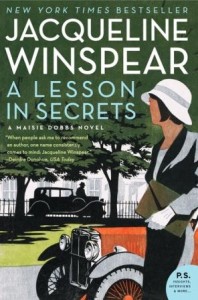
A Lesson in Secrets by Jacqueline Winspear is the eighth book in the Maisie Dobbs series of cozy mysteries, but can be read as a stand-alone novel.  Set between the end of WWI and the beginnings of WWII, Dobbs is called upon by the British Special Branch to be their eyes and ears inside the College of St. Francis about events that would cause concern to the Crown.  Once installed as a junior lecturer of philosophy, a murder occurs that sets events in motion and tangles Dobbs in yet another mystery.

Dobbs runs her own private investigation agency in London, but she’s called away to a college in Cambridge on special assignment, leaving the office in the capable and reliable hands of Billy Beale.  Beyond the murder mystery and the search for anything that threatens national security, Dobbs is concerned about her father and her friend Sandra, who has just lost her husband in a freak accident.

“She wound down the window and gave a hand signal to indicate that she was pulling over to the side of the road, thus allowing an Austin Seven behind to pass, followed by the motor car that had been shadowing her for at least half an hour.  As soon as they passed, she turned back onto the road again and began to drive as close to the vehicle in front as safety would allow.” (page 3)

Winspear crafts an intricate novel of mystery that resonates with the reader as Dobbs is a strong woman making her way in a man’s world just after the war has ended and women are struggling to maintain their new found freedom.  Dobbs is a strong woman, though scarred, who is intelligent and observant.  Interestingly, Winspear demonstrates how idle gossip can provide just the nugget of information investigators need to close in on a killer.  While Dobbs is kept in the dark about the knowledge held by government officials, she manages to uncover their secrets and those of other government officials who view her as an inconsequential lecturer.

Although there are three or more stories going on at once, Maisie is always central and she juggles so many tasks with ease — almost like she is superhuman.  Pacifism, the treatment of conscientious objectors, and whether someone’s heritage plays a role in their loyalties are just some of the issues addressed in this novel.  A Lesson in Secrets by Jacqueline Winspear raises questions of how much should we idolize our mentors — after all they are just human — and whether we should vilify those that do not see the world in quite the same way that we do.  Moreover, she tackles the power of the written word and its impact on political parties, soldiers, and average citizens, plus how words can inflame already volatile situations.

About the Author:

Jacqueline Winspear was born and raised in the county of Kent, England. Following higher education at the University of London’s Institute of Education, Jacqueline worked in academic publishing, in higher education, and in marketing communications in the UK.

She emigrated to the United States in 1990, and while working in business and as a personal / professional coach, Jacqueline embarked upon a life-long dream to be a writer.  Find out more about Jacqueline at her website, www.jacquelinewinspear.com, and find her on Facebook.

This is my 19th book for the 2012 New Authors Challenge.


This is my 8th book for the WWI Reading Challenge.

The Devil’s Scribe by Alma Katsu

The Devil’s Scribe by Alma Katsu is an e-short story released by Simon & Schuster this month, and it’s the first thing I’ve read on my Kindle!  Can you believe it?!  What prompted me to finally read on the Kindle?!  You’ll never guess, well maybe you will by the end of this unconventional review.

“He fell on the bottle before he took a seat, pouring two fingers of whiskey into his wineglass, streaked with the last of a red he’d consumed.  Now that he’d gotten his invitation, his tentative edge fell away, replaced by relief.”  (from the e-story)

Lanore McIlvrae from The Taker (my review) meets with the one and only Edgar Allan Poe by chance in an expensive Baltimore hotel in 1846 after having been gone from America for the last 20 years.  Poe describes himself as an orphan and a widower able to support himself as the “devil’s scribe,” but Lanny seems passingly interested in his life story and the fact that he’s a writer.  However, in spite of her preoccupation with why she came back to America, she walks with this stranger through the streets of Baltimore, careful not to reveal too much of herself to him.

The story raises the idea of telling strangers secrets as a way to unburden the soul without having to deal with the same consequences one would have to deal with should they tell someone they know intimately or should they tell a family member.  It is reminiscent of the relationship between dying soldiers and/or patients and the priest that comes to hear their sins, though in this situation, Poe cannot offer Lanny absolution.

Even in this short story, Katsu is adept at creating tension and suspense as Lanny and her new companion make their way to Boston.  The story is predictable — though because I’ve already read The Taker — but well written.  Readers who know anything about Edgar Allan Poe should realize where the story is headed, but I’ll not give it away.  I really enjoyed learning more about Lanny and her fears, and it will likely play into Katsu’s next book, The Reckoning.

***Reading on the Kindle***

It wasn’t too bad with a short story.  I actually was surprised how I remained focused, but I’m not sure that I can remain focused for a full length novel.  I may try doing that soon, but for now, I’m still a fan of “real” books.