Quantcast

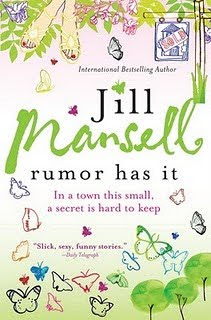
Rumor Has It by Jill Mansell

Jill Mansell‘s Rumor Has It departs somewhat from the romantic comedies she’s written previously in that it tackles tough issues of acceptance, compassion, and tragedy.  Mansell has a writing style that will make readers stand up and pay attention as well as fall of their chairs in laughter.

“Normally she could shave her legs without incident in two minutes flat, but tonight — OK, probably because she’d given herself half a dozen razor cuts and the shower had ended up looking like the one in Psycho.  Then, having stubbed her tow against the chest of drawers in the bedroom, she’d managed to drop the hairdryer on her other foot.”  (page 67 of ARC)

“‘Bloody hell,’ complained Max, just home from a meeting with a client in Bristol.  ‘You’d think I was threatening you with a night in a torture chamber having your ribs cracked without anesthetic.'”  (page 133 of ARC)

Tilly Cole leaves London for Roxborough when her live-in boyfriend abandons their apartment when she’s at work.  She becomes a “Girl Friday” for a suburban family led by an interior designer, Max Dineen.  She’s thrilled to have an out and to be near her friend Erin.

Tilly has sworn off men and is prepared to step into her role as Girl Friday until she meets Jack Lucas, a man with a severe reputation as a philanderer.  He’s to die for, but he should be ignored because all he does is break women’s hearts.  Tilly fights her passion for him on many occasions, but Mansell does not get overly melodramatic with the love triangles she creates.  In fact, she uses humor to illustrate the social ineptitude of her characters.

“But since he wasn’t stupid, he couldn’t really think that.  The chemistry between them was inescapable; there was a crackling electricity in the air that only a turnip could miss.”  (page 219 of ARC)

From down-to-earth Tilly to her loyal friend Erin and conceited Stella, Mansell creates a cast of characters who are fun to watch and be around.  At times, they make stupid decisions, but doesn’t everyone?  Rumor Has It has everything you need in a beach read, a quick read, and a moment of entertainment on a train ride.  Mansell is a fantastic comedic writer, but she also has the skill to deal with more tragic topics such as death and trying to fit in knowing that you are a social outsider.

Thanks to Sourcebooks for sending me a copy of Rumor Has It for review.  If you pick up a copy to read, you’ll probably notice a quote from my blog on the back.
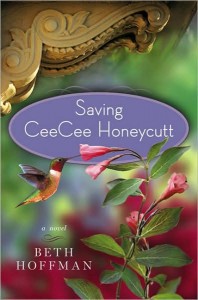
Saving CeeCee Honeycutt by Beth Hoffman

Beth Hoffman‘s debut novel, Saving CeeCee Honeycutt, has become a New York Times bestseller, and what a debut it is.  Her novel is a prime example of what’s great about southern fiction from the enveloping summer heat of Georgia to the fragrant aroma of orchids and other flowers.  CeeCee Honeycutt is a young girl living in Ohio mainly with her mother as her father travels weekly for his job, but she’s got more worries than just school and peer pressure — her mother is slowly losing her grip.

“‘Oysters are a lot like women.  It’s how we survive the hurts in life that brings us strength and gives us our beauty.’  She fell silent for a moment and gazed out the window.  ‘They say there’s no such thing as a perfect pearl — that nothing from nature can ever be truly perfect.'”  (page 255)

Eventually, CeeCee comes to live with her great aunt Tallulah “Tootie” Caldwell, who is a busy society woman interested in preserving the historical structures in Savannah.  In many ways the restoration of these homes resembles the rebuilding CeeCee must accomplish after her life is irrevocably altered.  At the young age of 12, CeeCee must contend with tragedy, being an outcast, the confusing emotions about her parents, and fitting in with a society that is foreign to her.

“Momma left her red satin shoes in the middle of the road.  That’s what three eyewitnesses told the police.”  (Page 1)

Hoffman creates dynamic characters in CeeCee, Mrs. Odell, Oletta, and Tootie, but she also has crafted a supporting cast of eccentric older women who are neighbors and have their own problems and tensions with one another.  Picture large hats, garden parties, and soirees, and you’ll be transported in CeeCee’s Georgia, away from her hometown in Ohio.

“The bedsheets were damp with humidity and sleep, and from the pillowcase I detected a familiar scent:  it was just like the lavender sachets Mrs. Odell made every year as Christmas gifts.  I rubbed my eyes and tried to sit up, but I was nestled deep in the feather bed, like a baby bird in a nest.”  (page 57)

“Though she’d long since passed the zenith of youth, unmistakable remnants of a mysterious beauty oozed from the pores of her porcelain-white skin.  Swirling around her ankles, as light as smoke and the color of midnight, was a silk caftan splashed with bits of silver glitter.”  (page 81)

Readers will be absorbed in CeeCee’s evolution from young, responsible woman caring for her mother to a mischievous child lashing out and back to a young lady becoming content in her own skin.  Hoffman does an excellent job of painting Georgia and its traditional society in a nostalgic hue that enables readers to grasp that CeeCee is remembering this period of her life fondly and with greater clarity than she probably did as a child.  Saving CeeCee Honeycutt is captivating debut novel and coming-of-age story about a young lady who has lost her way, only to find a new chapter has begun.

About the Author:

Beth Hoffman was the president and owner of a major interior design studio in Cincinnati, Ohio, before turning to writing full time. She lives with her husband and two cats in a quaint historic district in Newport, Kentucky. Saving CeeCee Honeycutt is her first novel.

Thanks to Penguin and Inkwell Management for sending me a free copy of Saving CeeCee Honeycutt for review.

Check out the other tour stops:

5/17 & 5/18 – Devourer of Books

5/19 & 5/20 – Diary of an Eccentric

5/21 – Savvy Verse & Wit

5/22 – Medieval Bookworm

5/23 – lit*chick

5/24 – A Novel Menagerie

5/25 – The Tome Traveller’s Weblog

5/26 – Peeking Between the Pages

5/27 – Steph Su Reads

5/28 – Galleysmith

5/29 – The Literate Housewife Review

Giveaway details — three copies for US/Canada readers and one copy for an international reader:

1.  Leave a comment about why you want to read this book; don’t forget to let me know if you are living outside the United States or Canada.

2.  Leave a comment on the guest post.

3.  Blog, Tweet, Facebook, or otherwise spread the word about the giveaway and leave a comment on this post.

4.  Become a Facebook fan of the blog and leave a comment.

Deadline is June 2, 2010, at 11:59 PM EST.

This is my 33rd book for the 2010 New Authors Challenge.

On Folly Beach by Karen White

Karen White‘s On Folly Beach shifts between two time periods — 2009 and 1942 — and between two women’s lives — Emmy Hamilton and Lulu.  Emmy lost her husband six months ago to the war in Afghanistan and loves solving mysteries with old documents and books, and Lulu is a complicated older woman with a lot of secrets and a penchant for bottle tree artistry.

“The shirt was a poor substitute for his arms, and wearing it in Ben’s absence was something her mother had told her was like swimming with a raincoat.”  (page 2)

Emmy is empty in her grief and unwilling to move on, but her mother convinces her to move from Indiana to South Carolina and buy a bookstore, Folly’s Finds, which served as the model for her mother’s bookstore.  Once in her newly rented house, she meets Lulu, her grandson Heath, Heath’s mother Abigail, and the rest of the family.  But her journey begins with a box of old books, and she strives to unravel the mystery of two star-crossed lovers.  Emmy has a journey back to the living to embark upon as well.

“‘Like right now? Don’t you need a bathing suit?’

He smiled and the wrinkles at the corners of his eyes reminded Emmy of his mother.  ‘Don’t need one.’  He walked past her, then stopped when he realized she wasn’t following him.

‘I’ll wait here.’

“I’ll keep my shorts on, promise.'”  (page 129)

White’s characters have their own personalities and evolve carefully over the alternating chapters.  The WWII chapters transport readers back in time, making the fear of war as vivid as the dances on the ocean pier.  But with the prevalence of chapters in the present, it is clear that this is Emmy and Lulu’s story. Emmy becomes the amateur detective that Lulu played when she was a young girl living with her sister, Maggie and cousin Cat.

On Folly Beach by Karen White uses a variety of water and wind imagery to mimic the foolish choices made by the main characters and mirror the dramatic choices that they make out of loyalty and love.  White creates dynamic characters who are deeply flawed and who are in search of peace and love, like many of us.  Bibliophiles will enjoy the literary references, the characters named for Elizabeth Bennet and Heathcliff of Wuthering Heights, and the quotes in the margins.  Another Karen White novel that engages, mystifies, and satisfies readers as they unwind the puzzles of On Folly Beach.

Please check out the rest of the stops on the tour. And check back tomorrow for a guest post on Karen White’s writing space.

About the Author:

Karen’s novel The Memory of Water was a WXIA-TV Atlanta & Company Book Club Selection. Her work has been reviewed in Southern Living, Atlanta Magazine, the Atlanta  Journal-Constitution, and by Fresh Fiction, among many others, and has been adopted by numerous independent booksellers for book club recommendations. Last year her 2007 novel Learning to Breathe received several honors, notably the National Readers’ Choice Award and the Booksellers’ Best Award, which in 2009 was again presented to Karen, this time for The Memory of Water.

US/Canada Giveaway for 2 copies of On Folly Beach by Karen White:

1.  Leave a comment about what historical period fascinates you and why.

2.  Blog, Tweet, Facebook, or otherwise spread the word about the giveaway and leave me a link.

Deadline May 20, 2010, at 11:59PM EST.

College in a Nutskull by Professor Anders Henriksson

Professor Anders Henriksson has compiled a list of mistakes made by students in higher education in College in a Nutskull.  The spiral bound notebook with lined pages with doodles in the margin is filled with mistakes, misinformation, wrong facts, and spelling errors.  These answers are taken from essay tests all over the world, which were sent to Henriksson.

“Cast aside all worry and savor this text as an opportunity to visit a world remarkably different from the reality we think we inhabit.” (page viii)

The blunders, malapropisms, spoonerisms, and poor facts are arranged by subject, ranging from religious studies to all kinds of history and science and technology.  Many of these examples could be attributed to test-taking jitters as students rush to finish their timed essays, but it makes them no less amusing.  However, some of these lines read more like a “smart ass” spouting off “witty” comments, such as “Descartes began this by stating, ‘I think, therefore I’m Sam.'” (page 11) and “Some of these ideas are unfortunately too long for my attention spam.” (page 69)

Here are a couple malapropisms and spoonerisms:

“A vassal was a kind of servant, only rounder.” (page 63)

“Slavery was the big issue in the Anti-Bedlam South.” (page 76)

Beyond the unintentional word usage, there are just some major factual errors, from “The executive branch exists because Congress allows it to exist” to “Laws are invented by the courts.” (page 90-1)  What is likely to trouble readers, including me, is that the mistakes made are a sad commentary on the state of public education and its ability to prepare students for college.  Terrible grammar, improper word usage, Freudian slips, and other factual mistakes merely demonstrate how ill-prepared students are for college or a career, especially since they cannot communicate clearly.

Overall, College in a Nutskull by Professor Anders Henriksson is a humorous compilation of mistakes by college students that may make an unintentional commentary on public education and student preparedness.  For those who find student errors amusing or for those that enjoy malapropisms, this collection will have you chuckling, shaking your head, and spitting out your coffee.

Check out this article on Henriksson.

FTC Disclosure:  Thanks to Workman Publishing for sending me a free review copy of College in a Nutskull for review.

About the Author:

Photo credit: Kevin G. Gilbert

Dr. Henriksson is a professor at Shepherd University is located in historic Shepherdstown, West Virginia, and the author of Vassals and Citizens: The Baltic Germans in Constitutional Russia, 1905-1914, and The Tsar’s Loyal Germans. The Riga German Community: Social Change and the Nationality Question, 1855-1905. He is co-author of The City in Late Imperial Russia and has published articles in Russian Review, Canadian Slavonic Papers, the Wilson Quarterly, the Journal of Baltic Studies, and the Modern Encyclopedia of Russian, Soviet, and Eurasian History. His research interests focus on the role of class, ethnicity, and gender in the development of civil society in Russia and Eastern Europe. He is currently at work translating and editing the memoir of a Russian nurse in the Russo-Japanese War. Also a chronicler of the humorous side of campus life, Dr. Henriksson is compiler of Non Campus Mentis: World History According to College Students. A second humor book, College in a Nutskull, is due to appear in 2010.

This is my 32nd book for the 2010 New Authors Challenge.

Fool by Christopher Moore (audio)

Christopher Moore‘s Fool is loosely based upon William Shakespeare’s King Lear.  If you haven’t read King Lear, what are you waiting for?  Talk about a tragedy of one’s own making.  The source material centers on a king who splits up his kingdom between his daughters based upon their professions of love for him, but of course, one daughter deigns to tell the truth rather than gush and engage in hyperbole.

“‘I’ve never even seen them,’ Taster said.

‘Oh, quite right.  What about you, Drool? Drool? Stop that!’

Drool pulled the damp kitten out of his mouth.  ‘But it were licking me first.  You said it was only proper manners–‘” (page 40)

In Moore’s version, King Lear’s fool of many years — an appropriately named Black Fool — Pocket plays a significant role in the downfall of a king and a kingdom.  Pocket has a hidden past of his own that involves an abbey, an ankress, witches, and more.  He’s sarcastic, runs rampant with his verbal barbs at the royal family, but he’s got a darker streak that trends toward manipulation behind the jokes.  Pocket is great at planting the seeds in the players’ minds from the Bastard Edmund to Lear’s daughters Regan and Goneril.  In a way, Pocket is a comic relief fool, but he does have a sidekick who is — Drool.

“‘I shagged a ghost,’ said Drool to the young squires.  They pretended they couldn’t hear him.

Kent shuffled forward, held back some by the alabaster grandeur of my nakedness.  ‘Edmund was found with a dagger through his ear, pinned to a high-backed chair.’

‘Bloody careless eater he is, then.'”  (page 168)

Some of the best parts of the book are the jibes at the main royals, but also the references to other works by Shakespeare.  Moore definitely knows his literature, and is a master at rearranging syntax to create new images and environments within the Shakespearean middle ages  He stretches the edges of that world and tosses it out into the moat.  Readers who need a laugh out loud book to chase away the blues, are looking for clever prose and outlandish characters, and seeking a literary jaunt should pick up Fool.

“‘So, it sounds as if you’re thinking of conquering more than just the petting zoo?’

‘Europe,’ said the princess, as if stating the unadorned truth.

‘Europe?’ said I.

‘To start,’ said Cordelia.

‘Well, then you had better get moving, hadn’t you?’

‘Yes, I suppose,’ said Cordelia, with a great silly grin.  ‘Dear Pocket, would you help me pick an outfit?'” (page 255)

However, the ending of the novel could leave readers feeling flat or unsatisfied.  Overall, Fool by Christopher Moore is a “bawdy tale.” Moore has a number of fun books, and readers who enjoy humor, particularly dark or raunchy humor with a bit of whimsy, will love his books.  Moore is always a riot.

My husband enjoyed the audio version on our daily commute, laughing and giggling into work, but was seriously disappointed with the ending.  In his words, “The sexual jokes were funny and the ending sucked.”

Check out this great video:

FTC Disclosure:  I listened to the Fool by Christopher Moore on audio CD, which I borrowed from the library, and read portions of the book from another library copy.

Bite Me: A Love Story by Christopher Moore

Christopher Moore‘s Bite Me: A Love Story continues to the trials of the Countess Jody, Lord Flood, and their minion Abby Normal.  It is the third book in the series set in San Francisco and focuses mainly on Goth teenager Abby Normal, her boy-toy and ultra-nerd Foo Dog (aka Steve), and her gay BFF Jared as they battle a city of vampyre cats . . . and rats.  The Emperor of San Francisco and Detectives Cavuto and Rivera return along with the Animals, Flood’s former colleagues of the Safeway stocking crew.

“I am Nosferatu, bee-yotch.”  (page 176)

“It just goes to show you, like Lord Byron says in the poem:  ‘Given enough weed and explosives, even a creature of most sophisticated and ancient dark power can be undone by a few stoners.’

I’m paraphrasing.  It may have been Shelley.”  (page 6-7)

Moore’s writing is crass and humorous and will have readers laughing out loud about how thick Abby is and yet so smart about the magical.  He has a way with language and creating and adopting slang for his characters, like booticuity, ownage, Mombot, va-jay-jay, and Skankenstein boots.   The vampyres are equally good and bad in this novel, but Abby and her friends are all that stand between San Francisco and total annihilation.  From katanas to LED sunlight jackets and UV lamps to flame throwers and Grandma’s special tea, these kids have tricked out rides and kung-fu skills like no one else.

“The outside city people live on, like, a different plane of existence, like they don’t even see the inside people either.  But when you’re a vampyre, the two cities are all lit up.  You can hear the people talking and eating and watching TV in their houses, and you can see and feel the people in the streets, behind the garbage cans, under the stairs.  All these auras show, sometimes right through walls.  Like life, glowing.” (page 226)

Even more enjoyable is how Moore intertwines other story lines from his previous books, particularly Dirty Job.  It is fun for readers to see how characters from other novels pop in and add spice to the vampyre mayhem.  Moore is a very talented writer with a gift for making readers laugh.  Those who love vampire novels should read the entire series — Bloodsucking Fiends and You SuckBite Me is another laugh-out-loud novel from Moore for those of us who need to step into another world, destress, and laugh intelligently.

This is my 1st book for the 2010 Vampire Series Challenge.

***

Don’t forget to vote for your favorite National Poetry Month Blog Tour post.

FTC Disclosure:  I got my copy of the book from the local library!

Let the Great World Spin by Colum McCann

What do you do when your world spins out of control and changes so drastically that you begin to feel adrift?  Colum McCann‘s Let the Great World Spin examines these issues, while at the same time demonstrating how individuals can be connected to one another without even realizing it.

“But it struck me, as I sketched, that all I wanted to do was to walk out into a clean elsewhere.” (page 153)

“No newspapers big enough to paste him back together in Saigon.” (page 81)

McCann focuses his story in 1974, mostly in New York City, where a tenuous thread is stretched between a series of characters from an Irish monk and a grieving mother who lost her son in the Vietnam War to a young artistic couple and a black prostitute. That thread is the a tightrope walker, Philippe Petit who traversed the still under construction World Trade Center towers.

“It was the dilemma of the watchers:  they didn’t want to wait around for nothing at all, some idiot standing on the precipice of the towers, but they didn’t want to miss the moment either, if he slipped, or got arrested, or dove, arms stretched.” (page 3)

In a way, the tightrope walker is all of us, teetering on the edge of every decision we make, but what we often do not have is the courage to enjoy the moment or revel in the thrill of each step we take in our lives.  McCann is a gifted storyteller, but some readers may find the shifts between story lines hamper their ability to become emotionally tethered to the characters.  There are some moments where the prose takes on a list making quality, which is a bit overdone and jambs up the narrative.

The Vietnam War plays a significant role in the novel, touching lives in immediate ways and peripherally.   In many ways the tightrope walker symbolizes the perceived precariousness of the world at large in the 1970s, with the threat of communism and the deteriorating situation in Vietnam.  Overall, Let the Great World Spin by Colum McCann is a satisfying examination of the 1970s, the Vietnam War, and modern society, and would be a good selection for book club discussions.

About the Author:

Colum McCann, a Dublin born writer, is the internationally bestselling author of the novels Let the Great World Spin, Zoli, Dancer, This Side of Brightness, and Songdogs, as well as two critically acclaimed story collections. His fiction has been published in thirty languages. He has been a finalist for the International IMPAC Dublin Literary Award and was the inaugural winner of the Ireland Fund of Monaco Literary Award in Memory of Princess Grace. He has been named one of Esquire’s “Best and Brightest,” and his short film Everything in This Country Must was nominated for an Oscar in 2005. A contributor to The New Yorker, The New York Times Magazine, The Atlantic Monthly, and The Paris Review, he teaches in the Hunter College MFA Creative Writing Program. He lives in New York City with his wife and their three children.

Check out the other tour stops.  Thanks to TLC Book Tours and Random House for sending me a free copy of Let the Great World Spin by Colum McCann for review.


This is my 5th book for the 2010 Vietnam War Reading Challenge

This is my 31st book for the 2010 New Authors Challenge.

This is my 2nd and final book for the 2010 Ireland Reading Challenge.

Letter to My Daughter by George Bishop Jr.

George Bishop Jr.’s Letter to My Daughter is narrated by a Louisiana mother whose daughter has just run away from home after a typical fight with her parents.  To cope with the anxiety, the mother writes a demonstrative history of her own teenage angst to provide them some common ground from which to begin anew.

“But believe it or not, I was your age once, and I had the same ugly fights with my parents.  And I promised myself that if I ever had a daughter, I would be a better parent to her than mine were to me.  My daughter, I told myself, would never have to endure the same inept upbringing that I did.”  (Page 4 of ARC)

Laura Jenkins takes her daughter back in time to when she is a young high school girl during the 1970s and the Vietnam War.  She falls in love with a young man, Tim Prejean, but he’s the wrong kind of man in her parent’s eyes.  How can she make them see that he’s exactly the man they should want her to be with and love.  But it all hits the fan one night and she’s sent away to Catholic school even though her family is Baptist.  Charity runs deep at Sacred Heart Academy, but Laura’s love still burns for her sweetheart, Tim.

Bishop’s prose is conversational as Laura continues to write her letter to Elizabeth, whom she named after the poet Elizabeth Barrett Browning.  Browning’s Sonnets from the Portuguese #43 says, “I shall but love thee better after death,” and her poems would complement this novel well.  There is a great sadness and love in this letter.  Laura wants to make amends to her daughter and to generate the closeness she always dreamed would be between them.

“Up until that day I had known her only as a pale older nun who seemed unnaturally preoccupied with grammar; she smelled musty, like a library, and she rustled when she walked, like her very insides were made of parchment.”  (page 35 of ARC)

“And then there was silence:  black silence, that in the moments as I gripped the phone seemed to grow deeper and deeper until it was black as the dark spaces between the stars.” (page 59 of ARC)

Bishop’s prose is poetic and easily absorbing, transporting readers to a tumultuous time in U.S. history when the country was divided about war.  But as young men and women engaged one another in high school, how would these larger issues have impacted them?  Letter to My Daughter answers these questions in a way that will tear into the hearts of readers, generate a profound sympathy and confusion about what motivates humans to make war, and how teens handle not only the typical struggles they face of which boy to date and which dress to wear, but also the larger issues that permeate their lives.

About the Author:

George Bishop, Jr. graduated with degrees in English Literature and Communications from Loyola University in New Orleans before moving to Los Angeles to become an actor. He later traveled overseas as an English teacher to Czechoslovakia, Turkey and Indonesia before returning to the States to earn his MFA in Creative Writing at the University of North Carolina in Wilmington, where he studied under Clyde Edgerton, Wendy Brenner, and Rebecca Lee.

Giveaway; I have one copy of the book for U.S./Canada only:

1.  Leave a comment about whether you think a male can do justice to the mother-daughter relationship.

2.  Blog, Tweet, Facebook, etc. the giveaway and leave me a link.

Deadline is May 11, 2010, 11:59 PM EST.

Check the other stops on the tour.


This is my 4th book for the 2010 Vietnam War Reading Challenge.

This is my 30th book for the 2010 New Authors Challenge.

Song of Napalm by Bruce Weigl

Bruce Weigl’s Song of Napalm is another collection of poems dealing with the impact of the Vietnam War.  Robert Stone says in the introduction, “Bruce Weigl’s poetry is a refusal to forget.  It is an angry assertion of the youth and life that was spent in Vietnam with such vast prodigality, as though youth and life were infinite.  Through his honesty and toughmindedness, he undertakes the traditional duty of the poet:  in the face of randomness and terror to subject things themselves to the power of art and thus bring them within the compass of moral comprehension.”

Weigl takes readers on a journey to Vietnam in the late 1960s and explores the anxiety he feels as a soldier in a strange nation.  Each poem’s narrator carefully observes his surroundings, detailing the corner laundry, the hotel, the jungle, and his fellow soldiers.

“Who would’ve thought the world stops
turning in the war, the tropical heat like hate
and your platoon moves out without you,
your wet clothes piled
at the feet of the girl at the laundry,
beautiful with her facts.”  (from “Girl at the Chu Lai Laundry,” page 4)

Song of Napalm chronicles the narrator’s transformation from boy to soldier to terrified man in the jungle and recovering killer.  In a way some of these poems contain a dark sense of humor about the war, which probably kept the narrator sane.

Temple Near Quang Tri, Not on the Map (page 7-8)

Dusk, the ivy thick with sparrows
squawking for more room
is all we hear; we see
birds move on the walls of the temple
shaping their calligraphy of wings.
Ivy is thick in the grottoes,
on the moon-watching platform
and ivy keeps the door from fully closing.

The point man leads us and we are
inside, lifting
the white washbowl, the smaller bowl
for rice, the stone lanterns
and carved stone heads that open
above the carved faces for incense.
But even the bamboo sleeping mat
rolled in the corner,
even the place of prayer, is clean.
And a small man

sits legs askew in the shadow
the farthest wall casts
halfway across the room.
He is bent over, his head
rests on the floor and he is speaking something
as though to us and not to us.
The CO wants to ignore him;
he locks and loads and fires a clip into the walls
which are not packed with rice this time
and tells us to move out.

But one of us moves towards the man,
curious about what he is saying.
We bend him to sit straight
and when he’s nearly peaked
at the top of his slow uncurling
his face becomes visible, his eyes
roll down to the charge
wired between his teeth and the floor.
The sparrows
burst off the walls into the jungle.

Weigl’s dark humor permeates these pages, but it is more than the humor that will engage readers.  It is his frank lines and how the narrator tells readers the truth about the situation.  From “Elegy,” Weigl says, “The words would not let themselves be spoken./ Some of them died./ Some of them were not allowed to.”  There are just unspeakable atrocities that happen in war, and soldiers who return home may not actually return home resembling who they were before they left.  Song of Napalm is a frank discussion about becoming a man in a time of war, dealing with the horrors of killing and worrying about being killed, and returning home to a world you don’t recognize and trying to reinsert yourself into the society that sent you to war in the first place.

This is my 3rd book for the 2010 Vietnam War Reading Challenge.

This is my 17th book for the contemporary poetry challenge.

This is my 5th book for the Clover Bee & Reverie Poetry Challenge.

***

Please also remember to check out the next stops on the National Poetry Month Blog Tour at Online Publicist and Boston Bibliophile.

TODAY is Poem in Your Pocket Day! What poem will you be reading?

Full Moon Boat by Fred Marchant

Fred Marchant’s Full Moon Boat, published by Graywolf Press, is a poetry collection from my shelves that has been dipped into on many occasions.  The collection not only contains original poems by Marchant, a Suffolk University professor, but also translations of Vietnamese poets.  Many of these poems not only examine deep emotional turmoil through nature, but also the theme of war, particularly the Vietnam War.

“In 1970, Georgette, Harry’s war bride,
wrote to me on Okinawa, pleading that
I not leave the service as a conscientious
objector.  She said Jesus could not approve,”  (From “The Return,” page 3)

“From the steps of the pagoda where Thich Quang Duc
left to burn himself in Sai Gon, I took a photograph

which centered on a dragon boat
drifting on the Perfume River, framed by a full-leafed
banana tree.  An image of mourning.
Another photograph:  this one in front of the Marine insignia,

my right hand raised, joining.  I am flanked
by my parents, their eyes odd and empty too.
It was 1968, and none of us knew what we were doing. (from “Thirty Obligatory Bows,” page 28)

Unlike other poetry collections with a focus on the Vietnam War, Marchant’s collection zeroes in on the deep emotional states of families sending their sons overseas to war, ranging from pride to shame and even confusion.  In many ways the lines of these poems are deceiving in their simplicity, releasing their power only after the reader has read the lines aloud or for the second time.  In “A Reading During Time of War,” readers may miss the turning point in the poem on the first read through, but sense that something has changed in the last lines, prompting another read and the realization that the realities of war will always rear their ugly heads.

A Reading During Time of War (page 54)

It is the moment just before,
with no intent to punish,

a wish for all to be air
and scrubbed by rain,

filled with eagerness to learn
and be if not a child

then openhearted, at ease,
never to have heard

of the bending river
that stretches to the delta

where a bloated corpse
bumps softly,

snags on a tree stump
and, waterlogged,

rolls slowly, just below.

Additionally, these poems touch upon the beauty and emotional anchor deep within the chests of the Vietnamese.  In “Letter,” by Tran Dang Khoa and translated by Marchant with Nguyen Ba Chung, readers will find that Vietnamese families and soldiers had the same trepidations as American soldiers and their families.

“Mother, I may well fall in this war,
fall in the line of duty–as will so many others–
just like straw for the village thatch.
And one morning you may–as many others–
hold in your hand apiece of paper,
a flimsy little sheaf of paper
heavier than a thousand-pound bomb,
one that will destroy the years you have left.”   (from “Letter,” page 36)

Overall, Full Moon Boat by Fred Marchant examines the nuances of the human condition during times of crisis, including The Vietnam War, and heartbreaking decisions that soldiers and families make when conflicts begin or continue to rage even in strange lands.  Through translations of Vietnamese poems, Marchant explores the similarities between each side of the conflict in how they react and deal with war.  Other poems in the collection examine the dynamics of families through natural imagery.  Both beginning readers of poetry and those who have read other poetry collections will find Marchant’s comments on the human condition and how that condition is altered by war poignant and true.

About the Poet:

Fred Marchant is the author of Tipping Point, which won the Washington Prize in poetry. He is a professor of English and the director of creative writing at Suffolk University in Boston, and he is a teaching affiliate of the William Joiner Center for the Study of War and Social Consequences at the University of Massachusetts, Boston.

This is my 2nd book for the 2010 Vietnam War Reading Challenge.

This is my 16th book for the contemporary poetry challenge.

This is my 4th book for the Clover Bee & Reverie Poetry Challenge.

***

Please also remember to check out the next stops on the National Poetry Month Blog Tour at Ooh Books and Estrella Azul.


I, Alex Cross by James Patterson (Joint Review With Mom)

James Patterson’s I, Alex Cross is the latest book in the Alex Cross series, and it will shock readers.  Cross must face a death in the family, a health crisis with another family member, and a horrific series of murders that involve call girls, an exclusive gentleman’s club, and a wood chipper.

“I brought home the files I’d gathered and took them to my office in the attic after dinner.  I cleared off one entire wall and started tacking up everything — pictures of the missing, index cards with case vitals that I’d written up, plus  a DC street map, flagged everywhere that victims had last been seen.”  (Page 48)

Each book in the Alex Cross series can be read alone, though readers will miss the evolution of his character if they don’t read them in order.  Patterson is skilled at building tension and suspense in these novels through short chapters, changing points of view, and clipped sentences.  Readers will be running alongside Cross as he uncovers the true identity of the killer, known only as Zeus.

“This was the kind of homicide that used to make me wonder why I keep coming back for more, year after year.  I knew that on some level I was addicted to the chase, but I used to think that if I figured out why, then I’d stop needing it so much, maybe even turn in my badge.  That hadn’t happened.  Just the opposite.”  (Page 48-9)

Cross is a deeper character than most main characters in crime novels, with his psychology degrees, his intense organization during cases, his family, the loss of his wife, and the face offs he has with a variety of criminal masterminds.  Patterson has kept this character fresh even after 16 books, and he still has room to grow.  I, Alex Cross is a welcome addition to the series.

I’m going to turn over the reins to my mom, Pat, for her review of I, Alex Cross.

One of the best books written by James Patterson.  All of his books are exciting and suspenseful and make fast reads.  In I, Alex Cross, Detective Alex Cross is at his birthday party when he gets the phone call about a brutal murder.  He finds out that his niece Carolyn isn’t who she pretends to be and has a life that nobody knows about.  Cross is called in to work on the case.  A five-star read!

Thanks to Hachette Group for sending myself and my mom a free review copy of I, Alex Cross for review.

Don’t forget about the Alex Cross giveaway going on now through April 24th at 11:59PM EST.

***

Please stop by the next stops on the National Poetry Month Blog Tour at Everything Distils Into Reading and In Bed With Books.


This is my 8th book for the 2010 Thriller & Suspense Reading Challenge.

SOS! The Six O’Clock Scramble to the Rescue by Aviva Goldfarb (Earth Day Celebration)

Happy Earth Day, everyone!  I try my best to celebrate Earth Day and its 40th anniversary.  What better way to take action in our homes to save the environment and become healthier than by heeding the advice in Aviva Goldfarb‘s SOS! The Six O’Clock Scramble to the Rescue.

Before we get the actual cookbook, I wanted to let you know that each copy purchased includes a one-month subscription to the Scramble and a portion of the proceeds will be donated to the Environmental Working Group, which works to use public information’s power to help consumers improve their health and save the environment by offering resources to make better decisions and to affect policy change.

Goldfarb’s cookbook expands upon her popular Web site with its seasonal weekly meal planner subscription for busy families.  The introduction discusses how the organization of the Scramble and its weekly meal planning enables families to reduce their carbon footprint by:

  • limiting trips to the grocery store to once per week
  • reducing the use of takeout containers
  • limiting food waste
  • using highly sustainable fish
  • and reducing the heavy use of meat in our diets.

Following the introduction, Goldfarb outlines the items you need in your pantry at all times, with indicators next to those that you should consider buying in bulk (among others):

  • nonstick cooking spray
  • minced garlic
  • olive oil
  • reduced sodium soy sauce

Once the staples are purchased and available to you, you should check out the break down of fruits and vegetables by season so that you shop for those items when they are in season.  Shopping for veggies and fruits in season reduces your carbon footprint, according to Goldfarb, because it reduces the need to truck those foods across the country or from another nation where they are in season.

The rest of the cookbook is broken down by season and includes a weekly plan of menus for families to try out and advice for keeping the menu plan on schedule, using canvas bags or reusing plastic and paper bags, creating healthy and tasty lunches for school, picking healthy snacks, and more.  However, the book does not include photos of the recipes, which novice cooks might want to check out to see how well they are doing with their own attempts at the recipes.

For busy, book blogger and other moms, SOS! The Six O’Clock Scramble to the Rescue is an excellent edition to your cookbooks.  Goldfarb’s book is more than a cookbook, it is full of advice on how to make healthy choices for families, how to reduce carbon footprints, shop locally, and more.

About the Author:

Aviva Goldfarb (Photo credit: Rachael Spiegel) is author and founder of The Six O’Clock Scramble®, a seasonal online weekly menu planner and cookbook (St. Martin’s Press, 2006) who lives in Chevy Chase, Md.  She has just released a new cookbook, SOS! The Six O’Clock Scramble to the Rescue: Earth-Friendly, Kid-Pleasing Dinners for Busy Families.  Aviva is regularly quoted in popular online and print Family and Health publications. She is an advocate for healthy families, actively working with national nonprofit organizations and with parents to improve nutrition.

Thanks to Diane Saarinen and St. Martin’s Press for sending me a free copy of SOS! The Six O’Clock Scramble to the Rescue by Aviva Goldfarb for review.

The giveaway details:  (I’m buying 1 copy and giveaway is open internationally)

1.  Leave a comment about what you are doing to celebrate Earth Day.

2.  Leave a second comment with a tip about how you live greenly.

3.  Blog, Tweet, Facebook, Stumble, spread the word about the giveaway and leave me a link.

Deadline April 29, 2010, at 11:59 PM EST

This is my 29th book for the 2010 New Authors Challenge.

I hope you enjoyed this latest Literary Road Trip with Chevy Chase, Md., author Aviva Goldfarb.

***

Also check out today’s stop on the National Poetry Month Blog Tour at Necromancy Never Pays!