Quantcast

Interview With Poet Ann Fisher-Wirth

From Carta Marina

December 16

Red taillights lead me uphill, downhill—
I watch them from the bus’s steamy window,
pressing my cheek against cold glass
as I’m carried from the airport past fields and factories,
past Märsta in the midnight
where the old men still hunt elk-moose
till bloody haunches fill their freezers.
It’s not this man or this man, not
these golden daughters or this dream-ravened swaddle:
no, it’s the doors closed or the doors opened,
it’s the heart gone night. The gods
stream back and forth across the threshold.
You can ride it, you know,
get on the dark bus and let it carry you.
That’s how I’ve always been, going home, going nowhere—
uphill, downhill, the taillights like rubies,
past fields where the trees are just darker effacings.

Ann Fisher-Wirth agreed to an interview with myself and 32 Poems. And here is what she had to say.

How would you introduce yourself to a crowded room eager to hang on your every word? Are you just a poet, what else should people know about you?

I’d never say anyone was “just” a poet, because a poet is a pretty amazing thing to be. But writing poetry is not the only thing I do. I teach American literature, poetry workshops and literature courses, and a wide range of courses in environmental studies at the University of Mississippi.

I also teach yoga, and that is a really important part of my life. I’ve been married for nearly 26 years to Peter Wirth. We have five grown children—mine, his, and ours—and rapidly expanding numbers of grandchildren. We live in a very cool old Victorian house with two huge pecan trees in front of it, in Oxford, Mississippi.

I’ve lived in the South for almost 30 years, but I grew up first as an Army brat all over the world, and then in Berkeley, California, so I love to travel and hold many places in my heart.

Do you have any obsessions that you would like to share?

Environmental issues and consciousness-raising are my obsession. Truly they are. I am convinced from everything I’ve read that we have very little time left before we reach a catastrophic tipping point for life on earth. We may already be there.

One helpful book is Lester R. Brown’s Plan B 3.0: Mobilizing to Save Civilization, which can be downloaded free from the Earth Policy website, and which fully documents how desperate a situation we humans have created environmentally, and how thorough-going and rapid our response must be—far beyond anything now being considered by those in power.

In terms of friendships, have your friendships changed since you began focusing on writing? Are there more writers among your friends or have your relationships remained the same?

It’s true, most of my friends are writers, and if they are not writers they are professors. I have gotten to know hundreds of writers since I began focusing on writing, and some of them have become wonderful friends.

I’m also very close to a number of people I know through the Association for the Study of Literature and Environment—again, writers and academics. But how could I escape it? My mother was a teacher, my sisters, brother-in-law, husband, and two of our five children are all teachers. It’s a great way to live.

If you’ve enjoyed Ann’s answers so far, I suggest you check out the rest of my interview with her over at 32 Poems Blog. Once there, you can find out about her workspace, her inspirations, and much more. Feel free to leave me comments and discuss Ann’s work (sampled above), her interview, or your thoughts on poetry in general.

The Last Dickens by Matthew Pearl

Matthew Pearl‘s The Last Dickens is one of a number of books about Charles Dickens‘ last, albeit unfinished novel, The Mystery of Edwin Drood.  But what sets this novel apart from its compatriots is Pearl’s ability to build suspense and extrapolate from historical events to create a palpable underbelly of the publishing world.  

“A man stretched out on a crusty, ragged couch granted them admission into a corridor, after which they ascended a narrow stairs where every board groaned at their steps; perhaps out of despair, perhaps to warn the inhabitants.”  (Page 199 of hardcover)

Charles Dickens’ final, incomplete novel–he only completed six installments–caused a great deal of controversy as to whether the author indeed had not finished the manuscript, which in those days were released in installments.  Pearl mimics this method by breaking up the narration in separate installments from the Boston publishing house, Dickens’ American tour, Dickens’ son Frank in India at the height of the opium trade, and in England as Dickens’ American publisher Mr. Osgood with his bookkeeper Rebecca Sand search for the lost installments and the true end of Dickens’ final novel.

“At the top of the stick was an exotic and ugly golden idol, the head of a beast, a horn rising from the top, terrible mouth agape, sparks of fire shooting from its outstretched tongue.  It was mesmerizing to behold.  Not just because of its shining ugliness, but also because it was such a contrast to the stranger’s own mouth, mostly hidden under an ear-to-ear mustache.  The man’s lips barely managed to pry open his mouth when he spoke.”  (Page 8 of hardcover)

Pearl includes an examination of the historical accuracies in the novel and which characters were pure fiction or modified historical figures.  One part mystery, one part historical fiction, and one part crime novel, The Last Dickens weaves a complex and detailed story that holds readers rapt attention from beginning to end.

While the chapters involving Frank Dickens’ time in India uncovering an opium trade are not as prominent as some of the other narratives, it is intricately connected to the main story.  However, some readers could find these chapters frustrating because of the gap between those chapters, which could either leave readers frustrated that the tale of Frank Dickens is dropped or anxious for its conclusion.  Most readers are likely to err on the side of anxiety, wanting to know more.

“There are many reasons murder is not always found out, and they are not always for cunning.  The reason might be the fatigue among those who have been deadened on the inside.”  (Page 264 of hardcover)

Osgood is not easily swayed when he is hot on the trail of the missing installments and the end of Dickens’ novel, and as each layer of the mystery is peeled back for the reader, the dark, cutthroat publishing industry is revealed.  Bookaneers are the bottom feeders of the publishing industry, waiting on the docks for the latest installments from the Old World, while publishing giants from New York, like Harper, are eager to acquire these installments by any means necessary and at the expense of their competitors.

The Last Dickens is not just about an unfinished novel or the dark side of publishing.  It also takes a look at human conviction in the face of adversity and how perseverance and a moral compass can yield surprising results.  Pearl is a mystery master, and The Last Dickens will not disappoint its readers.

If you missed Matthew Pearl’s guest post, check it out.  I want to thank Matthew Pearl, Random House and TLC Book Tours for providing me a free copy of The Last Dickens for review.

Click on the title links for my Amazon Affiliate purchasing pages.  

For an additional treat, check out this YouTube video:

For the giveaway for U.S. and Canada residents:  ***Just got word I have 2 copies available***

1.  Leave a comment on this post.
2.  Blog, Tweet, or Spread the Word for an additional entry.
3.  If you follow, get a third entry.

Deadline is Oct. 29, 2009 at 11:59 PM EST

The Widow’s Season by Laura Brodie

Laura Brodie’s debut novel, The Widow’s Season, is a dirge of grief, wraiths, and resurrection of a professional woman whose been lost in of the song’s cadence for far too long.  Set in Jackson, Va., in a small college town, the season’s change and sweep the protagonist, Sarah McConnell along.

“Sarah McConnell’s husband had been dead three months when she saw him in the grocery store.  He was standing at the end of the seasonal aisle, contemplating a display of plastic pumpkins, when, for one brief moment, he lifted his head and looked into her eyes.”  (First line, Page 3)

Not only does Sarah mourn her husband and the life they had, but she also mourns the life they dreamt about, the life that was snatched from them time and again, and the illusion of their future happiness.  The Widow’s Season is a character driven novel that teeters on the brink of despair as Sarah attempts to navigate her after-life alone.  Nate, her brother-in-law, has lost his mother and his brother in such a short time, and he, like Sarah, does not grieve in an outward display of sobs and outbursts, but turns inward.  Sarah’s friend Margaret anchors her to reality and persuades her to meet for tea every Friday and join her widow’s group once a month.  Unlike, Sarah, Nate’s support system is gone, but he has his investment work to bury himself in.

“An hour later, when she pulled up at the cabin, she had the old sensation of arriving at an empty house.  No lights shone in the windows; the grass was still unmowed.  When she unlocked the door, an immense stillness confronted her.”  (Page 151)

Told in third person, Brodie’s language has a eerie, otherworldly quality that will suck readers easily into an alternate reality.  Grief drips from the pages of Sarah’s life and will consume readers in its wake as she lifts the fog that has surrounded her existence and uncovers her strength, poise, and determination.  Fresh and frank is Brodie’s writing as if she has first hand knowledge of deep desolation and how it can twist reality into alternative that is more palatable.

A great selection for the Fall and Halloween holiday, though it is not a ghost story in a traditional sense, The Widow’s Season is about transformation and living with ones ghosts.

Thanks to Laura Brodie for sending me a free copy of her novel for review.

If you missed my interview with Laura Brodie on D.C. Literature Examiner, you should check it out and find out what she recommends for Halloween reading.  Stay tuned for Laura Brodie’s guest post later today.


Also Reviewed By:

As Usual, I Need More Bookshelves
Missy’s Book Nook

Interview With Poet Thomas Stemmer

Thomas Stemmer recently agreed to an interview with myself and 32 Poems. And here is what he had to say. 

How would you introduce yourself to a crowded room eager to hang on your every word? Are you just a poet, what else should people know about you?

I cannot imagine a crowd eagerly listening to poetry. However, in 2008, when I was invited to a conference in Pakistan, I took part in a Mushaira (a traditional poetry reading), and indeed, everybody was very eager to listen. Even a peasant there knows verses of – let’s say – Rumi or local poets for example. This is incredible. But, I am just a poet, yes, a romantic in a way.

Do you have any obsessions that you would like to share?

Yes: My mechanic typewriter. I JUST LOVE IT!

From Shortest Poems these Days:

The Law of Grace
There is
Some good fat
Bavarian sausage
In the refrigerator.


Poetry is often considered elitist or inaccessible by mainstream readers. Do poets have an obligation to dispel that myth and how do you think it could be accomplished?

Poetry is not elitist. If you WANT to read poetry, you can. Everybody is responsible for himself. The accusation of elitism is just an excuse to cover up a certain – maybe unconscious – unwillingness, I suppose.

Do you have any favorite foods or foods that you find keep you inspired? What are the ways in which you pump yourself up to keep writing and overcome writer’s block?

Foods? No. But in order to overcome a writer’s block, I use to draw, to make collages on paper or to do more of my scientific work as a orientalist. On of these doors is always open. In case of poetic emergency: hours of daydreaming! That helps ALWAYS.

If you’ve enjoyed Thomas’ answers so far, I suggest you check out the rest of my interview with him over at 32 Poems Blog. Once there, you can find out about his workspace, his inspirations, and much more. Feel free to leave me comments and discuss Thomas’ work (sampled above), his interview, or your thoughts on poetry in general.

The Tudor Rose by Margaret Campbell Barnes

Margaret Campbell Barnes’ The Tudor Rose:  A Novel of Elizabeth of York is a historical novel that chronicles the final moments of Edward IV’s reign in England and the usurpation of the thrown by Richard, Duke of Gloucester and later the conquest of England by Henry Tudor.

“Elizabeth came out of her own private thoughts with a start.  Her blue eyes stared almost uncomprehendingly.  During her short life she had become accustomed to being offered as matrimonial bait for some political reason or another; but the implications of her mother’s words appeared to have neither rhyme nor reason.”  (Page 55 of ARC)

Elizabeth of York, who is about age 17-19, is adrift in a family and country torn apart following the death of her father, Edward IV.  As she attempts to navigate the politics of a nation in turmoil and a family walled up in Westminster Abbey in sanctuary, she also has lost her sense of security and the love her father bestowed upon her willingly.  Throughout much of the book, Elizabeth vacillates from security and insecurity and reserve and outbursts.  In many ways, readers will find Elizabeth immature, particularly given her royal stature, and her character does not seem to improve much through out the novel–whether that is due to historical accuracy or not, it is unclear.

Despite the historical nature of The Tudor Rose, the narration flows like a contemporary novel and the dramatic revolving door of the kingdom is surprisingly easy to follow.  However, readers may find Elizabeth’s actions a bit out of character in some places or seem to happen on a whim without much forethought, though the historical events in the novel follow what can be found on Wikipedia.  Barnes is a capable author of historical fiction, particularly of the Tudor period in England.  The Tudor Rose is a fast-paced read and will entertain readers with a series of plot twists.

Thanks to Sourcebooks and Margaret Campbell Barnes for sending me a free copy of this book for review.  

Sourcebooks has offered 1 copy of The Tudor Rose by Margaret Campbell Barnes for a lucky U.S. or Canadian reader.  To Enter:

1.  Leave a comment on this post about what time period you enjoy reading about in historical fiction.

2.  Blog, Tweet, or Facebook this post.

Deadline is Oct. 20, 2009, at 11:59PM EST

When You Went Away by Michael Baron

Michael Baron‘s When You Went Away is more than a novel about grief and fatherhood; it’s a novel about being lost and the journey to find the right path.

Gerry Rubato has lost his whole world–first his daughter Tanya runs away with an older man at age 17 and then he loses his wife tragically.  All he has left to center him is his infant son, Reese.  The story is told from Gerry’s point of view, and much of the beginning pages focuses on his grief and confusion about how to move on.  Readers will be swept up in his grief, his struggle to find his way, and the dilemmas that face him when he begins to fall in love again.  However, despite the focus on Gerry’s grief, readers may not find When You Went Away to be a tearjerker. 

“And just for a second — that instant between dreaming and being awake when almost anything still seems possible — I believed that everything else about my dream was true as well.  My wife was next to me.  My daughter, five or nine or seventeen, was two doors down the hall, about to protest that it was too early to go to school.”  (Page 3 of ARC)

Reese becomes Gerry’s world for a long two months of seclusion before he heads back to work at a catalog firm.  Codie, his wife’s sister, becomes a sounding board for Gerry and he for her, allowing their relationship to go beyond sister-in-law and brother-in-law to confidants.  The first few weeks back to work for Gerry are rough with sympathetic looks and a number of “How are you feeling?” questions from coworkers.  Eventually, he finds a friend in Ally Rittan, a fellow creative mind.

“Ally slipped into the side door of my life and made herself at home without moving any of the furniture.” (Page 213 of ARC)

Readers will embark upon a meditative journey with Gerry and Reese as Gerry works through the loss of his wife, the realization that love can find you at the most inopportune moments, and the harsh realities of repairing a relationship with his lost daughter.  Some of the most insightful sections of the novel involve Gerry’s journal conversations with his daughter Tanya; they are frank and raw.

When You Went Away is an apt title given that the narration focuses on what Gerry feels, does, and how he reacts to the absence of his daughter and his wife, but readers may also find that this novel examines what can happen to the self when tragedy strikes and the journey it takes to locate or transform that lost self. 

Also Reviewed By:
Cheryl’s Book Nook

Thanks to Michael Baron, The Story Plant, and Joy Strazza at Joan Schulhafer Publishing and Media Consulting for sending me a free copy of this book for review.  

Michael Baron agreed to share with my readers his writing space in a guest post.  Check back tomorrow.

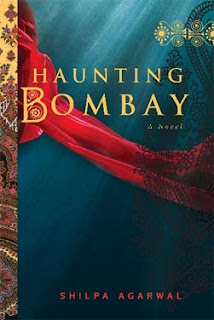
Haunting Bombay by Shilpa Agarwal

Shilpa Agarwal‘s Haunting Bombay immerses readers in a deeply saturated drama and literary ghost story reminiscent of the Bollywood films the Mittal family’s driver Gulu adapts into his own adventures.  Set in Bombay, India, the story spans two decades from the end of World War II into the 1960s.

Each member of the Mittal family is vivid from the main protagonist Pinky, a thirteen-year-old girl uncomfortable with her place in the family and grandmother Maji, who keeps the family unit running smoothly and keeps all of its secrets secure to self-centered Savita, Maji’s daughter-in-law bent on driving Pinky out and her seventeen-year-old son Nimish, who always has his head in a book and is too timid to talk to the girl he has a crush on.

“Pinky dreamt she was drowning.  She felt herself being pushed down into water, down, down, down until her lungs began to burst.  The only way out was to push her head farther in, to stop thrashing, to trust that she would not die.  But each time she grew afraid, each time she thrashed.  Each time she startled awake just as she was about to pass out.”  (Page 111)

Pinky’s mother dies during the partition of India, forcing her to become a refugee, but Maji takes her granddaughter into her bungalow, along with her son, his wife, and their three boys.  The mystery of the bolted bathroom door at night is resolved when Pinky in a fit of frustration unbolts the door.  Haunting Bombay is about the secrets buried within a family and the ghosts tied to those secrets until they burst through the bathroom door.

“Here it was, proof that she had once inhabited this place at the world’s rim, before she had begun to bleed, before the women had gathered, their salty voices crooning the ancient tale of the menstruating girl who caused the waves to turn blood-red and sea snakes to infest the waters.”  (Page 4)

Agarwal’s poetic language is like a siren song, pulling the reader into the Mittal family’s struggles with one another.  With the start of the monsoon season accompanied by the heavy rains, the ghost grows more powerful and the drama more turbulent.  Readers looking for a ghost story will get more than they bargained for with Haunting Bombay.  It’s a ghost story, mystery, and historical novel carefully crafted to hypnotize the reader.

Shilpa Agarwal kindly took the time out of her busy schedule–at the last minute, I might add, because I am incredibly out of sorts with my own schedule–to answer a few questions.  I graciously thank her.

1.  Please describe yourself as a writer and your book in 10 words or less. 

Myself as writer: A researcher, thinker, poet, dreamer.

Haunting Bombay: A literary ghost story set in Bombay, India.

2.  Haunting Bombay features a ghost story; what inspired you to use a haunting to illustrate family secrets and how they are uncovered? 

Haunting Bombay takes place in a wealthy Bombay bungalow and opens the day a newborn granddaughter drowns in a brass bucket while being bathed. The child’s ayah (nanny) is blamed for the death and is immediately banished from the household.  The child and her ayah are silenced in the realm of human language – they have no voice or power in the bungalow – so I had them come back in the supernatural realm in order to speak the truth of what happened that drowning day.  I remember a quote from Buddhist nun Pema Chodron that is something like, “Fear is what happens when you get closer to the truth.”  I wanted my characters’ journey to discovering the truth to be both frightening and enlightening, involving self-reflection, compassion, and sacrifice. 

3.  Do you have any particular writing habits, like listening to music while writing or having a precise page count to reach by the end of each day or week? 

When I was writing Haunting Bombay and my children were very young, I used to get up at 4:30 each morning to write because that was the only time in the day I had to myself.  Now I write while they are at school.  I always light a candle before writing, put my editorial hat away, and allow the story to unfold as it comes to me.  Later I go back and rewrite but I always like the first draft to come from a place of emotion and instinct.  My writing process is very organic.  I never write an outline because, inevitably, the story will take an entirely different direction than the one I’ve plotted out.   So I let the story flow, and however far I get that day is fine with me.

4.  Name some of the best books you’ve read lately and why you enjoyed them.

During my book travels these past months, I’ve met wonderful authors whose books I subsequently read, including Cara Black’s Murder in the Marais (Aimee Leduc Investigation), David Fuller’s Sweetsmoke, and Diane Gabaldon’s Outlander.  This weekend I spoke at an event with Judith Freeman, Ann Packer, and Jacqueline Winspear so Red Water: A Novel, The Dive From Clausen’s Pier: A Novel, and Maisie Dobbs are on my current reading list.  There is something almost magical in reading a book after hearing an author speak about it, and in this process my own interests have expanded into new genres of literature.  I also recently read Kathleen Kent’s The Heretic’s Daughter: A Novel which I thought was an engaging work of historical fiction.

For the rest of my interview with Shilpa Agarwal, check out my D.C. Literature Examiner page.

Thanks again to Shilpa Agarwal, Soho Press, and TLC Book Tours.  I have 1 copy of Haunting Bombayfor my readers anywhere in the worldTo Enter:

1.  Leave a comment about why you like ghost stories or describe a scary story you heard or told.
2.  Leave a comment on my D.C. Literature Examiner interview and get a second entry.
3.  Tweet, Facebook, or blog about this giveaway and leave a comment.

Deadline is Oct. 16, 2009 at 11:59 PM EST.

Catching Fire by Suzanne Collins

Catching Fire (The Second Book of the Hunger Games) by Suzanne Collins follows up where The Hunger Games (Click here for my review) left off.

In this novel, Katniss discovers that her final act in the arena had unintended consequences and she must now decide whether to run and hide with her loved ones or face a new reality–rebellion.  However, readers may find that the final act in the hunger games is not necessarily the catalyst for the rebellion so much as the Capitol’s unwitting acceptance of her defiance for the rules.

“The smell of roses and blood has grown stronger now that only a desk separates us.  There’s a rose in President Snow’s lapel, which at least suggests a source of the flower perfume, but it must be genetically enhanced, because no real rose reeks like that.”  (Page 20-1)

Catching Fire (The Second Book of the Hunger Games), like The Hunger Games, is an excellent book club selection for adults given the regime that makes up Panem and the inner workings of the Capitol itself.  From democracy run amok in the Capitol to a dictatorship or totalitarian regime in control of Panem and its districts.  While the totalitarian/dictatorship of the Capitol may not be precise in that President Snow’s manipulative actions run contrary to traditional totalitarian/dictatorship reactions of crushing the enemy and rebellion with an iron fist, readers will have a number of issues to discuss.  However, Collins may not be intentionally shedding light on these political structures, but simply writing dystopian fiction.

“Desperate, yet no longer alone after that day, because we’d found each other.  I think of a hundred moments in the woods, lazy afternoons fishing, the day I taught him to swim, that time I twisted my knee and he carried me home.  Mutually counting on each other, watching each other’s backs, forcing each other to be brave.”  (Page 117)

Katniss, Peeta, Haymitch, and Gale find more action and intrigue in the sequel and must deftly navigate the twisted rules and procedures of their nation to find themselves and freedom.  Katniss, Peeta, and Gale are still in the midst of a young-love romantic triangle, but again the struggles they face against the government take precedence.  More is revealed about Haymitch in this book, which readers will find helpful given his past behavior, but still too little is known about the how the current government came to be and who President Snow really is and how he came to power.

If readers think the mockingjay on the cover is a nice touch, they may soon get sick of the symbol as Collins uses it repeatedly in her narration.  However, its use is not overly bothersome, just a bit overdone. 

Meanwhile, readers will be introduced to new characters, like suave Finnick, unintelligible Mags, and Nuts and Volts, rounding out the cast for some additional suspense, drama, and amusement.  The final scene in the book will leave many in shock, but anxious for the next installment.  Overall, Catching Fire (The Second Book of the Hunger Games) is a strong middle book to the trilogy.

***As an aside, there’s a quote from the book that should spark some recognition about current environmental concerns in readers, as we struggle to modify our behavior to preserve our resources***

“Where the sand ends, woods begin to rise sharply.  No, not really woods.  At least not the kind I know.  Jungle.  The foreign, almost obsolete word comes to mind.  Something I heard from another Hunger Games or learned from my father.”  (Page 274-5)

Also Reviewed By:
Lou’s Pages 
Dreadlock Girl 

A Match for Mary Bennet by Eucharista Ward

Eucharista Ward O.S.F.’s A Match for Mary Bennet: Can a serious young lady ever find her way to love? is delightful and reminiscent of the regency craftswoman Jane Austen herself.  The novel’s pace is dead on, unfurling Mary Bennet’s character slowly, allowing readers to sit with her, getting to know her mind, her choices and motivations, and her true heart’s desire.

“‘I fell asleep in Inferno, and the candle went out.  I awoke in Purgatorio.  But all the light is on now.  I have found Paradiso.'” (Page 323 of ARC)

With her older sisters, Jane and Elizabeth married to Mr. Bingley and Mr. Darcy, and her youngest sister, Lydia, married off to Mr. Wickham, Mary and Catherine Bennet are left at home with their meddling mother, eager to marry them off.  Mary continues her ways of sitting alone with her books and her music, content to expand her mind rather than chase after men in society.

“‘You sat so creep mouse in a corner with, of all things, a book! What a way to comport yourself at a dance! Why, you might as well scream to all the world that no man is good enough for you. . . .'” (Page vi of ARC)

Despite her shyness and unconscious judgment of others, Mary comes to learn there is more to life than just books and music, though they certainly enhance her journey and even direct her ultimate place in society.  Readers will revisit with Mr. & Mrs. Darcy and Mr. & Mrs. Bingley following their marriages and how Mary perceives their married lives.  Lydia, Mr. Wickham, Mr. and Mrs. Bennet, Lady Catherine de Bourgh, her daugher, and Kitty Bennet return as well.  But there are new characters to love and dislike from the new pastor Mr. Oliver to the odd Mr. Grantley and the musical Mr. Stilton. 

Ward lives in Austen’s world, manipulates language easily to emulate regency England, and expands the characterizations sketched out in Pride and Prejudice: (Penguin Classics Deluxe Edition) without losing Austen’s vision.  However, Ward’s Mary Bennet is more than the thinly sketched, judgmental, religious, bookworm on the sidelines.  She is observant, knowledgeable, and deeply committed to her family and her faith.  Overall, readers will find A Match for Mary Bennet fills out the other Bennet sisters deftly and makes a perfect addition to any Austen lovers’ collection.

Sourcebooks has kindly offered 1 copy of A Match for Mary Bennet: Can a serious young lady ever find her way to love? by Eucharista Ward O.S.F. for a U.S./Canada reader.  To Enter:

1.  Leave a comment here about why you want to read about Mary Bennet or what your first impressions of her were when you first read Pride & Prejudice.

2.  Blog, Tweet, Facebook, or spread the word about the giveaway and leave me a comment. 

Deadline is October 16, 2009 at 11:59PM EST 

This is my 4th item for the Everything Austen Challenge 2009.

The Woodstock Story Book by Linanne G. Sackett and Barry Z. Levine

The Woodstock Story Book by Linanne G. Sackett and Barry Z. Levine is much more than photographs of the infamous peace concert called Woodstock.  It’s a chronicle of the festival from its inception to its completion.  Levine’s images are immediate, palpable, and candid, while Sackett’s storytelling is clipped, providing only the essential details readers will need to grasp the photos before them.  The foreward, written by Wavy Gravy, discusses the nostalgia he felt after seeing the book in its completion, and he notes that even though the outdoor festival ended, the principals and dreams of Woodstock live on.

“People, who were called freaks because of their hair and their way of dressing, came to Woodstock and they said, ‘Holy smokes.  We’re all freaks’ and they began to embrace that term.  There were a lot of people who opposed the Viet Nam War that thought they were alone.  They looked around and realized that they weren’t alone–that there were a half a million people who felt the same way,” Wavy Gravy says in the book.  (Page 3)

Through poetic lines, The Woodstock Story Book tells a lyrical account of the days leading up to the festival, the struggles with locating a large enough venue, and the community created in just a few days.  The festival’s stages were not even completed before the crowds started arriving.  Check out this crowd shot from Barry Levine’s Web site.

“They Stood for their truth
and pointed out lies

They were accused of
Communist ties”  (Page 40)

The Woodstock Story Book is an essential photographic history of a tumultuous time in our nation’s history.

From my D.C. Literature Examiner preview of the book (check out the full article):

This 40th anniversary, collector’s edition provides readers with a backstage pass to the best outdoor event in our nation’s history.  Even after 40 years, the Woodstock experience in Bethel, New York, between Aug. 15 and Aug. 18, 1969, continues to capture the imagination.

With never-before-seen photos of Jimi Hendrix, Janis Joplin, Jerry Garcia, and more, The Woodstock Story Book tells a chronological story of the music festival that became one of Rolling Stone’s 50 Moments That Changed the History of Rock and Roll.  There are over 300 full-color photographs in this book and are accompanied by humorous descriptions of the festival.  Great for those who remember Woodstock, wished they had been there, or are interested in rock and roll history.

For more information, check out The Woodstock Story Book blog.

Thanks to Lisa Roe at Online Publicist for sending me the book to review.

Hex in High Heels by Linda Wisdom

Linda Wisdom‘s Hex in High Heels is a fun novel that will have readers giggling and becoming inspired to use their own magical revenge spells.

“Horace bounced up and down in his excitement as he met Blair and Stasi at the kitchen door.  ‘Let me tell you, wolf shit smells really bad when it’s set on fire.  I put bags outside of every door, so they got it everywhere.  That Roan dude was royally pissed, too.  And I left a bag at the end of one of the ski runs and someone ran right into it!’ he chortled.  ‘Talk about brown skid marks,’ he snickered.” (Page 232 of ARC)

Blair is a a hot-headed, sexy small-town witch with fiery locks who just happens to have the hots for a shape-shifting Were Border Collie outcast, Jake Harrison.  Her roommate, Stasi (short for Anastasia) Romanov, own a pair of shops and a great deal of land, including a lake.  While Stasi sells lingerie and romance novels, Blair sells a variety of antiques with each day bringing in a new theme, ranging from the roaring 20s to WWII.

Their quaint life is interrupted when Jake’s former Pack moves in on the witches’ land and attempts to bring him back into the fold.  With help from a gargoyle sidekick named Horace, ghosts, and their other friends, the Were Pack runs into some trouble.

“Her squeak came out louder than expected.  She turned to the front of the room and took a longer look.  ‘Oh boy, you’re right — that’s one powerful Were up there, and I don’t think he’s a Werepoodle, either.'” (Page 68 of ARC)

Wisdom’s characters are quirky and outlandish, but the magic is in the fun these characters have with one another and when battling common enemies.  Readers who have not read paranormal romance before should be cautioned that there are detailed sex scenes in this novel and reality will have to be suspended.  Readers looking for some light reading and just a good deal of fun, Hex in High Heels is for you this Halloween.

Stay tuned for my interview with Linda Wisdom and a giveaway on Oct. 2, 2009.

Also Reviewed by:
Book Chick City

 Check out the rest of the Linda Wisdom Tour:

October 1
Yankee Romance Reviewers Guest Blog
http://yankeeromancereviewers.blogspot.com/
October 2 Savvy Verse & Wit Interview http://www.savvyverseandwit.com/
Fresh Fiction Guest Blog http://www.freshfiction.com
(weekend)
October 5 (open)
October 6 Long & Short of It Guest Blog http://longandshortreviews.blogspot.com/
Night Owl Romance Guest Blog 2 (recurring appearances throughout the month) http://nightowlromanceblog.blogspot.com/
October 7 Anna’s Book Blog Guest Blog http://annavivian.blogspot.com/
October 8 Midnight Café http://midnightmooncafe.blogspot.com/  
October 9 Bitten By Books Guest Blog http://bittenbybooks.com
(weekend)
October 12 Star-Crossed Romance Guest Blog http://www.star-crossedromance.blogspot.com/
October 13 Literary Escapism Interview http://www.literaryescapism.com/
Peeking Between the Pages Guest Blog http://peekingbetweenthepages.blogspot.com/
October 14 Drey’s Library Interview http://dreyslibrary.blogspot.com/
Night Owl Romance Guest Blog 2 http://nightowlromanceblog.blogspot.com/
October 15 A Journey of Books Guest Blog http://ajourneyofbooks.blogspot.com
October 16 Love Romance Passion http://www.loveromancepassion.com/
(weekend)
October 19 So Many Books Guest Blog http://purplg8r-somanybooks.blogspot.com
October 20 Pop Syndicate Interview http://www.popsyndicate.com
Night Owl Romance Guest Blog 3 http://nightowlromanceblog.blogspot.com/
October 21 Cheryl’s Book Nook Guest Blog http://nightowlromanceblog.blogspot.com/
October 22 Wendy’s Minding Spot Guest Blog http://mindingspot.blogspot.com/
October 23 Fang-tastic Books Guest Blog www.fang-tasticbooks.blogspot.com
(weekend)
October 26 Night Owl Romance Guest Blog 4 http://nightowlromanceblog.blogspot.com/

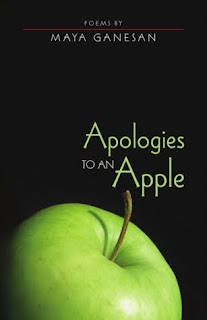
Apologies to an Apple by Maya Ganesan

Apologies to an Apple by Maya Ganesan is a breath of fresh air in contemporary poetry.  At eleven years old, Maya has a crisp style and is very observant and critical.  Her poems do not criticize overtly, like some poets that tend to hammer their messages home.

“They see the horizon, a smoky gold line
over the sea,
and call it names like faraway and
we’ll-never-reach-there.
To them,
horizon is a dream” (From Ash-Colored, pg. 10)

In these simple lines, the narrator observes the horizon in terms of what it means, its location, and how it is perceived by others.  It is an unattainable destination or a dream.

Maya uses short lines to let readers examine the images and statements and discern their own meaning–the greater meaning.  Readers will be reminded of William Carlos Williams‘ short lines, but Ganesan’s work holds a veiled innocence.  For such a young age, Ganesan has an old soul with a great deal of wisdom.  Some of these poems will make readers blush with their self-imposed innuendo.

A Message for You (Page 21)

I have traced your name
with
my finger

on the steamy
glass doors surrounding
the shower.

Readers will find poems to treasure, to savor, and to hold close to their hearts in this slim volume.  As a debut book of poetry, it stands tall among a vast crowd, waiting for readers to hear its whisper.

Yesterday (Page 24)

Yesterday is one book,
today is another.

Different books, telling
different stories.

I like to be part of 
both yesterday and
today, falling out of

one, tipped into
the other.

Her poem, September, was recently showcased in this past weekend’s Virtual Poetry Circle.  Readers enjoyed how the narrator speaks of trees as having souls and feelings.  It is a great commentary on how little we pay attention to the environment and its importance.

Susan at ColorOnline let me borrow her signed copy of Ganesan’s work for this review, though I did first read about this poetry book on 5-Squared.  I’m going to have to get my hands on another copy for myself.

Also Reviewed By:

5-Squared
Book of Kells
ReadWritePoem (also has a list of virtual tour sites for the book)

4th book for the poetry review challenge.