Quantcast

Check Out the Read-a-Long of Matterhorn by Karl Marlantes

Today is the official start of the Matterhorn by Karl Marlantes read-a-long that Anna and I started for the Vietnam War Reading Challenge‘s last hurrah!

Every Friday throughout December, Anna and I will be discussing the chapters we’ve read of Matterhorn.

Today’s discussion on War Through the Generations will be about Chapters 1-5!

If you’d like to join us, please do so.  We’d love to hear your thoughts on the book.  Even if you join us later on in the month, we won’t mind.  We love book discussions.

Go on over and check it out!

Lesley Castle: An Unfinished Novel in Letters by Jane Austen

Lesley Castle: An Unfinished Novel in Letters by Jane Austen is part of the Love and Freindship collection and is written in letters mostly between Margaret Lesley and her friend Charlotte Lutterell.  Readers will see a little bit of Emma in Charlotte as she talks about her matchmaking work and her failures at it.  In each letter, Austen uses societal norms of the time to poke fun at traditions and exaggerate the reactions of women in highly emotional situations.

“And now what provokes me more than anything else is that the Match is broke off, and all my Labour thrown away.  Imagine how great the Disappointment must be to me, when you consider that after having laboured both by Night and by Day, in order to get the Wedding dinner ready by the time appointed . . . ” (page 37)

Again, Austen shows adept understanding and mastery of the time period and traditions, turning them over and exaggerating their dramatic side.  In typical Austen style, the characters become connected in unusual and unexpected ways. Some of the best scenes involve societal gossip, and the dialogue that impugns the reputation of the Lesley women spoken by their latest stepmother.

While this story is not as over the top or outrageous as Love and Freindship, Lesley Castle shows the darker sides of friendship but also the ability of friends to be frank with one another even if it is hurtful or causes disagreement.  Austen’s early attempts at writing novels are indeed full of entertainment, and readers will instantly see why they captured her family’s attention.

This is my 12th book for the Jane Austen Challenge 2010.


This is my 8th book for the Everything Austen II Challenge.

Love & Freindship by Jane Austen

Love and Freindship by Jane Austen is among her earliest stories written for her family’s entertainment, and she’s said to have written it sometime between ages 14 and 17.  Yes, it is complete with misspellings in the title and throughout the short story, which unfolds in letters mostly from Laura to Marianne.  Laura tells a tale of misfortune and love to an apparently young and impressionable Marianne, her friend Isabel’s daughter.

The story begins with a plea from Isabel to Laura to discuss her misfortunes with Marianne, perhaps as a way to warn Isabel’s daughter away from similar hassles and heartache.  It is clear that Laura and Isabel’s relationship has been long given the frankness of the letters, which in some instances clearly illustrate flaws they find in one another.  In a letter from Isabel to Laura, “Surely that time is now at hand.  You are this day fifty-five.  If a woman may ever be said to be in safety from the determined Perseverance of disagreable Lovers and the cruel Persecutions of obstinate Fathers, surely it must be at such a time of Life.”  (page 3)

Much of this story is comical in that Laura is always fainting with her friend Sophia or she is running around madly because of one misfortune or other.  Otherwise, there are chance meetings with unknown and lost relatives that send Laura into dramatic action.

“She was all sensibility and Feeling.  We flew into each others arms and after having exchanged vows of mutual Freindship for the rest of our Lives, instantly unfolded to each other the most inward secrets of our Hearts–.”  (page 11)

Love and Freindship shows some signs of the writer Austen became, but it also showcases her novice writing skills.  Entertaining as this short story is, readers may find it too short to fully grasp the depth of these characters.  Marianne and Isabel are merely on the periphery and their characters are only seen through Laura’s eyes, who has her own biases.  Laura’s explanation of her marriage and other events often includes highly dramatic, even soap opera-ish, description and commentary.

This is my 11th book for the Jane Austen Challenge 2010.

This is my 7th book for the Everything Austen II Challenge.

9th Judgment by James Patterson and Maxine Paetro (audio)

9th Judgment by James Patterson and Maxine Paetro, and read on audio by Carolyn McCormick, begins with the murders of a mother and her young infant.  It’s clear that Lindsay and the other members of the Women’s Murder Club are in for a rough ride this time around.  McCormick does an excellent job providing different personalities and voices for each character, though at some points in the audio her interpretation of coroner Claire Washburn’s voice is a bit too deep and masculine.

Lindsay is not only tasked with finding the lipstick killer who kills women and children firms, but she also must take on a high profile case involving a movie star, Marcus Dowling, whose wife was murdered following a robbery.  Is the husband acting or is he devastated by the death of his wife, and was the robbery committed by the famed Hello Kitty cat burglar coincidental?

9th Judgment delves into how being a solider in war can twist your psyche, and how when these men return from combat, things are just not the same for them or their families.  Additionally, this novel connects characters in ways that are unusual and surprising, deals with physical abuse, and more.  In terms of depth, this novel has more of it than some of the others given that the motivations behind the criminals are examined.

Patterson and Paetro make a good team in the Women’s Murder Club series, although readers may find that some of the story lines are not as well crafted as some others.  However, in 9th Judgment, readers will find that even though they are introduced to the criminals in the first few chapters, how their capture unravels is titillating and edgy. Overall, this installment in the Women’s Murder Club series is a great addition and will have readers looking forward to the next one.

My husband and I listened to this one on our commute northward for Thanksgiving and finished it up on the way back.  He enjoyed the chase scenes for their vivid description and the comedic elements as Lindsay plays go-between for the FBI and the lipstick killer.  There were fewer instances of sound effects in this one, with just a few gunshots in the beginning, which was fine with us.  We’ve grown attached to these characters, even the latest member of the club, Yuki Castellano.  At one point near the end, my husband and I almost thought we’d have to write Patterson a scathing letter, but alas we just had to listen onward to learn that our fears were misplaced.

This is my 15th book for the 2010 Thriller & Suspense Reading Challenge.

Guest Post: John Aubrey Anderson, Author of The Cool Woman

John Aubrey Anderson‘s The Cool Woman is a novel that is on my Vietnam War reading list, and I plan to read and review it here before the end of the year.   Book Reviews by Molly already reviewed the book, so check that out.

In the meantime, I’ve got a treat for you!  I’m going to tantalize you with a portion of the author’s guest post, which you can read in full at War Through the Generations.

Check out an excerpt and then head on over.

As part of a school project, my granddaughter was required to interview a Vietnam War vet . . . she chose me. Her questions served to remind me . . . that I was relaxed about going to Vietnam because that was my job, that I wept when we buried one of my best friends in Arlington National Cemetery, and that my best memory of that part of my life is of returning home to my family.

The reality of the hell of war cannot be captured in the written word — be it fact or fiction. Nonetheless, I chose the chaos of the war in Vietnam as the backdrop for my fourth novel, The Cool Woman, because I wanted my main characters in an environment that would help “refine their thinking.” I tell much of the story from the cockpit — a vantage point familiar to me.

Please read the rest of the guest post at War Through the Generations today!

Also, the new 2011 War Through the Generations Topic is posted!

Sign up for the new 2011 Reading Challenge!

The Nighttime Novelist by Joseph Bates

The Nighttime Novelist by Joseph Bates is an excellent resource for aspiring novelists, especially those that have full time jobs and are writing in their spare time.  Housed in a hard bound, spiral notebook format, the book makes it easy to find the best advice for the crisis of the moment for beginnings, middles, or ends of novels with its outlined table of contents.  Most writers are fond of taking notes or using sticky papers to highlight gems of information . . . what’s even better is that we color-code that information to keep it all fresh.

Some of the ideas in the book are those writers have heard a number of times, such as keeping a small notebook handy at all times when dialogue is too juicy to pass up or someone’s style catches the eye.  Story ideas always come from experiences and what writers see in other art or in other books.  What’s unique about this reference book is that it counters advice given to many writers that they should write what they know or write about things that have never been done before.

National Novel Writing Month participants would be wise to check out this book, but even those not engaged in the month-long marathon, should take a look at Bates’ advice.  From creating the three-act structure complete with conflict and resolution to ensuring the larger structure is supported by a smaller structure of action and development, The Nighttime Novelist offers direct advice about plot and point of view choices, differences between POV and voice, settings and description, and much more.

Overall, Bates provides a comprehensive outline for writing a novel and offers a “coffee break” to help writers assess their progress throughout the novel.  While the book is written in a linear fashion from beginning to end, writers can plunge into any section of the book and obtain excellent advice.  There are additional online and other resources listed in the back of the book, and appendices with empty worksheets, which writers can copy to use multiple times for multiple novels.  The Nighttime Novelist is a great addition to any novelist or writer’s shelves.

About the Author:

Joseph Bates’ fiction and nonfiction have appeared in The South Carolina Review, Identity Theory, Lunch Hour Stories, The Cincinnati Review, Shenandoah, and Novel & Short Story Writer’s Market.  He holds a Ph.D. in comparative literature and fiction writing from the University of Cincinnati and teaches in the creative writing program at Miami University in Oxford, Ohio.

For more information please visit www.nighttimenovelist.com and follow the author on Facebook and Twitter.

Also check out the excerpt from the book posted earlier in November.

***Thanks to Writer’s Digest Books, Joseph Bates, and FSB Associates for sending me a copy for review. ***

This is my 59th book for the 2010 New Authors Reading Challenge.

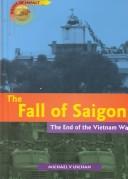
The Fall of Saigon by Michael V. Uschan

Michael V. Uschan‘s The Fall of Saigon provides an observant look at the history of how the Vietnam War begins, unfolds, and ends.  Unlike other books on this topic, Uschan begins with the fall of Saigon or the end of the war with one of the largest helicopter evacuations in history.  Although many would argue this is a civil war between its northern and southern counterparts, this war occurred at a time when democratic governments were wary of the spread of communism.

There is a great mix of photos and text in the book to provide a simplified explanation of the war and all of its moving parts.  It does touch upon the My Lai massacre and the deaths of innocent victims, but without the horrifying images that polarized many of those back home.  To teach students about the war, this is an excellent edition, but for children reading about the war on their own, it may be a bit dry.  However, photos often supplement the text and can provide a visual aid to kids.

Even adults can learn or relearn things about the Vietnam War and what may have happened as a result of the war.  For instance, the passage of the War Powers Act in 1973 required all future presidents to gain approval from Congress each time troops are sent into action overseas.

Overall, The Fall of Saigon is for older children, possibly between the ages of 9 and 12, and provides a great deal of information in just 30 pages, but in some ways the text needs to be supplemented with additional material on the Cold War and other events.

This is my 58th book for the 2010 New Authors Reading Challenge.

This is my 13th book for the 2010 Vietnam War Reading Challenge.

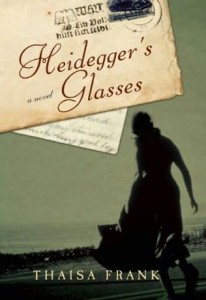
Heidegger’s Glasses by Thaisa Frank

Thaisa Frank’s WWII novel, Heidegger’s Glasses, combines philosophy, mystery, war, and more, woven with crisp, no-nonsense dialogue and just enough detailed description to tantalize the reader to continue the journey.  The story centers on Operation Mail, Briefaktion, a Nazi program to entice Jews to volunteer for relocation by sending letters from their taken relatives.  The letters are actually written by a group of Scribes pulled from the lines of people being relocated, who have special language skills.  A special set of orders, possibly from Goebbels, are sent to the Compound for a philosopher to answer Heidigger‘s letter to his Jewish optometrist Asher Englehardt, who was sent to Auschwitz and is probably dead.

“Hans Ewigkeit had originally planned to line the mine with thick brick walls.  But even before losing Stalingrad, the Reich was pinched for money.  So instead of brick walls, the Compound had thin pine walls covered with a single layer of plaster.  Workers had added five coats of paint.  But the Compound was a flimsy shell:  Scribes put their hands on their ears when they wanted to think.  Mueller had worn earmuffs.”  (page 81)

Enter Elie Schacten, a woman with two lives and names.  She writes some of the letters, but most importantly has permission to be outside after curfew and uses that to her advantage to save those she can from the oppressive Nazi regime.  She is caught between her lies and the ambitious Stumpf who considers himself in charge of the Compound as well as her affection for Lodenstein, the leader of the Compound.  Will the orders to write a response to Hiedigger’s letter expose the Compound for its lackadaisical work and Elie’s operations to rescue Jews, or will the orders be another means of saving helpless souls?

“Light snow began to fall — swirls of white on grey.  The streets widened, narrowed, widened again, expanding and contracting, as though they were breathing.  Nothing felt quite real to Elie — not the sky, or the air, or a coffeehouse where customers drank from incongruously large cups of ersatz coffee.  People hurried by, surrounded by pale grey air — the only thing that seemed to hold them together.  Elie passed a muddy street with a chain-link fence followed by a row of prosperous houses.  The town was breaking up, and she felt she was breaking up with it.  It began to snow thickly, surrounding everyone in white.  We’re bound by veils, Elie thought, fragile accidents of cohesion.” (page 95)

Heidigger’s Glasses is more than a philosophical journey, it takes a look at how the ordinary can become extraordinary.  Each object can have a hidden meaning or take on the life of a memory that will have to serve as a lifeline in the most dire of moments.  Like Hiedigger’s glasses help the philosopher “fall out of the world,” each character must find that moment in time when they fall out of the reality they fear and into the reality that they create.  Frank has taken the time to weave a complex story during a tumultuous time in history, and her novel accomplishes that goal and more.  Her characterizations are unique and dynamic, and the plot is unraveled slowly by the reader who takes an unexpected journey to discover the mettle of even the most ordinary individual.

About the Author:

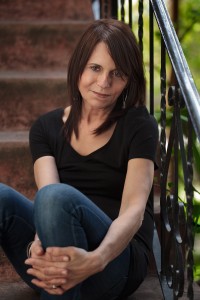
Photo by Chris Hardy; www.chrishardyphoto.com

Thaisa Frank has written three books of fiction, including A Brief History of Camouflage and Sleeping in Velvet (both with Black Sparrow Press, now acquired by David Godine). She has co-authored a work of nonfiction, Finding Your Writers Voice: A Guide to Creative Fiction, which is used in MFA programs.  Her forthcoming novel, Heidegger’s Glasses, is coming out this fall with Counterpoint Press.  Foreign rights have already been sold to ten countries.

***Thanks to the author, TLC Book Tours, and Counterpoint for sending me a review copy. ***

Please check out the other stops on the tour.

Giveaway information:  1 Copy for 1 lucky reader in the U.S. or Canada

1.  Leave a comment about what historical period you love to read about most.

2.  Blog, Tweet, Facebook, etc., for a second entry and leave a link in the comments.

Deadline Dec. 3, 2010, 11:59PM EST.

This is my 57th book for the 2010 New Authors Reading Challenge.

Tipping Point by Fred Marchant

Tipping Point by Fred Marchant is a collection of poetry broken down into five parts and published by Word Works after winning the 1993 Washington Prize.  Readers may wonder what a former Marine Corps Lieutenant and one of the first honorably discharged conscientious objectors would have to say about the Vietnam War, especially having only served two years.  This collection is a journey through the memories of childhood, adulthood, and military service, and beyond.
From Vietnam Era:

“. . . The papers
+++++ you heaved you imagined
grenades, and that the porches they
+++++ landed on the burst into flame,” (page 21)

Hard slaps and punches to his mother’s face from his father, feeling outcast in school being overweight, and a number of other adolescent anxieties scream from the pages.  But the most poignant lines of loss and anguish and even anger occur in his poems of the Vietnam War.  However, many of these poems are about inner turmoil and dealing with that struggle on a daily basis.

From Elephants Walking:

“On the news there was the familiar footage:
+++++ a Phantom run
ending in a hypnotic burst of lit yellow napalm.
+++++ I knew the war
was wrong, but that was why, I claimed, I should go,
+++++ to sing the song
of high lament, to get it into the books.”  (page 28)

From Tipping Point:

“and trousers which were not
+++++ supposed to rip, but breathe,
+++++++++++ and breathe they do — not so much
of death — but rather the long
++++++ living with it, sleeping in it,
+++++++++++ not ever washing your body free of it.”  (page 35-6)

Whether Marchant is discussing family history, struggles with illness, or his service in the Vietnam War, images leap off the page, billowing the smells of sweat into readers noses and making them squirm in discomfort. It is this discomfort the poet wishes for readers to feel as the narrators struggle with their own moral discomfort and struggle to come to terms with their decisions and situations beyond their control. Overall, Tipping Point by Fred Marchant reveals the dilemmas each of us deals with regarding personal, social, and political events, but it also teaches that individuals have a “tipping point” when principles must be take precedence or be set aside.

© Leslie Bowen

About the Author:

Fred Marchant is the author of Tipping Point, which won the Washington Prize in poetry. He is a professor of English and the director of creative writing at Suffolk University in Boston, and he is a teaching affiliate of the William Joiner Center for the Study of War and Social Consequences at the University of Massachusetts, Boston.

This is my 14th book for the Clover Bee & Reverie Poetry Challenge.

This is my 12th book for the 2010 Vietnam War Reading Challenge.

Guest Post: Richard Vnuk Talks About the Vietnam War

Today at War Through the Generations, Author Richard Vnuk discusses the Vietnam War and his book, Tested in the Fire of Hell, which he wrote after 40 years of silence.

I hope that you will hop on over to check out this author and his book and what inspired him to finally write about a war that he had kept silent about for a very long time.

Also, please remember to vote in the WTTG poll on what war should be covered in 2011.  There are three options: 1 year of American Revolution; 1 year of American Civil War; and 6 months each of the American Revolution and the American Civil War.

The poll will close on Nov. 22, and we will post the results after Thanksgiving.

Also, if anyone has some recommendations for books on either the Civil War and the American Revolution, please feel free to send them to warthroughgenerations AT gmail DOT com

Fatal Light by Richard Currey

Richard Currey‘s Fatal Light is an unusual novel in which an unnamed narrator provides readers with an inside view of what it is like to be a draftee before, during, and after the war.  Beyond the bullets, the Viet Cong, the mines, and the brutality of war, soldiers had to navigate a culture they didn’t understand, malaria, injury, and unexpected relationships.  The prose is sparse and the chapters are small, but each line, each chapter can knock readers over or back into their seats after putting them on the edge.

The unnamed narrator’s family is dispersed between West Virginia, Maryland, and Ohio, and the tranquility of the Ohio River and its surrounding landscape acts as the backdrop for the later contrasts of Vietnam’s jungles and the war.

“The festival queen and her court rode into view on a float garlanded with tissue flowers, gliding across the horizon of Main Street like a mirage, small-town madonnas sliding past waving their downy arms dreamily, their eyes the eyes of soft animals turned heavenward from thrones of blossoms and crepe, their faces all a magnificent promise, the romance at the end of the world passing so slowly in those long moments of perfect quiet, like the air over the river, the light and stillness inside the world at daybreak, like a held breath.”  (page 12)

There is a deep sadness in Currey’s prose as the narrator spirals further into the darkness of the jungle and of his memories as he recovers from injury and malaria.  But beyond the sadness and memory, the soldier lives on in grief, denial, and anger.  His anger rises at the military establishment, but his connection to his grandfather and those war stories still grounds him in reality.

“Mist filtered, smoke and constant drip. In the distance, the hoarse choke of approaching helicopters.

‘Choppers coming,’ I said. ‘We’re on the way.’

‘Gonna bleed the rest of my life,’ he hissed. ‘Gonna be coming right out of my bones all the rest of my life. You hear what I’m saying?’

I looked at him and the sound of the helicopters grew closer. ‘I hear what you’re saying,’ I whispered.” (page 80)

Unlike other war novels, Fatal Light is less graphic in describing wounds, battle, and recovery but the emotional connection between the narrator’s feelings and the readers are intertwined as they are drawn into each immediate, vivid observation.  While the observations are descriptive, they are not journalistic or clinical.  Currey’s prose is captivating, but realistic and gritty.  Overall, Currey’s slim novel is a memorable, twisted tale of a Vietnam soldier.

***If you missed my earlier recap of Currey’s reading in Bethesda, Md., check it out.  I purchased my copy of the book at the reading.***

Photo by Vivian Ronay

About the Author:

Richard Currey was born in West Virginia in 1949, was raised there and in Ohio, Virginia, Washington, D.C., and Canada. Drafted in 1968, he enlisted in the U.S. Navy and was detached to the Marine Corps, trained as a combat medic, and assigned to various infantry and reconnaissance units. He began publishing poetry after his discharge in 1972, and he drew upon his military experiences in Crossing Over: The Vietnam Stories. His first novel, Fatal Light, became an international bestseller published in 11 languages. Fatal Light received the Special Citation of the Hemingway Foundation as well as the Vietnam Veterans of America’s Excellence in the Arts Award. Currey’s second novel, Lost Highway, looks at the impact of the Vietnam War on an American family and was called “a rich, incisive American fable” by the Boston Globe. Currey’s short stories have received O. Henry and Pushcart Prizes and have been widely anthologized. A former military book reviewer for Newsday, he is now a contributing editor for The Veteran. A recipient of National Endowment for the Arts Fellowships in both poetry and fiction, Currey has also received the D. H. Lawrence Fellowship in Literature and the State of West Virginia’s Daugherty Award in the Humanities.

This is my 11th book for the 2010 Vietnam War Reading Challenge.


This is my 56th book for the 2010 New Authors Reading Challenge.


I hope you enjoyed this latest Literary Road Trip with Washington, D.C., author Richard Currey.

Safe From the Sea by Peter Geye

Safe From the Sea by Peter Geye is steeped in rough seas, relationships, and a break in the weather.  From water imagery to isolated wilderness, Geye takes readers on a descriptive and detailed journey of Noah and Olaf Torr’s strained father-son relationship and the past that comes between them.  Set in the northern regions of Minnesota near Lake Superior, Noah must confront his father when time is running out.  While there is doubt about whether his father is truly ill and dying, Noah drops everything in Boston, including his wife Natalie and their fertility issues, to come to his father’s aid.

“He took off his jeans and shirt, his socks and drawers, and stood naked at the end of the dock.  Instantly the sweat that only a few minutes earlier had been dripping from him dried — seemed almost to encase him — as the wind curled around him.  . . .  From the instant he went under he could feel the water seizing him.  Although he’d been anticipating something like it, he could never have expected the grip of the water.  If he hadn’t kicked and pulled for the surface the instant he was submerged he might have ended up sunk.”  (page 134)

Coming back to town brings back all the feelings of abandonment he felt as a child when his father worked on the Great Lakes with the shipping companies.  Readers will be absorbed in the descriptive detail, leaving their living rooms and subway cars and entering the wooded forest near Olaf’s cabin.  The wintry wind will whip through their collars, forcing them to wrap scarves around their necks and feeling the ice freeze on their skin as Noah takes a bath in the lake.

For a first novel, Safe From the Sea has very few flaws with only the relationship between Noah and Natalie feeling a bit confused, changing from a semi-adversarial relationship to a loving one once she too arrives in Minnesota.  Complex relationships abound in this novel and mirror the churning lake waters when storms approach, but calmer waters prevail as the family comes to terms with reality and the love they share.

As deep as the 800 feet of Lake Superior that nearly took Olaf’s life when Noah was a boy, Safe From the Sea will pull readers under and churn them in the undercurrent of Noah’s feelings for his father as he learns to forgive the man scarred by the sinking of the ship Ragnarok, the loss of his colleagues, and the inescapable truth that he was powerless against the elements.  Geye creates strong settings, tense relationships between Olaf, his son, and his daughter, and a story that is utterly absorbing from the first page.

***Thanks to Unbridled Books for sending me a copy for review.  Though I should have finished this book ages ago, it was easy to pick the book back up and become absorbed in the story after dealing with the death of my grandfather.***

About the Author:

Peter Geye received his MFA from the University of New Orleans and his PHD from Western Michigan University, where he was editor of Third Coast. He was born and raised in Minneapolis and continues to live there with his wife and three children.

If you’d like to win an ARC of Safe From the Sea by Peter Geye, please enter the international giveaway.

1.  Leave a comment about why you would like to read this novel.

2.  Name an Unbridled Book title you’ve read and enjoyed.

3.  Blog, Tweet, Facebook, or spread the word about the giveaway.

Deadline is Nov. 30, 2010, at 11:59 PM EST.

This is my 55th book for the 2010 New Authors Reading Challenge.