There are 2 copies up for grabs and the giveaway is international. So what are you waiting for? Go on over and enter.
Literature and Poetry Reviews, Home of the Virtual Poetry Circle

There are 2 copies up for grabs and the giveaway is international. So what are you waiting for? Go on over and enter.

Remember, this is just for fun and is not meant to be stressful.
Keep in mind what Molly Peacock’s books suggested. Look at a line, a stanza, sentences, and images; describe what you like or don’t like; and offer an opinion. If you missed my review of her book, check it out here.
Also, sign up for the 2011 Fearless Poetry Reading Challenge because its simple; you only need to read 1 book of poetry. Please contribute to the growing list of 2011 Indie Lit Award Poetry Suggestions, visit the stops on the National Poetry Month Blog Tour from April.
Today’s poem is from Deborah Ager‘s Midnight Voices:
Alone(page 38)
Over the fence, the dead settle in
for a journey. Nine o’clock.
You are alone for the first time
today. Boys asleep. Husband out.A beer bottle sweats in your hand,
and sea lavender clogs the air
with perfume. Think of yourself.
Your arms rest with nothing to doafter weeks spent attending to others.
Your thoughts turn to butter and will it last
the week, how much longer the car
can run on its partial tank of gas.
Let me know your thoughts, ideas, feelings, impressions. Let’s have a great discussion…pick a line, pick an image, pick a sentence.
I’ve you missed the other Virtual Poetry Circles. It’s never too late to join the discussion.
Also, please visit and enter the National Poetry Month giveaway. The giveaway is international. Today’s the last day to enter!
Midnight Voices by Deborah Ager, published by small press Cherry Grove Collections, is a collection that gives voice to the thoughts, the events, and the split seconds before tragedy or fateful decisions are made that are only heard in silence. The silence is a voice, quick to speak and die out without stalking across the stage and declaring itself. Secrets are revealed in these poems, like the undiscovered joy “Deborah Sampson” (page 11) — a woman who enlisted as a man in the Army during the Revolutionary War — felt posing as a man and disappearing from her real self. Or in “The Moment Before the Moment” (page 19), where the narrator comes across the hidden beauty of a sunrise before the actual sun rises above the horizon. Each poem illuminates the in-between, the edge, the precipice before the collision of events or moments in time.
The Space Coast (page 14; click the poem title and scroll the page to see this poem and others in the collection)
An Airedale rolling through green frost,
cabbage palms pointing their accusing leaves
at whom, petulant waves breaking at my feet.
I ran from them. Nights, yellow lights
scoured sand. What was ever found
but women in skirts folded around the men
they loved that Friday? No one found me.
And how could that have been, here, where
even botanical names were recorded
and small roads mapped in red?
Night, the sky is black paper pecked with pinholes.
Tortoises push eggs into warm sand.
Was it too late to have come here?
Everything’s discovered. Everything’s spoken for.
The air smells of salt. My lover’s body.
Perhaps it is too late. I want to run
the beach’s length, because it never ends.
The barren beach. Airedales grow
fins on their hard heads, drowned surfers
resurface, and those little girls
who would not be called back to safety are found.
At times, the images seem thrown together haphazardly, but readers must let themselves go, meditate on the words in the context of the moment presented, before the “truth” is revealed. What is not said explicitly about certain moments can be as violent as the moment that remains unspoken — what happens between walking through a park after dark following a mother’s rejection and when the narrator wakes up with his pants around his ankles in “Rohypnol” (page 34). What this style shows is that there are numerous ways to tell a story and to uncover “truth,” and it does not always have to be explicit or harrowing, though there are moments of violence on the surface of some poems.
Ager spends a great deal of time exploring the hidden spaces in our minds, our secret desires and thoughts, and even the thoughts we didn’t know we had. Like a mother who has no husband or children to take care of for the evening in “Alone” (page 38), and all she can think of is the next task on the list or when the next task will come for her. But beyond that, her personification of inanimate object, such as a telephone, can convey those unspoken desires in a way that a mere narrative involving a man and a woman cannot.
Midnight Voices by Deborah Ager is a personification of silent whispers in dark corners, where the secrets and mysteries of ourselves lie in wait — wanting to be revealed and not. Readers will take a journey into these recesses and uncover their own hidden secrets, smile at the camaraderie these poems produce, and search for more. One of the best collections I’ve read this year.
Deborah Ager’s poems appear in New England Review, The Georgia Review, Quarterly West, New South and in the anthologies No Tell Motel and Best New Poets. She’s received fellowships from the MacDowell Colony, the Mid Atlantic Arts Foundation, Virginia Center for the Creative Arts, the Atlantic Center for the Arts, and she received a Walter E. Dakin Fellowship to the Sewanee Writers’ Conference.
She is founding editor and publisher of 32 Poems Magazine. Many poems first appearing in 32 Poems have been honored in the Best American Poetry and Best New Poets anthologies and on Verse Daily and Poetry Daily. Ager codirects the Joaquin Miller Cabin Poetry Reading Series in Washington, DC and teaches at The Writer’s Center in Bethesda, MD.
This is my 12th book for the Fearless Poetry Exploration Reading Challenge.
This is my 19th book for the 2011 New Authors Reading Challenge.
This is my 11th book for the 2011 Wish I’d Read That Challenge. I’ve wanted to read this since the poet sent it to me for review, but life got in the way.

Many of these poems are like gazing through a lit windowpane at the wildness of nature, watching it from afar and not interacting or obstructing it — enabling it to just be. Frischkorn’s lines are short, yet powerful in that readers immediately picture the scene and the action. Upon further reflection, they come to see the message beneath the lines — from preserving nature to decrying the harm that has come to nature at the hands of humanity.
Youth Drowns in Housatonic River (page 4)
He swam across
+++ the inlet near Beard’s Island,and I was lying in my river bed
+++ watching light ripple the surface.I saw him swim a straight line
+++ through the sun. I had no choicebut to eat fish from the river,
+++ and the soil, it finds its way intomy skin. I am the river and the river
+++ is contaminated. The river is dyingand I am dying. His body was lean
+++ and strong, yet the cold shut downhis circulation. His arms. His legs.
+++ Please tell his mother I brushedthe hair from his forehead and sang
+++ sweet songs until the divers camea day later. Tell her, he swam a straight line.
In “Youth Drowns in Housatonic River,” the narrator not only becomes the river, but also tells the tale of a drowning youth and the interconnectedness of humans and their environment. “The river is dying/and I am dying,” shows this connection, as do the lines in which the narrator is eating fish from the contaminated river. Frischkorn’s images grown up and out, twisting around the reader, weaving a scene that gets under the skin and causes readers to rethink their own actions toward the environment. A perfect example of this is her poem “‘A Stone, A Leaf, An Unfound Door,’ T. Wolfe.” The narrator talks about being reincarnated as a stone, a leaf, and unfound door, and through each scene readers see how easily a stone or a leaf can be treasured one moment and either discarded or forgotten in the next moment.
Overall, Lit Windowpane by Suzanne Frischkorn is a collection that seeks to quietly raise awareness among its readers, while cultivating a new appreciation for the beauty and mystery of the natural world.
About the Poet:
Suzanne Frischkorn is the author of Girl on a Bridge (2010), and Lit Windowpane (2008) both from Main Street Rag Publishing. In addition she is the author of five chapbooks, most recently American Flamingo (2008).
Her poems have appeared in numerous journals and anthologies including Ecotone, Indiana Review, Margie, Verse Daily, and other publications. She has new poems forthcoming, or in the current issues of Barn Owl Review, Copper Nickel, North American Review, PALABRA, Printer’s Devil Review, and Puerto del Sol.
From 2001 to 2005 she served as an editor for Samsära Quarterly and is currently an Assistant Editor for Anti-.
A 2009 Emerging Writers Fellow of The Writer’s Center, her honors also include the Aldrich Poetry Award for her chapbook, Spring Tide, selected by Mary Oliver, and an Individual Artist Fellowship from the Connecticut Commission on Culture & Tourism.
This is my 11th book for the Fearless Poetry Exploration Reading Challenge.
This is my 18th book for the 2011 New Authors Reading Challenge.
This is my 10th book for the 2011 Wish I’d Read That Challenge. I’ve wanted to read this since the poet sent it to me for review, but life got in the way.

Katniss has been rescued by the rebel alliance of District 13 — thought to have been destroyed by the Capitol — but Peeta was left behind to be captured by President Snow’s forces. Beyond deciding whether or not to become the symbol — the MOCKINGJAY — of the rebellion, Katniss must further realize that she needs to make adult decisions, decisions that could impact the fate not only of the rebels, but of the human race. Along the way, she will reconnect with Gale, her family, Finnick, and others from the Games, but she also will be hit hard by the tragedy of loss, even those losses she was too numb or too blind to notice when they occurred. As part of her evolution, Katniss must learn to discern for herself the best course of action and how her actions impact others, as well as how each side is manipulating every move she makes.
“After about twenty minutes, Johanna comes in and throws herself across the foot of my bed. ‘You missed the best part. Delly lost her temper with Peeta over how he treated you. She got very squeaky. It was like someone stabbing a mouse with a fork repeatedly. The whole dining hall was riveted.'” (page 244)
Collins has a firm grasp of how a young teenage girl would react to high levels of danger, betrayal, and dystopian heartbreak. Her no-nonsense prose keeps the plot moving quickly and easily paints a picture that young and adult readers become lost in. Time flies quickly as readers get absorbed in the rebellion, cheering on Katniss and her struggle to find her rightful place. However, there are moments when the reader will want the plot to move more quickly or will want more action or will wonder why Collins is beating them over the head with the references to the oppressive nature and rigidity found in District 13. At one point, it seems that the narration takes on a preachy tone as the benefits of democracy are heralded above the current, rationing-and-sharing government of District 13 and the power wielded by the dictatorship of the Capitol. However, readers will easily forgive this digression as the action picks up once again.
What’s ironic about this third book is that Prim, Katiniss’ younger sister, seems more mature, while Katniss is still childlike and impulsive. Prim seems to have matured in a way that Katniss, who has seen more violence, could not — perhaps because Katniss’ childhood was a place she could retreat to and feel safe. Prim’s character development is not spelled out, but readers are likely to enjoy the new dynamic between her and her sister. A number of secrets about the Capitol and what happened in District 13 are revealed, rounding out the trilogy. Compared to the other books in the series, Mockingjay does not have as much action, but overall, it is a satisfactory end to this dystopian trilogy.
This is my 9th book for the 2011 Wish I’d Read That Challenge. I’ve wanted to read this since I pre-ordered the book from Amazon. It’s about time I read this one.

From “Wrinkles; on the wind’s forehead” (page 23-8)
3
the wind was tired
from carrying the coffins
and leaned
against a palm tree . . .6
My heart is a stork
perched on a distant dome
in Baghdad
it’s nest made of bones . . .12
the Tigris and Euphrates
are two strings
in death’s lute
and we are songs
or fingers strumming
The collection is divided into four parts, with Phantasmagoria II containing the most poems. Phantasmagoria, according to Wikipedia, “was a form of theater which used a modified magic lantern to project frightening images such as skeletons, demons, and ghosts onto walls, smoke, or semi-transparent screens, frequently using rear projection. The projector was mobile, allowing the projected image to move and change size on the screen, and multiple projecting devices allowed for quick switching of different images.” “A Photograph” is the most illustrative of phantasmagoria in that as the narrator unfolds the image of a photograph seen in the New York Times of a young boy in Baghdad, the true horror of the event comes to life and leaps off the page through the carefully chosen, yet sparse language used by Antoon.
Unlike other poets who discuss war in vivid and disturbing imagery, Antoon focuses on the impact of war on mothers, sons, and lovers as well as an entire nation and culture. His use of slanted images and subtle transitions sets his verse apart from other “war” poets in that it creates an ironic atmosphere as the narrator speaks of blind bravery and courage, while at the same time stripping away worries of death by setting up orderly ways in which people will be taken care of once they have died. There is a great sense of loss in many of these poems, but there is that faint hope that love will conquer all — whether it is the love of a mother for her son or the romantic love between men and women or the love of culture.
The Baghdad Blues by Sinan Antoon is a slim volume at 42 pages that will stick with readers long after they have read each poem. Returning to these poems, readers will uncover the irony of Antoon’s words, but also the truth behind them. Coping with the horrible sights and sounds that surround them, Iraqis must learn to preserve their sense of self amid chaos and find direction within the confines of their circumstances.
Sinan Antoon is an Iraqi-born poet, novelist, filmmaker and assistant professor at New York University. His novel I’jaam: An Iraqi Rhapsody and his collection of poems The Baghdad Blues are written with great sophistication and a haunting sense of irony, according to The Electronic Intifada.
Read more about him at NYU Gallatin.
This is my 10th book for the Fearless Poetry Exploration Reading Challenge.
This is my 17th book for the 2011 New Authors Reading Challenge.
This is my 8th book for the 2011 Wish I’d Read That Challenge. I’ve wanted to read this volume ever since I picked it up at the last Split This Rock Poetry Festival in March 2010.
Library Loot is a weekly event co-hosted by Claire and Marg that encourages bloggers to share the books they’ve checked out from the library. If you’d like to participate, just write up your post-feel free to steal the button-and link it using the Mr. Linky any time during the week. And of course check out what other participants are getting from their libraries!
I haven’t been to the library in ages, other than for library sales. But I recently discovered that one my favorite poets has a biography with his very own illustrations in it, so I had to go pick it up.
The Enormous Room by E.E. Cummings
What books have you picked up from the library lately?
To all those mothers out there, Happy Mother’s Day.
I never knew how hard mothers worked until now. As a new mother, I can tell you from my short experiences that being a mother is hard, stressful, and nerve-wracking to say the least. But there also are moments of significant joy and laughter.
I hope all of you mothers have a great day! Relax and have fun.

Remember, this is just for fun and is not meant to be stressful.
Keep in mind what Molly Peacock’s books suggested. Look at a line, a stanza, sentences, and images; describe what you like or don’t like; and offer an opinion. If you missed my review of her book, check it out here.
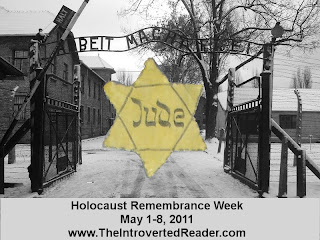
Also, sign up for the 2011 Fearless Poetry Reading Challenge because its simple; you only need to read 1 book of poetry. Please contribute to the 2011 Indie Lit Award Poetry Suggestions, visit the stops on the National Poetry Month Blog Tour from April, and check out Holocaust Remembrance Week.

Shipment to Maidanek by Ephraim Fogel (page 57)
Arrived from scattered cities, several lands,
intact from sea land, mountain land, and plain,
Item: six surgeons, sightly mangled hands,
Item: three poets, hopelessly insane,Item: a Russian mother and her child,
the former with five gold teeth and usable shoes,
the latter with seven dresses, peasant-styled.Item: another hundred thousand Jews.
Item: a crippled Czech with a handmade crutch.
Item: a Spaniard with a subversive laugh;
seventeen dozen Danes, nine gross of Dutch.Total: precisely a million and a half.
They are sorted and marked — the method is up to you.
The books must be balanced, the disposition stated.
Take care that all accounts are neat and true.Make sure that they are thoroughly cremated.
Let me know your thoughts, ideas, feelings, impressions. Let’s have a great discussion…pick a line, pick an image, pick a sentence.
I’ve you missed the other Virtual Poetry Circles. It’s never too late to join the discussion.
Also, please visit and enter the National Poetry Month giveaway. The giveaway is international.

In honor of those who survived and those who lost their lives, I want to point out that beyond memoir, fiction, and nonfiction, poetry also demonstrates the innate horror of the Holocaust and can emotionally rip through readers’ hearts with its use of imagery.

“Beyond the poems in the collection depicting the horrors and the losses of persecuted people in Germany, the poems of bystanders, perpetrators, and others are surprising. They talk of how they stood by and did nothing, how they want to help even if they are too late. Despite the time for help being long passed, these narrators express not guilt so much as regret — a deep regret at having been so paralyzed by fear that they did nothing or acted contrary to who they believed themselves to be.”

“While the collection does illustrate one Jewish woman’s journey during WWII and the Holocaust, it stands as a testament — a record — of how inexcusably these humans were treated and how their debasement impacted their lives, their relationships, their faith, and their souls.”
Whether you take a moment to reflect on the Holocaust or pick up a book to learn more about that time in history, you are sure to feel a deep emotional attachment to those who lived through and endured some of the most horrifying events in history. We all could learn a lesson from the past — to treat one another with more dignity and respect in our every day lives.
thesis writing and editing service
Let domyessay.com handle your academic load and receive your papers written to the highest standards.
Visit LegitimateEssayWriting to discover honest essay writing services reviews.
Visit http://legitimateessaywriting.com/ to know what research helper to choose.
Epitaph: 1 Star
Couplet: 2 Stars
Tercet: 3 Stars
Quatrain: 4 Stars
Cinquain: 5 Stars
Copyright © 2026 · Lifestyle Child Theme on Genesis Framework · WordPress · Log in