Quantcast

Where She Went by Gayle Forman

“But the end, when it finally came, was quiet.” (page 109)

Where She Went by Gayle Forman is the follow-up to If I Stay (my review — please do not read this review of Where She Went until you’ve read the first in the series because this will contain spoilers), and it is told from Adam’s point of view several years after the end of the previous book.  His band Shooting Star has hit it big, he’s got an A-list actress girlfriend, and all the money he could want, but what he doesn’t have is what he wants most of all.

Closure is a word that is thrown around a lot, but as humans we often want to know the reasons why things happen, and when we are not given a reason — even one we think is bollix — it incenses us.  In some ways we become obsessive about it.  Forman has a firm grasp of this obsession and its ties to passionate love, and the intensity of these feelings come to the fore when Adam is in New York and attends a concert at Carnegie Hall.

“I slide into my seat and close my eyes, remembering the last time I went to a cello concert somewhere this fancy.  Five years ago, on our first date.  Just as I did that night, I feel this mad rush of anticipation, even though I know that unlike that night, tonight I won’t kiss her.  Or touch her.”  (page 38)

In addition to the flashbacks of Adam’s rise to fame, Forman sprinkles in lyrics, which act like stanzas from poems, at the beginning of certain chapters, providing a certain lens or frame of mind for the characters.  Readers will enjoy seeing the more creative fruits of Adam’s labors because it provides an insiders view into his evolution into the “guy” he’s become.  Forman also does well showing the realities of the music industry and how many musicians just become commodities, losing themselves and their artistry.

Told from Adam’s point of view and using a similar style of flashbacks,  Forman again builds the tension between Mia and Adam from the beginning of their relationship and its end.  A young love unfinished, a journey taken alone by both characters, and so much left unsaid between them — a situation ripe for awkwardness, tenderness, and more.  Where She Went is an excellent follow up that not only fleshes out these characters, making them your friends so that you cheer them on and hope they find peace.  Both are quick, engaging reads, but are far from fluff, dealing with tough topics like death and redemption.

This is my 16th book for the 2011 Wish I’d Read That ChallengeI’ve wanted to read this book since reading Jill’s dual review in June.
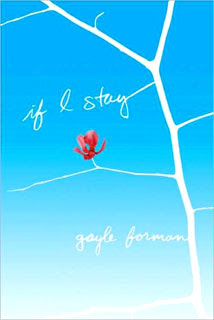
If I Stay by Gayle Forman

If I Stay by Gayle Forman is a young adult fiction novel about a teenage musical prodigy and her family.  She’s got a boyfriend with a band that is just taking off, and she’s under pressure to gain admission to Julliard playing the cello.  Tragedy strikes and changes everything, shaking up her world.

Forman’s prose is engaging from the first page, but the tragedy that befalls Mia is a predictable plot device that forces this blossoming 17-year-old to reassess her life.  Her music transports her to a safe place and even though she is not as confident as she thinks she must be to perform it, it is as much a part of her as her family and her boyfriend.  The strength of this novel is Mia’s character, her introspection, her trepidation at experiencing new things, and her ability to overcome embarrassment and fear.

“And I didn’t know how to rock-talk at all.  It was a language I should’ve understood, being both a musician and Dad’s daughter, but I didn’t.  It was like how Mandarin speakers can sort of understand Cantonese but not really, even though non-Chinese people assume all Chinese can communicate with one another, even though Mandarin and Cantonese are actually different.”  (page 47)

Mia often feels on the outside of her family, which has deep rock-and-roll ties in the community, and from her boyfriend, who is a lead guitarist in a up-and-coming rock band, and sometimes even from her own classical music because she has not done many of the things that other classical music prodigies have done with local quartets, etc.  However, Mia continues to plug along, beating back her insecurities and striving for the life she wants.  Forman has a firm grasp of a teenager’s life — the peer pressures they face, the insecurities that haunt each decision they make, and the passions in which they lose themselves.

Forman builds tension by shifting from Mia’s present into her past, careful not to rush through each moment and unfurling revelations as Mia sees them in each fragment of time.  Readers will be moved by Mia’s story and her struggle to find her true self amid high school pressures and more.  But If I Stay by Gayle Forman is more than a coming of age story, it’s about the ties that bind us to one another and how we keep those ties alive and relevant.

This is my 15th book for the 2011 Wish I’d Read That ChallengeI’ve wanted to read this book since reading Jill’s dual review in June.


This is my 32nd book for the 2011 New Authors Reading Challenge.


The Secret Lives of the Four Wives by Lola Shoneyin

Lola Shoneyin’s The Secret Lives of the Four Wives is set in modern-day Nigeria where men are supreme and wives are meant to breed children — an obsession of Baba Segi and the reason he has four wives.  However, his newest wife, Bolanle, is the youngest and most educated of the four — Iya Segi, Iya Tope, Iya Femi, and Bolanle — and her entry into the household generates jealousy and change.

Baba Segi’s only concerns are being catered to by his wives and procreation, and when Bolanle fails to produce an heir after much “pounding” (his words), he seeks counsel from his male friends and the “Teacher,” who advises him to bring her to the hospital.  It is then that the jealousy of the women becomes more concentrated on Bolanle, as they struggle to protect a family secret.

“Even a child would have worked out why my father was extolling qualities that had previously vexed him; I was compensation for the failed crops.  I was just like the tubers of cassava in the basket.  Maybe something even less, something strange — a tuber with eyes, a nose, arms and two legs.  Without fanfare or elaborate farewells, I packed my bags.  I didn’t weep for my mother or my father, or even my siblings.  It was the weeds I didn’t get the chance to uproot that year that bothered me.”  (page 91)

Shoneyin adopts what many might consider a very masculine prose that creates a crass view of sex in a polygamist household and a not-so-favorable perspective of Baba Segi, the husband.  Even when the narrative shifts to Bolanle’s first-person point of view, the language is harsh, making it difficult for readers to discern the speaker with each shift.  However, these shifts gradually become easier to discern, and each perspective adds a new layer to the narrative and deepens the complexity within the Segi family.

Readers may want more background and detail of Nigeria and its customs or at least its a more vibrant picture of its places and culture.  Shoneyin generates a harsh world that is not only Nigeria, but could be any country at any time in which polygamy is the norm and women are seen as second-class citizens.  What is absent here is a clear sense of place and time — a setting that could have made the story more vivid and memorable.

The Secret Lives of the Four Wives may have been long-listed for the Orange Prize, but the characters and story are reminiscent of other oppressed women under similar circumstances.  However, what makes this novel unique is the four wives and their perspectives on why they became wives of Baba Segi — what circumstances led them to that choice and why they continue to stay.  Each has a compelling story to tell, and while Baba Segi is not a sympathetic character, he does provide his wives with an oasis from their pasts and with the confidence to rule their own lives.  Overall, readers will get a glimpse into another world and of what it means to be one of many wives.


About the Author:

Lola Shoneyin lives in Abuja, Nigeria, where she teaches English and drama at an international school. She is married, with four children and three dogs.  Please visit her Website and her blog.


Please check out the other stops on the TLC Book Tour by clicking the icon.


This is my 31st book for the 2011 New Authors Reading Challenge.

Mailbox Monday #135

Mailbox Mondays (click the icon to check out the new blog) has gone on tour since Marcia at A Girl and Her Books, formerly The Printed Page passed the torch.  This month our host is A Sea of Books.  Kristi of The Story Siren continues to sponsor her In My Mailbox meme.  Both of these memes allow bloggers to share what books they receive in the mail or through other means over the past week.

Just be warned that these posts can increase your TBR piles and wish lists.

Here’s what I received this week:

1.  The Taker by Alma Katsu a win from TheBookTrib

2.  One Day by David Nicholls for review in Sept., but stay tuned for a giveaway in August.

3.  Kindle by Amazon, which I won from the Summer of Gomez event from Graham Parke

What did you receive this week?

Weekly Geeks 2011-02

I’m not sure how many weeks it has been since my last Weekly Geeks posting, but I thought this week’s topic was interesting.
“What book/novel would you suggest for someone like me, someone interested in learning about your state, city and/or country? What book do you think is perfect for presenting the history and culture of your place of residence in the most perfect and interesting way?”

I haven’t lived in Maryland that long compared to all the time I spent growing up in Massachusetts, but I think I can offer up at least one book that represents some of Maryland’s history and culture during a tumultuous time in our nation’s history.

I’d recommend Jarrettsville by Cornelia Nixon, which takes place just after the U.S. Civil War ends and the south has lost.  Remember Maryland is south of the Mason-Dixon line, which served as a demarcation between the North and South and thus the ideological differences about the legality of slavery.  Jarrettsville is just below that line in Maryland and is a perfect setting for a novel, especially since some of its residents held similar beliefs to their northern brethren that slavery was wrong.  I reviewed this book as part of the War Through the Generations U.S. Civil War reading challenge this year and really enjoyed it, especialy after learning that the story was based upon the life of Nixon’s distant relative, Martha Jane Cairnes.

What’s compelling about this story is that Nixon takes a tragic and personal event and weaves a story that illustrates the continued tensions between the North and South even after the end of the Civil War and the power of love to change someone’s long-held and deeply rooted perceptions about the world.  However, it also demonstrates how insecurity can breed deception and suspicion and tear apart love and family.  Slavery was not just a political issue or a business issue, but a family issue that even led to some men fighting one another on the battlefield and in the home.

What book would you recommend about your state?

106th Virtual Poetry Circle

Welcome to the 106th Virtual Poetry Circle!

Remember, this is just for fun and is not meant to be stressful.

Keep in mind what Molly Peacock’s books suggested. Look at a line, a stanza, sentences, and images; describe what you like or don’t like; and offer an opinion. If you missed my review of her book, check it out here.

Also, sign up for the 2011 Fearless Poetry Reading Challenge because its simple; you only need to read 1 book of poetry.  Please contribute to the growing list of 2011 Indie Lit Award Poetry Suggestions, visit the stops on the National Poetry Month Blog Tour from April.

Today’s poem is from Amy Lowell:

Spring Day [Bath]

The day is fresh-washed and fair, and there is a smell of tulips and narcissus in the air.

The sunshine pours in at the bath-room window and bores through the water in the bath-tub in lathes and planes of greenish-white. It cleaves the water into flaws like a jewel, and cracks it to bright light.

Little spots of sunshine lie on the surface of the water and dance, dance, and their reflections wobble deliciously over the ceiling; a stir of my finger sets them whirring, reeling. I move a foot and the planes of light in the water jar. I lie back and laugh, and let the green-white water, the sun-flawed beryl water, flow over me. The day is almost too bright to bear, the green water covers me from the too bright day. I will lie here awhile and play with the water and the sun spots. The sky is blue and high. A crow flaps by the window, and there is a whiff of tulips and narcissus in the air.

Let me know your thoughts, ideas, feelings, impressions. Let’s have a great discussion…pick a line, pick an image, pick a sentence.

I’ve you missed the other Virtual Poetry Circles. It’s never too late to join the discussion.

My Blogiversary Winner

Thanks to everyone who entered my 4-year blogiversary giveaway.  I’m happy about all the support I receive from my readers and I will try to continue providing you with the content you enjoy.

I received so many entrants that I decided to offer 2 gift certificates of $35.

Alyce of At Home With Books said, “Happy Blogiversary! I still have the intimidation factor when it comes to reading poetry, and it has to be really special for me to invest time in it. It’s not that I’m not willing to give it a try, but more that I get busy with other reading and don’t even think about poetry. So your blog is an excellent reminder for me. The most recent poetry I’ve been reading is Shel Silverstein’s A Light in the Attic to my boys at bedtime. Not exactly challenging reading for me, but certainly fun!”  She chose a $35 gift certificate from Better World Books.

Margie, who said, “You seem to be incorporating more reading challenges.  And, of course, you have more poetry-oriented posts.  I love the overall look of the blog.
Congrats on your Blogoversary.  Thank for the giveaway,” chose a $35 Amazon.com gift certificate.

Congrats ladies and enjoy your books because we know you’re buying them.

Interview With Eileen Clymer Schwab & Giveaway

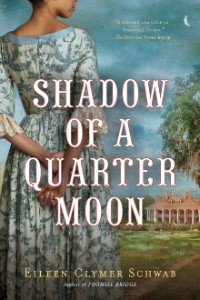
Today, I’d like to welcome Eileen Clymer Schwab, author of Shadow of a Quarter Moon.  The novel is set pre-U.S. Civil War and is a tale of romance, high racial tensions, and plantation life.  According to the publisher’s synopsis, “In 1839 North Carolina, Jacy has been raised in privilege as the daughter of a plantation owner. But when her father suddenly dies, her cold, unfeeling mother, Claudia, schemes to marry Jacy off to a well-positioned but lecherous suitor.  In a fit of fury over Jacy’s protests, Claudia calls her a ‘foolish, infernal quadroon’—and reveals that Jacy is the offspring of a dalliance between her father and a slave. Furthermore, her biological mother and brother are still slaves on the plantation. After these revelations, Jacy’s sense of who she is and where she belongs in the world is destroyed and, starts to see herself and the South with fresh eyes.”

Please welcome Eileen Clymer Schwab, and stay tuned for the giveaway:

1. What about the Civil War time period captured your attention enough to write a novel?

The years preceding the Civil War were so pivotal in American history, yet there is not a lot of adult fiction set in this time period. I suspect this is because it is not a time our nation is proud of, or wishes to reminisce over. We hide it from sight like an ugly scar. However, in keeping the door closed on this period, we miss the chance to honor and marvel at the incredible acts of courage and daring deeds that were the genesis of social change in the United States.

The Underground Railroad is the perfect example of the best of America within the worst of America. I am intrigued by this transitional period in history and find inspiration in the courage of those who sought freedom, as well as the spirit of joined purpose developed with those who provided aid during their journey.

2. Beyond the romantic aspect of your novel, SHADOW OF A QUARTER MOON, how much of the novel is about the racial tensions during the period and the issues that led up to the civil war?

Issues of slavery are central to the story, as is the Underground Railroad. In SHADOW OF A QUARTER MOON, an unimaginable secret changes the course of Jacy Lane’s life; not once, but twice. First, when it is hidden from her, and then when it is revealed. As the daughter of a plantation owner, Jacy has been raised in privilege until she discovers that she is the offspring of a dalliance between her father and a slave.

Amid the shock and complexities of her mixed heritage, Jacy is simply a woman longing for love, happiness, and a sense of wholeness; however the 1800s are not a simple time and Jacy begins a treacherous journey of denial and self-discovery that is fraught with danger and life-altering choices. She soon discovers that what she chases is as elusive as the secret network she hopes can save them.

3. When writing poetry, prose, essays, and other works do you listen to music, do you have a particular playlist for each genre you work in or does the playlist stay the same? What are the top 5 songs on that playlist? If you don’t listen to music while writing, do you have any other routines or habits?

I am a music lover, but I generally do not listen to music while writing because it might prevent me from “hearing” my characters. The process is different for every writer, but I am most creative when my mind is quiet. Scenes come alive visually in my mind and I hear the dialogue of my characters, not aloud, but like the voice of inner thought. But that’s not to say that music has not had a major impact on my work.

The spirit of my first novel, PROMISE BRIDGE was inspired the beautiful song, “Love Can Build a Bridge” performed by the country duo, The Judds. So much so, that they are mentioned in my Acknowledgments at the front of the book and again in my Author’s Notes. Often, as I prepared to write or contemplate a scene, listening to Love Can Build a Bridge helped plug me into the emotion of the scene.

4. How do you stay fit and healthy as a writer?

Nothing invigorates and centers me as much as a quiet walk. No iPods, no phone calls… just me and my dog, Sophie. Starting my day with a well-paced walk is good for my mind as well as my body. As I’ve mentioned earlier, I am most creative when my mind is quiet, so it’s not unusual for me to sort out a scene or capture the ideal turn of a phrase for a snippet of dialogue during my morning stroll. I don’t force the process. I simply let it percolate.

Sometimes, I let it all go and enjoy the birds and scenery around me, but more often than not, my mind comes alive and readies me for my time at the keyboard. I’m never without a pen and pad in the event ideas begin rushing at me. Of course the physical aspect is no less important. I’m out and moving which is a essential for someone who spends most of her day in front of a computer.

5. Most writers will read inspirational/how-to manuals, take workshops, or belong to writing groups. Did you subscribe to any of these aids and if so which did you find most helpful? Please feel free to name any “writing” books you enjoyed most (i.e. Bird by Bird by Anne Lamott).

This question makes me smile because I’ve done it all; books, classes, conferences, etc. Each was valuable its own way. First and foremost, these tools and activities brought me together with other writers. People who worked hard to learn their craft, hone their skills, and dared to take on the challenge of getting published. Writers write because we must. It’s like breathing; it’s a natural part of our being. We write whether we’re published or not. We write when there’s no guarantee that another soul will ever read as much as one word of what we’ve poured our hearts and souls into. Sharing that journey with others of like mind reminds us we are not alone. It assures us it is not impossible and gives us a network of support and encouragement.

6. What current projects are you working on and would you like to share some details with the readers?

I’m very excited about my next project which is set in the post-Civil War South. It was a very volatile period, particularly after the assassination of Abraham Lincoln. About a third of the novel is written and the entire story has been plotted. I have paused momentarily to complete some research.

I love the research phase because it’s a process of discovery – not just of historical facts, but of tendencies, beliefs, and nuances of the time. Through research, I become better acquainted with my characters and the world around them. Quite often the surprises discovered during research can shift plot lines and shape characters in unexpected ways. Combining research with imagination is the most creative part of the process, and for me, the most exhilarating.

Thanks so much Eileen for answering my questions.  These all sound like great novels.

To enter for 1 copy of Shadow of a Quarter Moon for a U.S./Canada reader:

1.  Leave a comment about what books you’ve read set during the U.S. Civil War or which you plan to read for this year’s War Through The Generations reading challenge.

2.  Facebook, Blog, or Tweet the giveaway for a second entry by leaving a link in the comments.

3.  For a third entry, please follow Eileen on Twitter and/or Facebook and leave a comment telling her you did so with your “handle.”

4.  Follow this blog and let me know in the comments (if you follow already, let me know)

Deadline is July 22, 2011, at 11:59PM EST.

***If you are a participant in the War Through the Generations Reading Challenge for the U.S. Civil War, you have another chance to win the book, here. 

Even if you are not in the challenge, please do check out Schwab’s guest post on writing about the U.S. Civil War.

Surprise!

Today has been a day of surprises, but one surprise was not as shocking as the other. Today, I’m featured on The Writer’s Center‘s First Person Plural blog. I talk a bit about the blog and its beginnings and what my main focus is among other things. I hope you’ll take a minute to go on over and comment.

Secondly, I received a pleasant surprise today when the winners of the Summer for Gomez winners were announced.  Check out the announcement below.

Summer of Gomez Winners

“Every once in a while you come across a novel so fresh and new it reacquaints you with feelings of childhood wonder. The novel my neighbor, Warren, wrote was my first example of the exact opposite of this.”
— Gomez in ‘No Hope for Gomez!’
Blogger Kindle Winner:
Serena from SavvyVerseandWit.comReader Kindle Winner:
Arthur Hall (US)

Reader iPod Winner:
Lynn Bassler (US)

Limited edition Winners:
Ebehireme Iyoha (US)
Yasmin Raad Muhi (Mal)
Sarah Bibi Setar (SA)
Gemma Richardson (UK)
David Lane (US)


Thanks to everyone who decided to make the summer of 2011 an official Summer of Gomez! I for one had a lot of fun and lost only a little bit of hair (and a few teeth) over the administration. A small price to pay of course.
Let’s try something great next year as well.

I’ve never owned an e-reader before, but if anyone has some tips, please share them. I’m not sure I’m ready to completely give up my hard copies, but I’m willing to give this new device a try. Any pros and cons you’d like to share, feel free. Oh, and naturally anything I should watch out for when downloading books and dealing with Amazon would be appreciated.

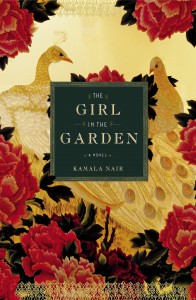
The Girl in the Garden by Kamala Nair

The Girl in the Garden by Kamala Nair is a stunning debut novel framed by an older Indian woman who leaves her fiance to return to her ancestral home and deal with the past, which is a bit cliche.  However, the bulk of the novel settles on Rakhee’s summer spent in India before her 11th birthday with her mother’s (Amma) mysterious family and away from her father, Aba.  Clearly Nair’s prose has been influenced by fairy tales and is sometimes reminiscent of The Secret Garden and Little Red Riding Hood, which makes the story that much richer.

“Slowly I moved toward the wall with my arm outstretched until my fingertips touched its vine-smothered surface.  I waited for something drastic to happen when my skin made contact with the stone, but when neither I nor the wall burst into flames or evaporated into thin air, I continued dragging my hand along the wall, emboldened, until my palm felt the roughness of the vines give way to a smooth, hard wood.

A door.” (page 67)

In a way the garden she discovers is like a fantasy with its beautiful plants and fanciful creatures.  Rakhee struggles a lot with her identity at home and abroad as a child, but its her curiosity and determination bred by the confidence of her father that will endear her to readers.  The world created by Nair is so absorbing that readers may even forget about the adult Rakhee.

“The thunder was deafening — I had only ever watched and listened to storms from behind the safety of a glass window.  But I was part of the storm now, ran-whipped and shaking.”  (page 140)

Rakhee is that young girl looking for her place in the world, a world where she doesn’t look like everyone else and doesn’t know or understand all of her family and their customs.  Nair paints a vivid landscape of India and the young girl’s odd family with its wizened aunties and an uncle with his broken dreams.  But the mystery of her mother’s past is just as captivating, if not predictable in some ways.

The Girl in the Garden by Kamala Nair is not just a coming of age story, its a clash of cultures, a love story, and a struggle between desire and family obligations.  Nair has crafted a world that readers will be reluctant to leave, especially as the storm kicks up more skeletons and other mysteries are unraveled about the past that could affect Rakhee’s future.  One of the best novels of this year, and it includes a bit of poetry from Mirabai.

About the Author:

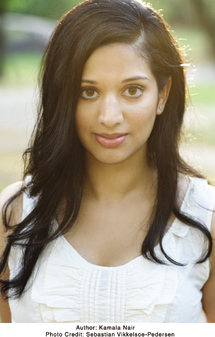
Kamala Nair was born in London and grew up in the United States. A graduate of Wellesley College, she studied literature at Oxford University and received an M.Phil in Creative Writing from Trinity College Dublin in 2005. She currently lives in New York City, where she has worked at ELLE DECOR.

Connect with Kamala on her Website, Facebook, or on Twitter.

I read this novel as part of a TLC Book Tour, for the rest of the tour stops, go here, or click on the icon at the right.

This is my 2nd book for the South Asian Reading Challenge.


This is my 30th book for the 2011 New Authors Reading Challenge.