Quantcast

Interview with Beth Hoffman, Author of Looking for Me

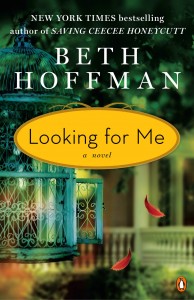
LookingForMePaperbackLooking for Me by Beth Hoffman, which made my Best of 2013 list, is due out in paperback this month.  Her second novel weaves “a story that will enchant readers with not only its southern charm and hospitality, but also the mysteries of family connections and miscommunications.”

Today, Beth will regale us with her wit and charm in a short interview.

Thank you so much for inviting me to chat with you, Serena.

1. In Looking for Me (on Kobo), Teddi Overman has a gift for restoring old furniture, but she seems unable to cope with the past. How do you think her ability to restore furniture reflects her inability to address her own past or the life she leads after high school?

Teddi adores her brother, and her hope for his survival is a tangled mess of guilt, unbearable grief, and even anger. These feelings translate into how she believes even the most severely damaged piece of furniture can be resurrected. By immersing herself in her craft, each repair represents how she’s trying to mend herself and her past.

2. Have you ever restored furniture or found a piece that just spoke to you?

Though I’ve restored a few pieces, I don’t have the patience to do what Teddi did. She was a master. Yes, certain pieces speak to me, and when they do it’s like being reunited with an old friend. Years ago I walked by an antiques shop and saw a circa 1908 Herschell-Spillman carousel horse in the window. My reaction was so powerful that nothing could have stopped me from having him. He was far outside my budget, but I found ways to scrape together enough to finally bring him home. I named him Ziggy.

3. When we leave home, we often leave behind who we were or were expected to be, how is this true of Teddi and do you think those pieces we leave behind can ever be recaptured?

The best way I can sum up my feelings is to quote Teddi: “I thought about that old saying, how we can never go home again. But I think it’s more like a piece of us stays behind when we leave—a piece we can never reclaim. One that awaits our next visit and demands that we remember.”

4. Between Saving CeeCee Honeycutt and Looking for Me, could you describe your experience in publishing and editing the books? How were they the same and how were they different?

CeeCee’s story was my debut, and I had no idea what to expect once it was acquired.

I had edited the manuscript with a ruthless hand, so the re-pub editing was minimal and easy. But when the book published I felt like I’d been shot out of a cannon! I’m an introvert, so having a big spotlight shined on my face was frightening. Plus, I didn’t know how grueling a book tour could be. But it was an amazing experience that I wouldn’t trade.

When Looking for Me published I knew the ropes and had my feet beneath me, so I was better prepared.

5. What current projects are you working on? Care to share any details?

I recently started a new novel, and so far I’m enthralled with the characters. The story takes place in two historic districts that sit back-to-back in Northern Kentucky (Newport and Covington). The two female main characters (one in her early 30s and one in her silver years) are both hiding something. It’s through their unusual friendship that their mysteries unfold.

Thanks, Beth, for sharing a little bit about your books with us and about your new work. I know I cannot wait to read it!

****Enter to win a copy of Looking for Me by Beth Hoffman by leaving a comment here.  You must live in the continental U.S. to enter.  Deadline to enter is May 9, 2014, by 11:59 PM EST.***
Mailbox Monday #269

Mailbox Monday, created by Marcia at To Be Continued, formerly The Printed Page, has gone through a few incarnations from a permanent home with Marcia to a tour of other blogs.

Now, it has its own permanent home at its own blog.

To check out what everyone has received over the last week, visit the blog and check out the links.  Leave yours too.

Also, each week, Leslie, Vicki, and I will share the Books that Caught Our Eye from everyone’s weekly links.

Here’s what I received:

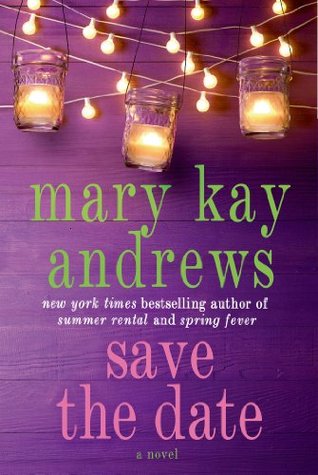
1. Save the Date by Mary Kay Andrews for review in June.

A savannah florist is about to score the wedding of a lifetime—one that will solidify her career as the go-to-girl for society nuptials. Ironically, Cara Kryzik doesn’t believe in love, even though she creates beautiful flower arrangements to celebrate them. But when the bride goes missing and the wedding is in jeopardy, Cara must find the bride and figure out what she believes in.  Maybe love really does exist outside of fairy tales after all.


What did you receive?

252nd Virtual Poetry Circle

Welcome to the 252nd Virtual Poetry Circle!

Remember, this is just for fun and is not meant to be stressful.

Keep in mind what Molly Peacock’s book suggested.

Look at a line, a stanza, sentences, and images; describe what you like or don’t like; and offer an opinion. If you missed my review of her book, check it out here.

Also, sign up for the 2014 Dive Into Poetry Reading Challenge because there are several levels of participation for your comfort level.

Today’s poem is from The Eight Stages of Translation by Robert Bly:

Old Winter by Salvatore Quasimodo,
translated by Robert Bly (pg. 76-7)

Desire of your hands I see through
in the darkness around the candle flame:
the had the odor of oak and of roses;
odor of death. Old winter.

The birds were looking for millet seeds
and suddenly they turned to snow;
words are like that:
a glimpse of sun, an instant of an angel,
and then the fog; and the trees
and us turned to air by morning.
Antico Inverno by Salvatore Quasimodo

Desiderio delle tue mani chiare
nella penombra della fiamma:
sapevano di rovere e di rose;
di morte. Antico inverno.

Cercavano il miglio gli uccelli
ed erano subito di neve;
cosi le parole:
un po' di sole, una raggiera d'angelo,
e poi la nebbia; e gli ableri,
e noi fatti d'aria al mattino.

What do you think?

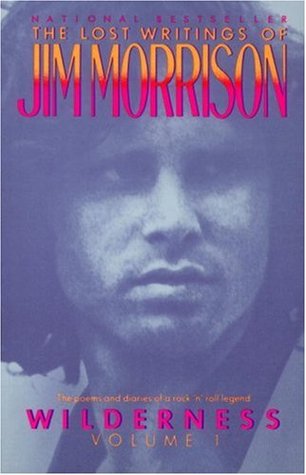
Wilderness: The Lost Writings of Jim Morrison Volume 1

Source: Purchased
Paperback, 214 pages
I am an Amazon Affiliate

Wilderness: The Lost Writings of Jim Morrison Volume 1 is a collection of poems, scribbled notes, photos, and a self-interview from Jim Morrison, lead singer of The Doors.  Like he music produced by Morrison and his band mates, his poetry has a hallucinatory quality.  Foremost a poet who unexpectedly found himself as a lead singer, lyrics of The Doors are in these poems, or vice versa depending on which he wrote first.  Fans of the band will enjoy looking at Los Angeles through Morrison’s eyes in these poems, with several referring to the city as LAmerica.  The seedy sides of L.A. are not glossed over, nor are his nomadic days with his family.  While much of his poetry is psychedelic in nature, dark, and offensive at times about carnal desires, there also is a reverence paid to the military, particularly military veterans, which could be influenced by the fact that his father was a military veteran.  However, like most artists, when compared to one another, the poems often contradict one another, as if the poet is working out some internal struggle of ideas.

“An interview also gives you the chance to try and eliminate all of those space fillers … you should try to be explicit, accurate, to the point … no bullshit.  The interview form has antecedents in the confession box, debating and cross-examination.  Once you say something, you can’t really retract it.  It’s too late.  It’s a very existential moment.” (page 1 — Self-Interview)

There are moments where the poems are lucid and easy to follow, but there are other times when the poems are confusing and make little sense to the reader without some reference point in the literature (i.e. William Blake or Nietzsche) or other knowledge Morrison picked up in his reading and living.  Despite the notes in the back that suggest Morrison often wrote many drafts of his poems (though the editors had a problem with chronology of those unnumbered and undated drafts), many of these poems feel unfinished and unpolished.

Selections from a few untitled poems:

"Men who go out on ships
To escape sin & the mire of cities
watch the placenta of evening stars
from the deck, on their backs
& cross the equator
& perform rituals to exhume the dead" (page 25)

LAmerica

"Androgynous, liquid, happy
Heavy
Facile & vapid
Weighted w/words
Mortgaged soul
Wandering preachers, & Delta Tramps" (page 87)

"Airport.
Messenger in the form of a soldier.
Green wool. He stood there,
off the plane.
A new truth, too horrible to bear.
There was no record of it
anywhere in the ancient signs
or symbols." (page 89)

"Actors must make us think
they're real
Our friends must not
make us think we're acting

They are, though, in slow
Time" (page 117)

As I Look Back

As I look back
over my life
I am struck by post
cards
Ruined Snap shots
faded posters
Of a time, I can't recall (page 201)

Wilderness: The Lost Writings of Jim Morrison Volume 1 is an existential journey of a poet, artist, and musician.  Fans of the band will love this collection, those that want an experience and look at the 1970s in Los Angeles will also love this collection.  Those looking for poetry that wows or connects with them may find it harder to connect with, especially since the poetry is a bit cryptic in purpose.

About the Poet:

Jim Morrison was an American singer-songwriter and poet, best remembered as the lead singer of Los Angeles rock band The Doors.

Book 14 for the Dive Into Poetry Reading Challenge 2014.


22nd book for 2014 New Author Challenge.

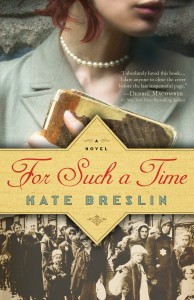
For Such a Time by Kate Breslin

Source: Bethany House and TLC Book Tours
Paperback, 432 pages
I am an Amazon Affiliate


For Such a Time by Kate Breslin is a WWII novel set in 1944 Czechoslovakia at the Theresienstadt concentration camp, a Jew work camp where many died from malnutrition, disease, or beatings, that acted as a stopgap for some Jews before reaching Auschwitz.  A miracle saves the life of Hadassah Benjamin from a Nazi firing squad, but the once blue-eyed, blonde finds herself in the middle of a hornet’s nest and forced to live under the assumed name of Stella Muller.  With her shorn locks, she ends up wearing a red wig and is given luxurious clothes, a warm bed, and food as SS-Kommandant Colonel Aric von Schmidt’s secretary.  With biblical quotes of Esther’s story, the parallels are unmistakeable between Stella’s struggles and that of Esther, with even Stella’s uncle bearing the same name as Esther’s cousin, Mordecai.  While the short quotes before each chapter are not strictly necessary to the story, it does offer some basis for the story Breslin is telling and for the strict moral grounds that Stella attempts to adhere to.  As a Jew who feels abandoned by God, it is interesting that she would turn to the bible and the tales a school friend of hers once told her, but her ability to connect with the bible demonstrates the transcendence that good morality can have no matter what religion, especially when she forces herself to break with Jewish traditions in order to remain concealed.

“Stella forced herself to look in the mirror.  Hadassah Benjamin, a Mischling, half Jew, bursting with a young woman’s exuberance, had ceased to exist.  In her place stood Stella Muller, subdued Austrian bookkeeper and suitable stock for the Third Reich.  A frail disguise comprised of no more than a scrap of official-looking paper, a red wig, and beneath her bruises the inherent fair features of a Dutch grandmother.”  (page 49-50)

Aric von Schmidt is the real enigma in this novel — a Nazi that does not hesitate to follow orders, but who still feels affection for Jews in his household.  He’s a man broken by WWI — literally, emotionally, and physically — and although he begins to see the devastation around him, of which he has played a significant part, it is hard for him to reconnect with his humanity without seeing how it would hamper his duties and possibly result in his own death or punishment.  Although he softens with Stella’s guidance, he’s still torn inside as he struggles to balance what he knows is right and what his orders are under the government he serves.

As the war nears its end and the final solution is called for by the Reich, the pressure is on for Stella, her uncle, and young boy named Joseph.  Breslin has crafted a poignant novel about the end of a war that had everyone concerned about their own safety, even the Nazi officers carrying out horrific orders.  She manages to humanize some of these monsters, and while we are not expected to completely forgive these men, it is clear that their decisions were based on their own demons and inabilities to sacrifice themselves for the good of others — a strength that few can muster in times of crisis when saving their own skin is a viable option.  For Such a Time by Kate Breslin is a stunning debut and would make a great book club selection given the moral issues and the emotional impact of the decisions these characters face.

About the Author:

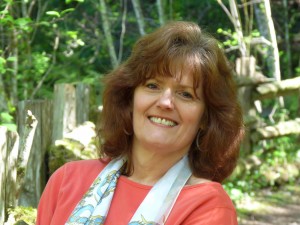
A Florida girl who migrated to the Pacific Northwest, Kate Breslin was a bookseller for many years. Author of several travel articles, award-winning poet, and RWA Golden Heart finalist, Kate now writes inspiring stories about the healing power of God’s love. For Such a Time is her first book. She lives with her husband and cat in Seattle, WA.

Connect with Kate on her website and on Facebook.

10th book (WWII) for the 2014 War Challenge With a Twist.


8th book for 2014 European Reading Challenge; It is set in Czechoslovakia.


13th book for 2014 Historical Fiction Reading Challenge.


21st book for 2014 New Author Challenge.

Guest Post: Kidlitosphere Progressive Poem by Tabatha Yeatts

It has been a very busy April with a variety of poetry.  I am so happy for all the participants this year, spreading their wings into new territory.

I hope that you’ve all found something new to read for the rest of the year and that it is a new poet or collection.  Click the icon at the left to see the whole tour and more!

Thanks to everyone for joining in the blog tour as a poster, blogger, or commenter.  I appreciate all of your enthusiasm.  See everyone again in 2015.

Without further ado, I bring the National Poetry Month Blog tour to a close with a guest post from Tabatha Yeatts, and a collaborative poem.  Please give her a warm welcome.

Poet and author Irene Latham introduced the idea for the Kidlitosphere Progressive Poem in 2012 and it has become an annual National Poetry Month event.

Each day in April, a different kidlitosphere blogger provides the next line in the poem. No plans for themes or rhyme schemes are worked out ahead of time — everyone is just working on the fly. If you’ve never tried to write collaboratively, you might want to give a project like this a go. It’s a very interesting process, both to participate in and to watch unfold.

Here’s this year’s poem:

Three Blue Eggs

Sitting on a rock, airing out my feelings to the universe
Acting like a peacock, only making matters that much worse;

Should I trumpet like an elephant emoting to the moon
Or just ignore the warnings written in the rune?

Those stars can’t seal my future; it’s not inscribed in stone.
The possibilities are endless! Who could have known?

Gathering courage, spiral like an eagle after prey,
Then gird my wings for whirlwind gales in realms far, far away.

But, hold it! Let’s get practical! What’s needed before I go?
Time to be tactical—I’ll ask my friends what I should stow.

And in one breath, a honeyed word whispered low—dreams—
Whose voice? I turned to see. I was shocked. Irene’s!

“Each voyage starts with tattered maps; your dreams dance on this page.
Determine these dreams—then breathe them! Engage your inner sage.”

The merry hen said, “Take my sapphire eggs to charm your host.”
I tuck them close—still warm—then take my first step toward the coast.

This journey will not make me rich, and yet I long to be
Like luminescent jellyfish, awash in mystery.

I turn and whisper, “Won’t you come?” to all the beasts and birds
And listen while they scamper, their answers winging words:

“Take these steps alone to start; each journey is an art.
You are your own best company. Now it’s time to depart!”

I blow a kiss. I hike for days, blue eggs pressed to my chest.
One evening’s rest, campfire low, shifting shadows brought a guest.

A boy, with hair in wild waves and eyes blue as the sea,
Says, “You’ve traveled far. What did you find—your best discovery?”

“I found a bird, I found a song, I found a word,” I say.
The hidden eggs, I make them known. “I’ve brought these on the way.”

We share an omelet and some talk; is my quest at an end?

Check out the last line, here.

1 Charles at Poetry Time

2 Joy at Joy Acey

3 Donna at Mainely Write

4 Anastasia at Poet! Poet!

5 Carrie at Story Patch

6 Sheila at Sheila Renfro

7 Pat at Writer on a Horse

8 Matt at Radio, Rhythm & Rhyme

9 Diane at Random Noodling

10 Tabatha at The Opposite of Indifference

11 Linda at Write Time

12 Mary Lee at A Year of Reading

13 Janet at Live Your Poem

14 Deborah at Show–Not Tell

15 Tamera at The Writer’s Whimsy

16 Robyn at Life on the Deckle Edge

17 Margaret at Reflections on the Teche

18 Irene at Live Your Poem

19 Julie at The Drift Record

20 Buffy at Buffy Silverman

21 Renee at No Water River

22 Laura at Author Amok

23 Amy at The Poem Farm

24 Linda at TeacherDance

25 Michelle at Today’s Little Ditty

26 Lisa at Lisa Schroeder Books

27 Kate at Live Your Poem

28 Caroline at Caroline Starr Rose

29 Ruth at There is No Such Thing as a Godforsaken Town

30 Tara at A Teaching Life

Also, here’s the link to my collection of poems about imaginary places. It also mentions the Summer Poem Swap I’ll be holding. People are welcome to email me with questions about it or with requests to join.

Thanks, Tabatha!

When the Cypress Whispers by Yvette Manessis Corporon

Source: TLC Book Tours and HarperCollins
Hardcover, 368 pages
I am an Amazon Affiliate

When the Cypress Whispers by Yvette Manessis Corporon melds the island tranquility of Greece’s Erikousa with the Greek Gods and Goddesses and whispering of the Cypress, creating a modern-day mythology.  Daphne is a modern woman, her heart heavy with the loss of her first husband and her struggles as a single mother rising to the top in New York City’s restaurant scene.  She comes back to her island home to have a traditional Greek wedding, despite her fiance Stephen’s misgivings about constrained traditions, and to reconnect with her Yia-yia (grandmother).

“In hushed, reverent tones, Yia-yia insisted that the cypresses had their own secret language that traveled between the trees on the gentle morning breeze and quieted down again as the afternoon stillness set in.”  (page 4-5 ARC)

The juxtaposition between Daphne’s American life of being always on the go and struggling to make time even for her daughter is clear once she returns to the island.  It is not that as a child life was so much more care-free (though it was), but life on the island is slower and more connected to family and tradition than it is in the business world and career-focused life Daphne was building for herself.  Evie, her daughter, was named for her great-grandmother, but she’s never met her or been to the island until now.  Corporon’s focus on Daphne brings together the family story as it shifts between her childhood, her time in America, and the present time with the wedding planning.  Tensions are increased as a mysterious man, Yianni, begins making assumptions about her and seems too close to her grandmother.  A WWII mystery is revealed and Daphne sees the error of her judgments and realizes that she may have more in common with this mystery man than she first expected.

When the Cypress Whispers by Yvette Manessis Corporon has it all — well-drawn characters, mythology and tradition, love and loss, and the power of family.  An emotional, heartfelt novel about the traditions and cultures that make us who we are and the dangers of committing halfway or only looking at the surface.

Photo credit Dia Dipasupil

About the Author:

Yvette Manessis Corporon is an Emmy Award-winning writer, producer, and author. She is currently a senior producer with the syndicated entertainment news show Extra. In addition to her Emmy Award, Yvette has received a Silurian Award for Excellence in Journalism, and the New York City Comptroller and City Council’s Award for Greek Heritage and Culture. She is married to award-winning photojournalist David Corporon. They have two children and live in New York.

Find out more about Yvette at her website, follow her on Twitter, and connect with her on Facebook.


7th book for 2014 European Reading Challenge; It is set in Greece.


20th book for 2014 New Author Challenge.


12th book for 2014 Historical Fiction Reading Challenge.


9th book (WWII) for the 2014 War Challenge With a Twist.


The Eight Stages of Translation by Robert Bly

Source: Purchased
Paperback, 107 pages
I am an Amazon Affiliate

The Eight Stages of Translation by Robert Bly is a slim how-to manual for amateur translators or those just beginning to dip their toes into poetry translation.  He breaks down the process into eight stages, which he illustrates using a René Maria Rilke poem, XXI.  He translates the poem in several drafts from the German into American English.  The eight stages he talks about and provides examples for through his drafts are:

  1. Setting down the literal translation
  2. Get a handle on the concepts and beliefs presented in the original poem; abandon the poem if the translator does not feel a connection with them.
  3. Rewrite the literal translation to ensure the meanings of the poem are not lost.
  4. Translate the latest draft into spoken English, using phrases that have been heard in natural conversation.
  5. Examine the translation in terms of tone to ensure that it carries over from the original (whether happy, sad, etc.)
  6. Listen to the original for sound and carry those same sounds over to the translation, such as the use of open vowel sounds.
  7. Speak with a native speaker to go over the translation to ensure meanings and tone are maintained.
  8. The final stage is completing the translation with all of the advice given and paying close attention to the original poem’s rhythm and rhymes (which are often less about end rhymes than internal rhymes).

The thought process through which Bly guides the reader through translation can be easily understood in the example given and the drafts presented, but even for those with no interest in translating poems themselves, the book includes some breathtaking translations done by Bly himself.  Although I am not fluent in any language, other than English, reading translations is always a peek inside another culture and world.  These translations are no different.  Bly has taken great care with them, and it shows.  Read The Eight Stages of Translation by Robert Bly not for the how-to, but for the poetry.

About the Poet:

Robert Bly is an American poet, author, activist and leader of the mythopoetic men’s movement. His most commercially successful book to date was Iron John: A Book About Men (1990),[1] a key text of the mythopoetic men’s movement, which spent 62 weeks on the The New York Times Best Seller list.[2] He won the 1968 National Book Award for Poetry for his book The Light Around the Body.


Book 13 for the Dive Into Poetry Reading Challenge 2014.


19th book for 2014 New Author Challenge.


For today’s 2014 National Poetry Month: Reach for the Horizon tour stop, click the image below:

Mailbox Monday #268

Mailbox Monday, created by Marcia at To Be Continued, formerly The Printed Page, has gone through a few incarnations from a permanent home with Marcia to a tour of other blogs.

Now, it has its own permanent home at its own blog.

To check out what everyone has received over the last week, visit the blog and check out the links.  Leave yours too.

Also, each week, Leslie, Vicki, and I will share the Books that Caught Our Eye from everyone’s weekly links.

Here’s what I received:

1. The Vintner’s Daughter by Kristen Harnisch from Caitlin Hamilton Summie Marketing for review in August!

Loire Valley, 1895. When seventeen-year-old Sara Thibault’s father is killed in a mudslide, her mother sells their vineyard to a rival family, whose eldest son marries Sara’s sister, Lydia. But a violent tragedy compels Sara and her sister to flee to New York, forcing Sara to put aside her dream to follow in her father’s footsteps as a master winemaker.

Meanwhile, Philippe Lemieux has arrived in California with the ambition of owning the largest vineyard in Napa by 1900. When he receives word of his brother’s death in France, he resolves to bring the killer to justice. Sara has travelled to California in hopes of making her own way in the winemaking world. When she encounters Philippe in a Napa vineyard, they are instantly drawn to one another, but Sara knows he is the one man who could return her family’s vineyard to her, or send her straight to the guillotine.

2.  Goodnight Songs by Margaret Wise Brown for review from Sterling Books.

From Margaret Wise Brown, author of the beloved Goodnight Moon, comes a previously unpublished collection of charming lullabies, gorgeously illustrated by 12 award-winning artists. The roster of celebrated names includes Carin Berger, whose The Little Yellow Leaf was a New York Times Best Illustrated Children’s Book; Eric Puybaret, who brought the bestselling Puff, the Magic Dragon to life on the page; Coretta Scott King Honor Award winner Sean Qualls; and Caldecott Honor medalist Melissa Sweet. An accompanying CD, with lilting songs beautifully composed and sung by Emily Gary and Tom Proutt, makes this the perfect gift to wish children a sweet goodnight.

3.  Grand Central: Original Stories of Postwar Love and Reunion with an introduction by Kristin Hannah for review in July.

On any particular day, thousands upon thousands of people pass through New York City’s Grand Central Terminal, through the whispering gallery, beneath the ceiling of stars, and past the information booth and its beckoning four-faced clock, to whatever destination is calling them. It is a place where people come to say hello and good-bye. And each person has a story to tell.

Now, ten bestselling authors inspired by this iconic landmark have created their own stories, set just after the end of World War II, in a time of hope, uncertainty, change, and renewal.

What did you receive?

For today’s 2014 National Poetry Month: Reach for the Horizon tour stop, click the image below:

Emma Eden Ramos Interviews Poet Brooke Elise Axtell

Emma Eden Ramos is a poet, middle-grade, and young adult novelist, and I’ve featured her a few times on the blog.  We’re Internet buddies who have a “poking” war from time to time, and we talk poetry and books all the time.  Check out my reviews of Still, At Your Door, The Realm of the Lost, and Three Women: A Poetic Triptych and Selected Poems.  Check out the interviews, and her guest interview.

BRK2Emma will be interviewing poet Brooke Elise Axtell, and we’ll share one of her poems.  Please give them a warm welcome.

be careful with a woman like me 
by Brooke Elise Axtell

be careful with a woman like me
who lives like a drunkard 
for the grey honey of the sea
who sends her singing voice to distant coves
like a hurricane trapped in a green bottle just to see 
if shrouds can be ripped & the dead raised.

be careful with a woman like me
who sharpens her heart like an ivory dagger
& howls her monsoon music to the moon
who wraps her secrets in silver cloths
to hide beneath deck & makes no promises
who is a cloud no hammer can nail to the bed
who will keep you restless & well fed on blackberries.

be careful with a woman like me
who dances in with a brass band
then slips away like a line in the sand
when the slightest wind moves.
it is not that i can't be true.
it is not that you are a red lacquered door
to open & quickly pass through.

but what appears to be 
a delicate locket hanging
from a gold chain at my neck
holds a private tempest & the shipwreck
of every storm-torn night my skin eats.

be careful of a woman like me.
i am true the way rain is true.
i am pure & vanishing. 
when the thirst of brittle leaves is quenched
when the land is a screaming emerald
it is clear. i am no longer here.

i am as restless as a sloop at bay, 
swaying with the seducing wave & her dark granite gaze.

i secretly flunked the school of manners
though i held my spoon at such a graceful angle.
i disguised my dissent behind the careful lifting 
of the teacup & memorized the map of their make believe.

i breathed heavy in the bed of my enemy
so i could overturn the twist of the sordid fist. 
i oiled the gears of my mind like a pleasing machine.
you should be careful with a woman like me.

all the while i trained in guerilla warfare 
chewed rabbit stew, sank my teeth 
into the neck of a god who does not topple 
at the earthquake of the shrine.

i crossed seven purple mountains on my knees.
i sucked on stones until they turned to bread.
i gave my heart to a hungry harlot to eat for breakfast

& you will find only the grey honey of the sea 
rocking, rocking 
in a woman like me.

Emma: The ability to write isn’t always all inclusive. Someone who composes beautiful prose may find that they’re completely hopeless when it comes to writing verse. You, however, are an award winning poet and short story writer. What, for you, is the link that makes both mediums accessible?

Brooke: I start with an initial instinct, a visceral energy that inevitably gives way to a particular form. When I begin writing I know that there is an underlying architecture that will reveal itself, but the line between verse and story in not absolute. Hybrid forms fascinate me. The intersection of text, song, performance and story yields such a rich alchemy. Lately, I’ve been intrigued by journalism as a site of beautiful protest.When you watch the boundaries between genres breed and dissolve, you begin to feel that every form is open to you.

Emma: You are also a very well-established singer/songwriter. You’ve worked with artists such as Terry Bozzio (of Missing Persons and Frank Zappa), Charlie Sexton (guitarist for Bob Dylan), Mitch Watkins (guitarist for Leonard Cohen), and a number of other great musicians. How do you find the collaborative process?

Brooke: It is an incredible honor to collaborate with such powerful musicians. I grew up dancing with a professional ballet company, so I approach the songwriting process as both a poet and a dancer. Music connects language and movement in a way that is completely transformative for me.

Emma: Which do you prefer, collaborating with other artists on a project or creating on your own?

Brooke: I appreciate both modalities. I crave solitude and connection. I am most alive as an artist when I create space for each side of the process. Collaboration challenges me to expand and grow. Solitude renews me and helps me reconnect with my courage. In a media-saturated climate I am vulnerable to distraction. I need to set aside moments to honor the interior life as well as cultivate authentic community.

Emma: Some time back, you won first place in the Young Texas Writer’s Awards for your short story “Maya’s Mirror.” Have you been writing since you were a young girl?

Brooke: Yes. As soon as I could write I started inventing stories about aliens, ghosts and unknown planets. I also wrote mystical poems about nature with themes of isolation. In retrospect, I see that I was working with creative codes to process the trauma I experienced.

Emma: Are there a few poets, fiction writers or lyricists who have deeply influenced you?

Brooke: I am nourished by many sources. As far as poets, I am reading the work of Akilah Oliver, Alice Notley, Bhanu Kapil and countless others. As far as songwriting, I am drawn to the work of Tori Amos, Bjork, Ani Di Franco, PJ Harvey, Billy Holiday and Sarah Vaughan. Fierce, imaginative women who tap into multiple states of consciousness. I am also grateful for the rich legacy of feminist writer/activists such as Audre Lorde and Adrienne Rich.

Emma: What would you say is your greatest inspiration?

Brooke: Mending the aftershocks of violence, honoring the body, healing ruptures through creative alchemy, a fierce hunger for social justice, my love of women, blues and jazz.

Emma: Do you have any advice for aspiring writers?

Brooke: Set aside time to write consistently. It has to become your way of life. This is a core decision, a sacred space you create, a ritual. You write because it is who you are and silence feels like a form of erasure.

I keep a hand-written journal to collect all the fragments: streams of consciousness, postcards of films, research, drawings, poetry. Recently, I found a gorgeous photograph of an anatomical heart and taped it inside. It is important to have private places as a writer, where there is no pressure to perform.

Immerse yourself in writers who speak to you. Join some form of creative community with writers who are more experienced than you. Ultimately, trust the value of you own voice, honor your instincts and stay open to wise counsel.

If you do not connect to someone else’s work they may not be an ideal mentor for you. Teachers and professors can be helpful, but take a look at their body of work before you invest too much in their critiques.

Going to open mics and public readings is a powerful way to come into your voice. For my poetry collections, I engage with performance as part of the editing process. I listen to what resonates and what feels like excess. It brings me back to the original energy of a piece.

Keep writing and refining your process. You deserve to be heard.

Thanks to both Emma and Brooke for this great interview today, as we wind down the April National Poetry Month celebration.

Description from GoodReads:

Brooke Axtell’s mesmerizing poetry explores the thirst for solace in desolate spaces. It is a thirst for cleansing, healing and rejuvenation. In her third collection of poems, she plunges the body of pain, the “remembering body,” into the renewing element of water. With fierce elegance, she reveals the core thirst of life: to experience all as sacred. Her gift of striking imagery and stunning, musical language has the power to haunt and heal. She transmutes pain into incantation. This is the alchemy of the artist.Just as Kore of Greek myth was forced into the underworld and initiated into a cycle of ascension, Axtell investigates a realm of ruin and rises to share a new vision of life. Her poems confront the ravages of violence with the relentless hope of the creative process. She explores the archetype of the wild woman, the sacred marriage of the soul, the cost of injustice, the modern sex industry, the Divine Feminine and the gift of intimacy that honors the emergence of the true untamed nature. Here is the map of one woman’s spiritual journey. You will find solace in these waters, “the healing waterfall behind the ancient wall.”

For today’s 2014 National Poetry Month: Reach for the Horizon tour stop, click the image below: