Quantcast

The Rat by Elise Gravel

Source: Tundra Books
Hardcover, 32 pages
On Amazon and on Kobo

The Rat (Disgusting Creatures) by Elise Gravel packs a lot of information in its pages and includes colorful images and punchy commentary.  My daughter enjoys looking at the fun pictures of the Rat, and some of the large words are easier for her to notice, which makes a teachable moment for her to learn new words.  While some of the information may be too much for kids in one sitting, after a few reads, kids will learn more an more about rats.  Other books in the series focus on flies, head lice, slugs, spiders, and worms.  Most kids are fascinated with bugs and creepy crawly things, probably because they are smaller and often within their field of view and touch, unlike birds and other animals.

Gravel’s images are fun, and it allows young readers to learn about the rat, his habits, and his behavior, as well as how important rats are to human research.  When the rat picks her nose with her tail, kids will laugh or say its disgusting.  It’s just one example of how these books can entertain readers as well as help them learn.  The Rat (Disgusting Creatures) by Elise Gravel is fun and informative, allowing young readers to learn new words and spellings, while also having fun with life’s more creepy creatures.

About the Author/Illustrator:

Elise Gravel is an award-winning author/illustrator from Quebec. She was the winner of the 2013 Governor General’s Award for Children’s Illustration in French, and is well-known in Quebec for her original, wacky picture books. She has published a number of books with US publisher Blue Apple and is currently working on a graphic novel for Roaring Brook Press. Having completed her studies in graphic design, Elise found herself quickly swept up into the glamorous world of illustration. Her old design habits drive her to work a little text here and there into her drawings and she loves to handle the design of her assignments from start to finish. She is inspired by social causes and is likes projects that can handle a good dose of eccentricity.
57th book for 2014 New Author Reading Challenge.
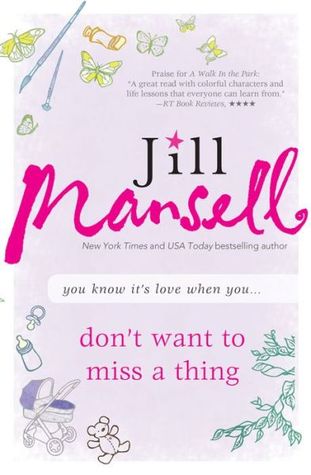
Don’t Want to Miss a Thing by Jill Mansell

Source: Gift from Diary of an Eccentric
Paperback, 418 pages
On Amazon and on Kobo

Don’t Want to Miss a Thing by Jill Mansell is another delightful story of love and life changes, and Mansell’s characters are always flawed human beings in search of better lives.  Dexter Yates takes the cake with his womanizing ways and charmed high-income life, but his sister has faith that he’s just lost and in need of a little guidance.  Soon, Laura will get her wish when Delphi, Dex’s niece, is born and the two become inseparable.  Molly Hayes, a cartoonist, lives in a Cotswolds village, and she’s happily teaching her classes at a local cafe and avoiding her latest ex-boyfriend, who just can’t seem to take no for an answer.  The village was the setting for a hit show Next to You, and her friend Frankie has the perfect marriage and family.

“Dex spent his life being laid-back and supremely confident; it was endearing to see him admit to a weakness.  Laura said encouragingly, ‘You can do it.  Just remember to support her head.  Like this.’

She demonstrated with her own hands and watched from the bed as Dex copied her.  ‘There you go, that’s it.'” (page 4)

Dex decides to buy the Gin Cottage in Molly’s village after she nearly drops a stinky fish on him and his current flavor of the month.  He has no one else to turn to when his sister suddenly dies and he has to make a major life decision in the blink of an eye, but the encouragement from a stranger seems to be all he needs.  Mansell excels at characterization and there is now doubt about her ability to write believable female leads, but in this novel, her lead is male, and she does an equally great job.  Dex is multifaceted and lacks the confidence he needs to fully commit to his decision, and Molly is strong and tries to keep her distance, even as she falls for Delphi.

“Well anyway, good luck to them.  Molly’s stomach tightened as she doodled a quick sketch of Amanda Carr with her geometrically perfect hair, pert nose, and crisp white shirt, always so calm and in control.  They were probably close in age, but Amanda was the proper grown-up.  She had a stethoscope.

With mixed emotions, Molly exaggerated the slightly pointed chin and narrow mouth for witchy effect.  Perhaps it was the grownupness that had attracted Dex’s interest.  Maybe this was what he wanted or needed from a partner in order to stop him endlessly sloping off in search of the next conquest.” (page 236)

Don’t Want to Miss a Thing by Jill Mansell is heartwarming, fun, and full of missed cues and lost chances, but its also about second chances and glances and what it means to be a family.  Mansell has hit another one out of the park, which is why she continues to be a favorite women’s fiction author of mine.  You’re always going on a fantastic ride with her and her characters.

About the Author:

Jill Mansell lives with her partner and children in Bristol, and writes full time. Actually that’s not true; she watches TV, eats fruit gums, admires the rugby players training in the sports field behind her house, and spends hours on the internet marvelling at how many other writers have blogs. Only when she’s completely run out of displacement activities does she write.

Other Mansell books reviewed:

The Best Loved Poems of Jacqueline Kennedy Onassis by Caroline Kennedy

Source: Purchased
Hardcover, 192 pages
I am an Amazon Affiliate

The Best-Loved Poems of Jacqueline Kennedy Onassis selected and introduced by Caroline Kennedy, her daughter, is a collection of classic poems that the former first lady adored for either their sense of adventure and whimsy or because she felt the passion of the love the poets expressed.  Caroline Kennedy does an excellent job of explaining why the poems meant so much to her mother and how they were selected and categorized, and it was great to see that she carried on the traditions started by her own mother with her own children.  In particular, Jacqueline Kennedy Onassis started a tradition of having her children read, write, and recite poems for each holiday and birthday, and the children were encouraged to write the poems down and illustrate them, and those memories were kept in a scrapbook.  Rather than making it seem like work, it became a competition among the children to find the longest poem, the best poem, and to outshine one another when they read them.  I can only imagine what pride that gave their mother.

First Fig by Edna St. Vincent Millay

My candle burns at both ends;
It will not last the night;
But ah, my foes, and oh, my friends—
It gives a lovely light!
Second Fig by Edna St. Vincent Millay

Safe upon the solid rock the ugly houses stand:
Come and see my shining palace built upon the sand!

As with any collection dealing with the Kennedy family, it is no wonder that this poetry collection begins with poems that pay homage to America, and also includes the poem read by Robert Frost at the Kennedy inauguration.  Kennedy said at the dedication of a library named for Robert Frost, “The men who create power make an indispensable contribution to the Nation’s greatness, … When power corrupts, poetry cleanses.  For art establishes the basic human truth which must serve as the touchstone of our judgment.” (page 5)  There are points in the collection that will require readers to have more patience as the older poems have more complex language and verses.

The Best-Loved Poems of Jacqueline Kennedy Onassis selected and introduced by Caroline Kennedy is a homage to poetry’s place in the United States, in politics, and in families, but it also provides a portrait of a multifaceted woman who became the darling of a nation and the face of sorrow when her husband was assassinated.  But like most women, she was more than her family, her famous husband, or her stint in the White House.  She was a passionate woman who loved the arts, particularly poetry, and wanted to pass the love of beauty onto her children.  Readers will come to see that she was successful in that endeavor at least and she inspires all mothers to do the same.

About Caroline Kennedy:

Caroline Bouvier Kennedy is an American author and attorney. She is the daughter and only surviving child of U.S. President John F. Kennedy and his wife, Jacqueline Bouvier Kennedy Onassis. An older sister, Arabella, died shortly after her birth in 1956. Brother John F. Kennedy, Jr. died in a plane crash in 1999. Another brother, Patrick Bouvier Kennedy died two days after his birth in 1963.

Book 22 for the Dive Into Poetry Reading Challenge 2014.

The Vintner’s Daughter by Kristen Harnisch

Source: Caitlin Hamilton Marketing and She Writes Press
Paperback, 368 pgs
On Amazon and on Kobo

The Vintner’s Daughter by Kristen Harnisch is set in Loire, France, in 1895 on the Thibault vineyards, as a family struggles to revive their grapes after a blight rocked the industry.  Sara has dreams of becoming a vintner like her father, and he has cultivated those dreams, allowing her to work the vines and learn all that she can from Jacques, the foreman.  She keeps a seasonal notebook about each harvest and process for making the wine, but when a blight threatens their harvest once again and the set price for barrels offered by the Lemieux family is too low to pay the vineyard’s debts, her father makes a fateful decision that changes the course of the entire family’s lives.  Harnisch clearly knows wine, vineyards, and the trade itself; her research is in depth and adds layers to her narrative.  Her characters are dynamic and engaging, and readers will be drawn into the Thibault family and cheer for them to triumph over the rival Lemieux family.

“Upon Jacques’s return, Sara wished him adieu and lifted her skirts to trudge through the mud between the vines toward the other end of the field.  There she hunched over to examine one of the vines more closely.  She ran her fingers over the leaves’ withering edges, fearing the worst.  She took her knife from her belt and split the vine’s bark.  With the tip of her blade, she scraped out hundreds of translucent eggs that lined the interior of the vine.  Some had already hatched, producing the dreaded pale yellow insects that were now sucking the vine dry.”  (page 8 ARC)

Fleeing France with her sister, Lydia (who resembles the Lydia of Pride & Prejudice in some ways), Sara finds herself adrift in New York City and reliant on the kindness of a convent and the church.  In their highly regimented life, she learns of the lush land in California and its vineyards, and she finally begins to dream of a way in which she can reclaim her family’s lost fortune.  While she’s making plans, she’s swept up in a different life, assisting a midwife.  As she learns to hold her ground in this more modern world in which women are making their own way, Sara is even more confident that she can right the wrongs done to her family.  When tragedy strikes again, Sara is forced to remain strong and to do what she thinks is best as she runs from the specter of the guillotine.

The Vintner’s Daughter by Kristen Harnisch is a fascinating look at the business of vineyards right around the time of prohibition in the United States and during the suffrage movement for women.  Sara comes into her own in the New World, and she learns what it is she truly has lost when she is pushed back to France by her boss in California.  Harnisch has crafted a emotional journey of a young woman coming into her own in the modern world and learning to forgive and be forgiven.  Stunning debut.

About the Author:

Kristen Harnisch’s ancestors emigrated from Normandy, France, to Canada in the 1600s. She is a descendant of Louis Hebert, who came to New France from Paris with Samuel de Champlain and is considered the first Canadian apothecary. She has a degree in economics from Villanova University and now lives in Connecticut. The Vintner’s Daughter, her debut novel, is the first in a series about the changing world of vineyard life at the turn of the century.

29th book for 2014 Historical Fiction Reading Challenge.


56th book for 2014 New Author Reading Challenge.

A Hero for the People by Arthur Powers

Source: Author and Book Junkie Promotions
Paperback, 190 pages
I am an Amazon Affiliate

A Hero for the People by Arthur Powers is a quiet collection of short stories about the Brazilian backlands that examine faith and perseverance among people who were downtrodden and beaten down by their richer brethren off and on between 1964 and the early 1990s.  In this crucible, men and women are either made stronger or they are broken by the land, the people, and the government.  Powers uses sparse language and thrusts the reader in the middle of situations, but there is enough background given so that the reader understand each character’s position in the towns they visit — from the Brother sent to help an older priest live out his final years before the parish is closed and finds himself becoming a people’s hero to the young wife and mother who dreams of escaping her life as a wife for a passionate love affair.

“She turned and walked inside.  She would miss this house.  The house where she had grown up had been made of wattle — mud and sticks — plastered over in parts where the plaster hadn’t worn through.  Its floor had been dirt, pressed hard enough so that you could sweep it almost clean, but turning muddy when rain leaked through the old tile roof.  In this house, when water leaked through the tiles in the hard rains, it could be swept off the floor.  And here there was a pump in the kitchen; she didn’t have to walk to the river for water.”  (from “The Moving”, page 96)

While Powers begins his collection with a note about the political and social environment during the time in which these stories are set; it is hardly necessary because it is clear that those factors influenced the lives of his characters.  At the heart of these stories are families trying to make their way in the world and keep what little they have, but there are the missionaries who come from the outside world to help them and there are the wealthy landowners and their gangs who try to take it all.  Powers’ style is reminiscent of the stories told by the fire before televisions were prevalent in homes, and these stories will transport readers outside of their own lives into the lives of these Brazilian farmers and ranchers.  As they struggle, readers will feel the tension grown, and when they fall, they will cheer them onward.

A Hero for the People by Arthur Powers is a powerful look at a less affluent society that is no less worthy of prosperity and happiness than the next.  Hearts will break, families will falter, but in the end faith and love hold them together through the toughest parts of their lives.  Powers has crafted harrowing stories that dig at the root of all human societies when they are beginning anew.

About the Author:

Arthur Powers went to Brazil in 1969 and lived most his adult life there. From 1985 to 1997, he and his wife served with the Franciscan Friars in the Amazon, doing pastoral work and organizing subsistence farmers and rural workers’ unions in a region of violent land conflicts. The Powers currently live in Raleigh North Carolina.

Arthur received a Fellowship in Fiction from the Massachusetts Artists Foundation, three annual awards for short fiction from the Catholic Press Association, and 2nd place in the 2008 Tom Howard Fiction Contest. His poetry, fiction, and essays have appeared in many magazines & anthologies. He is the author of A Hero For The People: Stories From The Brazilian Backlands (Press 53, 2013) and The Book of Jotham (Tuscany Press, 2013).

Website | Facebook | Twitter | Goodreads

heroforpeople


55th book for 2014 New Author Reading Challenge.


28th book for 2014 Historical Fiction Reading Challenge.

Mailbox Monday #287

Mailbox Monday, created by Marcia at To Be Continued, formerly The Printed Page, has a permanent home at its own blog.

To check out what everyone has received over the last week, visit the blog and check out the links.  Leave yours too.

Also, each week, Leslie, Vicki, and I will share the Books that Caught Our Eye from everyone’s weekly links.

Here’s what I received:

1. It’s the Great Pumpkin, Charlie Brown: The Making of a Television Classic by Charles M. Schulz and Lee Mendelson for review from Harper’s Dey Street Books.

Now available in a hardcover edition, the lushly illustrated It’s the Great Pumpkin, Charlie Brown: The Making of a Tradition, stars Charles M. Schulz’s beloved Peanuts gang, and features hundreds of full-color images as well as enlightening anecdotes that take you behind-the-scenes of how the charming Halloween special was created.

Trick-or-treating has never been more fun—with Charlie Brown, Snoopy, Lucy, Sally, Schroeder, Linus, and, of course, the Great Pumpkin. Since its first airing more than forty years ago, It’s the Great Pumpkin, Charlie Brown has become a beloved perennial classic synonymous with Halloween.

Illustrated with more than 250 full-color images.

2. The Rat (Disgusting Creatures) by Elise Gravel for review from Tundra Books.

One in a series of humorous books about disgusting creatures, The Rat is a look at the black rat. It covers such topics as the rat’s long, agile tail (it’s good for balancing and picking noses), long teeth (they can chew through anything, including books) and disgusting taste in food (delicious electrical wires in tomato sauce, anyone?). Although silly and off-the-wall, The Rat contains real information that will tie in with curriculum.

3.  Children’s Activity Atlas by Jenny Slater and illustrated by Katrin Wiehle and Martin Sanders for review from Sterling Children’s Publishing.

Young explorers: grab your ticket to a world of fun! Featuring 12 fully illustrated maps, this atlas is jam-packed with information about the different continents and each region’s wildlife, food, architecture, and culture. The journey continues with more than 250 reusable stickers, eight perforated postcards, and a pocket-size passport with quizzes and cool facts. Curious kids will dream about their adventures to come.

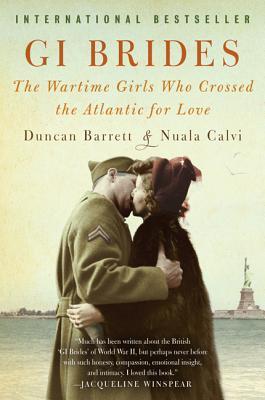
4. GI Brides: The Wartime Girls Who Crossed the Atlantic for Love by Duncan Barrett and Nuala Calvi for TLC Book Tours in September.

The “friendly invasion” of Britain by over a million American G.I.s bewitched a generation of young women deprived of male company during the Second World War. With their exotic accents, smart uniforms, and aura of Hollywood glamour, the G.I.s easily conquered their hearts, leaving British boys fighting abroad green with envy. But for girls like Sylvia, Margaret, Gwendolyn, and even the skeptical Rae, American soldiers offered something even more tantalizing than chocolate, chewing gum, and nylon stockings: an escape route from Blitz-ravaged Britain, an opportunity for a new life in affluent, modern America.

Through the stories of these four women, G.I. Brides illuminates the experiences of war brides who found themselves in a foreign culture thousands of miles away from family and friends, with men they hardly knew. Some struggled with the isolation of life in rural America, or found their soldier less than heroic in civilian life. But most persevered, determined to turn their wartime romance into a lifelong love affair, and prove to those back home that a Hollywood ending of their own was possible.

What did you receive?

270th Virtual Poetry Circle

Welcome to the 270th Virtual Poetry Circle!

Remember, this is just for fun and is not meant to be stressful.

Keep in mind what Molly Peacock’s book suggested.

Look at a line, a stanza, sentences, and images; describe what you like or don’t like; and offer an opinion. If you missed my review of her book, check it out here.

Today’s poem is from Carl Sandburg, recited by Christian DeKett:

I am the People, the Mob

I am the people—the mob—the crowd—the mass.
Do you know that all the great work of the world is done through me?
I am the workingman, the inventor, the maker of the world’s food and
clothes.
I am the audience that witnesses history. The Napoleons come from me
and the Lincolns. They die. And then I send forth more Napoleons
and Lincolns.
I am the seed ground. I am a prairie that will stand for much plowing.
Terrible storms pass over me. I forget. The best of me is sucked out
and wasted. I forget. Everything but Death comes to me and makes
me work and give up what I have. And I forget.
Sometimes I growl, shake myself and spatter a few red drops for history
to remember. Then—I forget.
When I, the People, learn to remember, when I, the People, use the
lessons of yesterday and no longer forget who robbed me last year,
who played me for a fool—then there will be no speaker in all the
world say the name: “The People,” with any fleck of a sneer in his
voice or any far-off smile of derision.
The mob—the crowd—the mass—will arrive then.

What did you think?

Guest Review: Canyon in the Body by Lan Lan, translated by Fiona Sze-Lorrain

Erica Goss is a talented poet, whose Wild Place poetry collection I loved (my review) and who was the Poet Laureate for Los Gatos 2013-14, has offered up her talents today as a reviewer.  She also has a new book, Vibrant Words: Ideas and Inspirations for Poets, that was published in March this year.

Her video poems, 12 Moons, also have appeared at Atticus Review:

Today, she’ll be reviewing Canyon in the Body by Lan Lan, translated by Fiona Sze-Lorrain (Zephyr Press, 2014, USA).  “Lan Lan is considered one of today’s most influential Chinese lyrical poets. Her work has been translated into 10 languages. She is much-awarded in China, and appears often at international poetry festivals. Canyon in the Body is her first book to appear in English,” says Goss.

Without further ado, please give her a warm welcome:

In her speech at the 2013 National Book Awards ceremony, Mary Szybist stated “There’s plenty that poetry cannot do, but the miracle, of course, is how much it can do, how much it does do. So often I think I know myself, only to discover in a poem a difference, an otherness that resonates, where I find myself, as Wallace Stevens once put it, ‘more truly and more strange.’” The poems in Canyon in the Body create an environment where we also find ourselves “more truly and more strange,” an experience that only a certain type of poetry delivers.

Lan Lan accomplishes this as much by what she leaves out as by what she includes. Her poems invite the reader into a series of microscopic moments, honed and spare, yet resonant with layers of meaning. Her diction seems direct, even simple, but simmering in that simple language is a spirit of rebellion, even violence.

Consider “Dream, Dream:”

My loosened hand holds you tight
The door is shut for you to pass.

You’ve already found 
silence in my body.

I fear…in our gaze
to contort   and shrink

The speaker’s “loosened hand” holds tight, while a closed door invites passage. She successfully captures the transition between dream and consciousness, intertwining opposing ideas instead of contrasting them. She uses this technique often and with skill throughout the book.

In “Startle,” the direct language of the poem plays against its cryptic sentences:

Startle

You’re asleep
dreaming      running
Stars in the sky as the tides rise

Everything as one thing
You’re dreaming      running
Perhaps it’s real
I watch your eyelashes tremble

Your hand tells me what I’m becoming:
               woman.
Neither a flower
nor an anonymous poem
--is this also real?
When you help a woman deliver herself
I’ve no idea
she was never born
waiting so long for your password in this night—

The poem gives off a kind of heat, a compression of logic that makes leaping the only choice. It exudes a fierce delicacy, like a cactus flower or a rose among thorns. Her poems about the natural world create mysterious landscapes that feel quickly glimpsed, as if from a moving vehicle, as in these lines from “Will There Be a Tree:”

What enters this instant includes
eyes more than eyes
mountain chains more than mountain chains
a scar on a tree trunk
omens from sparks remaining on a page
a man rolling an iron hoop from his childhood
		running through this night

The reader enters the instant in the poem, the flash of power from the mountain juxtaposed with the vulnerability of the scarred tree trunk, ending with a human being engaged in memory or dream. The repetition of “eyes” and “mountain chains” intensifies the affect.

Lan Lan’s poems are not what they seem at first, and resist attempts to explain or paraphrase. They are pared down to a separation of essentials, with the reader needing to make leaps of understanding or meaning within the poem’s structure. There are chasms between these lines, deep spaces of potential. Fiona Sze-Lorrain, the collection’s translator, leaves those chasms intact, moving with deft confidence from line to line and poem to poem. She is our able guide in the strange, intriguing world of these poems.

In these lines from “Wild Sunflower,” a flower is a metaphor for passing time:

Old past veiled in sorrow, for whom
have I died once more?

Untrue wild sunflower. Untrue
singing.
A lethal thorn of autumn wind pricks my chest.

When I finished the book, I felt like I had a splinter lodged in my finger, the tip of which I could feel every time I touched something. Lan Lan’s poems are sharp and tough, and they take up residence in the reader’s mind for a long time. They open a world of “otherness,” to quote from Mary Szybist. As Lan Lan writes in “One Thing,” “I thank the darkness for listening.”

Thanks, Erica, for sharing your thoughts on this collection. I wonder too about these poems and that otherness; it is as if Lan Lan is asking readers to jump — jump into that otherness!

Twelve Dancing Unicorns by Alissa Heyman

Source: Sterling Children’s Books
Hardcover, 32 pages
I am an Amazon Affiliate

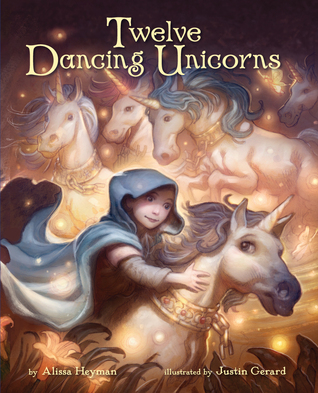
Twelve Dancing Unicorns by Alissa Heyman, illustrated by Justin Gerard, is gorgeously illustrated. Like paintings that leap off the page by some magical power, these unicorns will dance into the hearts and dreams of any little girl.  Heyman adapts her fairytale from Grimm’s “Twelve Dancing Princesses,” and here the little girl loves the unicorns so much that she is willing to help them in any way she can.  When the King says that he will grant any wish to the person who finds out how the chains are broken each night by the unicorns in his corral, she is determined to do just that.  While there are few obstacles in the girl’s way and the text can be in huge paragraphs for little kids, Heyman does a great job of showing the girl’s determination and love for the unicorns in a few pages.

The illustrations are fantastic; it’s like stepping into another world, but the unicorns look as if they could be real animals.  The book is clearly for older learning readers probably ages 6+, as some of the words will require assistance from parents and older readers and the paragraphs are longer than in other picture books.  While the story has little that’s new to offer and is not in the poetry-like prose my daughter enjoys most, the story will seem new to younger readers and engage them with its fantastic world popping off the pages.  Twelve Dancing Unicorns by Alissa Heyman, illustrated by Justin Gerard, is visually stunning and shows that young girls can not only solve problems but achieve their goals, no matter how overwhelming they may seem.

Follow the Twelve Dancing Unicorns blog tour tomorrow on Kindred Spirit Mommy.

About the Author:

Alissa Heyman is a freelance writer who edited The Best Poems of the English Language (Mud Puddle Books). Her poems have appeared in the St. Petersburg Review, Lyric, and Quarto, and she has adapted The Big Book of… series for Sterling Publishing, which includes The Big Book of Horror, The Big Book of Fairies, and The Big Book of Pirates. Alissa lives in New York City where she also curates the Perfect Sense poetry reading series at the Cornelia Street Café.

About the Illustrator:

Justin Gerard has done illustration for DreamWorks, Warner Brothers, Disney, HarperCollins, Penguin, Little, Brown, and others. The Society of Illustrators featured his illustration “Beowulf and Grendel” in the 50th Annual of American Illustration, from his IPPY Award-winning book, Beowulf, Book I: Grendel the Ghastly. Justin lives in Greenville, SC.

54th book for 2014 New Author Reading Challenge.

Stella Bain by Anita Shreve

Source: Gift from Anna
Hardcover, 272 pgs
On Amazon and on Kobo

Stella Bain by Anita Shreve, which was the War Through the Generations August read-a-long book, is set during WWI.  When the novel opens, a woman who has been wounded finds herself in a field hospital in Marne, France, in 1916.  She was found in the uniform of a British nurse’s aide, but has an American accent and cannot remember her own name.  As she grapples with her lost memory and identity, she plucks Stella Bain from her mind and begins to call herself such, even though she knows it may not be her real name.  Stella continues to work alongside the French women near the front and eventually volunteers as an ambulance driver.  Her jumbled mind takes a back seat to her duties at the front, but eventually, she feels drawn to England and the Admiralty, though she’s not sure what she’ll find there or if she will uncover anything about who she was.

“‘No.  Nothing is normal.  How can it be? I don’t yet know who I am.  I may discover, when I know my identity, that I’m not a good person at all.  I fear that I’m not.  I seek my identity, and yet I’m afraid of it.  But I’m more afraid of never knowing.'” (page 75)

Stella learns her true identity, and her true name is a near-anagram of the one she had chosen for herself.  When she learns of her identity and all that she frantically left behind in the United States, she must make passage home.  While Dr. Bridge and his wife, Lily, helped her to be calm and recover her name and identity, they are left behind in England without so much as a goodbye from her.  However, she never forgets their kindness and through letters, readers are given insight into her gratitude.  Shreve’s prose in this novel is distant.  While we see Stella’s point of view, readers are still distanced from her, which could be intentional given the absence of her memories and true identity.  In many ways, as the mystery unravels and readers learn more about the woman without a name, she becomes an everywoman for those women leaving during the early 1900s — caged in by marriage and family, but yet yearning for something outside of their home and legally allowed to own their own property.

Stella Bain by Anita Shreve is not just about a woman with shell shock or a lost memory, but a woman in an era where the modern world was just beginning to take shape.  A world in which women were fighting for independence from their families and husbands, to live lives as they wished to without seeking permission or approval.  Overall, while the ending could leave some readers wanting more, the novel would make for an excellent book club discussion.

About the Author:

Anita Shreve is an American writer. The daughter of an airline pilot and a homemaker, she graduated from Dedham High School in Massachusetts, attended Tufts University and began writing while working as a high school teacher in Reading, MA.

Interested in the read-a-long discussions at War Through the Generations, go here; though there will be spoilers.

17th book for 2014 European Reading Challenge(Set in France, England)


27th book for 2014 Historical Fiction Reading Challenge.


22nd book (WWI) for the 2014 War Challenge With a Twist.