Quantcast

274th Virtual Poetry Circle

Welcome to the 274th Virtual Poetry Circle!

Remember, this is just for fun and is not meant to be stressful.

Keep in mind what Molly Peacock’s book suggested.

Look at a line, a stanza, sentences, and images; describe what you like or don’t like; and offer an opinion. If you missed my review of her book, check it out here.

Today’s poem is from Howard Nemerov, recited by Olivia Cacciatore:

Writing

The cursive crawl, the squared-off characters   
these by themselves delight, even without   
a meaning, in a foreign language, in
Chinese, for instance, or when skaters curve   
all day across the lake, scoring their white   
records in ice. Being intelligible,
these winding ways with their audacities   
and delicate hesitations, they become   
miraculous, so intimately, out there
at the pen’s point or brush’s tip, do world   
and spirit wed. The small bones of the wrist   
balance against great skeletons of stars   
exactly; the blind bat surveys his way   
by echo alone. Still, the point of style   
is character. The universe induces
a different tremor in every hand, from the   
check-forger’s to that of the Emperor
Hui Tsung, who called his own calligraphy   
the ‘Slender Gold.’ A nervous man
writes nervously of a nervous world, and so on.

Miraculous. It is as though the world
were a great writing. Having said so much,   
let us allow there is more to the world   
than writing: continental faults are not   
bare convoluted fissures in the brain.   
Not only must the skaters soon go home;   
also the hard inscription of their skates
is scored across the open water, which long   
remembers nothing, neither wind nor wake.

What do you think?

The Other Girl by Pam Jenoff

Source: NetGalley/Kindle
ebook, 21 pages
I am an Amazon Affiliate

The Other Girl by Pam Jenoff is a complementary story to her new novel, The Winter Guest (my review), in which Maria finds herself married and estranged from her father in rural Biekowice, Poland, during WWII.  Maria, who is married to Piotr, finds that she is an outsider at her in-laws home, and is unable to share even her sense of loss with them after he was conscripted by the Germans.  She fills her days avoiding the scrutiny of her mother-in-law, and dreaming about what life will be like when her husband returns.  She feels alone now that she’s severed herself from her father, whom she caught selling information to the Nazis.  However, her father’s betrayal is the least of the secrets she will uncover.

“War had nipped at the edges of their tiny village, Biekowice, changing little things first, like the requirement of registration cards.  Later had come the food requisitioning that left the market so bare.  Piotr’s family had not been affected as badly as most — the farm produced enough simple fare to keep their stomachs full.”

While she lives in relative comfort, Maria must remain strong for herself and a young Jewish girls she discovers hiding in the family barn.  Maria is a young wife who is still finding her place in her new family, while at the same time trying to make sense of the families around her who turn in their neighbors or make other deals with the Nazis to survive.  When she is faced with the dilemma of a little Jewish girl, it is clear that her father’s betrayal propels her to take a different action.  The Other Girl by Pam Jenoff expounds upon a minor character in her novel, The Winter Guest, giving readers a glimpse into how much the paranoia and fear had begun to permeate even the smallest villages as Nazis traipsed through the city squares and fought through the countryside.  It’s too bad that this story is so short; it would make a good novel.

About the Author:

Pam Jenoff was born in Maryland and raised outside Philadelphia. She attended George Washington University in Washington, D.C., and Cambridge University in England. Upon receiving her master’s in history from Cambridge, she accepted an appointment as Special Assistant to the Secretary of the Army. The position provided a unique opportunity to witness and participate in operations at the most senior levels of government, including helping the families of the Pan Am Flight 103 victims secure their memorial at Arlington National Cemetery, observing recovery efforts at the site of the Oklahoma City bombing and attending ceremonies to commemorate the fiftieth anniversary of World War II at sites such as Bastogne and Corregidor.  Visit her Website and Facebook page.

22nd book for 2014 European Reading Challenge; (Set in Poland)


32nd book for 2014 Historical Fiction Reading Challenge.


27th book (WWII) for the 2014 War Challenge With a Twist.

The Winter Guest by Pam Jenoff

Source: Diary of an Eccentric
Paperback, 352 pages
On Amazon and on Kobo

The Winter Guest by Pam Jenoff explores the bonds between sisters, particularly twins, and how those bonds can be tested and crack beneath the pressures of war and persecution.  The Nowak twins live in a small fictitious town in Poland, Biekowice, and are charged with raising their two younger sisters and brother after the death of their father.  Ruth is considered the more feminine and nurturing of the sisters, while Helena was adventurous, gathering wood and setting animal traps with their father from a young age.  Ruth was the first to fall in love and have her heart broken, and this heartbreak helped to define her views on family and loyalty, while Helena has yet to fall in love and does the best she can to provide for the family as the Nazis move across Poland and take over not only Krakow, but smaller villages along the way.

“As I stroll beneath the timeless canopy of clouds, the noises of the highway and the planes overhead fade.  I am no longer shuffling and bent, but a young woman striding upward through the woods, surrounded by those who once walked with me.”  (page 8 ARC)

Jenoff is a talented story-teller and her ability to transport readers into the harsh conditions of a rural town in Poland during WWII is nothing short of miraculous.  Readers will feel the biting cold, the harsh stares of neighbors looking for information to sell to the Nazis to get ahead, and feel the warmth of the Nowak family even as it struggles to stay together.  Ruth weighs loyalty above everything, while Helena places her family’s happiness above her own for so long that when she sees happiness for herself within her grasp, she wants to hold it close and not have to share it.  Like all sisters, Ruth and Helena share the burdens of bringing up their siblings alone, keeping food on the table and checking on their mother who is in a Krakow hospital.

Helena stumbles upon an American paratrooper in the woods and the Nowak family’s trajectory becomes skewed.  Jenoff has created twin sisters who are connected but seeking their own individuality while keeping their family together.  These dynamic women must face their own fears, as well as the reality of the WWII knocks on their door, literally.  The Winter Guest by Pam Jenoff demonstrates how the unexpected can be a blessing and a curse, how families can pull together even when they don’t really like one another at that moment, and how guilt can compel us forward to make things right.

This book was phenomenal, well told, and would be a great pick for book clubs — also it is likely to make the 2014 Best of list.

About the Author:

Pam Jenoff was born in Maryland and raised outside Philadelphia. She attended George Washington University in Washington, D.C., and Cambridge University in England. Upon receiving her master’s in history from Cambridge, she accepted an appointment as Special Assistant to the Secretary of the Army. The position provided a unique opportunity to witness and participate in operations at the most senior levels of government, including helping the families of the Pan Am Flight 103 victims secure their memorial at Arlington National Cemetery, observing recovery efforts at the site of the Oklahoma City bombing and attending ceremonies to commemorate the fiftieth anniversary of World War II at sites such as Bastogne and Corregidor.  Visit her Website and Facebook page.

21st book for 2014 European Reading Challenge; (Set in Poland)


31st book for 2014 Historical Fiction Reading Challenge.


26th book (WWII) for the 2014 War Challenge With a Twist.

Whiny Whiny Rhino by McBoop

Source: Blue Blanket Publishing and iRead Book Tours
Paperback, 34 pages
I am an Amazon Affiliate


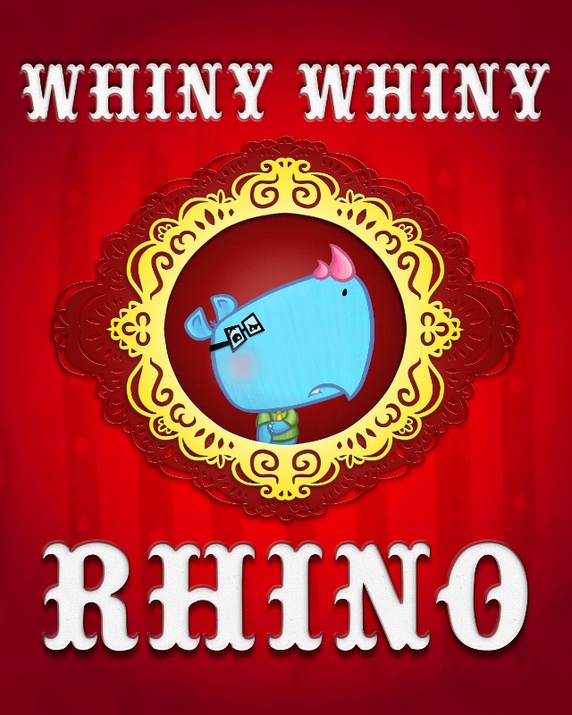
Whiny Whiny Rhino by McBoop, the father-daughter team of Carmin Iadonisi & Amanda Iadonisi-Word, is a vividly illustrated book about overcoming your fears by looking inside and taking a leap for fun.  Tiny Rhino has three older brothers, and they are rough and tough, often telling Tiny that he’s too whiny and scared all of the time.  They say that he needs to be tough to make it out in the world.  He would rather stay inside and read, but one day, he decides he’s had enough of his brothers’ teasing and leaves the house.  Rather than jump at the opportunities presented to him by his friends, Tiny stays away from all the fun.  When he’s in bed thinking about his day and how much fun he didn’t have, Tiny comes to a realization that he needs to be more adventurous.

My daughter was captivated by the vivid images and the fun Tiny encountered.  Her favorite pictures were Tiny’s injured foot and when he’s in bed dreaming about becoming a superhero with a cape.  With easy rhymes, my child followed the story with little confusion and she wasn’t easily distracted from the story as we read and looked at all the pictures.  Whiny Whiny Rhino by McBoop, the father-daughter team of Carmin Iadonisi & Amanda Iadonisi-Word, is about taking a chance, letting go of anxieties, and take life one experience at a time.  These are good lessons for kids to learn, especially as most everything they encounter is new to them.

About the Authors:

McBoop is the creative team of Carmin Iadonisi & Amanda Iadonisi-Word. This father-daughter duo co-wrote and illustrated Whiny Whiny Rhino. They currently live in New England where they enjoy making art, reading comics, playing board games, eating fancy chocolate and whining about the weather.  Connect with them on Facebook, Twitter, and through their Website.

64th book for 2014 New Author Reading Challenge.

This Is How I’d Love You by Hazel Woods

Source: Penguin
Paperback, 320 pages
On Amazon and on Kobo

This Is How I’d Love You by Hazel Woods is a WWI novel set in 1917 that demonstrates the power of the written word.  New York Times columnist Sacha Dench, who graciously agrees to be a pen-pal and chess opponent to Charles Reid, is forced to resign from his position as sentiment in the United States leans more toward entering the war than remaining isolated from it.  He and his daughter, Hensley, leave quickly for Hillsboro, New Mexico, to take up the residence of a former mine supervisor.  Dench’s letters to Reid are philosophical debates about the justice of the war and its final outcome, but they are also a test of wills on a chess board that mirror those tensions.  Hensley is intrigued by the letter and utterly infatuated with a play director in New York City, but when she’s forced to decide between staying in New York with her brother or go to New Mexico, she chooses to leave.  Like the notes in the margins of her father’s letters, her life is lived on the outskirts of the proper role she is meant to play as a young 17-year-old woman without a mother.

“Mr. Dench has taken one of Charles’s pawns in the third move of the game, their bishops facing one another and the next move of utter importance.  Charles must be wary of the temptation to play too aggressively, putting his own pieces at risk in the next turn, which, he senses, is probably his opponent’s strategy.  A classic lure.  But playing like this, without body language or eye contact, is a new challenge.” (page 5 ARC)

It is striking how Woods uses the game of chase to depict the art of war on many levels, from the war between Dench and Reid’s competing philosophies to the difficulties in playing chess without the social cues to guide him as they would in hand-to-hand combat.  Reid is not so much a soldier as an ambulance driver from the United States who signed up to make something of his life, rather than live the life expected of him by his rich parents.  While he finds his actions independent, he is also aware as the war goes on just how foolhardy the decision may have been.  Feeling adrift on foreign fronts, Reid holds onto Dench’s letters and later the secret correspondence he has with Hensley as a lifeline.  But her life is far from as simple as she would like him to believe in their forced exile.

“By the end, the lead had become so dull that his signature is hardly more than a thick looping smudge.  Even so, Hennie moves her index finger across the page, mimicking the script, slowing especially over his name, until she can trace his signature perfectly.  Inhabiting his body, exiting her own, she crouches down under the table, imaging the cramped feel of the cellar, the roughness of chapped lips, the stale smell of urine on her clothes, the sound of artillery just outside.”  (page 71 ARC)

Hensley is living in the world of their letters as much as he is, but soon she is forced to make a choice — not once, but twice — that could change the course of her life forever.  This Is How I’d Love You by Hazel Woods explores the power of letters, the devastation of war and grief, and the societal pressures to which we can succumb or fight against.  Woods has made WWI vivid and gruesome as it must have been, demonstrating the irreparable harm that soldiers may face but also the inner strength it requires for them to move forward and to continue doing so even when they return home.  Expectations should be their own and not imposed upon by others, and only through compassion and love can these men soldier onward.

About the Author:

HAZEL WOODS lives in New Mexico with her husband and two children.

30th book for 2014 Historical Fiction Reading Challenge.


20th book for 2014 European Reading Challenge; (Set in France)


25th book (WWI) for the 2014 War Challenge With a Twist.


63rd book for 2014 New Author Reading Challenge.

Mailbox Monday #290

Mailbox Monday, created by Marcia at To Be Continued, formerly The Printed Page, has a permanent home at its own blog.

To check out what everyone has received over the last week, visit the blog and check out the links.  Leave yours too.

Also, each week, Leslie, Vicki, and I will share the Books that Caught Our Eye from everyone’s weekly links.

Here’s what I received:

1.  Remember The Sun: Poems of Nature and Inspiration by Melanie Simms for review from the poet.

Poems on Nature and Inspiration This collection of poems by Melanie Simms (all previously published in magazines, newspapers and poetry journals) covers such themes as Pennsylvania place poetry, inspirational poetry, and reflections on nature and love. Remember the Sun: Poems on Nature and Inspiration offers a wide variety of poems to suit the diverse tastes of the poetic palette. This hardcover volume is 50 pages with numerous photographs.


2.  There’s a Pig in my Class! by Johanna Thydell and illustrated by Charlotte Ramel for review.

A lonely pig dressed and disguised as a student sneaks into school where he enjoys lunchtime and making new friends in this story that expands on the definition of inclusion.


What did you get in your mailbox, virtual or otherwise?

273rd Virtual Poetry Circle

Welcome to the 273rd Virtual Poetry Circle!

Remember, this is just for fun and is not meant to be stressful.

Keep in mind what Molly Peacock’s book suggested.

Look at a line, a stanza, sentences, and images; describe what you like or don’t like; and offer an opinion. If you missed my review of her book, check it out here.

Today’s poem is from Shirley Geok-Lin Lim, recited by Shara Gunawan:

Learning to Love America

because it has no pure products

because the Pacific Ocean sweeps along the coastline
because the water of the ocean is cold
and because land is better than ocean

because I say we rather than they

because I live in California
I have eaten fresh artichokes
and jacaranda bloom in April and May

because my senses have caught up with my body
my breath with the air it swallows
my hunger with my mouth

because I walk barefoot in my house

because I have nursed my son at my breast
because he is a strong American boy
because I have seen his eyes redden when he is asked who he is
because he answers I don’t know

because to have a son is to have a country
because my son will bury me here
because countries are in our blood and we bleed them

because it is late and too late to change my mind
because it is time.

What do you think?

It’s the Great Pumpkin, Charlie Brown by Lee Mendelson and Bill Melendez & Giveaway

Source: Dey Street Books
Hardcover, 160 pages
I am an Amazon Affiliate

It’s the Great Pumpkin, Charlie Brown: The Making of a Television Classic by Lee Mendelson and Bill Melendez provides an inside look at how the television special about the great pumpkin and Charlie Brown came to be.  The prologue illustrates just how engrained Charlie Brown and the gang’s antics are in our popular culture, as politicians recently started using iconic scenes from the comics and movies to illustrate their own disappointments.

When Charles Schulz, Mendelson and Melendez created the Christmas special, they had low expectations that it would do well, but when it ranked #2 in 1965, they figured they earned a little confidence from the network, CBS.  The network executives, however, were still skeptical and were still not convinced even after the creation and success of a second special, Charlie Brown’s All Stars!  The executives basically called on them to create a blockbuster or else.  The recounted brainstorming session with Schulz is fantastic and the back-and-forth is inspiring as the animator and the creator of the comic bounce ideas around the room with Mendelson.

Included in the book are some great strips from the newspaper, photos of the creative team and actors, and the music sheets.  The book also includes the illustrated script for the special.  It’s the Great Pumpkin, Charlie Brown: The Making of a Television Classic by Lee Mendelson and Bill Melendez is another wonderful keepsake or gift for the Charlie Brown aficionado in your life.  Slightly smaller than coffee table size, but great to put on the shelf, pull out on the holidays, and just share with the family any time.

About the Cartoonist:

Charles M. Schulz, nicknamed Sparky, was an American cartoonist, best known for the comic strip Peanuts. He is widely regarded as one of the most influential cartoonists of all time, cited as a major influence by many later cartoonists.

Giveaway:

For U.S. residents.  Leave a comment below about one of your Halloween or Christmas Traditions and one winner will be chosen to get both books — It’s the Great Pumpkin, Charlie Brown: The Making of a Television Classic and A Charlie Brown Christmas: The Making of a Tradition!

Deadline to enter is Sept. 30, 2014, at 11:59 pm EST.

Other reviews:

A Charlie Brown Christmas: The Making of a Tradition

Blue Moon Rising by Simon R. Green

Source: Public Library
Paperback, 480 pages
On Amazon and on Kobo

Blue Moon Rising by Simon R. Green is an adventure story of kings, castles, dragons, and unicorns whose hero, Rupert, is a second son in line for the throne and dedicated to his duty to the Land even at the expense of his own safety.  On his first quest he is sent to slay a dragon, but what he encounters runs contrary to everything he’s ever heard about quests from the minstrels.  Knowing that he can never rule as king, Rupert is aware that he isn’t meant to return from his quest or if he does, he’s to return with something of value that his bankrupt kingdom can use to fight off the Barons who wish to take control.  Unfortunately, he and his unicorn return with a live dragon, not jewels, and a difficult Princess Julia.

In typical adventure fashion, but with humor, Green creates a world in which the darkness threatens to overtake the Forest Kingdom.  Rupert is a reluctant hero and Princess Julia is the antithesis of feminine royals who care more about dresses and balls.  Harald, the prince next in line for the throne, is charismatic and wily, and he has a reputation with the ladies.  He and his brother are often at odds, though readers will wonder if they would get along better if their father didn’t show preference for Harald over Rupert at every turn or if the kingdom was not in such turmoil politically that factions are vying for their own favorite son to ascend to the throne.  Green populates his novel with a few too many quests when one would have sufficed before the kingdom was threatened by the Darkwood and the Demon Prince.

“For a long while the Court stood silent, shaken by the Astrologer’s dark vision.
‘There must be something we can do,’ said Rupert haltingly.
‘There is,’ said the Astrologer.  ‘Prince Rupert; you must journey to the Dark Tower, and there summon the High Warlock.’
Rupert stared at the Astrologer.
‘I should have volunteered to lead an army against the Demon Prince,’ he said finally.  ‘It would have been safer.'” (page 87)

The dragon doesn’t play much of a role here, but the unicorn seems to be the comic relief for the most part.  The debate between the privilege in royalty and being a peasant is consistent throughout the book, as is the tension between duty and desire.  Despite its wordiness, Blue Moon Rising by Simon R. Green is a keen adventure with humor and plot twists, though some may be predictable and less satisfying than expected.

Unfortunately, the book club discussion for this one was postponed do to some illnesses and other conflicts.

About the Author:

Simon was born in Bradford-on-Avon, Wiltshire, England (where he still resides), in 1955. He has obtained an M.A. in Modern English and American Literature from Leicester University and he also studied history and has a combined Humanities degree. His writing career started in 1973, when he was a student in London. His first actual sale was a story titled Manslayer, back in 1976, but it didn’t appear till much later; Awake, Awake…. was his first sale to a professional editor, in 1979. Furthermore he sold some six or seven stories to semi-pro magazines before that market disappeared practically overnight.

After years of publishers’ rejection letters, he sold an incredible seven novels in 1988, just two days after he started working at Bilbo’s bookshop in Bath (this after three and a half years of being unemployed!). This was followed in 1989 by two more, and a commission to write the bestselling novelization of the Kevin Costner film Robin Hood: Prince of Thieves, which has sold more than 370.000 copies.

62nd book for 2014 New Author Reading Challenge.

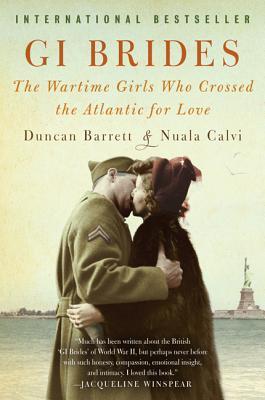
G.I. Brides by Duncan Barrett and Nuala Calvi

tlc tour host

Source: TLC Book Tours and William Morrow
Paperback, 368 pages
On Amazon and on Kobo

G.I. Brides: The Wartime Girls Who Crossed the Atlantic for Love by Duncan Barrett and Nuala Calvi is a biography-memoir hybrid in which the stories of four women who married American soldiers, known as G.I. brides, during WWII are told.  Sylvia Bradley is a bit young and naive but an optimist, while Gwendolyn Rowe is a determined woman.  Rae Brewer is the tomboy to Margaret Boyle’s beauty.  These stories are romantic as these ladies decide to leave the only home and family they have known to marry an American, only to find themselves facing more than just marital challenges.  Culture shock is just one aspect that is well depicted in these stories, especially as the women marry into not only American families, but families that still maintain their old world cultures and traditions — like the Italians big family dinners to the rowdy Irish parties.  As different as their lives had been from each other during WWII, they are vastly different when they reach America.

“During the day, Margaret did her best to get up on deck as much as possible to assuage her seasickness.  Starting out across the endless miles of ocean, she was reminded how cut adrift she had always felt in her life.  Some brides might feel the ache of homesickness, but she had never had a real home to miss.”  (page 98)

“As she packed her bag, she heard a chugging noise coming from outside and looked out of the window.  There in the distance was the menacing outline of a doodlebug passing over hoses opposite.  Then suddenly the noise stopped.  Rae knew what that meant — the flying bomb was about to fall.” (page 114)

Through extensive interviews with these women and their families, Barrett and Calvi have brought to life the home front in England, as these women struggled with rationing and the fear of bombs killing them on the way to work or in their sleep.  As their families struggled, brothers were sent off to fight the Germans, and they found work to support the war effort, these women were introduced to a whole new world outside the cocoon of their family units.  They went to dances with Yanks and volunteered in Red Cross-sponsored facilities, only to find that these Americans were not as crass as they were told by brothers and parents.

“For months Lyn had felt desperate to return home to England, but now she realized that the thing she had been looking for no longer existed.  It was her younger self — that confident, carefree girl who hadn’t had any knocks in life, who could stand on her own two feet …” (page 340)

Once in American, these women must fight another war — a war within themselves.  They feel like outsiders, they struggle to find their place with their new families, and many times they are met with failure.  But even though they long to return to England and walk away, they also realize that they must first stand on their own and learn what they want for themselves.  G.I. Brides: The Wartime Girls Who Crossed the Atlantic for Love by Duncan Barrett and Nuala Calvi may only breathe life into the lives of four G.I. brides from WWII, but it stands to reason that many of those 70,000 brides experienced similar hesitations, failures, and triumphs in their new lives.  Wonderfully told and executed.

About the Authors:

Duncan Barrett studied English at Cambridge and now works as writer and editor, specialising in biography and memoir. He most recently edited The Reluctant Tommy (Macmillan, 2010) a First World War memoir.


Nuala Calvi also studied English and has been a journalist for eight years with a strong interest in community history pieces. She took part in the Streatham Stories project to document the lives and memories of people in South London. They live in South London.


Connect with them through their website.

61st book for 2014 New Author Reading Challenge.


24th book (WWII) for the 2014 War Challenge With a Twist.


19th book for 2014 European Reading Challenge; (Set in England)