Quantcast

Mailbox Monday #318

Mailbox Monday, created by Marcia at To Be Continued, formerly The Printed Page, has a permanent home at its own blog.

To check out what everyone has received over the last week, visit the blog and check out the links.  Leave yours too.

Also, each week, Leslie, Vicki, and I will share the Books that Caught Our Eye from everyone’s weekly links.

Here’s what I received:

1.  The Cherry Harvest by Lucy Sanna from William Morrow for review.

The war has taken a toll on the Christiansen family. With food rationed and money scarce, Charlotte struggles to keep her family well fed. Her teenage daughter, Kate, raises rabbits to earn money for college and dreams of becoming a writer. Her husband, Thomas, struggles to keep the farm going while their son, and most of the other local men, are fighting in Europe.

When their upcoming cherry harvest is threatened, strong-willed Charlotte helps persuade local authorities to allow German war prisoners from a nearby camp to pick the fruit.

But when Thomas befriends one of the prisoners, a teacher named Karl, and invites him to tutor Kate, the implications of Charlotte’s decision become apparent—especially when she finds herself unexpectedly drawn to Karl. So busy are they with the prisoners that Charlotte and Thomas fail to see that Kate is becoming a young woman, with dreams and temptations of her own—including a secret romance with the son of a wealthy, war-profiteering senator. And when their beloved Ben returns home, bitter and injured, bearing an intense hatred of Germans, Charlotte’s secrets threaten to explode their world.

2.  Dark Sparkler by Amber Tamblyn from Harper for review.

The lives of more than twenty-five actresses lost before their time—from Marilyn Monroe to Brittany Murphy—explored in haunting, provocative new work by an acclaimed poet and actress

Amber Tamblyn is both an award-winning film and television actress and an acclaimed poet. As such she is deeply fascinated-and intimately familiar—with the toll exacted from young women whose lives are offered in sacrifice as starlets. The stories of these actresses, both famous and obscure-tragic stories of suicide, murder, obscurity, and other forms of death—inspired this empathic and emotionally charged collection of new poetic work.

Featuring subjects from Marilyn Monroe and Frances Farmer to Dana Plato and Brittany Murphy—and paired with original artwork commissioned for the book by luminaries including David Lynch, Adrian Tome, Marilyn Manson, and Marcel Dzama—Dark Sparkler is a surprising and provocative collection from a young artist of wide-ranging talent, culminating in an extended, confessional epilogue of astonishing candor and poetic command.

3. Hiroshima by John Hersey from the library sale for 50 cents.

On August 6, 1945, Hiroshima was destroyed by the first atom bomb ever dropped on a city. This book, John Hersey’s journalistic masterpiece, tells what happened on that day. Told through the memories of survivors, this timeless, powerful and compassionate document has become a classic “that stirs the conscience of humanity” (The New York Times).


4.  Self-Reliance by Ralph Waldo Emerson, edited by Richard Whelan from the library sale for 50 cents.

A finely honed abridgement of Emerson’s principal essays with an introduction that clarifies the essence of Emerson’s ideas and establishes their relevance to our own troubled era. This is the first truly accessible edition of Emerson’s work, revealing him to be one of America’s wisest teachers.


5. Rachael Ray 2, 4, 6, 8 Great Meals for Couples or Crowds from the library sale for 50 cents.

If you’re like Rachael Ray, mealtime is a time to hang out and reconnect with family and friends. That means you could be making a late dinner for you and your sweetie one night and making brunch for your entire family the next day. No matter how many people join the party, Rachael firmly believes that cooking should be fun, easy–and done in 30 minutes or less.

Transforming recipes for four into recipes for two or eight can be a tricky guessing game. If you use twice the amount of chicken will you have to cook it twice as long? Is it possible to make a satisfying pot of soup for two without having to eat leftovers for a week? What’s the best–and most economical–way to feed a crowd of eight? With Rachael Ray: 2, 4, 6, 8 there’s no need to guess, because Rachael has designed right-sized menus for every occasion, with perfect meals for two, four, six, or eight.
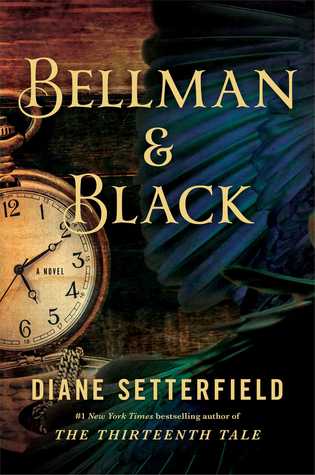
6. Bellman & Black by Diane Setterfield from a friend.

Bellman & Black is a heart-thumpingly perfect ghost story, beautifully and irresistibly written, its ratcheting tension exquisitely calibrated line by line. Its hero is William Bellman, who, as a boy of 11, killed a shiny black rook with a catapult, and who grew up to be someone, his neighbours think, who “could go to the good or the bad.” And indeed, although William Bellman’s life at first seems blessed—he has a happy marriage to a beautiful woman, becomes father to a brood of bright, strong children, and thrives in business—one by one, people around him die. And at each funeral, he is startled to see a strange man in black, smiling at him. At first, the dead are distant relatives, but eventually his own children die, and then his wife, leaving behind only one child, his favourite, Dora. Unhinged by grief, William gets drunk and stumbles to his wife’s fresh grave—and who should be there waiting, but the smiling stranger in black. The stranger has a proposition for William—a mysterious business called “Bellman & Black”.

What did you receive?

Guest Post: On Writing Sonnets by Rebecca Foust

Rebecca Foust‘s collection of sonnets, Paradise Drive, is very reminiscent of the journey taken by Dante in The Divine Comedy, but her pilgrim is taking a modern journey in a world that is focused on money and the superficial and she is in search of something more.

Paradise Drive won the 2015 Press 53 Award for Poetry and as of this date, has attained #1bestseller status at Amazon. About it, Molly Peacock says “Foust drives her Keatsian sensibility straight into the 21st century of terrorism and autism, divorce and yoga, soldiers and syringes, booze and valet parking, determined to prove that truth makes beauty,” and Thomas Lux says “There is great music in these poems, and sonnet after sonnet is masterful. Not since Berryman’s Henry have I been so engaged by a persona.”  Today, Foust has agreed to share with us her experience writing sonnets, one of the more traditional poetic forms and one that many find difficult to write.

Please give her a warm welcome.

I’ve loved sonnets since I was young, appreciating the compression and tension in poems of that form by Shakespeare, Herbert, Donne, Hopkins, Yeats, Milton, Rilke, and Frost. If that seems like a whole lot of dead-white-guy-poets, it’s because that’s what I was exposed to during my high school and college years, so thank God for the erosion of barriers to entry now shaping a new canon, and for organizations like VIDA that continue to keep those doors open.

Later, of course, I found a broader base of sonneteers, delighted to discover poets like Kim Addonizio, Robin Becker, Kim Bridgford, Elizabeth Bishop, Eavan Boland, Anne Bradford, Gwendolyn Brooks, Jehanne Dubrow, Rhina Espaillat, Anna Evans, Annie Finch, R.S. Gwynn, Marilyn Hacker, Robert Hayden, Julie Kane, Claude McKay, Mary Meriam, Molly Peacock, Sylvia Plath, Christina Rossetti, Edna St. Vincent Millay, A.E. Stallings, Ellen Bryant Voigt, and too many others to name here.

When I found myself, after a 30-year hiatus in my writing, in grad school pursuing an MFA, it was to those early sonnets I first returned, amazed that what had moved a moody, restless teenager in the 1970’s could still move a restless, moody woman in her fifties, several decades of marriage, children, and law practice later. As my syllabus expanded, I was amazed by something else: the sheer persistence of the form. Just about every poet I read, it seemed, had at least tried his or her hand at writing sonnets, and I was surprised to learn that edgy modernists and postmodernists like Ezra Pound, William Carlos Williams, e.e. cummings and John Ashbery had written at least a few. And, that contemporary poets like Tony Barnstone, Willis Barnstone, Mark Jarmon, Major Jackson, Troy Jollimore, and Julie Kane were still winning national awards with entire books of sonnets. I was also surprised to see sonnets popping up with regularity in contemporary journals and books, this in a time when “form” was coming to be viewed, first with suspicion and then as a thing to be avoided at all costs.

What accounts for the lasting fascination with a form invented as a sort of parlor game in a Sicilian court eight centuries ago, and why is it relevant now? I took the modern sonnet as the topic for the graduate class I had to teach in my last residency at Warren Wilson and then read sonnet after sonnet, in anthologies and anywhere else I could find them.

I quickly realized that one secret to the longevity of the form is the freedom with which its practitioners have felt to depart from it, so much so that the variations have, over time, become recognized as their own forms. Thus we have Petrarchan sonnets, Elizabethan (Shakespearian) sonnets, Miltonic sonnets, sonnets with more than 14 lines (caudal sonnets, arguably the poems in George Meredith’s Modern Love and John Berryman’s Dream Songs), sonnets with fewer than 14 lines (curtal sonnets like Hopkins’ “Pied Beauty”), and even wholly unrhymed and unmetered 14-liners some call “American Sonnets.” One can detect the shadow of the form in the work of poets as experimental as Brenda Hillman (see, e.g. her poem “Trance”).

What makes a sonnet a sonnet? What are the traditional indicia of the form, and just how many of them can be jettisoned before the thing loses its identity? That inquiry became the subject of my graduate class. In the end, I concluded that sonnet structure is more internal than external, kind of like those tremendous load forces working in opposition that keep a skyscraper standing or an airplane aloft. I hoped to inspire in my students my awe for the infinite elasticity of this deceptively “fixed” form, how you can infuse it with your own voice and subjects to, in the words of Monica Van Duyn, “make it your own.”

I tried to make it my own in my fifth book, Paradise Drive, which consists wholly of sonnets linked in a narrative and featuring a protagonist named Pilgrim on a journey, actual and metaphoric, from despair in rust-belt Pennsylvania to despair in the glittering, affluent suburbs of Marin County, California. I like to say that Pilgrim is six parts me and four parts wholly-made-up, and that the book is populated with composites of people I’ve met in my own life while living the life described by Pilgrim’s journey.

While writing the poems for Paradise Drive I was thinking about the idea that poetry should be for all people, not just academics or other poets, and that what occupies people universally is story, especially story rooted in structure. In my book, the scaffolding is provided by the sonnet form. Its core poems came in one great insomniac rush in 2008 when, just after having read James Cummins’ darkly funny book of narratively-linked sestinas, The Whole Truth, I wrote about 40 sonnets without stopping. They were terrible, of course, and the few that made it into Paradise Drive had to be revised maybe a hundred or more times.

But Cummins showed me a way to weave comedy and tragedy into the language of contemporary vernacular and pop culture, and in this, he seemed to me a modern Shakespeare. “It can be alive” is what I kept thinking. Poetry can be alive.” Another triggering factor was the recent series of suicides of three women in Marin County, all housewives and mothers like me. What was going on, I wondered, in this place—Marin County—that I and most people thought of as “Paradise?” Over the next few years the poems continued to pour out, always in sonnet form, and eventually aligned themselves along the arc that is Paradise Drive. I hope that readers of all kinds—from people like my mother who never went to college but loved poetry to people who have devoted their lives and educations to its study—will find points of entry and enjoy the book.

About the Poet:

Rebecca Foust’s other books include All That Gorgeous Pitiless Song (Many Mountains Moving Book Prize), God, Seed (2010 Foreword Book of the Year Award and Massachusetts Book Award finalist), and two chapbooks that won the Robert Phillips Poetry Chapbook Prize in 2007 and 2008. The 2014 Dartmouth Poet in Residence, Foust is the recipient of fellowships from The Frost Place and the MacDowell Arts Colony. Her essay, “Venn Diagram” won the 2014 Constance Rooke Creative Nonfiction Award and was published in The Malahat Review.

You can order Paradise Drive at Press53.

301st Virtual Poetry Circle

Welcome to the 301st Virtual Poetry Circle!

Remember, this is just for fun and is not meant to be stressful.

Keep in mind what Molly Peacock’s book suggested.

Look at a line, a stanza, sentences, and images; describe what you like or don’t like; and offer an opinion. If you missed my review of her book, check it out here.

Today’s poem is in honor of the new postage stamp for Maya Angelou, she recites it here below:

I have posted this poem’s text previously, but I found this powerful when she recites her own poem.

What are your thoughts?

Haiku Friday! #2

I’ve decided to write at least 30 haiku for National Poetry Month 2015.

I’ve been writing them if not daily, but in groups of three or more.  If you missed my first three haiku from this month, feel free to check them out.

For those of you who are wondering about haiku — beyond the 5-7-5 syllable count — please visit Parrish Lantern‘s post on the form.

If you’ve written or read any great poems this month, please feel free to share them in the comments.

Here are some of my most recent haiku pieces:

Feet tap concrete beat
platform dance, boogie ants
wait, pause, pulse nearby

My voice carries out
across the tunnel, aloud
silent in dark stillness.

Boxed cereal line
array of colors, contents
wait for cockroaches.

HOV fast lane
two or more, comfy seats
inflated, plastic girl

Guest Post: Poetry Begins with a Look Inside by Emma Eden Ramos

Emma Eden Ramos — the author of Still, At Your Door: A Fictional Memoir, The Realm of the Lost, and Three Women: A Poetic Triptych and Selected Poems — contacted me long before the start of National Poetry Month and asked me if I was organizing another blog tour.  I have been such a basket case about blog stuff and trying to keep on top of everyone and everything, but her reminder put me into full gear.  I want to thank her for that.

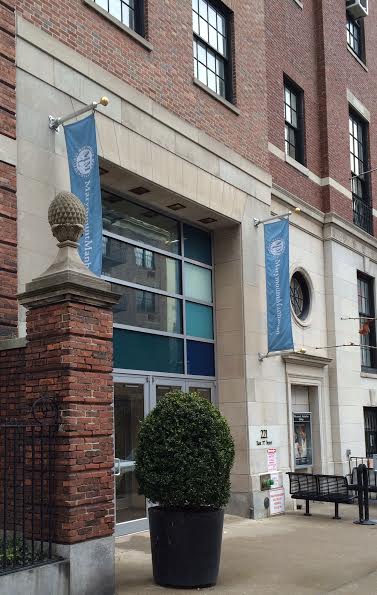
Please give her a warm welcome as she talks with members of her Alma Mater, Marymount Manhattan College.

“Studying poetry,” Cameron Kelsall explains, “expands and, in some cases, explodes your understanding of language.” Kelsall graduated from Marymount Manhattan College in 2010 with a major in English and a minor in creative writing. Kelsall went on to pursue an MFA in poetry, and now has his work published in a number of well-known periodicals such as The Eunoia Review, Octave Magazine, Drunken Boat and Foothill: A Journal of Poetry.

MMCMarymount Manhattan College—or MMC, as it’s affectionately called—has become a haven for aspiring poets who, like Cameron Kelsall, find their voices as undergraduates, then go on to thrive in the literary community. With guidance from Dr. Jerry Williams, Pushcart nominee and editor of It’s Not You, It’s Me: The Poetry of Breakup, students explore the craft of writing and, in many instances, gain insight into their own personal experiences. As Sally Stroud, a junior who minors in creative writing, writes, “I’ve learned a lot about myself as a person. Poetry forces you to look inside yourself. You might not like what you see, but in the end, a beautiful piece can be crafted.” Some undergraduate institutions offer creative writing as a major. While students at MMC cannot major in creative writing, they have the option, along with declaring the discipline as a minor, of writing and/or editing for The Marymount Manhattan Review.

MMCReviewAs NewPages.com points out on its page dedicated to undergraduate writing programs across America, Marymount Manhattan College has a campus literary magazine called The Marymount Manhattan Review. The review includes poems, short stories and short nonfiction pieces written by Marymount students. Below is a poem selected from last year’s issue of The Marymount Manhattan Review. This year’s issue will be released in early May.

Drawl
By Leisa Loan

The Southern Illinois state line made me feel
like I lived three separate lives,
all on separate lawns
as I drove to see Superman and return his library books.

The look on his face could shut the roads down,
empty like an impatient morning before a parade.
I’d put my house right on a flatbed,

Metropolis seems made for settling down,
buying groceries, and chaining up a swing over fried grass.
Let tourists pay money for magnets and museums while I live on water
and the comfort of hula hoops in the garage.

One life saw me poor and aware of it,
wanting to buy something nice for a summer birthday
everything around us colored gold and worth nothing
crop corn you can’t swallow.

But the other lives see envy from the tops of water towers,
watching sunsets like you’d never see anywhere else
thinking—the city is evil, stay here a while, forever.
Busy blood of a confused Yankee finally sitting down
and desperately thinking of space
and where to put a porch swing
in the middle of Manhattan.

*Leisa Loan is from Boston. She is a senior at Marymount Manhattan College. She will be attending graduate school for her MFA in poetry this fall.

Thanks, Emma.  This was a great look at a college that some may never have looked at before, and I think its good to know that there are more creative writing programs available than just the ones at the big schools.

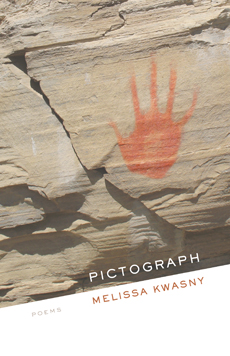
Pictograph: Poems by Melissa Kwasny

Source: Milkweed Editions
Paperback, 80 pgs
I am an Amazon Affiliate

Pictograph: Poems by Melissa Kwasny is a collection of prose poems in which cave drawings, pictographs, and petroglyphs the poet found in Montana come to life.  Readers are looking over her shoulder as she looks closely at these images while she wonders about the people who created them.  We begin near a cave in “Outside the Live Cave Spot” where we observe the opening as “lopsided, irregular dripping down like a lock of hair over someone’s eye.”  Things here are obscured from view, like the picture is not full.  It is just like the narrator of the poem, we get a glimpse of the life that was here, but something has been lost as humanity has moved away from pictorial communication to words on a page and online.  Many of these prose poems examine this sense of loss, a part of our culture that has disappeared into the ether, but it is still with us, as we can imagine and remind ourselves of what those lives must have been like.

From “Pictograph: Bird Site, Maze District” (pg 16)

“We recognize a figure, a brother, a twin, who is punished
for our disabilities, our own strangeness.  We are removed from
our families or we remove ourselves.”

From “Sign With Convergent Nested Elements” (pg 28)

“Sometimes things shine forth with their own
magnitude. Brushstroke of the mountain above the bank. As one ages,
it seems to me, one begins to separate from the body. One sees its frailties, it needs at a remove. Dimly lit, not important to return to.”

The narrator continues on this journey of discovery, which leads her to self-discovery. She examines not only the past, but also the faith it must have taken for those people to have lived and continue onward — a faith that she finds wobbles in herself.  The narrator is discovering more than she bargained for, making connections not only with the past but with the nature present before, like the mountain chickadee who wobbles before her in “The Wounded Bird.”  Here she is identifying with this bird’s struggle for life and noting her own inability to come to terms with god.

Pictograph: Poems by Melissa Kwasny contains some really stunning images and examinations of human evolution and struggle, but readers may connect with just a few poems in the collection at first.  “Kayak,” for instance, is the most removed from the idea of studying these ancient drawings in that the narrator is in the water surrounded by nature, but the effect is similar in that we have the power to blend in or to disturb or even to merely stand out by being ourselves, which can cause others to take flight.

About the Poet:

Melissa Kwasny is the author of the acclaimed poetry collections The Nine Senses (Milkweed Editions, 2011) Reading Novalis in Montana (Milkweed Editions, 2009), The Archival Birds (Bear Star Press, 2000), and Thistle (Lost Horse Press, 2006), which won the Idaho Prize in 2006. She is also the author of Pictograph, forthcoming in 2015. She is the editor of Toward the Open Field: Poets on the Art of Poetry 1800–1950 (Wesleyan University Press, 2004). Widely published in journals, including Willow Springs, Threepenny Review, Ploughshares, Poetry Northwest, Bellingham Review, Crab Orchard Review, and River Styx, she was recently the Richard Hugo Visiting Poet at the University of Montana and a Visiting Writer at the University of Wyoming. Kwasny received the Poetry Society of America’s 2009 Cecil Hemley Award for a series of poems that appears in The Nine Senses. She lives in Jefferson City, Montana.


The Robot Scientist’s Daughter by Jeannine Hall Gailey

Source: the poet
Paperback, 82 pgs
I am an Amazon Affiliate

The Robot Scientist’s Daughter by Jeannine Hall Gailey, which will be on tour with Poetic Book Tours this month, is a collection that blends invention with a cautionary tale.  Imaginary friends and close connections we make as children often help fill in the holes we have because of our own family dynamics, and the robot scientist and his daughter are no different.  While the scientist experiments for the pure joy of discovery, the consequences of his actions often take a backseat even if those consequences are widely devastating.  In the author’s note, Gailey says, “One reason I wrote this book was to raise awareness that nuclear research is never harmless; that the half-life of the pollution from nuclear sites is longer than most human lifespans; that there is, from reading my father’s research as well as my college classes, no truly safe way to store nuclear waste.” (pg. 6)

These poems will definitely make you think deeper about nuclear research and the effects of not only disposing of waste, but also the impact of atomic bombs and nuclear meltdowns.  Some of Gailey’s signature references to comic book characters and myths are present in these poems if you know where to look, like Dr. Manhattan who found himself transformed by an accident in a lab — an accident that resembles one caused by physicist Louis Slotin — and his modified outlook on humanity, which resembles the attacks of conscience felt by Oppenheimer.  While there are references to the Manhattan nuclear project, the bulk of the collection focuses on the Oak Ridge National Laboratory in Tennessee.

America Dreams of Roswell

The forbidding sugar of hot desert sand
and hallucinations of mushroom clouds

linger in a city where you can still get pie
with a fried egg on top, where you might catch

a glimpse of UFO dazzle, even the lampposts bloom
into alien heads, where barbed wire might keep out enemies

of the American dream, where the tiny famous lizard’s legs
cling to sad, solid rock.  On the Trinity site, that sand

turned to green glass.  The scientists were unsure
about igniting the whole earth’s atmosphere, nevertheless

the violet light demanded goggles; the shadows
of ranch houses burned into the ground.

Like most young girls, our narrator tries to fit in, which is hard in a secretive community where the government has sought waivers from its workers and those living and working in the community cannot speak to anyone about the research being done. Even children get a sense of being cloistered, being penned in.  While some poems are about the past and the nuclear research at the Tennessee labs, some poems take a more recent approach in examining the fallout from the Fukushima disaster, the direct result of a earthquake-generated tsunami.  From butterflies born without eyes to the beautiful disaster that is the art of an explosion, the poet calls into question human curiosity and the vanity that sometimes comes with that, in which the scientist believes only good will result from research and experiments, despite historical evidence to the contrary.

The Robot Scientist’s Daughter by Jeannine Hall Gailey has a gift of putting the bigger questions into a more manageable world within her poems.  From “They Do Not Need Rescue,” “No one needs rescue here in America’s Secret City./…/Not the children/dying of leukemia quietly in hospitals funded/by government grants, uncounted because/their numbers might seem damning.//”  We want to bury our sins and hide from the truth, but it cannot be secreted away, no matter how hard we try.

About the Poet:

Jeannine Hall Gailey is the Poet Laureate of Redmond, WA and the author of Becoming the Villainess, She Returns to the Floating World, and Unexplained Fevers, available spring of 2013. Her work has been featured on NPR’s The Writer’s Almanac, Verse Daily, and The Year’s Best Fantasy and Horror. Her poems have appeared in The American Poetry Review, The Iowa Review, and Prairie Schooner. She teaches part-time at National University.


Mailbox Monday #317

Mailbox Monday, created by Marcia at To Be Continued, formerly The Printed Page, has a permanent home at its own blog.

To check out what everyone has received over the last week, visit the blog and check out the links.  Leave yours too.

Also, each week, Leslie, Vicki, and I will share the Books that Caught Our Eye from everyone’s weekly links.

Here’s what I received:

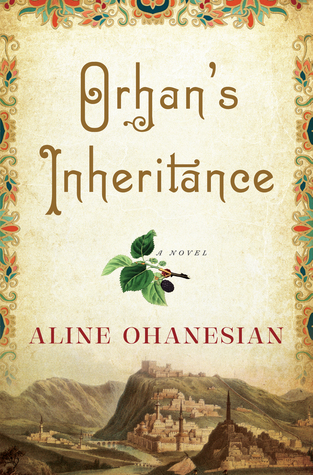
1.  Orphan’s Inheritance by Aline Ohanesian an unexpected surprise from Algonquin Books.

When Orhan’s brilliant and eccentric grandfather Kemal—a man who built a dynasty out of making kilim rugs—is found dead, submerged in a vat of dye, Orhan inherits the decades-old business. But Kemal’s will raises more questions than it answers. He has left the family estate to a stranger thousands of miles away, an aging woman in an Armenian retirement home in Los Angeles. Her existence and secrecy about her past only deepen the mystery of why Orhan’s grandfather willed his home in Turkey to an unknown woman rather than to his own son or grandson.

Left with only Kemal’s ancient sketchbook and intent on righting this injustice, Orhan boards a plane to Los Angeles. There he will not only unearth the story that eighty-seven-year-old Seda so closely guards but discover that Seda’s past now threatens to unravel his future. Her story, if told, has the power to undo the legacy upon which his family has been built.

2.  Beach Town by Mary Kay Andrews an unexpected surprise from Tandem Literary.

Greer Hennessy is a struggling movie location scout. Her last location shoot ended in disaster when a film crew destroyed property on an avocado grove. And Greer ended up with the blame.

Now Greer has been given one more chance—a shot at finding the perfect undiscovered beach town for a big budget movie. She zeroes in on a sleepy Florida panhandle town. There’s one motel, a marina, a long stretch of pristine beach and an old fishing pier with a community casino—which will be perfect for the film’s climax—when the bad guys blow it up in an all-out assault on the townspeople.

Greer slips into town and is ecstatic to find the last unspoilt patch of the Florida gulf coast. She takes a room at the only motel in town, and starts working her charm. However, she finds a formidable obstacle in the town mayor, Eben Thinadeaux. Eben is a born-again environmentalist who’s seen huge damage done to the town by a huge paper company. The bay has only recently been re-born, a fishing industry has sprung up, and Eben has no intention of letting anybody screw with his town again. The only problem is that he finds Greer way too attractive for his own good, and knows that her motivation is in direct conflict with his.

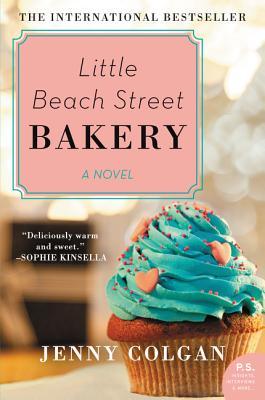
3. Little Beach Street Bakery by Jenny Colgan, an Instagram win from William Morrow.

A quiet seaside resort. An abandoned shop. A small flat. This is what awaits Polly Waterford when she arrives at the Cornish coast, fleeing a ruined relationship.

To keep her mind off her troubles, Polly throws herself into her favorite hobby: making bread. But her relaxing weekend diversion quickly develops into a passion. As she pours her emotions into kneading and pounding the dough, each loaf becomes better than the last. Soon, Polly is working her magic with nuts and seeds, chocolate and sugar, and the local honey–courtesy of a handsome beekeeper. Packed with laughter and emotion, Little Beach Street Bakery is the story of how one woman discovered bright new life where she least expected–a heartwarming, mouthwatering modern-day Chocolat that has already become a massive international bestseller.

4.  Gorillas in Our Midst by Richard Fairgray, illustrated by Terry Jones for review from Skyhorse Publishing.

Gorillas can be hard to spot, because they are masters of disguise and really good at hiding. Gorillas often have jobs where they get to wear masks—that’s why so many gorillas are surgeons, astronauts, scuba divers, and ninjas. There are adult gorillas and kid gorillas. There are even gorillas that go to school with you. You may think you’ve seen a gorilla swinging by before, but it’s much more likely that he was an orangutan—orangutans are terrible at hiding. You will know when there are lots of gorillas living in your midst because the grocery stores will be entirely out of bananas. In fact, you should always carry a banana with you, because you never know when there might be a gorilla around.

5.  Take a Peek with Peek-a-Bear by Jill Mangel Weisfeld, illustrated by Garry Thorburn for review from STRATEGIES Literary Public Relations.

“Take a Peek with Peek-a-Bear” is cleverly designed children’s book filled with colorful imagery and playful poetry that takes you on a exciting interactive adventure with the character Peek-a-Bear. It is the first of a series of “Peek & Play” books.

What did you receive?

300th Virtual Poetry Circle

Welcome to the 300th Virtual Poetry Circle!

Remember, this is just for fun and is not meant to be stressful.

Keep in mind what Molly Peacock’s book suggested.

Look at a line, a stanza, sentences, and images; describe what you like or don’t like; and offer an opinion. If you missed my review of her book, check it out here.

Today’s poem is from Robert Hayden, recited by Shawntay A. Henry:

Frederick Douglass

When it is finally ours, this freedom, this liberty, this beautiful
and terrible thing, needful to man as air,
usable as earth; when it belongs at last to all,
when it is truly instinct, brain matter, diastole, systole,
reflex action; when it is finally won; when it is more
than the gaudy mumbo jumbo of politicians:
this man, this Douglass, this former slave, this Negro
beaten to his knees, exiled, visioning a world
where none is lonely, none hunted, alien,
this man, superb in love and logic, this man
shall be remembered. Oh, not with statues’ rhetoric,
not with legends and poems and wreaths of bronze alone,
but with the lives grown out of his life, the lives
fleshing his dream of the beautiful, needful thing.

What do you think?

Haiku Friday! #1

I’ve written some great haiku so far, and I’m having a great time revisiting this form.

Many of the haiku I’m writing are urban and modern, compared to the nature haiku of the Japanese.

Today is Haiku Friday for National Poetry Month 2015. I hope that you’ll share your haiku or even just your favorite haiku from other poets.

Here are the three I’ve written since April started; feel free to comment below:

Pull tab, sliding door
a sigh of air passes out,
inside motion yells.

Under his armpit
held high, towering over me
an anchor dug deep.

Peel back tin lid slow,
we’re lined up like fish
ready for eating.

***Update***

If you want more about Haiku, Parrish Lantern has a great review up that will help you examine haiku in new ways.