Quantcast

71st Virtual Poetry Circle


Welcome to the 71st Virtual Circle!

Remember, this is just for fun and is not meant to be stressful.

Keep in mind what Molly Peacock’s books suggested. Look at a line, a stanza, sentences, and images; describe what you like or don’t like; and offer an opinion. If you missed my review of her book, check it out here.

Returning to our theme for the month of Veterans and/or war, we’re going to check out a classic poem from Pablo Neruda about the Spanish Civil War.

I Explain a Few Things

You are going to ask: and where are the lilacs?
and the poppy-petalled metaphysics?
and the rain repeatedly spattering
its words and drilling them full
of apertures and birds?
I’ll tell you all the news.

I lived in a suburb,
a suburb of Madrid, with bells,
and clocks, and trees.

From there you could look out
over Castille’s dry face:
a leather ocean.
My house was called
the house of flowers, because in every cranny
geraniums burst: it was
a good-looking house
with its dogs and children.
Remember, Raul?
Eh, Rafel?        Federico, do you remember
from under the ground
my balconies on which
the light of June drowned flowers in your mouth?
Brother, my brother!
Everything
loud with big voices, the salt of merchandises,
pile-ups of palpitating bread,
the stalls of my suburb of Arguelles with its statue
like a drained inkwell in a swirl of hake:
oil flowed into spoons,
a deep baying
of feet and hands swelled in the streets,
metres, litres, the sharp
measure of life,
stacked-up fish,
the texture of roofs with a cold sun in which
the weather vane falters,
the fine, frenzied ivory of potatoes,
wave on wave of tomatoes rolling down the sea.

And one morning all that was burning,
one morning the bonfires
leapt out of the earth
devouring human beings —
and from then on fire,
gunpowder from then on,
and from then on blood.
Bandits with planes and Moors,
bandits with finger-rings and duchesses,
bandits with black friars spattering blessings
came through the sky to kill children
and the blood of children ran through the streets
without fuss, like children’s blood.

Jackals that the jackals would despise,
stones that the dry thistle would bite on and spit out,
vipers that the vipers would abominate!

Face to face with you I have seen the blood
of Spain tower like a tide
to drown you in one wave
of pride and knives!

Treacherous
generals:
see my dead house,
look at broken Spain :
from every house burning metal flows
instead of flowers,
from every socket of Spain
Spain emerges
and from every dead child a rifle with eyes,
and from every crime bullets are born
which will one day find
the bull’s eye of your hearts.

And you’ll ask: why doesn’t his poetry
speak of dreams and leaves
and the great volcanoes of his native land?

Come and see the blood in the streets.
Come and see
The blood in the streets.
Come and see the blood
In the streets!

Let me know your thoughts, ideas, feelings, impressions.  Let’s have a great discussion…pick a line, pick an image, pick a sentence.

I’ve you missed the other Virtual Poetry Circles.  It’s never too late to join the discussion.

Safe From the Sea by Peter Geye

Safe From the Sea by Peter Geye is steeped in rough seas, relationships, and a break in the weather.  From water imagery to isolated wilderness, Geye takes readers on a descriptive and detailed journey of Noah and Olaf Torr’s strained father-son relationship and the past that comes between them.  Set in the northern regions of Minnesota near Lake Superior, Noah must confront his father when time is running out.  While there is doubt about whether his father is truly ill and dying, Noah drops everything in Boston, including his wife Natalie and their fertility issues, to come to his father’s aid.

“He took off his jeans and shirt, his socks and drawers, and stood naked at the end of the dock.  Instantly the sweat that only a few minutes earlier had been dripping from him dried — seemed almost to encase him — as the wind curled around him.  . . .  From the instant he went under he could feel the water seizing him.  Although he’d been anticipating something like it, he could never have expected the grip of the water.  If he hadn’t kicked and pulled for the surface the instant he was submerged he might have ended up sunk.”  (page 134)

Coming back to town brings back all the feelings of abandonment he felt as a child when his father worked on the Great Lakes with the shipping companies.  Readers will be absorbed in the descriptive detail, leaving their living rooms and subway cars and entering the wooded forest near Olaf’s cabin.  The wintry wind will whip through their collars, forcing them to wrap scarves around their necks and feeling the ice freeze on their skin as Noah takes a bath in the lake.

For a first novel, Safe From the Sea has very few flaws with only the relationship between Noah and Natalie feeling a bit confused, changing from a semi-adversarial relationship to a loving one once she too arrives in Minnesota.  Complex relationships abound in this novel and mirror the churning lake waters when storms approach, but calmer waters prevail as the family comes to terms with reality and the love they share.

As deep as the 800 feet of Lake Superior that nearly took Olaf’s life when Noah was a boy, Safe From the Sea will pull readers under and churn them in the undercurrent of Noah’s feelings for his father as he learns to forgive the man scarred by the sinking of the ship Ragnarok, the loss of his colleagues, and the inescapable truth that he was powerless against the elements.  Geye creates strong settings, tense relationships between Olaf, his son, and his daughter, and a story that is utterly absorbing from the first page.

***Thanks to Unbridled Books for sending me a copy for review.  Though I should have finished this book ages ago, it was easy to pick the book back up and become absorbed in the story after dealing with the death of my grandfather.***

About the Author:

Peter Geye received his MFA from the University of New Orleans and his PHD from Western Michigan University, where he was editor of Third Coast. He was born and raised in Minneapolis and continues to live there with his wife and three children.

If you’d like to win an ARC of Safe From the Sea by Peter Geye, please enter the international giveaway.

1.  Leave a comment about why you would like to read this novel.

2.  Name an Unbridled Book title you’ve read and enjoyed.

3.  Blog, Tweet, Facebook, or spread the word about the giveaway.

Deadline is Nov. 30, 2010, at 11:59 PM EST.

This is my 55th book for the 2010 New Authors Reading Challenge.

A Sober Veterans Day

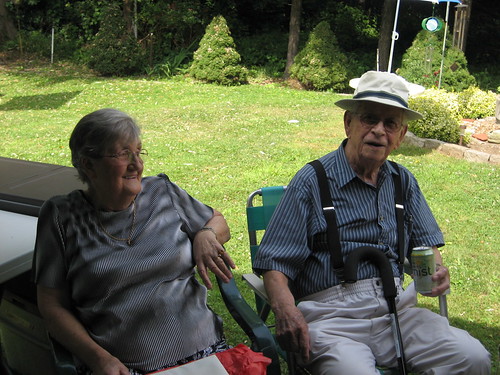
Vova and Vovo

Today is a day of remembrance, honor, and respect for those who fought for this nation and our continued freedom. I’ve read quite a bit about WWII and the Vietnam War because those are the wars that have closely touched my life with a grandfather, Armando, who fought in WWII with the U.S. Army Air Corps. stationed in the AÇORES and an uncle, Louis, who does not talk much about his time in Vietnam, but was with the U.S. Army in unit 218.  Both men were and are proud of their service from what I can tell, though neither has discussed the actual events they witnessed with me.

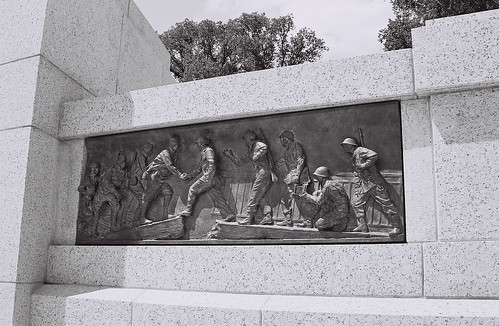
The above picture is how I will remember my grandfather who fought among others of the so-called Greatest Generation and died earlier this year. Unfortunately, he was never able to visit and see the WWII Memorial that commemorated his efforts and those of the other veterans.  I’ve visited the memorial on many occasions and am always awed when I see members of that generation tearing up and sharing memories with their family and friends.

WWII memorial soldiers.jpg

While none of my cousins have gone into the military, I know they were inspired by my grandfather in many other ways, as was I.  Today is the perfect day to honor these inspiring people and their contributions to our freedom.

Please also visit today’s post at War Through the Generations.

***

Also, please check out this heart-warming story about communities finally welcoming Vietnam Veterans home from the New York Times.

2010 Green Books Campaign: Crazy Love by Pamela Uschuk

Created by Susan Newman

Welcome to the 2010 Green Books Campaign, sponsored by Eco-Libris!  The campaign is in its second year and aims to promote “green” books being published today. Last year for the first campaign, I read Saffron Dreams by Shaila Abdullah.

Crazy Love by Pamela Uschuk is just one of 200 books you’ll see reviewed or highlighted throughout the day on over 200 blogs.  Those books range from nonfiction and historical to poetry and fiction — and everything in between.  Crazy Love, a collection of poems, is printed with 50 percent recycled fiber.  The publisher, Wings Press, says, “Wings Press is committed to treating the planet itself as a partner.  Thus the press uses as much recycled material as possible, from the paper on which the books are printed to the boxes in which they are shipped.”

Pamela Uschuk uses melodious language in Crazy Love to drawn in her readers, sucking them into the depths of each poem and churning them in a tumbler.  The collection is broken down into four sections and each appears to deal with a different aspect of love whether it’s the passion of “Crazy Love” or the eternal connection of love in “Hit and Run.”

From “The Horseman of the Cross and Vulnerable Word:” (page 3)

I was young and fell in love
with your wounds, your tongue,
half-song, half-glands,
strong as the Calvinist hands
that whacked and fed your swampy youth.
I was young and drank vermouth
while you fell to your knees

Beautifully, Uschuk demonstrates human love through bird and nature imagery, but she also draws parallels between the destructive nature of grasshoppers on crops to that of humans on the overall environment.  There is a light and dark side to love and when love is too intense it can be destructive.

Feeling the Kitchen (page 25)

Talk about exfoliation.  This archaeology will
take weeks.  First comes the ripping, then
total destruction.
+++++++ Wrenching out
nails with screeching crow bars,
we pry huge sheets of cheap paneling
from the old walls to reveal
the smoky history of paint, and under
+++++++ that, a century of wallpapers shed
like snake skins embossing rough sandstone.

Who chose the bottom pattern tattooed
with blue and red flowers or the pink sky
spackled with gold stars, tiny and multitudinous as fleas?
Beneath everything, the harsh ash-smeared
plaster is the logic that holds.

Like an argument that spirals out of control,
my husband and I cannot stop tearing.
+++++++++++ The white celotex ceiling
we’ve despised for years must go, so
with our bare fingers, we yank it
crashing, with its load of coal soot, onto our heads.

When the ceiling lies at our feet, what is there
but more dingy ochre paint, stars
blurred dusty as the distant Pleiades, a silver filigree
some wife may have chosen to mimic moonlight
bathing her spinning head while she sweated
over meals and dishes, waddled with her pregnant belly
between woodstove and table, where
her silver miner sat to slurp her rich soup.

Day after day, I mount the rickety ladder
to avoid my computer, where I should compose
poems that shake their fists at stars or hold
the fevered heads of children in distant warring lands.

It is comforting this peeling back,
the scraper prying up paint chips
the size of communion wafers
while I balance on precarious steps abrading,
the motion repetitive as prayer.

Where all the sweet conformity of yellow
+++++++ once soothed our kitchen, strange maps
of foreign planets bloom, a diasphora of galaxies
blasted into the variegated watershed of hearts
we can never really know.

Perhaps, this simple work is poetry, to strip
chaotic layers revealing the buried patterns
of our stories, charting
love’s labyrinth, the way betrayal,
faith and fear spin us
in their webs, awful and light.

In this poem, Uschuk reminds us of the gems beneath the surface, like those that hover beneath the surface of words and phrases in stories and poems. The editing process fine tunes and refines the lines to reveal those underlying truths. Many of the poems read like folklore and myths from Native American stories. Overall, Crazy Love by Pamela Uschuk is a collection of poems that explores love and human connection and reminds us that we need to reconnect with nature and the planet, as well as one another.

About the Author:

Pamela Uschuk’s work has appeared in over 200 journals and antholgies worldwide, including Poetry, Parnassus Review, Ploughshares, Nimrod, Agni Review, Calyx, and others. Her work has been translated into nearly a dozen languages, including Spanish, Russian, Czech, Swedish, Albanian, and Korean.

Her Wings Press titles include Finding Peaches in the Desert (book and CD), (out of print), Scattered Risks and , which won the American Book Award (Sept. 2010).

Among her other awards are the Dorothy Daniels Writing Award from the National League of American PEN Women, the Struga International Poetry Prize, and the ASCENT, IRIS and King’s English prizes.

Uschuk also writes and publishes nonfiction articles and has been a regular contributor to journals such as PARABOLA and INSIDE/OUTSIDE. In 2005 she gave up her position as Director of the Salem College Center for Women Writers in North Carolina to become Editor In Chief of Cutthroat, A Journal of the Arts and to conduct poetry workshops at the University of Arizona Poetry Center. In 2006, Uschuk was a featured writer at the Prague Summer Writers Workshops, the Meacham Writers Conference and the Southwest Writers Institute. She makes her home in Tucson, Arizona, and outside of Bayfield, Colorado, with her husband, poet William Root.

To check out the rest of the Green Books, please visit the campaign Web site beginning at 1 p.m. EST. I’m a rebel, what can I say!

This is my 54th book for the 2010 New Authors Reading Challenge.

This is my 13th book for the Clover Bee & Reverie Poetry Challenge.

Fallen Angels by Walter Dean Myers

Fallen Angels by Walter Dean Myers is a young adult novel for ages 9-12 or ages 12 and older depending upon maturity.  It touches upon the role and racism encountered by young African-American draftees and volunteers in the Vietnam War.  The coming-of-age novel was banned by certain school districts for its use of profanity, violence, sexual language, and vulgarity, and continually challenged by parents and teachers for the last decade.  Myers pulls no punches in this young adult novel, painting a picture of war as teens drafted in the 1960s would have experienced it and been impacted by it.

Harlem, New York’s Richie Perry volunteers to join the army at age 17 after he realizes its the best option to provide for his alcoholic mother and younger brother and that college is a dream that is too far out of reach since his father abandoned them.  He joins Alpha Company once in Vietnam and meets a cast of characters from a soldier who preaches faith to Peewee who acts as tough as he does on the Chicago streets and sees racism in every comment.

“Hot.  Muggy.  Bright, Muggy.  That was the airport at Tan Son Nhut.  We deplaned, followed Lieutenant Wilson across the field into an area in front of some Quonset huts, and started forming ranks.  It took a while.  The sergeant with the clipboard came along and tried to encourage us as best he could.

‘You faggots can’t even line up straight, how you gonna fight?’ he shouted.” (page 7)

Perry thinks a lot about what to write to his mother and his brother, Kenny, and he details every moment of his time in Vietnam as if he’s keeping a journal.  His relationship with Peewee continues to grow even though their outlooks on getting back to the World differ and their reactions to tragic events are opposite.  Death touches these men in many ways, but mostly they try to forget despite the visions that flit in front of their minds out in the field as they fight the Viet Cong.

“‘How about people in the hamlet?’ Brew asked.

‘We got to show them that we can be peaceful if they peaceful with us, or we can mess them up,’ Sergeant Simpson said.

‘Pacify them to death!’ Peewee said.”  (page 120)

Fallen Angels tackles very adult themes, but from the point of view of young teenagers thrown into a war they do not understand, are unable to describe to their loved ones, and have a hard time dealing with on a day-to-day basis.  How do you define courage? Can killing the enemy and seeing fellow soldiers die be forgotten and should they?  From the spider holes used by the Viet Cong in their guerrilla warfare against the Americans to the miscommunications and changed orders for each unit, Fallen Angels provides an inside look at this confusing war, and sheds light on how inexperienced soldiers react when facing death and superiors they do not understand.  Walter Dean Myers tackles not only morality, but also racism, courage, forgiveness, and finding oneself amidst terrifying circumstances.  The anniversary edition includes information about the author and some book club discussion questions with answers from the author.

About the Author:

Walter Dean Myers is a writer of children’s and young adult literature. Walter Dean Myers was born in West Virginia in 1937 but spent most of his childhood and young adult life in Harlem. He was raised by foster parents and remembers a happy but tumultuous life while going through his own teen years. Suffering with a speech impediment, he cultivated a habit of writing poetry and short stories and acquired an early love of reading.


This is my 53rd book for the 2010 New Authors Reading Challenge.


This is my 10th book for the 2010 Vietnam War Reading Challenge.

Mailbox Monday #104

Mailbox Mondays (click the icon at the right to check out the tour) has gone on tour since Marcia at The Printed Page passed the torch.  This month our host is Julie of Knitting and Sundries .  Kristi of The Story Siren continues to sponsor her In My Mailbox meme.  Both of these memes allow bloggers to share what books they receive in the mail or through other means over the past week.

Just be warned that these posts can increase your TBR piles and wish lists.

Here’s what I received:

1.  The Perfect Bride for Mr. Darcy by Mary Lydon Simonsen for review in January 2011.

2. The Nighttime Novelist by Joseph Bates for review from FBS Associates.

What did you receive in your mailbox?

Book Chick City Features Savvy Verse & Wit’s Bookshelves

TODAY, Sunday, Nov. 7, 2010, Savvy Verse & Wit‘s bookshelves will be featured in all their glory on Book Chick City.

I hope you’ll all check them out.  You’ll be in for some surprises.

If you click on the image to the left, you can check out all the posts from other bloggers that have been featured and shared their bookshelves.  Mine will appear at the top TODAY, Nov. 7,  since it will be the most recent of the features.

Thanks for checking it out and be sure to let me know what you think.

70th Virtual Poetry Circle

Welcome to the 70th Virtual Circle!

Remember, this is just for fun and is not meant to be stressful.

Keep in mind what Molly Peacock’s books suggested. Look at a line, a stanza, sentences, and images; describe what you like or don’t like; and offer an opinion. If you missed my review of her book, check it out here.

I hope you enjoyed the Halloween themed poetry last month.  I think this month we’ll take a look at poems from either Veterans or about war. Today’s contemporary poet is Brian Turner:

Phantom Noise

There is this ringing hum this
bullet-borne language ringing
shell-fall and static this late-night
ringing of threadwork and carpet ringing
hiss and steam this wing-beat
of rotors and tanks broken
bodies ringing in steel humming these
voices of dust these years ringing
rifles in Babylon rifles in Sumer
ringing these children their gravestones
and candy their limbs gone missing  their
static-borne television  their ringing
this eardrum this rifled symphonic this
ringing of midnight in gunpowder and oil this
brake pad gone useless this muzzle-flash singing  this
threading of bullets in muscle and bone this ringing
hum this ringing hum this
ringing

Let me know your thoughts, ideas, feelings, impressions. Let’s have a great discussion…pick a line, pick an image, pick a sentence.

I’ve you missed the other Virtual Poetry Circles. It’s never too late to join the discussion.

It’s That Time Again, Time to Think Green!

Created by Susan Newman

It’s November; Veterans Day is coming; It’s National Novel Writing Month (NaNoWriMo); and it’s time for the Green Books Campaign.

I’ve tried to keep track of the “green” books I’ve been reading and disclosing that to all of you.  Hopefully, that helps you add to the list of books I know you all keep.

This year, I’ll be participating again with a poetry book, Crazy Love by Pamela Uschuk.  On Nov. 10, at 1 PM, I’ll be posting about the book, its “green” qualities, the author, and my thoughts on Uschuk’s poems, along with 199 other bloggers who will be discussing 199 other books.

The Eco-Libris Green Books Campaign also made a new announcement about the participation of large Canadian book retailer Indigo Books & Music.  There is a list of great supporters to the campaign on the collaborators page, including BookMooch, Strand, and many others.

See you all next week!

Excerpt from The Nighttime Novelist by Joseph Bates in Honor of NaNoWriMo

As many of you know, November is National Novel Writing Month.  Although I won’t be participating this month, I did want to call attention to the one month out of the year where aspiring writers simply sit down and write for 30 days to reach the ultimate word count of 50,000 words.  Writers can lock themselves away or join others at local write-ins to share the joy of the experience.

In honor of NaNoWriMo, I’d like to share an excerpt from Joseph Bates‘ release from Writer’s Digest Books, The Nighttime Novelist, about what elements make up a good opening scene.  Check out the excerpt and let me know what you’ll be writing this month.

A good opening scene:

1.    Has a compelling hook. A hook is an opening line that entices the reader into your story by (1) beginning in a clear moment of action or interaction and (2) serving as a tease, revealing just enough information to ground the reader in the moment while maintaining enough mystery — through the careful omission of certain information — to keep her reading.

By moment of action, I don’t mean that you begin with a bomb ticking,or someone running for his life, or a massive explosion. Rather it means that you avoid synopsis, stage direction, and backstory by dropping us directly into a scene in progress so that were in the midst of the action, or in medias res. (Such a direct opening can be particularly difficult for the meticulous writer, who’s thought so much about her protagonist and his backstory that she’s not really sure where to begin.)

Likewise, the tease of a compelling hook is not about intentionally hiding things from the reader, making it difficult for her to figure out what’s going on. Inexperienced writers often confuse abstraction for mystery, and they’ll believe that an interesting opening scene is one where the reader has no clue what’s going on and has to figure it out for himself, as when the reader is dropped into the middle of a dream, or a drug trip, or a riot, or the ocean, or whatever. (“What was that? Who’s talki — wait, something was touching her now — Is that a voice she heard? Who’s talking? And what was touching her on the leg? And is that a white glowing mist in the distance — ?”) The result, as you can see, is less one of mystery than frustration, which is obviously not what you want your reader to experience — on page one or anywhere else.

So let’s consider what we do mean by a compelling hook. Let’s say your opening scene takes place in a dentist’s office, with your protagonist going in for a root canal. Probably your first inclination would be to begin with some straight-up information getting the character there: “Barbara Morris walked into the dentist’s office and up to the receptionist’s window to sign in for her root canal.” But while that’s very informative, it’s also a bit of a bore. How, then, might we convey the same basic information — we’re in a dentist’s office for a procedure — that begins in the action of the moment and also holds enough mystery to convince the reader to keep going?

Maybe something like this: “Barbara Morris breathed in the hissing gas and immediately felt her face sliding off her skull.”

At the baseline, this conveys the same basic information as the previous first line we tried. But it puts us in the moment, with the reader feeling as if he has that little hissing mask on his face, too, already an improvement over the first. Plus, in the first line we tried out, there’s very little mystery involved; we know what’s likely to come next (the character is going to speak to the receptionist). But in the second one, we get the feeling that anything might still happen: Barbara Morris might panic and try to take the mask off; she might accidentally reveal her darkest secret while loopy on gas; she might look at those two hairy dentist’s hands coming toward her and suddenly realize she’s in love. We don’t know what’ll happen next, but hopefully we’re intrigued enough to read to the next line to find out.

And all of this is accomplished by starting with something fairly general (going to the dentist), considering what exact moment there we might focus on to begin, and finding a first line that conveys the moment in an interesting way and makes us, as authors, want to write the next line.

2.    Grounds us in the protagonist’s perspective. It’s good to begin in a moment of action or interaction, something to grab the reader’s attention right away, but it’s important to remember that your reader experiences your fictional world as your protagonist does. Thus a good opening scene is one that grounds us in the main character’s perspective, shows us the world through his eyes, from the very beginning.

Immediate action that’s not grounded in character is just Stuff Happening and can be disorienting for a reader. As an editor and teacher I see this quite a bit: stories that begin with a gun battle, for instance, with characters barking out orders and bullets flying and lots of Stuff Happening — high action, the author thinks, this’ll hook a reader — but that offers no way for the reader to know whom to root for, whom to run from, what’s important and what’s just chaos. And our reaction to such a scene at the beginning of a novel is much the same as if we’d been dropped into a gun battle in real life: Get me outta here.

This is the double burden of a solid opening: introduce the character and get us into his head and heart while simultaneously engaging us in action. But when you find that opening that does both of these things well, the chances are good that your reader — not to mention your potential editor and publisher — will be drawn into the story and will feel compelled to keep going.

NOTE:  The use of the third-person omniscient narrator for a novel with a large cast (e.g. the example on pages 75–6 from Susanna Clarke’s Jonathan Strange & Mr. Norrell) might seem like a possible exception to the “protagonist first” rule, but if you go back and take a look at those introductory lines, you’ll see that we’re still grounded by a particular perspective and personality from the start: that of the omniscient- narrator-as-storyteller.

3.    Has a complete arc of its own but also urges us toward the next.
Your opening scene has an arc of its own: We have our protagonist, who we understand has a clear internal motivation because we’re grounded in the protagonist’s perspective; we have a conflict, which comes up against the character’s motivation or want; and finally we have a resolution that’s satisfying by the scene’s end — though the way the arc plays out should raise a number of related questions that keep us reading, to see how those questions or problems play out.

It’s tempting to think of your opening scene as an introduction, something that’s slyly moving pieces into place that’ll become revelatory later, and in a sense this is what an opening scene does (as we’ll discuss in just a moment). But your first scene can’t merely be a scene that delays, that promises something more important coming later on if you’ll just keep reading; we need to see stakes right away. Making sure your scene has a complete arc is one way you assure the reader has a sense of something at stake immediately, even if what’s at risk in this first scene is relatively minor in relation to what’s coming up (as you get to the first act’s Inciting Incident and Plot Point 1 that leads us to the second act, both of which raise the overall stakes even more).

But while the arc we see play out in the opening scene must be, in relation to what’s coming up, minor, your opening scene can’t simply be a throwaway scene, just a quick conflict for conflict’s sake; in fact, this first minor arc and how it plays out will resonate throughout the rest of your book. And that’s because a good opening scene . . .

4.    Contains or suggests the end of your novel. What’s that? We have to start thinking about the end so soon? Actually, yes. There are really two closely related arcs launched at the beginning of your novel: one that plays out and resolves itself by the end of the opening scene (the external motivation and conflict of the particular moment), and one that plays out over the course of the book (the character’s internal motivation and conflict: what’s revealed about what he wants in the longer run). Thus, an important consideration in crafting your opening scene is to begin thinking about and crafting the end of your novel, planning for how you believe the story will resolve, and then making sure that whatever ending or resolution you have in mind is established in the beginning.

Think back, for example, to the overall arc of The Wizard of Oz. We begin and end that story in the same place, Kansas — I defy you not see it in black-and-white — though the scenes we have in the beginning and end are poles apart from each other, showing the far ends of Dorothy’s arc. In the beginning we see Dorothy feeling unwanted and unsure she belongs, wishing she were someplace else; at the end, we see her knowing that this is home, the place she belongs. That ending scene is the completion of what we see of Dorothy’s arc from the very first scene. In the beginning of that story is the end.

The above is an excerpt from the book The Nighttime Novelist: Finish Your Novel in Your Spare Time by Joseph Bates. The above excerpt is a digitally scanned reproduction of text from print. Although this excerpt has been proofread, occasional errors may appear due to the scanning process. Please refer to the finished book for accuracy.

Copyright © 2010 Joseph Bates, author of The Nighttime Novelist: Finish Your Novel in Your Spare Time.

About the Author:

Joseph Bates’ fiction and nonfiction have appeared in The South Carolina Review, Identity Theory, Lunch Hour Stories, The Cincinnati Review, Shenandoah, and Novel & Short Story Writer’s Market.  He holds a Ph.D. in comparative literature and fiction writing from the University of Cincinnati and teaches in the creative writing program at Miami University in Oxford, Ohio.

For more information please visit www.nighttimenovelist.com and follow the author on Facebook and Twitter.

Stay tuned for my review of The Nighttime Novelist later this month.  Happy writing, everyone.

Mr. Darcy Takes the Plunge by J. Marie Croft

J. Marie Croft’s Mr. Darcy Takes the Plunge is filled with alliteration, puns, and word play, which can take away from the unique story she’s attempting to tell.  While plays on words and puns can be amusing, there are entire paragraphs and sections of alliteration that take away from the pace of the novel, such as one scene between Darcy and Lizzy viewing an art exhibit.

“Elizabeth was preoccupied with attempting to espy a certain gentleman and said, ‘Yes, but fashion is something that goes in one era and out the other.'” (page 141 of ARC)

Rather than have Elizabeth Bennet and Fitzwilliam Darcy meet at a ball in Hertfordshire, they meet at the Pemberley estate when her aunt brings her to visit an old friend Mrs. Reynolds, the Darcy’s housekeeper.  Jane meets Bingley and Colonel Fitzwilliam, and there is a new man on the scene for Georgiana — Ellis Fleming.  How they meet is unconventional to say the least and a bit embarrassing for each of the men, though it does raise the sexual tension beyond the norm of other Pride & Prejudice spinoffs or retelllings.

“‘Jane, why does it feel like the most beautiful woman in the world is in my arms?’  Good God Almighty, please, please tell me I did not just repeat that inanity aloud.

‘You are not allowed to address me in such a familiar manner, sir.  You are far too forward.  Are you, perchance, a trifle disguised, Colonel?’

‘I am not drunk, dear lady, just intoxicated by you.’  He winced slightly.  Oh God, I am a Colonel of corn!”  (page 165 of ARC)

Croft’s inspiration is clearly the 1995 BBC movie version with its infamous lake scene, but it’s twisted to display a sillier side of Austen’s characters.  However, what is most captivating about this version of the story is that the Bennet household is not as lowly or poor as it was in the original, and there is an heir to their estate.  The obstacles to Darcy and Elizabeth are not wealth and position, but misunderstandings, other suitors, and the hurdles most relationships have.

Readers that dislike puns, extensive alliteration, and wordplay on a nearly constant basis should avoid reading Mr. Darcy Takes the Plunge.  Rather than confine the puns to Mr. Bennet where they could be considered a part of his personality and occasionally allowing Lizzy to use them since she is most like him, Croft drags the trait into even the upper echelons of society with the Darcys.  Taken all at once, the wordplay also can take away from the story Croft is telling, and the introductions to each part of the novel still incite head scratching.  Unfortunately, the puns and world play seem overdone and detract from the more creative aspects of the novel.  However, if unique takes on Jane Austen’s characters and alternative story lines are welcome, even when liberties are taken with the characters, Croft’s novel is for you.

About the Author: (from Rhemalda Publishing)

J. Marie Croft, a Nova Scotia resident and avid reader all her life, discovered Jane Austen’s works later than others but made up for lost time by devouring the six novels and as many adaptations and sequels as she could find. In the midst of reading prodigious amounts of Austen-based fan-fiction, she realized, “Hey, I can do that.” In her spare time, when not working at a music school or on a wooded trail enjoying her geocaching hobby, she listens to the voices in her head and captures their thoughts and words in writing. Her stories are light-hearted; and her motto is Miss Austen’s own quote, “Let other pens dwell on guilt and misery.”

J. Marie Croft is a member of the Jane Austen Society of North America (Canada) and admits to being “excessively attentive” to the 1995 BBC version of Pride and Prejudice.

This is my 10th book for the Jane Austen Challenge 2010.

This is my 6th book for the Everything Austen II Challenge.

This is my 52nd book for the 2010 New Authors Reading Challenge.

Winner of A Vampire’s Coming to Dinner

Out of just a few entrants, the random winner of A Vampire is Coming to Dinner! by Pamela Jane is:


Colleen of Books in the City

Congrats and enjoy the book!