Quantcast

89th Virtual Poetry Circle


Welcome to the 89th Virtual Poetry Circle!

Remember, this is just for fun and is not meant to be stressful.

Keep in mind what Molly Peacock’s books suggested. Look at a line, a stanza, sentences, and images; describe what you like or don’t like; and offer an opinion. If you missed my review of her book, check it out here.

It’s a new year, and if you haven’t heard there is a new feature on the blog this year . . . my first ever, poetry reading challenge. Yup, that means everyone should be signing up because all you need to do is read 1 book of poetry.

Today’s poem by Annie Dillard comes from her Mornings Like This:

Learning to Fear Watercolor (page 59)
++++++Nicholson’s Peerless Water Colors. Instructions. 1991

FEARLESS WATER COLORS . . . The ONLY
Water Colors on FILM LEAFLETS.

Lay them on quickly. Begin.
They flow; they form shades and tints.

FLESH TINT: Be very careful
With this color. The tendency is
To get the wash too strong.

LIGHT GREEN: The tendency is
To get all greens too dark.

SKY BLUE: The tendency is
To color the sky too deeply. It must
Be well diluted and put on with great care.

SEPIA BROWN: Roadway, limbs
Of trees . . . a very serviceable color.
Much patience will be required.

DEEP BLUE: Very strong,
So use only small clippings.

Go at the work boldly. Cultivate
A free wrist movement. WE THANK YOU
For your interest in Peerless Colors
And hope you have enjoyed using them.

Always color your sky first–
Most fascinating, and so simple.

Let me know your thoughts, ideas, feelings, impressions. Let’s have a great discussion…pick a line, pick an image, pick a sentence.

I’ve you missed the other Virtual Poetry Circles. It’s never too late to join the discussion.
Guest Review: Delights & Shadows by Ted Kooser

Today’s guest review of Ted Kooser’s Delights & Shadows is by a good friend and blogging pal of mine, Anna from Diary of an Eccentric.  It didn’t take too much arm twisting to get her to participate in Celebrating Indie & Small Press Month; All I had to do was give her a book to read.  She also gets to count this one for the Fearless Poetry Reading Challenge I’m hosting . . . see how diabolical I am?!

Ok, on with the review:

Former U.S. Poet Laureate Ted Kooser won the Pulitzer Prize for Delights & Shadows, which was published by Copper Canyon Press in 2004. Kooser’s poetry is what one would call “accessible” because it doesn’t take much deciphering or pondering to get at least a surface understanding, though some of his poems go much deeper.

Delights & Shadows is a collection of quiet poems touching upon such themes as memory, aging, death, and nature. Kooser obviously spends a lot of time observing his surroundings, and many of his poems bring ordinary objects or simple moments to life. When Kooser looks at the world, he sees things that many of us would miss, and the descriptions of what he sees are fascinating. In “Tattoo,” Kooser describes an old man browsing a yard sale and contemplates his past after he sees a tough-guy tattoo on his arm. In “A Rainy Morning,” he compares a woman pushing herself in a wheelchair to a pianist, writing “So expertly she plays the chords/of this difficult music she has mastered” (page 15).

Kooser manages to say so much in just a line or two. In “Father,” in remembering his father’s illness, he writes “you have been gone for twenty years,/and I am glad for all of us, although/I miss you every day” (page 36). In “Horse,” he calls a horse “the 19th century” (page 56), which calls to mind civilization’s past dependence on the animal. Other poems compare a pegboard to ancient cave drawings, describe the moment in which a bike rider pedals off, and use a spiral notebook to conjure memories of the past.

Delights & Shadows also includes a couple of narrative poems, poems that tell a story in verse. In “Pearl,” Kooser talks about visiting his mother’s childhood playmate to tell her that his mother has died. My favorite poem in the collection is “The Beaded Purse,” about a man taking home the coffin containing the body of his daughter, who’d left home to pursue an acting career and hadn’t been home in years.

Kooser is a master of quiet observation and finding the extraordinary in the ordinary. In Delights & Shadows, he describes the delights in these simple things, as well as the shadows of the past that these objects and observations conjure up.

Delights & Shadows was published by Copper Canyon Press, which was founded in 1972 and publishes only poetry. The company’s pressmark is the Chinese character for poetry, which stands for “word” and “temple.”

Disclosure: I borrowed Delights & Shadows from Serena to review for Independent and Small Press Month. I am an IndieBound affiliate and an Amazon affiliate.

Thanks, Anna, for participating in Celebrate! Indie & Small Press Month!  Seems to me that you really enjoyed this collection.  What other Kooser books will you be reading?

Guest Post: Libby Sternberg Talks about Istoria Books

Istoria Books is an e-press publisher with a focus on digitally printing the best possible books at rates readers want to pay.  They have a range of titles in the literary, science fiction, fantasy, historical fiction, women’s fiction, and other categories.  It’s a relatively new press begun in 2010 that hopes to make its mark in the e-press arena to help readers choose “good reads.”

Libby Sternberg is with us today to discuss the press and its mission.

ISTORIA BOOKS: A PLACE FOR WELL-TOLD STORIES

Thanks for having me as a guest to talk about a new publishing venture, Istoria Books.

Istoria Books is a new digital press dedicated to releasing “eBooks You Want to Read at Prices You Want to Pay.”

We’re in the start-up phase right now, but we’re excited to announce we’ve acquired digital rights to a page-turning Vietnam novel (written by Vietnam veteran Gary Alexander) called Dragon Lady and the backlist to award-winning romance author Jerri Corgiat, whose five books in the Love Finds a Home series were originally published by Penguin’s Signet imprint. We also offer some of my own backlist (I’m an Edgar-nominated author). And we’re open to submissions–even from unagented authors.

We started Istoria Books because we saw real opportunity in the expanding ebook world and because we’re committed to the idea that good stories, well-told can find an audience. Digital publishing, in fact, enhances the possibility that such stories will find readers because the books never “go out of print.”

The big print publishers have to deal with tremendous marketing pressures that smaller presses and digital publishers do not face (we have a different set of challenges!). Because print publishers have more money on the line–more overhead, usually larger advances, more production costs–they try to spend their dollars on manuscripts that can be considered sure things. So, when they see books like the Da Vinci Code selling like hotcakes, they look for similar tales.

This is why you see so many books about vampires, Tudor ladies, and Knights Templar receiving a great deal of space at bookstores.

I’ve nothing against these books or the success of their authors–bravo for their hard work! But I want to see other stories succeed, too, stories that might be overlooked in the quest for these “sure things” or might not be given enough time to catch on with readers before books are sent back from bookstores to publishers.

If you don’t write that kind of story–the “sure thing”–if your muse whispers a different kind of tale in your ear, what are you to do? Can you find an editor wiling to take a chance on you?

Sometimes you can find that editor in the big publishing houses, and the results are often breathtaking when a “different” kind of story grabs the reading public’s attention. Think of books such as The Help, The Secret Life of Bees, The Life of Pi, Water for Elephants. None of these stories takes a cookie-cutter, imitative approach. None of them shares elements with a “trend” except the trend of good storytelling. At least one of them — Water for Elephants — was published by a house outside of New York, Algonquin Books, after being rejected by a big house. Unfortunately, I think it’s becoming harder and harder, in this difficult economy, for other authors writing those kinds of stories to find homes.

Istoria Books, like all small publishing houses, has more freedom to offer those kinds of reads. Because we’re a digital press, we don’t have the overhead associated with print and distribution. Our only questions as we consider manuscripts are: Do I want to keep reading this story, and do I want to keep hearing this author tell it to me? We want good stories, well-told

As we say in our submission guidelines, if your romance is told from the hero’s POV, we’ll still look at it. If your young adult novel features a college-age protagonist, we’ll consider it. If your women’s fiction book puts romance way on the back burner, we’re open to it. If your inspirational involves a sinning protagonist, we’ll still take a look. And if your literary novel is a quirky memoir-like offering set in Saigon 1965, we’ll be very happy to read it (and publish it–see below).

Istoria Books is a selective publisher–not a vanity press or self-publisher. While we don’t pay advances, we split royalties and do not ask authors to “earn out” expenses associated with release of the book (editing, ISBN registration, formatting, marketing, cover art, etc.). We are currently exploring print options or partnerships.

We hope authors will check out our submission guidelines, at the “About Us” page on our website. We hope readers will check out our offerings and get on our mailing list by signing up at our website or blog. Freebies and discounts will be available at various time to our subscribers.

_______________

Istoria Books will publish Gary Alexander’s literary novel Dragon Lady in April 2011. Set in 1965 Saigon, Dragon Lady tells the story of Joe, a young draftee, who becomes obsessed with a Vietnam girl named Mai, his own “Dragon Lady” from his beloved Terry and the Pirates cartoon strips that his mother still sends him. As he pursues a relationship with her, Saigon churns with intrigue and rumors–will the U.S. become more involved with the Vietnamese struggle? What’s going on with a special unit that’s bringing in all sorts of (for the time) high tech equipment? Will the U.S. make Vietnam the 51st state and bomb aggressors to oblivion? But for Joe, the soldier, the big question is–does Mai love him or will she betray more than just his heart? Gary’s intelligent voice, filled with dry wit, and his own experiences give this story a sharp sense of truth, recounting the horror and absurdity of war. Reminiscent of books such as Catch-22, Dragon Lady serves up equal measures of outrageous humor and poignant remembrance. Gary served in Vietnam in ’65. When he arrived, he joined 17,000 GIs. When he left, 75,000 were in country.

Gary Alexander also writes mystery; his three mystery novels in the Buster Hightower series are published or under contract to be published by print publisher Five Star/Cengage. A Vietnam vet himself, Gary lives in Seattle.

Thanks, Libby, for sharing with us your mission and goals.

Don’t I wish I had an e-reader now for that digital copy of Dragon Lady?!  Vietnam War literature is right up this gal’s alley.  Now to convince someone to print it out and bind it for me?!

The Map of True Places by Brunonia Barry

Brunonia Barry‘s (check out her writing space) The Map of True Places (out on March 22 in paperback) is set in New England — Boston and Salem with a touch of Irish charm — much like her first book The Lace Reader (my review).  Zee Finch is a psycotherapist working for the prestigious practice of Dr. Liz Mattei and with patients who have bi-polar disorder.  Her patients’ symptoms remind her of her deceased mother in many ways, but Lilly Braedon, her problems, and her suicide take center stage for Zee.

“She carefully placed the bottle into the trash compactor, then flipped the switch, waiting for the pop and the smash.  The bag was almost full, so she removed it and took it out to the deck, walking all the way back down the stairs in her bare feet, placing the compacted bottle into the bottom of the garbage bin, not with the recyclables, as she would have preferred, but with the regular trash, so that there would be no evidence of the bottle.”  (page 21-2, hardcover)

Like the puzzle of the underground tunnels in The Lace Reader and the patterns in the lace, The Map of True Places presents a series of puzzles, mazes, and other patterns to follow as Zee struggles to put the pieces of her past back together so that she can deal with them one-on-one rather than burying them deep inside.  Unlike her professional persona that helps her patients discuss their internal turmoil and family problems, Zee continues to struggle with the death of her mother and the emotional absence of her father throughout her adolescence.  The broken wine bottle is just one significant image in Barry’s book in that it signifies how Zee deals with her problems and hides from confrontation as much as possible.

Barry’s prose is complex, full of imagery, and engaging.  She easily weaves her puzzles, leading readers through the narrative without revealing too much before it needs to be.  Zee is a broken character who tries to put a good face on her life even when she is not as sure about her choices as she should be.  Zee not only needs to deal with her past, but also determine if her present and future will include her fiance Michael, one of the state’s most eligible bachelors.  Overall, The Map of True Places is an engaging novel that navigates the past, present, and future simultaneously as Zee examines herself and her choices searching for her true path.

This is my 6th book for the 2011 Wish I’d Read That Challenge.

Guest Post: Lou Aronica on Running a Small vs. Big Press

You’re in for a real treat today because Story Plant publisher Lou Aronica has worked in big publishing houses and small ones, so he’s got a unique perspective on the whole issue.

Story Plant publishes a number of fiction novels, including those reviewed here on the blog:  When You Went Away and The Journey Home by Michael Baron (click his name to find guest post from the author about his path to publication and his writing space.)

Without further ado, let’s turn over the stage to Lou:

I spent the first twenty years of my career at big New York publishing houses. I was Deputy Publisher at Bantam, then Publisher of Berkley, and finally Publisher of Avon. When I switched my focus to writing, I always had in the back of my mind that I would go back to publishing at some point. However, I didn’t imagine myself ever going back to a large corporate entity. The scale was too big, and I found that the operation of a company was much less interesting to me than the development of writers and publishing programs. This is a reality of any big organization: if you want to have any level of influence, you need to spend a huge percentage of your time simply keeping the organization running.

When I finally did get back into publishing, I decided to do it at a much smaller scale than anything I’d been involved with before. Literary manager Peter Miller and I started The Story Plant, an independent house dedicated to developing commercial novelists. There have been things I’ve missed about having a large publisher behind me – the financial resources, for example, or the collegiality of a big staff, or having an IT department to address my latest computer malfunction. However, a small imprint has allowed me to concentrate on the books. Sure, I’m spending time on the kind of clerical work I haven’t done since my entry-level days, but I’m not spending my time in budget meetings, forty-person planning sessions, or dealing with myriad personnel issues. I see this as a net gain. The majority of the time I spend on The Story Plant is time spent directly affecting the books on our list.

There’s no question that I felt at a competitive disadvantage for the first few years. The big houses were getting all of the display and we had no muscle. However, the considerable digital shifts in the business have made the playing field more level.  I now feel that, if we can provide high editorial quality and do an effective job of drawing attention to our books, we can compete very effectively. Perhaps the biggest advantage of being a small house is that we can stick longer with writers we believe in. Big houses need to walk away quickly from writers that fail to immediately achieve certain sales because those houses need to keep the machine humming. Small houses can seek new ways to introduce good writers to the world if the first approach doesn’t work. This is beginning to bear fruit for us.

I think it’s a good time to be a small publisher. Scale is beginning to matter less in this business, and that hews to the benefit of the little guys. More than it has been in a long time, our business is all about the books. As a small publisher, I can maintain my focus on our titles and worry much, much less about our operation.

Thanks, Lou, for sharing your unique perspective with my readers.  Please check out this interview with Lou.

About the Publisher:

Lou Aronica, Publisher, spent twenty years at publishing houses, serving as Deputy Publisher at Bantam before becoming Publisher at Berkley and Avon. During this time, he edited and published numerous New York Times bestsellers. A New York Times bestselling author himself, Aronica has written two pseudonymous novels and coauthored eight works of nonfiction.

Guest Post: Victor Volkman Talks About Small Presses in the Modern Era

We’re almost midway through the month, and today’s guest post is from Loving Healing Press Inc.‘s Victor Volkman.  The press has been in operations since 2003, and is located in Ann Arbor, Michigan.  The press also has a number of imprints, one of which — Modern History Press — published two volumes of Sweta Vikram‘s poetry, which I’ve reviewed and whom I’ve interviewed on the blog (click the links to read the reviews or interview).

I hope you enjoy today’s guest post from Victor.

Small Presses in the Modern Era: Loving Healing Press Inc.

My name is Victor R. Volkman and I am the president of Loving Healing Press Inc., which encompasses self-help and personal growth books as well as additional imprints like Modern History Press, which focuses on stories about the struggle for identity in contemporary times. Today I would like to address the question: “Why continue to struggle against mass market producers?”

That is a very good question and one which is germane to the reason why I founded LHP and its imprints. Specifically, there are important healing methods to expose and important stories to tell that are ignored by mainstream media. Specifically, there is only so much you can do with a website and if you want to engage someone in a meaningful discourse as opposed to topical news, opinion, or gossip, the longer format of the book is still the best way to go. In this guest post, I’ll highlight some specific books and why we continue to fight against the tide.

LHP addresses some very difficult topics that are rarely heard in the mainstream media, except with the perception that they are “terrible and nothing can be done about it”. This all started in 2003 with my first book at LHP, Beyond Trauma: Conversations on Traumatic Incident Reduction (TIR), which highlights a brief therapy that can bring tremendous relief to sufferers of Post-Traumatic Stress Disorder (PTSD) regardless of its source: combat, motor vehicle accident, domestic violence, rape, and so on. Best of all, it can be learned and applied effectively in a matter of a few weeks training. This is something the world needs now more than ever!

Getting further into trauma, we have a series of books about sexual abuse recovery from just such a survivor Margie McKinnon who has gone on to found a worldwide network of peer-support groups called “The Lamplighters.” Margie has written books for us which highlight a specific, seven-stage program called R.E.P.A.I.R. in different editions for adult survivors, children and adolescents, and even toddlers. Again, Margie’s vision of hope and recovery runs counter to the culture’s manifestation of victims being “scarred for life” with little chance of normal relationships.

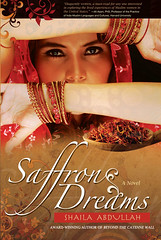
Switching gears to our Modern History Press, we focus on books from people who have no access to ordinary media and are telling stories that you aren’t going to hear on the nightly news. For example, Issam Jameel’s Iraq Through a Bullet Hole: A Civilian Wikileaks is a highly documented factual account of his attempt to return to Iraq to resume a normal life after years of exile and the sheer chaos and mayhem of the new normal in Iraq. Shaila Abdullah’s Saffron Dreams (click for Savvy Verse & Wit review) tells the fictional story of a Muslim-American woman in the aftermath of 9/11 trying to make a new life while grieving her husband who as lost in the destruction of the World Trade Center itself. There’s a story you won’t find anywhere else! MHP’s “World Voices” series is focusing on English-speaking writers from around the world, including Africa, Asia, and the Caribbean. MHP includes not only biography but also fiction and poetry as well. We’re anticipating the launch of new chapbooks by South African poet Nick Purdon and African-American poet Regina Jemison this spring.

Returning to the question, why struggle against mass-market producers? Because there is a whole world of stories out there to tell and with it the possibility of change for the better. Finally, with the mass-market acceptance of the eBook platform’s we’re seeing the last barriers fall between us and the conglomerates because the eBook has created a level playing field where no one may claim the “home court advantage!”

Thanks, Victor, for providing your thoughts on small presses in the modern era for the Indie & Small Press Celebration!

About Victor Volkman:

Victor Volkman is a Senior Software Engineer at UGS in Ann Arbor, Michigan. He writes for CodeGuru.com other print/online publications. Former part-time instructor at Washtenaw Community College, now serving on CIS Faculty Advisory Board.

He’s also webmaster for the Traumatic Incident Reduction Association (TIR.ORG) and the editor of Beyond Trauma: Conversations on Traumatic Incident Reduction and several other books on TIR.  And is a features editor for TIR Association quarterly newsletter.

He’s the owner of Loving Healing Press.  Check out this interview with Victor.

Breaking News . . .

Good afternoon blogging buddies and readers,

If you’ve been on Flickr, Facebook, or Twitter, I’m sure you’ve heard the news that my daughter, Katerina, finally made her debut this week.  So she’s a March baby and a Pisces.

If you want to see some photos, please visit my Flickr page.  Please ignore the horrible photos of me.  I hate my pictures always, but these are particularly unflattering.

For those that just want to see the little one, here she is:

I hope everyone is still enjoying the Indie & Small Press celebration this month because there is more to come.

88th Virtual Poetry Circle


Welcome to the 88th Virtual Poetry Circle!

Remember, this is just for fun and is not meant to be stressful.

Keep in mind what Molly Peacock’s books suggested. Look at a line, a stanza, sentences, and images; describe what you like or don’t like; and offer an opinion. If you missed my review of her book, check it out here.

It’s a new year, and if you haven’t heard there is a new feature on the blog this year . . . my first ever, poetry reading challenge. Yup, that means everyone should be signing up because all you need to do is read 1 book of poetry.

Today’s poem is from Alicia Suskin Ostriker‘s collection The Crack in Everything:

Somalia (page 32)

Compared to being burned alive
When they torch your village
Death by starvation is a good death
Compared with being shot
Dying slowly of wounds
Or being beaten
By frenzied young men
This is much better

You experience little pain
You become like dry wood
Though your lips parch
It is not so bad
You simply shrink up, except for your eyes
Which grow ever larger, like sponges
Taking in the beautiful liquid sun

And the night stars–

And if you are a baby, like me,
Sighing and growing sleepy
Strapped to this woman who keeps
Humming high in her throat
A thing to drive the devil far away
Death by starvation
Is very good, yes, good
As life can be.

+++++++++October 1992

Let me know your thoughts, ideas, feelings, impressions. Let’s have a great discussion…pick a line, pick an image, pick a sentence.

I’ve you missed the other Virtual Poetry Circles. It’s never too late to join the discussion.

Interview With Margaret C. Sullivan, Author of The Jane Austen Handbook

I recently read and reviewed The Jane Austen Handbook by Margaret C. Sullivan (check out my review) by Quirk Books and adored the set up, the illustrations, and the information within its pages about the Regency period in England and the instances it plays a pivotal role in Jane Austen’s novels.

Author and Jane Austen blogger, Margaret C. Sullivan kindly agreed to answer a few questions about her book and her writing.  I’m happy to have this interview as part of the Celebration of Indie & Small Presses this month, and I hope you enjoy it.

1.  When did you begin to fall in love with Jane Austen and her writing and why?

I didn’t read Jane Austen’s novels until I was in my late 20s, and even then it took me a few years to work my way through them. I read Emma and Pride and Prejudice a year or so apart and liked them well enough to keep going. The third of her novels I read was Persuasion and I fell in love, hard. I loved the language and the dark humor and the intensity of feeling, not to mention the best love letter in the history of Western literature. “You pierce my soul.” All these years later those four words still make my toes curl.

2.  When did this love of Austen transform itself into more than just a hobby and into a passion with its own blog and other books?

Not long after I started becoming really enthusiastic about Austen’s work, we had the mid-1990s rush of film adaptations—first Sense and Sensibility, then Persuasion, then Emma (it actually took me a couple of years to get around to watching the 1995 Pride and Prejudice—I didn’t have cable, and was really intimidated by the idea of renting six videotapes). Around the same time there was a big rush of Austen biographies, and it was easy to feed the beast. Things calmed down around 1999, and then in early 2004 it started up again—a new film version of P&P was being planned, the producers were trying to get financing for Becoming Jane—and there was very little information, so rumors were being passed around as fact. I thought the fandom needed a news site, like the Harry Potter fandom site The Leaky Cauldron, dedicated to news about Jane Austen in popular culture, and I started AustenBlog. There is still a lot of interest in Austen-related films, despite the generally disappointing nature of the recent batch of films (in my opinion, which is not widely shared).

3.  Explain your thoughts on the phenomenon or retellings, sequels, and mashups with zombies that now attach themselves to Jane Austen’s novels?

I’ve been writing Austen fan fiction, some of which I have published, for more than ten years, so obviously I’m quite open to the idea in general. However, some of the quality of these productions is not good. Some are very well-written, but I personally prefer those that adhere more to the originals. There are some books that have been very popular that go far afield of the originals, but they are not to my own taste unless they are doing it for satire and humor.

Speaking of far-out satire, I thought the idea of the first monster mashup, Pride and Prejudice and Zombies, was really funny, and I still do—and funny on many levels, not just the whole crazy juxtaposition of Austen and zombies, but the idea of repressed 19th-century British gentry being “zombies” like the suburbanites in the Living Dead movies. I also liked the presentation of the book as an edited “classic” novel—that kind of humor is very much to my taste, and I think would have been to Jane Austen’s taste as well, as she was a gifted satirist and understood a subtle, straight-faced approach to humor.

I had no idea it was going to be such a big hit, and I had no idea that it would create such a really nasty backlash against Jane Austen. The hipsters who hated being forced to read her books in school now had an excuse to trash her, and sometimes in a manner that showed the critics distressingly ignorant of the actual novels (“they’re all bonnets and tea-drinking!”). I realize Austen’s books are not to everyone’s taste, but she took the novel and dragged it into its modern form from a morass of 18th-century melodrama and overwritten romance (in the literary sense, meaning not reflecting real life) and showed that it was okay and even interesting to write about everyday people and events. A lot of the “rules” we now follow for writing fiction can be found in the way Austen shaped her books differently from her predecessors—write what you know, concentrate on your hero’s story, and leave out stuff that doesn’t move the plot along, however amusing or interesting. You don’t have to like or even read her books, but I submit that all those writing fiction today owe her a debt. We can draw a line in the development of the novel from Richardson, Burney, Radcliffe, and Fielding through Jane Austen to Dickens, Eliot, James, right up to the present. I doubt that in 2011 we would be writing 12-volume epistolary romances if Austen hadn’t published, but I think literature would be poorer for the loss.

4.  Do you have a retelling, sequel, or film adaptation?  Why do you enjoy those particular ones over others?

I don’t know if I have one over-arching item that stands out, but certainly within the individual categories I have favorites.

My favorite retelling is Colonel Brandon’s Diary by Amanda Grange. Brandon has a really romantic, dramatic backstory, and it’s all right there in Sense and Sensibility if you look carefully! But Grange did a great job not making it overly melodramatic and unAustenish. When Eliza died in Brandon’s arms, I cried; being on the train at the time, it was kind of embarrassing. But if you ever thought Marianne Dashwood should not have married Brandon because he was a boring old guy in a flannel waistcoat, read his backstory, because it’s as romantic as she could ever have wished. I mean, he fights a duel, for crying out loud!

A sequel I read a long time ago and then re-read quite recently for my Jane Austen book group is Pemberley Shades by D.A. Bonavia-Hunt. It is a really charming sequel to P&P, about four years after the Darcys are married. Lizzy is witty and amusing, just as she ought, and it’s fun to watch Darcy not only take her teasing but actually enjoy it and tease her back—clearly he has learned! Bonavia-Hunt obviously read J.E. Austen-Leigh’s Memoir of his aunt, in which he passed on some tidbits Jane herself let drop about the lives of her characters after the novel ended, and some whimsical bits in her letters about Mrs. Darcy’s and Mrs. Bingley’s favorite colors.

My favorite film adaptation is the 1995 Persuasion (which is also my favorite Austen novel). While not a perfect adaptation, it is beautiful and romantic and feels very real, and the cast is just marvelous. It’s the only adaptation of Persuasion that doesn’t mess up Captain Wentworth’s gorgeous letter to Anne. Also it makes me want to drink tea, and tea is good for you. They are forever drinking tea in that movie.

Some other books and films I’ve enjoyed that are not directly in those categories are The Jane Austen Book Club (both book and film), Michael Thomas Ford’s book Jane Bites Back, which is a hilarious sort of spoof of the worst excesses of Janeitism that I think Jane herself would have loved, and Laurie Viera Rigler’s books Confessions of a Jane Austen Addict and Rude Awakenings of a Jane Austen Addict. The thing all these have in common is that they celebrate our love of Jane Austen without being twee or overly sentimental.

5.  Beyond reading Austen-related materials, what other books have you read recently and would recommend to others?

Unfortunately I haven’t had much time to read non-Austen-related stuff lately! I read a lot of classics, but in many cases they are books that Austen would have read, so that makes them kind of Austen-related. However, I do recommend them on their own: anything by Fanny Burney, The Mysteries of Udolpho by Anne Radcliffe, and the rest of the “horrid novels” named in Northanger Abbey.

I’m a big fan of Elizabeth Gaskell’s work and there’s a Gaskell Blog that is running a reading challenge for 2011. Austen fans should check it out—I think they would like Gaskell’s work.

My favorite modern book that I’ve read in the last year or so was The Guernsey Literary and Potato Peel Pie Society by Mary Ann Shaffer and Annie Barrows. What a charming, thoroughly delightful book, sweet and romantic and heartbreaking. I just loved it. It’s not a very recent book, but I recommend it highly!

6.  Please describe your ideal writing space versus your current writing space or if you currently have your ideal writing space, please describe it (you can also include a few photos of your favorite aspects of that room).

I think my ideal writing space is in my head more than a physical place. It’s hard for me to write when I am busy and stressed out—there is too much furniture up there (as Gandalf said of Barliman Butterbur in The Lord of the Rings, my mind is like a lumber-room: thing wanted always buried). So anywhere where I am left alone and have time and space to clear out my head and concentrate on my task works for me. That can be anything from a busy coffee shop to the balcony of my apartment on a warm spring day. Lately I’ve been getting a lot done by getting up very early (5 a.m.). If I went to bed early and am well-rested, that’s the best time of day for me to write.

7.  What projects are you working on now? Could you provide my readers with a few hints?

A few years ago, I wrote a novella for the Jane Austen Centre at Bath’s online magazine, a sequel to Northanger Abbey called There Must Be Murder. It was serialized over a year. I had some requests for hard copy publication, so recently I published it as a paperback, and it’s also available as a free ebook—I’m very enthusiastic about ebooks and have four ebook readers, plus my smartphone! I also have a short story in an anthology being published by Ballantine later this year called Jane Austen Made Me Do It, edited by my friend and fellow Jane Austen blogger Laurel Ann Nattress. My story is a tidbit of backstory from Persuasion, inspired by my love for Age of Sail novels such as the Hornblower series.

I’m also working on a couple of things off and on, some Austen-related and some not. I don’t like to talk too much about stuff in progress, though, in case it goes pear-shaped, as it so often does. I have lots of concepts but they don’t often develop into actual plots. 😉

Thanks for having me! This was fun.

Thank you, Margaret, for being part of the March Celebration of Indie & Small Presses.

About Quirk Books:

An independent publisher from Philadelphia, Pa., Quirk Books/Classics blends the work of classic literary masters with new scenes of horrific creatures and gruesome action. The publisher strives to mesh class literature with pop culture with the hope of creating literary cult-classics.

Also from a publisher letter: “Quirk Books isn’t just a creative publishing company, it’s also a place where dreams come true (especially the ones involving monkeys), where there are no stupid ideas, where words and pictures live together in ironic bliss, and where bills are paid, invoices are sent, and numbers are crunched. In Quirk, you’ll find a publisher of impractical reference and irreverent nonfiction (probably the first ever). You’ll find a publisher of humor books, of pop culture books, of gift books, of reference books, and of hybrid books that cross over from market to market and genre to genre.”

Guest Post: Caleigh Minshall Talks About Porcupine’s Quill and Its Mission

Caleigh Minshall is our guest today, and she’ll be talking about Porcupine’s Quill, which is nestled in the town of Erin Village, Ontario, Canada.  She’s an intern over there and blogs as Porcupette.

It sounds like this press is really enthusiastic about its mission and helping out writers and poets alike.  I’m sure you can guess which part of that mission makes me happy, especially with National Poetry Month around the corner.

Happy Independent and Small Press Month! My name is Caleigh and I’m your guest blogger for today. I’m the intern at the Porcupine’s Quill, a unique literary publisher based in Erin Village, Ontario. On our website I also blog about my ventures in the publishing world as the Porcupette (which is, in case you didn’t know, a very young porcupine).

The Porcupine’s Quill is proud to be a small press (we have three full-time employees and an output of around 10-12 titles a year), but we consider our authors to have the same national and creative importance as those published by multinationals. Many popular Canadian authors today got their start with us: Jane Urquhart, Steven Heighton, Russell Smith, Gil Adamson, Michael Winter, Elizabeth Hay and Annabel Lyon, to name a few.

Of course, we don’t publish them anymore. In Serena’s call for guest posts, she suggested publishers write about “why the[y] continue to struggle against the mass market producers.” The fact is, at the Quill, we don’t have a choice.

Our fiction editors (once John Metcalf, now Doris Cowan) have always had a good eye for new writers. And this is what inevitably happens: we take a chance on a first-time writer, a chance no other publisher would take, and the book – often a collection of short stories – happily receives a lot of praise. In the early years of the Quill, publisher Tim Inkster thought that this new writer would grow alongside the press, finish a novel or two, and together they could make money. In reality, this almost never happens. Those commercial publishers dangle their large advances in front of our new writers, and the Quill’s budget just can’t compete.

Really, we can’t (and don’t!) blame the writers for jumping at the larger advances. Every good writer deserves the opportunity to make a living off their work, if they can, and their chances of making a living increase when they have the big budgets and distribution power of a major publisher. In another way, too, this constant reshuffling of our author stable forces us to constantly seek out new, exciting, innovative talent. We don’t have the luxury of relying on the growth of an author’s backlist or skills. Perhaps this reshuffling makes us stronger as publishers, as editors, as critical readers. It certainly makes the work more challenging! Regardless, we’ve been operating this way for over thirty-five years – it doesn’t get easier but we have managed to stay afloat, and to publish a lot of great books while we’re at it.

The Porcupine’s Quill isn’t limited to fiction. Our goal is and always has been to publish brilliant fiction by largely unknown Canadian authors, and brilliant poetry by well-known Canadian poets. These days, we’ve also added a cutting-edge wordless novel series, featuring young OCAD University artists and professors, which has received a lot of good press. The most recent is Book of Hours by George A. Walker, a provocative series of wood engravings depicting the lives of regular people in the twenty-four hours before the Twin Towers fell.

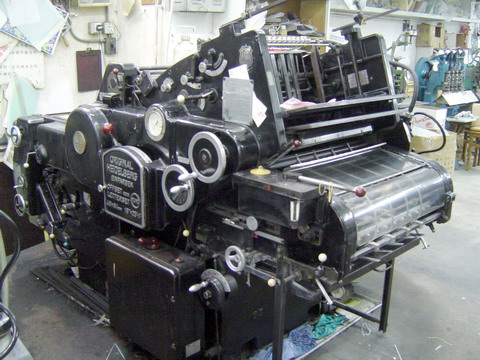
The unique thing – well, one of them – about the Quill is that we complete almost all of our production in-house. To us, the beauty of the physical book is as important as the beauty of the content. Publisher Tim Inkster uses twentieth-century offset printing technology – a twenty-five inch Heidelberg KORD – to replicate the quality, look and feel of a nineteenth-century letterpress product. If you’re interested in more details, we’ve uploaded a few videos to YouTube outlining the process. All of our books feature thick, creamy paper and colourful endpapers, and they’re all bound using a 1905 Model Smyth National Book sewing machine (instead of just flimsy glue). The shop is jam-packed with printing paraphernalia, most of which I have no idea how to use (that’s Tim’s job). It’s a very intricate and difficult process, and you’ll only find two other publishers in Canada that do the same sort of work that we do (those two being Coach House Press and Gaspereau).

Small presses are vital to a healthy literary culture. They have the courage and knowledge to take an unknown writer and help them create something great, something that challenges the norm. It might be difficult to make any money, but luckily that’s not what small presses are for – instead we dedicate ourselves, when no one else will, to finding and publishing the most excellent, daring and original literature around.

Risky business, sure, but we consider it an art.

Thanks, Caleigh, for contributing to the Celebration of Indie & Small Press Month.

Guest Post: Bancroft Press’ Harrison Demchick on Small Press

Bancroft Press has Harrison Demchick on the front lines, and his press is another local one, situated in Baltimore, Md.  We’re going to be taking another Literary Road Trip of sorts today, as Harrison talks about being a small press and what that entails in the day and age of publishing battles in the media and beyond.

Anything you read most anywhere about the present state of publishing will dwell on the industry’s ongoing war, or transformation, or whatever you want to call it. They’ll talk of the trend toward self-publishing and the inevitable impact on the long-standing dominance of the New York super-publishers. They’ll talk of the eBook, and the way it’s changed the price of big press hardcovers from standard to outrageous.

In this narrative, the war has two combatants: the major publishers and the self-publishers.

Everyone forgets about the rest of us.

Bancroft Press represents the element you don’t hear about—the forgotten combatant, if you will. Between the big press and the no press is the small press, comprised of groups operating more or less in the mold of traditional publishing, but with a narrowed list of titles and authors. And what does that mean?

Well, if you’re only going to publish four, maybe six books a year, they’d better be books you believe in. This should be less a novelty than it is, but with the big publishers more and more focused on commercial appeal above all other considerations, and the self-published authors pretty much a total crapshoot in terms of quality, there aren’t many places left simply publishing good books they like.

Or maybe there are. Maybe you’re just not hearing about them.

It’s certainly not easy to be a small press. The major publishers monopolize the bookstore shelves—hell, Borders’ stock is under their control outright. Barnes and Noble won’t stock your book if they don’t like the cover. Most newspapers won’t read your book if they can instead read a HarperCollins book they know has the budget behind it to be a hit. Most don’t care about the diamond in the rough.

It’s a funny thing, actually. The major publishers have a huge budget and focus on only what their marketing departments believe they can sell. We have hardly any budget and no marketing department, and publish what we believe in regardless of perceived popularity.

If eBooks and the rise of self-publishing are evening things out a little, then all the better from our point of view. But that doesn’t necessarily make the invisible publishers visible—certainly not with the dichotomy most seem to believe exists. It’s a tough road, but the small presses wouldn’t be in the game at all if they didn’t believe their books deserved to make it.

So that’s small presses in general—but what’s Bancroft Press?

Our slogan is “Books That Enlighten.” If that seems very broad, it is. We publish a huge variety of books, the only determination being belief in the material. Bancroft began in 1995, founded by its publisher, Bruce Bortz. We’ve published Alex Award winners (Jonathon Scott Fuqua’s The Reappearance of Sam Webber), Edgar finalists (Libby Sternberg’s Uncovering Sadie’s Secrets), Pulitzer nominees (Gus Russo’s Live by the Sword), and also really great, even critically acclaimed books that didn’t sell the way they could have, and should have (Fuqua’s In the Wake of the Boatman, Ron Cooper’s Hume’s Fork, Elizabeth Leinkes’s The Sinful Life of Lucy Burns).

Right now, we’re focused on three particular projects.

Purple Jesus, which we published in mid-October, is the one you may have heard of. Ron Cooper’s second novel, a terrific Southern Gothic masterpiece, was called “a literary achievement of the first magnitude” by The Washington Post.

A small press literary novel with a major newspaper review, by the way, is an incredibly rare thing, and comes as a result mainly of persistent obnoxiousness.

You’re less likely to have heard of The Naperville White House: How One Man’s Fantasy Changed Government’s Reality, an offbeat and hugely inventive novel we published at the end of 2010. Jerome Bartels’s book, written as a nonfiction account, tells of a terrorist crisis resolved not by the real government, but by a fantasy government—think live-action role-playing meets fantasy football—comprised of a librarian secretary of state, a gas station owner director of national security, a customer service representative chief of staff, an obsessive gamer secretary of defense, and an insurance adjustor president.

There’s nothing quite like it. That makes it very, very hard to sell. We knew that going in—in fact, one New York publisher, which otherwise loved it, rejected it for explicitly that reason—but we believe in this book and published it anyway. We’re still pushing it and hoping it catches on.

Finally, there’s our upcoming foray into young adult adventure, The Atomic Weight of Secrets or The Arrival of the Mysterious Men in Black, the first book in Eden Unger Bowditch’s Young Inventors Guild trilogy. It’s the story of five genius children in 1903 who seek to break free from their bizarre, black-clad kidnappers to find their missing parents, using the mysterious creation they have all, unbeknownst to one another, been inventing.

We see it as the scientific answer to Harry Potter, and we have high hopes for its release on March 15.

So this is Bancroft Press: a small publisher putting its minimal but determined weight behind some truly amazing books. The narrative of the industry’s transformation would render us nonexistent, but we’re here, and publishing books every bit as good as the larger publishers—and sometimes quite a bit better.

It’s all about what we believe in. How could it be anything else?

Thanks, Harrison, for sharing your thoughts on the publishing wars and on Bancroft Press’ mission.  You also catch Harrison at the Maryland Writers Conference on Saturday, April 2, 2011, at the University of Baltimore’s Thumel Business Center.

The Rorschach Factory by Valerie Fox

The Rorschach Factory by Valerie Fox is a collection of poems that are left up to the interpretation of the reader in many cases.  Much like the inkblot test, these poems provide snippets of color, image, and story to provide an outline for readers, and those readers are then tasked with filling in the blanks and interpreting what is there.  Some poems seem to carry a personal history in many of the lines, while others are whimsical in their interpretations of pop culture and real-life relationships.

From “This Is Not My Cousin” (page 9):
This is not the sensational human
condition.  God is not in the picture
just me and trees and my cousin’s shadow.
We like how I am standing on the high place
a smiling paperdoll propped up on the edge
about to step back, waving to Columbus.

From “You’re No Axl Rose” (page 43):

You’re no Axl Rose but your sentences are
as complex as your hair, in an unintended,
wiry, I will live forever way, the way Axl
swings his hips and smokes just enough
to achieve his pristine scratchy scream.
You’re no James Dean but when you can afford
to drive a Porsche I’ll let you drive me
to the Acme to buy aspirin or milk.

Fox’s writing style leaves room for the imagination of the reader so that each new audience can take their own journey.  In other poems, there is a clear tone that shines through the lines, like in “The Temple” (page 37) where the narrator talks about her time with a poet who thought of himself as upper class, but of her as much lower.  The poet was slumming it with the narrator, but you can tell from turns of certain phrases that this view was not accurate:  “He’s my essay.//Soon enough/he ran out of money./I’m a poet, and I’d squirreled a bit of currency away./This became my motto-//’I got mine.'” (page 38)

Broken down into four sections — Out of Time, The One Who Leaves You, Accomplice, and Unrest — the narrator has set up a collection of poems that would appear to be drenched in despair and regret, but readers will be surprised by the not only whimsical poems but also the humor with which she highlights pop culture and elements of the ridiculous in intimate relationships.  Overall, The Rorschach Factory by Valerie Fox is a collection that you can read in one sitting, piecemeal, and revisit over and over, finding nuances to each poem that may not have been as prominent upon first reading.

About the Poet:

Dr. Fox’s most recent book is Bundles of Letters, Including A, V and Epsilon (Texture Press), written with Arlene Ang. Previous books of poems are The Rorschach Factory (Straw Gate Books) and Amnesia, or, Ideas for Movies (Texture Press). Her work has appeared in many magazines, including Hanging Loose, The World, Feminist Studies, Siren, Phoebe, Watershed, sonaweb, and West Branch.

She was a founding co-editor of 6ix magazine (1990-2000), and currently edits Press 1, a journal featuring poetry, short fiction, opinion, and photography.  Very involved in collaborative writing, she and Arlene Ang have collaborated in the writing of poetry and fiction, publishing in magazines such as Admit 2, Origami Condom, Per Contra and Qarrtsiluni.  At Drexel, Dr. Fox teaches Freshman Writing, Creative Writing (poetry), and Readings in Poetry. She’s particularly interested in experimental poetics and online teaching/e-learning.

About the Indie/Small Press:

Straw Gate Books published Valerie Fox’s The Rorschach Factory and was founded in 2005 by poet and co-founding editor of 6ix magazine (1990-2000) Phyllis Wat in Philadelphia, Pa.  Here’s a snippet of their mission:

“We are particularly interested in works by women and non-polemical writing with an underlying social content. We also feature new authors and authors whose work is underserved.”

This is my 3rd book for the Fearless Poetry Exploration Reading Challenge.


This is my 9th book for the 2011 New Authors Reading Challenge.


Here’s a confession, I’ve had this book for a couple of years, and I believe it came from the author or her good friend Arlene Ang.  I’m just now getting around to it.  This is my 5th book for the 2011 Wish I’d Read That Challenge.