Quantcast

Bone Key Elegies by Danielle Sellers

Danielle Sellers’ Bone Key Elegies is a collection of poems published by Main Street Rag Publishing as part of its Editor’s Select Poetry Series.  (You can check out my previous 32 Poems Magazine interview with the poet, here, and one of her poems in the 81st Virtual Poetry Circle).  Unlike eulogies that praise someone upon his or her death, elegies are a lament for the dead and are often mournful.  In this vein, Sellers excels at creating memorable elegies for her sister, a lost family, and happier memories.  However, many of these poems will deceive the reader at first, beginning with scenery or a happy moment in time before turning melancholy.  Sellers’ style echoes the turn of line expected in haiku or the final couplet of Shakespearean sonnets.

However, some poems, like “The Bridge Fishers” (page 16), are less full of despair than the other beginning poems in the collection and more mischievous, especially as the narrator drives away in a boat beneath a bridge where fisherman are waiting for their first bite from the fish, only to have the engine of the boat scare the fish away.  Sellers’ poems are filled with surprises:  some shocking, some full of dark humor, and some violent.  In “Welcome to my Father’s Showroom” (page 26), readers are given a quirky picture of the showroom as a sort of maze through which the father navigates or hides to peer at customers secretly, but in the final lines, ” . . . He watches them.  In case one should step out of/line, a shotgun leans against the metal filing cabinet.  On its shaft,/his hand-print is outlined in dust.” (please check out some sample poems).

What’s surprising is that each poem has its own depth of despair and melancholy, like an elegy is supposed to have, but the depth of that sorrow generally corresponds well to the connection the narrator has with each subject.  Losing a father can be very devastating to a daughter, but is it more or less devastating to a daughter who has seen her father cheat on her mother or leave her mother?  Losing a sister at a very young age can be tragic and life changing, but is it more or less life changing than if you were to lose a sister after having lived half your life with her by your side?  These are just some of the emotional questions tackled by Sellers’ poems, and Bone Key Elegies is an excellent examination of the various levels of melancholy and despair that individuals can experience at different intervals in their lives. It is clear that the poem about the death of a sister sets the tone for the entire collection, a tone that deepens and thins out in a see-saw of emotion.

Through rich language and vivid imagery from the Florida Keys, Sellers’ illustrates not only the brackish nature of woe, but also the desperate fight against that emotion — leaving readers breathless.

 

This is my 7th book for the Fearless Poetry Exploration Reading Challenge.


This is my 13th book for the 2011 New Authors Reading Challenge.


***This is a part of the National Poetry Month 2011 Blog Tour.

Winner of Forgetting English

Random.org selected #5 out of 13 entrants in the Forgetting English by Midge Raymond giveaway.

The winner is Julie of Read Handed, who said:  “I love the title of this collection. I enjoy reading short stories so I will have to check this out. One of my favorite collections of short stories is Coronado by Dennis Lehane. He is so well known for his novels (many of which have been adapted into movies) that his short stories are often overlooked, which is a shame.”

Congrats to Julie.  I hope you enjoy the book.

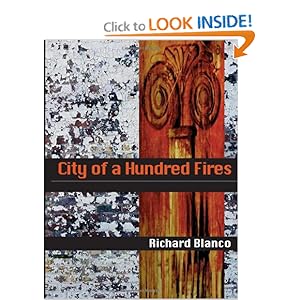
City of a Hundred Fires by Richard Blanco

Richard Blanco‘s City of a Hundred Fires is a collection published by the University of Pittsburgh Press about the Cuban-American experience, which won the 1997 Agnes Lynch Starrett Poetry Prize.  (You can check out one of his poems in the 40th Virtual Poetry Circle and my take on a reading he did at the local Writer’s Center in 2009.)  The collection is broken down into two sections and each poem contains not only English, but also Spanish phrases, which readers may or may not know offhand.  Readers who are bilingual will have little trouble, though those who have a working knowledge of Spanish or don’t will be able to gather what Blanco is getting at from context clues.  Poems are either in traditional short narrative lines or in longer, more paragraph-like lines, but each tells a story, reveals a memory, and explores a bit of the Cuban-American experience.

“Crayons for Elena” on page 13 is one of the most poignant poems in the collection as it uses the box of 64 crayons to illustrate the differences in skin tones and cultures of the people the narrator encounters and the colors that represent elements from the narrator’s own culture, including pinatas and mangoes.  “. . . All these we wore down to/stubs, peeling the paper coating further and further, peeling and sharpening/until eventually we removed the color’s name.  This is for leaving the box in/the back seat of my father’s new copper Malibu, the melted collage, the butter/”  It seems that though these differences confuse the narrator and cause discomfort, eventually, these differences are forgotten and life moves beyond those variations and instead absorbs the similarities, “melting them into a collage.”

Blanco continues to straddle the Cuban culture — kept alive in family traditions such as Quinces balls — and his new home in American culture.  In a way, his traditional family culture seems foreign to the narrator as he assimilates to American traditions of turkey at Thanksgiving and peanut butter and jelly sandwiches.  Unlike the older relatives talked about in the poems, the narrator does not kid himself that he will be returning to Cuba after the revolution; he knows that the dream of returning to the old country is just that — a dream.

At times, however, the narrator does experience moments of nostalgia, in which he remembers family events or moments.  There are other moments in which the voids left by an American culture that does not feel exactly like home are filled with reminders of a culture left behind whether those voids are filled with sake by a Japanese immigrant or by dark rum with lemon for a Cuban-immigrant.

Unlike in part one where the narrator delves into familial memories and the confusion of bridging two cultures, in the second part, the narrator has become more observant of how his home culture is mutilated and warped by the American idea of capitalism to create a caricature of Cuban life and culture, like in “El Jagua Resort” (page 43):  “where Canadians and Italians step out/drunk congas from megaphone instructions –/side-to-side, kick-then-kick, hand-to-hip;/caught in spells of tabaco, dark rum,/brown sugar, and the young mulatas/”  In a way, the little Havana created in America by the narrator’s parents’ generation is fading and being replaced, but the second part also illustrates more historical details of Cuba, the revolution, and other events.

For a slim volume of poems at 74 pages, City of a Hundred Fires by Richard Blanco will knock you on your butt with its passion, anger, and disbelief.  But it also will drag you to your feet as it clings to hope and harmony.  Overall, Blanco has crafted a diverse collection of poems on the Cuban-American experience that delves below the surface struggles of bias and loneliness to the internal struggle of one narrator and how he copes with those struggles and more.

This is my 6th book for the Fearless Poetry Exploration Reading Challenge.


This is my 12th book for the 2011 New Authors Reading Challenge.


***This is a part of the National Poetry Month 2011 Blog Tour.
 

Wickham’s Diary by Amanda Grange

Amanda Grange‘s Wickham’s Diary takes a look at Wickham’s relationship with his childhood friend Darcy before they became enemies.  Even in the early entries, readers get a sense that Wickham feels he is entitled to certain pleasantries and that he is better than Darcy in many ways.  Much of this stems from his jealousy at being merely the steward’s son and being born into a particular class.

“Fitzwilliam and I rode out this early morning.  We raced down to the river and I won, beating him by a good two lengths, at which I laughed and called him a sluggard.  He was annoyed and challenged me to a race back to the house.  I accepted the challenge and, once our horses were rested, we set off.” (page 3)

Initially, Wickham captures that jealousy at the behest of his mother to mold his charm and air of authority in an effort to better his station and prospects through his acquaintance with Darcy, his relatives, and his friends.  However, once he and Darcy head off to Cambridge, things take a turn for the worse for Wickham.  And while many of his problems are self-induced, tragedy does step in and become a catalyst for his downward spiral.

Grange has taken the character of Wickham, and while not making him sympathetic, helps readers understand his motivations and the role his parents and friends played in making him the man he becomes when readers meet him in Pride & Prejudice.  However, there are gaps in the diary, some lasting several years, that are not elaborated on or talked about.  What happens to Wickham and his family during those intervening years is unknown and not explored, which readers may find disheartening.  Readers also could disagree with the picture Grange paints of Wickham — a man easily swayed into trouble by others.

Overall, Wickham’s Diary by Amanda Grange is an inside look at the possible motivations of the villain in Jane Austen’s Pride & Prejudice.  Her George Wickham is a young man unhappy with his life station, but too lazy to change it and easily swayed down the easiest path — whether it is finding an heiress or having a good time while away at school.  At just about 200 pages, the novel is a light read and the diary entries make it easy for readers to pick up and read for short intervals at a time.

Mailbox Monday #125

Mailbox Mondays (click the icon at the right to check out the new blog) has gone on tour since Marcia at A Girl and Her Books, formerly The Printed Page passed the torch.  This month our host is Passages to the Past.  Kristi of The Story Siren continues to sponsor her In My Mailbox meme.  Both of these memes allow bloggers to share what books they receive in the mail or through other means over the past week.

Just be warned that these posts can increase your TBR piles and wish lists.

Here’s what I purchased at a recent flea market trip:

1. 61 Hours by Lee Child

2. Reckless by Andrew Gross

3. Vapor Trail by Chuck Logan

4. Don’t Blink by James Patterson

5. Private by James Patterson

And one book from my mom, which she bought while visiting Wiggles and I for the month, but didn’t finish reading until she made it back home . . . so she had to mail to me.

6. Tick Tock by James Patterson

What did you receive in your mailbox?

***Please also stop by Rhapsody in Books’ National Poetry Month post on Eleanor Swanson.

94th Virtual Poetry Circle

Welcome to the 94th Virtual Poetry Circle!

Remember, this is just for fun and is not meant to be stressful.

Keep in mind what Molly Peacock’s books suggested. Look at a line, a stanza, sentences, and images; describe what you like or don’t like; and offer an opinion. If you missed my review of her book, check it out here.

Also, sign up for the 2011 Fearless Poetry Reading Challenge because its simple; you only need to read 1 book of poetry.  Please contribute to the 2011 Indie Lit Award Poetry Suggestions and check out the National Poetry Month Blog Tour.

For today’s poem, we’re going to look at Luke Rathborne’s “Calypso”:

CALYPSO

I am slipping
who is slipping
blue rips in the sky
I am sleeping through
an unbelievable dream
where a man rips through
my throat
I re-imagine you in my
faintest dream
you are never disappointed
I see California clearly
like Colorado sees mountains
I cherish silence more than music
Calypso, Mediterranean,
I write you thousands of end-
less letters about the fur-
thering from love
I read the same lines over
and over, completely entranced
You cannot see me, because
I disappear the parts while
you are looking
I am overly looking rea-
ching into you
but I have never gone deep
enough
to puncture in
do not remind me of myself

Let me know your thoughts, ideas, feelings, impressions. Let’s have a great discussion…pick a line, pick an image, pick a sentence.

I’ve you missed the other Virtual Poetry Circles. It’s never too late to join the discussion.

**Check out the giveaway for Luke Rathborne’s poetry and music as part of National Poetry Month.

Earth Day 2011

Happy Earth Day, everyone.  I’ve done a number of posts over the years about recycling, ebooks, and other environmental topics, but today, I wanted to provide you with more of a hodgepodge of information.

First, Eco-Libris, which hosts the Green Books Campaign annually, is hosting a contest as part of its 41 reasons to plant a tree for your book. Today is the last day to enter the giveaway.  Check out the giveaway information from Eco-Libris:

Last November you took part in our Green Books Campaign and we thought you might be interested to learn on the campaign we’re launching for the upcoming Earth Day. This year we are celebrating the 41th Earth Day with a special campaign – 41 Reasons to Plant a Tree for Your Book.

With more than 180,000 trees planted so far on behalf of readers, authors and publishers working with Eco-Libris, it’s no surprise we think planting trees to green up books is a great idea..

But we also want to hear what readers think about it and why they believe planting trees for their books is a good idea, and so for 41 days, beginning on March 13 and continuing through April 22 (Earth Day) we’ll publish on our blog 41 of the best replies we’ll get, one reply every day!

We have great prizes to all the readers whose replies we’ll publish, including a $25 gift card for Strand Bookstore, audiobooks from Simon & Schuster Audio (such as The Half Life by Jennifer Weiner, American Assassin by Vince Flynn and Essence of Happiness by the Dalai Lama) and great green books, like Planet Home by Jeffrey Hollender, Little Green Books,  Spit That Out! by Paige Wolf, The Story of Stuff by Annie Leonard and many more! You can see the full list of the prizes on the campaign’s page.

If you would like to share the information on the this campaign with your readers and invite them to take part and send us their replies that would be great! Our email is [email protected] and the campaign’s page address is http://www.ecolibris.net/41reasons.asp

Yours,
Raz @ Eco-Libris

Today, I’m striving to reduce energy use in my new home by installing eco-friendly light bulbs, ensuring that I recycle as much plastic and paper as I can, and reducing water consumption through my dishwashers “water miser” setting.  I’ve also heard some great things about rain barrels, and hope to comparison shop for one which we can use in our backyard.  Since giving birth to my daughter, I’ve reduce my energy consumption by working from home, but naturally, that’s a perk that will end sooner than I’d like.  What plans do you have to reduce your carbon footprint (take the quiz to see what your footprint is) or to conserve?

If you are interested in signing a petition to foster a “greener” economy here in the United States, please sign it here.

You also can go to the Earth Day Network and find events happening in your local area.  Please check out those events for the Washington, D.C., region.

But even if you don’t have the time or there are no Earth Day events near you, take the time to spend a moment or two outside cleaning up your own yard or  your local neighborhood, which can be as easy as picking up stray litter or dog poop.  You can even take time to visit a local park and clean up there or simply sit and enjoy the pleasures of nature.

Enjoy Earth Day and spread the word!

***Please also stop by the next National Poetry Month Blog Tour stop at Diary of an Eccentric and Read Handed.

National Poetry Month Giveaway: L.A. by Luke Rathborne

Luke Rathborne is a musician and poet reminiscent of another poet/musician I know.  First I’d like you to check out this video of his single “Dog Years,” as performed at Three Clubs, Hollywood, California:

I hope you enjoyed the music because I’ve got an approved MP3 download of “You Let Me In” for you. All you have to do is use the following password once you get to the site: letmeinLR

And you know that as a poet, I can’t just post about Luke’s songs or videos, especially when its National Poetry Month. I’ve got an excerpt of one of his poems, “The Cowboy Song,” but please check out a full poem, “Calypso,” from Luke on Saturday during the Virtual Poetry Circle.

From The Cowboy Song by Luke Rathborne

Cut me free,
Cut me free of the sun,
Sand, dirt
tail-whip
feel the wind
have a dream of that far off place
out on the lake,
don’t need to tell you where . . .

Now that you’ve been properly introduced, don’t you think Luke’s poetry and music is something you should have? Well, you are in luck because in honor of National Poetry Month, he’s offering my US/Canada readers a chance to win 1 signed copy of L.A. (his poetry) and a limited vinyl press of his music.

To Enter:

1. Leave a comment on this post about who you think Luke Rathborne sounds most like when he sings or what you think of his poetry.

2. Blog, Tweet, Facebook, etc. the giveaway, leave a link, and receive a second entry.

Deadline April 30, 2011 May 14, 2011, at 11:59PM EST.

About Luke Rathborne (from Paul Gargano):

Luke Rathborne writes songs about life, and life is rarely simple, neat and easy.

On his Dog Years / I Can Be One split-EP, the singer-songwriter defies today’s cookie cutter flavors, preferring to hold true to his artistic vision – a vision that embraces the zen of Leonard Cohen and the weathered tone of Bob Dylan, basking both in a heady aura of dialed-down pop exuberance.

“Hopefully, people will see the difference in the music here,” says the 23 year-old troubadour of his ambitious release. “They are two groups of songs that belong with each other, but not necessarily together. As an artist, you really have to think about the way you’re putting a record together, and it’s got to be done in a way that interests people – if you think, in your gut, that you’re just going to smash songs together and call them a record . . . that’s just material, that’s not a record.”

Dog Years embraces Rathborne’s more pop aesthetic – not shiny, happy pop, but effervescent, melancholic pop. The title track offers a cynical poke to not letting the ‘dog years’ pass you by, and If you hear a bit of Dylan in the New Yorker’s tone, you aren’t mistaken. He also cites a lot of ‘60s and ‘70s music like the Kinks and the Beatles as impacting those early tracks, written as a teenager in Maine.

The material from the second set was penned following Rathborne’s move to New York City after high school. . . . “The second EP is more of a reaction to living in New York, and it’s a lot more personal and minimal,” he says. “It’s like battery acid – people are really freaked and don’t know what to do with it.”

You can connect with Luke Rathborne on Facebook, MySpace, and Twitter, and you can check out his music on iTunes and on his Website.

***Please also stop by the next National Poetry Month Blog Tour stop at Diary of an Eccentric and Read Handed.

An Interview With Poet Jeffery L. Bahr

Poet Jeffery L. Bahr

This week at the Poetry Blog of 32 Poems Magazine my interview with poet Jeffery L. Bahr was posted. He’s a contributor to the magazine and was a delight to interview.

First, let me tantalize you with a bit from the interview, and then you can go on over and check the rest out for yourself.

Without further ado, here’s the interview.

How would you introduce yourself to a crowded room eager to hang on your every word? Are you just a poet, what else should people know about you?

I have been in love with computing for almost 45 years, back to a time when I could go to a large social gathering of 1000 people and be the only one involved with computers. I’ve studied every facet of computer science, been a professor and been in the industry all my adult life. I’ve only written poetry the last 12 years. I think there is tension in my poetry between the analytical and the mysterious.

Poetry is often considered elitist or inaccessible by mainstream readers. Do poets have an obligation to dispel that myth and how do you think it could be accomplished?

Poetry can be quite excellent and still span a very wide range of aesthetics. Some of those aesthetics take time to understand or acquire a taste for, and some are more readily accessible. For example, I think Bob Hicok, G. C. Waldrep, and Mary Jo Bang are terrific poets, but a “lay person” is probably going to connect more quickly with one of Bob’s poems. I don’t think there’s anything you can do about this, and the same phenomenon takes place everywhere in the arts (music, visual art, sculpture, . . . ).

How do you stay fit and healthy as a writer?

Well, I quit smoking and joined the Y. As a working software engineer, I’m in front of a monitor a lot (like 60+ hours a week), so I’m not worried by the sedentary nature of writing, I need a way get out of my chair periodically anyway (like taking a 15 minute break on my treadmill).

What current projects are you working on and would you like to share some details with the readers?

I have finished a manuscript of poetry that I think represents the arc of my life in the last decade. I will tinker with it and submit it to lots of contests and cross my fingers.

He also included a poem for readers to check out:

Walking Reliquary

Primitive, and so, face
of stromatolite, glottal-stop
cilia, pre-Cambrian gut.

Derivative, and so, grackle’s
nest mate, jackal’s familiar.
Nose like a nocked arrow,
eyes like a lemur’s, only lonelier.

Fatuous, and so, bag of bones,
old bones, some close to broken,
others opposable. Scot organs
and pipes, blood of a Choctaw,
stretched skin of a Norse war drum.

Inattentive, and so, collapse
at the waterhole, hair growing
gray like the seat
of a prayer bench.

Ebullient, and so, grief
of a treed raccoon,
arms like a starfish. Grin
like the wolves
at a timberline.

Acquisitive, and so, Isles
of Langerhorn, rings
of wild cypress, rings
of dead Popes.

Transitory, and so, brain
of an ocelot, brain
of a cockatoo,
mind of a lilac.

Heretical, and so, postprandial
half-life, quarterstaffs
for thighs, three-fourths
of a pumpkin’s DNA.

Incorruptible, and so, knuckles
like gambling stones, shroud
of a leper, eggs like a fossil find.

Redeemable, and so, water-logged
flesh, airborne ash, sedimentary compression.

–The title is taken from a line in G. C. Waldrep’s “Confessions of the Mouse King”

About the Poet:

Jeffery Bahr is a software engineer who lives in Colorado. He holds a Masters degree in Computer Science and a PhD in Operations Research and Statistics. He has created and managed a number of online poetry forums, and served as a co-director for the literary journal, Many Mountains Moving. His poetry and reviews have been most recently published in Black Warrior, Chelsea, Colorado Review, Iowa Review, Pleiades and Verse. His manuscript, Anabasis, was a finalist for the Poetry Foundation’s First Book Award.

Please check out the rest of the interview on 32 Poems Blog.

***Please also stop by the next National Poetry Month Blog Tour stop at Diary of an Eccentric and Read Handed.

Giveaway: Eighth Scroll by Dr. Laurence Brown

The Gatekeepers Post would like to sponsor a giveaway of Dr. Laurence B. Brown’s Eighth Scroll for my readers.

Up for grabs is 1 physical copy of the novel for my US/Canada readers and 1 digital download of the audiobook version.

To Enter:

1.  Leave a comment on the interview with the author.

2.  Blog, Tweet, Facebook the giveaway for a second entry.

Deadline is April 30, 2011, at 11:59 PM EST

What Would Mr. Darcy Do? by Abigail Reynolds

What Would Mr. Darcy Do? by Abigail Reynolds is another variation of Jane Austen’s Pride & Prejudice.  In this version, Elizabeth and Darcy have an opportunity to express their feelings following her surprise tour of the Pemberley grounds at Lambton just before the news of Lydia’s elopement reaches Elizabeth.  The story begins months after her refusal of Darcy’s proposal at Hunsford, and the plot follows along much of the original story, with stolen kisses and embraces, as well as secret letters.

“Dear Miss Bennet,

It is always a pleasure to hear from you, but I must admit the arrival of your letters is becoming quite a source of entertainment in itself.  My brother thinks I do not notice how he watches for the post now, but how could I miss the way he hovers in an agony of suspense over me when I read your letters until I finally take pity on him and allow him to read for himself, and then he spends no less than half an hour admiring your letter, for it cannot possibly take him so long to read it!”  (page 46 of ARC)

No new characters are introduced, but Reynolds does provide us with a version of Georgiana Darcy that is not seen in the original novel.  She opens up to Lizzy and becomes less reserved once she’s around girls her own age.  However, will the changes in Georgiana be welcome to Darcy or run contrary to his expectations?  And how will this new Georgiana impact Lizzy and Darcy’s relationship?

Unlike the Lizzy in Austen’s novel, Reynold’s Lizzy is more cautious in her assessments of Darcy and his behavior as she realizes her prejudices and misjudgments nearly cost her a love she never knew she had.  Darcy also is more cautious in his dealings with Lizzy.  Readers, however, will be happy to know that each is still impetuous when it comes to one another and their passion.  This is where the novel deviates into a more modern sensibility as Lizzy and Darcy share a few intimate moments — some of which get them into trouble and others that leave them breathless.

Beyond the intimacies of Darcy and Elizabeth and their budding relationship, readers also get a glimpse into Lizzy’s character, particularly how her wit helps her keep an adequate distance from friends and acquaintances and enables her to disengage quickly from distasteful relationships and situations.  Overall, What Would Mr. Darcy Do? by Abigail Reynolds is a delightful escape into Austen’s world with her beloved characters.

Gatekeeper Interviews Dr. Laurence B. Brown, Author of The Eighth Scroll

Today’s guest interview is from The Gatekeeper Post.  They’ve kindly interviewed Dr. Laurence B. Brown, author of The Eighth Scroll.

His novel has been compared to Dan Brown’s Da Vinci Code.  In 68 CE, precious scrolls are hidden during an uprising of Essene Jews against the Romans, and 19 centuries later, archaeologist Frank Tones comes across the diary of their librarian, Jacob.  One of the scrolls described in the diary, “The Gospel of the Teacher of Righteousness,” could be the lost gospel of James or Jesus himself.  However, before the truth is discovered, Tones finds his friend and colleague dead.  The mysteries they unravel will shake religious foundations.

Without further ado, here’s the interview with Dr. Laurence Brown.

Where did you grow up?

I grew up as a swaying sea sponge in a sparkling tide pool on the rocky coast of Waikiki. But then I budded off and seeded the ocean’s currents with my creative genius and . . .seriously, I grew up in San Francisco – the liberal capital of America – a few locks away from the infamous ‘tune in, turn on, drop out’ Haight-Ashbury district during the sixties and seventies, in the middle of the hippies’ rock-and-roll, anti-establishment, free love and drug culture revolution. But that culture never touched me, as you can probably tell from the first sentence of my answer to this question, which is completely lucid, copacetic and . . . and . . . and where was I? Oh, yeah. San Francisco. Led Zeppelin, the rock operas Hair and Jesus Christ, Superstar, flowers in the hair and cold Corn Flakes in the morning in Golden Gate Park. Missed it all, as you can tell.

Somehow, I survived, clean. Headed off to Cornell University in 1977, on to Brown Medical School, dot, dot, dot, and here I am!

You’re a doctor, so what lead you to your passion of writing?

The pay. I mean, doctors are starving and writers are just raking in the dough, aren’t they? What? They’re not? Oh. Well, too late now. The problem is, once you catch the writing bug, you’re hooked. I plain and simply love it. I love seeing the characters come alive in my imagination and then on the page. There is a point where everything just begins to flow, and it’s the greatest feeling in the world when the plot begins to carry itself and the characters expand beyond the parameters you originally constructed for them. As the story develops, it’s like watching the greatest movie in the world, in your mind’s eye, because most things happen precisely the way you want them to.

Are you concerned that people will call The Eighth Scroll another Da Vinci Code knock-off?

Sure. Unfortunately, it’s all a matter of timing. Living overseas, I didn’t know I was writing The Eighth Scroll at the same time that Dan Brown was rising in popularity in America. As you see from the book reviews, many critics compare The Eighth Scroll favorably to The DaVinci Code. Some even consider The Eighth Scroll to be the better of the two books. But since Dan Brown’s book came out first, my work may always be seen as having been written in his shadow. Had the timing been different, it might have been the other way around. Such is life.

Where can we get a copy of your book?

You can find The Eighth Scroll for sale on Amazon.

About the Author:

A graduate of Cornell University, Brown University Medical School and George Washington University Hospital residency program, Laurence B. Brown is an ophthalmic surgeon, a retired Air Force officer, the medical
director and chief ophthalmologist of a major eye center in the Middle East. The author of four books of comparative religion, he is also an
ordained interfaith minister. His most recently discovered passion is writing fiction, of which The Eighth Scroll is the first of three completed novels.

For the past two decades, he has divided his time between America, England, Jordan, and Saudi Arabia. Dr. Brown’s immediate family consists of his wife, three daughters and an ever changing assortment of hamsters and parrots.

Don’t forget to stop by Read Handed for today’s poet spotlight.