Quantcast

The Switch by Beth O’Leary (audio)

Source: Purchased
Audiobook, 10+ hrs.
I am an Amazon Affiliate

The Switch by Beth O’Leary, narrated by Alison Steadman and Daisy Edgar-Jones, finds Leena Cotton agreeing to swap lives, computers, and phones with her grandmother, Eileen Cotton, in Yorkshire. The swap has Leena stepping back from her cutting edge technology and fast-paced life, while Eileen is stepping into her first London adventure. The title and the swapping of lives seems like it would be comical and funny, but like other O’Leary books, there’s much more to the story. Leena and Eileen are just two of the people affected by the death of Leena’s sister. Both have been living their lives by rote, while Leena’s mother has fallen apart a number of times, struggling with the loss of her daughter and the absence of another. Eileen has been there for it all, trying to hold her daughter together, without interfering too much.

I loved Eileen’s story of navigating online dating long after her divorce from her cheating husband, and Leena’s time in her grandmother’s shoes reignites her passion for event planning and connecting with other people in the community. Leena has to learn that she can rely on others and feel the emotions she’s been bottling up, while Eileen needs to find her own life and passions. These two are more alike than they think. The narrators did a fantastic job of differentiating between the characters, bringing life to the emotions the two women feel, and navigating the interactions of O’Leary’s characters, making them feel real.

I love that O’Leary tackles heavy topics in her books, while still making them fun reads with some comic moments. The Switch by Beth O’Leary will not disappoint. I loved the older people in Yorkshire and their interactions from the busybody to the woman who is at her husband’s beck and call. The city people that Eileen meets run the gamut, including a cat fisher. There’s a lot to juggle, but O’Leary does well to keep every story line on track.

RATING: Quatrain

About the Author:

Beth O’Leary is a Sunday Times bestselling author whose books have been translated into more than 30 languages. She wrote her debut novel, The Flatshare, on her train journey to and from her job at a children’s publisher. She now lives in the Hampshire countryside and writes full time.

Mailbox Monday #682

Mailbox Monday has become a tradition in the blogging world, and many of us thank Marcia of The Printed Page for creating it.

It now has its own blog where book bloggers can link up their own mailbox posts and share which books they bought or which they received for review from publishers, authors, and more.

Velvet, Martha, and I also will share our picks from everyone’s links in the new feature Books that Caught Our Eye. We hope you’ll join us.

Here’s what I received:

Finding Me: A Memoir by Viola Davis, purchased from Audible.

In my book, you will meet a little girl named Viola who ran from her past until she made a life-changing decision to stop running forever.

This is my story, from a crumbling apartment in Central Falls, Rhode Island, to the stage in New York City, and beyond. This is the path I took to finding my purpose but also my voice in a world that didn’t always see me.

As I wrote Finding Me, my eyes were open to the truth of how our stories are often not given close examination. We are forced to reinvent them to fit into a crazy, competitive, judgmental world. So I wrote this for anyone running through life untethered, desperate and clawing their way through murky memories, trying to get to some form of self-love. For anyone who needs reminding that a life worth living can only be born from radical honesty and the courage to shed facades and be . . . you.

Finding Me is a deep reflection, a promise, and a love letter of sorts to self. My hope is that my story will inspire you to light up your own life with creative expression and rediscover who you were before the world put a label on you.

What did you receive?

Bloomsbury Girls by Natalie Jenner

Source: Publisher
Hardcover, 368 pgs.
I am an Amazon Affiliate

Bloomsbury Girls by Natalie Jenner is set in post-war England when women are looking to hold onto the freedoms they’ve gained as the men became soldiers. Evie Stone, from her previous book The Jane Austen Society (check out my review), is one of the women working at the rare book store, Bloomsbury Books. She’s working in the background on her own project after a disappointment at Cambridge. Vivien Lowry, who works at the cash, has a list of grievances about the men who run the shop, particularly the Head of Fiction Alec McDonough, the golden boy of the manager Mr. Dutton, who has more than 50 rules that need to be followed without question by his employees. Meanwhile, Grace Perkins helps keep the ledgers for the bookstore and is a calming force. Her time at the bookstore is a source of solace from a turbulent home life where her husband has lost his job and she becomes the sole breadwinner and caregiver for her two sons and husband. These women appear to have little in common other than their jobs.

Jenner is fast becoming an automatic pre-order buy for me. Bloomsbury Girls is another historical fiction novel that takes real-life people like Samuel Beckett and others and breathes life back into them as they interact with Jenner’s own characters. Vivien has such a chip on her shoulder given how she was treated by her fiance’s family after his death in WWII, but she also sees the world of men in the shop as stifling. She wants everyone to see the world through her eyes, but Grace has her own ghosts to deal with and her approach is more conciliatory. Meanwhile, Evie prefers to fly under the radar as much as she can, although her work at Cambridge did gain recognition, though not the kind she wanted.

This little bookshop is a microcosm for the post-war world around them. Evie, Grace, and Vivien may be working women, but there is a little bit of distrust or hesitancy in trusting others on the part of all three women, until they realize that they need to come together to create the world they wish to see. I don’t want to giveaway anything in Bloomsbury Girls by Natalie Jenner. I absolutely loved the characters and their foibles, and I loved how these women came together with the help of some famous women who paved their way behind the scenes of other men. Don’t miss this gem of a novel.

RATING: Cinquain

Bloomsbury Girls is on sale on 5/17, check out this excerpt from the audiobook.

About the Author:

Natalie Jenner is the author of the instant international bestseller The Jane Austen Society and Bloomsbury Girls. A Goodreads Choice Award runner-up for historical fiction and finalist for best debut novel, The Jane Austen Society was a USA Today and #1 national bestseller and has been sold for translation in twenty countries. Born in England and raised in Canada, Natalie has been a corporate lawyer, career coach and, most recently, an independent bookstore owner in Oakville, Ontario, where she lives with her family and two rescue dogs.

A Message from Author Natalie Jenner:

Dear readers,

I am immensely grateful for the outpouring of affection that so many of you have expressed for my debut novel The Jane Austen Society and its eight main characters. When I wrote its epilogue (in one go and without ever changing a word), I wanted to give each of Adam, Mimi, Dr. Gray, Adeline, Yardley, Frances, Evie and Andrew the happy Austenesque ending they each deserved.

But I could not let go of servant girl Evie Stone, the youngest and only character inspired by real life (my mother, who had to leave school at age fourteen, and my daughter, who does eighteenth-century research for a university professor and his team).

Bloomsbury Girls continues Evie’s adventures into a 1950s London bookshop where there is a battle of the sexes raging between the male managers and the female staff, who decide to pull together their smarts, connections, and limited resources to take over the shop and make it their own. There are dozens of new characters in Bloomsbury Girls from several different countries, and audiobook narration was going to require a female voice of the highest training and caliber. When I learned that British stage and screen actress Juliet Stevenson, CBE, had agreed to narrate, I knew that my story could not be in better hands, and I so hope you enjoy reading or listening to it.

Warmest regards,

Natalie

Check out the Book Trailer:

The Flatshare by Beth O’Leary (audio)

Source: Purchased
Audible, 9+ hrs.
I am an Amazon Affiliate

The Flatshare by Beth O’Leary, narrated by Carrie Hope Fletcher and Kwaku Fortune, Tiffy Moore is a woman who has been chucked out of an apartment she shared with her boyfriend Justin. She’s got a small budget, so she has few options that don’t involve horrible conditions or strange alternatives. One alternative is to share a flat with Leon, a hospice nurse who works nights. They would need to share the one bed, but they would be in it at different times. Tiffy works day shift as a book editor, so she’d have the place on weekends and at night during week.

How can this be romantic or comical, if Tiffy and Leon never meet? They do start communicating about the mundane doings of apartment sharing through post-its notes on the fridge, tables, etc. Leon is a man of few words, and Tiffy is the opposite — she’s effusive and chaotic.

***Trigger warning for sufferers of abuse***

This is not a light-hearted comedy alone; there are deeper issues dealt with, and yes, in a quicker timeline than normally would happen. Tiffy’s ex-boyfriend may have left her for another woman he plans to marry, but she is more than gun-shy when it comes to other men. She’s so consumed by everything Justin ever said about her, she can no longer just be herself without second-guessing or putting herself down. It’s clear something about her relationship with Justin wasn’t right. You find out later in the book.

Leon, meanwhile, is not without his own troubles. He’s dating Kay who clearly doesn’t think he spends enough time with her, which is why she’s all for the flatshare and having him on weekends at her place. He is consumed with work, finding the long lost love of one of his patients, and freeing his wrongly accused brother from prison. Leon may be quiet and mild-mannered, but he has a busy schedule.

O’Leary really writes quirky characters so well. Tiffy is someone you can imaging bubbling up you life and bringing color to it, while Leon is that introspective friend who overthinks but always has great advice. Her plot enables Tiffy and Leon to lead separate lives, even as they fall into like with each other. The comic set of side characters also keeps things unpredictable. The Flatshare by Beth O’Leary, narrated by Carrie Hope Fletcher and Kwaku Fortune, is one to read if you don’t mind a little heavy stuff mixed with your romantic comedy.

RATING: Cinquain

About the Author:

Beth O’Leary is a Sunday Times bestselling author whose books have been translated into more than 30 languages. She wrote her debut novel, The Flatshare, on her train journey to and from her job at a children’s publisher. She now lives in the Hampshire countryside and writes full time.

The Road Trip by Beth O’Leary (audio)

Source: Purchased
Audible, 10+ hrs.
I am an Amazon Affiliate

The Road Trip by Beth O’Leary, narrated by Josh Dylan and Eleanor Tomlinson, has the makings of a light, fun romantic read, but there are dark edges of depression, alcoholism, and sexual assault that make this a more serious novel than expected. Dylan and Addie fall in love/lust over a summer in France where she works as a caretaker of her friend Cherry’s villa and Dylan, a poet, is a rich man’s son who is looking for himself abroad. Immediately, I was drawn to the character of Dylan because he’s a poet and lines of verse come to him out of no where and he struggles to remember them, all the while he’s falling for Addie. They have broken up because in the present, they haven’t spoken in a few years, but they are headed to Cherry’s wedding and end up carpooling.

Dylan and Marcus have been friends for ages, but it is clear that something happened in their relationship as well because Marcus is “trying” to be better. As the novel unravels, it is clear that the relationship between Addie and Dylan was colored by the presence of Marcus. I really enjoyed the dynamics at play between Addie and Dylan (working-class, family girl and upper crust boy trying to distance himself from his father even though he still relies on family wealth) and the interplay with Marcus who seemed so much like a puppet-master of Dylan at times.

While in the present, crammed in a Mini with Marcus, Addie’s sister Deb, and random acquaintance of Cherry’s Rodney, Addie and Dylan are forced to confront their past, why they broke up, and whether the love they both have for each other still is enough to move forward with. There’s some hilarity when traffic stalls their travels or their car breaks down, but overall, there are some deep issues afoot.

What bothered me was how glossed over Marcus’ role in their relationship was until the end. At no point did Dylan try to see things from Addie’s point of view, while she bent over backward to be understanding of his connection to Marcus, even though she wasn’t really privy to why they were so tight in the first place. The Road Trip by Beth O’Leary is a good novel, I just wish there had been a little more background earlier on about Marcus and Dylan’s relationship and a little more awareness on Dylan’s part that Marcus didn’t always have his best interests at heart.

RATING: Quatrain (really 3.5)

About the Author:

Beth O’Leary is a Sunday Times bestselling author whose books have been translated into more than 30 languages. She wrote her debut novel, The Flatshare, on her train journey to and from her job at a children’s publisher. She now lives in the Hampshire countryside and writes full time.

Mailbox Monday #681

Mailbox Monday has become a tradition in the blogging world, and many of us thank Marcia of The Printed Page for creating it.

It now has its own blog where book bloggers can link up their own mailbox posts and share which books they bought or which they received for review from publishers, authors, and more.

Velvet, Martha, and I also will share our picks from everyone’s links in the new feature Books that Caught Our Eye. We hope you’ll join us.

Here’s what I received:

The Fervor by Alma Katsu, which I pre-ordered because it combines my favorite things to read about.

1944: As World War II rages on, the threat has come to the home front. In a remote corner of Idaho, Meiko Briggs and her daughter, Aiko, are desperate to return home. Following Meiko’s husband’s enlistment as an air force pilot in the Pacific months prior, Meiko and Aiko were taken from their home in Seattle and sent to one of the internment camps in the Midwest. It didn’t matter that Aiko was American-born: They were Japanese, and therefore considered a threat by the American government.

Mother and daughter attempt to hold on to elements of their old life in the camp when a mysterious disease begins to spread among those interned. What starts as a minor cold quickly becomes spontaneous fits of violence and aggression, even death. And when a disconcerting team of doctors arrive, nearly more threatening than the illness itself, Meiko and her daughter team up with a newspaper reporter and widowed missionary to investigate, and it becomes clear to them that something more sinister is afoot, a demon from the stories of Meiko’s childhood, hell-bent on infiltrating their already strange world.

Inspired by the Japanese yokai and the jorogumo spider demon, The Fervor explores the horrors of the supernatural beyond just the threat of the occult. With a keen and prescient eye, Katsu crafts a terrifying story about the danger of demonization, a mysterious contagion, and the search to stop its spread before it’s too late. A sharp account of too-recent history, it’s a deep excavation of how we decide who gets to be human when being human matters most.

What did you receive?

Sunday, May 1, 11-3 p.m. in Washington D.C.: Literary Hill BookFest

Even when National Poetry Month in April ends, there’s still more poetry to be had!

Literary Hill BookFest is on May 1 from 11 to 3 p.m. in Washington, D.C.’s Eastern Market. Address: 225 7th St. SE, Washington, D.C.

The Literary Hill BookFest is an annual celebration of books and authors held each spring on Capitol Hill.

I’ve only attended this festival online. You can see my video from 2021 on my Publication Credits page.

I hope to see some of you at Tunnicliff’s Tavern at 3 p.m. for the poetry open mic. It will be good to be around other poets at an in-person event! I’ll be reading with some fantastic poets:

Bring some cash or a venmo and you may be able to pick up some of their books at the reading.

In case you missed my recent online Zoom Reading: There’s a Poem in this Place, you can check it out here:

There's a Poem in This Place from Elizabeth Gauffreau on Vimeo.

Virtual Poetry Circle: Mary Oliver

Hello Everyone!

It’s National Poetry Month and in honor of April as National Canine Fitness Month, I’m going to share one of my favorite Mary Oliver Poems about dogs.

I’m sharing one of my favorite poems about dogs:

LITTLE DOG’S RHAPSODY IN THE NIGHT

He puts his cheek against mine
and makes small, expressive sounds.
And when I’m awake, or awake enough

he turns upside down, his four paws
in the air
and his eyes dark and fervent.

“Tell me you love me,” he says.

“Tell me again.”

Could there be a sweeter arrangement? Over and over
he gets to ask.
I get to tell.

Feel free to share your favorites in the comments.

Poetry Activity: Blackout Poems

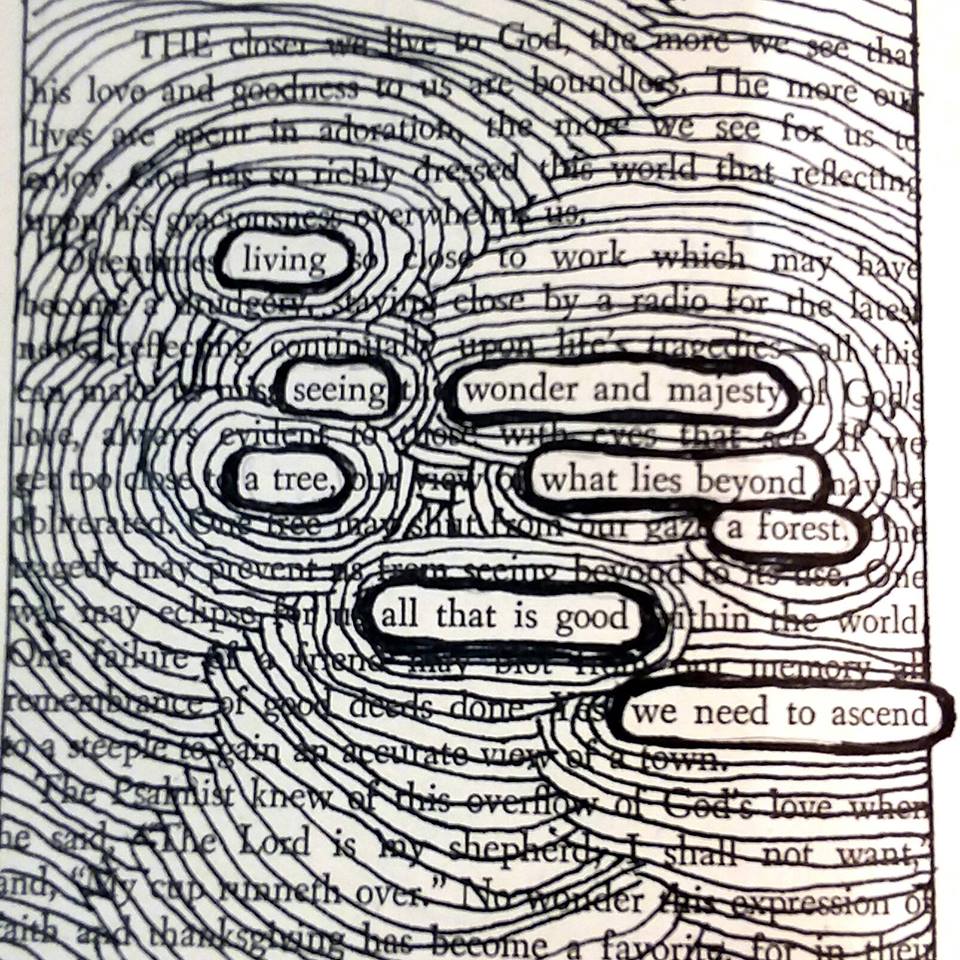
Today, we’re going to try one of my favorite poetry activities: Blackout poetry.

This is one of the easiest forms to create because it really just requires you remove the text of an existing piece by blacking it out. The text can be from a book, newspaper, magazine, or poem. You’re going to redact it, much like the FBI or CIA would do when allowing the public to view government reports.

I’m going to use this poem from Robert Frost: Nothing Gold Can Stay.

Nothing Gold Can Stay

Nature’s first green is gold,
Her hardest hue to hold.
Her early leaf’s a flower;
But only so an hour.
Then leaf subsides to leaf.
So Eden sank to grief,
So dawn goes down to day.
Nothing gold can stay.

Here’s my version:

Nothing Gold Can Stay

Nature’s first green is gold,
Her hardest hue to hold.
Her early leaf’s a flower;
But only so an hour.
Then leaf subsides to leaf.
So Eden sank to grief,
So dawn goes down to day.
Nothing gold can stay.

I’d love to hear about your experience with black out poetry. Feel free to take a photo and send it to me via email.

Guest Post: Clarity in Poetry by Shoushan Balian, author of Through the Soul Into Life

Today’s guest post is from poet Shoushan Balian, author of Through the Soul Into Life.

Check out the collection:

“This abrupt jolt
That rattled
The realms of my faith
Bent me, knocked me down
To the ineffability of my resilience”

A woman’s enigma and quest in search of herself and her power. Redefining her relationship with the world and the Divine with an earnest urge to pinpoint the cause of human suffering with an intent of alleviating it.

In Through The Soul Into Life by Shoushan B, we experience the complexities and the challenges of our inner world in relation to social norms, religion, politics, anguish, love, human rights and the hurdles that we have to face to recover our authenticity, spirituality and empathy.

Without further ado, please welcome Shoushan:

A time comes in our lives when we can no longer live life at face value, always distracted by everyday demands. Out of anxiety, frustration, and tiredness—and if we are curious enough—we stop… and start asking questions about our reality and the purpose of life. Questions without apparent answers, questions that keep us in limbo, or even questions that we avoid asking.

This journey started for me about twenty-five years ago. The more I examined my life, the more I realized the presence of pain, dissatisfaction, agony, disappointment, and so on… with a void almost impossible to fill. The more I scrutinized life in general, the more I perceived the wreckage caused by the human ego.

Eventually I began journaling my everyday inquiries and emotions. As I went along with my puzzling query, I came upon insights, as if some wiser part of me knew these all along. As I searched deeper and deeper, my understanding and explanations took a flight in such extensions, all the way to the distant beginning of our universe… tracing and understanding our journey, now as human beings, originating from the birth of our universe. A journey we are still continuing to unseen horizons. A journey worth living as long as our hearts are open to the presence of love. A journey to be ready to lose ourselves totally to redefine ourselves and to be ready to lose totally our misconception of life to reinvent ourselves from a place of self-acceptance, self-understanding, and respect for others and life.

This journey and introspection eventually, about seven years ago, led me to share my insights on my Facebook writer’s page, Shoushan B. This is how the process of writing poetry developed for me, combining my raw emotions and insights, distilling and condensing them in a distinctive style, in rhythmical lines and in rhyming words.

I owe my decision to publish my poetry collection, Through The Soul Into Life, to a very dear friend of mine, Hripsime. After reading my poems on my Facebook page, for four years she persistently pushed me to publish a book. Encouraged by her enthusiasm, I decided to polish some of my poems, write new ones, present them in a poetry collection, and actively search for a publisher until I found Atmosphere Press last February, who accepted for publication my first collection.

Life is a journey with its highlights and challenges, and it’s up to us how we navigate through it to grow and to discover our inborn gifts in order to share our experiences with others.

And I’m thankful for it!

About the Poet:

Shoushan Balian is of Armenian origin, born and raised in Beirut, Lebanon, later living in Paris, and now a resident of California. She is a writer, a poet, a visual artist and a visionary. She has published some of her poems on her Facebook and on Shoushan B writer’s page, and has read at poetry reading circles in the Bay Area. Through the Soul Into Life is Shoushan B’s first published poetry book.

Winter at a Summer House by Mary Beth Hines

Source: Purchased
Paperback, 98 pgs.
I am an Amazon Affiliate

Winter at a Summer House by Mary Beth Hines, which toured in Winter 2021-22 with Poetic Book Tours, explores the evolution of a self-made woman from birth through her later years, enhanced by the water imagery of the undulating waves that affect our lives. This is clear from the first poem, “First Born,” in which a child is born and “breathes blue/water for air,/dark whorl/of muscle, hair,/sea whistle/sways in wave/after wave/of shore/” (pg. 17) In the next poem, “A Cry So Close to Song,” the child’s cry becomes the cry of a gull. Hines takes a look at the simplicity of childhood, but she also notes those moments when you’re given a nickname that might not be so flattering. Alternating between her own childhood and that of her own children, she’s creating a family story that comes in waves across the pages.

“Scarborough Sail” sees a father become a tall ship, with sturdy rigging to hold his child upright in a turbulent sea. It is clear the poem is speaking to some rocky moments in the narrator’s life, but how her father ensured she had a stable home and structure around her. With every tumble, she rises up again, stronger. By the end of the poem, she’s swimming on her own through the ocean “beeline into surf swell,/under mayhem, into sparkle.” (pg. 29)

Ritual (pg. 30)

Sunday afternoon and my turn
to kneel on the creaky yellow
kitchen step stool and bow
over the sink, unspool my locks
into the clean pool, the white
enamel basin. Two rust eyes blink
from the bottom. I bend my neck
for Mother's blessing. I might be clay.
I might be dough. Her pulsing
soap-slicked fingers sink and knead.

Later the poems become more nostalgic for the childhood of the past, with memories of summer camp and lifeguarding. The 4th of July parties and the man all the girls giggle and blushed for. It was fun to read “Swim Meet” since my daughter is a swimmer and has a number of these competitions in all-year round. There’s that moment of realization in this poem that the narrator will not be the best on the team, but the beauty of the swim and the burn of the exercise is something that is seared into her memory: “streaks through blue, the kick-/stroke-surge through the wake/of the winter’s churn.//”

Winter at a Summer House by Mary Beth Hines is introspective in its look at a life that is evolving and moving forward, even as we hope to hold all of our memories close. The final poems may make you weep with sadness as the family faces the passing of loved ones and the closing of the summer house. Another chapter has closed, but the ghosts slip out into the swells of the sea on their next journey, just as the narrator will do.

RATING: Cinquain

Photo Credit: David Mullen

About the Poet:

Mary Beth Hines grew up in Massachusetts where she spent Saturday afternoons ditching ballet to pursue stories and poems deep in the stacks of the Waltham Public Library. She earned bachelor of arts in English from The College of the Holy Cross, and studied for a year at Durham University in England. She began a regular creative writing practice following a career in public service (Volpe Center, Cambridge, Massachusetts), leading award-winning national outreach, communications, and workforce programs. Her poetry, short fiction, and non-fiction appear in dozens of literary journals and anthologies both nationally and abroad. Winter at a Summer House is her first poetry collection. When not reading or writing, she swims, walks in the woods, plays with friends, travels with her husband, and enjoys life with their family, including their two beloved grandchildren. Visit her online.

Challenges While Photographing for Poetry: Himalayas by Jon Meyer, author of Clouds: love poems from above the fray

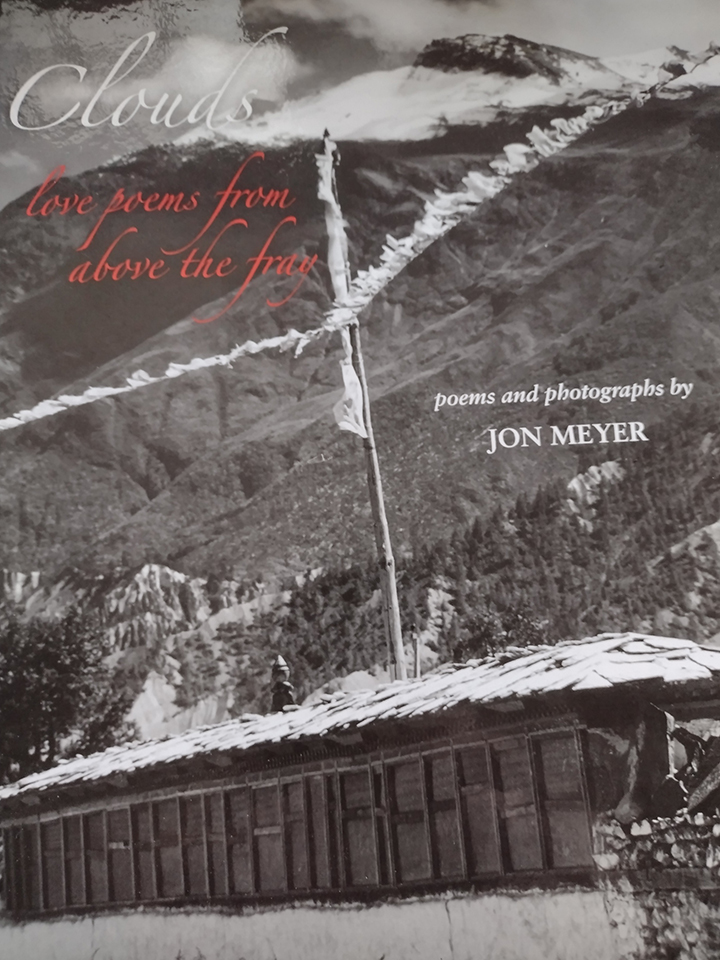
Today’s guest post is from Jon Meyer, author of Clouds: love poems from above the fray, which is a available digitally or as a coffee table book.

Here’s a little more about the book:

Clouds: love poems from above the fray features beautiful black and white photographs from around the world, paired with Jon’s reflective and inspirational poetry and stories behind the photographs. One such story explains the unforgettable experience behind Jon’s photo of a small plane surrounded by the snow-capped Himalayas in Nepal:

After sitting in the tiny airport in Pokara, Nepal for 5 hours, I started to get restless. We still had not taken off to fly up into the Himalayas.  So, I asked a man wearing a pilot’s uniform when we would board and take off. “When I can see blue sky,” he replied, “because in Nepal, the clouds have rocks in them.” (Jon Meyer, 2022) (#21)

Please give Jon Meyer a warm welcome:

Photography for use with poetry requires patience, sometimes requiring hours of waiting for the right light or having a cloud in the right place, or even the position of a cold midnight reflection.

Traveling to take a photograph can be a macro or micro adventure. The micro may be just walking around the corner or into a nearby forest. A macro adventure sometimes requires visiting a new country, learning about new (to me) cultures, or finding places that illustrate previous writing. Capturing the right image may require climbing mountains, flying to remote destinations, trudging through mud or snow, riding in a car on a steep mountain road without guard- rails and having the brakes fail, or even barely avoiding an avalanche.

The latter experience occurred when trekking in the high Himalaya and taking photos of their magnificent snow- covered peaks. The tiny villages along the Annapurna Circuit trek in Nepal are basic. The most prosperous of the small dwellings are made of carefully placed stone, and some are covered with whitewash. At the time that I was there, my guide and I stayed overnight in hut/ homes with minimal heating that consisted of a cooking fire inside, and most villages at altitude did not have electricity nor running water. The villagers were always welcoming and gracious with Namaste greetings to all strangers. We were happy to take shelter from the night’s wind and cold. The views of the ice- covered Himalayan peaks remain unsurpassed. Homes are now starting to acquire solar for lighting and essentials.

We passed by the prayer flags in the cover photo for Clouds on our trek up toward Thorong La, the world’s highest pass at 18,000 feet (over 5,400 meters). That morning, we had a good start before dawn, and by 10 AM we were well above the tree line at 16000 feet in a steep valley. Above us to the left was a peak with a sheer, high degree inclination, and on that smooth stone face was a thick ice field extending down from 26,000 feet to just above the rock- strewn trail we were scrambling on. The continuous ice was more than a mile wide.

By this time of morning, the strong sun was out with scattered clouds, similar to those in the photo. As we passed below the ice field, my guide and I both noticed the increase of water pouring down the smooth black mountain from below the ice field. It was really a rushing river. A shiver shook my body at the thought that in a moment the whole ice field could collapse, avalanche down, and cover the narrow valley we were in.

We looked for large boulders to crouch behind if the ice let go, but there were few with no guarantee that the ice wouldn’t roll them over us if we took cover there or back down the trail. So, we increased our pace but the altitude’s reduced oxygen made progress slower than necessary. With help from adrenaline, we pushed on and up. It was like a dream of running as fast as possible but still very slowly. When I was in High School, I ran sprints while on sports teams. The longest I could go was less than 30 seconds all out. This time, after 45 minutes of a maximum effort slow sprint and my repeating Love’s name with great intensity, we reached a point on the trail out of peril.

Just then I heard a loud crack, like a rifle shot too close to my ear. The ice field had let go, and cascaded down over the trail where we had just been. Since we were now ‘above the fray’ my stress and determination changed to gratitude. The Ancient One, Lord of the Mountains sent a lesson and a message, “Now that’s the way to remember Me always.”

Clouds: love poems from above the fray has been a project spanning more than four decades containing poems influenced by visiting many places, giving lectures, and witnessing beautiful vistas, in towns, cities, and above all, in nature. Over my career, I have been invited to speak at universities and cultural centers across the US and in a number of other countries, and I took photographs while in those places. Thousands of those photos are now in my archive. Hundreds of five- line quintain poems were written down, from which 64 were chosen for Clouds. These were then matched with photos in my archive.

Thank you, Jon, for sharing your poetry, photos, and stories.

About the Poet:

Jon Meyer has written for The Village voice, ARTnews, ARTS, New Art Examiner, Visions Quarterly, CRITS, Q, Dialog, Art New England, Fictional Café, and many more publications. As Department Chair, Meyer led a small team producing a film about one of his students, Dan Keplinger. This film, King Gimp, won the Oscar for best short documentary at the 2000 Academy Awards. Meyer’s work has been in 60 solo and group exhibitions (18 museum exhibitions) and 20 museum/public collections globally. He has received 12 grants, including a National Endowment for the Arts grant.