Quantcast

Mailbox Monday #680

Mailbox Monday has become a tradition in the blogging world, and many of us thank Marcia of The Printed Page for creating it.

It now has its own blog where book bloggers can link up their own mailbox posts and share which books they bought or which they received for review from publishers, authors, and more.

Velvet, Martha, and I also will share our picks from everyone’s links in the new feature Books that Caught Our Eye. We hope you’ll join us.

Here’s what I received:

Kill It with Fire: Manage Aging Computer Systems (and Future Proof Modern Ones) by Marianne Bellotti, narrated by Katie Koster, which I downloaded for work.

Kill It with Fire examines aging computer systems, the evolution of technology over time, and how organizations can modernize, maintain, and future-proof their current systems.

“Kill it with fire”, the typical first reaction to a legacy system falling into obsolescence, is a knee-jerk approach that often burns through tons of money and time only to result in a less efficient solution. This book offers a far more forgiving modernization framework, laying out smart value-add strategies and proven incremental techniques that work equally well for ancient systems and brand-new ones.

Internationally known for restoring some of the world’s oldest, messiest computer networks to operational excellence, software engineering expert Marianne Bellotti distills key lessons and insights from her experience into practical, research-backed guidance on topics from “chaos” testing solutions to building momentum-driven teams and effective communication structures. Using clear explanations and simple exercises, she’ll help you determine when to modernize, how to organize, what migrations will add the most value, and where to focus your maintenance efforts for maximum impact. With witty, engaging prose, Bellotti explains why new doesn’t always mean better, weaving in illuminating case studies and jaw-dropping anecdotes from her work in the field.

You’ll learn:

Tips and best practices for assessing architecture and testing assumptions
How to avoid trends and pick the right modernization solutions for your specific needs
How to determine whether your migrations will add value before you invest in them
Critical considerations every organization should weigh before moving data to the cloud
Team-based strategies and motivational tricks for keeping modernization plans on track
Key outcomes and checklists for determining when a project is finished

Packed with resources, exercises, and flexible frameworks for organizations of all ages and sizes, Kill It with Fire will give you a vested interest in your technology’s future.

The No-Show by Beth O’Leary, which I purchased.

Siobhan is a quick-tempered life coach with way too much on her plate. Miranda is a tree surgeon used to being treated as just one of the guys on the job. Jane is a soft-spoken volunteer for the local charity shop with zero sense of self-worth.

These three women are strangers who have only one thing in common: They’ve all been stood up on the same day, the very worst day to be stood up—Valentine’s Day. And, unbeknownst to them, they’ve all been stood up by the same man.

Once they’ve each forgiven him for standing them up, they are all in serious danger of falling in love with a man who may have not just one or two but three women on the go….

Is there more to him than meets the eye? Where was he on Valentine’s Day? And will they each untangle the truth before they all get their hearts broken?

Memory and Desire by Gregory Luce, which I purchased.

Memory and Desire is a collection of poetry exploring the themes articulated in the title, both individually and as they are woven together. Roaming from childhood recollections to captured moments from the natural and the urban environments, the book includes poems ranging from brief lyrics to longer narratives, some humorous, others wistful.


What did you receive?

April 24, 4-6 PM: Local D.C. Event: Poetry Reading with Photopoetry by Gordana Gerskovic, Serena Agusto-Cox, and More

What: Poetry Reading with Photopoetry
When: Sunday, April 24 at 4 p.m. to 6 p.m.
Where: Foundry Gallery at 2118 8th Street NW, Washington, D.C.

Two of my poems have been paired with Gordana Gerskovic‘s wonderful art. Come see the art and hear some great poems.

Also featured:

I hope that if you are in the area, you’ll drop by the poetry reading on April 24.

April 23, 4 p.m. EST: National Poetry Month Zoom Reading: Poets in the Blogosphere


I hope you’ll be available to register and listen in on Zoom on April 23 at 4 p.m. EST.

I’ll be reading with some fantastic poets from the blogosphere. I was honored to be invited.

Check out these wonderful poets:

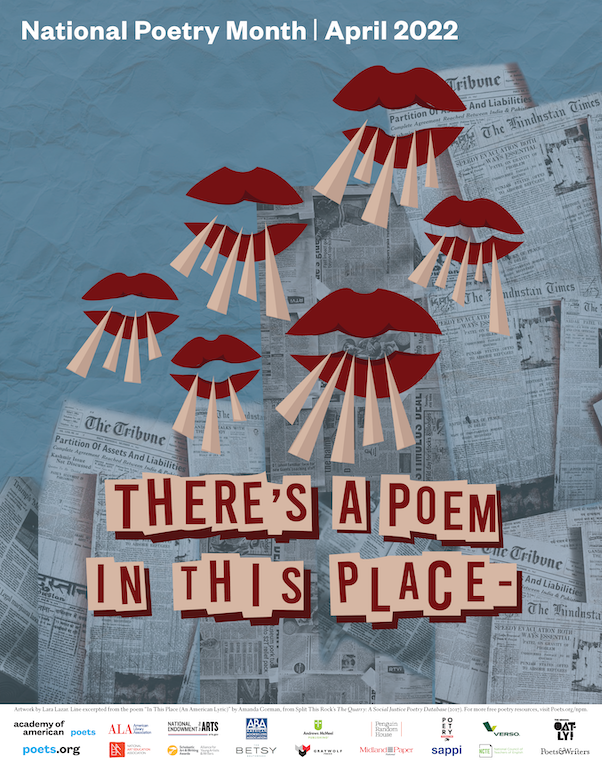
The theme of this reading is There’s A Poem in This Place.

Two places to find contemporary poetry at its most vibrant are in the blogging community and at live readings. On April 23, 2022, from 4-5:30 PM ET, the two places come together when a select group of poets from the blogosphere present a live reading of their poetry at Poets in the Blogosphere.

Most poetry is meant to be read aloud, and hearing poets read their own work is a heightened experience.The event is moderated by Elizabeth Gauffreau. Please register in advance at https://tinyurl.com/Poets-in-the-Blogosphere #NationalPoetryMonth #blogpoetsread2022

Virtual Poetry Circle: Earth Day Poems

Hello everyone!

It’s National Poetry Month and in honor of April as Keep American Beautiful Month and Earth Day celebrations on April 22, I’m sharing one of my favorite poems about the beauty of our world. A little reminder to slow down and protect the only home we have.

The Thaw by Henry David Thoreau

I saw the civil sun drying earth’s tears —
Her tears of joy that only faster flowed,

Fain would I stretch me by the highway side,
To thaw and trickle with the melting snow,
That mingled soul and body with the tide,
I too may through the pores of nature flow.

But I alas nor tinkle can nor fume,
One jot to forward the great work of Time,
‘Tis mine to hearken while these ply the loom,
So shall my silence with their music chime.

There’s a sense of desire to be part of nature around him, a seeping of the human self into that seamless flow. But he can merely sit and marvel. Wouldn’t it be lovely to have that time to sit and marvel at it all.

Check out these other Earth Day poems:

Feel free to share your favorites in the comments.

Guest Post: Publishing Poetry by Kurtis Ebeling, author of Beneath Stretching Pines

Today’s guest post is from Kurtis Ebeling, author of Beneath Stretching Pines.

Here’s a little bit about the poetry collection:

Please give Kurtis a warm welcome:

Publishing a collection of poetry, even one as modest as Beneath Stretching Pines, was a rather extensive, drawn-out endeavor. Some of the 30 poems were composed and then published in journals nearly 3 years before I decided to compile and organize them, and a few others were composed within a couple weeks of the book’s publication. It is also important to note that these poems are, in many respects, an extension of my graduate studies at EWU—my studies of the modernist poets in particular. Thus, for better or worse, I have both teachers and academia to thank and/or blame for the inadvertent inspiration for these poems.

While Beneath Stretching Pines takes simple, modest subjects as its focus (trees, dead leaves, streetlamps, bedside windows, etc.), it is also at play with a somewhat complicated philosophical subtext. Namely, the poems in this collection are inspired by the epistemological, or meaning-
producing, relationship created between the self and the world as we experience it. I like to think that my poems use language in a way that collapses (and questions) the distinction between abstraction and the perceived world (selfhood and worldhood), and that, in doing so, they articulate self-expression in relation to self-effacement. They suggest that thought and the experienced world are, moment to moment, co-emergent and intertwined. To use a favorite metaphor of both W.B. Yeats and William Carlos Williams, these poems suggest that the material world and perceiving mind come together to perform a kind of dance, which, in this case, symbolizes sensory experience and abstract meaning making observation and thought active rather than passive. That said, I hope that my readers will interpret my work in other, perhaps more interesting, ways unique to their own thinking. My ideas about poetry can be—to my chagrin—deceptively romantic.

It is also very likely that I was slightly overeager to publish Beneath Stretching Pines when I did. While I am incredibly happy with the way this collection turned out, I do remember feeling like I needed to be free of these poems to continue writing new ones. Ultimately, the only difference additional time would have likely made is that this collection would have probably ended up longer. Nevertheless, there is a certain charm to its brevity. Beneath Stretching Pines is also my debut collection, so I wasn’t entirely conscious of the effort I’d have to put into marketing, post-publication, if I wanted to reach an audience outside of my friends and family. As time passes though, I am becoming more and more comfortable with its small, intimate audience. Art doesn’t have to find a home within the larger culture to be worthwhile—its creation is an accomplishment either way. Of course, a large part of me would like to find a larger audience, which is why I continue searching for places like Savvy Verse & Wit to promote my work.

Opportunities like these are always exciting.

Thank you, Serena, for extending this opportunity, and thank you readers for spending time with the words I’ve strung together!

Thank you, Kurtis!

Please take a moment to read a sample poem from his collection:

A Willow

A willow—limbs cracking under
grayish white bark and hunching
under gravity (somewhere between
consciousness and sleep)—shrugs

in early spring: where breath flows
in woody veins. Behind the guise
of death—undressed by winter,
touching spears of grass—there is

a small kind of hidden horizon:
a small kind of scene.

Curling from some central stem,
an entangled mess of branches
sway with the subtle breeze; sunlight
colors in yellow and clarifies 
 
what little we get to know
before dying: what little we get
to see without undressing.

This poem speaks the beauty of nature and the many unknowns we face in the shadow of death.

Guest Post: Poetry Writing Tips from a Published Poet by D.L. Heather

Today’s guest post is from D.L. Heather, author of Life Interrupted. Here’s a little about the book:

Life Interrupted is a powerful and intensely moving poetry book of one woman’s journey into a life of chronic pain-and the unyielding resilience of the human spirit. D.L. Heather’s collection of poems takes you on a journey through living with chronic pain, healing, self-discovery, inner strength, and personal transformation. A journey through powerful feelings that grow from seeds and change into blooming flowers.

Please give D.L. Heather a warm welcome:

Ever wondered how to write a poem? For writers who want to dig deep, composing verse lets you sift the sand of your experiences for flickers of light and insight.

If you’re tempted to try your hand at a few verses but you’re not sure where to start, keep reading this blog by haikuist author & poet D.L. Heather.

Start with an idea

Don’t force yourself to write your poem linearly, from the first line to the last. Instead, start with an idea your brain can latch onto as it learns to think in verse.

Your starting point can be a word, a line, or a phrase you want to work into your poem. It might be a vivid picture floating around in your mind. It can be a complex feeling you want to execute with precision, or a memory that you can’t seem to let go of. I think the most powerful poems give voice to something true about the human experience and help us look at everyday experiences in new and exciting ways.

Think of your starting point as the why in your poem, what’s your motivation for writing it?

Mind Mapping

Now that you’ve got a starting point, it’s time to put fingertips to the keyboard or, if you’re old school like me, pen to paper. Before you write out verses, take some time to look deep into the feelings, imagery, or theme at the centre of your poem.

Take as much time as you need and write anything that comes to mind when you think of your initial idea. You can draw your mind map by hand, add bullet points, jot down words, form brief paragraphs. The purpose of this mind map isn’t to produce an outline, rather to gather raw material to draw upon as you draft your poem.

My advice, don’t censor yourself. Overthinking or mentally grumbling will drive you crazy! “This line will never make it into the final draft”? Tell that inner critic to be quiet for now and just keep writing. You just might refine it down into a witty, poignant line.

Choosing your style

Once you’re happy with your mind map, look at what you came up with. Chances are, you’ve got one beautiful mess: sentences that trail off or change structure midway. That’s okay! Don’t beat yourself up! I promise you, there’s a poem in there somewhere.

You’re going to take your creation and sculpt the hell out of it. You will figure out what kind of shape you can make out of it — whether it’s naturalistic, free flowing or restrained.

Will you write free verse, or do you prefer following more traditional “rules,” like rhyming poetry or the syllabic constraints of tanka or haiku? Even if your words beg for a poem without restrictions, like free verse, you still have to know the tone and texture of the language of your poem.

Read… Read and Read Some More

A poem isn’t like reading a novel: you don’t have to spend hours upon hours researching to write a wonderful poem. Although, reading poetry of any style can keep you inspired throughout the writing process, especially if you’re feeling stuck.

Say you’re writing a sensory rich poem about a toxic relationship between a married couple. In that scenario, I would recommend reading some key imagist poems, alongside some poems that sketch out complicated visions of relationships.

Choose a poem that speaks to you and:

  • Find examples of simile and metaphors
  • Look for other senses than sight
  • Come up with questions and try to answer them
  • Try to analyse what emotions it stirs in you

Write for yourself

With an idea, a mind map and some inspiration under your belt, it’s time to draft your poem!

After all the exploratory thinking, you’re ready to write. But the pressure of actually producing verse can still cause self-doubt and anxiety. I suggest writing for yourself, at first, to take some of that pressure off of you.

I wholeheartedly believe that as writers, songwriters, poets, novelists that we can determine the validity of our success if we start by writing for ourselves. Personally, my life has certainly changed through the years. By certain lines, I’ve had the bravery to think of and then write — and those moments are when I’ve most felt like I’ve made it. Most of those lines in those first drafts were for my eyes only, and they were the most poignant.

As the first draft comes together, treat it like it’s meant for your eyes only.

Read your poem out loud

A memorable poem doesn’t have to be beautiful on paper: maybe a flowing, melodic prose isn’t your aim. Though it should come alive on the page regardless of your style. To achieve that, always read your poem out loud — at first, word by word, line by line, and then all together.

Trying out every line against your ear can help you weigh out a choice between synonyms. Reading out loud can also help you hear line breaks that just don’t fit. Is the line too long? Does it force you to speed through it? Do you want to give your readers some time to take it all in and give them room to breathe?

Take a Breather

By now, you’ve successfully written your first draft. It may not be perfect, but you should be proud of yourself – you’ve written a poem! Congratulations!

Now it’s time to step away and take a breather. If you’re like me, you’ve probably read out loud every single line so many times that all meaning has leached out of the syllables. So take some time off, go for a walk, catch up on some reading, or start your next writing project. Then come back with a fresh set of eyes because trust me, you’re not finished, not just yet — you still have to do revisions.

Revision Time

Revising poetry is a process that requires word play and loads of patience. Don’t beat yourself up if it’s not coming together how you imagined it. Take your time. Have fun with it! Your poems will grow and evolve. For me, my revision process is much like my brainstorming and writing process. I find a quiet place where I can be alone with myself and really listen to how I’m feeling at the moment.

You can skip all of the above writing hassles by using an AI PoemGenerator tool.

About the Poet:

D.L. Heather is the pen name for poet, writer, and former music journalist Debra Heather. She has a B.A. in English and is the author of the inspirational poetry collections; Life Interrupted and Metamorphosis. Debra was born on 04 December 1978 in Penticton, British Columbia, Canada, and now resides in Detroit.

Writing came into her life in her teens by way of therapy and the exploration of healing through journaling. Her writing is motivated by her experiences with childhood trauma, love, loss, healing, heartbreak, and self-discovery.

A private person by nature, she prefers to let her work speak for itself, in the way poetry allows her to. She hopes to inspire others and reinforce the fact that you are not alone.

When she isn’t writing in her studio, she enjoys traveling, reading, movies and gardening. Her current book, Metamorphosis: Extended Edition, will be available December 21, 2021. Connect with her on Instagram @dlheatherpoetry

Poetry Activity: Tanka

Today’s poetry activity is to build a tanka poem.

The tanka is a thirty-one-syllable poem, traditionally written in a single unbroken line. A form of waka, Japanese song or verse, tanka translates as “short song,” and is better known in its five-line, 5/7/5/7/7 syllable count form.

Please check out this tutorial video on how to create a tanka:

If you’d like a simpler way to create one, check out the Tanka Poem Generator.

Here’s mine:

Sycamore

Oh my sycamore
It is hungry and solid.
It has perfect limbs
And a mighty roots as well
When it soars I feel happy

Share your tanka below.

Mailbox Monday #679

Mailbox Monday has become a tradition in the blogging world, and many of us thank Marcia of The Printed Page for creating it.

It now has its own blog where book bloggers can link up their own mailbox posts and share which books they bought or which they received for review from publishers, authors, and more.

Velvet, Martha, and I also will share our picks from everyone’s links in the new feature Books that Caught Our Eye. We hope you’ll join us.

Here’s what I received:

The Tradition by Jericho Brown, which I purchased.

Jericho Brown’s daring new book The Tradition details the normalization of evil and its history at the intersection of the past and the personal. Brown’s poetic concerns are both broad and intimate, and at their very core a distillation of the incredibly human: What is safety? Who is this nation? Where does freedom truly lie? Brown makes mythical pastorals to question the terrors to which we’ve become accustomed, and to celebrate how we survive. Poems of fatherhood, legacy, blackness, queerness, worship, and trauma are propelled into stunning clarity by Brown’s mastery, and his invention of the duplex—a combination of the sonnet, the ghazal, and the blues—is testament to his formal skill. The Tradition is a cutting and necessary collection, relentless in its quest for survival while reveling in a celebration of contradiction.

Time Is a Mother by Ocean Vuong, which I purchased.
In this deeply intimate second poetry collection, Ocean Vuong searches for life among the aftershocks of his mother’s death, embodying the paradox of sitting within grief while being determined to survive beyond it. Shifting through memory, and in concert with the themes of his novel On Earth We’re Briefly Gorgeous, Vuong contends with personal loss, the meaning of family, and the cost of being the product of an American war in America. At once vivid, brave, and propulsive, Vuong’s poems circle fragmented lives to find both restoration as well as the epicenter of the break.

The author of the critically acclaimed poetry collection Night Sky With Exit Wounds, winner of the 2016 Whiting Award, the 2017 T. S. Eliot Prize, and a 2019 MacArthur fellow, Vuong writes directly to our humanity without losing sight of the current moment. These poems represent a more innovative and daring experimentation with language and form, illuminating how the themes we perennially live in and question are truly inexhaustible. Bold and prescient, and a testament to tenderness in the face of violence, Time Is a Mother is a return and a forging forth all at once.

What did you receive?

Virtual Poetry Circle: Mahmoud Darwish

Hello everyone!

It’s National Poetry Month and in honor of April as Arab-American Heritage Month, I wanted to share one of my favorite poems from Mahmoud Darwish.

I Belong There

I belong there. I have many memories. I was born as everyone is
     born.
I have a mother, a house with many windows, brothers, friends, and
    a prison cell
with a chilly window! I have a wave snatched by seagulls, a panorama 
    of my own.
I have a saturated meadow. In the deep horizon of my word, I have
    a moon,
a bird's sustenance, and an immortal olive tree.
I have lived on the land long before swords turned man into prey.
I belong there. When heaven mourns for her mother, I return 
    heaven to her mother.
And I cry so that a returning cloud might carry my tears.
To break the rules, I have learned all the words needed for a trial by 
    blood.
I have learned and dismantled all the words in order to draw from 
    them a
single word: Home.

This poem is a reflection on the trauma and turmoil, but also the blessed things in a home torn by fighting. There a deep longing for the home in his mind, one filled with light and beauty, but the reality is that it is a country torn.

Please share one of your favorite Arab-American poets. Or take some time check find one on poets.org.

Poetry Events: Roundup of Weekend Poetry Events

Here’s some local D.C. area and online poetry events for you to check out this weekend!

In-Person:

Pop-Up & Poetry: poetry series dedicated to the synergy of BLACK lyricism, artists, and space in the home of Nubian Hueman. (21+ audience only) April 15 7-9 p.m.

Nubian Hueman – Baltimore
211 West Read Street
Baltimore, MD 21201

For kids ages 5-12, you can pick up a Poetry Packet at the Tenley-Friendship Neighborhood Library. (pick up during library hours on April 15)

Tenley-Friendship Neighborhood Library
4450 Wisconsin Ave., NW
Washington, D.C.

Charlottesville Reading Series with poet Aran Donovan and fiction writer Anna Caritj. (April 15 at 7 p.m.)

New Dominion Bookshop
404 E Main St
Charlottesville, VA  22902

Online Events:

Virtual: National Poetry Month Celebration w/ The Rumpus with Derrick Austin, Michael Chang, Chen Chen, & Brionne Janae. (April 15 at 7 p.m.)

What poetry events are you excited about? Drop the details in the comments.

Poetry Activity: Limericks

Limericks are a fun poetry form to create. They remind me of stand-up comics where anything becomes fodder for humor.

Definition of Limericks:

A limerick is a humorous poem consisting of five lines. The first, second, and fifth lines must have seven to ten syllables while rhyming and having the same verbal rhythm. The third and fourth lines should only have five to seven syllables; they too must rhyme with each other and have the same rhythm.

Edward Lear is one of the most well known writers of Limericks, and this is one of my favorites:

There was an Old Man with a beard
Who said, "It is just as I feared!
Two Owls and a Hen,
Four Larks and a Wren,
Have all built their nests in my beard!"

I love using the limerick generator, and I hope you’ll give it a try, too. Here’s mine:

There once was a lass called sally.
She said, "See the great vitaly!"
It was rather poor,
But not louis pasteur,
She just couldn't say no to the halle.

Share yours below.

Any Dumb Animal by AE Hines

Source: Purchased
Paperback, 88 pgs.
I am an Amazon Affiliate

Any Dumb Animal by AE Hines, which toured with Poetic Book Tours, is a compact powerhouse of poems where the poet tackles his demons, the rejection of his father, becoming at father himself, turning 50, and so much more. Hines is brave in these poems where he lays bare his fears, heartbreaks, and deep regrets, but these poems also offer glimmers of light, love, and hope.

***Be aware that some of the poems can be triggering if you’ve suffered abuse, trauma, and hate because of your sexual orientation.***

“Phone Call” opens the collection with a harrowing experience of a father pinning his son to floor after dragging him from his bed and squeezing his hands in the hardware store, as if force could mold him into what his father wishes him to be. However, Hines’ torment doesn’t stop there as he finds himself with a marriage counselor and a spouse who diminishes him in the same way. This poem explores trauma and how that trauma lasts years and years unless it is addressed.

In “How We Learn,” we find Hines has some anxieties: “Having nearly drowned as a child,/having been terrified to leave/the confines of dry land, I already knew/a thing or two about avoiding/the obvious dangers./” (pg. 5) But here we see a father “tossing” him “into the deep end of pools”. This dynamic between father and son is the anchor of the collection and a trauma that infects all of the other relationships he speaks about until he has come to terms with his deep-seated pain.

I don’t want to go into too much detail about these poems because you should read these poems for yourself. Any Dumb Animal by AE Hines is devastating all the more so because these personal experiences will make your heart break.

RATING: Cinquain

About the Poet:

AE Hines (he/him) grew up in rural North Carolina and currently resides in Portland, Oregon. His poetry has been widely published in anthologies and literary journals including I-70 Review, Sycamore Review, Tar River Poetry, Potomac Review, Atlanta Review, Crosswinds Poetry Journal and Crab Creek Review. He is winner of the Red Wheelbarrow Prize and has been a finalist for the Montreal International Poetry Prize. He is currently pursuing his MFA in Writing at Pacific University. Follow him on Twitter, Facebook, Instagram.