Quantcast

279th Virtual Poetry Circle

Welcome to the 279th Virtual Poetry Circle!

Remember, this is just for fun and is not meant to be stressful.

Keep in mind what Molly Peacock’s book suggested.

Look at a line, a stanza, sentences, and images; describe what you like or don’t like; and offer an opinion. If you missed my review of her book, check it out here.

Today’s poem is from Jack Collom, recited by Natasha Vargas:

Ecology

Surrounded by bone, surrounded by cells,
by rings, by rings of hell, by hair, surrounded by
air-is-a-thing, surrounded by silhouette, by honey-wet bees, yet
by skeletons of trees, surrounded by actual, yes, for practical
purposes, people, surrounded by surreal
popcorn, surrounded by the reborn: Surrender in the center
to surroundings. O surrender forever, never
end her, let her blend around, surrender to the surroundings that
surround the tender endo-surrender, that
tumble through the tumbling to that blue that
curls around the crumbling, to that, the blue that
rumbles under the sun bounding the pearl that
we walk on, talk on; we can chalk that
up to experience, sensing the brown here that’s
blue now, a drop of water surrounding a cow that’s
black & white, the warbling Blackburnian twitter that’s
machining midnight orange in the light that’s
glittering in the light green visible wind. That’s
the ticket to the tunnel through the thicket that’s
a cricket’s funnel of music to correct & pick it out
from under the wing that whirls up over & out.

What do you think?

The Last Mile by Blair Richmond

Source: Ashland Creek Press
Paperback, 244 pgs
I am an Amazon Affiliate

The Last Mile by Blair Richmond is the third book in the Lithia trilogy — see my reviews of Out of Breath and The Ghost Runner and be aware that this review could contain spoilers for the previous two books — that combines environmentalism and supernatural elements.  Kat’s world has been upended once again, but she now is more determined than ever to get her life back on track, even if that means revisiting some previous relationships and exploring some untapped feelings.  If there’s one drawback, there is a little too much back story included here and some of it is repeated later in the short novel.  But other than that, Kat has come into her own and gained the strength that she needs to fight Lithia’s demons and ensure that the town has a future.

“He shakes his head.  ‘You know, it was strange back then.  I had moments when I looked up at these trees, these monuments to time, and I felt so guilty.  So cruel.  I knew even then that what I was doing was wrong.  The trees couldn’t fight back.  They were just standing there, like they had for centuries, living their lives, not bothering a soul, cleaning our air, giving nests to birds, making the world a better place just by being alive.  And then we arrived with out axes and saws and train cars, and we left behind miles and miles of stumps.”  (page 43)

Richmond has created a lasting environmental and supernatural hybrid that opens readers eyes to the wonders of nature and the ease with which we can live symbiotically with it, rather than cut it down in the name of progress.  Alex, the vegan vampire, is still at Kat’s side in friendship, though he wants more, but she’s made her choice and she’s moving forward as best she can as the death and destruction of Victor continues to hover in the shadows.  She’s a 20 year old young woman with great responsibility to the land she inherited and to the town where she’s found herself more at home than ever before, but she’s also aware that a delicate balance must be kept between panic and protection.

The marathon race into the Lithia Mountains, Cloudline, is approaching, and despite the anxiety she has regarding Victor’s intentions, Kat continues to train and strategize.  The Last Mile by Blair Richmond is about the push runners must consciously decide to take to make it to the finish line no matter the cost to them physically and emotionally.  Kat faces this last mile as a runner, on her own, and while she perseveres, she’s aware that her finish line may not only save Lithia, but also those she loves.

About the Author:

Blair Richmond is the pen name of a writer from the Pacific Northwest. Out of Breath and The Ghost Runner are books one and two of the Lithia Trilogy. Visit Blair’s blog for the latest on The Lithia Trilogy.

Other Reviews:

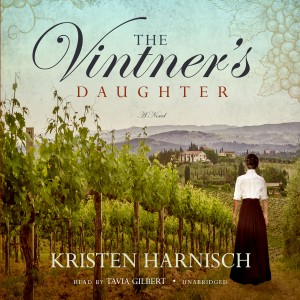
Giveaway: Audio of Kristen Harnisch’s The Vintner’s Daughter

audio book coverEarlier this year, I raved about Kristen Harnisch’s The Vintner’s Daughter.

Loire Valley, 1895. When seventeen-year-old Sara Thibault’s father is killed in a mudslide, her mother sells their vineyard to a rival family, whose eldest son marries Sara’s sister, Lydia. But a violent tragedy compels Sara and her sister to flee to New York, forcing Sara to put aside her dream to follow in her father’s footsteps as a master winemaker.

Meanwhile, Philippe Lemieux has arrived in California with the ambition of owning the largest vineyard in Napa by 1900. When he receives word of his brother’s death in France, he resolves to bring the killer to justice.

I said in my review, “Harnisch has crafted a emotional journey of a young woman coming into her own in the modern world and learning to forgive and be forgiven.  Stunning debut.”

I am excited to share with you that there will be a sequel to the book and to celebrate, I’ve got one audio download from Blackstone Audio to give away to one winner.

Please enter by Nov. 14, 2015 at 11:59 PM EST.

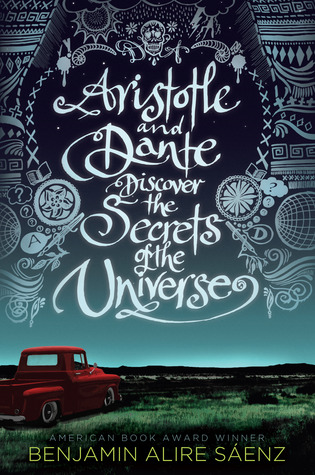
Aristotle and Dante Discover the Secrets of the Universe by Benjamin Alire Saenz

Source: Public Library
Hardcover, 359 pgs
On Amazon and on Kobo

Aristotle and Dante Discover the Secrets of the Universe by Benjamin Alire Saenz is a brilliant coming of age story that examines not only how tough it is to be a young boy — a young Mexican American — but also how these boys struggle with cultural stereotypes of what becoming a man should be.  Dante is an optimistic boy who sees the beauty of the world all around him, while Aristotle (Ari) seems himself as a loner and a pessimist.  These boys meet one summer in 1987 in El Paso at a local pool, and Dante offers to teach Ari how to swim.  Dante loves the water and he wants to share that love with someone who could become his best friend.  These boys are exploring their lives, learning that their lives are not their own, but often dictated by the parents who care for them and they wonder when they will get to create and be in lives wholly their own.

“There is a famous painting, Nighthawks, by Edward Hopper.  I am in love with that painting.  Sometimes, I think everyone is like the people in that painting, everyone lost in their own private universes of pain or sorrow of guilt, everyone remote and unknowable.  The painting reminds me of you.  It breaks my heart.”  (page 185)


In Ari’s home, his brother is dead to them because he is in prison, but Ari knows that he must have loved him and doesn’t understand why there are no pictures of him in the house, why he is never spoken of, and why he doesn’t know what happened to him.  This void is huge and hard to fill, but he’s also impacted by the silence of his father, a Vietnam veteran forever changed by a horrifying war and other deeply felt losses.  Dante’s family is different, it is affectionate physically and emotionally, and his parents are well-educated intellectuals.  But there are secrets here too, secrets held close by Dante, who only wants to share them with someone who could understand — Ari.  Being 15, these are in between childhood and becoming men, and that is a tough time for any adolescent, but its even tougher when you are confused about who you are and who you want to be.  Dante and Ari’s friendship is far from easy, but the understand one another.

“‘Sometimes don’t you just want to stand up and yell out all the cuss words you’ve learned?’
‘Every day.’
‘Every day? You’re worse than me.’ He looked at the hail. ‘It’s like pissed off snow,’ he said.
That made me laugh.” (page 104)

Aristotle and Dante Discover the Secrets of the Universe by Benjamin Alire Saenz is an award winning book for great reasons. It is never forced, it is as easy as a friendship between two boys can be, but it also tackles that harder issues that we as a society continue to struggle with. At its heart, it is a beautiful love story, one that will stay with readers long after turning the last page. Another contender for the Best of 2014 list.

***I want to thank Beth Kephart for her review of this book in August.  She always has the best recommendations.***

About the Author:

Benjamin Alire Sáenz is an award-winning American poet, novelist and writer of children’s books.  He was born at Old Picacho, New Mexico, the fourth of seven children, and was raised on a small farm near Mesilla, New Mexico. He graduated from Las Cruces High School in 1972. That fall, he entered St. Thomas Seminary in Denver, Colorado where he received a B.A. degree in Humanities and Philosophy in 1977. He studied Theology at the University of Louvain in Leuven, Belgium from 1977 to 1981. He was a priest for a few years in El Paso, Texas before leaving the order.

In 1985, he returned to school, and studied English and Creative Writing at the University of Texas at El Paso where he earned an M.A. degree in Creative Writing. He then spent a year at the University of Iowa as a PhD student in American Literature. A year later, he was awarded a Wallace E. Stegner fellowship. While at Stanford University under the guidance of Denise Levertov, he completed his first book of poems, Calendar of Dust, which won an American Book Award in 1992. He entered the Ph.D. program at Stanford and continued his studies for two more years. Before completing his Ph.D., he moved back to the border and began teaching at the University of Texas at El Paso in the bilingual MFA program.

76th book for 2014 New Author Reading Challenge.

The Monuments Men by Robert M. Edsel, Bret Witter

Source: Hachette Books
Hardcover, 473 pgs
On Amazon and on Kobo

The Monuments Men by Robert M. Edsel and Bret Witter expertly combines the search for art with the internal mechanics of military operations.  These Monuments Men are struggling to justify their mission to their compatriots and superiors, even though they are given a mandate from the U.S. government, and they are forced to get creative as they are continually denied the resources they need to locate, transport, and protect the art they are searching for.  Stout at one point decides to place signs on monuments that will ensure they are not disturbed: “Danger — Mines!”  Through a series of chapters that not only delve into the fall of the Third Reich but also the confusion of orders from Adolf Hitler with regard to the Nero Decree, Edsel and Witter personalize the stories of these unassuming and dedicated men.

“But with that, the portrait was complete.  Balfour the British scholar.  Hancock the good-natured artist.  Rorimer the bulldog curator.  Posey the Alabama farmboy.  And, lurking somewhere in the back, dapper, pencil-mustached George Leslie Stout.” (page 58)

“This was not to say the job was easy: far from it.  The men had all realized that they really were on their own in the field.  There were no set procedures to follow; no proper chain of command; no right way of dealing with combat officers.  They had to feel each situation out; to improvise on an hourly basis; to find a way to finish a job that seemed more daunting every day.  They had no real authority, but served merely as advisors.”  (page 86)

These men are not only dedicated to their mission, but some are longing for home and the future they have dreamed about.  Like other soldiers in the war, their lives are at risk as the military meets sustained combat and pockets of resistance even as the Nazis retreat into the Alps.  Even after the art has been found and collected, it takes more than six years after the end of WWII before the art would be returned to the museums, owners, and countries from which they were taken.  In many cases, the success of the mission was aided by luck, infiltration of key French personnel, and the meticulous record-keeping skills of the Germans themselves.

“‘A number of our officers went up to see the camp,’ he wrote.  ‘I did not go, because much of my work depended on friendly relations with German civilians, and I feared that after seeing the horrors of the camp my own feelings toward even these innocent people would be affected. …'” (page 310)

The Monuments Men by Robert M. Edsel and Bret Witter brings to life a part of WWII history that had been buried and forgotten for far too many years, and it pays tribute to the modest and dedicated men who fought to preserve not only works of art but entire cultures in the face of great evil and destruction.  These men were hardly alone in their fight to save the art, but they continued to have the courage to push onward and achieve their goals in spite of the obstacles they faced.  As Jacques Jaujard, one of the integral players in France, said, “It matters little that you are afraid if you manage to hide it.  You are then at the edge of courage.”  Moreover, he said, “There are fights that you may lose without losing your honor; what makes you lose your honor is not to fight them.”

About the Authors:

Robert M. Edsel is the best-selling author of Saving Italy, The Monuments Men and Rescuing da Vinci and co-producer of the award-winning documentary film The Rape of Europa. Edsel is also the founder and president of the Monuments Men Foundation, a recipient of the National Humanities Medal, and a trustee at the National WWII Museum. After living in Florence for five years, he now resides in Dallas, Texas.

Bret Witter has co-authored eight New York Times bestsellers. His books have been translated into over thirty languages and sold over two million copies worldwide.
26th book for 2014 European Reading Challenge; (Set in Austria/Germany)
30th book (WWII) for the 2014 War Challenge With a Twist.

Mailbox Monday #295

Mailbox Monday, created by Marcia at To Be Continued, formerly The Printed Page, has a permanent home at its own blog.

To check out what everyone has received over the last week, visit the blog and check out the links.  Leave yours too.

Also, each week, Leslie, Vicki, and I will share the Books that Caught Our Eye from everyone’s weekly links.

Here’s what I received:

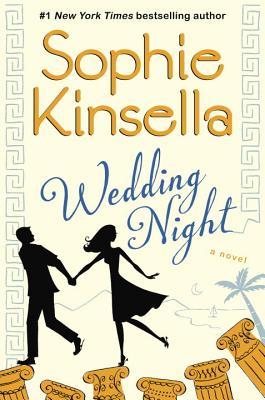
1.  Wedding Night by Sophie Kinsella from a friend.

Lottie just knows that her boyfriend is going to propose, but then his big question involves a trip abroad—not a trip down the aisle. Completely crushed, Lottie reconnects with an old flame, and they decide to take drastic action. No dates, no moving in together, they’ll just get married . . . right now. Her sister, Fliss, thinks Lottie is making a terrible mistake, and will do anything to stop her. But Lottie is determined to say “I do,” for better, or for worse.


2.  Saving Grace by Jane Green, an unexpected surprise from Tandem Literary.

Grace and Ted Chapman are widely regarded as the perfect literary power couple. Ted is a successful novelist and Grace, his wife of twenty years, is beautiful, stylish, carefree, and a wonderful homemaker. But what no one sees, what is churning under the surface, is Ted’s rages. His mood swings. And the precarious house of cards that their lifestyle is built upon. When Ted’s longtime assistant and mainstay leaves, the house of cards begins to crumble and Grace, with dark secrets in her past, is most vulnerable. She finds herself in need of help but with no one to turn to…until the perfect new assistant shows up out of the blue.  To the rescue comes Beth, a competent young woman who can handle Ted and has the calm efficiency to weather the storms that threaten to engulf the Chapman household.

What did you receive?

278th Virtual Poetry Circle

Welcome to the 278th Virtual Poetry Circle!

Remember, this is just for fun and is not meant to be stressful.

Keep in mind what Molly Peacock’s book suggested.

Look at a line, a stanza, sentences, and images; describe what you like or don’t like; and offer an opinion. If you missed my review of her book, check it out here.

Today’s poem is from Stanley Kunitz, recited by Anita Norman:

The Layers

I have walked through many lives,
some of them my own,
and I am not who I was,
though some principle of being
abides, from which I struggle
not to stray.
When I look behind,
as I am compelled to look
before I can gather strength
to proceed on my journey,
I see the milestones dwindling
toward the horizon
and the slow fires trailing
from the abandoned camp-sites,
over which scavenger angels
wheel on heavy wings.
Oh, I have made myself a tribe
out of my true affections,
and my tribe is scattered!
How shall the heart be reconciled
to its feast of losses?
In a rising wind
the manic dust of my friends,
those who fell along the way,
bitterly stings my face.
Yet I turn, I turn,
exulting somewhat,
with my will intact to go
wherever I need to go,
and every stone on the road
precious to me.
In my darkest night,
when the moon was covered
and I roamed through wreckage,
a nimbus-clouded voice
directed me:
“Live in the layers,
not on the litter.”
Though I lack the art
to decipher it,
no doubt the next chapter
in my book of transformations
is already written.
I am not done with my changes.

What do you think?

Something Wicked This Way Comes by Ray Bradbury

Source: Public Library
Paperback, 293 pgs
On Amazon and on Kobo

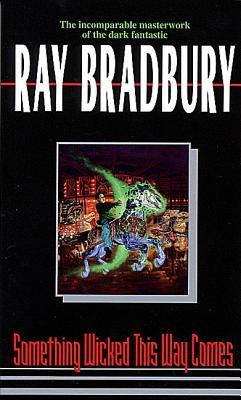
Something Wicked This Way Comes by Ray Bradbury, which I read as part of a read-a-long and for the RIP Challenge, is an odd little book about a strange carnival that enters a Midwestern town and silently creeps through the streets and feeds off of the people in that town.  Will and Jim are your typical boys, about 15-yrs-old, who look for fun and sometimes find it in the wrong places.  They stumble upon a lightning rod salesman who warns them of an upcoming, devastating storm — a storm that is likely to hit someone’s house and destroy it.  Is this foreshadowing of what is to come when the carnival arrives? Perhaps, but Bradbury’s prose is dense in places and cryptic, leaving many readers lost as to what is going on and which boy is which.  Perhaps the similarities are done on purpose to signify that it could have been any set of boys in the town targeted, but readers may want more to go on, a greater connection and an ability to differentiate between the two boys as the story moves forward.  Readers will get some of that when Will’s father enters the picture.

“Dad winked at Will.  Will winked back.  They stood now, a boy with corn-colored hair and a man with moon-white hair, a boy with summer-apple, a man with winter-apple face.”  (page 15)

“‘The library,’ said Will. ‘I’m even afraid of it, now.’  All the books, he thought, perched there, hundreds of years old, peeling skin, leaning on each other like ten million vultures.  Walk along the dark stacks and all the gold titles shine their eyes at you.  Between the old carnival, old library and his own father, everything old…well…” (pg. 188-9)

A lot of the fear permeating the pages is atmospheric from the dark carnival and its sinister cast of characters lurking in the dark, around corners, and popping up when least expected, but there also is a sense of psychological fear, particularly when it comes to the boys and those targeted by the carnival.  Despite the issues with the oddities in the prose and the dialogue, as well as the indistinguishable characteristics of the boys, this story is haunting in its use of spiritual lore and mythology, creating a deadly combination of foes who can be reborn and reconfigured.  There is a lack of detail about the boys’ relationships with their fathers and mothers, but it is the relationship between youth and old age that is the broader picture.

Something Wicked This Way Comes by Ray Bradbury is about a loss of innocence, the things we do as we age, the things we forget as we grow older and begin families of our own, and about the longing in us to recapture those carefree days and relationships.  What is the something wicked coming for you?  Only you can know the answer, and only you know how to fight it.

About the Author:

American novelist, short story writer, essayist, playwright, screenwriter and poet, was born August 22, 1920 in Waukegan, Illinois. He graduated from a Los Angeles high school in 1938. Although his formal education ended there, he became a “student of life,” selling newspapers on L.A. street corners from 1938 to 1942, spending his nights in the public library and his days at the typewriter. He became a full-time writer in 1943, and contributed numerous short stories to periodicals before publishing a collection of them, Dark Carnival, in 1947.

His reputation as a writer of courage and vision was established with the publication of The Martian Chronicles in 1950, which describes the first attempts of Earth people to conquer and colonize Mars, and the unintended consequences.

Deadline by Mira Grant

Source: Public Library
Paperback, 581 pgs
On Amazon and on Kobo

Deadline by Mira Grant is the second in the NewsFlesh series; see my review of Feed and be aware that could be spoilers in this review.  Following the presidential campaign of Peter Ryman, the news blog After the End Times has grown exponentially, and Shaun Mason hardly keeps track of the day to day administration of the site or who actually works for the business.  He’s still in mourning, but he knows that he has a team to lead, and he does it as best he can, while being mentally haunted by the dead.  No longer an Irwin who pokes zombies for ratings, Shaun has jumped to lead the Newsies and has no desire to return to the field.  Unfortunately, stumbling upon a larger-than-life conspiracy significantly changes his plans to hide in the background, pushing him and his team out into the field and on the run.

“‘Mahir, my main man! You sound a little harried.  Did I wake you?’
‘No, but I really do wish you’d stop calling so late at night.  You know Nandini gets upset when you do.’
‘There you go again, assuming that I’m not actually trying to piss of your wife.  I’m really a much nicer person inside your head, aren’t I? Do I give money to charity and help old-lady zombies across streets so that they can bite babies?’
Mahir sighed.  ‘My, you are in a mood today, aren’t you?'” (page 25)

Combining zombie infestations, anxiety, and conspiracy theories with humor, Mira Grant has built a world in which bloggers have replaced traditional news mediums and surviving zombie infestations is an everyday battle.  Kellis-Amberlee is the result of two bio-engineered viruses combining into something unexpected, and it it causes amplification in any mammal of 40 lbs or more to transform them into zombies.  Shaun and his team report on infestations, outbreaks, and other newsworthy items, as well as post fiction poems, stories, etc. on zombies and other things in their lives.  Generating ratings is a tough business following a successful president election.  Grant includes enough background in her second novel that it could be picked up without reading the first, but there could have been additional editing, as there was too much backstory included from the previous novel.

Deadline by Mira Grant is a fun romp in zombie infested waters, and will be a delight for those who love novels with government conspiracies.  While there is little that is resolved in this book, as there is a third book in the series, there is enough here to whet readers’ appetites for more.  Grant’s world is a unique post-apocalyptic rendering in which not only is surviving essential, but the world has irrecoverably changed from politics and media to how families cope and communities interact.

About the Author:

Born and raised in Northern California, Mira Grant has made a lifelong study of horror movies, horrible viruses, and the inevitable threat of the living dead. In college, she was voted Most Likely to Summon Something Horrible in the Cornfield, and was a founding member of the Horror Movie Sleep-Away Survival Camp, where her record for time survived in the Swamp Cannibals scenario remains unchallenged.

Mira lives in a crumbling farmhouse with an assortment of cats, horror movies, comics, and books about horrible diseases. When not writing, she splits her time between travel, auditing college virology courses, and watching more horror movies than is strictly good for you. Favorite vacation spots include Seattle, London, and a large haunted corn maze just outside of Huntsville, Alabama.

Mira sleeps with a machete under her bed, and highly suggests that you do the same.

Pen & Ink: Tattoos and the Stories Behind Them by Isaac Fitzgerald, illustrated by Wendy MacNaughton

Source: Public Library
Hardcover, 144 pgs
On Amazon and on Kobo

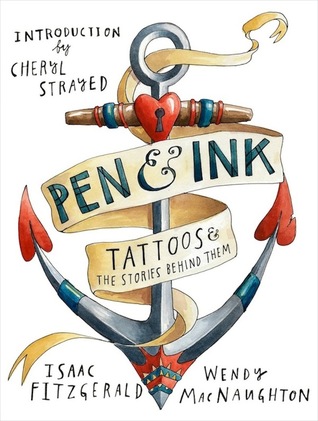
Pen & Ink: Tattoos and the Stories Behind Them by Isaac Fitzgerald, illustrated by Wendy MacNaughton and introduction by Cheryl Strayed, is fantastic for those who are interested in not only body art but personal stories.  Some of the stories behind the tattoos illustrated by Wendy MacNaughton are silly, while others are sad and some are inspiring.  The illustrations are colorful and fantastic, though readers may almost prefer to see photos of the stunning art work of the tattoos.  But that’s a minor complaint given the personal stories behind the tattoos.  It is not just that the tattoos tell a story but that these tattoos contain memories for their bearers.

Isaac Fitzgerald says in the preface, “My tales of driving trucks through small Massachusetts towns, drunk and with no license, made me who I was.  I learned that people define you by your stories.”  And in many ways, it is not just your stories that others use to define you, but it is also how you define yourself.  Tattoos are an expression of those stories and those memories you hold dear and choose to share, and those tattoos and memories also can define you.

From the introduction by Cheryl Strayed, “Each of the stories is like being let in on sixty-three secrets by sixty-three strangers who passed you on the street or sat across from you on the train.  They’re raw and real and funny and sweet.  They speak of lives you’ll never live and experiences you know precisely.  Together, they do the work of great literature — gathering a force so true they ultimately tell a story that includes us all.”

Pen & Ink: Tattoos and the Stories Behind Them by Isaac Fitzgerald, illustrated by Wendy MacNaughton and introduction by Cheryl Strayed, could become a series of books with other tattooed professionals, students, and non-professionals that provide a look into not only the variety of people who get tattoos but the various reasons that people get tattoos.  How these individuals feel about their tattoos now is irrelevant to why they were added to their bodies in the first place — whether a tribute to a loved one or a passion for an unwritten future.

About the Author:

Isaac Fitzgerald has been a firefighter, worked on a boat, and been given a sword by a king, thereby accomplishing three out of five of his childhood goals. He is co-founder of Pen & Ink, co-owner of The Rumpus, and the editor at BuzzFeed Books.

About the Illustrator:

Wendy MacNaughton is an illustrator and a graphic journalist based in San Francisco. Her documentary series Meanwhile tells the stories of communities through drawings and the subject’s own words, and is being published as an anthology by Chronicle Books in 2014. She’s illustrated two other forthcoming books: Lost Cat: A True Story of Love, Desperation, and GPS Technology, by Caroline Paul and Wendy MacNaughton (Bloomsbury, 2013) and The Essential Scratch & Sniff Guide to Wine, by Richard Betts (Houghton Mifflin, 2013).

She has degrees in fine art/advertising and social work from Art Center College of Design and Columbia University. When they let her, she likes to talk with students at Art Center College of Design, and she is an artist in residence at Intersection for the Arts.

About the Introduction Writer:

Cheryl Strayed’s memoir, Wild, will be published by Knopf in March 2012. It will also be published in Brazil, Germany, the Netherlands, the United Kingdom, and Italy. Her novel, Torch (Houghton Mifflin, 2006) was a finalist for the Great Lakes Book Award and was selected by The Oregonian as one of the top ten books of the year by writers from the Pacific Northwest. Strayed’s writing has appeared in the New York Times Magazine, the Washington Post Magazine, Allure, Self, The Missouri Review, Brain, Child, The Rumpus, The Sun and elsewhere. The winner of a Pushcart Prize as well as fellowships to the Bread Loaf Writers’ Conference and the Sewanee Writers’ Conference, her essays and stories have been published in The Best American Essays, The Best New American Voices, and other anthologies. She holds an MFA in fiction writing from Syracuse University and a bachelor’s degree from the University of Minnesota. She’s a founding member of VIDA: Women In Literary Arts, and serves on their board of directors. Raised in Minnesota, Strayed now lives in Portland, Oregon with her husband, the filmmaker Brian Lindstrom, and their two children.

74th book for 2014 New Author Reading Challenge.

Before I Go to Sleep by S.J. Watson

Source: Public Library
Audiobook, 11+ hours
On Amazon and on Kobo

Before I Go to Sleep by S.J. Watson, narrated by Orlagh Cassidy, chronicles the disjointed life of a woman who has lost her memory in an accident.  Each night, while she is sleeping, she loses all her memories of her present and past.  She remembers her life up until about her 20s, but only the journal she keeps helps her remain grounded in the life and the husband she no longer recognizes.  This is a fast-paced debut novel that examines the role that memory plays in how we identify ourselves and our own happiness.  Christine Lucas is a writer who is struggling each day to remember her life before an accident wiped out her memories, an accident she doesn’t even remember.  As she begins keeping a secret journal and meeting with Dr. Nash to try some treatments to regain her memory, dark secrets about her life, her past, and her current situation bubble to the surface.

Watson has carefully crafted a character adrift in her own life, and while some of the details are needlessly repeated as she wakes from sleep each morning and struggles to remember her life, readers are swept up in this mystery.  As the book is told from Christine’s point of view, the reader has only her knowledge to draw conclusions from, and this can be frustrating.  While the cues are there to unravel the mystery beforehand, readers will likely enjoy this crazy journey as well as become frustrated with the main character’s stupid decisions from time to time.  There are times when reading the journal should have taken much more time than it seems to, which would have left her little time to do much else in a day, especially for someone who wakes up with a blank slate every morning.

Before I Go to Sleep by S.J. Watson, which was out October book club selection, was an interesting debut, and it did mirror the feel of the movie Memento, but the ending was disappointing and some parts in the middle dragged a bit.  While this is fast-paced toward the end when everything starts to fall in place, there could have been further editing in the middle that would have tightened this up more and made it even more thrilling.

A note about the narrator, her voice really grated on my for some reason and she seemed to lose the tone when speaking as a male character, slipping back into Christine’s voice, which made it hard for me to follow along at certain points.

About the Author:

S J Watson was born in the UK, lives in London and worked in the NHS for a number of years.  In 2011 Watson’s debut novel, Before I Go to Sleep, was released to critical acclaim. It has now been published in over 40 languages, and has become an international bestseller, winning numerous awards.   The movie of Before I Go To Sleep, starring Nicole Kidman, Colin Firth and Mark Strong, is due for worldwide release in Autumn 2014. Watson’s second book is out in Spring 2015.

What Book Club Thought (Beware of spoilers):

Most of the book club felt that this was a quick and entertaining read, even though many of us didn’t think the mystery was much of one.  The writing was well done for the most part, and with it being made into a movie a few people expressed interest in seeing it, either on video or on Netflix, etc. I personally thought a better twist would have been to have Dr. Nash be her son. While one person couldn’t even get into the book at all.  There was quite a bit of repetition, which may have grated on people early on, but when a main character has no ability to make new memories, they tend to repeat things.

73rd book for 2014 New Author Reading Challenge.

Mailbox Monday #294

Mailbox Monday, created by Marcia at To Be Continued, formerly The Printed Page, has a permanent home at its own blog.

To check out what everyone has received over the last week, visit the blog and check out the links.  Leave yours too.

Also, each week, Leslie, Vicki, and I will share the Books that Caught Our Eye from everyone’s weekly links.

Here’s what I received:

1.  Banned for Life by Arlene Ang for review from the poet.

Arlene Ang’s third poetry collection examines the lives of those who have been forced by either circumstance or their personality problems to watch from the sidelines — unwanted birds, zombies, psychopaths, missing children, even the recently dead who have been “banned” from their own existence.


2. Rudolph the Red-Nosed Reindeer Pop-Up Book by Lisa Ann Marsoli and illustrated by Keith Andrew Finch

Start a new holiday family reading tradition with this delightful pop-up retelling of the beloved Christmas story. Just in time for its 50th anniversary, Rudolph the Red-Nosed Reindeer is now a stunning pop-up book, a treasure for generations to come. All of the classic characters join Rudolph for his North Pole adventure: Hermey the elf/aspiring dentist, Yukon Cornelius, and the doe-eyed Clarice. The impressive large-scale pop-ups re-create classic scenes using actual movie stills. Fly along with Rudolph, join in the reindeer games, flee from the Abominable Snow Monster, visit the Island of Misfit Toys, and save Christmas one foggy night. Most importantly, be touched by the timeless story of acceptance and the true meaning of the holiday spirit.

What did you receive?