Quantcast

Extractions by Melissa M. Firman

Source: Purchased
E-short story
I am an Amazon Affiliate

Extractions by Melissa M. Firman is an e-short story in which something is not quite right with Kari and her family.  While they have that suburban home, there are some financial issues lurking in the background, but that could just be the tip of the iceberg.  This family is racking up the debt with no end in sight and her impending dental work is only going to exacerbate that situation.  Firman has packed a lot of detail into the first couple of pages of this short story, which according to the Kindle estimate is just seven pages in total.

Whether Kari’s drinking has to do with their financial problems or the fact that she’s cyber-stalking an ex-boyfriend on Facebook, it doesn’t matter.  Something has got to change for this family.  They are in a very precarious situation and something is going to push them over the brink.  Kari is dissatisfied, and she’s searching for something outside herself to make herself content.  An unexpected act of vandalism, however, will have her questioning her own actions.   Extractions by Melissa M. Firman is well done, but will likely leaving readers wanting more.

About the Author:

Growing up in the suburbs of Philadelphia, Pa., Melissa Firman was convinced she would be a world-famous author before she was 18. When that didn’t quite happen, she earned a B.A. in English/Communications from Cabrini College and worked with various nonprofits. Melissa currently lives in Pittsburgh with her husband of 20 years and their two children.

“Extractions” is Melissa’s first short story published on Amazon. She recently edited young adult author Melissa Luznicky Garrett’s much-anticipated novels “The Prophecy” and “Blood Draw.”

Melissa Firman is currently in the process of writing her first novel and is a freelance book reviewer for the Pittsburgh Post-Gazette. Connect with Melissa on her website and blog at MelissaFirman.com or on Facebook at Melissa Firman, writer – www.facebook.com/TheFirmanGroup.
80th book for 2014 New Author Reading Challenge.
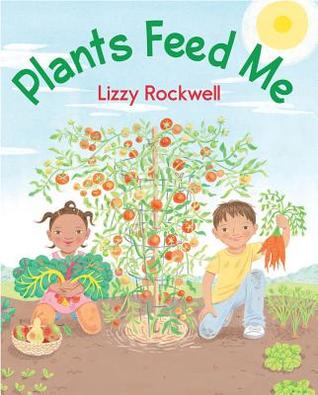
Plants Feed Me by Lizzy Rockwell

Source: Holiday House
Hardcover, 29 pgs
I am an Amazon Affiliate

Plants Feed Me by Lizzy Rockwell includes adorable illustrations of vegetables, fruits, plants, and children to demonstrate the importance of plants in feeding humans.  The book provides the basics of plants and their growth cycle for young children to easily understand, including the need for sunlight and nutrients in the earth.  Children are smiling as they dig holes, plant seeds, water plants, and begin harvesting food.  My daughter and I have read this book several times and each time she tells me something new.  She’ll point to something we’ve talked about in previous readings even before I read it to her.  She is recognizing carrots, lettuce, beets, potatoes, and more.

The author talks about the different parts of edible plants and she labels each vegetable and fruit depicted.  Fruits grow on trees and in bushes, vegetables can grow in the ground and above the ground, and some plants that many think are vegetables are actually fruits.  The pictures are well drawn and easy to understand.  Plants Feed Me by Lizzy Rockwell is a great story for young readers to share with their parents, helping them understand the natural wonders and where food comes from.

About the Author:

Lizzy Rockwell is an illustrator whose artwork can be seen in picture books, magazines, games and on walls. She studied art and art history at Connecticut College, and drawing and illustration at the School of Visual Arts in New York City.

Lizzy is the illustrator of over 25 children’s books by a variety of authors including her mother, Anne Rockwell. She is the author/illustrator of Plants Feed MeGood Enough to Eat: A Kid’s Guide to Food and Nutrition, Hello Baby! and The Busy Body Book: A Kid’s Guide to Fitness.

Lizzy has two grown sons, and lives and works in Bridgeport, CT with her husband, Ken Alcorn, a high school social studies teacher, and their dog Reggie.

79th book for 2014 New Author Reading Challenge.

Interview with Mingmei Yip, Author of Secret of a Thousand Beauties

Secret of a Thousand Beauties by Mingmei Yip is set to be published Nov. 25, 2014, and is the latest release from Yip.  I’ve reviewed Skeleton Women and The Nine Fold Heaven, which I enjoyed.
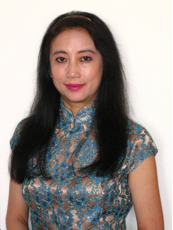
Here’s a bit about the book:

Spring Swallow was promised in marriage while still in her mother’s belly. When the groom dies before a wedding can take place, seventeen-year-old Spring Swallow is ordered to become a ghost bride to appease his spirit. Under her in-laws’ protection, she will be little more than a servant, unable to know real love or bear children. Refusing to accept her fate as a “bad-luck woman,” Spring Swallow flees on her wedding day.

In the city of Soochow, Spring Swallow joins a community of renowned embroiderers. The women work for Aunty Peony, whose exquisite stitching once earned her the Emperor’s love. But when Aunty Peony agrees to replicate a famous painting–a lucrative assignment that will take a year to complete–betrayal and jealousy emerges within the group. Spring Swallow becomes entangled in each woman’s story of heartbreak, even while she embarks on a dangerous affair with a young revolutionary. On a journey that leads from the remote hillsides around Soochow to cosmopolitan Peking, Spring Swallow draws on the secret techniques learned from Aunty Peony and her own indomitable strength, determined to forge a life that is truly her own.

MingmeiToday, Mingmei Yip has agreed to join us and answer some questions about her novel and her work.  Please give her a warm welcome.
Where do your story ideas come from?

Story ideas usually pop up in my mind, mostly triggered when I am reading, watching a movie, looking at art works in a museum, or just day dreaming. Not long ago I saw a book on embroidery in a bookstore and was inspired to write a novel about embroiderers and the painstaking efforts they apply to create their beautiful works. That novel is my newest, Secret of a Thousand Beauties.

The idea for my third novel, Song of the Silk Road – a romantic adventure on China’s fabled route with a promised reward of three million dollars — came to me in a dream.

The heroine of your latest book, Secret of a Thousand Beauties, is a strong and independent woman like the women in your other novels. Why do you choose to write about these women who live in cultures that tend to curtail their independence?

All my protagonists are brave and strong women who relentlessly overcome hardship and tragedy to live life on their own terms and achieve happiness. It is hard now even to try to imagine the miseries women had to endure in traditional China such as marriage to a dead fiancé, making them the slaves of the dead man’s parents, or being forced into prostitution, yet not being allowed to marry or keep their babies.

Some of my characters are inspired by the lives of actual women, including Camilla the singer-spy in my novels Skeleton Women and The Nine Fold Heaven, and the teenage prostitute Xiang Xiang in my debut novel Peach Blossom Pavilion (now in its 5th printing!) I feel honored to be able to give these once-silenced women their voices. Also, by writing about them, they have become my teachers of determination, courage, and compassion.

What are your first loves as a reader about novels? Do you prefer plot or characterization?

Both. But if I have to choose, insightful description of human nature are more satisfying to me than plots filled with twists and turns.

Do you prefer to write historical fiction and would you consider writing something more contemporary?

Among my seven novels (the 7th one will come out in 2015), four are historical – Secret of a Thousand Beauties; The Nine Fold Heaven; Skeleton Women; Peach Blossom Pavilion and two are contemporary – Song of the Silk Road; Petals from the Sky. I also wrote and illustrated two children’s books: Chinese Children Favorite Stories and Grandma Panda’s China Storybook, both published by Tuttle Publishing.

Who are some of your favorite authors/poets?

My favorite authors are Eileen Cheung and Echo, unfortunately both deceased. In the West, I read almost everything by Lisa See, Amy Tan, and Anchee Min.

calligraphymingmeidemonstrationmingmeiMingmeidemonstrate

What current projects are you working on? Care to share any details?

My next novel, which will be my seventh is The Witches Market, about a young woman who has suddenly acquired supernatural talents. After this realization, she travels to the Canary Islands, seeking witches against whom to test her own powers and calling.

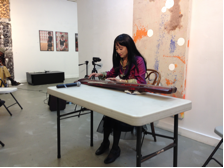
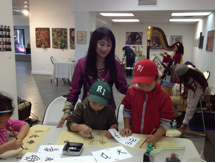
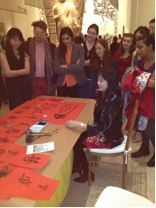
MusicalMingmeiBesides writing, I perform on the guqin, a very ancient Chinese instrument which I’ve been playing for over thirty years. I also teach calligraphy workshops for both adult and children at many venues including the Metropolitan Museum of Art, Lincoln Center, CUNY and others. All these activities help provide material for my novels.

Thank you, Yip, for joining us today.  Check her out on Facebook, Twitter, and GoodReads.

Check out the book trailer:

Northern Lights by Tim O’Brien

Source: Personal library
Paperback, 372 pgs
On Amazon and on Kobo

Northern Lights by Tim O’Brien, which was our November and final book club pick of the year and a re-read for me, is the author’s first book, and not my favorite.  The story is about two brothers — Perry and Harvey — and one went to Vietnam and the other stayed home and got married.  Perry works for the agriculture department in Sawmill Landing, Minn., which is a small dying town with very few farmers left.  Heavily populated by Swedes, Finns, and Germans, the town has gone through periods of prosperity and periods of fallow ground.  Harvey is set to return from the war, and he’s altered in more than one way.  While O’Brien has crafted a story of brothers who were always different from one another — Harvey, the bull, considered the outdoorsy and confident brother, and Perry, the book smart and self-conscious brother — the story slowly unwinds to show just how false those perceived differences were.

“They call it a dying town.  People were always saying it: Sawmill Landing won’t last another decade.  But for all the talk, Perry never saw the death, only the shabby circumstances of the movements around him.  It was melancholia, seeded in the elements, but he had no idea where it started.”  (page 65)

When his brother returns, there is a heaviness that settles on the house, a house their father lived and died in and a house that was often filled with tension between the three men.  With Grace, Perry’s wife, in the house, there is a lightness from her womanly touch as she tries to keep the peace and make Harvey feel at home.  But then there is Addie, a young lady who flirts endlessly and teases all the time.  She’s an enigma, flirting with married Perry and with single Harvey, but it is clear that she’s never serious.  She likes the games.  The moral tension is palpable throughout the novel in whether Harvey and Perry are flirting with Addie, or whether Perry has to overcome his fears and hunt in the woods as his brother did with their father.

Rather than focus on the Vietnam War, Northern Lights by Tim O’Brien is a look at the home front after the soldier returns home and tries to fit back into society, as well as the brother’s struggle with seeing his own brother so changed.

***Unfortunately, due to car issues, I missed this meeting with the book club.  A meeting I was really looking forward to.***

About the Author:

Tim O’Brien was born in 1946 in Austin, Minnesota, and spent most of his youth in the small town of Worthington, Minnesota. He graduated summa cum laude from Macalester College in 1968. From February 1969 to March 1970 he served as infantryman with the U.S. Army in Vietnam, after which he pursued graduate studies in government at Harvard University. He worked as a national affairs reporter for The Washington Post from 1973 to 1974.  Here’s the reading group guide.

36th book for 2014 Historical Fiction Reading Challenge.


32nd book (Vietnam War) for the 2014 War Challenge With a Twist.

Interview with Syrie James, Author of Jane Austen’s First Love

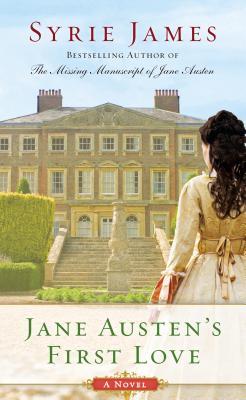
Syrie James is a quintessential Austenite and her Jane Austen-related fiction is never a disappointment.  Her latest release, Jane Austen’s First Love, is a contender for the Savvy Verse & Wit Best of 2014 list.

Here’s a snippet from my review:

“James cannot be praised enough for her ingenuity and dedication to the spirit of Austen and her novels.  She pays tribute to a young Jane in the best way possible.  Jane Austen’s First Love by Syrie James is the author’s best novel yet, and a must read for anyone who loves historical fiction, Jane Austen, or coming of age stories.”

Other James’ books you should consider reading include:


Today, I have a special treat … an interview with Syrie James! Please give her a warm welcome.

As a writer of Austenesque fiction, you must have a favorite Jane Austen book and character, or at least a few.  What and who are they and why?

Like many readers, my favorite Austen novel is Pride and Prejudice. It’s brilliantly constructed, beautifully written, and the characters are unique, fun, and recognizable. Best of all, Elizabeth’s and Darcy’s character arcs as they go from intense dislike to admiration to love are so wonderfully drawn and so satisfying that the story has been endlessly imitated. Pride and Prejudice, unlike Austen’s other novels, also begins with a lively conversation that grabs your attention right off the bat. I am a huge fan of Persuasion as well, with its theme about second chances. It was written later in Jane Austen’s life, and her maturity as writer really shines through.

As for favorite characters, I have so many! I adore Elizabeth Bennet, with her bright eyes and feisty nature, and Anne Elliot, who is goodness personified. I think I fell in love with Mr. Darcy (along with the rest of the female world) when Colin Firth turned him into an icon. I am also mad about Captain Wentworth and Mr. Knightley, truly divine Austen heroes who feel very real to me on the page! And this may be heresy—but my two other favorite characters are Lady Catherine de Bourgh, who I love to hate, and the foolish Mr. Collins, who, with every re-reading and in every film version, always makes me laugh.

Syrie James headshot 2012 x 250Did you always love Jane Austen’s books and when did you first fall in love with them (how did you find out about them)?

I was first introduced to Jane Austen in a British literature course in college, when we read Pride and Prejudice and Emma. I don’t remember my first reaction to the books, and Jane Austen didn’t resurface on my radar again until the mid 1990s, when four Jane Austen films came out that quickly became my favorites: SENSE AND SENSIBILITY (Emma Thompson and Hugh Grant), PRIDE AND PREJUDICE (Colin Firth and Jennifer Ehle), PERSUASION (Amanda Root and Ciarán Hinds), and EMMA (Gwyneth Paltrow and Jeremy Northam.) Yes, it’s true—I fell in love with Austen because of the movies!

I immediately read or re-read all her novels, then devoured the juvenilia, biographies, and her preserved correspondence. I was desperate to learn more about the woman who wove such incredible stories and showed such a deep understanding of human nature—and the obsession has never stopped. Because there were no Austen memoirs to discover, I wrote one myself: The Lost Memoirs of Jane Austen. Because there were no more new Austen novels to read, I decided to write one: The Missing Manuscript of Jane Austen. And because I was intensely curious to read about Jane as a teenager while experiencing her first romance, I researched and wrote Jane Austen’s First Love.

As a fan of Austen, you must have visited the various sites in which she lived and visited. Which of these places is your favorite, where is it located, and why? What advice would you give someone interested in touring Austen’s places?

I’ve taken two Jane Austen tours of England—one of them self-guided, the other as part of a formal tour group—and I’ve had the opportunity to visit nearly all the famous Austen sites, some of them twice. It’s hard to pick a favorite, but I guess it’d have to be Chawton Cottage, now known as Jane Austen’s House Museum. It was like a pilgrimage to walk through the rooms and gardens of the house where Jane lived during the nine year period when she wrote or rewrote all her masterpieces. And to see the little table where she sat by the window and wrote, was too thrilling for words!

The Austen tour that I took with my husband was absolutely wonderful, but took many months to research and plan. To see all the iconic Austen sites I’d recommend a guided bus tour, where you will enjoy the company of like-minded people, as well as guest speakers and other Austen-related events that you won’t get on your own. JASNA has such a tour every year; they’re run by Pathfinders, the same tour company I traveled with, and they’re fabulous.

For Jane Austen’s First Love, you did quite a bit of research into her mentions of Edward Taylor, who was the heir to a home in Kent. When did you know that you should stop researching and start writing? What part of the research did not make it into the book that you wish had made it in?

I continued researching the entire time I was writing the novel! Re-reading books by Jane Austen and biographies about Jane Austen while I was writing gave me an infusion of details to use here and there, and helped me to keep her voice in my head. Continuous research proved to be even more important where Edward Taylor was concerned. When I first began the novel, I hadn’t found much information about him, and had created an imaginary back story for him—but it never felt right. So I kept looking. And looking.

By a stroke of luck, I came upon Edward Taylor’s brother’s memoirs, which filled in so many details about the Taylor family and the unusual way in which all eight children were raised abroad. What I learned was far much more fascinating and remarkable than anything I could have made up! I put all that was pertinent into my novel. There were a few great scenes however that didn’t make the final cut. I had to delete one scene, for example, where Edward is telling Jane about a family excursion off the southern coast of Italy that ended in disaster. It was a great tale, but unfortunately it didn’t move forward the action of my novel, so it had to go.

A much bigger disappointment was when I felt obliged to delete a scene from Chapter One, in which Jane inscribes her name and the names of three imaginary suitors in the register at her father’s church at Steventon. I loved the scene I’d written, but once again, it didn’t move the plot forward, and the first chapter was too long. (The deleted scene may have a new life, however, as a short story.)

As the market becomes even more saturated with works about Jane Austen and her books, do you think readers will ever tire of these spinoffs, retellings, and fictionalized accounts of her life and work?

I hope not!

What keeps you returning to Jane Austen and her world?

I love Austen for so many reasons. I love immersing myself in the way the gentry class lived and loved during the Regency era, where we rarely see anyone working (other than the servants.) Austen’s characters lived in grand manor homes, were waited on hand and foot, drove around in elegant carriages, hunted on horseback, played cards and music, sang and read, sewed and drew, took walks on impeccable grounds, and danced at balls. What’s not to like? Not to mention the way they dressed! Tight breeches, tailcoats, and cravats! Gossamer, empire-waisted gowns! Hair pinned up like the ancient Greeks! It’s like something out of a fairy tale.

What I love most about Austen, though, is not the fairy tale setting—but the brilliant way her stories are plotted and the familiarity of her characters. We all know an overbearing woman like Lady Catherine de Bourgh, who believes she knows best and must be catered to. We’ve all met a sweet, kindly blabbermouth like Miss Bates. And while we laugh at Austen’s fools and love to hate the villains, we can’t help but fall in love with her heroes and heroines, who are all flawed—just as we are—and who must earn their happy endings by recognizing their missteps and working to correct them. That’s the real reason I keep returning to Jane and her world—because her tales of courtship and romance are perfectly structured morality tales, and the lessons resonate today.

Finally, do you read poetry, why or why not? And if you do, what are some of your favorite poems and who are some of your favorite poets? Also do you read contemporary poets or classic poets, why or why not?

I’ve been so busy reading novels over the last twenty years that I haven’t read much poetry—which I truly regret (I enjoy poetry.) While researching my three Austen novels and The Secret Diaries of Charlotte Brontë, however, I read all the poetry written by Austen and the Brontës. Jane and Charlotte wrote rather good poetry, but Charlotte’s sisters Emily and Anne outshone them. I’ve posted a selection of the Brontës’ poetry on my website, which were published together in one volume in 1846. Emily’s work is as darkly compelling as her novel Wuthering Heights. One of my favorites of this collection was written by Anne Brontë (under the pseudonym Acton Bell), when she was miserable and homesick while working as a governess for a wealthy family:

Home
by Acton Bell

How brightly glistening in the sun,
The woodland ivy plays!
While yonder beeches from their barks
Reflect his silver rays.
That sun surveys a lovely scene
From softly smiling skies;
And wildly through unnumbered trees
The wind of winter sighs. . .

But give me back my barren hills
Where colder breezes rise;
Where scarce the scattered, stunted trees
Can yield an answering swell,
But where a wilderness of heath
Returns the sound as well. . .

Restore me to that little spot,
With gray walls compassed round,
Where knotted grass neglected lies,
And weeds usurp the ground.

Though all around this mansion high
Invites the foot to roam,
And though its halls are fair within-
Oh, give me back my HOME!

Many thanks for having me here, Serena, at Savvy Verse and Wit. I’m happy to answer any other questions you or your visitors might have, so feel free to leave a comment and ask away!

JAFL Banner v6Please check out the other stops on the tour.


Win One of Five Fabulous Jane Austen-inspired Prize Packages

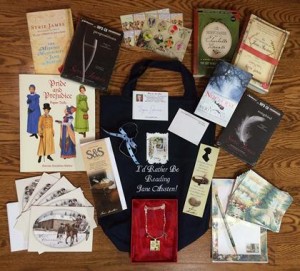
To celebrate the holidays and the release of Jane Austen’s First Love, Syrie is giving away five prize packages filled with an amazing selection of Jane Austen-inspired gifts and books!

To enter the giveaway contest, simply leave a comment on any of the blog stops on the Jane Austen’s First Love Holiday Blog Tour.

Increase your chances of winning by visiting multiple stops along the tour! Syrie’s unique guest posts will be featured on a variety of subjects, along with fun interviews, spotlights, excerpts, and reviews of the novel. Contest closes at 11:59pm PT, December 21, 2014.

Five lucky winners will be drawn at random from all of the comments on the tour, and announced on Syrie’s website on December 22, 2014. The giveaway contest is open to everyone, including international residents. Good luck to all!

JAFL Grand Prize x 420

Click the image for more details

Mailbox Monday #297

Mailbox Monday, created by Marcia at To Be Continued, formerly The Printed Page, has a permanent home at its own blog.

To check out what everyone has received over the last week, visit the blog and check out the links.  Leave yours too.

Also, each week, Leslie, Vicki, and I will share the Books that Caught Our Eye from everyone’s weekly links.

Here’s what I received:

1.  Extractions by Melissa M. Firman, downloaded from Kindle.

In this short story, a slight moment of deception is all it takes for Kari to realize how quickly and suddenly her carefully-crafted life could be destroyed.


2. Countdown by Mira Grant, which I downloaded to Kindle after reading the three books in the NewsFlesh series.

The year is 2014, the year everything changed. We cured cancer. We cured the common cold. We died.  This is the story of how we rose.

When will you rise?


What did you receive?

280th Virtual Poetry Circle

Welcome to the 280th Virtual Poetry Circle!

Remember, this is just for fun and is not meant to be stressful.

Keep in mind what Molly Peacock’s book suggested.

Look at a line, a stanza, sentences, and images; describe what you like or don’t like; and offer an opinion. If you missed my review of her book, check it out here.

Today’s poem is from John Donne, recited by Thomas Fields:

The Canonization

For God's sake hold your tongue, and let me love,
         Or chide my palsy, or my gout,
My five gray hairs, or ruined fortune flout,
         With wealth your state, your mind with arts improve,
                Take you a course, get you a place,
                Observe his honor, or his grace,
Or the king's real, or his stampèd face
         Contemplate; what you will, approve,
         So you will let me love.

Alas, alas, who's injured by my love?
         What merchant's ships have my sighs drowned?
Who says my tears have overflowed his ground?
         When did my colds a forward spring remove?
                When did the heats which my veins fill
                Add one more to the plaguy bill?
Soldiers find wars, and lawyers find out still
         Litigious men, which quarrels move,
         Though she and I do love.

Call us what you will, we are made such by love;
         Call her one, me another fly,
We're tapers too, and at our own cost die,
         And we in us find the eagle and the dove.
                The phœnix riddle hath more wit
                By us; we two being one, are it.
So, to one neutral thing both sexes fit.
         We die and rise the same, and prove
         Mysterious by this love.

We can die by it, if not live by love,
         And if unfit for tombs and hearse
Our legend be, it will be fit for verse;
         And if no piece of chronicle we prove,
                We'll build in sonnets pretty rooms;
                As well a well-wrought urn becomes
The greatest ashes, as half-acre tombs,
         And by these hymns, all shall approve
         Us canonized for Love.

And thus invoke us: "You, whom reverend love
         Made one another's hermitage;
You, to whom love was peace, that now is rage;
         Who did the whole world's soul contract, and drove
                Into the glasses of your eyes
                (So made such mirrors, and such spies,
That they did all to you epitomize)
         Countries, towns, courts: beg from above
         A pattern of your love!"

What do you think?

Blackout by Mira Grant

Source: Public Library
Paperback, 659 pgs
On Amazon and on Kobo

Blackout by Mira Grant (beware there could be spoilers for Feed or Deadline in this review) is the final installment in the Newsflesh series, and it is a stunning ride that will leave readers breathless to the final page.  It has been a long time since a zombie series has been this well developed and thought out.  Grant has created a masterful new world after the Rising of zombies in which bloggers have taken over as the trusted form of communication and information, and while the American populace continues to trust the CDC, the government is still considered sketchy at best.  Shaun Mason and his group of bloggers at After the End Times continue to dig into the death of one of their own, looking for someone to blame.  At the same time, Shaun is hardly coping, speaking with voices in his head, and his team is enabling his craziness.

“‘Shaun … ‘ There was a wary note in Alaric’s voice.  I could practically see him sitting at his console, knotting his hands in his hair and trying not to let his irritation come through the microphone.  I was his boss, after all, which meant he had to at least pretend to be respectful.  Once in a while.  ‘That’s your fourth catch of the night.  I think that’s enough, don’t you?’

‘I’m going for the record.’

There was a click as Becks plugged her own channel into the connection and snapped peevishly, ‘You’ve already got the record.  Four catches in a night is twice what anyone else has managed, ever.  Now please, please, come back to the lab.'”  (page 20)

As a tropical storm wreaks havoc on Florida and other southern states ad the dead begin to rise at a faster rate, Shaun and his team not only have to uncover what has happened, but have to find a way to get the word out when the government has effectively caused a media blackout.  While the team is still gathering information and poking zombies, the focus on higher ratings has fallen off the radar for the team.  Conspiracy theorists and zombie fiction lovers will love the ride Grant takes them on, and the series touches upon a number of issues, particularly medical ethics.

Blackout by Mira Grant wrapped up the series nicely, though there is an e-novella that follows this, and Grant has created characters who struggle with the truth — finding it and keeping it real for everyone else.  From experimenting on live subjects to creating clones, the Newsflesh series runs the gamut of medical ethics issues, but it also highlights the idea of journalistic ethics and objectivity.

About the Author:

Born and raised in Northern California, Mira Grant has made a lifelong study of horror movies, horrible viruses, and the inevitable threat of the living dead. In college, she was voted Most Likely to Summon Something Horrible in the Cornfield, and was a founding member of the Horror Movie Sleep-Away Survival Camp, where her record for time survived in the Swamp Cannibals scenario remains unchallenged.

Mira lives in a crumbling farmhouse with an assortment of cats, horror movies, comics, and books about horrible diseases. When not writing, she splits her time between travel, auditing college virology courses, and watching more horror movies than is strictly good for you. Favorite vacation spots include Seattle, London, and a large haunted corn maze just outside of Huntsville, Alabama.

Mira sleeps with a machete under her bed, and highly suggests that you do the same.

Relish: My Life in the Kitchen by Lucy Knisley

Source: Public Library
Paperback, 192 pgs
On Amazon and on Kobo

Relish: My Life in the Kitchen by Lucy Knisley is a journey in olfactory memory and the memories generated by tastes.  Memory is tricky, but recalling even our oldest memories can be difficult without a trigger, and many of those triggers are often related to food.  Whether its a first experience with food, a food we associated with a specific relative or friend, or just food that we loved, our taste, sight, and olfactory senses can bring those memories flooding back with just a hint of smell or taste, even color.  Knisley says in the opening pages, “Sometimes it’s frustrating, this selective memory.  I can remember exactly the look and taste of a precious honey stick, balanced between my berry-stained fingers, but my times tables are long gone, forgotten, in favor of better, tastier memories.”

What’s fresh about this book is that it includes recipes along with the memories and some of them should be just as delicious as the author remembers if prepared using her precise instructions, which do include the use of patience!  In graphic novel style, the images are fun and the memories are dispersed in a way that makes reading a memoir about food even more fun.  It even seems as though it is geared in a way that will entice younger readers to get interested in food and cooking.

Knisley not only explores the creativity of cooking, but also its precise science and measurement, which leads to the perfect recipe.  For an example, you’ll have to check out her memories of baking, particularly chocolate chip cookies and how she still strives and falls short of making the perfect cookie.  Her mother maintains a cool head with her baking, while Knisley bakes through emotion.  It’s an interesting contrast and demonstrates not only the power of baking as a way to soothe emotions, but also as a way to connect with family.  Relish: My Life in the Kitchen by Lucy Knisley is colorful and flavorful all at once — a travelogue of food memories — that readers will not soon forget.  And as the author would say, “Devour it with relish.”

About the Author:

Beginning with an love for Archie comics and Calvin and Hobbes, Lucy Knisley (pronounced “nigh-zlee”) has always thought of cartooning as the only profession she is suited for. A New York City kid raised by a family of foodies, Lucy is a graduate of the School of the Art Institute of Chicago currently pursuing an MFA at the Center for Cartoon Studies. While completing her BFA at the School of the Art Institute, she was comics editor for the award-winning student publication F News Magazine.

Lucy currently resides in New York City where she makes comics. She likes books, sewing, bicycles, food you can eat with a spoon, manatees, nice pens, costumes, baking and Oscar Wilde. She occasionally has been known to wear amazing hats.

78th book for 2014 New Author Reading Challenge.

Women of Valor: Polish Resisters to the Third Reich by Joanne D. Gilbert

Source: Gihon River Press
Paperback, 204 pgs
On Amazon and on Kobo

Women of Valor: Polish Resisters to the Third Reich by Joanne D. Gilbert is a collection of heart-warming, terrifying, and inspiring stories of Polish resisters against the Nazi Third Reich during WWII.  These four women have tension filled tales to tell, and they are full of bravery, luck, and serendipity.  As stated in the introductory pages and the brief history on Poland and its Jewish people, Poland was often conquered and victimized and in some areas of the nation, there was rampant antisemitism.  In fact, the country was often treated like a spoil of war, and that did not change when the Nazis began expanding their reach across Europe.  Several of these resisters mention in their stories how Jews are often considered weak and meek, but their stories clearly illustrate that these women engaged in all kinds of resistance against the Nazis and that they were not alone in their fight.

“Before the 1939 German invasion, Poland’s population of approximately 35 million included almost 3.5 million Jews, more than any other European country.  In fact, for many centuries in Poland had been considered the heart and center of Europe’s Jewish population.  When German occupation of Poland ended in 1945, over 6 million Poles–approximately half of which were Jews–had been annihilated.”  (page 17)

Manya Feldman, a nurse and fighter during the war, was considered the “crazy Jewess” when she was infected during the war and unable to walk and move.  She was forced at an early age to decide to flee the ghetto into the forest or stay with her mother and young sisters, but her decision left her haunted forever.  After joining the Kovpak partisans in the forest, she was again separated from her brother and father, but she had little time to wallow as she was expected to not only engage in village raids for supplies, but also nurse the wounded and sick.  Faye Schulman was a nurse, fighter, and photographer, and her skills as a photographer saved her from Nazi punishment more than once.  She even noted, “We all had to be off the streets at dark, which was difficult in winter when darkness came so early.  It was especially challenging for teenagers who wanted to socialize or carry on romances at night.  … I had no idea that this sneaking around would soon become a skill that would keep me alive.”  And at one point, she even found herself near the camp of the Bielski partisans, who were depicted in the movie Defiance.

“When we arrived, we were astounded to see that my possessions had been neatly packed in several boxes, and placed out on the sidewalk.  Everything was just sitting there. Apparently someone in the house had figured out that I’d be in on this partisan raid, and in the chaos of a war zone, took a chance on helping me.”  (page 81)

Lola Lieber was a young woman between childhood and womanhood who was forced to grow up quickly when the Nazis came to Poland.  Her birth outside Poland in Czechoslovakia even became an asset, not only because she knew different cultures and languages, but because the Nazis spared her and the family for a time.  As they put their artistry to the test in forging documents, Lola’s life and that of her family was constantly hanging in the balance.  Miriam Brysk was a little girl who dressed as a boy, and she took to heart the discipline she had been taught as a young girl: to always listen and follow orders.

Women of Valor: Polish Resisters to the Third Reich by Joanne D. Gilbert is a fantastic look at how these women used their intelligence and the skills they had since childhood to resist the Germans, to fight them through guerrilla tactics, and evade capture and death.  Gilbert does a great job of setting up each story so that the reader knows how these women fared after the war and where they live now.  And as many of these women, men, and soldiers are passing on, these stories from WWII grow ever more important to collect because they remind us that people’s courage should never be under-estimated.

About the Author:

Influenced as a little girl by her Grandmother’s vivid and poignant stories of the beloved family and friends who were so brutally murdered when the Nazis destroyed the Jewish People of Vilna, Lithuania, Joanne has always understood the importance of preserving Jewish History – one family story at a time. With this mission in mind, she became a professional Personal Historian in 2007, creating her own business, “Your Write Time!”

A popular Adjunct English professor at the College of Southern Nevada, Joanne is also a sought-after-public-speaker, whose presentations on both Jewish Genealogy and Jewish and Gentile WOMEN OF VALOR: Polish Resisters to the Third Reich consistently receive glowing reviews.

Joanne’s extensive travels to meet with Female Resisters and Partisans have taken her to Toronto, Detroit, Grand Rapids, Palo Alto, Brooklyn, Los Angeles, San Francisco, and Paris, where she was honored to meet with a group of women who had been in the French Resistance.

77th book for 2014 New Author Reading Challenge.


31st book (WWII) for the 2014 War Challenge With a Twist.


27th book for 2014 European Reading Challenge; (Set in Poland/Czechoslovakia)

Interview with Khanh Ha, author of The Demon Who Peddled Longing

You might remember my review of Khanh Ha’s Flesh in 2012.  Ha’s prose is highly stylistic and transports readers into a dark world full of mythology, and I called Flesh a “stunning debut.”

He’s got a second novel coming out called The Demon Who Peddled Longing, which is likely to look at the dark side of humanity as well, and I’ll be reviewing that in December.

Today, I’ve got an interview treat for you.  Khanh Ha has agreed to answer some questions about his writing and his books.

Please give him a warm welcome.

What myths/legends of the Vietnamese culture appeal to you most and which do make you apprehensive?

As a child growing up in Vietnam, I had an indelible belief in animism. An unseen presence dwelling in an odd-looking rock by the roadside where people placed a bowl of rice grains and a stick of incense long gone cold. Those anthropomorphic images sown in a child’s mind began with the legendary origin of Vietnam when a teacher read a textbook story to the class: “The Dragon and the Immortal,” or Tiên Rồng, from whom the Vietnamese claim their lineage.

As a child, I lived in Huế, the former ancient capital of Vietnam, living in its mysterious atmosphere, half real, half magic. I used to walk home under the shade of the Indian almond trees, the poon trees. At the base of these ancient trees I would pass a shrine. If I went with my grandmother, she would push my head down. “Don’t stare at it,” grandmother said. “That’s disrespect to the genies.” Yet the one practice I deem mindless is the spirit medium-ship when a trance-induced medium lets herself be possessed by a spirit who claims himself a demigod, a deity, a medieval lord marshal; and the audience then make offerings to such spirit, asking for blessings, for their fortune foretold.

Your novels, Flesh and The Demon Who Peddled Longing, bring forth the darker sides of the humanity. What about those desires and dark secrets fascinates you as a writer?

I write dark fiction because of the dystopian world around me. But I want to come out of it alive and atoned for. My main character is like that. He is impetuous, single-minded and yet tender-hearted and loyal.

He hides his dark secrets of the love he has for his cousin, of his longing for the untouchable girl who is married to the overlord triple her age and sexually impotent. Writers are those who know how to fictionalize their dark secrets and desires, and allow readers to experience them secondhand.

If you were to offer one seed of advice to novice writers looking to get published, what would it be?

Find your own writerly voice! When you do, write as the only writer that exists, none before you, none after you. But write something, even if it’s just a suicide note. Somewhere I remember Toni Morrison once said, “I wrote my first novel because I wanted to read it.”

What was the best piece of advice you ever received as a writer?

None. Like every self-made man, I worship my creator. Because I taught myself how to write, I found it dreadful to sit and listen to someone trying to teach techniques in fiction writing. I always consider writing a private business, like lovemaking—you don’t learn how to do it, do you?

Do you read poetry?  Why or why not?  And if you do, who are some of your favorite poets or some of your favorite poems?

I love poetry. It’s the cadence and imagery in poetry that live in me when I write. I must have them to induce moods. I love poetry that’s down-to-earth, simple and sincere, crisp and elegant. For that, I love Charles Bukowski’s You Get So Alone at Times That it Just Makes Sense, and Maya Angelou’s Passing Time, which was used as the epigraph of my novel The Demon Who Peddled Longing.

Thank you, Khahn Ha, for answering my questions.  I look forward to reading your next novel.

Mailbox Monday #296

Mailbox Monday, created by Marcia at To Be Continued, formerly The Printed Page, has a permanent home at its own blog.

To check out what everyone has received over the last week, visit the blog and check out the links.  Leave yours too.

Also, each week, Leslie, Vicki, and I will share the Books that Caught Our Eye from everyone’s weekly links.

Here’s what I received:

1.  The Robot Scientist’s Daughter by Jeannine Hall Gailey for review.

In The Robot Scientist’s Daughter, Jeannine Hall Gailey charts the dangerous secrets in a nuclear family as well as a nuclear research facility. Her ecofeminist approach to the making of bombs, celebrates our fragile natural world. Full of flowers and computers, this riveting poetry captures the undeniable compromises and complexities of our times. –Denise Duhamel

What did you receive?