Quantcast

Archives for March 2018

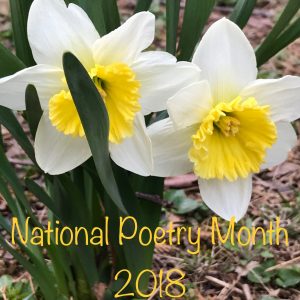
National Poetry Month 2018

Welcome to National Poetry Month at Savvy Verse & Wit.

April has come fast, and with it some beautiful blooms in the garden. I couldn’t resist using them for this year’s image.

I have no formal plans for this year’s celebration, but I do plan to feature mostly poets, poetry, and readings. I would love to share some original poems and maybe a few posts about poetry I’ve found on the Internet. If you have any suggestions, feel free to email them to me.

I hope that you’ll join me this year in celebrating poets and poetry. Feel free to share your links in the Mr. Linky below:


Guest Post & Giveaway: Jenetta James on the Process of Title Choice for Lover’s Knot

I want to give Jenetta James a warm welcome today as she walks us through the title selection process for her novels, including her latest Lover’s Knot.

Of course, there will be a giveaway and you’ll learn about the book below. Enjoy!

About the Book:

A great love. A perplexing murder. Netherfield Park — a house of secrets.

Fitzwilliam Darcy is in a tangle. Captivated by Miss Elizabeth Bennet, a girl of no fortune and few connections. Embroiled in an infamous murder in the home of his friend, Charles Bingley. He is being tested in every way. Fearing for Elizabeth’s safety, Darcy moves to protect her in the only way he knows but is thwarted. Thus, he is forced to turn detective. Can he overcome his pride for the sake of Elizabeth? Can he, with a broken heart, fathom the villainy that has invaded their lives? Is there even a chance for love born of such strife?

Lover’s Knot is a romantic Pride & Prejudice variation, with a bit of mystery thrown in.

Take it away, Jenetta:

What’s in a name? Finding a title for “Lover’s Knot”

Firstly – a big thank you to Serena for having me to visit Savvy Verse & Wit as part of the “Lover’s Knot” blog tour. It is a pleasure and an honour to be here.

The first time I mentioned the title of my latest JAFF story to my family, there were looks of bemusement all around. “That doesn’t sound like a Pride & Prejudice variation” was the universal response.

The truth is that I enjoy the challenge of thinking up titles, but that doesn’t mean it comes easily to me. In the case of my first published story – “Suddenly Mrs. Darcy” – the title, which reflects a rapid forced marriage scenario, did just come to me one day. It turned up like a fortuitous taxi and I immediately knew that it was right, so it stayed, and that was that. For “The Elizabeth Papers”, I had more of a struggle. I wanted to elude to the mystery in the book, but also place the Darcys centre stage (as they are in the story). I had a number of possible titles and a piece of paper with dozens of words scrawled all over them. Hours would go by with me swapping them about and reading them out loud. Just when I began to think it was a hopeless task, “The Elizabeth Papers” revealed itself to me.

Now it is fair to say (I think) that the majority Pride & Prejudice variation stories have titles that in some way reflect the original. Alliterative plays on Jane Austen’s title and titles including the names of the major characters and of the major houses in the story, are rightly popular.

Lover’s Knot does not fit in with that – so where does it come from?

As many of you will know, a lover’s knot it is a well recognised type of knot – featuring more than one – usually two – knots threaded together. In addition to fastening things, it is a popular motif in jewellery – made most famous by the Cambridge Lover’s Knot tiara worn by Queen Mary, Diana,
Princess of Wales and now the Duchess of Cambridge.

Why did I chose it for my title?

The novel itself features a leather lover’s knot and it was only after I had written it that I quite realised the usefulness of the knot as a way of thinking about the story. It comes just before the end of part 1 that the reader is shown an item – a clue – which is fastened by lover’s knots. It isn’t particularly valuable – but it is difficult to explain and it seems important. When Mr. Darcy begins to investigate the crimes that have taken place, part of what he is seeking to explain is the item with the knot. It is a sort of symbol of the “whodunnit”. If he can sort out the clue – he might be able to fathom the mystery.

On top of that, the lover’s knot is a symbol of other things. It has a character which is both useful and decorative which is also apposite to the story.

This strong fastening is, and has been since antiquity, a symbol of love and friendship. Now that is useful in itself because love – and specifically the love between Mr Darcy and Elizabeth is the heart of this story and most other variations. However, there is more to it than that. Being a knot – it also represents a tangle – a thing to be unfastened if the occasion demands it. In “Lover’s Knot” – as in Pride & Prejudice – both Elizabeth and Mr. Darcy get themselves in something of a muddle. By reason of pride, prejudice and social mores, they each find themselves locked into unhappy situations. This is exacerbated in Lover’s Knot by the fact of the crimes that have taken place. For the story to resolve to provide for their happiness (which of course, it must do!), that knot has to be undone.

So, that is my explanation. What do you think? What are your favourite JAFF titles and why?

About the Author:

Jenetta James is a mother, writer, lawyer and taker-on of too much. She grew up in Cambridge and read history at Oxford University where she was a scholar and president of the Oxford University History Society. After graduating, she took to the law and now practices full-time as a barrister. Over the years, she has lived in France, Hungary, and Trinidad as well as her native England.

Jenetta currently lives in London with her husband and children where she enjoys reading, laughing, and playing with Lego. She has written, Suddenly Mrs. Darcy and The Elizabeth Papers as well as contributed short stories to both The Darcy Monologues and Dangerous to Know: Jane Austen’s Rakes and Gentlemen Rogues. Follow her on Twitter and Facebook.

GIVEAWAY:

Jenetta has selected a lovely giveaway package where one lucky winner will
receive a Pride & Prejudice scarf, a Kindle cover and paperback copies of all five of her JAFF books.

To enter, answer Janetta’s question about your favorite P&P titles.

Terms and conditions:

Readers may enter the drawing by tweeting once each day and by commenting
daily on a blog post or review that has a giveaway attached to this tour.
Entrants must provide the name of the blog where they commented.
Each winner will be randomly selected by Rafflecopter and the giveaway is
international. Each entrant is eligible to win one eBook.

a Rafflecopter giveaway

Guest Post & Giveaway: Riana Everly, Author of The Assistant: Before Pride and Prejudice, Speaks about University of King’s College

I want to welcome Riana Everly back to Savvy Verse & Wit today with her new book, The Assistant.

About the Book:

A tale of love, secrets, and adventure across the ocean.

When textile merchant Edward Gardiner rescues an injured youth, he has no notion that this simple act of kindness will change his life. The boy is bright and has a gift for numbers that soon makes him a valued assistant and part of the Gardiners’ business, but he also has secrets and a set of unusual acquaintances. When he introduces Edward to his sparkling and unconventional friend, Miss Grant, Edward finds himself falling in love.

But who is this enigmatic woman who so quickly finds her way to Edward’s heart?

Do the deep secrets she refuses to reveal have anything to do with the appearance of a sinister stranger, or with the rumours of a missing heir to a northern estate? As danger mounts, Edward must find the answers in order to save the woman who has bewitched him . . . but the answers themselves may destroy all his hopes.

Set against the background of Jane Austen’s London, this Pride and Prejudice prequel casts us into the world of Elizabeth Bennet’s beloved Aunt and Uncle Gardiner. Their unlikely tale takes the reader from the woods of Derbyshire, to the ballrooms of London, to the shores of Nova Scotia. With so much at stake, can they find their Happily Ever After?

Please give Riana a warm welcome.

In The Assistant, Edward Gardiner has recently returned to England after completing his degree at King’s College in Nova Scotia. Having grown up in Canada, I had known about The University of King’s College for many, many years, but the university reasserted itself in my consciousness about five years ago when my son was starting to explore options for his own degree. He ultimately decided to go elsewhere, but he was very much taken with both King’s and Halifax, where the university is now located. When a friend’s son did choose to attend King’s, I was all the more impressed with the institution and what it has to offer, because it has been a terrific experience for this young man.

But what makes King’s so special? Every place has its first-rate institutions of higher learning. One of the many things that fascinated me about King’s was its history, reaching back to the 1700s, not a mean feat for such a young country as Canada.

The University of King’s College was founded in Windsor, Nova Scotia, in 1789. It was the first university to be established in what is now English-speaking Canada, and is the oldest English-language university in the Commonwealth outside the United Kingdom.

King’s actually began its existence in New York City, where it was founded by King George II on October 31, 1754. However, in 1776 the college was forced to halt operations for eight years due to ongoing revolution, warfare and social strife. During that time the library was looted and the university’s building was commandeered by both the British and American forces for use as a military hospital. When the school was taken over by revolutionary forces, the Loyalists, led by Bishop Charles Inglis, fled to Windsor, Nova Scotia. There, they founded the King’s Collegiate School in 1788, and the following year, the University of King’s College was established as a permanent institution. It was there that Edward Gardiner received his education just five years later.

And the old King’s in New York? After the revolution it was revived and renamed and is now located at Broadway and 116 th Street, New York City. These days, it is known as Columbia University.

There are a few more interesting points about King’s. It was modeled on the English universities, which were residential, based on a tutorial system, and were closely linked to the Church of England. In fact, until the end of the nineteenth century, all students had to be Anglican and take oaths affirming their assent to the 39 articles of the church. This is unlike Scottish universities of the time, where there was no religious test for students.

Of more interest to many sports fans, it is possible that the first game of hockey was played by King’s students in Winsdor, around the year 1800, when they decided to strap on skates and play a version of the field game of Hurley on the frozen pond. I am no tremendous sports fan, but there is something fun about imagining a very young Edward Gardiner being one of the first people to venture onto the ice and engage in an exciting game of Ice Hurley… or Ice Hockey!

These days, King’s is located in the city of Halifax, where it is affiliated with Dalhousie University. It remains, however, an independent institution, and one of the finest in Canada, with a world-wide reputation.

~*~ (Excerpt from Chapter One)

It was Edward’s own mother, Mary, who had convinced James Gardiner that young Edward needed an Education. Not of the social class to consider Oxford or Cambridge for their son, the Gardiners embarked upon a quest, and eventually determined upon the colonies. An old friend of Gardiner senior made the suggestion of King’s College in Nova Scotia, along with the offer of an apprenticeship in his export business there, which sent timber and furs across the ocean. The double allure of a classical education and personal experience in another part of his own family’s trade was too great to refuse, and upon completing his primary education in the local parish, Edward was sent to the small town of Windsor, Nova Scotia, some fifty miles from Halifax, the capital of that colony.

His three years abroad were initially lonely ones for the shy young man, but along with an excellent education, he also acquired the social skills required of a successful businessman. He learned to meet people and engage with them on their own terms; he learned that a pleasant smile and a friendly demeanour would better recommend him to others than mere social éclat; he learned the importance of business in keeping the blood of the Empire flowing; and most importantly, he learned that, in this less stratified world of the Atlantic colonies, tradesmen and sons of local magistrates were social equals, who could converse intelligently on matters of consequence. Edward returned home educated and mature, with a knowledge of his place in the world, but with the skills to move beyond his circles. He could discuss business affairs with his fellow merchants, fashion with the Ladies who sought unique decorations at his establishments, literature and sport with the gentlemen who accompanied them, and was a competent and sought-after chess partner.

In short, Edward Gardiner had every prospect of outshining his father.

Thank you, Riana, for sharing the history of King’s College and early hockey.

About the Author:

Riana Everly was born in South Africa, but has called Canada home since she was eight years old. She has a Master’s degree in Medieval Studies and is trained as a classical musician, specialising in Baroque and early Classical music. She first encountered Jane Austen when her father handed her a copy of Emma at age 11, and has never looked back.

Riana now lives in Toronto with her family. When she is not writing, she can often be found playing string quartets with friends, biking around the beautiful province of Ontario with her husband, trying to improve her photography, thinking about what to make for dinner, and, of course, reading! Visit her on Facebook and at her website.

GIVEAWAY:

ENTER HERE.

Blossom the Flower Girl Fairy by Daisy Meadows

Source: Purchased
Paperback, 176 pgs.
I am an Amazon Affiliate

Blossom the Flower Girl Fairy by Daisy Meadows is a chapter book for readers who are in grades two through five. My daughter is a pretty advanced reader but she still loves pictures, so this is a little tough for her to stay focused through, which is why we chose it as our nightly bedtime read-together book. Blossom has a very important job in fairy land. She has to keep the royal wedding on track and when things go awry in fairyland, they go wrong in the real world too. Kirsty and Rachel find this out first hand when Rachel’s Aunt Angela asks them for help with the flower girls and the wedding flowers.

We had a fun time reading this book together, and she was so caught up in tricking Jack Frost’s goblins into returning stolen wedding items. We ended up reading more than one chapter per night of this one.  She couldn’t wait to see what happened and if the fairytale endings for both weddings happened.

Blossom the Flower Girl Fairy by Daisy Meadows enables kids to see how to solve problems in real life, though the girls do ask for some fairy dust to help on occasion. These girls are crafty and get the job done, even when it looks like all is lost.

About the Book:

Here comes the bride!

Rachel’s Aunt Angela is a talented wedding planner. She’s organizing the biggest wedding Tippington has ever seen — and she needs Rachel and Kirsty’s help!

Rachel and Kirsty are put in charge of the bride’s flower girls. But when Jack Frost’s goblins show up uninvited, the wedding is in trouble. Luckily for everyone, Blossom the Flower Girl Fairy has a very special kind of magic — and she’s determined to make sure this wedding goes off without a hitch!

Find the magic objects in all three stories inside this Rainbow Magic Special Edition and help save the wedding magic!

RATING: Quatrain

About the Author:

Daisy Meadows is the pseudonym used for the four writers of the Rainbow Magic children’s series: Narinder Dhami, Sue Bentley, Linda Chapman, and Sue Mongredien. Rainbow Magic features differing groups of fairies as main characters, including the Jewel fairies, Weather fairies, Pet fairies, Petal fairies, and Sporty fairies.

Mailbox Monday #472

Mailbox Monday, created by Marcia at To Be Continued, formerly The Printed Page, has a permanent home at its own blog. To check out what everyone has received over the last week, visit the blog and check out the links. Leave yours too.

Also, each week, Leslie, Martha, and I will share the Books that Caught Our Eye from everyone’s weekly links.

Here’s what we received:

Dork Diaries: Tales From a Not-So-Perfect Pet Sitter by Rachel Renée Russell, which my daughter bought from the school book fair.

Nikki has to hide seven ADORKABLE puppies from two parents, one nosy little sister, an entire middle school, and…one mean girl out for revenge, Mackenzie Hollister. If anyone can do it, it’s Nikki…but not without some hilarious challenges along the way!

Bad Kitty: Camp Daze by Nick Bruel, which my daughter bought at her school book fair.

Kitty’s life is really hard. Like really, REALLY hard. All she asks for is twenty-two hours a day to sleep and food to be delivered morning and night. But does she get it? No. And when Puppy and Baby get a little rambunctious during her naptime, Kitty gets bonked on the head and starts to believe she’s . . . a dog.

This new dynamic freaks out Puppy, so he’s sent away to Uncle Murray’s Camp for Stressed-Out Dogs to relax with other canine campers.

But guess who sneaks along?

Still believing she’s a dog, Kitty fits right in. That is until she and Uncle Murray encounter a bear, and then the feline claws come out.

Before She Was Harriet by Lesa Cline-Ransome, which I bought for my daughter at the book fair.

A lush and lyrical biography of Harriet Tubman, written in verse and illustrated by an award-winning artist.

We know her today as Harriet Tubman, but in her lifetime she was called by many names. As General Tubman she was a Union spy. As Moses she led hundreds to freedom on the Underground Railroad. As Minty she was a slave whose spirit could not be broken. An evocative poem and opulent watercolors come together to honor a woman of humble origins whose courage and compassion make her larger than life.

What did you receive?

Walk With Me by Debra Schoenberger

Source: the author
ebook, 108 pgs.
I am an Amazon Affiliate

Walk with Me by Debra Schoenberger is just that a journey along with the photographer as she explores not only her own city of Victoria, British Columbia, but places to which she’s traveled. Her pictures range from the mundane moments of empty chairs in a restaurant to the pilled moisture on fruit. Her macro shots are detailed and well contrasted, and her close-ups of people illustrate the unbridled joy found in daily jaunts.

Schoenberger chooses to frame not only every day moments, but also colors that we often forget we see.  Highlighting the rainbows present in our busy lives demonstrates to readers of her book that there is more to our life than those scheduled appointments and deadlines. We need to remember those colors, those giggles of children’s laughter, and soft touch of petals on our skin. We can breathe in the scent of life to calm us and look at our neighborhoods to find the humor lost in large window displays.

Walk with Me by Debra Schoenberger is a journey, a meditation, and a pause for readers. I would like to have known where some of the photos were shot because there are some really interesting places captured here. They could be anywhere in the world, or right down the street.

RATING: Quatrain

About the Author:

Debra Schoenberger aka #girlwithcamera

“My dad always carried a camera under the seat of his car and was constantly taking pictures. I think that his example, together with pouring over National Geographic magazines as a child fueled my curiosity for the world around me.

I am a documentary photographer and street photography is my passion. Some of my images have been chosen by National Geographic as editor’s favorites and are on display in the National Geographic museum in Washington, DC.  I also have an off-kilter sense of humor so I’m always looking for the unusual.  Website ~  Facebook ​~ Instagram ~  Pinterest

ENTER THE GIVEAWAY:

a Rafflecopter giveaway

How to Love the Empty Air by Cristin O’Keefe Aptowicz

Source: Wunderkind PR
Paperback, 100 pgs.
I am an Amazon Affiliate

How to Love the Empty Air by Cristin O’Keefe Aptowicz is emotionally arresting and a love letter to the past and the passing of a mother. How many times have we said, “I’ll get back to that in a few days” or “It’s only for a year.” Many of us have said these things and others when speaking with friends, parents, and others. In this busy world, we often forget to go back to those events or people. This leaves an emptiness. How do you deal with that emptiness or learn to love that emptiness?

In “My Mother Wants to Know If I’m Dead,” Aptowicz’s narrator finds an email from her mother asking if she’s died because she has not let her know that she’s arrived safely. These are real life situations that come to life in poems throughout the collection. She points out the inanity of these emails if the receiver is in fact deceased, but she also acknowledges the sentiment and the anxiety and the worry behind the contact. These are moments we all can relate to, understand, and lament.

“Rabbit Hole” is the poem in this collection that brings the whole together. It hammers home the connections between the poems and the struggle with emptiness.

Holding your mother's hand
while she is dying is like trying to love
the very thing that will kill you.

Similarly, “Text From My Sister, June 2015” expresses how this loss that seems so singular is broader and encloses everyone who was connected with her mother.

Definitely have had lots of
sadness lately. The passenger
seatbelt in Dads car smells like
her. But the house is starting to
forget.

There are days when there is a hole in our lives that doesn’t seem like it will ever be full again. How to Love the Empty Air by Cristin O’Keefe Aptowicz is not as tough to read as you’d expect. It’s funny, it’s witty, it’s sad, but it’s also content in the empty moments of life.

RATING: Cinquain

About the Poet:

Cristin O’Keefe Aptowicz is a New York Times bestselling nonfiction writer and poet. She is the author of six books of poetry (including Dear Future Boyfriend, Hot Teen Slut, Working Class Represent, Oh, Terrible Youth andEverything is Everything) as well as the nonfiction books, the >Dr. Mutter’s Marvels: A True Tale of Intrigue and Innovation at the Dawn of Modern Medicine, which made 7 National “Best Books of 2014″ lists (including Amazon, The Onion’s AV Club, NPR’s Science Fridays and the UK newspaper The Guardian, among others) and Words In Your Face: A Guided Tour Through Twenty Years of the New York City Poetry Slam, which Billy Collins wrote “leaves no doubt that the slam poetry scene has achieved legitimacy and taken its rightful place on the map of contemporary literature.” On the National Endowment for the Arts (NEA) podcast Art Works, host Josephine Reed introduced Cristin as being “something of a legend in NYC’s slam poetry scene. She is lively, thoughtful, and approachable looking to engage the audience with her work and deeply committed to the community that art (in general) and slam poetry (in particular) can create.” Cristin’s most recent awards include the ArtsEdge Writer-In-Residency at the University of Pennsylvania (2010-2011), a National Endowment for the Arts Fellowship in Poetry (2011) and the Amy Clampitt Residency (2013). Her sixth book of poetry, The Year of No Mistakes, was released by Write Bloody Publishing in Fall 2013, and would go on to win the Writers’ League of Texas Book of the Year Award for Poetry (2013-2014). Her second book of nonfiction, Dr. Mutter’s Marvels: A True Tale of Intrigue and Innovation at the Dawn of Modern Medicine, was released by Gotham Books (Penguin) in Fall 2014, debuted at #7 on the New York Times Bestseller List for Books about Health.

Mailbox Monday #471

Mailbox Monday, created by Marcia at To Be Continued, formerly The Printed Page, has a permanent home at its own blog. To check out what everyone has received over the last week, visit the blog and check out the links. Leave yours too.

Also, each week, Leslie, Martha, and I will share the Books that Caught Our Eye from everyone’s weekly links.

Here’s what we received:

And Only to Deceive by Tasha Alexander from Audible for Book Club.

For Emily, accepting the proposal of Philip, the Viscount Ashton, was an easy way to escape her overbearing mother, who was set on a grand society match. So when Emily’s dashing husband died on safari soon after their wedding, she felt little grief. After all, she barely knew him. Now, nearly two years later, she discovers that Philip was a far different man from the one she had married so cavalierly. His journals reveal him to have been a gentleman scholar and antiquities collector who, to her surprise, was deeply in love with his wife. Emily becomes fascinated with this new image of her dead husband and she immerses herself in all things ancient and begins to study Greek.

Emily’s intellectual pursuits and her desire to learn more about Philip take her to the quiet corridors of the British Museum, one of her husband’s favorite places. There, amid priceless ancient statues, she uncovers a dark, dangerous secret involving stolen artifacts from the Greco-Roman galleries. And to complicate matters, she’s juggling two very prominent and wealthy suitors, one of whose intentions may go beyond the marrying kind. As she sets out to solve the crime, her search leads to more surprises about Philip and causes her to question the role in Victorian society to which she, as a woman, is relegated.

What did you receive?

Daphne and Her Discontents by Jane Rosenberg LaForge

Source: the poet
ebook, 86 pgs.
I am an Amazon Affiliate

Daphne and Her Discontents by Jane Rosenberg LaForge begins with the dancing tree on the cover. It sets the tone for her latest collection, as Daphne was a nymph turned into a tree as she sought to escape Apollo. She uses the tree and the myth to explain the flexibility of being a woman with responsibilities, but how that flexibility can have its limits in “My Mother the Tree.”

LaForge explores motherhood, being a daughter to a harsh father, and a sister in her poems. Readers are taken on a journey in a myth as it is made and as the narrator is transformed and relationships are modified. In “Goddess of Water,” she says, “We are bodies of water so of course/What controls the tides/Conquers us.”

There are juxtapositions between Christianity and her Jewish heritage as she speaks about the Christmas tree business her father owned. She speaks to the past, the present and the rest, and how it is internalized to generate new growth if we allow it and do not hinder it with our own doubts and criticisms and dwelling upons.

Daphne and Her Discontents by Jane Rosenberg LaForge is a woven history and myth rolled out over several poems. She re-engages readers with old myths to create new ones. Not to be missed.

RATING: Quatrain

Other Reviews:

About the Poet:

Jane Rosenberg LaForge’s poetry, fiction, critical and personal essays have appeared in numerous publications, including Poetry Quarterly, Wilderness House Literary Review, Ottawa Arts Review, Boston Literary Magazine, THRUSH, Ne’er-Do-Well Literary Magazine, and The Western Journal of Black Studies. Her memoir-fantasy, An Unsuitable Princess, is available from Jaded Ibis Press. Her full-length collection of poetry, With Apologies to Mick Jagger, Other Gods, and All Women  was published in fall 2012 by The Aldrich Press. She is also the author of the chapbooks After Voices, published by Burning River of Cleveland in 2009, and Half-Life, from Big Table Publishing of Boston in 2010. She lives in New York City with her husband and daughter.

Dead Men Can’t Complain and Other Stories by Peter Clines (audio)

Source: Purchased
Audible, 4+ hours
I am an Amazon Affiliate

Dead Men Can’t Complain and Other Stories by Peter Clines, narrated by Ralph Lister and Ray Porter, thrusts listeners into a surreal world in which lizard men are interrogated by police and travel through time and in which zombies seek full human rights even though they are dead and could possibly begin eating living human beings.

Clines’ stories are highly imaginative and often rely on tropes from science fiction, but he twists them into his own inventions that leave readers considering ethical issues and more. Science fiction fans will enjoy this set of stories, but so too will those who can suspend their disbelief and have never read a “space” novel. He twists the tales of Jacob Marley and Superman to make them his own, and these stories are highly entertaining and clever.

Generally, short story collections are books that readers dip in and out of, but in the case of Clines’ book, readers will be hooked and keep reading until they’ve finished. Each story is unique and the characters are dynamic and fleshed out, but the stories are complete and do not leave readers hanging or wanting a resolution that doesn’t come. These stories encapsulate these worlds neatly and completely.

Dead Men Can’t Complain and Other Stories by Peter Clines, narrated by Ralph Lister and Ray Porter, is delightful, disturbing, and fun. Readers will be hooked and may even explore other “sci-fi” or apocalyptic books about zombies or aliens or superheroes.

RATING: Cinquain

About the Author:

Peter Clines grew up in the Stephen King fallout zone of Maine and–inspired by comic books, Star Wars, and Saturday morning cartoons–started writing at the age of eight with his first epic novel, LIZARD MEN FROM THE CENTER OF THE EARTH.

Mailbox Monday #470

Mailbox Monday, created by Marcia at To Be Continued, formerly The Printed Page, has a permanent home at its own blog. To check out what everyone has received over the last week, visit the blog and check out the links. Leave yours too.

Also, each week, Leslie, Martha, and I will share the Books that Caught Our Eye from everyone’s weekly links.

Here’s what we received:

A Governess for Longbourne by Chelsea Fraisse, a free Kindle.

Mrs. Bennet has fallen ill, and Mr. Bennet seeks to remedy his shortcomings in his role as a father.

What did you receive?

Giveaway & Interview with John Kessel, Author of Pride and Prometheus

It has been quite some time since I’ve conducted an interview with an author, but today, John Kessel, author of Pride and Prometheus, will answer a few questions. And there is a giveaway to be had.

First, a bit about the book:

Pride and Prejudice meets Frankenstein as Mary Bennet falls for the enigmatic Victor Frankenstein and befriends his monstrous Creature in this clever fusion of two popular classics.

Threatened with destruction unless he fashions a wife for his Creature, Victor Frankenstein travels to England where he meets Mary and Kitty Bennet, the remaining unmarried sisters of the Bennet family from Pride and Prejudice. As Mary and Victor become increasingly attracted to each other, the Creature looks on impatiently, waiting for his bride. But where will Victor find a female body from which to create the monster’s mate?

Meanwhile, the awkward Mary hopes that Victor will save her from approaching spinsterhood while wondering what dark secret he is keeping from her.

Pride and Prometheus fuses the gothic horror of Mary Shelley with the Regency romance of Jane Austen in an exciting novel that combines two age-old stories in a fresh and startling way.

Now, for the interview; give John a warm welcome:

1. When did you start writing and what was the first story or poem you wrote?

I was writing stories as early as grade school and sent my first submission to a magazine when I was in seventh grade. It was a terrible little one-page science fiction story that ended with a pun. I sent it to the Magazine of Fantasy and Science Fiction and it was rejected, but I was very excited to have the form rejection slip, which meant that some editor had read my story. I was not discouraged.

I did not send another story out until I was in college, and did not sell a story that actually appeared until I was in my late 20s. Ironically, my first sale that eventually got published was to the same magazine, Fantasy and Science Fiction, where I have since sold eighteen stories.

2. Why Jane Austen as a basis for a novel?

I love Austen’s novels but I would not have considered writing a novel based on Pride and Prejudice if I had not seen the opportunity to fuse Austen's characters with the characters and plot of Frankenstein. I became intrigued as much by the differences between Jane Austen’s and Mary Shelley’s writing as by the similarities, and in writing the book thought a lot about the differences between the novel of manners and the gothic, and the odd ways in which they might speak to one another. Also, it was fun, a kind of challenging puzzle, to make them come together in a satisfying way without disrespecting either writer or her work.

3. What character surprised you the most when writing Pride & Prometheus?

Mary Bennet surprised me the most. The Mary portrayed in Pride and Prejudice is a minor character, the most socially maladroit of the Bennet sisters, the only one who is not pretty. She’s the bookish one who quotes morality at her sisters and who cannot see how odious Mr. Collins is. Every time she appears in the book she says something pompous or clueless and everyone ignores her.

But I picked her to be my heroine, so I had to try to understand her and imagine how she might have an interior life that would not make her obnoxious or tedious even though others might see her that way. I had to grow her up—my story happens 13 years after Austen’s, so Mary has had a chance to evolve and mature. She became a stronger and more admirable character the farther the story went, and I liked her more and more. She
struggled to make things better in situations where others would give up, and she said and did a few things that surprised even me.

4. What was left on the cutting room floor during the editing process that you love most?

I don’t remember having to cut anything very substantial that I regretted losing. Mostly the story grew with successive drafts. There were some options I considered early on—notably a number of different endings—that I let go of as I worked through the story, but I think the ending I came to is the right one for this book.

5. What is next on the writing horizon? Future book?

I have been working on a story about the assassination of President William McKinley by the anarchist wannabe Leon Czolgosz at the Pan-American Exposition, a world’s fair, in Buffalo, New York in 1901. I grew up in Buffalo. Czolgosz was the son of Polish immigrants; my father was a Polish immigrant. The turn of the 20th century was a time of great wealth and poverty, political, and social change—like our own time. The fair was designed to promote electrification and the wonders of the future, a subject of interest to a person as obsessed with science fiction as I was as a young man.

There was an attraction at the fair called “A Trip to the Moon,” the first “dark ride” ever designed, like the ones at Disneyworld or Universal. One could take this ride to the moon and meet the underground Selenites, modeled after H.G. Wells’s novel First Men in the Moon. I think maybe Leon Czolgosz went to the moon before he shot the president. I think there’s a story in this, an opportunity for comedy and tragedy and social comment, though I am not sure exactly how it will work out. My tentative title is The Dark Ride.

Thanks, John, for taking the time to share with us your latest work and how Mary Bennet surprised you.

ENTER the U.S. giveaway below:

1. Leave a comment on the post with an email
2. Share on social media #giveaway #Pride&Prometheus @SavvyVerseWit #JohnKessel for another entry

Deadline to enter is March 14, 2018, 11:59 PM EST

Photo Credit: John Pagliuca

About the Author:

Born in Buffalo, New York, John Kessel’s most recent book is the new novel Pride and Prometheus. He is the author of the earlier novels The Moon and the Other, Good News from Outer Space and Corrupting Dr. Nice and in collaboration with James Patrick Kelly, Freedom Beach. His short story collections are Meeting in Infinity (a New York Times Notable Book), The Pure Product, and The Baum Plan for Financial Independence.

Kessel’s stories have twice received the Nebula Award given by the Science Fiction and Fantasy Writers of America, in addition to the Theodore Sturgeon Memorial Award, the Locus Poll, and the James Tiptree Jr. Award. His play “Faustfeathers’” won the Paul Green Playwright’s Prize, and his story “A Clean Escape” was adapted as an episode of the ABC TV series Masters of Science Fiction. In 2009 his story “Pride and Prometheus” received both the Nebula Award and the Shirley Jackson Award. With Jim Kelly, he has edited five anthologies of stories re-visioning contemporary short sf, most recently Digital Rapture: The Singularity Anthology.

Kessel holds a B.A. in Physics and English and a Ph.D. in American Literature. He helped found and served as the first director of the MFA program in creative writing at North Carolina State University, where he has taught since 1982. He and his wife, the novelist Therese Anne Fowler, live and work in Raleigh, N.C.