Quantcast

Taboo Poetry…A Game

Be sure to click the image above for today’s tour stop on the National Poetry Month Blog Tour!

Have you ever played that early 1990’s game Taboo from Hasbro?  Today, I would invite you all to play along with me as we create a poem in the comments in celebration of National Poetry Month.

The object of the game here is to create a poem about the word below, without referring to that word or any of the other 5 words that are most used to describe it.

The word is ROMANCE

And the forbidden words (and their variations) are:  LOVE, BURNING, PASSION, SWEET, HEART

So each commenter can write one line for the poem that describes ROMANCE, but does not use that word or the five forbidden words.

At the end of the day, I’ll collect all the lines and post the full poem next week; It’ll be fun to see what all the creative minds out there can come up with.

OK, Get started!

When All My Disappointments Came at Once by Todd Swift

When All My Disappointments Came at Once by Todd Swift, published by Tightrope Books, are poems about a series of mid-life crisis in literature and throughout history, with some less grandiose crises in the mix.  There are new takes on the midlife crisis, with the narrator in “The Shelf” trying to take on the life of another through their writing, only to find the words fit falsely and do not ring true.  But in others, like “Michael Kohlhaas,” reference the vengeful exploits that go off of the deep end to the point that the narrator cannot be brought back from the brink.  With a wide breadth of topics, Swift covers a lot of historic and emotional ground in his poems, though clearly some of these poems will require additional research into some of the historic and literary elements referenced, especially if they are not familiar.

From "In Memory of F.T. Prince" (page 15)

Desire ages, ages hardly at all,
Edges, like those of a book,
Curled at the beach, where waves,
Sent by the summer, brush

The salt away, finely-combed,
And it is homosexual love
That holds us in its palm,
That cuts and dries the hair

Beautifully rendered, Swift harkens to the original poem written by Prince about soldiers bathing in a river during World War II, but he also takes a new twist on the scene, pinpointing the desire that can rise up when all that surrounds you is death. Where is the beauty, where is the love — you find it where you can, at least to a certain extent. While some of these poems are dark and harrowing, others are sad, suspenseful, and heart-pounding as Swift takes readers on a journey through several devastating events in history and literature.

However, there are moments in the collection where Swift shows his humor, like using two rhyming lines in “Hunting Party” to make the celebratory scene after the hunt more comical, poking fun at the midlife crisis aspect depicted in the poem. In others, there is a ray of hope even as the narrator loses faith in God. These poems have a wide range of perspectives to offer, and Swift is masterful in some poems and cryptic in others. When All My Disappointments Came at Once by Todd Swift is an interesting examination of midlife crises, the emotions tied to that, and the rays of hope and comedy that can emerge from those incidents.

About the Poet:

Dr. Todd Swift is Lecturer in English Literature and Creative Writing, at Kingston University, London. He is Director and Editor of new small press Eyewear Publishing. Published by the age of 18 in The Fiddlehead, Swift is the prolific author of eight collections of poetry and many more pamphlets. He is editor or co-editor of a dozen anthologies, most recently Lung Jazz: Young British Poets for Oxfam, with a preamble from David Lehman. His poems have appeared in numerous international publications, such as Poetry (Chicago), Poetry Review (London), and The Globe and Mail (Toronto). He has been Oxfam’s poet-in-residence, based in Marylebone, since 2004. His widely-read blog, Eyewear, has been archived by The British Library.

Please click on the National Poetry Month Blog Tour image for today’s tour stop:

This is my 7th book for the Dive Into Poetry Challenge 2013.


This is my 18th book for the 2013 New Authors Challenge.

No Ocean Here by Sweta Srivastava Vikram

No Ocean Here by Sweta Srivastava Vikram, published by Modern History Press, is a collection of poems about the subjugation of women and all of its forms, across not only the Middle East and Africa, but also throughout the various parts of Asia and South Asia.  These poetic portraits are often prefaced by some facts about a particular woman’s story encapsulated in the poem or about statistics of crimes against women in various countries.  Not all of the poems are prefaced, but even those that are could stand on their own and speak for the women they represent.  Beyond the violence and inequality women deal with on a daily basis, these poems also shed light on the women-on-women violence and the silent acceptance among older women of continuing these traditions with the younger generations.

From War (page 12; which is related to Sri Lankan battles)

The sun was shining on shells
of burnt-out houses in their neighborhood.
Her mother, sister, and she were drinking

coffee, thanking bees for leaving them alone
when three men in uniforms entered

their house under the pretense of search.

All cavities of the women's trust were emptied out
when each man selected a victim:

Vikram’s poetry not only provides a story that is easily accessible on the surface, but she also provides themes and hardships that call for closer inspection.  In this way, her collection would make an excellent book club pick, which could be even further enhanced by additional materials on the subjugation of women across the globe even today. Her poetry speaks of social injustice in a way that shocks the reader, but also pays homage to those who have suffered with the deft strokes of her imagery.  Some poems are stronger than others in terms of theme and imagery, while others are more in-your-face and full of surface meaning.

No Ocean Here by Sweta Srivastava Vikram is a vast ocean of pain, discomfort, and horror that should make women in the modern world, including those inside and outside the United States, stand up for themselves and others. Beyond that, it should make men stand up and take notice that their actions and those of other males in societies across the world should not be tolerated — and ended.

About the Author:

Sweta Srivastava Vikram is an award-winning poet, writer, novelist, author, essayist, columnist, and educator. She is the author of four chapbooks of poetry, two collaborative collections of poetry, a novel, a nonfiction book, and a book-length collection of poems (upcoming). Her work has also appeared in several anthologies, literary journals, and online publications across six countries in three continents. Sweta has won two Pushcart Prize nominations, an International Poetry Award, Best of the Net Nomination, Nomination for Asian American Members’ Choice Awards 2011, and writing fellowships. A graduate of Columbia University, she lives in New York City.

This is my 6th book for the Dive Into Poetry Challenge 2013.


Click on the image below for today’s National Poetry Month Blog Tour post:

Poetry as Gold. . .

Welcome to the Savvy Verse & Wit blog tour for National Poetry Month in the United States, but here on the blog, I consider it more of an international celebration.

If you have signed up to celebrate poetry this month, there are still some dates open, just check the schedule and let me know what date you’d prefer.

This past week I was reading Night Train to Lisbon by Pascal Mercier, translated by Barbara Harshav, and I came across a commentary about recreating the Portuguese language to make it clearer and truer to its origins: “The waiter, the barber, the conductor — they would be puzzled if they heard the newly set words and their amazement would refer to the beauty of the sentence, a beauty that would be nothing by the gleam of their clarity. … At the same time, they would be without exaggeration and without pomposity, precise and so laconic that you couldn’t take away one single word, one single comma. Thus they would be like a poem, plaited by a goldsmith of words.” (page 26) This passage reminded me of how poets — and fiction writers — often seek out ways through language to make images, characters, situations, emotions, and more clear to the reader — drawing connections between images that may, at first, seem to have nothing to do with one another, but through a juxtaposition or other means provide the reader with some insight or generate within him or her a deeper understanding or emotional response.

As I’m sure many of my faithful readers know, I read and write poetry, but they probably also know that I love Yusef Komunyakaa‘s work in particular.  “Facing It” is one of my all time favorites, and I think part of it is because I can picture exactly what he’s seeing as the Vietnam veteran in the poem describes his first experience with the Vietnam War Memorial.

Facing It

My black face fades,   
hiding inside the black granite.   
I said I wouldn't  
dammit: No tears.   
I'm stone. I'm flesh.   
My clouded reflection eyes me   
like a bird of prey, the profile of night   
slanted against morning. I turn   
this way—the stone lets me go.   
I turn that way—I'm inside   
the Vietnam Veterans Memorial
again, depending on the light   
to make a difference.   
I go down the 58,022 names,   
half-expecting to find   
my own in letters like smoke.   
I touch the name Andrew Johnson;   
I see the booby trap's white flash.   
Names shimmer on a woman's blouse   
but when she walks away   
the names stay on the wall.   
Brushstrokes flash, a red bird's   
wings cutting across my stare.   
The sky. A plane in the sky.   
A white vet's image floats   
closer to me, then his pale eyes   
look through mine. I'm a window.   
He's lost his right arm   
inside the stone. In the black mirror   
a woman’s trying to erase names:   
No, she's brushing a boy's hair.

In particular, I love the parts of the poem where he describes reflections in unique ways, especially when the reflection eyes him like a bird of prey and the names that “shimmer on a woman’s blouse” but remain on the wall as she walks away. In addition, the poem reflects on the practice of rubbing the names onto paper from the wall as a form of care and caress — “she’s brushing a boy’s hair.”

Sorrow 2 -- Vietnam Wall

In many ways, poetry not only tells stories, but creates them with their readers and generates an emotional response that can be carried over to friends, families, or even book clubs. These are the types of poems that I consider “gold.”

What makes a great poem for you?

National Poetry Month Blog Tour Calendar for April 2013

Welcome to the National Poetry Month Blog Tour Event Calendar as it currently stands.  I’d like to fill in all the dates, so please leave a comment or fill out the form to join the fun.

April 1:  Savvy Verse & Wit Kick-Off

April 2: Things Mean a Lot

April 3:  MaggieMaeIJustSayThis

April 4:  Necromancy Never Pays

April 5:  Regular Rumination

April 6:  Booking Mama

April 7: Rhapsody in Books

April 8:  Maximum Exposure

April 9:  The Picky Girl

April 10: Tabatha Yeatts

April 11:  Book Snob

April 12:  Peeking Between the Pages

April 13:  The Betty and Boo Chronicles

April 14:  Rhapsody in Books

April 15: My Juicy Little Universe and Life’s A Stage

April 16:  Lost In Books

April 17: Diary of an Eccentric

April 18:  Still Unfinished

April 19:  Wordy Evidence of the Fact

April 20:  Bermudaonion Weblog

April 21:  Insatiable Booksluts

April 22: Ad Astra (To the Stars)

April 23:  So Many Books

April 24:  Lit and Life

April 25:  A Bookish Way of Life

April 26: Life’s a Stage

April 27:  Insatiable Booksluts

April 28:  The Indextrious Reader

April 29:  Pen Paper Pad at Savvy Verse & Wit

April 30:  Worducopia


2013 National Poetry Month Blog Tour Sign-Ups

2013 National Poetry Month Blog Tour

Welcome to the sign ups for the 2013 National Poetry Month blog tour. Everyone is invited to share poetry in April either through the tour, on your own, or just hop on the tour and discussions at any time throughout the month with spotlights on poets, reviews of poetry books, event information about poetry readings, your own poems, and more.

If you cannot see the form, please use this link.

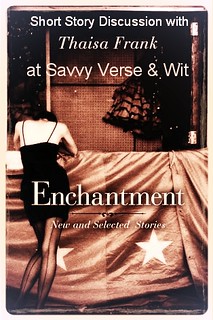
Enchantment Short Story Discussion of ‘Night Visions’ by Thaisa Frank

Welcome to today’s discussion of “Night Visions” from Thaisa Frank’s collection of short stories in Enchantment.

After the last discussion in October for “The Mapmaker,” Thaisa Frank mentioned that a companion set of stories was “Night Visions.”  As a group, we decided to visit again with Frank’s family of characters.

This short story is broken down into several sections as well:

“Afternoon in Kansas”
“My Face”
“Origins”
“The Kiss”
“The Enchanted Man”
“The Store”
“My Mother’s Voice”
“Door into Dark”
“Country Boy”

I hope everyone has had a chance to read all of the sections for today’s discussion. I wanted to start everyone off with a few things to talk about.  Please be aware there could be spoilers.

1.  Night is referenced in “Night Visions” in reference to the mother and the night’s inability to recapture her.  Does this reference to night say something in particular about the narrator’s feelings toward her mother or more about the mother’s personality and behavior.

2.  In “Origins,” how does the absence of a past for the family present itself in the narrative and what impact does this have on the narrator?  Why do you think the past is so absent from the present?

3.  Brueghel’s picture is mentioned several times — a reference to a family of Flemish renaissance painters — one is of a wedding feast and another seems to be of a snowy landscape.  What theories do you have about their significance?

OK, that’s enough from me.  Let’s get this discussion started…

Also, if you want to discuss another short story in November, let’s pick a date that we’re all available and see what story we all want to discuss.

Novel Places’ Translation Event Draws Crowd

****First, to all my subscribers, you may or may not know that Feedburner is ending. If you’ve subscribed through my RSS button, you will have to modify the feed to the following: https://savvyverseandwit.com/feed

If you are an email subscriber, not to worry, I’ve exported you all to the new MailChimp system and the delivery should be more regular and only once per day. New email subscribers can use the new form in the left sidebar to receive their own copy of Savvy Verse & Wit reviews.

Thanks everyone for your patience!****

First, I wanted to reach out and thank those who came to the translation reading, including my wonderful book club.  Second, the day began with an incredible baking spree, so I’d like to thank Anna’s daughter for all of her expert assistance.  We spent a great deal of the morning mixing and mashing and baking Danish and Norwegian treats for the readers and the audience.  The recipes I chose were Danish Apple Cake, Danish Butter Cookies, and Norwegian Spice Cookies.  All of these recipes were easy to follow, so we made these easily with a few modifications, such as no cardamom (which is outrageous at $15+ at the supermarket) and no nuts.

We set up a circle of chairs for an intimate reading at Novel Places, put the goodies out at the front table, and waited.  Books were ready and soon too were the poet and the translators.  K.E. Semmel read first from The Caller by Karin Fossum (you may be able to get a translator signed copy if you contact the local bookstore), which he translated for the U.K. market originally before it was published here in the United States.  I think he read just enough to get everyone interested in the Norwegian author’s mystery novel, which he later said offers some of the most harrowing scenes a parent could read.  He also told the audience that he translated both The Caller and Jussi Adler-Olsen’s The Absent One without any direct contact with the authors.  Given that he is well versed in Danish and Norwegian, he didn’t seem to have any problems.

Following a short reading from Semmel (A BIG THANK YOU to Semmel for the video, since my idiot camera died), the floor opened up to Carsten René Nielsen, the Danish poet of House Inspections, and his translator David Keplinger, a poet and director of the American University MFA in Creative Writing program.  Nielsen would read the poem in its original Danish form and then Keplinger would then read the translation.  They read about six poems from House Inspections and one or two poems from a previous collection.

Following each reading, the translators were asked questions about their process and experiences, as well as about what makes a good translation. Keplinger and Nielsen work collaboratively on the poems, with Nielsen sending English literal translations to Keplinger, who does not speak Danish, to fiddle with to make the content, music, and essence of the poem shine through in the English version in the best way possible. Keplinger said that he offers Nielsen a few different options when translating the poems, allowing Nielsen to pick the one he likes best. In terms of “Wistfulness,” Keplinger and Nielsen said it took them a while to capture the meaning of the Danish word properly.  Keplinger said it is just one of the poems in the collection that he can read over and over and never be tired of it.  (Photo at the right:  Danish poet Carsten René Nielsen speaks with audience member Susi Wyss, author of A Civilized World)

It was great to mingle with fellow translation enthusiasts, eat some goodies, buy some books, get some autographs, and chat.  It seemed like the audience, which was mostly my own book club (thanks guys and gals), had a good time and learned some interesting things about translation.  What surprised me the most was that it seemed as though the poetry books may have outsold the fiction thrillers!

Enchantment by Thaisa Frank Short Story Discussion

enchantment button Welcome to today’s discussion of “The Mapmaker” from Thaisa Frank’s collection of short stories in Enchantment.

I selected “The Mapmaker” because its one of the longer stories in the collection and follows the passage of a “map” throughout the hands of a family.  The story is broken down into different parts:

“Ninevah”
“Dime Store”
“Sandra Greenaway”
“A Hidden City”
“The Journey of the Map”
“My Father’s Study”
“The Antique Writing Chest”
“A Walk in the Snow”
“Eating”
“A Visit to Ninevah”
“The Post Box”
“The Magician’s Eye”
“The Tibetan Book of the Dead”
“Mildred”
“Ashes”
“The Map”

I hope everyone has had a chance to read all of the sections for today’s discussion. I wanted to start everyone off with a few things to talk about.  Please be aware there could be spoilers.

1.  There seems to be a line drawn in this story between myth and reality, where the enchantment of the “fairy tale” is cracked or shattered.

2.   At the same time that the masks are taken down and reality reveals itself, the narrator sometimes continues to believe in a better place, a shining world where dreams are reality.

3.  Do you think that families are like countries, in that each person has their own boundaries and their own cultures that can sometimes clash and more?

OK, that’s enough from me.  Let’s get this discussion started…

Also, if you want to discuss another short story in October, let’s pick a date that we’re all available and see what story we all want to discuss.

BBAW: Profile of Poetry Blogger Everything Distils Into Reading

BBAW has bled over into the weekend for me for several reasons:

  1. I waited too long to send out my interview questions to poetry bloggers I wanted to profile.
  2. I have a crazy life with a 1 year old.
  3. I remembered at the last minute that it was BBAW and already had a review scheduled for the week.

However, that does not mean that you can’t have fun reading my profile interviews of poetry bloggers.  It’s good to highlight these daring bloggers and to see how they view poetry.  Plus, I hope they will convince you to give poetry a try.

Today, I’ve got a great interview with Gautami of Everything Distils into Reading, who also writes her own poetry, which you can view at Rooted.

As a reader of poetry, what is it that poetry can provide that you think other genres do not or what makes poetry unique? Why do you read it?

Poetry is spirituality for me, the writing of it, the reading of it. Poetry encapsulates so much in so little. I consider myself a poet first and foremost. It is a way of life for me. Take away my poetry and I am merely existing.

Thinking about new readers of poetry, what are some of the mistakes you think they make when approaching a poem? What are some tips that can improve their enjoyment of the genre?

Poetry is seldom literal. One has to look for depth. Many times, the reader interprets differently from what a poet wishes to convey. That is good too, because the poet too learns about what the reader thinks. My advice is to keep on reading poetry and the rest will fall into place.

About how many books of poems do you review each year on average? Do you have an established goal of how many or is it a more organic process?

I used to review 12 poetry books a year. Lately, I have not been able to do so. However, that has not stopped me from reading poetry. I read it all the time, in print form and/or on the net!

As someone who lives outside of the United States, do you find that poetry is more popular, less popular, or about the same as it is in American or other cultures? What kinds of poetry books do you find yourself recommending?

Poetry is not popular at all. No one wants to read it. It requires deep understanding and patience and no one seems to have any time.  I recommend that one should start from reading contemporary poets and go slowly back to classics.  Structured poetry is also a good starting point. I did the other way round. I started with classics and now I read contemporary poetry.

What are you reading now? How do you view the world of poetry and its future?

I am reading Carl Sandburg and loving it.  And I do think poetry has a great future. It is not going to die any time soon. Or maybe never. As long as I live, I will keep on writing poetry.

Thanks, Gautami, for answering my interview questions. And for participating in my BBAW profile experiment.  We are kindred spirits in that without poetry we would merely be existing.

BBAW: Profile of Poetry Blogger Read Handed

As a last profile in honor of Book Blogger Appreciation Week, I sent over a few interview questions to Julie at Read Handed.  Her blog has a bit of everything, from poetry to nonfiction and literary fiction, and she’s a librarian who tells her readers that you’ll probably see books on her blog that aren’t what everyone else is talking about.

Please check out what she had to say about poetry and blogging.

As a reader of poetry, what is it that poetry can provide that you think other genres do not or what makes poetry unique? Why do you read it?

Poetry to me is largely about the words – their sounds, their forms, and (lesser so) their meanings. In poetry, every word is deliberate. In a novel, or even a short story, one word, or even an entire sentence, can be ineffective without lessening the overall work too much. Not so in poetry. That is why it fascinates me so much. Poets are masters of language, knowing when words can be cut to make the feeling more immediate, but also knowing which words are essential to the poem.

Thinking about new readers of poetry, what are some of the mistakes you think they make when approaching a poem? What are some tips that can improve their enjoyment of the genre?

The biggest mistake readers make when they approach poetry for the first time is assuming there is some secret code – some one singular meaning that must be derived. Then, if they don’t “get” that intended meaning, they feel like they failed at reading the poem. This is not true.

Yes, most poets have a “meaning” in mind when they craft a poem, but it is not our job as readers to figure out that meaning. And sometimes, poets leave the meaning intentionally ambiguous. Poetry is what you make of it. Whether it’s a phrase in the poem that just works and stays with you for the beauty of how it sounds, or an image that resonates with you, or a meaning you derived that speaks to you – these things all make for a successful poetry reading.

My main advice would be to stop trying to figure out what the “experts” think the poem means, or even what the poet intended the poem to mean. Instead, simply enjoy the poem. Read it aloud, roll the words on your tongue, and delight at how they fit together.

About how many books of poems do you review each year on average? Do you have an established goal of how many or is it a more organic process?

I review probably 2-3 books of poems a year. It’s really an organic process, though this year I did have a set goal of 2 for the Fearless Poetry Exploration Challenge. In general, I tend to not read books of poems cover to cover, though that is a great way to get to know a poet. Instead, I read poems randomly, pulling from several books at once. For me, reading poetry is more about the individual poems than the collections.

As a librarian, how often do you recommend books of poetry to patrons? Do you find yourself recommending poetry books to friends/family? If so, which ones do you recommend mostly?

Well, I work in an academic health sciences library, so poetry does not come up often (i.e. at all) with my patrons. But I do recommend poets to my friends and family. Again, I tend to concentrate more on the individual poem than the collection, and poets in general more than a specific volume. Some poets that I love recommending are Liz Robbins, Gerald Stern, Sara Teasdale, and Lisel Mueller.

What are you reading now? How do you view the world of poetry and its future?

Not reading too much poetry right now, unfortunately. I’m actually reading an information literacy instruction handbook for work. I have been meaning to read more in my Seamus Heaney collection, so maybe that will be next.

I think poetry will continue to be a sort of niche genre. The proliferation of the Internet has both helped and hurt poetry in that regard – it has exposed more people to poetry, but it has also let anyone “publish” their bad poetry. Either way, I don’t think poetry is going anywhere, but I also think that most poets will continue to have a hard time making a living on poetry alone.

Thanks, Julie, for answering these questions and participating.

BBAW: Profile of Poetry Book Blogger The Written World

So for my final Book Blogger Appreciation Week (BBAW) profile of poetry book bloggers this week, I’m going with a relatively new reader of poetry, Kelly of The Written World.  She’s also the other half of The Poetry Project.

As a relatively new reader of poetry, how would you describe your experiences so far? What poems or poets have you loved and which have you disliked?

I describe my experiences as a tad bit overly paranoid. I am always worrying that I am not getting the idea behind the poems. As a result I overthink and then miss things entirely. It is a problem I have long had with poetry sadly. I still haven’t read a lot of poetry, but I did enjoy my time with Robert Frost last month. I had read his poetry before, but not in such a quantity. It was basically a poem here and there in school. In the end I read two collections.

Because you’re a new reader of poetry, was there a particular catalyst that started your journey to read more poetry? And why had you not read poetry before?

A conversation on Twitter lead to the Poetry Project. First, there was just a list of poems to read and then it grew into something more wide-spread. I think it is working having a poetry fan and a not so poetry fan reading together. Leslie says “look at all these wonderful poems” and I slowly explore them and decide it is not so bad. I hadn’t really read poetry before because I don’t get the appeal. I am a novel fan over the shorter types of writing. I also don’t read a lot of short story collections. I am trying to get beyond that, though.

As the “other half” of The Poetry Project with Regular Rumination, what are your goals for the project and how did you come up with the monthly themes? Was there a slew of ideas and a particular process of elimination or was it easily agreed upon?

The idea of The Poetry Project is to read more poetry. Now that others are joining in, it is basically to get people reading and talking about poetry more. The themes came about because people felt overwhelmed deciding on what to read. This way they can either read in the themes or still have a chance to explore whatever they want to read. As to the themes, Leslie and I both chose 6 and then rotated months. Some of them are decided for the seasons, holidays, events, etc. that happen during that month. Others were random choices. If we successfully get near the end of a year, we plan to get participants to pick the next 12 themes.

Do you read full books of poetry or do you just read individual poems?  Have you been reviewing books of poetry on your blog, The Written World?

In the beginning, I was just reading a poem here and there. In August, though, the theme was ‘Pulitzer Winners’.  I went back to some of the early award-winners and found their collections in the public domain.  As a result, I read poetry collections in August. Very impressive for me! Every Wednesday one of us says something poetry related. I just say a few short lines about the poems. I sometimes include favourite lines. I wouldn’t call them reviews, though.

What are you reading now? How do you view the world of poetry and its future in your reading life?

The theme for September is classics. I have been trying to decide what to read. There is a lot that would fit into that category. One of the few poetry books I owe is a collected works of Emily Dickinson, so I was thinking maybe I would hunt that down. As to the future, I am hoping that I will become comfortable enough with poetry that even without the Poetry Project I will explore something poetry-related each month. There is so much out there that I haven’t tried. It’s a slow process, but I have made big changes so far this year. I would like to think, anyway!

Thanks, Kelly, for answering my questions, and I can’t wait to see what the Poetry Project has in store in 2013 and what you discover in poetry.