Quantcast

Unleashing Mr. Darcy by Teri Wilson

Source: Public Library
Paperback, 368 pgs
I am an Amazon Affiliate

Unleashing Mr. Darcy by Teri Wilson takes Jane Austen’s Pride & Prejudice and creates a modern version that will have readers laughing and shaking their heads in frustration as Elizabeth Scott enters the prestigious world of dog shows, where Donovan Darcy reigns as judge.  Unlike the young ladies of the classic novel, women are able to carve their own futures and hold jobs; they no longer need to rely on finding a husband to be happy.  Elizabeth Scott, however, is even less interested in marriage given that her mother owns a bridal shop and insists on fixing her up with eligible men.  She’s made her way as a teacher at a private high school until one day a student in her class is suspended from the lacrosse team because of his failing mid-term grade.  While suspended from her job, she enters her new pup in a dog show where she meets the drop-dead gorgeous and brooding Donovan Darcy, as well as the Barrows, a couple from England that shows terriers.

Like Austen’s novel, Darcy is prideful and Lizzy is prejudiced, though given her treatment by her employer, readers will understand where her prejudice against the wealthy comes from.  Wilson’s modern Darcy and Lizzy are at odds for much of the novel, and while their miscommunications could be addressed more quickly, there would be far less enjoyable banter between the two.  Moreover, Darcy does focus a great deal on Lizzy’s appearance as a reason for his attraction, which can be disheartening for those who view Darcy as more attracted to Lizzy’s personality, intelligence, and loyalty to family and friends.  Given that this Darcy is known for his professionalism and restraint, it’s fascinating to see how Lizzy’s presence makes him lose control in a number of ways.

Wilson breaks open the fascinating world of dog shows, and its wonderful to see how the arena is governed and how rules are sometimes circumvented by participants.  One of the best scenes of the novel is when Darcy quotes from the breed standard in the ring, and Lizzy takes it the wrong way entirely.  Unleashing Mr. Darcy by Teri Wilson is a fun read and is much better than the Hallmark movie version (though Darcy in that film is very easy on the eyes).

About the Author:

Teri Wilson is a romance novelist for Harlequin Books and contributing writer at HelloGiggles.com. Her most recent book is ALASKAN SANCTUARY, set on a wolf habitat in Alaska. She’s also the author of UNLEASHING MR. DARCY, now a Hallmark Channel Original Movie premiering January 23, 2016. Teri loves books, travel, animals and dancing every day.  Visit her Website.

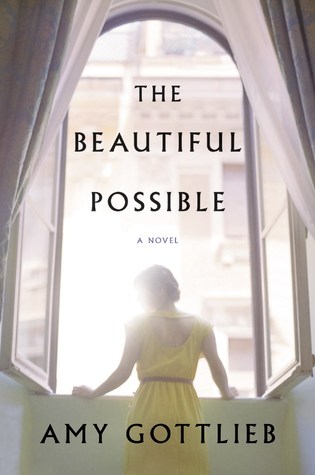
The Beautiful Possible by Amy Gottlieb

tlc tour hostSource: TLC Book Tours
Paperback, 336 pgs.
I am an Amazon Affiliate

The Beautiful Possible by Amy Gottlieb will immerse readers in the religious fervor of Judaism, which is both beautiful in its confinement and infuriating in its inability to be more flexible. Opening with Maya Kerem reminiscing about her parents, the novel seems as though it’s going to be a love story about her parents, but then, readers are introduced to German Jew Walter Westhaus, whose life is shattered one night by the Nazis in 1938.  The tragedy he experiences in his apartment pushes him into blind action, leaving his homeland to board a boat and travel not to Palestine as he and his fiance dreamed but to Bombay, as he follows a man with a brown felt hat.

“They are alone for four days and their recognizable lives become obliterated, irrelevant.  For both of them, this time is not joyful, but necessary.” (pg. 199 ARC)

Despite the complications and the religious context, the story of Walter is one that is familiar, a man who becomes lost in the face of trauma and who wanders to find meaning in what’s left of his life.  The man with the brown felt hat befriends him among the spices and dreams of a different life for Walter.  He begs Walter to come to America and become a scholar of religion and faith.  This is a friendship held at a distance, a connection that allows Walter to meet Sol Kerem and Rosalie Wachs, with whom he will be connected in the most beautiful and impossible ways — creating a deep love and braided life that is beneath the surface of all that they are.

The poetry of the Torah and the other texts examined in Rabbinical school by Walter and Sol mimic the beautiful relationship between Sol, Rosalie, and Walter, an impossible braid that cannot be broken because if it were, all strength would be lost.  While Gottlieb’s characters are each lost in their own way, when they come together, they find the strength and faith they need to keep going, even when they are miles and countries apart.  Like the intertwined relationships of the novel, Gottlieb weaves in religious texts and rituals in a way that is seamless and artistic, making beautiful the impossible.

“…the secret of these weeks will resound in my bones as private music that only I will be able to hear.” (g. 70 ARC)

The Beautiful Possible by Amy Gottlieb is a rapture where decisions are not analyzed but made, and where love is the driving force of faith.  Even in death, a story can live on, unraveling its intricate and closely held secrets for all to behold.  It’s a mystical take on the average lives we lead and how they compare to the dreams of something more that we harbor in locked places.

Rating: Cinquain

About the Author:

Amy Gottlieb’s fiction and poetry have been published in many literary journals and anthologies, and she is the recipient of fellowships from the Bronx Council on the Arts and the Drisha Institute for Jewish Education. She lives in New York City.


I’m calling this my A Fiction Book set during WWII.

River House by Sally Keith

Source: Milkweed Editions
Paperback, 96 pgs.
I am an Amazon Affiliate

River House: Poems by Sally Keith is a collection where absence becomes palpable, and it is clear that this is a very personal collection as the narrator’s focal point is the loss of a mother.  Keith lost her mother and this collection will speak to those who are dealing with the depths of grief, or in fact, not dealing with it well.  Grief is one of the most devastating emotions, and it can take months and years to deal with, particularly if the loss is one so central to one’s identity and world.  The river house is a place the family vacationed with their mother, and it’s a place that even being shared with others would not have the same meaning because it was a place filled with the mother who is no longer living.

From 5.

That spring I was in France my mother spent alone
At the house on the river caring for her father who was dying.

At high tide the road in is swallowed, making the house an island.
Hard to describe, but the walls are thin, it isn’t easy getting through storms.

Grief is indeed a storm, with waves of anguish and loss hitting a person at varying intervals, leaving them awash in a sea that is unpredictable and hard to navigate, keeping one’s head up. Within the grief, the narrator is attending workshops and going through the day-to-day of a life without her mother. In “6.,” the poem speaks of life as a journey of “being in another,” and the narrator speaks to Inma about loss, and Inma’s response is that “life is not sad,” leaving the narrator to “feel the effort in her turning.” That effort is twofold, the effort of providing advice Inma knows not to be entirely true and the effort of hiding the grief that can still overwhelm her, even long after the loss has occurred.

Keith’s poems have a powerful quiet, a storm that lies beneath the surface, much like the storm many of us can sense beneath a person’s facade at funerals and wakes — like there is one word that could trigger the worst of it to burst forth in an uncontrollable torrent. In “17.,” the narrator views a collage sent from Inma, pondering how different it is to look at the storm of images, a near disarray made beautiful with life. In many ways, it is the nearest imitation of life that there can be, unlike a single photo or poem that depicts a paused moment of motion.

From 31.

“Between the way things used to be and the way
they were now was a void that couldn’t be crossed.”

River House: Poems by Sally Keith pays homage to the past and recognizes that life continues on past the traumatic moments of our lives. It doesn’t mean that those lives did not matter, it just means that how they mattered is not as visually present as it used to be.

Rating: Cinquain

About the Poet:

Sally Keith is the author of two previous collections of poetry: Design, winner of the 2000 Colorado Prize for Poetry, and Dwelling Song, winner of the University of Georgia’s Contemporary Poetry Series competition. Her poems have appeared in Colorado Review, A Public Space, Gulf Coast, New England Review, and elsewhere. Keith teaches at George Mason University and lives in Washington, DC.


Octopus Alone by Divya Srinivasan

Source: Public Library
Hardcover, 40 pgs.
I am an Amazon Affiliate

Octopus Alone by Divya Srinivasan is a cute story about an octopus who lives in a cave alone.  Sea horses are curious about her, but she likes her solitary life and changes color to escape.  Using camouflage, she is able to see life as it is in the coral reef while she’s hidden from scrutiny.  She’s a shy octopus, but she’s fascinated by the activities of her neighbors.  The octopus, however, also appreciates her privacy.

This underwater world is colorful, but it’s also busy. She wants something a little less busy and finds herself a new home beyond the reef.  When a whale appears and breaches in song, she’s fascinated and remembers the antics of the sea horses as they danced in the reef.  She finds that she misses her old life and her old home.  She’s come to appreciate all that she had, even if there were times when she wanted to be alone.

Octopus Alone by Divya Srinivasan is an engaging story for young readers, teaching them that it is okay to want to be alone sometimes.  It also teaches them about different sea creatures and how to appreciate what they have before it is gone.

Rating: Quatrain

About the Author:

Check out Divya Srinivasan‘s website.

M Train by Patti Smith (audio)

Source: Public Library
Audiobook, 6 CDs
I am an Amazon Affiliate

M Train by Patti Smith, narrated by the author, is a poetic and meandering memoir that illustrates how the writing life can not only be rich with inspiration but also frustratingly slow and difficult.  Smith spends much of her time drinking black coffee in different cafes, and as she interacts with those she meets and in her projects, she is still holding on to the pain of loss, as her husband passed away too young.  While the loss of her husband is there with her as she rides the subway (there is an M train in New York City that travels between Queens and Manhattan), travels to Tangiers and other foreign locations, it does not take center stage.

Memories drag her daily ruminations into different directions, and these memories are all that are left of those she loves and who have inspired her as a woman, an artist, a poet, and as a person.  She is obsessed with crime dramas and coffee, and her writing is on napkins, in blank pages of books she’s reading (for the upteenth time), and on scraps and in notebooks.

You can see some elements of the memoir online.

Like the dilapidated bungalow she buys on Rockaway beach just before Superstorm Sandy, Smith endures the everyday erosion of life, the waves that threaten to break us and smash us into pieces.  The only testament to our strength is to continue onward and to move forward through our lives chasing our passions and enjoying every moment we are graced with.  Her empty house on Rockaway is where her memories rattle around, emerging only when necessary, allowing her to look back on how much her life has evolved and how much she wants to hold onto as much of it as she can.

The self-narrated M Train by Patti Smith is numbing in the amount of loss in one person’s life, but her life is not that different from that of others who struggle against the tidal wave of loss.  Memory can help us hold onto those we love, but even those are eroded by time.  Many of us have a hard time moving on, and in her memoir, she explores this in depth.

Rating: Quatrain

Photo: © Jesse Dittmar

About the Author:

Patti Smith is a writer, performer, and visual artist. She gained recognition in the 1970s for her revolutionary merging of poetry and rock. She has released twelve albums, including Horses, which has been hailed as one of the top one hundred albums of all time by Rolling Stone.

Please visit her Website.


Buddha in a Birdcage and Other Poems by Betty Oliver

Source: Purchased
Paperback, 64 pgs.
I am an Amazon Affiliate

Buddha in a Birdcage and Other Poems by Betty Oliver is a collection of poems and photos of her mixed media art, which was published posthumously by the Haystack Mountain School of Crafts where she once taught.  The executor of her estate Billy Bernstein indicated that she performed her poems, sometimes “fighting her way out of a giant paper bag.”  In the Foreword, Stuart Kestenbaum says, “Reading these poems you may not be able to see Betty fighting her way out to begin to speak, but you will feel the power — and the need to speak — that she brought to this work.” (pg. 1) In many cases, this is true. You can imagine her up on a stage struggling through a paper bag, trying to get those words out. Some of these poems have lines that repeat, and it is almost like there is so much passion behind them that the voice of the poem stutters.

Untitled (pg. 11)

The bear’s purple gutted chest
gave off steam suggesting life
he looked stunned not dead
the men still high from his blood
pranced and preened by the pick up truck
I went closer to look
the heat from his cooling heart
met my gaze.

Her artwork often involves the use of paper in unusual ways, and like her art, these poems are unusual. Her verse is at times playful, but also stern in its criticism of how the world operates or is expected to operate. She’s interested in providing readers with a new perspective on the ordinary, and she holds nature as sacred and tangible. Living on a dairy farm, she had a very close knowledge of milking cows, and what jobs men were expected to do every day. In “Fenceposts,” she talks about how men use posthole diggers and women do not, and how in her family, she has held onto her father’s posthole digger as her mother held onto her father’s twenty-two pistol.

From her time on a dairy farm to her moments in New York City, Oliver’s poems are moments in time that recall things from her past and remind her about the ephemeral nature life, especially when she falls ill. Buddha in a Birdcage and Other Poems by Betty Oliver offers readers just a little of Oliver’s work, and what’s here can seem unfinished at times, but overall, her work is about our moments in time and the thought we do or don’t give them as we live them.

Rating: Tercet

About the Poet:

Betty was truly a multi-media artist. Her visual art was focused on sculpture incorporating paper, paper pulp, and found objects. Though born, raised and perhaps haunted by her childhood in Eastern Virginia, she eventually elected to make New York her home, establishing a home and studio in upper Manhattan and channeling the vibrant texture and rhythms of the city and her neighborhood into her life and work. In a sense, the city became her pallet. She incorporated all manner of discarded and found objects into her art. Old phone books, calendars, Chinatown boxes, newspapers and jigsaw puzzles all were processed into her creative output of sculpture, paintings and photos.

Around 1990 she began to write and perform poetry, and created a powerful body of written work. As a poet, Betty was an engaging and compelling performer, often beginning readings by fighting her way out of a giant paper bag. As in her visual work, her writing echoes the many voices of her experience. A scream from the sidewalk on 110th Street, an impassioned plea to a lover, a strident declaration from the pulpit all resonate with truth, soul, and authenticity.

Betty was a very effective and sought after teacher and led many classes and workshops primarily at Penland School of Craft in the mountains of North Carolina, and Haystack Mountain School of Craft on the Maine coast. The book will be marketed by these schools and any profits will be given to the scholarship funds of these two schools.


Bone Map by Sara Eliza Johnson

Source: Milkweed Editions
Paperback, 96 pgs.
I am an Amazon Affiliate

Bone Map by Sara Eliza Johnson, 2013 Winner of National Poetry Series, is visceral and raw, filled with a great deal of tactile and violent imagery as well as traumatic moments that meld into regenerative water-based forces.  These poems reflect the most basic human needs for shelter, nourishment, and survival, and in these dark images, Johnson reveals a stunning beauty in that underbelly, which many often ignore or avoid.

The collection opens with “Fable,” allowing Johnson to establish the readers expectations that her verse will not be straightforward, but subtle and more instinctual.  “In the forest, the owl releases a boneless cry,” the narrator begins, hearing “your bones/singing into mine.”  A father is observed with his son in the square of a city before a war begins, and he is blissfully unaware of “what his hands will be made to do/to other men.”  However, the boy is the final comment from the narrator, a symbol of innocence and hope that can change the future.

The collection’s title demonstrates how detailed the poems will be, creating a bone map (a visual representation of an excavation site) to understand what has come before.  Like in “Deer Rub” when “the rain scratches at the deer’s coat//as if trying to get inside,” Johnson’s lines bore into the reader’s mind to create vivid and unsettling images.  Readers are forced to watch, to wash “their antlers of blood,” forcing themselves to recognize their transformation into a less “innocent” man or woman and accept those base natures that have children carrying knives.  More than once, Johnson calls the readers attention to a foreignness entering something untouched, like the “tender-rooted flowers/inside the belly of the horse” in “As the Sickle Moon Guts a Cloud.”

In the darkness and uncertainty of the forest, Johnson reveals the devastation of man, but also the unmovable force of nature to encroach where it isn’t wanted.  Bone Map by Sara Eliza Johnson, 2013 Winner of National Poetry Series, is a journey that readers will want to repeat to fully perceive all of Johnson’s subtleties.

Rating: Quatrain

About the Poet:

Sara Eliza Johnson‘s poetry has appeared or is forthcoming in Boston Review, Ninth Letter, New England Review, Best New Poets 2009, Crab Orchard Review, Pleiades, Meridian, and elsewhere. She is the recipient of a National Endowment for the Arts Fellowship in poetry, a Rona Jaffe Foundation Writers’ Award, a Winter Fellowship from the Fine Arts Work Center in Provincetown, a work-study scholarship to the Bread Loaf Writers’ Conference, and an Academy of American Poets Prize from the University of Utah, where she is PhD student in the Literature & Creative Writing program. Her first book, Bone Map (Milkweed Editions, 2014), was selected for the 2013 National Poetry Series.


Guyku: A Year of Haiku for Boys by Bob Raczka, illustrated by Peter H. Reynolds

Source: Public Library
Hardcover, 48 pgs
I am an Amazon Affiliate

Guyku: A Year of Haiku for Boys by Bob Raczka, illustrated by Peter H. Reynolds, is a book I picked up to read with my daughter because I love finding new poetry books to read with her.  I want her to at least appreciate poetry, even if she doesn’t love it as much as I do later on in life.  Although this says its a year of haiku for boys, I think even girls can appreciate these short poems and the seasons they represent.  My daughter participates in some of the same activities as boys, such as flying kites and bike riding, and I’m sure when she grows older, she’ll be climbing trees and taking other adventures.

The illustrations are great, very simply drawn and colored, reflecting the poems themselves in their obvious and fun witticisms.  In one of the first haikus, a young boy is flying a kite, but he’s engaged in a game of tug-of-war, and he’s not winning.  I bet you can guess who is.  These poems speak to the imagination of children, like boys making their bikes sound like motorcycles by putting baseball cards and other objects in their wheels.  These boys are imaginative and curious, and they take on anything that comes their way.  It’s hard to imagine them ever being bored.

The wind and I play
tug-of-war with my new kite.
The wind is winning.

Guyku: A Year of Haiku for Boys by Bob Raczka, illustrated by Peter H. Reynolds, is a wonderful collection of poems for boys and girls.  Not only are the poems short enough for younger kids to pay attention to them, but they are about subjects that they are familiar with and probably already engage in regularly.

Rating: Cinquain

About the Author:

Bob Raczka loved to draw, especially dinosaurs, cars and airplanes, as a boy. He spent a lot of time making paper airplanes and model rockets. He studied art in college, which came in quite handy while writing a series of art appreciation books, Bob Raczka’s Art Adventures. He also studied advertising, a creative field in which he worked in for more than 25 years. Bob also discovered how much he loved poetry and began writing his own. His message for today’s kids is to make stuff!”

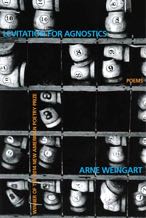
Levitation for Agnostics by Arne Weingart

Source: Book Savvy Public Relations
Paperback, 122 pgs.
I am an Amazon Affiliate

Levitation for Agnostics by Arne Weingart, 2014 winner of the New American Poetry Prize, questions our faith, which oftentimes is passed down through families as a foregone conclusion.  In “Chopping Roots,” Weingart’s narrator is digging to move water away from the base of his home and protect the retaining wall from eventual decomposition through erosion.  If we have unmoor ourselves from the faith we’ve been brought up with, will be float without direction and is that such a terrible thing?  These are just a few questions asked in these poems.

“…you will simply give up and lean down
into the hillside tearing all your roots out of the ground with
a great explosive twanging leaving a huge and unaccountable
hole we must stare into while
we listen to the river.” (“Chopping Roots”, pg. 86)

In many of these poems the narrator is unmoored and drifting, and structures are erected only to be considered false supports. Weingart also transforms solid objects into theories and mutable things that can be perceived differently and claimed by many. There is a dissatisfaction with what has come before in terms of religious fervor and faith, but at the same time, the narrator is in awe of these beliefs and long-standing institutions. In many ways, the narrator is seeking to become more, to be the creator of “big ideas” rather than just a believer of them.

“Every scaffold is highly
instrumental but exterior to
some central purpose some
permanent intention meant to
resist time and desire and the
inevitable slide of tectonic
earth. To live in scaffolding
is not to be free exactly but” (“A Theory of Scaffolds”, pg. 27-8)

From the sacrifices of ancient people in Machu Picchu to the Jewish religion, the narrator seeks to hold up the faith of these people to scrutiny, while at the same time being respectful. Exploring how religion and faith can bring people together, the narrator also examines how it drive wedges between neighbors and even family. In “Hebrew School,” kids are taught a language that is understood by few, in the way that children do not understand how they could be the chosen people. Despite the disenchantment with religion and faith, Weingart displays a sense of humor about ancestors and their quirks and about overcoming things that can make us different, like stuttering, only to want to be different again and take steps to recapture those differences.

Levitation for Agnostics by Arne Weingart, 2014 winner of the New American Poetry Prize, is a straightforward look at faith and ancestry, the ideas and mores that bind families, and the questions that should be asked about their tangibility and their applicability to our own lives, as we live them. Like in “Recursion,” as the rocks are skipped across the lake no matter how many times they reach the shore, the poet needs to question and continue to question because there is much more to learn and be taught.

Rating: Quatrain

About the Poet:

Born and raised in Nashville, Tennessee, and educated at Dartmouth College and Columbia University, Arne Weingart lives in Chicago with his wife Karen, where he is the principal of a graphic design firm specializing in identity and wayfinding. Recent poems have been published in Arts & Letters, Beecher’s Magazine, Coal Hill Review, Enizagam, Nimrod, Oberon, Plume, RHINO, Sow’s Ear Poetry Review, The Georgetown Review, The Massachusetts Review, and The Spoon River Poetry Review. His work has been nominated for a Pushcart Prize and his book, “Levitation For Agnostics,” winner of the 2014 New American Press Poetry Prize, will be released in February, 2015.


The Girl on the Train by Paula Hawkins (audio)

Source: Audible
Audiobook, 11 hrs.
I am an Amazon Affiliate

The Girl on the Train by Paula Hawkins — narrated by Clare Corbett, Louise Brealey, and India Fisher — is a mystery in which a woman with low self-esteem, who is an alcoholic, continues to stalk her ex-husband, mostly at a distance.  Rachel Watson’s divorce and drinking caused her to lose her job, but she still wakes up like clockwork to take the train into London so her roommate is unaware that she’s lost her job. She has some money saved, and even though she could be moving on with her life and getting a new job, she wallows in her sorrow at the bottom of a bottle, creating perfect, imaginary lives for the people she sees out the train windows.

Jason and Jess become a couple that she can imagine lives in marital bliss, but in reality, Megan and Scott Hipwell have a marriage that has lost its appeal, at least for Megan. She desires something more than what she has with Scott, who she fails to see as controlling even as he goes through her emails on a regular basis.  She wants her life to be more than just sitting at home waiting for her husband to come home.  Like Rachel, she is dissatisfied with what her life has become.

Rachel, meanwhile, is on the outside of her ex-husband’s life with his new wife and daughter, who continue to live in the house she and he used to live in, and she’s on the outside of the world looking in, much like she’s staring out the train windows.  She’s searching for something, she needs to belong to something, but what she ends up entangling herself in is something that could lead to her own death.  Meanwhile, her ex-husband’s new wife Anna is terrified of Rachel, worried that her stalking will turn to something more.

Listening to the audio was never boring and the different narrators helped when Hawkin’s story changed points of view.  Moreover, the narrator for Rachel really put you in the mindset of a broken woman who was down on herself, blamed herself, and was unable to break out of her self-destructive cycle of drinking and blacking out.  Hawkins’ The Girl on the Train is a twisted tale of the suburban lives we often perceive as idyllic, and the lives we believe we have but actually do not.  How well do we know our spouses, their experiences, their families, and how well do they know us?  Many of us have inner demons or secrets we would rather not face, so we lie about them to ourselves and those we love.

Rating: Quatrain

About the Author:

Paula Hawkins worked as a journalist for fifteen years before turning her hand to fiction. Born and brought up in Zimbabwe, Paula moved to London in 1989 and has lived there ever since. The Girl on the Train is her first thriller.

No More Beige Food by Leanne Shirtliffe, illustrated by Tina Kugler

Source: Sky Pony Press
Hardcover, 32 pgs.
I am an Amazon Affiliate

No More Beige Food by Leanne Shirtliffe, illustrated by Tina Kugler, is another winner from Sky Pony Press.  This book is told in verse in a way that kids will find funny, but also relatable.  My daughter is not much of a picky eater now, but she has been in the past, so this book is a reminder that that pickiness could return.  Parents also will want to take note of what they say to their kids in these kinds of arguments, because as illustrated by Wilma Lee Wu and her brother, those kids may take your words literally.

Wilma is sick of bland, beige food, and when her mother says to learn how to cook, she takes her brother by the hand on an adventure around the neighborhood.  While some neighbors are close, others are a bit further from home, to which my four-year-old daughter said, “Wilma and her brother are going to get in trouble.” When I asked why, she replied, “Because they went too far away from home.”  It is unclear how far these children walked or how old they are, but the book is said to be for kids ages 3+.   I promptly explained to my daughter that this neighborhood is probably small and everyone knows one another, so the kids will just be learning from family friends.

The book is a great teaching tool for kids about the different foods that people eat and the recipes they make, which can vary widely from our own.  It also demonstrates how different foods, spices, etc. can be just as tasty as the foods we eat regularly at home.  Variety is never a bad thing in food.  The only complaint, other than the distance the kids seemed to travel, from my daughter was that the finished recipes were not illustrated every time.  She was curious to see what each one looked like.  Her favorite parts were the discussion about frog legs and mousse, and how the kids popped into the playground on the way to another house.

No More Beige Food by Leanne Shirtliffe, illustrated by Tina Kugler, will demonstrate different cultures and food to children in a friendly way, and encourage them to think outside of their own daily lives for inspiration.

About the Author:

She is a humor writer, a mom to nine-year-old twins, and the author of DON’T LICK THE MINIVAN: Things I Never Thought I’d Say As a Parent (2013). My first picture book, THE CHANGE YOUR NAME STORE, will be out in May 2014 (Sky Pony Press) and my humor gift book, MOMMYFESTO: We Solemnly Swear…Because We Have Kids, hits the shelves in November 2014. I contributed to the hilarious anthology I JUST WANT TO BE ALONE (2014).

My Life on the Road by Gloria Steinem (audio)

Source: Public Library
Audiobook, 8 CDs
I am an Amazon Affiliate

My Life on the Road by Gloria Steinem, narrated by Debra Winger, is not only about the feminist movement, but also literally about her life as an activist and a woman on the road, who practiced the art of active listening.  Learning in India of a decentralized way of making decisions and interacting, Steinem learned that discussing different points of view on an even plane, without hierarchy, can be much more productive and diplomatic.  Debra Winger is a great narrator because her cadence is very similar to Steinem’s narration of the introductory material.

I love how her parents left their mark on her early on – a mother who wanted a different life than the one she lived and a father who had a hard time staying still, traveling and selling as much as possible.  Her early life and how she travels from one place to the next are captivating, but there are times that the narrative wanders pretty far afield, leaving readers at sea as to what time period they are in until she mentions another year or date.  Steinem, co-founder of Ms. Magazine, has a deep fear of public speaking on her own, though she would speak before groups with others.

Among the most memorable events are the large convention she organizes for the women’s movement, her talk at Harvard University that was mostly male, and her interactions with taxi drivers and others on the streets because she does not drive.  As someone who gets that question a lot about why I don’t drive, this part of the story resonated with me.  I want to be and remain connected to my world, and separating myself in a car alone is not accomplishing that at all.  Steinem says that her adventure begins the moment she walks out the door.

Her discussion of the election process is very similar to what I as a mere voter expected, even though she had more of an insider’s perspective.  In particular, her struggle during the Democratic primary to choose between President Obama and Hillary Clinton was fascinating.  While many people voted because they wanted a woman president and others voted for a black president, Steinem’s thought process was more detailed based upon their track records and their abilities, and more.  For those interested in politics and the political process, these aspects of the book are wonderful, and for those who listen, they will see that they need to adopt Steinem’s ability to listen and examine the minute details of each candidate before voting.

My Life on the Road by Gloria Steinem, narrated by Debra Winger, is engrossing in that it provides a detailed account of the women’s movement, the civil rights movement, and the political process.  How did women get the vote, how did they use and keep it, and are voices of women heard now?  Steinem is optimistic in our ability to change and evolve into a more inclusive society through careful listening toward shared solutions.

***I read this as part of Emma Watson’s Book Club on GoodReads***

About the Author:

Gloria Marie Steinem is an American feminist, journalist, and social and political activist who became nationally recognized as a leader of, and media spokeswoman for, the women’s liberation movement in the late 1960s and 1970s. A prominent writer and key counterculture era political figure, Steinem has founded many organizations and projects and has been the recipient of many awards and honors. She was a columnist for New York magazine and co-founded Ms. magazine. In 1969, she published an article, ” After Black Power, Women’s Liberation”, which, along with her early support of abortion rights, catapulted her to national fame as a feminist leader.