Quantcast

The Painted Girls by Cathy Marie Buchanan

The Painted Girls by Cathy Marie Buchanan is about dreams, dreams that can raise you up out of the most dire circumstances, if only you are willing to work hard and do what you must to survive.  Antoinette and Marie, by turns, are ballet girls in the Paris Opera, with Antoinette learning too late that she cannot hold her tongue or bend her stubbornness.  Imagine a time in 1880’s France when Emile Zola publishes L’Assommoir, which becomes a play about a laundress and the dire consequences of poverty and alcoholism, and when Cesare Lombroso postulates that people who are born criminals can be identified by physical characteristics of the skull.  Buchanan has taken the real-life figures of Edgar Degas, Emile Zola, and Degas’ model for the statute Little Dancer of Fourteen Years — Marie van Goethem — and intertwined their stories with criminals Emile Abadie and Pierre Gille.  Tempted by different fates, Marie and Antoinette’s stories are told in alternating chapters, providing greater insight into certain situations and events as well as the complicated relationship between sisters, particularly those struggling to survive with a drunk mother, deceased father, and younger sister weighing heavily upon them.

“But then the next minute, my mind flipped back to thinking how a smear of greasepaint might hide her sallow skin.  Back and forth I went.  How to diminish.  How to boost up.  All I knew for sure was even if old Pluque saw his way to giving her a chance, even if she clawed her way up from the dance school to the corps de ballet, she was too skinny, too vulgar in her looks, too much like me to ever move up from second set of the quadrille, the bottom of the scale.”  (Page 13 ARC)

Even as each sister raises the other up with praise and support when times are tough, there are moments of doubt — that the love is not enough and that the support is somehow hollow.  Antoinette has fallen from her place with the ballet and is scrambling for walk-on parts in the opera before she meets Emile and gets a steady role in L’Assommoir, while Marie is just embarking upon her journey in the ballet with their sister Charlotte close behind.  There is the push and pull of these sisterly relationships as they compete to be the best in ballet and to earn the most, while still supporting one another and doing the little things that keep them spirited.  However, their world is about to fall apart when Antoinette falls in love and becomes tempted by that love to throw all that she knows away on the belief that her love is real and ever-lasting.

Buchanan also demonstrates through Marie the notion that believing something to be true can make it a self-fulfilling prophecy.  Marie says at one point, “Monstrous in face, monstrous in spirit.”  She does not see herself as the beauty others see, and her self-image is a faulty foundation for her to stand on when she enters the ballet as she compares herself not only to her sister, Charlotte, whom is considered a cherub, but also to the beauty and grace of the other ballet dancers.  Meanwhile, Antoinette does not have as many concerns about her beauty, relying on her wiles to capture the attentions of Emile and hold his rapt attention.  She sees him as her escape from poverty, despite his criminal-like behavior and greater commitment to his friends.

In many ways, The Painted Girls is about the bond between sisters and about the self-fulfilling traps that many of us fall into even when the support system is there to support us.  It is about taking things for granted, about being selfish, and about not giving into temptation.  Buchanan’s storytelling is captivating, and her characters, while rooted in history, are dynamic and flawed — like the criminals spotted by their physical characteristics, Antoinette and Marie are typecast by the law, theater members, ballet instructors and the wealthy sponsors who have designs on dancers.  Buchanan’s portrait of sisters in France during this period is gritty and emotional. Readers will immediately feel the dark, dank alleys of Paris and the heel of class distinctions upon their necks, just as the van Goethem sisters do.

The first contender for the 2013 best of list.

Credit: Nigel Dickson

About the Author:

CATHY MARIE BUCHANAN is the author of The Painted Girls, a novel set in belle époque Paris and inspired by the real-life model for Degas’s Little Dancer Aged 14 (forthcoming January 2013). Her debut novel, The Day the Falls Stood Still, was a New York Times bestseller, a Barnes & Noble Recommends selection, a Barnes & Noble Best of 2009 book, an American Booksellers Association IndieNext pick and a Canada Reads Top 40 Essential Canadian Novels of the Decade. Her stories have appeared in many of Canada’s most respected literary journals, and she has received awards from both the Toronto Arts Council and the Ontario Arts Council. She holds a BSc (Honours Biochemistry) and an MBA from Western University. Born and raised in Niagara Falls, Ontario, she now resides in Toronto.

Please check out the reading guide.

Giveaway: Jane Austen’s Pride & Prejudice Turns 200

Jane Austen is best know for her novels and her close-knit family, particularly her relationship with Cassandra, who painted a famous portrait of her sister and for burning a number of her sister’s letters following her death.  Following her first novel, Sense and Sensibility, Austen turned to her second novel, Pride & Prejudice, originally titled First Impressions.  Her second novel has been one of my favorites for many years, and I think I’ve read it at least five times or at least parts of it at any given moment.  Each time I read it, I learn or discover something new, and I think that is the mark of a successful author.

January 28, 2013 is the 200th anniversary of Jane Austen’s most beloved novel, Pride & Prejudice.  Austen’s novel examines the differences between social classes, elements of marriage and morality, and comments on the societal expectations regarding the manners and education of women in different circles.  It is often considered a great love story even as Elizabeth Bennet and Mr. Fitzwilliam Darcy spar with one another and must overcome great adversity and societal impediments to find their way back to one another. 

The novel and the author have become so popular in modern society that a number of spinoffs, continuations, and re-tellings have cropped up in recent years, and there are a number of blogs dedicated to her novels and those other novels and books.  Facebook even has a page dedicated to the 200th birthday of Pride & PrejudiceCheck it out.

As part of my Jane Austen celebration, check out the giveaway below.

Quirk Books is offering one copy of The Jane Austen Handbook by Margaret C. Sullivan to one winner in the United States, Canada, or United Kingdom.

I reviewed this in February of 2011, and said that it was “a great companion for the Jane Austen fanatic and fan because it offers guidance on how young men and women navigated a complex set of social rules and even broke them at times.  As each moment in life is addressed, Sullivan also offers moments in Austen’s work where traditions are bent.”

If you want to check out my interview with Sullivan, feel free.  She offers some great insights into her love of Austen and what books she recommends for fellow Austen lovers.

Quirk Books is offering one copy of Pride & Prejudice and Zombies by Jane Austen and Seth Grahame-Smith to one winner in the United States, Canada, or United Kingdom.

In my review from 2010, I called the novel “an exercise in revision and an examination of Austen’s characters in a new light.  Many readers will disagree with Grahame-Smith’s portrayal of Lizzy as a cutthroat assassin who is quickly turned by her own emotions or strict sense of duty and honor, particularly since she often talks of dispatching her peers for slighting her family, imagines beheading her own sister Lydia simply because she prattles on, and other unmentionable actions.”

To enter for one or both of these books, leave a comment about the first time you read Jane Austen and what you enjoyed about her work or the first time you read Pride & Prejudice and why you would reread it.  If you have never read Austen before, leave a comment about what book you’d be interested in reading and why.

Deadline to enter is Jan. 11, 2013, at 11:59 PM EST.

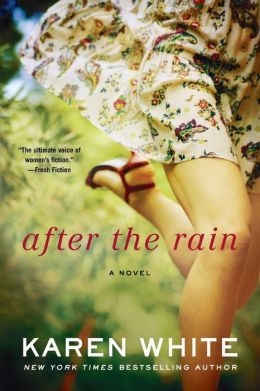
After the Rain by Karen White

After the Rain by Karen White is a republished and remastered novel that is full of twists and turns, touches lightly on the desolation of a broken family life and the darkness people can fall into as a result, and the hope that just might be around the corner.  Suzanne Paris is on a bus to Atlanta when she decides on a whim to get off in Walton, Ga., where she meets a large family and finds the home she’s been looking for all of her life.  But with the sun comes rain.  And there is a deluge of it in this book.

Suzanne has a past that is not far behind her, even as her freelance photography job takes her to many places.  She’s running from a life and for her life, and White has created a character who is both likeable and unlikeable.  She keeps secrets even from those know care for her, and her ability to trust others is very tenuous and easily broken by the wrong word or action, which White captures easily in her imagery.  From how she’s described by the muscular, hot mayor Joe Warner — who also teaches at the high school and coaches football — to how Suzanne pauses before answering questions about her past, readers will find a character who is taken in slowly by the small town and its residents but frightened of how her own past could harm them.

“Tides change.  So does the moon.  With the unfailing constancy of brittle autumn closing in on bright summer, things always changed.  If Suzanne had ever had faith in anything, it was in knowing that all things were fleeting.  And for good reason.  The highway of life was littered with the roadkill of those who didn’t know when to change lanes.”  (Page 1)

While things can be fleeting in life, there are things that are ever-lasting, and in this case, White talks about the support systems that we can have within our own families.  Whether those families are the ones we are born into or the ones we fall into or create out of friends and husbands and our own children, they are there to love and support us unconditionally.  Suzanne has a lot of lessons to learn, but the slow unraveling of her fears and her heart is endearing.  In many ways, though she’s an adult, she’s like a child being led into the life she’s always wanted.

“‘Amanda! You quit right now or I’m gonna jar your preserves!'”  (Page 5)

Photography plays a large role in the novel, and Suzanne not only takes photos of the people in Walton but also finds that she’s become a part of the town’s tapestry as she weaves parts of herself into the photos she takes.  Even more poignant, she connects with teenage Maddie when she shares with her the techniques a budding photographer needs to learn that are not necessarily taught in art classes.  After the Rain also offers readers that down-home southern feel that all of White’s novels have — from the caring strangers to the idioms that make the place its own.  There are moments when readers will want to strangle Suzanne for her decisions, and some events are easy to see coming, but the way White writes these characters and their story endears them to readers and ensures their love and struggles will never be forgotten.

183rd Virtual Poetry Circle

Welcome to the 183rd Virtual Poetry Circle!

Remember, this is just for fun and is not meant to be stressful.

Keep in mind what Molly Peacock’s books suggested. Look at a line, a stanza, sentences, and images; describe what you like or don’t like; and offer an opinion. If you missed my review of her book, check it out here.

Also, sign up for the 2013 Dive Into Poetry Challenge because its simple; you only need to read 1 book of poetry. Please visit the stops on the 2012 National Poetry Month Blog Tour.

Today’s poem is from Ruby Urlocker:

Hidden People

There’s a man between my bedroom floor
And the wooden kitchen ceiling.
I heard him once when I was younger,
Before the walls started peeling
And there I sat in the bedroom, reading
And I heard the sound of feet.
Loud echoing shoes from under me
In sync with my heart beat.

My mother told me it was nothing,
My father only scoffed
And as the rolling days went by
They eventually forgot.
One morning I combed my six year old hair
And my reflection made me cry
For instead of the freckled face I knew
With glimmering mischievous eyes
I saw a woman with skin like snow
And eyes, two empty sockets,
Grinning at me as I gasped in horror,
My little hands clutching my pockets.

Then she faded away and left me there,
Crying my eyes out in hopeless despair
And wondering why her long flowing hair
Was only strands of cobwebs.
When I was eight I became best friends
With a boy who I found in my closet.
He’d be there staring back at me
Each time I unhooked the locket
To my many clothes and things
Because I wanted to see him again.

We wrote down our hearts
In permanent pen
All across the closet wall
And laughed and whispered until the nightfall
When my mother would tuck me in.
His eyes were the twinkling midnight sky
As we talked of mystery
And I did not stop to wonder why
Nobody else could see him.

As I grew older I did not sense
As much of the secret world
The figures slowly disappeared
Along with the little girl.
But even now I’m afraid of the dark
And I wake up to somebody singing
So far away that it’s more like a whisper
That tingles and leaves my ears ringing.

I used to think I’d never see
My ghostly friends again
When the silence between us was so long
My conscience would pretend
They never existed and I’d only dreamed
Of the beautiful and horribleness
My family had never seen.
I put on makeup and watched more TV
And detached the shadowy part of me.
That playful and magical mystery
Was a figure that lost its way
In the sea of labels and one way traffic
And words we’re forbidden to say.

And I let my hair turn gray
And my face grew wrinkles across it.
The friendly spidery shadow of mine
Turned to mist and I thought I had lost it
Until last night when I turned on the light
Of my dingy old bedroom closet
And felt my questioning face turn white.
There was a boy with tear-stained cheeks
Who turned his head to me,
A sparkling fragment lost in the storm
And turned to a memory
And an ignorant woman, taken by surprise
Who met the gaze of his unforgiving eyes.

About the Poet:

Ruby Urlocker is a teenaged author, singer and songwriter. She has been writing and publishing stories since she was seven. Ruby lives with her family and dog, Rufus, a wheaten terrier. Monsters in my Closet is Ruby’s fourth book.

What do you think?

If you want to win a copy of Ruby’s book, please leave a comment below about the poem.  U.S./Canada residents only

Deadline to enter is Jan. 11, 2013, at 11:59 PM EST

Savvy’s Best of 2012 List

Of all the poetry I read in 2012, two books stayed with me the longest, and both were published in 2012. So while, I wanted to select one book for each genre I read, I opted to break the rule in the poetry category and highly recommend these two collections:

Both of these collections are powerful in the words and imagery the poets use to discuss not only family, but also the societal expectations and ethnic constraints their subjects face throughout history and int today’s world. These struggles continue to be present, real, and humbling. The poems in these collections strive to give readers pause — to collect their thoughts and to reform their own behavior.

In fiction, this is my top selection for the year:

Umrigar is an author who has yet to disappoint me with her work. She makes the Indian culture come alive for me. I loved this novel and its intricacies about social movements and idealism versus realities and cultural norms. And even when things can pull friends in different directions, there is often the pull of shared history that can hold them together.

In memoir — which I don’t often read a lot of because I don’t find it that enjoyable most of the time — this was my top selection and it shouldn’t be a surprise:

While this Vietnam War memoir is about Delmar Presley, it is also about the hardships that family members of war veterans often face given that violence and war has changed their loved ones into people they do not recognize or often understand. Christal’s experiment to engage with her father, his past in Vietnam, and their shared past is striking, engaging, and emotional. It’s a memoir that any war veteran, family member, or person dealing with PTSD should read.

In Young Adult Fiction, there is no one else’s book that could match Beth Kephart’s mastery of language, character, and setting for me. She tackles tough subject matter with a fine pen and a compassionate hand. So for me, the winner in this category was easily:

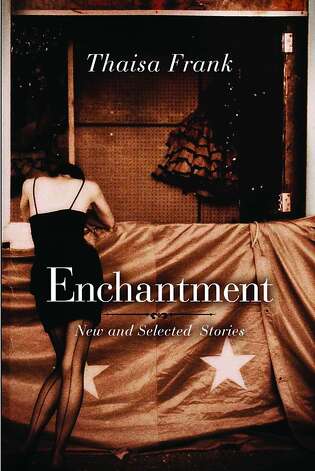
Finally, in the short story category, it was a tough choice for me as one of my favorite collections was finished earlier in the year, Tracks by Eric D. Goodman, and another later in the year, Enchantment by Thaisa Frank. But after a lot of thought, I chose Tracks because those characters just made me year to ride the rails with them and enjoy their journeys over again:

What books were on your best list for 2012?

2012 Savvy’s Honorable Mentions

Want the 2012 Best of Savvy Verse & Wit’s reads? Submit a $5 payment to savvyverseandwit at gmail via PayPal, and we’ll email you the password for the list and you can come back and access it.

However, for those of you interested in those that just missed the list, these are my honorable mentions:

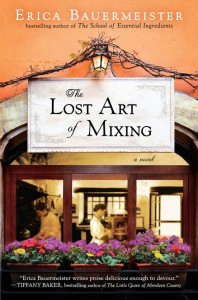
Interview with Erica Bauermeister

The Lost Art of Mixing by Erica Bauermeister was one of my favorite books from last year and continues where The School of Essential Ingredients left off.  I said in my review of The Lost Art of Mixing, “Bauermeister has created another set of deep characters with nuanced personalities and places them in unusual situations that are all at once odd and plausible, and readers will be swept up in the relationships within these pages and how the characters mingle and mesh with one another in different ways.”

Today, I’ve got a giveaway and a great interview for you.  Without further ado, here’s my interview with Ms. Bauermeister:

The role of food as a way to connect people to one another and their memories is strong in both The School of Essential Ingredients and The Lost Art of Mixing. What is your relationship with cooking and is there someone in your life that sparked your interest in the culinary arts?

My relationship with cooking is similar to Lillian’s. I am far less intuitive when it comes to matching people and food – but I do love playing with ingredients. Interestingly, the spark came from a place more than a person. I was brought up in a recipe-oriented household, and it was language I was never really comfortable with. In 1997, my husband was relocated to Italy and we took our children and lived there for two years. No one I met there used recipes – they cooked with their five senses. That approach was felt as natural as breathing. I haven’t looked back.

Lillian has a pretty good head on her shoulders when it comes to connecting people in her cooking classes to others and themselves but when it comes to her own life, she seems adrift. How did you come to create her as a character and what elements of her personality were strongest to you when you started writing her?

I think many of us know someone who has taken a gift or talent and hidden inside its beauty. We’re so in awe of the magic, we forget to look inside.

When it came to Lillian, I started with two images in The School of Essential Ingredients – a woman wise beyond her years, and a child who had been abandoned and had turned to cooking for solace. In The Lost Art of Mixing I wanted the chance to go deeper into her character, to explore Lillian as the flawed and wonderful human being that she is. Her strength becomes more complicated in Mixing, and that makes her even more interesting to me.

In terms of cooking, would you consider yourself a follower of recipes or someone who experiments in the kitchen with just a few guiding principles. Name one successful dish you’ve created and one that didn’t work as well.

If I am learning a new cuisine –Thai or Indian, for example – I’ll need to use recipes for a while to learn those guiding principles. But once I understand the basic grammar, I want to go play.

One of my favorite things to do is to open the refrigerator and see what I have left over, and then turn those ingredients into something new. One of my favorites was a butternut squash, pancetta, garlic, cream, and truffle oil sauce served over penne pasta. It tasted like autumn, but in a completely seductive way.

Less successful? I was trying to see just how little flour I could put in cookies. I went from one batch that was light and crispy and wonderful to a complete mess in the next. Yes, there is a tipping point.

The Lost Art of Mixing deals a lot less with the creation of food and there is less food imagery than the first book, but the title still calls to readers’ minds the idea of cooking. Why the absence of strong food imagery and elements in this book?

One of my main goals in writing is to get my readers to slow down and pay attention. Cooking provides a wonderful opportunity to do that, but it isn’t the only way. In my second novel, Joy For Beginners, I branched out into gardening and perfume and books and travel and pottery – all of them activities that are more rewarding when you slow down and use your five senses. In The Lost Art of Mixing I wanted to remind readers to pay attention to those around them.

So why the title? In my mind, the “mixing” refers to the characters and the situations they get themselves into. There are four pairs of characters in this novel, each pair in the midst of misunderstanding. My job was to present those conflicts from the viewpoint of each of the characters involved – allowing the reader to stand in the middle and become immersed in both sides of an argument, to mix, as it were. I think empathy is one of the most valuable qualities a human being can possess.

Finally, what are some of the best poems/poets you’ve read recently and do you prefer contemporary or classic poetry? Why or why not?

The creating of rhythms and the making of images are two of my favorite parts of writing. I probably spend more time on that than anything. And yet, I could never write poetry, and I am in awe of those who do.

Some of my favorite poets are those who take ordinary parts of a day and shine a new light on them. I love the way Billy Collins can be writing about losing your memories in a way that feels comfortable and familiar, until the last two lines, when the poem suddenly surges into beauty. Mary Oliver does the same thing with the natural world, observing closely and then making us see something new and brilliant. They cause me to slow down and pay attention to the day around me, and in doing so give it meaning.

Thanks, Erica Bauermeister for writing such great books with wonderful characters.

Giveaway is open to US/Canada readers through Jan. 11, 2013. To enter for a copy of The Lost Art of Mixing, please leave a comment with one of your favorite recipes.

Failed 2012 Challenge

I signed up to finish 2 series — Sookie Stackhouse and Alex Cross and failed!  I didn’t finish either series, but I almost finished the Melissa de la Cruz series of Blue Bloods.  I have just two books to go in that series…until the next one is published.

Maybe in 2013, I can finish at least one of these series.

Happy New Year 2013

We rung out 2012 with a 24-hour stomach bug here, and most of us were asleep or in the bathroom yesterday. But we all went to bed early and missed the ball drop, etc.

We seem to be a bit better today, so hopefully that is a good sign for 2013.

I hope you all had a great New Year’s celebration, and I want to apologize to Anna and our other guests with whom we had to cancel yesterday. I hope you all found alternate plans and fun. So sorry.

For those interested in the Savvy Verse & Wit best of list, it is coming soon at the same standard price of $5. Payment is accepted via PayPal and you’ll receive a password to access the list.

Not Young, Still Restless by Jeanne Cooper, Lindsay Harrison

Not Young, Still Restless by Jeanne Cooper and Lindsay Harrison is a great memoir for the fans of The Young and the Restless soap opera and Katherine Chancellor.  She was born in 1928 to part-Cherokee parents, and was the youngest of three children.  My mother has watched the show since before I was born, and I remember the fateful episode in which Mrs. C. drove her husband off a cliff in a drunken stupor — I was one.  Yes, this show has been in my life for a very long time.

Cooper infuses her memoir with honesty, but also refuses to tell stories that are not her to tell.  She may be harsh on her ex-husband, but once you read about his antics, it’s hard not to see why she’d still not be his biggest fan.  However, she does admit that her relationship with her husband did beget her some wonderful and talented children — Corbin Bernsen, Collin, and Caren.

“I don’t care who you are, you don’t get more than one chance to betray me, and as this book should make apparent, I have a very long memory.”  (page 13)

There is some kissing and telling, but it’s not graphic, and its touching for the most part.  Cooper also offers some great insights into the soap opera business and movie/TV business.  One touching moment in the book is when she talks of her dear friend, Raymond Burr — a WWII veteran who survived the Battle of Okinawa and was awarded a Purple Heart!  She and Ray had a great friendship and there is a fun story about the time she “borrowed” his trophy just before he headed to Japan to meet with troops at an army base.

Cooper is frank in her stories and her memories — or lack there of — about events, and yes, there are moments where she doesn’t explain how she met certain famous actors and actresses, like Grace Kelly, but her open heart and charitable spirit shine through in how she cares for her family and others.  I loved the story of how she and her young daughter witnessed a car accident and stopped to help.  Her daughter was scared, but Cooper explained to her that they had to help if someone was in need.  It was their duty to do so.  We need more parents like this and more citizens who care!

Not Young, Still Restless by Jeanne Cooper and Lindsay Harrison shows that no matter your age, you are not done living yet and that there is more love, devotion, and duty to give.  Cooper’s memoir offers some great insight about the Y&R, Hollywood, and family.  Highly recommended for fans of the show and for those who are interested in learning about old Hollywood.

About the Author:

Jeanne Cooper has earned the love of soap-opera fans for her long-running role as Katherine Chancellor on CBS’s The Young and the Restless. She received back-to-back Daytime Emmy Award nominations as Outstanding Leading Actress in a Drama Series in 1989, 1990, and 1991. In 1993, she was awarded a star on the Hollywood Walk of Fame, in recognition of her many years in show business.

This is my 89th book for the New Authors Reading Challenge in 2012.