Quantcast

343rd Virtual Poetry Circle

Welcome to the 343rd Virtual Poetry Circle!

Remember, this is just for fun and is not meant to be stressful.

Keep in mind what Molly Peacock’s book suggested.

Look at a line, a stanza, sentences, and images; describe what you like or don’t like; and offer an opinion. If you missed my review of her book, check it out here.

This poem is from Tess Gallagher:

Choices

I go to the mountain side
of the house to cut saplings,
and clear a view to snow
on the mountain. But when I look up,
saw in hand, I see a nest clutched in
the uppermost branches.
I don’t cut that one.
I don’t cut the others either.
Suddenly, in every tree,   
an unseen nest
where a mountain   
would be. 

What do you think?

Guyku: A Year of Haiku for Boys by Bob Raczka, illustrated by Peter H. Reynolds

Source: Public Library
Hardcover, 48 pgs
I am an Amazon Affiliate

Guyku: A Year of Haiku for Boys by Bob Raczka, illustrated by Peter H. Reynolds, is a book I picked up to read with my daughter because I love finding new poetry books to read with her.  I want her to at least appreciate poetry, even if she doesn’t love it as much as I do later on in life.  Although this says its a year of haiku for boys, I think even girls can appreciate these short poems and the seasons they represent.  My daughter participates in some of the same activities as boys, such as flying kites and bike riding, and I’m sure when she grows older, she’ll be climbing trees and taking other adventures.

The illustrations are great, very simply drawn and colored, reflecting the poems themselves in their obvious and fun witticisms.  In one of the first haikus, a young boy is flying a kite, but he’s engaged in a game of tug-of-war, and he’s not winning.  I bet you can guess who is.  These poems speak to the imagination of children, like boys making their bikes sound like motorcycles by putting baseball cards and other objects in their wheels.  These boys are imaginative and curious, and they take on anything that comes their way.  It’s hard to imagine them ever being bored.

The wind and I play
tug-of-war with my new kite.
The wind is winning.

Guyku: A Year of Haiku for Boys by Bob Raczka, illustrated by Peter H. Reynolds, is a wonderful collection of poems for boys and girls.  Not only are the poems short enough for younger kids to pay attention to them, but they are about subjects that they are familiar with and probably already engage in regularly.

Rating: Cinquain

About the Author:

Bob Raczka loved to draw, especially dinosaurs, cars and airplanes, as a boy. He spent a lot of time making paper airplanes and model rockets. He studied art in college, which came in quite handy while writing a series of art appreciation books, Bob Raczka’s Art Adventures. He also studied advertising, a creative field in which he worked in for more than 25 years. Bob also discovered how much he loved poetry and began writing his own. His message for today’s kids is to make stuff!”

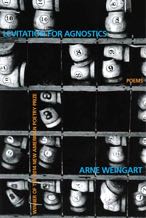
Levitation for Agnostics by Arne Weingart

Source: Book Savvy Public Relations
Paperback, 122 pgs.
I am an Amazon Affiliate

Levitation for Agnostics by Arne Weingart, 2014 winner of the New American Poetry Prize, questions our faith, which oftentimes is passed down through families as a foregone conclusion.  In “Chopping Roots,” Weingart’s narrator is digging to move water away from the base of his home and protect the retaining wall from eventual decomposition through erosion.  If we have unmoor ourselves from the faith we’ve been brought up with, will be float without direction and is that such a terrible thing?  These are just a few questions asked in these poems.

“…you will simply give up and lean down
into the hillside tearing all your roots out of the ground with
a great explosive twanging leaving a huge and unaccountable
hole we must stare into while
we listen to the river.” (“Chopping Roots”, pg. 86)

In many of these poems the narrator is unmoored and drifting, and structures are erected only to be considered false supports. Weingart also transforms solid objects into theories and mutable things that can be perceived differently and claimed by many. There is a dissatisfaction with what has come before in terms of religious fervor and faith, but at the same time, the narrator is in awe of these beliefs and long-standing institutions. In many ways, the narrator is seeking to become more, to be the creator of “big ideas” rather than just a believer of them.

“Every scaffold is highly
instrumental but exterior to
some central purpose some
permanent intention meant to
resist time and desire and the
inevitable slide of tectonic
earth. To live in scaffolding
is not to be free exactly but” (“A Theory of Scaffolds”, pg. 27-8)

From the sacrifices of ancient people in Machu Picchu to the Jewish religion, the narrator seeks to hold up the faith of these people to scrutiny, while at the same time being respectful. Exploring how religion and faith can bring people together, the narrator also examines how it drive wedges between neighbors and even family. In “Hebrew School,” kids are taught a language that is understood by few, in the way that children do not understand how they could be the chosen people. Despite the disenchantment with religion and faith, Weingart displays a sense of humor about ancestors and their quirks and about overcoming things that can make us different, like stuttering, only to want to be different again and take steps to recapture those differences.

Levitation for Agnostics by Arne Weingart, 2014 winner of the New American Poetry Prize, is a straightforward look at faith and ancestry, the ideas and mores that bind families, and the questions that should be asked about their tangibility and their applicability to our own lives, as we live them. Like in “Recursion,” as the rocks are skipped across the lake no matter how many times they reach the shore, the poet needs to question and continue to question because there is much more to learn and be taught.

Rating: Quatrain

About the Poet:

Born and raised in Nashville, Tennessee, and educated at Dartmouth College and Columbia University, Arne Weingart lives in Chicago with his wife Karen, where he is the principal of a graphic design firm specializing in identity and wayfinding. Recent poems have been published in Arts & Letters, Beecher’s Magazine, Coal Hill Review, Enizagam, Nimrod, Oberon, Plume, RHINO, Sow’s Ear Poetry Review, The Georgetown Review, The Massachusetts Review, and The Spoon River Poetry Review. His work has been nominated for a Pushcart Prize and his book, “Levitation For Agnostics,” winner of the 2014 New American Press Poetry Prize, will be released in February, 2015.


Jane Austen Lives Again by Jane Odiwe

Source: Author Jane Odiwe
ebook, 275 pgs.
I am an Amazon Affiliate

Jane Austen Lives Again by Jane Odiwe requires readers to suspend disbelief, and those fans of Jane Austen who wish she had written more than her 6 novels will surely have no problem doing that.  Her death is averted by her physician, who has discovered the secret to immortal life with the help of the Turritopsis dohrnii in 1817.  When Austen awakens she is in 1925, just after The Great War.  Many families, including rich families, have fallen on hard times and experienced great loss as many lost sons, brothers, and husbands in the war.  Times have changed for women, and Austen is able to get work outside the home to support herself, and although her family has passed on and she’s effectively alone in the world, she pulls up her hem and gets to work as a governess to five girls at Manberley Castle near the sea in Stoke Pomeroy.

“Having lived cautiously, and under strict rules and regulations for so long, Miss Austen felt the winds of change blowing across the Devon landscape.”

Cora, Emily, Alice, Mae, and Beth are a bit more to handle than Austen expects, especially as she is a little younger than she had been before the procedure.  Upon her arrival, Austen is faced with staff who are eager to gossip, which rubs her the wrong way because she prefers to make up her own mind about people.  The heir to the castle, William Milton, is one person who keeps her on her toes, and as Austen gets caught up in the drama of others, she begins to realize that her life would be empty without the Miltons in it.

Odiwe is one of the best writers of Jane Austen-related fiction, and it shows as she weaves in Austen’s own novels into her own novel.  Emma, Sense & Sensibility, Pride & Prejudice, and more are illustrated in a variety of situations here, and Austen is at the center of them all.  However, readers should be warned that Odiwe is not rehashing these plots point for point.  Jane Austen Lives Again by Jane Odiwe is her best novel yet, and if there were something to complain about, it would be that it could have been longer.

Rating: Cinquain

About the Author:

Jane Odiwe is an artist and author. She is an avid fan of all things Austen and is the author and illustrator of Effusions of Fancy, consisting of annotated sketches from the life of Jane Austen. She lives with her husband and three children in North London.  Check out Jane Odiwe’s blog here.

Other Reviews:

The Girl on the Train by Paula Hawkins (audio)

Source: Audible
Audiobook, 11 hrs.
I am an Amazon Affiliate

The Girl on the Train by Paula Hawkins — narrated by Clare Corbett, Louise Brealey, and India Fisher — is a mystery in which a woman with low self-esteem, who is an alcoholic, continues to stalk her ex-husband, mostly at a distance.  Rachel Watson’s divorce and drinking caused her to lose her job, but she still wakes up like clockwork to take the train into London so her roommate is unaware that she’s lost her job. She has some money saved, and even though she could be moving on with her life and getting a new job, she wallows in her sorrow at the bottom of a bottle, creating perfect, imaginary lives for the people she sees out the train windows.

Jason and Jess become a couple that she can imagine lives in marital bliss, but in reality, Megan and Scott Hipwell have a marriage that has lost its appeal, at least for Megan. She desires something more than what she has with Scott, who she fails to see as controlling even as he goes through her emails on a regular basis.  She wants her life to be more than just sitting at home waiting for her husband to come home.  Like Rachel, she is dissatisfied with what her life has become.

Rachel, meanwhile, is on the outside of her ex-husband’s life with his new wife and daughter, who continue to live in the house she and he used to live in, and she’s on the outside of the world looking in, much like she’s staring out the train windows.  She’s searching for something, she needs to belong to something, but what she ends up entangling herself in is something that could lead to her own death.  Meanwhile, her ex-husband’s new wife Anna is terrified of Rachel, worried that her stalking will turn to something more.

Listening to the audio was never boring and the different narrators helped when Hawkin’s story changed points of view.  Moreover, the narrator for Rachel really put you in the mindset of a broken woman who was down on herself, blamed herself, and was unable to break out of her self-destructive cycle of drinking and blacking out.  Hawkins’ The Girl on the Train is a twisted tale of the suburban lives we often perceive as idyllic, and the lives we believe we have but actually do not.  How well do we know our spouses, their experiences, their families, and how well do they know us?  Many of us have inner demons or secrets we would rather not face, so we lie about them to ourselves and those we love.

Rating: Quatrain

About the Author:

Paula Hawkins worked as a journalist for fifteen years before turning her hand to fiction. Born and brought up in Zimbabwe, Paula moved to London in 1989 and has lived there ever since. The Girl on the Train is her first thriller.

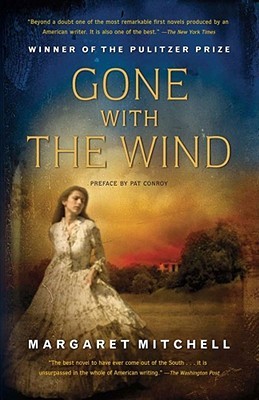
Guest Review: Gone With the Wind by Margaret Mitchell

Entertainment Weekly says – “Mitchell’s landmark novel illustrates the luxury of the Southern antebellum aristocracy and its downfall through some of literature’s (and film’s) most memorable characters.”

Synopsis

Since its original publication in 1936, Gone With the Wind—winner of the Pulitzer Prize and one of the bestselling novels of all time—has been heralded by readers everywhere as The Great American Novel.

Widely considered The Great American Novel, and often remembered for its epic film version, Gone With the Wind explores the depth of human passions with an intensity as bold as its setting in the red hills of Georgia. A superb piece of storytelling, it vividly depicts the drama of the Civil War and Reconstruction.

This is the tale of Scarlett O’Hara, the spoiled, manipulative daughter of a wealthy plantation owner, who arrives at young womanhood just in time to see the Civil War forever change her way of life. A sweeping story of tangled passion and courage, in the pages of Gone With the Wind, Margaret Mitchell brings to life the unforgettable characters that have captured readers for over seventy years.

Today’s review is from Elisha at Rainy Day Reviews.

Gone With the Wind is a classic for a reason. Well written, timeless, and tells a story of bravery, heart, and the difficulty of living life during the Civil War. I can see why people would call this novel a romance however, I would not call this a romantic read but a dramatic read with romance as a key part of the novel. Even though I was not a big fan of Scarlett, she had backbone and had to learn rather quickly that life was not always as easy or pleasant as she once thought due to the civil war and the surrounding issues of life then on the plantation. All around a great book and I can see why the movie is four hours long and look forward to  watching it (I still haven’t seen it).

I most definitely would recommend this read for all.

USofBooksGeorgia

Who’s Psyched for the Pride & Prejudice & Zombies Movie?

When Pride & Prejudice & Zombies by Jane Austen and Seth Grahame-Smith first came out in 2010, I was excited to read it. As I read the book, I could picture some of the scenes unfolding on a movie screen, and now I’ll be able to see it in action. I’m really hoping that the sparring match between Lizzy and Mr. Darcy is in the film, since it was my favorite part of the book.

Here’s a bit of my review:

Jane Austen and Seth Grahame-Smith’s Pride and Prejudice and Zombies is a mash-up of Jane Austen’s classic, Pride and Prejudice, and a zombie conflict. Grahame-Smith effectively weaves in the zombie attacks and how the Bennet clan dispatches them with skill. A majority of this novel is Austen’s words, but the dialogue and descriptions that are modified to accommodate zombies are done with aplomb.

I’m hoping that Anna and I can make a girl’s night out to see this movie!

Mailbox Monday #360

Mailbox Monday, created by Marcia at To Be Continued, formerly The Printed Page, has a permanent home at its own blog.

To check out what everyone has received over the last week, visit the blog and check out the links.  Leave yours too.

Also, each week, Leslie, Vicki, and I will share the Books that Caught Our Eye from everyone’s weekly links.

Here’s what I received:

The Girl on the Train by Paula Hawkins which I received with my audible credit.

Rachel takes the same commuter train every morning and every night. Every day she rattles over the same track junctions, flashes past the same stretch of cozy suburban homes. And every day she stops at the same signal and she sees the same couple, breakfasting on their roof deck, living the perfect life that Rachel craves for herself – a lifestyle she recently lost. She looks forward to observing this household every morning, even makes up names and narratives for its residents. Then one day Rachel sees someone new in their garden, and soon after, the woman who lived there disappears.

Unable to keep this information to herself, Rachel offers what she knows to the police, and in the process is drawn into the lives of the couple she thought of as Jason and Jess but whose names – she has learned from the news – are really Megan and Scott Hipwell.

But the police accuse Rachel of being unreliable, and it’s true that her memories can’t always be trusted. Plus there are the stories that her ex-husband’s new wife has been spreading about her. By the time Megan’s body is found, Rachel is in over her head, intricately entangled in the details of the investigation, as well as in the lives of everyone involved. Has she put others in danger? Has she done more harm than good?

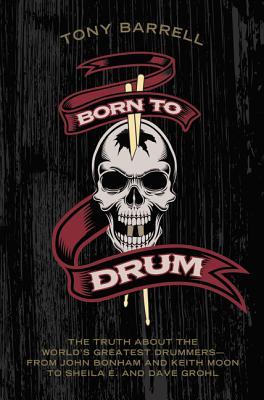
Born to Drum by Tony Barrell from Dey Street Books for review.

The pulse of rock ‘n’ roll—the drummer—finally gets its due in this unique, all-encompassing inside look at the culture and history of drumming

Beating the hell out of a drum kit is hard, sweaty, demanding work. Yet instead of being showered with respect, drummers are often viewed with derision—stereotyped as crazy, borderline psychotic, or just plain dumb. But as every musician knows, to have a great band you need a great drummer: Ginger Baker. John Bonham. Chad Smith. Stewart Copeland. Neil Peart.

For the first time, Tony Barrell shines a long-overdue spotlight on these musicians, offering an exciting look into their world, their art, and their personalities. In Born to Drum, Barrell explores the extraordinary history of the world’s most primitive instrument and the musicians who have made it legend. He interviews some of the most famous, revered, and influential drummers of our time—including Chad Smith, Ginger Baker, Clem Burke, Sheila E., Phil Collins, Nick Mason, Patty Schemel, Butch Vig, and Omar Hakim—who share astonishing truths about their work and lives. He investigates the stories of late, great drummers such as Keith Moon and John Bonham, analyzes many of the greatest drum tracks ever recorded, and introduces us to the world’s fastest and loudest drummers, as well as the first musician to pilot a “flying drum kit” onstage.

The Total Package by Stephanie Evanovich for review in March with TLC Book Tours.

Star quarterback, first-round draft-pick, and heartthrob Tyson Palmer has made a name for himself with his spectacular moves. When the head coach of the Austin Mavericks refuses to let him waste his million-dollar arm, Tyson makes a Hail Mary pass at redemption and succeeds with everyone . . . except Dani, whose negative comments about his performance draw high ratings and spectacular notices of her own.

Dani can’t forgive Tyson’s transgressions or forget the sizzling history the two of them shared in college, a passionate love Tyson casually threw away. And even more infuriating, he doesn’t realize that the bombshell with huge ratings is the cute girl whose heart he once broke.

But can a woman trying to claw her way to the top and a quarterback who knows all about rock bottom make it to the Super Bowl without destroying each other? And what will happen when Tyson—riding high now that he’s revived his career—realizes he needs to make an even more important comeback with Dani? Can he make some spectacular moves to get past her defenses—or will she sideline him for good?

What did you receive?

342nd Virtual Poetry Circle

Welcome to the 342nd Virtual Poetry Circle!

Remember, this is just for fun and is not meant to be stressful.

Keep in mind what Molly Peacock’s book suggested.

Look at a line, a stanza, sentences, and images; describe what you like or don’t like; and offer an opinion. If you missed my review of her book, check it out here.

This poem is from Roberta Hill:

Horses in Snow

They are a gift I have wanted again.
Wanted: One moment in mountains
when winter got so cold
the oil froze before it could burn.
I chopped ferns of hoarfrost from all the windows
and peered up at pines, a wedding cake
by a baker gone mad. Swirls by the thousand
shimmered above me until a cloud
lumbered over a ridge,
bringing the heavier white of more flurries.

I believed, I believed, I believed
it would last, that when you went out
to test the black ice or to dig out a Volkswagon
filled with rich women, you’d return
and we’d sputter like oil,
match after match, warm in the making.
Wisconsin’s flat farmland never approved:
I hid in cornfields far into October,
listening to music that whirled from my thumbprint.
When sunset played havoc with bright leaves of alders,

I never mentioned longing or fear.
I crouched like a good refugee in brown creeks
and forgot why Autumn is harder than Spring.
But snug on the western slope of that mountain
I’d accept every terror, break open seals
to release love’s headwaters to unhurried sunlight.
Weren’t we Big Hearts? Through some trick of silver
we held one another, believing each motion the real one,
ah, lover, why were dark sources bundled up
in our eyes? Each owned an agate,

marbled with anguish, a heart or its echo,
we hardly knew. Lips touching lips,
did that break my horizon
as much as those horses broke my belief?
You drove off and I walked the old road,
scolding the doubles that wanted so much.
The chestnut mare whinnied a cloud into scrub pine.
In a windless corner of a corral,
four horses fit like puzzle pieces.
Their dark eyes and lashes defined by the white.

The colt kicked his hind, loped from the fence.
The mares and a stallion galloped behind,
lifting and leaping, finding each other
in full accord with the earth and their bodies.
No harm ever touched them once they cut loose,
snorting at flurries falling again.
How little our chances for feeling ourselves.
They vanished so quickly—one flick of a tail.
Where do their mountains and moments begin?
I stood a long time in sharpening wind.

What do you think?

No More Beige Food by Leanne Shirtliffe, illustrated by Tina Kugler

Source: Sky Pony Press
Hardcover, 32 pgs.
I am an Amazon Affiliate

No More Beige Food by Leanne Shirtliffe, illustrated by Tina Kugler, is another winner from Sky Pony Press.  This book is told in verse in a way that kids will find funny, but also relatable.  My daughter is not much of a picky eater now, but she has been in the past, so this book is a reminder that that pickiness could return.  Parents also will want to take note of what they say to their kids in these kinds of arguments, because as illustrated by Wilma Lee Wu and her brother, those kids may take your words literally.

Wilma is sick of bland, beige food, and when her mother says to learn how to cook, she takes her brother by the hand on an adventure around the neighborhood.  While some neighbors are close, others are a bit further from home, to which my four-year-old daughter said, “Wilma and her brother are going to get in trouble.” When I asked why, she replied, “Because they went too far away from home.”  It is unclear how far these children walked or how old they are, but the book is said to be for kids ages 3+.   I promptly explained to my daughter that this neighborhood is probably small and everyone knows one another, so the kids will just be learning from family friends.

The book is a great teaching tool for kids about the different foods that people eat and the recipes they make, which can vary widely from our own.  It also demonstrates how different foods, spices, etc. can be just as tasty as the foods we eat regularly at home.  Variety is never a bad thing in food.  The only complaint, other than the distance the kids seemed to travel, from my daughter was that the finished recipes were not illustrated every time.  She was curious to see what each one looked like.  Her favorite parts were the discussion about frog legs and mousse, and how the kids popped into the playground on the way to another house.

No More Beige Food by Leanne Shirtliffe, illustrated by Tina Kugler, will demonstrate different cultures and food to children in a friendly way, and encourage them to think outside of their own daily lives for inspiration.

About the Author:

She is a humor writer, a mom to nine-year-old twins, and the author of DON’T LICK THE MINIVAN: Things I Never Thought I’d Say As a Parent (2013). My first picture book, THE CHANGE YOUR NAME STORE, will be out in May 2014 (Sky Pony Press) and my humor gift book, MOMMYFESTO: We Solemnly Swear…Because We Have Kids, hits the shelves in November 2014. I contributed to the hilarious anthology I JUST WANT TO BE ALONE (2014).