Quantcast

Mailbox Monday #410

Mailbox Monday, created by Marcia at To Be Continued, formerly The Printed Page, has a permanent home at its own blog.

To check out what everyone has received over the last week, visit the blog and check out the links. Leave yours too.

Also, each week, Leslie, Martha, and I will share the Books that Caught Our Eye from everyone’s weekly links.

Here’s what I purchased:

Wishful Drinking by Carrie Fisher on Audible.

In Wishful Drinking, Carrie Fisher tells the true and intoxicating story of her life with inimitable wit. Born to celebrity parents, she was picked to play a princess in a little movie called Star Wars when only 19 years old. “But it isn’t all sweetness and light sabers.”

Alas, aside from a demanding career and her role as a single mother (not to mention the hyperspace hairdo), Carrie also spends her free time battling addiction, weathering the wild ride of manic depression and lounging around various mental institutions. It’s an incredible tale – from having Elizabeth Taylor as a stepmother, to marrying (and divorcing) Paul Simon, from having the father of her daughter leave her for a man, to ultimately waking up one morning and finding a friend dead beside her in bed.
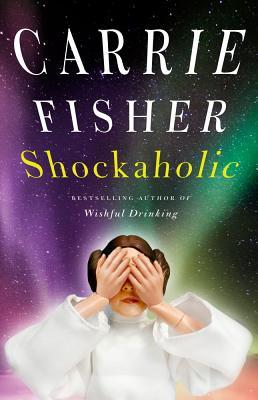
Shockaholic by Carrie Fisher on Audible.

Infused with Carrie Fisher’s trademark incisive wit and on the heels of Wishful Drinking’s instant New York Times bestselling success, Shockaholic takes readers on another rollicking ride into her crazy life.

There is no shortage of people flocking to hear what Princess Leia has to say. Her previous hardcover, Wishful Drinking, was an instant New York Times bestseller and Carrie was featured everywhere on broadcast media and received rave reviews from coast to coast, including People (4 stars; one of their top 10 books of the year), Entertainment Weekly, New York Times, and scores of others.

Told with the same intimate style, brutal honesty, and uproarious wisdom that placed Wishful Drinking on the New York Times bestseller list for months, Shockaholic is the juicy account of Carrie Fisher’s life, focusing more on the Star Wars years and dishing about the various Hollywood relationships she’s formed since she was chosen to play Princess Leia at only nineteen years old. Fisher delves into the gritty details that made the movie—and herself—such a phenomenal success, admitting, “It isn’t all sweetness and light sabers.”

The Princess Diarist by Carrie Fisher, purchased from Audible.

The Princess Diarist is Carrie Fisher’s intimate, hilarious and revealing recollection of what happened behind the scenes on one of the most famous film sets of all time, the first Star Wars movie.

When Carrie Fisher recently discovered the journals she kept during the filming of the first Star Wars movie, she was astonished to see what they had preserved—plaintive love poems, unbridled musings with youthful naiveté, and a vulnerability that she barely recognized. Today, her fame as an author, actress, and pop-culture icon is indisputable, but in 1977, Carrie Fisher was just a (sort-of) regular teenager.

With these excerpts from her handwritten notebooks, The Princess Diarist is Fisher’s intimate and revealing recollection of what happened on one of the most famous film sets of all time—and what developed behind the scenes. And today, as she reprises her most iconic role for the latest Star Wars trilogy, Fisher also ponders the joys and insanity of celebrity, and the absurdity of a life spawned by Hollywood royalty, only to be surpassed by her own outer-space royalty. Laugh-out-loud hilarious and endlessly quotable, The Princess Diarist brims with the candor and introspection of a diary while offering shrewd insight into the type of stardom that few will ever experience.

Ulysses by James Joyce, purchased for the informal February read-a-long with Ti from Book Chatter.

The revised edition follows the complete and unabridged text of ULYSSES as corrected and reset in 1961. Like the first American edition of 1934, it also contains the original foreword by the author and the historic court ruling by Judge John M. Woolsey to remove the federal ban on ULYSSES. It also contains page references to the 1934 edition, which are indicated in the margins.

For Review:

Darcy’s Hope at Donwell Abbey by Ginger Monette for review in February.

1917. Captain Fitzwilliam Darcy has won the heart of Elizabeth Bennet. Finally.

Then she disappears.

When tragedy strikes on the battlefield, Darcy is sent to Donwell Abbey to recover. There he is coaxed back to life by an extraordinary nurse determined to teach him how to live and love again. A woman whose uncanny similarities to Elizabeth breach his walls and invite his admiration.

His heart tells him to hold on to Elizabeth. His head tells him to take a chance with his nurse.

But Donwell Abbey holds a secret that just might change everything.

What did you receive?
392nd Virtual Poetry Circle

Welcome to the 392nd Virtual Poetry Circle!

Remember, this is just for fun and is not meant to be stressful.

Keep in mind what Molly Peacock’s book suggested.

Look at a line, a stanza, sentences, and images; describe what you like or don’t like; and offer an opinion. If you missed my review of her book, check it out here.

Today’s poem is from Helen Hunt Jackson:

January

O Winter! frozen pulse and heart of fire, 
What loss is theirs who from thy kingdom turn 
Dismayed, and think thy snow a sculptured urn 
Of death! Far sooner in midsummer tire 
The streams than under ice. June could not hire 
Her roses to forego the strength they learn 
In sleeping on thy breast. No fires can burn 
The bridges thou dost lay where men desire 
In vain to build. 
        O Heart, when Love’s sun goes 
To northward, and the sounds of singing cease, 
Keep warm by inner fires, and rest in peace. 
Sleep on content, as sleeps the patient rose. 
Walk boldly on the white untrodden snows, 
The winter is the winter’s own release.

What are your thoughts?

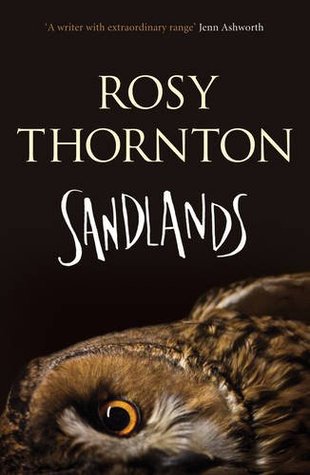
Sandlands by Rosy Thornton

Source: the author
Paperback, 320 pgs.
I am an Amazon Affiliate

Sandlands by Rosy Thornton is a devastating collection of short stories, some of which shift between the present and WWII and some of which occur during WWII. These 16 short stories are set near the village of Blaxhall in coastal Suffolk, England, and it is Gothic in many ways as Thornton creates micro-worlds in which her characters are haunted or lost. These characters dwell in an ethereal world in which nature itself becomes a character of its own, including the owl who keeps secrets.

Each story is a magical world in which anything is possible, though some have a more meditative pace than others. There are two in particular that have a crescendo that will leave readers breathless and devastated — “The Watcher of Souls” and “Stone the Crows.”

In the “Watcher of Souls,” an older woman takes walks in the woods daily and comes across an owl, and they have a moment in which their eyes lock. This connection becomes something she seeks to explore after she’s read about the legends and myths of owls. When she discovers the owl’s home in a hollow of a tree, she also discovers a tale of love and sadness. This story enables her to connect with others in a way that had been lost to her since her children moved out and began their own adult lives and she was left to live alone. It’s a touching story about human connection, love, and the solace it can bring, even just through words from the past.

These stories are complex puzzles with dynamic characters who are developed in a short span by Thornton, but who will leave an indelible impression on the reader. The setting is steeped in myth and historical legends of witches and witch hunters, WWII POWs, pagan religions carried on in the iconography of Christian churches, and folklore. In Sandlands, Thornton has created an absorbing atmosphere that envelops readers like the fog, providing them just enough to discern a path forward but not enough to see the end before it arrives.

RATING: Quatrain

Other Reviews:

About the Author:

Rosy Thornton is an author of contemporary fiction, published by Headline Review. Her novels could perhaps be described as romantic comedy with a touch of satire – or possibly social satire with a hint of romance. In real life she lectures in Law at the University of Cambridge, where she is a Fellow of Emmanuel College. She shares her home with her partner, two daughters and two lunatic spaniels.  Visit her Website.

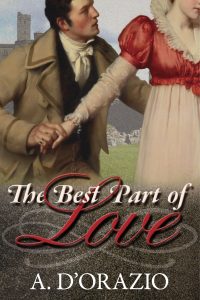
Guest Post & Giveaway: The Best Part of Love by A. D’Orazio

Welcome to our tour stop for The Best Part of Love by A. D’Orazio

We want to welcome you to a cut scene from the novel in which Darcy, Colonel Fitzwilliam, and Wickham are in coversation, but first check out the book’s blurb below:

Book Blurb:

Avoiding the truth does not change the truth

When Fitzwilliam Darcy meets Miss Elizabeth Bennet he has no idea that she — that indeed, the entire town of Meryton — harbors a secret. Miss Elizabeth, a simply country girl from a humble estate, manages to capture first his fascination and then his heart without him ever knowing the truth of her past.

When she meets Darcy, Elizabeth had spent the two years prior hiding from the men who killed her beloved first husband. Feeling herself destroyed by love, Elizabeth has no intention of loving again, certainly not with the haughty man who could do nothing but offend her in Hertfordshire.

In London, Elizabeth surprises herself by finding in Darcy a friend; even greater is her surprise to find herself gradually coming to love him and even accepting an offer of marriage from him.  Newly married, they are just beginning to settle into their happily ever after when a condemned man on his way to the gallows divulges a shattering truth, a secret that contradicts everything.  Elizabeth thought she knew about the tragic circumstances of her first marriage. Against the advice of everyone who loves her, including Darcy, Elizabeth begins to ask questions. But will what they learn destroy them both?

And now for the conversation:

……………………

For those of you who have a copy of the book already, this interview might have come somewhere in the middle of chapter 20.

……………………

By silent agreement, it was Colonel Fitzwilliam who conducted the interview. Darcy knew that his anger, a deep anger fed by his growing fears, prohibited him from being a disinterested inquisitor and as such, he ceded the office to his cousin.

Wickham had acted stupidly brave for a time, but when at last it appeared the other two men would leave him to his fate, he relented. At length, he realised candour was in his best interests, as well as Darcy’s, and he promised to tell them the truth as he best remembered it.

“Very well,” said Colonel Fitzwilliam. “Perhaps it might do to begin with how came your involvement in this dreadful business.”

Wickham sighed heavily. “Does that honestly matter?”

“Oblige me.”

After a moment’s pause, Wickham spat out, “I was cheated but then again, when is it that life does not present to me its very hindquarters? All is well and good for those of you who sit, high and mighty, who know not the deprivations of—”

Darcy waved his hand tiredly. “Yes, yes, we know your song, you have sung it many times over to any who will hear you. Do go on with something we do not know.”

“It was a design from the beginning, to see me a part of it. I hardly remember the night, ’twas such a bosky sort of evening but the long and short of it was that I ended with empty pockets and then some.”

Fitzwilliam snorted. “This is hardly anything we did not know or at least might have imagined. Who did you owe?”

“I knew them not but could easily discern they were high, very high. They were not the sorts to be easily put off. They wanted their due, immediately.” Wickham swallowed hard.

“But you did not have it.”

Wickham shook his head. “It was an amount not easily laid by for such a man as myself. Ah but if only I could have had the living your father promised, Darcy. Then I think I should have been—” Darcy stopped him with a glare and a word. “Enough.”

“I was given a day to come up with it.”

“Knowing you as I do, I would suppose you used that reprieve to try to escape,” said Darcy.

“I did,” Wickham admitted. “But they anticipated me. I was moments away from boarding a coach when one of the men appeared, and looking none too pleased to see me. A veritable brute he was, and quite undignified in the manner that he took me to see his friend.”

“His friend?”

Wickham nodded. “A friend called only Smith. He sat with another man in a brothel where we met several times. He was there with another man. He did not speak — Smith spoke for him but I had no doubt it was he who called the tune.”

“And what did Smith talk to you about?” Fitzwilliam asked.

“He spoke to me about helping them out a bit. Said my expenses — including my debt from the table — would be taken care of and I would receive payment besides.”

“Naturally the money spoke to you, and never mind what you had to do to earn it.” Darcy shook his head.

“Your father was a good man, I cannot bear to think of his feelings if he knew what you were.”

“I had no choice,” Wickham replied defensively. “Make no mistake of it, the payment was for my silence. If I had refused my task, I should not have left the room under my own power — of this I can assure you.”

“So you took the money, that much we know.” Fitzwilliam leant forward, fixing Wickham in a steely blue gaze. “But my question is: did you do what they asked?”

Author Bio:

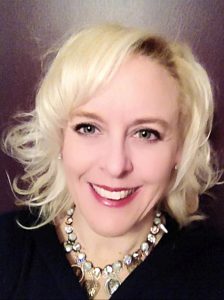
Amy D’Orazio is a former breast cancer researcher and current stay at home mom who is addicted to Austen and Starbucks in about equal measures. While she adores Mr. Darcy, she is married to Mr. Bingley and their Pemberley is in Pittsburgh, Pa.

She has two daughters who are devoted to sports which require long practices and began writing her own stories as a way to pass the time she spent sitting in the lobbies of various gyms and studios. She is a firm believer that all stories should have long looks, stolen kisses and happily ever afters. Like her favorite heroine, she dearly loves a laugh and considers herself an excellent walker.  Join her on GoodReads, Twitter, Pinterest, Instagram, and Facebook.

Giveaway:

a Rafflecopter giveaway

Blog Tour Schedule:

Save

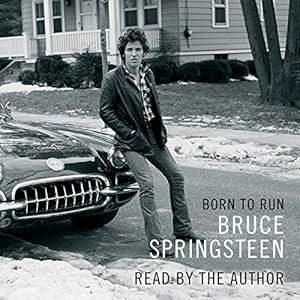
Born to Run by Bruce Springsteen (audio)

Source: Purchased
Audible, 18+ hours
I am an Amazon Affiliate

Born to Run by Bruce Springsteen is probably best told by its author. Springsteen is never afraid to speak his truth about his upbringing in New Jersey, the hard relationship with his father, and his incredible drive to become the musician he heard and envisioned in his own mind. Fans of Springsteen will be more aware of the bands he speaks of and the people in the music business than I am, but this did not detract from my enjoyment in his story. In some places the names and bands slow the pace a little, but that might be more of an issue in a print copy than in the audio.

Springsteen is the perfect narrator for his life, and it is clear that as he reads he is taken back in time to those early days as a musician playing in clubs and being told he is no singer. In many ways, this memoir is not about the past and what happened, but about how each experience helped him grow and learn — to be a good father, to be a better musician than even he dreamed, and to reach out to the working class homes of his past. He strove to become as successful as he could, focusing on his guitar skills and his songwriting at first before eventually using his voice to tell the stories in his songs.

He’s always been a storyteller, and he’s telling this story as part of the legacy for his own children. He wants them to know their roots, where they come from … but he also wants to provide them with a sketch of his mind and how he handled things, even when he made mistakes. Readers will love how he praises those who were patient with him, and they will see how he’s not afraid to hold a mirror up to his faults.

Born to Run by Bruce Springsteen is a memoir that gives an inside look into one of the longest surviving bands, the music industry, and one of the most memorable songwriters of all time. The thought he put into each song’s lyrics and atmosphere, and staging, etc., is nothing short of inspiring. It is clear that his early determination to make music served him well.

RATING: Quatrain

***Please visit The 3Rs Blog: Reading, ‘Riting, and Randomness for an even better review. Seriously!***

About the Author:

Bruce Springsteen is an American songwriter, singer and guitarist. He has frequently recorded and toured with the E Street Band. Springsteen is most widely known for his brand of heartland rock infused with pop hooks, poetic lyrics, and Americana sentiments centered around his native New Jersey. His eloquence in expressing ordinary, everyday problems has earned him numerous awards, including twenty Grammy Awards and an Academy Award, along with an international fan base. His most famous albums, Born to Run and Born in the U.S.A., epitomize his penchant for finding grandeur in the struggles of daily life. He has sold over 64 million albums in the U.S. alone.

Mailbox Monday #409

Mailbox Monday, created by Marcia at To Be Continued, formerly The Printed Page, has a permanent home at its own blog.

To check out what everyone has received over the last week, visit the blog and check out the links. Leave yours too.

Also, each week, Leslie, Martha, and I will share the Books that Caught Our Eye from everyone’s weekly links.

What I purchased:

Breakup/Breakdown by Charles Jensen

With wry humor and poignant contemplation, Breakup/Breakdown provides readers with excellent company, whether recalling breakups of their own or simply witnessing the narrative of the book’s hero. In the poem “Disruption,” our speaker advises that, “Love, my friends, should never / be entrusted to the heart, whose job // is to push away the only thing / the world will ever offer it.” In the midst of loss that is both personal and universal, Jensen conjures familiar figures, from literature to film, to offer another dimension of insight on the path from sorrow to empowerment. This chapbook has all the emotional heft of a full-length collection, and every line glistens with truth. — Mary Biddinger, author of Small Enterprise

Born to Run by Bruce Springsteen, which I purchased from Audible.

In 2009, Bruce Springsteen and the E Street Band performed at the Super Bowl’s halftime show. The experience was so exhilarating that Bruce decided to write about it. That’s how this extraordinary autobiography began.
Over the past seven years, Bruce Springsteen has privately devoted himself to writing the story of his life, bringing to these pages the same honesty, humor, and originality found in his songs.
He describes growing up Catholic in Freehold, New Jersey, amid the poetry, danger, and darkness that fueled his imagination, leading up to the moment he refers to as “The Big Bang”: seeing Elvis Presley’s debut on The Ed Sullivan Show. He vividly recounts his relentless drive to become a musician, his early days as a bar band king in Asbury Park, and the rise of the E Street Band. With disarming candor, he also tells for the first time the story of the personal struggles that inspired his best work, and shows us why the song “Born to Run” reveals more than we previously realized.
Born to Run will be revelatory for anyone who has ever enjoyed Bruce Springsteen, but this book is much more than a legendary rock star’s memoir. This is a book for workers and dreamers, parents and children, lovers and loners, artists, freaks, or anyone who has ever wanted to be baptized in the holy river of rock and roll.
Rarely has a performer told his own story with such force and sweep. Like many of his songs (“Thunder Road,” “Badlands,” “Darkness on the Edge of Town,” “The River,” “Born in the U.S.A,” “The Rising,” and “The Ghost of Tom Joad,” to name just a few), Bruce Springsteen’s autobiography is written with the lyricism of a singular songwriter and the wisdom of a man who has thought deeply about his experiences.

What did you receive?

Save

391st Virtual Poetry Circle

Welcome to the 391st Virtual Poetry Circle!

Remember, this is just for fun and is not meant to be stressful.

Keep in mind what Molly Peacock’s book suggested.

Look at a line, a stanza, sentences, and images; describe what you like or don’t like; and offer an opinion. If you missed my review of her book, check it out here.

Today’s poem is from Mary Karr:

Requiem for the New Year

On this first dark day of the year
      my daddy was born lo
these eighty-six years ago who now
      has not drawn breath or held
bodily mass for some ten years and still   
      I have not got used to it.
My mind can still form to that chair him   
      whom no chair holds.
Each year on this night on the brink
      of new circumference I stand and gaze
towards him, while roads careen with drunks,   
      and my dad who drank himself
away cannot be found. Daddy, I’m halfway   
      to death myself. The millenium
hurtles towards me, and the boy I bore   
      who bears your fire in his limbs
follows in my wake. Why can you not be   
      reborn all tall to me? If I raise my arms
here in the blind dark, why can you not   
      reach down now to hoist me up?
This heavy carcass I derive from yours is   
      tutelage of love, and yet each year
though older another notch I still cannot stand   
      to reach you, or to emigrate
from the monolithic shadow you left.

What do you think?

Most Anticipated Poetry of 2017

Normally, I don’t have time to check out the upcoming books for the year, but I made a conscious effort to do so — at least for poetry.

Below are the books I’m looking forward to this year:

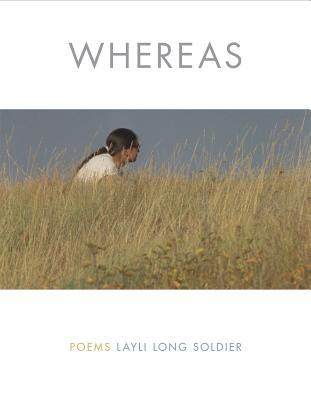
Whereas by Whiting Award winner Layli Long Soldier, published by Graywolf Press in March 2017.

WHEREAS her birth signaled the responsibility as mother to teach what it is to be Lakota therein the question: What did I know about being Lakota? Signaled panic, blood rush my embarrassment. What did I know of our language but pieces? Would I teach her to be pieces? Until a friend comforted, Don’t worry, you and your daughter will learn together. Today she stood sunlight on her shoulders lean and straight to share a song in Diné, her father’s language. To sing she motions simultaneously with her hands; I watch her be in multiple musics.

Afterland by Mai Der Vang, also published by Graywolf Press in April 2017.

Afterland is a powerful, essential collection of poetry that recounts with devastating detail the Hmong exodus from Laos and the fate of thousands of refugees seeking asylum. Mai Der Vang is telling the story of her own family, and by doing so, she also provides an essential history of the Hmong culture’s ongoing resilience in exile. Many of these poems are written in the voices of those fleeing unbearable violence after U.S. forces recruited Hmong fighters in Laos in the Secret War against communism, only to abandon them after that war went awry. That history is little known or understood, but the three hundred thousand Hmong now living in the United States are living proof of its aftermath. With poems of extraordinary force and grace, Afterland holds an original place in American poetry and lands with a sense of humanity saved, of outrage, of a deep tradition broken by war and ocean but still intact, remembered, and lived.

Said Not Said by Fred Marchant, from my mentor and friend who was recently honored by the city of Boston, and it is also from Graywolf Press in May 2017.

In this important and formally inventive new poetry collection, Fred Marchant brings us into realms of the intractable and the unacceptable, those places where words seem to fail us and yet are all we have. In the process he affirms lyric poetry’s central role in the contemporary moral imagination. As the National Book Award winner David Ferry writes, “The poems in this beautiful new book by Fred Marchant are autobiographical, but, as is always the case with his poems, autobiographical of how he has witnessed, with faithfully exact and pitying observation, the sufferings in the lives of other people, for example the heartbreaking series of poems about the fatal mental suffering of his sister, and the poems about other peoples, in Vietnam, in the Middle East, written about with the noble generosity of feeling that has always characterized his work, here more impressively even than before.”

Said Not Said is a poet’s taking stock of conscience, his country’s and his own, and of poetry’s capacity to speak to what matters most.

Incendiary Art: Poems by Patricia Smith, published by Triquarterly in February 2017.

ne of the most magnetic and esteemed poets in today’s literary landscape, Patricia Smith fearlessly confronts the tyranny against the black male body and the tenacious grief of mothers in her compelling new collection, Incendiary Art. She writes an exhaustive lament for mothers of the “dark magicians,” and revisits the devastating murder of Emmett Till. These dynamic sequences serve as a backdrop for present-day racial calamities and calls for resistance. Smith embraces elaborate and eloquent language— “her gorgeous fallen son a horrid hidden / rot. Her tiny hand starts crushing roses—one by one / by one she wrecks the casket’s spray. It’s how she / mourns—a mother, still, despite the roar of thorns”— as she sharpens her unerring focus on incidents of national mayhem and mourning. Smith envisions, reenvisions, and ultimately reinvents the role of witness with an incendiary fusion of forms, including prose poems, ghazals, sestinas, and sonnets. With poems impossible to turn away from, one of America’s most electrifying writers reveals what is frightening, and what is revelatory, about history.

Cold Pastoral: Poems by Rebecca Dunham from Milkweed Editions in March 2017.

A searing, urgent collection of poems that brings the lyric and documentary together in unparalleled ways—unmasking and examining the specter of manmade disaster.

The explosion on the Deepwater Horizon oil rig. Hurricane Katrina. The Flint water crisis. Thousands dead, lives destroyed, and a natural world imperiled by human choices. This is the litany of our time—and these are the events that Rebecca Dunham traces, passionately and brilliantly, in Cold Pastoral. In poems that incorporate interviews and excerpts from government documents and other sources—poems that adopt the pastoral and elegiac traditions in a landscape where “I can’t see the bugs; I don’t hear the birds”—Dunham finds the intersection between moral witness and shattering art.

Hard Child by Natalie Shapero from Copper Canyon Press in April 2017.

Thought-provoking and sardonically expressive, Shapero is a self-proclaimed “hard child”—unafraid of directly addressing bleakness as she continually asks what it means to be human and to bring new life into the world. Hard Child is musical and argumentative, deadly serious yet tinged with self-parody, evoking the spirit of Plath while remaining entirely its own.

My Mother Was a Freedom Fighter by Aja Monet from Haymarket Books in May 2017.

Textured with the sights and sounds of growing up in East New York in the nineties, to school on the South Side of Chicago, all the way to the olive groves of Palestine, My Mother Is a Freedom Fighter is Aja Monet’s ode to mothers, daughters, and sisters—the tiny gods who fight to change the world. Complemented by striking cover art from Carrie Mae Weems, these stunning poems tackle racism, sexism, genocide, displacement, heartbreak, and grief, but also love, motherhood, spirituality, and Black joy.

Eat This Poem: A Literary Feast of Recipes Inspired by Poetry by Nicole Gulotta from Roost Books in March 2017.

Inspired by her popular blog by the same name, the Eat This Poem cookbook features more than 75 new recipes paired alongside verse from 25 of America’s most beloved poets. Forage mushrooms with Mary Oliver, then wander into your kitchen to stir creamy truffle risotto. Study the skin of a pear with Billy Collins while you bake a warm vanilla-pear crumble. And honor the devoted work of farmers with Wendell Berry while snacking on popcorn dusted with rosemary and drizzled with brown butter.

Beating the Graves by Tsitsi Ella Jaji from University of Nebraska Press in March 2017.

The poems in Tsitsi Ella Jaji’s Beating the Graves meditate on the meaning of living in diaspora, an experience increasingly common among contemporary Zimbabweans. Vivid evocations of the landscape of Zimbabwe filter critiques of contemporary political conditions and ecological challenges, veiled in the multiple meanings of poetic metaphor. Many poems explore the genre of praise poetry, which in Shona culture is a form of social currency for greeting elders and peers with a recitation of the characteristics of one’s clan. Others reflect on how diasporic life shapes family relations.

The praise songs in this volume pay particular homage to the powerful women and gender-queer ancestors of the poet’s lineage and thought. Honoring influences ranging from Caribbean literature to classical music and engaging metaphors from rural Zimbabwe to the post-steel economy of Youngstown, Ohio, Jaji articulates her own ars poetica. These words revel in the utter ordinariness of living globally, of writing in the presence of all the languages of the world, at home everywhere, and never at rest.

The Thin Wall by Martha Rhodes from University of Pittsburgh Press in February 2017.

Past Praise for Mother Quiet:
“The aim of poetry (and the higher kind of thriller) is to be unexpected and memorable. So a poem about death might treat it in a way that combines the bizarre and the banal: the Other Side as some kind of institution—a creepy hospital, an officious hotel or retirement home. Martha Rhodes takes such an approach in ‘Ambassadors to the Dead,’ from her abrupt, unsettling, artfully distorted, indelible new book Mother Quiet. Blending the matter-of-fact with the surreal, as a way of comprehending the stunning, final reality, Rhodes is an inheritor of Emily Dickinson’s many poems on the same subject.”
—Robert Pinsky, Washington Post

Chiapas Maya Awakening: Contemporary Poems and Short Stories by Nicolás Huet Bautista (Editor), Sean S. Sell (Translator), Inés Hernández-Ávila (Introduction), Marceal Méndez (Foreword) from University of Oklahoma Press in January 2017.

Mexico s indigenous people speak a number of rich and complex languages today, as they did before the arrival of the Spanish. Yet a common misperception is that Mayas have no languages of their own, only dialectos, and therefore live in silence. In reality, contemporary Mayas are anything but voiceless. Chiapas Maya Awakening, a collection of poems and short stories by indigenous authors from Chiapas, Mexico, is an inspiring testimony to their literary achievements. A unique trilingual edition, it presents the contributors works in the living Chiapas Mayan languages of Tsotsil and Tseltal, along with English and Spanish translations.
As Sean S. Sell, Marceal Mendez, and Ines Hernandez-Avila explain in their thoughtful introductory pieces, the indigenous authors of this volume were born between the mid-1970s and the mid-1990s, a time of growing cultural awareness among the native communities of Chiapas.

Although the authors received a formal education, their language of instruction was Spanish, and they had to pursue independent paths to learn to read and write in their native tongues. In the book s first half, devoted to poetry, the writers consciously speak for their communities. Their verses evoke the quetzal, the moon, and the sea and reflect the identities of those who celebrate them. The short stories that follow address aspects of modern Maya life. In these stories, mistrust and desperation yield violence among a people whose connection to the land is powerful but still precarious.
Chiapas Maya Awakening demonstrates that Mayas are neither a vanished ancient civilization nor a remote, undeveloped people. Instead, through their memorable poems and stories, the indigenous writers of this volume claim a place of their own within the broader fields of national and global literature.”

What books are you looking forward to in 2017?

War Through the Generations Reading Challenge 2017

After our one-year hiatus, Anna and I have resurrected the War Through the Generations blog with the 2017 reading challenge.

We’ll be revisiting WWII books, and we’ll hold an end-of-challenge giveaway for the participants that read the most books — fiction, nonfiction, poetry, children’s books, etc.

We hope that you’ll join us, sign up in the comments and link your reviews in Mr. Linky throughout 2017.

We’ll also be announcing three read-a-longs for March, June, and September 2017 soon, so stay tuned for that as well.

Have a great year of reading!

The First Book of 2017 and One Word

Sheila at Book Journey has been doing this for a long time, and I always seem to jump on the bandwagon late.

I had thought I would be absorbed in a short story collection, Sandlands by Rosy Thornton, but it turns out that I’m too absorbed in the audio of Bruce Springsteen’s Born to Run.

Sheila also has become a powerhouse supporter of the One Word resolution, and if you read her entries and how she comes up with her word, you’ll know why. There is a certain serendipity to her selection process.

I have tried to come up with a word before and failed to do so due to commitments and other issues that end up taking over. This year, however, my word is DELIBERATE.

  • Adjective: done consciously and intentionally
  • Verb: engage in long and careful consideration

I’ve had a rough year of over-committing myself, and it led to a lot of disappointments. I want to take more time to consider the opportunities before me before I commit to them. If I take too long to think and miss out on something, so be it. It was probably not right for me.

I love to help people. It’s part of who I am, but it shouldn’t be all I am. I need to do things that make me happy, too. One of those things is a renewed focus on finishing writing projects (I may not finish them all, but finishing one would be a huge step forward).

I also need to be more deliberate in my word choices and actions. I need to mean what I say and practice what I mean. I need to do this for myself and my family. It’s going to be a hard road this year, but I’m up for the challenge, so long as I carefully weigh all that is before me.

What’s your first book and one word this year?