Quantcast

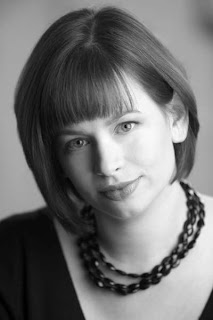
Interview With Poet Kelle Groom

Kelle Groom recently agreed to an interview with myself and 32 Poems. And here is what she had to say.

How would you introduce yourself to a crowded room eager to hang on your every word? Are you just a poet, what else should people know about you?

I also write personal essays/memoir. For the last year, I’ve been poetry editor for The Florida Review, and have now shifted into an advisory editor position. I work full-time as the Grants & Communications Manager for Atlantic Center for the Arts, an international artists-in-residence program in New Smyrna Beach, Florida. Prior to this, I was the Director of Grants Administration for the Coalition for the Homeless of Central Florida.

Do you have any obsessions that you would like to share?

Writing, of course. And books. Coffee. Oceans. Ireland. Prehistory.

When writing poetry, prose, essays, and other works do you listen to music, do you have a particular playlist for each genre you work in or does the playlist stay the same? What are the top 5 songs on that playlist? If you don’t listen to music while writing, do you have any other routines or habits?

I always listen to music when I write, but feel weirdly secretive about it. A few of the pieces are Antony and the Johnsons cover of Dylan’s, “Knockin’ on Heaven’s Door.” Gorecki’s Symphony # 3 with soprano Dawn Upshaw, especially the second movement (that should count for at least two…). Steve Earle’s Ft. Worth Blues, Jeff Buckley’s cover (and John Cale’s) of Leonard Cohen’s Hallelujah. It’s pretty much the same songs/pieces for a year or so, regardless of the genre I’m writing in.

LOUD HOUSE

Het up boys, skitter boys, muttonchop
go-go boys, gurgle music, kidney stone
music, muchachos party, rubicon sand fire
flaring party, thunderbird ski hats in summer
party, sweaty head party, pound & thump,
socket burning beach party, orange forklift
beach, orange moon ba-boom, hooch smoke,
ta-ta smoke, stonkered house, pandemonium
tetherballed, turtle orbitted, oriflamme ant
house, rust hilled, I know I’m violating
myself house, Maybe you’ll see me
on MTV house, No, dude (to a dog) house,
evening knock knock knock knock
house, evening anamatter clink: glass and tin,
goo food jars, chest hammer music, earthmover,
dog bark music, beep beep back-up
talk, rag and straw sleep, panic sleep, dart
sleep, rummage, rumple, canyon sleep,
sulky bunco, mittenheaded boys, saw-
voiced reclamation boys, fumarole,
radio pale, tar breathing boys
in the chewed grass, white sail an exhale.

(originally appeared in 32 Poems; forthcoming in Five Kingdoms, Anhinga Press, 2009)

If you’ve enjoyed Kelle’s answers so far, I suggest you check out the rest of my interview with her over at 32 Poems Blog. Once there, you can find out about her workspace, her inspirations, and much more. Feel free to leave me comments about her interview or your thoughts on poetry in general.
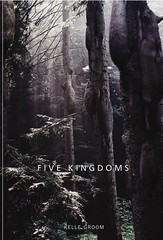
About the Poet:

Kelle Groom’s poems have appeared in The New Yorker, Ploughshares, and Poetry, among others. Her poetry collections are Five Kingdoms (Anhinga Press, 2009), Luckily, a 2006 Florida Book Award winner (Anhinga), and Underwater City (University Press of Florida).

She’s received awards from Atlantic Center for the Arts, The Millay Colony, Sewanee Writers’ Conference, Virginia Center for the Creative Arts, State of Florida Division of Cultural Affairs, Barbara Deming Memorial Fund, United Arts of Central Florida, Volusia County Cultural Council, and New Forms Florida.
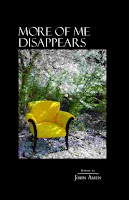
More of Me Disappears by John Amen

John Amen’s More of Me Disappears is broken down into three separate sections and each poem in each section is accessible, vivid, and explosive.  In a number of poems, Amen’s musical and song writing talents permeate the lines.  However, these are more than rhythmic dances, his work gradually moves toward a vanishing point. 

From Verboten (Page 17)

“They are drinking wine and speaking
of French-U.S. relations when the long
sleeve on her arm falls down.  Before
she can clutch it, I see the faded blue
tattoo on her flesh.  “What are those
numbers?” I ask.  A silence explodes
through the room like spores.”

Each poem in this collection tells a story, reflects on a bright memory, and picks these events apart to reveal the truth beneath.  There are times in this volume when the narrator is sure of his path and at other times ideas run contrary to one another.  Some of my favorite lines will leave readers squirming or gritting their teeth.

From Walking Unsure of Myself (Page 65)

“The fortune teller is battling a migraine.
Wind has swallowed my itinerary.

A man in blue goggles is on his knees outside the bank.
The rape victim is scrubbing herself with a steel brush.”

Readers will enjoy the music of these poems and how these poems pop off the pages, with an in your face quality.  Subtlety is not a prevalent style in Amen’s work, but readers will appreciate his frankness.  From poems where the narrator takes an active role to poems to observances from a distance, Amen draws the reader in with immediate and concrete details.  One of the best collections I’ve read in 2009.

New York Memory #3 (Page 36)

“When I get to my dead father’s apartment,
Liz emerges from ruptured planks and exploded plaster.
She is covered with soot, like some pagan baptized
in refuse.  The wrecking crew has come before
we had a chance to vacate the place, stripped the loft
to its skeleton.  My father’s furniture has been destroyed,
a lifetime buried beneath an avalanche of wood and iron.
Beds have been gutted, paintings raped by protruding nails.
A fast-food cup rises from the ruin like a conqueror’s flag.
The apartment is quickly remodeled, rent raised;
the revolving door of humanity spins.  Over the years,
I make a point of knowing who is living there.  I see tenants
come and go.  I accept that we’re not so unlike animals.
I mean, I have this friend who tells me all about bees,
how the queen is revered and protected, ultimately
replaced in a savage deposition, how the mad
hive continues, greater than any one member.
And everything he says sounds familiar, and stings.”

I want to thank John Amen for sending me a free copy of his book More of Me Disappears for review.   For additional examples from this book, visit John Amen’s Web site.

Also, clicking on images and text links to books will bring you to my Amazon Affiliate page.  No purchases are required.

This is my 6th book for the poetry review challenge.

Carta Marina by Ann Fisher-Wirth

Carta Marina was the first largely accurate map of the Northern Countries, completed by the Swedish historian Olaus Magnus in 1539.  Ann Fisher-Wirth has taken her inspiration from this map–complete with its lions, sea monsters, and warriors–for her poem in three parts–Olaus Magnus’ Carta Marina, The Coming of Winter, and Les Tres Riches Neures.

“When I was young, Yeats said, I wanted to take off my clothes,/
now I want to take off my body.” (From April 3. In the Restaurant, Page 61)

Each poem within the overarching three parts of the larger poem, Carta Marina, chart the story of the narrator as she travels through Sweden and the inner heart and soul.  The poems are dated so readers can follow the poet narrator’s progress as they deal with old age, finding a lost love, and incredible loss.

In section one of the poem, readers follow Olaus Magnus on his journey into the north interspersed with email from Paris between lovers.  Fisher-Wirth uses a combination of images and stylistic devices to create her own unique account of a cartographer’s journey, but in some cases, the use of the alphabet was a bit difficult to follow and at times distracting.  Readers may need to sit with these poems, allowing their meaning to simmer to the surface.

“But in the booth facing me the twenty-first child/
chews stolidly, gazing . . ./
lost in whatever dream, as her duckling-colored//

braids bob and her jaws revolve./
Above her pale blue jacket her eyes meet mine;/
I look away, look back, she is watching me./
In this season of coming winter she is my daughter.//”  ( From November 14, Page 33)

The second section of the poem, the narrator is reflecting on her existence and how she relates to those in in her life and life-changing events.  But there is also a reflective self-examination of who she once was and how to reconcile that person who is no longer present with the woman she has become.  From beautiful and mysterious phrases like “icy mercury blackness” to jarring images such as “Three skulls form the base of the table,” readers will transition from thoughtful to alert awe.

In the final third of the book, Fisher-Wirth incorporates some musical rhythm through repetition.  Carta Marina may resemble a cartography of life and aging, but the poem in three parts is a journey, like a journey through the northern lands of Sweden, wrought with harsh weather and rough terrain.  The background story behind the map inspiring these poems is intriguing, but readers could find that they will have to take their time with some of these poems, churning over their images like the Baltic Sea.

December 17, 4 a.m.

I know how to find you.
I go where your sleeping
is filled with the shadows
of leaves, where the leaves have
bled their green,
and all that remain are
their skeletons, nearly
transparent, translucent,
and tissue gone blurred as
the moon among clouds, as
the fur on a moth’s wing,
and tips as if trailing
through water . . .

Such leaves are not common.
In this snowy country
they cherish them, save them,
the white skelettbladen–
like us, they have died, to
become more enduring.

(From Page 47)

I’d like to thank Ann Fisher-Wirth (click her name for my interview) for sending me a free copy of her book, Carta Marina, for review.   Also, clicking on images and text links to books will bring you to my Amazon Affiliate page.  No purchases are required.

This is my 5th book for the poetry review challenge.

Interview With Poet Claudia Burbank

Claudia Burbank recently agreed to an interview with myself and 32 Poems. And here is what she had to say.


How would you introduce yourself to a crowded room eager to hang on your every word?  Are you just a poet, what else should people know about you?

I’ve come to writing after retiring from the corporate world (telecommunications).  I was one of those road warriors you see running through the airport.  I knew I was traveling too much when the airline crew celebrated my birthday.  Lacking a background in English or writing I had to start from scratch.  Reading has been a lifelong delight though. 

I’m a graduate of Vassar College and a 30 year subscriber to the Metropolitan Opera in NYC.  Few people know I’m proficient at wallpapering and installed a tub surround with sliding glass doors by myself.  

I received a Fellowship in poetry from the New Jersey State Council on the Arts, won the Inkwell Award (Alice Quinn, judge), and had my work featured on Verse Daily.  I’ve published about 90 poems so far, most recently in Subtropics, Hotel Amerika, and Passages North.

Do you see spoken word, performance, or written poetry as more powerful or powerful in different ways and why? Also, do you believe that writing can be an equalizer to help humanity become more tolerant or collaborative? Why or why not?

Most writers are better at writing than reading their work aloud which often tends to be dull, interminable, largely indistinguishable and unmemorable.

The written word tends to be more powerful and lasting and easier to grasp.  Studies show that the brain is actively engaged in creating the experience when you read as opposed to being a passive listener.  If your mind wanders you can simply start over. 

On the second question: if only.

Do you have any obsessions that you would like to share?

I tend to be obsessive about most things I do.  This month that includes Ken Ken puzzles, keeping my teeth extra clean, and the adagio from Beethoven’s “Emperor Concerto.”

If you’ve enjoyed Claudia’s answers so far, I suggest you check out the rest of my interview with her over at 32 Poems Blog. Once there, you can find out about her workspace, her inspirations, and much more. Feel free to leave me comments about her interview or your thoughts on poetry in general.

Free Verse: Edgar Allan Poe

Cara at Ooh…Books has started a new meme on Wednesdays called FreeVerse to introduce poetry to new and old readers in a variety of ways.

I took my cue from Cara today and decided to post a YouTube video in which Christopher Walken reads Edgar Allan Poe’s The Raven.

Check it out, feel free to leave your impressions, and please do check out Cara’s Edgar Allan Poe reading by one of my favorites Vincent Price.

Don’t forget Virtual Poetry Circle on Saturdays, every week. Check it out, come participate–no pressure, really!!  🙂

Interview With Poet Ann Fisher-Wirth

From Carta Marina

December 16

Red taillights lead me uphill, downhill—
I watch them from the bus’s steamy window,
pressing my cheek against cold glass
as I’m carried from the airport past fields and factories,
past Märsta in the midnight
where the old men still hunt elk-moose
till bloody haunches fill their freezers.
It’s not this man or this man, not
these golden daughters or this dream-ravened swaddle:
no, it’s the doors closed or the doors opened,
it’s the heart gone night. The gods
stream back and forth across the threshold.
You can ride it, you know,
get on the dark bus and let it carry you.
That’s how I’ve always been, going home, going nowhere—
uphill, downhill, the taillights like rubies,
past fields where the trees are just darker effacings.

Ann Fisher-Wirth agreed to an interview with myself and 32 Poems. And here is what she had to say.

How would you introduce yourself to a crowded room eager to hang on your every word? Are you just a poet, what else should people know about you?

I’d never say anyone was “just” a poet, because a poet is a pretty amazing thing to be. But writing poetry is not the only thing I do. I teach American literature, poetry workshops and literature courses, and a wide range of courses in environmental studies at the University of Mississippi.

I also teach yoga, and that is a really important part of my life. I’ve been married for nearly 26 years to Peter Wirth. We have five grown children—mine, his, and ours—and rapidly expanding numbers of grandchildren. We live in a very cool old Victorian house with two huge pecan trees in front of it, in Oxford, Mississippi.

I’ve lived in the South for almost 30 years, but I grew up first as an Army brat all over the world, and then in Berkeley, California, so I love to travel and hold many places in my heart.

Do you have any obsessions that you would like to share?

Environmental issues and consciousness-raising are my obsession. Truly they are. I am convinced from everything I’ve read that we have very little time left before we reach a catastrophic tipping point for life on earth. We may already be there.

One helpful book is Lester R. Brown’s Plan B 3.0: Mobilizing to Save Civilization, which can be downloaded free from the Earth Policy website, and which fully documents how desperate a situation we humans have created environmentally, and how thorough-going and rapid our response must be—far beyond anything now being considered by those in power.

In terms of friendships, have your friendships changed since you began focusing on writing? Are there more writers among your friends or have your relationships remained the same?

It’s true, most of my friends are writers, and if they are not writers they are professors. I have gotten to know hundreds of writers since I began focusing on writing, and some of them have become wonderful friends.

I’m also very close to a number of people I know through the Association for the Study of Literature and Environment—again, writers and academics. But how could I escape it? My mother was a teacher, my sisters, brother-in-law, husband, and two of our five children are all teachers. It’s a great way to live.

If you’ve enjoyed Ann’s answers so far, I suggest you check out the rest of my interview with her over at 32 Poems Blog. Once there, you can find out about her workspace, her inspirations, and much more. Feel free to leave me comments and discuss Ann’s work (sampled above), her interview, or your thoughts on poetry in general.

Interview With Poet Thomas Stemmer

Thomas Stemmer recently agreed to an interview with myself and 32 Poems. And here is what he had to say. 

How would you introduce yourself to a crowded room eager to hang on your every word? Are you just a poet, what else should people know about you?

I cannot imagine a crowd eagerly listening to poetry. However, in 2008, when I was invited to a conference in Pakistan, I took part in a Mushaira (a traditional poetry reading), and indeed, everybody was very eager to listen. Even a peasant there knows verses of – let’s say – Rumi or local poets for example. This is incredible. But, I am just a poet, yes, a romantic in a way.

Do you have any obsessions that you would like to share?

Yes: My mechanic typewriter. I JUST LOVE IT!

From Shortest Poems these Days:

The Law of Grace
There is
Some good fat
Bavarian sausage
In the refrigerator.


Poetry is often considered elitist or inaccessible by mainstream readers. Do poets have an obligation to dispel that myth and how do you think it could be accomplished?

Poetry is not elitist. If you WANT to read poetry, you can. Everybody is responsible for himself. The accusation of elitism is just an excuse to cover up a certain – maybe unconscious – unwillingness, I suppose.

Do you have any favorite foods or foods that you find keep you inspired? What are the ways in which you pump yourself up to keep writing and overcome writer’s block?

Foods? No. But in order to overcome a writer’s block, I use to draw, to make collages on paper or to do more of my scientific work as a orientalist. On of these doors is always open. In case of poetic emergency: hours of daydreaming! That helps ALWAYS.

If you’ve enjoyed Thomas’ answers so far, I suggest you check out the rest of my interview with him over at 32 Poems Blog. Once there, you can find out about his workspace, his inspirations, and much more. Feel free to leave me comments and discuss Thomas’ work (sampled above), his interview, or your thoughts on poetry in general.

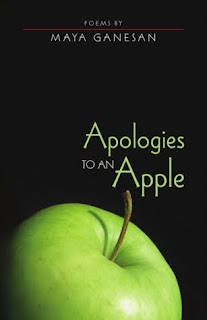
Apologies to an Apple by Maya Ganesan

Apologies to an Apple by Maya Ganesan is a breath of fresh air in contemporary poetry.  At eleven years old, Maya has a crisp style and is very observant and critical.  Her poems do not criticize overtly, like some poets that tend to hammer their messages home.

“They see the horizon, a smoky gold line
over the sea,
and call it names like faraway and
we’ll-never-reach-there.
To them,
horizon is a dream” (From Ash-Colored, pg. 10)

In these simple lines, the narrator observes the horizon in terms of what it means, its location, and how it is perceived by others.  It is an unattainable destination or a dream.

Maya uses short lines to let readers examine the images and statements and discern their own meaning–the greater meaning.  Readers will be reminded of William Carlos Williams‘ short lines, but Ganesan’s work holds a veiled innocence.  For such a young age, Ganesan has an old soul with a great deal of wisdom.  Some of these poems will make readers blush with their self-imposed innuendo.

A Message for You (Page 21)

I have traced your name
with
my finger

on the steamy
glass doors surrounding
the shower.

Readers will find poems to treasure, to savor, and to hold close to their hearts in this slim volume.  As a debut book of poetry, it stands tall among a vast crowd, waiting for readers to hear its whisper.

Yesterday (Page 24)

Yesterday is one book,
today is another.

Different books, telling
different stories.

I like to be part of 
both yesterday and
today, falling out of

one, tipped into
the other.

Her poem, September, was recently showcased in this past weekend’s Virtual Poetry Circle.  Readers enjoyed how the narrator speaks of trees as having souls and feelings.  It is a great commentary on how little we pay attention to the environment and its importance.

Susan at ColorOnline let me borrow her signed copy of Ganesan’s work for this review, though I did first read about this poetry book on 5-Squared.  I’m going to have to get my hands on another copy for myself.

Also Reviewed By:

5-Squared
Book of Kells
ReadWritePoem (also has a list of virtual tour sites for the book)

4th book for the poetry review challenge.


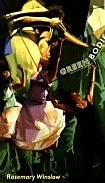
Green Bodies by Rosemary Winslow

Rosemary Winslow’s Green Bodies is divided into three parts, with the first section of poems steeped in deep grief and struggle for understanding following the death of a brother. From “To a Fish” (Page 14-15), “I see a knife/once put to me,/bone opened white to daylight,/red floor on concrete.” Many of these poems have an inner rhythm and musical quality, though the music is dark and somber.

The second section’s narrator begins with poems of cutting oneself off from the outer world and possibly the grief felt in the first section. From “The Gothic Truth” (Page 40), “not making a sound, she watches the grindstone/wobbling hung turning him spitting not stopping/” Throughout the second section, the poems examine the paralysis felt by the narrator by that oppressive grief. From “Carnal” (Page 37), “crumpled and blooded she curled/under a stairwell in hay”

In the final section of this volume, the narrator is rising from the darkness and turmoil of grief to find a way to move on, evolve, and become a stronger self. Readers will enjoy the complexity of these poems, their deep secrets, and highly emotional language.

5 a.m. (Page 54-55)

I rise from a wreckage of sleep
again the long blind scarf of grief

and yesterday and yesterday’s
gunmetal page

the porch lights hiss
at the shroud-hung sky

I go down the stairs to the garden
to be where the roses are leaning

heavy and sweet on the long fence
I lift my face from burial

into burial in the softness of flowers
that is like the skin under the necks of animals

tears shine
in the small white crosses

in their fire centers
the start clematis has made

and entered on
the dead espaliered pear

suddenly I am
jarred

wheep and again
wheep wheep I hear

hidden birds
coming alive

one by one
in the trees

thick pollen of light
undraping the roof lines

composing the sky

This is my 3rd book for the poetry review challenge.

Interview With Poet Rosemary Winslow

Going Home
by: Rosemary Winslow

There is no going home
as usual

the vehicle stalls

in reverse gear

in mud tracks

as essential as
the flat fields, the blades

of shadowed pines over the drive,

the sun bleeding

from the west.

On the rise the house,
painted clapboard, the color of cream,

is rented now like bodies

of water and minerals made

living by some miracle

which is to say some process
we don’t understand.

Some day we’ll have a

different owner,

a different lover,

pine trees and whirling wind
that primitive communion

a new testament

of each generation.

All going home is never going back—

there may be ruin and mud tracks
deep to make wheels spin. The only way

is slogging on,

or else walking

on water.

Or yet it may be dry
the sand flying in your nostrils

but you must breathe, must go, must go

on, which is to say, go on making

required visits, like stations

of a cross. It is a way
of finding what we lost

or never had, of learning we are only

renters, and making new covenants,

going where we belong.

Rosemary Winslow recently agreed to an interview with myself and 32 Poems. And here is what she had to say.

1. Not only are you a contributor to 32 Poems, you are also a professor of literature and writing at The Catholic University of America and have won the Larry Neal Award for Poetry twice. Which of these do you find most rewarding and why? Could you explain how you felt about winning the Larry Neal Award and how that came about?

Serena, I want to thank you for the opportunity to think more about what I do as a poet and why. I’ve been fortunate to have many poems published in 32 Poems and other really fine places. And, yes, I’ve won the Larry Neal Award for Poetry three times–third place in 2001, second place in 2002, and first place in 2006. Awards can be a wonderful affirmation of one’s work, and I’ve been pleased that there are folks out there who like poems I’ve written. I wish there were more awards and more recognition for others who write at least as well if not better than I get less recognition.

I also love teaching, especially teaching poetry. To work with students in small classes–which I’ve been given the good fortune and opportunity to do–is enormously rewarding. I’ve stayed in touch with many of my former students through the years—I get to experience the amazing transformation of students into friends, each time as interesting and unique as a poem Opening up ways of reading, both understanding meaning and also the other forces at work in fine poems, is a real joy. I feel it enriches students’ lives, and teaching them certainly enriches mine. I can’t say which is most rewarding. They go together. I couldn’t teach what, nor the way, I do if I weren’t writing poems.

The first excellent teachers and critics of literature in the U.S. were writers, they started this business and I’m pleased to be able to do in some measure what they did and envisioned for the future. Writing literature gives a teacher the capacity to teach poems from the inside, from the perspective of how they are made, how they are put together. It’s possible to teach poems as poems, as made, and verbal art, in a way not possible without knowing how to make them.

2. Do you have any obsessions that you would like to share?

Obsessions? I haven’t tried to discover what obsessions I might have. I try to confine my obsessiveness to poetry, to getting every word, line, mark of punctuation perfect, which is a way of saying a poem’s done, finished, it looks and feels right to me. Poetry’s a good place for that, much better than in other areas of life! Eamon Grennan once said a particular long poem of mine was obsessive when he read it in draft. “Obsessiveness is good,” he said. He meant, in poetry, and that’s fine with me to have it if it makes for good art. As long as it enriches instead of dampening my life!

3. What current projects are you working on and would you like to share some details with the readers?

Right now I’m working on poems about a week last month when my mother died. I’ve never written about experiences so close in time to their happening before, and I was surprised that I both felt pressured to and could actually write so soon. The experience was so intense, because I stayed with her during her last two days and nights. The sheer physicality stripped away from everything that normally occupies us, and the huge emotional range were so indescribable that I found I was too restless to sit still, or even think straight, afterward. Then one afternoon I decided to sit down and try to write poems about that week, and from that moment the restlessness ceased and hasn’t returned.

Before my mother died, I had been working on a series of poems about genocide, and then some poems that I still don’t know what they are about. Something inner, but expressed in a kind of half-surrealistic half-realistic imagery taken from nature. I grew up immersed in nature on the farm, so my mind naturally goes there. I’ve lived in cities for 20 years, but I’ve given up hoping I might write much urban poetry.

If you’ve enjoyed Rosemary’s answers so far, I suggest you check out the rest of my interview with her over at 32 Poems Blog. Once there, you can find out about her workspace, her inspirations, and much more. Feel free to leave me comments and discuss Rosemary’s work (sampled above), her interview, or your thoughts on poetry in general.

About the Poet:

Rosemary Winslow is on the faculty of the Catholic University of America, where she teaches writing and literature, and where she has directed writing programs for 19 years. Based on her work, which has appeared in numerous literary magazines and anthologies, she has received a residency grant at the Vermont Studio Center as well as a writer’s grant and three Larry Neal Awards for Poetry from the DC Commission on the Arts & Humanities. Her latest book is Green Bodies.

Becoming the Villainess by Jeannine Hall Gailey

Jeannine Hall Gailey‘s Becoming the Villainess is a unique volume of poetry housing poems steeped in Greek mythology, comic book characters, and more.

Gailey’s images are crisp and immediate with recurring uses of pomegranates, wolves, and other items. Alice in Wonderland, Wonder Woman, Persephone, and many more make appearances in Becoming the Villainess, which is separated into five parts. At the end of the book, Gailey includes brief descriptions of the myths inspiring the poems enclosed within its pages.

From “Female Comic Book Superheroes” (Page 5)

Impossible chests burst out of tight leather jackets,
from which they extract the hidden scroll, antidote, or dagger,
tousled hair covering one eye.

They return to their day jobs as forensic pathologists,
wearing their hair up and donning dainty glasses.
Of all the goddesses, these pneumatic heroines most

resemble Artemis, with her miniskirts and crossbow,
or Freya, with her giant gray cats.
Each has seen this apocalypse before.

Each section in Becoming the Villainess examines the evolution of female characters from innocent girls to darker, vengeful women, but these characters are deeper than stereotypical comic book characters, mothers, and goddesses. While some of these poems have a lighter, tongue-in-cheek quality to them, some of them drive home the deep dark horrors found in many legends, myths, and real-life events. One particularly jarring poem in the collection is “Remembering Philomel,” in which a professor is asking for grittier details of the narrator’s sexual assault.

Becoming the Villainess by Jeannine Hall Gailey is a wonderfully insightful collection that looks beneath the surface of myths and sexy comic book characters to find their motivation, their desires, and spunk. If this is your kind of poetry, you should pick it up. I count this among the best of contemporary poetry that I’ve read this year. If you missed my interview with Jeannine Hall Gailey, go check it out.

About the Poet:

Jeannine Hall Gailey was born at Yale New Haven Hospital in Connecticut, and grew up in Knoxville, Tennessee. She has a B.S. in Biology and an M.A. in English from the University of Cincinnati, as well as an M.F.A. in Creative Writing from Pacific University.

Her first book of poetry, Becoming the Villainess, was published by Steel Toe Books in 2006. Poems from the book were featured on NPR’s The Writer’s Almanac and on Verse Daily; two were included in 2007’s The Year’s Best Fantasy and Horror. She recently taught with the Young Artist Project at Centrum. In 2007 she received a Washington State Artist Trust GAP Grant and a Dorothy Sargent Rosenberg Poetry Prize. She volunteers as an editorial consultant for Crab Creek Review, writes book reviews, and teaches at National University’s MFA Program.

Her inspirations often come from mythological sources, such as Ovid’s Metamorphoses or The Tales of Genji, folk and fairy tale collections, and of course, comic books.

This is my second book for the poetry review challenge.

Interview With Poet Jeannine Hall Gailey

When Red Becomes the Wolf

In my dream you brought me fried bologna sandwiches.
“But wait,” you said, “You don’t even like bologna.”
I wolfed them down without answering.

I have never owned a red cape,
that’s asking for trouble, I knew.
In the forest by your house,

I met someone gathering wood. “Nice axe,”
I said before wandering further.
I was obtaining samples for my botany class.

How many daisies make a statistic?
I thought of Persephone, her dark gash
that allowed Hades passage. Which flower?

I was hungry, and tired. I entered someone’s
cottage, it was dark, and there was an old woman.
I volunteered to take her to get her hair done.

Alone, I mentioned I was born under the sign
of Lupus. “No,” she corrected, “Lupae.”
Later, eating sandwiches, we discussed you

and also whether I could wear her fur coat.
“It makes you look feral, with your green eyes,”
she said. Oh grandmother, what a big mouth you have.


I recently had an opportunity to interview Jeannine Hall Gailey, author of Becoming the Villainess, in conjunction with 32 Poems. The interview will be partially posted at Savvy Verse & Wit and in full at 32 Poems Blog. Without further ado, here’s what Jeannine had to say.

1. Not only are you a contributor to 32 Poems, you teach at National University’s MFA program, have published several poetry books, and volunteer on the editorial staff at Crab Creek Review. What “hat” do you find most difficult to wear and why?

I found out that despite years of resisting it, I actually adore teaching, especially teaching poetry, so I feel really lucky to be doing a little bit of graduate student teaching at National University. For me, writing and reading poetry can consume all my time, so it’s important to balance out the poetry work with paying freelance gigs and volunteering – I’ve been a volunteer in some capacity for local literary magazines for about ten years, first with Raven Chronicles, then The Seattle Review, then Silk Road (out of Pacific University) and now Crab Creek Review, which is run by some excellent editors that are also good friends. I really want to help them succeed. My hardest hat to wear is usually whatever I’m doing for money – it’s easy to get distracted by all that unpaid poetry work! I’ve been trying to do more freelance work that involves poetry – essays, interviews, articles, etc. – to kind of stave off that poetry-addict problem.


2. Could you explain your shift from an interest in biology as an undergrad to your current proclivity to literature and poetry today as an MFA graduate?

Well, I wanted to be a holistic doctor – a bit of a weird goal for someone back in 1991 — but I ended up getting sick so often while volunteering for various hospitals around campus that my doctor advised me that medicine might not be an ideal career for me. So my health problems led to me become a technical writer after getting my degree in biology, combining my love of writing and science/technology, then to life as a professional writer, editor, and manager for some big companies during the tech boom, and finally to getting back to one of my early dreams – writing poetry.

As a kid my mother encouraged me to read and memorize poetry, and my fifth-grade teacher had me bring in new poems every day, to get me in the habit of writing and revising poetry. So I think I reverted to my early training in my late twenties, and ended up going back to school – first, for an MA at University of Cincinnati, then, some years later, for my low-res MFA at Pacific University. I was fascinated by the critical work at UC, where I found out about things like “feminism” and “intertextuality” but I have to say my experience at Pacific was much more liberating and, well, it was a lot of fun to focus on my own writing for two years.

I’m still very interested in environmental science, and things like the science of virology or medical botany. I still read a lot of academic science journals just for kicks. Science creeps into my poetry every once in a while.

3. Poetry is often considered elitist or inaccessible by mainstream readers. Do poets have an obligation to dispel that myth and how do you think it could be accomplished?

I think that people who consider poetry elitist or difficult just haven’t been exposed to enough poetry. People often encounter poetry once, in high school – and form their opinion for life – probably from a sample of high modernism or poetry written hundreds of years ago; no wonder they consider it difficult!

In today’s poetry world, there are so many diverse forms and types of poetry, that there really is something for everyone. In my chapbook and first book, I worked consciously to write poetry that would be appealing and accessible to a contemporary high-school or college student – I thought poetry about superheroes and video game characters might be interesting to them. Of course, there are references to Greek and Roman mythology and 16th-century fairy tales in the book too, so I guess I couldn’t make it all too easy. I think I was using my little brother as my “ideal” reader – someone who is intelligent, who grew up playing on the computer, who was well-versed in popular culture, who was a reader, but might not pick up a book of poetry unless he liked the subject matter.

And, I should also say that when my little brother was 17 and a bit of a…hoodlum, I dragged him and some of his friends to a Louise Gluck reading – this was back when she was promoting Meadowlands. There we were in the back of the room, this bunch of teenage boys dressed in black and me. But they loved it. My brother still has her book. So you can never assume that you know what a reader might understand or enjoy. I believe we should trust readers more, not less.

I wouldn’t prescribe that all writers should try and be “accessible;” I actually like poetry that makes me work a little bit, hunting down references or making imaginative cognitive jumps. Every writer has to stay true to their own style.

4. What current projects are you working on and would you like to share some details with the readers?

I’m working on finding a good home for two manuscripts, one on Japanese folk tales and anime characters, another called “Unexplained Fevers” about fairy tales trapped in sleep states – Sleeping Beauty, Snow White, and Rapunzel. And I’m working on yet another manuscript that focuses on the history of Oak Ridge, Tennessee and my own personal history growing up there: my father, a robotics scientist and professor, consulted for Oak Ridge National Labs while we lived there. It’s probably the most personal work I’ve written.

I’d also like to get more involved in the local poetry community here in San Diego. It’s not quite as diverse or lively as the poetry community in Seattle, but I want to be an active part of it in some way. Someday, when I have enough money and time, I’d like to start my own press.

If you’ve enjoyed Jeannine’s answers so far, I suggest you check out the rest of my interview with her over at 32 Poems Blog. Once there, you can find out about her workspace, her obsessions, and much more. Feel free to leave me comments and discuss Jeannine’s work (sampled above), her interview, or your thoughts on poetry in general.

Also, stay tuned for my review of Becoming the Villainess.

About the Poet:

Jeannine Hall Gailey was born at Yale New Haven Hospital in Connecticut, and grew up in Knoxville, Tennessee. She has a B.S. in Biology and an M.A. in English from the University of Cincinnati, as well as an M.F.A. in Creative Writing from Pacific University. Her first book of poetry, Becoming the Villainess, was published by Steel Toe Books in 2006. Poems from the book were featured on NPR’s The Writer’s Almanac and on Verse Daily; two were included in 2007’s The Year’s Best Fantasy and Horror.

She recently taught with the Young Artist Project at Centrum. In 2007 she received a Washington State Artist Trust GAP Grant and a Dorothy Sargent Rosenberg Poetry Prize. She volunteers as an editorial consultant for Crab Creek Review, writes book reviews, and teaches at National University’s MFA Program.