Quantcast

Interview With Poet Steve Schroeder

In conjunction with 32 Poems Blog, Savvy Verse & Wit continues to bring you interviews with contemporary poets. Please welcome, Steve Schroeder.


We Never Did Anything

by Steve Schroeder

Previously Published by Copper Nickel

We never did anything bad to him.

He never did anything bad to us, he said, he cried, he lied.

He hit the reset button.

We hit the wall with him.

We taught him to shout shit at the neighbors across the street.

He learned his words with fucking Cocoa Puffs.

He squeaked when squeezed.

We named that disease for him.

We slingshotted golf balls and ball bearings.

He bundled up in blankets and blundered through the dark.

We were a bear hungry under the stairs.

He hid the hummingbird feeder syrup.

He pounced from the ceiling fan as it spun.

We grabbed the scruff of his rubber chicken neck and shook.

He stuffed himself with fluff and hot lightbulbs.

We wrapped him in subliminal tape while he slept.

We unzipped his chest.

He was completely hole.

He never did anything bad.

We never did anything worse.

1. Not only are you a contributor to 32 Poems, but you also have a new book, Torched Verse Ends, coming out soon. Please share a bit about your experience writing the book and about how many poems you previously published that are included in the book. (And anything else you would like to share.)

Torched Verse Ends, now out from BlazeVOX, is my first book. It contains poems written from 2003 through 2008, though far from all the poems I wrote or published in that time. It’s evolved a lot since I started sending it out in 2006, when it was not yet remotely ready to be a book. The experience of writing the overall book boils down to “Whoa, I might be able to organize these poems I’ve been writing into a book,” then “God, why did I ever think this was a good way to organize a book?”

2. Do you see spoken word, performance, or written poetry as more powerful or powerful in different ways and why? Also, do you believe that writing can be an equalizer to help humanity become more tolerant or collaborative? Why or why not?

For me, the sonic and textual aspects of the best poems are inextricable, but reading a poem on the page and hearing the same poem can be vastly different experiences depending on the speaker. If you’re not a particularly good reader, do something besides reading straight into the page in a monotone, even if it’s setting off firecrackers mid-poem.

If writing improves humanity in any way, it’s going to be incidental at best and most likely completely accidental. Sure, occasionally a didactic piece like The Jungle or Uncle Tom’s Cabin achieves its goal, but mostly it’s just bad literature. That’s not to say you can’t address political or social issues, but good writing has to be paramount over trying to change the world.

3. Do you have any obsessions that you would like to share?

Almost anything I do, I do obsessively: Reading and trying to write speculative fiction and Watching and quoting The Simpsons. Fire’s another obsession, to judge by the first book. Poker, Scrabble, basketball, Competition. Publishing poetry happens to be a fun competitive game I’m pretty good at.

Check out the rest of the interview with Steve at 32 Poems Blog, here.

Interview With Poet Alexandra Teague

In conjunction with 32 Poems Blog, Savvy Verse & Wit continues to bring you interviews with contemporary poets. Please welcome, Alexandra Teague.

Nose Bleeds
by: Alexandra Teague
Previously published by 32 Poems and forthcoming in Mortal Geography (2010)

When I was the poor girl at the private school, I imagined the rich

living at higher altitudes where the air was thinner. This explained

why the girls with new penny loafers lay like swooning princesses

in the nurse’s office, their heads tilted back, nostrils trickling red

threads of refinement. They would return to class, collars stained,

Russian royalty like the hemophiliac Romanovs of whom I was

only a namesake, not an heir. At recess in winter, snow-white

kleenex drifting from pockets, white rabbit fur jackets. Years later,

my classmate, daughter of Texas’s largest fur fortune, stabbed

her father to death for money and was sentenced for life. She’d played

the mother in our 4th-grade melodrama. As her daughter, the heroine,

I could pretend to be frail. My nose never bled, no matter how

I willed thick veins to weaken. I blamed my mother, granddaughter

of a housekeeper, our ruddy bloodline that kept surviving surviving.

1. How would you introduce yourself to a crowded room of listeners hanging on your every word? What would you tell them and what wouldn’t you tell them and why?

My standard self-trivia is that I’ve visited all 50 states; I’ve also lived in 8 of them. I’ve always had a strong sense of impermanence and a wariness about getting too comfortable in one version of reality.

For years, I’ve had a hard time explaining where I’m from. Oakland is pretty homey right now, although I’ve been claiming since I moved to the Bay Area 8 years ago that I’m on my way somewhere else. I definitely love traveling: Oaxaca, Guatemala, the Kalalau Trail in Kauai, Japan.

A couple of summers ago, my boyfriend and I hiked all 220 miles of the John Muir Trail through the High Sierras. We love hiking, but we didn’t really know what we were getting into and spent a lot of our time trying to figure out how to quit. In the end, 19 days of hiking and camping was one of the most powerful, transformative things I’ve ever done. I might admit that some of my friends roll their eyes now when I say that I’m going on a trip. I’m always complaining about not having enough writing time, but the minute I get a break from teaching, I climb on a plane or pack my hiking gear. I know I might be more productive if I stayed put occasionally, but there’s too much of the world left to see.

2. Do you have any obsessions that you would like to share?

Besides maybe traveling, I don’t think of myself as having obsessions, but I can actually get pretty obsessive once I immerse myself in a project: whether it’s cleaning the house, or grading a papers, or writing a poem. Poems are definitely the worst. I always think, “I’ll just work a little more on this line, and then I’ll take a break. . . Oh, except I’ve almost got this next part, so I’ll just work on that and then I’ll stop for lunch. Oh, I’m so close to being finished, and I’ll really, really stop by dinner time. . . “ And then suddenly it’s dark, and I haven’t eaten, and I’m still changing words and line breaks in the zillionth penultimate draft.

3. What current projects are you working on and would you like to share some details with the readers?

I’m starting to draft some poems for whatever comes after Mortal Geography. I definitely didn’t know I was writing that manuscript until many years into the process, so it’s strange to be starting a little more self-consciously. I have several ideas for themes, but am also not really sure I’m the kind of writer who can, or will, delve into a single theme. I guess we’ll see. I’ve also been working on a novel for a couple of years; my mental deadlines keep getting extended, but I’m hoping to finish a draft of it this year. It’s a magical-realist story set in Arkansas—nothing that I thought I’d ever write, and I’m having an amazingly fun time with it.

Read some of Alexandra Teague’s poems.

Check out the rest of the interview with Alexandra at 32 Poems Blog, here.
Also, have you checked out my latest article on the Examiner? Here’s my D.C. Literature Examiner posting about YA novels in verse or the Michael Jackson Biography Comic.

Don’t forget my giveaways: 2-year Blogiversary, here and here and here.

Interview With Poet H. L. Hix

Welcome to another 32 Poems Blog and Savvy Verse & Wit interview. This time, we have Harvey L. Hix, author of Legible Heavens and other poetry volumes.

1. Not only are you a contributor to 32 Poems, you are also a professor of English at the University of Wyoming. What “hat” do you find most difficult to wear and why?

The teaching, definitely. In my writing, I feel accountable, certainly, but to myself, to standards of integrity that feel as though they come from inside. In my job as a professor, though, I am accountable to the University that employs me (and ultimately to the citizens of the state whose university it is), and — more importantly — accountable to the students. I find those forms of accountability, which feel as though they impose themselves from outside, more difficult.

We live in a world populated by forces that conspire to reduce us to consumers (in which capacity it is crucial that we not think and that we not establish a unique identity), and, rightly or wrongly, I see the university as one of the few counter-forces resisting that conspiracy. Because the responsibility of resistance seems so vast, so far beyond the capacity of any one person to effect, teaching feels very oppressive to me. In the moment, conversing with students in the classroom, it is joyful, almost ecstatic, but as an ongoing fact and a duty, I find it intimidating, even overwhelming.

2. Do you see spoken word, performance, or written poetry as more powerful or powerful in different ways and why? Also, do you believe that writing can be an equalizer to help humanity become more tolerant or collaborative? Why or why not?

I myself have more interest in written poetry, because I want to be able to slow down, to re-read, to find my own path and pace through the work. And I do trust the expanded and clarified logic of the written, the complexity of thought it makes possible, which means that, yes, I think writing can/does invite tolerance and collaboration, can/does advance equality and liberty, in principle, though for various reasons I’m less certain of its doing so in fact. I’m influenced on this issue by Neil Postman’s Amusing Ourselves to Death, by Eric Havelock’s Preface to Plato, and other works.

3. Do you have any obsessions that you would like to share?

My poetry results from my obsessions, but surely the world is a better place if I don’t find any additional ways to enact or announce my obsessions.

To check out the rest of my interview with Harvey, go here. Harvey will tell you about his friendships, how he stays healthy as a writer, his writing space, and his current projects. Check out the 32 Poems Blog while your there, too.

About the Poet:

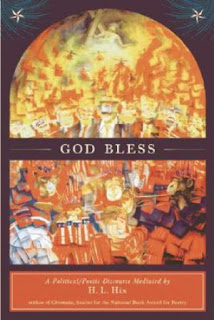
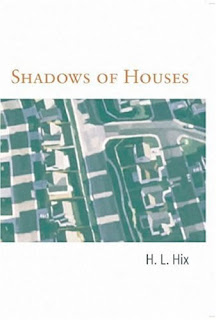
Recent Poetry Collections include God Bless: A Political/Poetic Discourse, Chromatic, which was a finalist for the 2006 National Book Award in Poetry, and Shadows of Houses, all from Etruscan Press. Translations include On the Way Home: An Anthology of Contemporary Estonian Poetry, translated with Jri Talvet. Other books include As Easy As Lying: Essays on Poetry (Etruscan) and Spirits Hovering Over the Ashes: Legacies of Postmodern Theory.

Honors & Distinctions: NEA Fellowship, KCAI Teaching Excellence Award, and the T.S. Eliot Prize

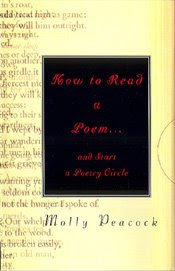
How to Read a Poem. . . and Start a Poetry Circle by Molly Peacock

“I found grown -up poetry to be as spongy as a forest floor–your foot sinks into the pine needles, the air smells mushroomy and dank, and filtered light swirls around you till you’re deep in another state.” (Page 8)

Molly Peacock’s How to Read a Poem . . . and Start a Poetry Circle provides a great deal of information in just 200 pages–from how to interpret poems to how to create a poetry circle and join the ranks of those dipping their feet into the poetic pool.

“Yet as strangely contemporary as this art has become, it involves a timeless childhood pleasure: rereading.” (Page 13)

Peacock clearly knows her stuff from writing verse to examining its structure and images. She postulates that any poem can be examined in three simple steps. Examine the poem line-by-line, which she notes is considered the skeleton of the poem. Examine the sentence, which readers could consider the muscles of the poem. Finally, readers should examine the image or nervous system of the poem. However, Peacock does not suggest that readers pick apart each element of a poem and discuss it ad nauseam.

“This shimmering verge between what is private and what is shared is the basis of a poetry circle. A poetry circle (which is very different from a writing workshop, where people bring in their own poems to be critiqued by one another or by a teacher) occurs when the mutual reading of poetry is at hand. For me, the circle has its beginnings in the side-by-side reading of a poem by two people.” (Page 16)

A number of chapters examine a number of poems, their images, their rhythms, and their internal music. Beyond the application of these techniques on actual poems, Peacock illustrates the beauty of poetry circles, how to start poetry circles, and provides readers with resources to begin their own poetry circles and how to select poetry for discussion in these circles.

“You never know what’s going to catch your finger–or your eye. You needn’t ever be comprehensive about a book of poetry.” (Page 191)

These groups are not like book clubs where copious notes should be taken and entire books should be read. The purpose of a poetry circle is to generate a mutual respect and joy for each line of verse.

After reading this book, I’m going to try an experiment. I want to create a virtual poetry circle. I’ll post a new poem each week for people to read and comment about what they enjoyed about a line, a stanza, or the entire poem. Comments can range from what is good about a poem to what readers don’t like about a poem. Share your thoughts, opinions, and vision of the poet’s work. I’ll probably post these each Friday or Saturday, so keep an eye out.

This is my 1st book for the poetry review challenge.

C.O.R.A. Diversity Roll Call–Poetry

The assignment for C.O.R.A. Diversity Roll Call is:

Your assignment is to post a poem in a form unique to a particular country, an example would be the sijo (Korea), haiku (Japan) or American Sentence (this is a single line of 17 syllables like a haiku. Created by Ginsberg).

Another option: post a favorite poem by a poet of color. Tell us a little about the poet and the poem.

Last option, post a poem that celebrates a particular country or culture. Tell us why you enjoy this poem.

Please cite the collections for your entries. Let us know if you own the collection containing your feature.

I’m going to go out on a limb here and post one of my previously published poems, which is in cinquain form, which is an American, five-line form inspired by Japanese Tanka and Haiku.

Baccantes
by: Serena M. Agusto-Cox

Red moon
burns in afternoon.
Char the meat upon ice,
Grin like frozen peas in the night,
and dance

Published in LYNX XVIII:3 SOLO in 2003.

What forms of poetry are your favorites and what makes you want to read them?

For me, Cinquain and Haiku are challenging because they are short and require a syllable count. Restrictions can sometimes help me think outside the box, while at the same time critically thinking about how I can fit images and ideas into a constricted space.

Don’t forget my current giveaways:

2-year Blogiversary, here and here.

Interview With Poet Sidney Wade

Welcome to the latest edition of my interviews with poets with 32 Poems magazine. The full interview with Sidney Wade was posted at 32 Poems Blog on May 11. Check out one of Sidney’s poems and then check out the interview below.

Sexual Blossoms and Their Fierce Addictions

Yesterday’s tulips in the crystal bowl

have begun to open and already they’ve

partially exposed their pistils and stamens.

In the coming days

these petals will open in a brazen

yawn, their private parts thrust

into the shocked and fascinated

room. Very soon the whole

apartment will start to misbehave–

the fainting couch and ottoman will shed their raiment,

weirdness will graze the ceiling and raise

eyebrows in the carpet lice. With sex emblazoned

on the air, the afflicted chamber will swell with lust.

A hystericalectomy is clearly indicated.

1. Not only are you a contributor to 32 Poems, you have authored five collections of poetry, edit Subtropics, and teach a variety of poetry courses. Which of these “hats” do you find most challenging or rewarding and why?

It’s nerve wracking work, writing poems, but when the work gets good and gets going, there’s nothing better in the world. So that’s probably the most challenging and rewarding at once. Editing Subtropics is easily the most simply rewarding, as I get to see, every week, every month, what very fine poems are being written around this country these days. And being able to tell people you’d like to publish their work elicits marvelously joyful responses. Who couldn’t love a regular influx of extremely happy emails? And teaching has its own pleasures and difficulties, the former fantastically outweighing the latter, thank goodness.

2. Do you have any obsessions that you would like to share?

Hunting for mushrooms. Cooking mushrooms. Pasta. Cheese. Practicing and improving, slowly, on the viola.

3. In terms of friendships, have your friendships changed since you began focusing on writing? Are there more writers among your friends or have your relationships remained the same?

Not really. Since I’ve been writing and teaching, my daily life tends to revolve around other writers, students, colleagues, etc., so by default those are the folks I get to know. My non-writer friends, however, are still with me, and always will be. Segregation is never a good idea.

4. How do you stay fit and healthy as a writer?

By reading, reading, reading.

5. What current projects are you working on and would you like to share some details with the readers?

I’m trying to find time to finish translating a book-length selection of the poems of Melih Cevdet Anday, an important Turkish poet. I also have completed about half or two-thirds of a book, tentatively entitled “run-on” which, if I can do it, will end up an entrancing and very long, skinny poem that just goes and goes and goes.

Grand Disastery

moored by fine

tethers to certain death

a hornet fizzes

on the windowsill

a spider flies

to its side

to securely bind

this abundant harvest

the hornet in shrill

thrall to agony drills

a hole in God’s

provident breast

pocket

in the sublime

cold light

of this tiny

constellation

the bald pulp

of the hornet’s diminishing

hum feeds growing eyes

and hungry sockets

the figure is clean

a small

black aster

hung among

the stars

Want to find out what Sidney’s writing space looks like? Find out what she thinks about contemporary poetry and popularity and much more. Check out the rest of my interview with Sidney here. Please feel free to comment on the 32 Poems blog and Savvy Verse & Wit.

About the Poet:

Sidney Wade is the author, most recently, of Stroke (2008) and Celestial Bodies (2002). Wade edits poetry for Subtropics, a magazine published by the University of Florida. From 2006-2007, she served as President of the Association of Writers and Writing Programs (AWP).

Don’t forget my giveaways:

1 copy of Rubber Side Down Edited by Jose Gouveia, here; Deadline is May 15 at 11:59 PM EST

2 copies of The Last Queen by C.W. Gortner, here; Deadline is May 22 at 11:59 PM EST

Interview With Poet Clive Matson, Author of Mainline to the Heart & Other Poems

I recently reviewed Mainline to the Heart & Other Poems by Clive Matson for National Poetry Month, if you missed it, go check it out, here.

Clive was good enough to take the time, read my review, email me a little compliment, and submit to some unorthodox interview questions. Here’s what he said in case you’re interested:

"Thanks for your insightful review of 
Mainline to the Heart.
I've been quoting you
at readings: 'not for the faint of
heart...
unlike other Beat poems, this volume is edgier
and
raw...some may find the images unsettling,
but it is this
nature that will encourage readers
to critically rethink
their world view and examine
their environment with new
eyes.'"

I think that’s one of the best compliment’s I’ve received. Thanks again, Clive; You made my day.

Without further ado, let’s see what Clive Matson had to say:

1. Do you have any obsessions that you would like to share?

Do I have any obsessions! Yes, there’s a flow of passion and unknown and archetypical images running through my body, and I’m obsessed with it. I sense a tide that’s much, much larger than the conscious mind can ever conceive. For some people this awareness might start with the realization that the body is an antennae, for others with the psychological truth that emotions reside in the body. For me this huge stream came into awareness through use of marijuana, hard drugs, and psychedelics. Mainline to the Heart and Other Poems (Regent Press 2009, Poets Press1966) chronicles some of that process and some of the insights from that endeavor.

Today, the tide seems inconceivably larger than emotions, far larger than what antennae can pick up, and much more stretchable than however drugs are able to expand our consciousness. Whenever I touch it I am in awe. At least for a split second, until I’m struggling with whatever wave is kicking spindrift into my face. I am small and it’s immeasurably large, some surprise that I don’t drown. But I can naturally access only a droplet at a time.

Chalcedony, though, (Chalcedony’s First Ten Songs, Minotaur Press, 2007) lives fully in that tide. She doesn’t have much patience for those of us who don’t, especially her boyfriend. She takes him to task, often, for his cluelessness. Sometimes I think I’m the real target of her rants. “Don’t you know you have to cry?” she yells, “Can’t you remember for even five minutes? For one minute?” “You don’t know how much you’re loved.”

2. Most writers will read inspirational/how-to manuals, take workshops, or belong to writing groups. Did you subscribe to any of these aids and if so which did you find most helpful? Please feel free to name any “writing” books you enjoyed most (i.e. Bird by Bird by Anne Lamott).

My how-to-write tutorial, Let the Crazy Child Write! (New World Library, 1998), has as its precedent Dorothea Brande’s Becoming A Writer (1934). Her overwhelming thesis, borne of a time when the unconscious was first coming into parlance, is that all knowledge is contained in the unconscious. Schools and universities would disappear from the planet as soon as this perception spread. This, obviously, did not happen. We’re still reading texts and going to lectures.

But, not to diminish Dorothea Brande’s thought, the book is full of practical exercises. “Morning Pages,” for one, the signature exercise in The Artist’s Way, originated in the 1930s with Brande. And we do still need the conscious mind: it’s our doorway to understanding these principles. Or indeed, anything about the world. Or, indeed, anything.

The power of this conception can push back the editorial and critical voices in our minds. This can be extremely important when those voices become overbearing, which they are wont to do. Writing straight from that unconscious tide, from the creative unconscious, especially when we don’t have the slightest idea what is coming next, gives us a wealth of raw material. We can shape and extrapolate this material.

If the critical voices had their way, though, they’d stop the process. It’s too messy! It’s too unformed! It’s too revealing! It’s embarrassing! It’s disgustingly rough! Hard for the conscious mind to understand that the tide is where our creativity starts. And the tide is huge. It’s responsible for 99 percent (or, according to some figures, a lot more, eight factors of ten more) of the human brain’s activity, and contains all our writing impulses, all our stories, all our native poetic images. Learning to write is akin to learning to swim. And the water, at first, may not feel very comfortable.

3. Poetry is often considered elitist or inaccessible by mainstream readers. Do poets have an obligation to dispel that myth and how do you think it could be accomplished?

I couldn’t agree more that our poetry should be accessible. I do believe the only poetry that works over time is direct and totally understandable. Poetry’s ancient and continuing role is to carry our culture from generation to generation, and we don’t join that tradition if our primary impulse is to show off our brilliance. Or to be witty. Or to make money. We would do well, I believe, to join the tradition with full humility.

Today, of course, this role is debased, but less than one might think. It seems so debased partly because of limited definitions of “poetry.” Advertising fits several definitions of poetry very well, and it certainly carries much of the culture. Spoken Word is totally accessible, and it’s poetry, and it’s carrying the culture for many of our young people. Same for rap.

The reading public is correct, though: what is termed “mainstream” poetry is often inaccessible. The term “mainstream” is a misnomer. It’s a marketing tool, and there’s nothing mainstream about it, other than that some successful publishers and their audiences use the term. Most mainstream poetry is oblique lyrical poetry, and it’s generally designed to be meditated on, rather than understood. But, to give it its due, we should note that mainstream poetry can be far more accessible than Language poetry, for instance, or procedural poetry.

If you read my poetry, you’ll see one way of working through this problem. And there are many ways. We should remember how accessible most of our favorite poems are, and “accessible” does accurately describe much poetry. What’s inaccessible about “rosy-fingered dawn” or “money doesn’t talk, it swears” or “the poem does not lie to us, we lie under its law” or “we were very tired, we were very merry” or “watch what they do, not what they say” or “be kind to yourself” or “the pure gold baby that melts to a shriek” or “I heard a fly buzz the day I died” or “mango warmth fills my belly”?

4. When writing poetry, prose, essays, and other works do you listen to music, do you have a particular playlist for each genre you work in or does the playlist stay the same? What are the top 5 songs on that playlist? If you don’t listen to music while writing, do you have any other routines or habits?

This world I swim in has its own inclinations, and it’s always changing. The best I can do is be open to whatever fits. I’m playing Brahms’ songs right now, and my favorites include Terry Riley, RJD2, Leonard Cohen, Hindemith, Bach, Mozart, Beethoven, Muslim Gauze, Nine Inch Nails, Eve, John Coltrane, Steve Reich, and so many others. Sometimes I’ll get in a groove and play the same album over and over. Then, on a whim, I’ll change my selection. At that moment the universe itself seems to change.

Sometimes the music comes as counteraction to what I’m doing, sometimes it augments the writing, sometimes … I have no idea what the relationship might be. And sometimes it has nothing to do with what I’m writing. Often any music can serve to create a bubble around me, and inside it I can hear what the muse is saying.

5. In terms of friendships, have your friendships changed since you began focusing on writing? Are there more writers among your friends or have your relationships remained the same?

Voltaire says, “Writing is music of the soul.” This seems a cue to give one’s writing total respect. It has taken me years and years and years to understand that the honor it earns in my inner world should also be given in the outer world. And by my friends. I have gradually sifted out of my life those who do not hold that deep respect. And I treasure those who do. Some are writers themselves, and some are not.

6. How do you stay fit and healthy as a writer?

I hike, I play basketball and table tennis, I believe in vigorous physical exercise, I meditate an extreme amount — some variation of Vipassana – and lately I’ve become a convert to Jin shin jyutsu. I eat organically as much as I can afford to and I’m as honest in my relations as I am able.

7. Do you have any favorite foods or foods that you find keep you inspired? What are the ways in which you pump yourself up to keep writing and overcome writer’s block?

I don’t “pump up” to write. It’s more like I sink into myself to write, and what’s needed is quiet space. The bubble that music creates around me in a crowded room will do just fine.

Of course, our own passions can pump us up. And then, well, all bets are off. And whatever edible object comes into view might just possibly increase the flow.

8. Please describe your writing space and how it would differ from your ideal writing space.

I like to be mobile! My preferred writing space is bed, before or after making love. I have a friend I have long conversations with, and often some funny or gripping lines come up. I’ve learned to keep a notebook by the phone, and to bring a notebook when we talk elsewhere, and I write down the lines. At workshops I like to take my notebook to the car, tilt the seat back, roll down the windows and moon roof until just the right amount of sun comes in and just the right amount of wind blows through. Long ago Diane di Prima said she likes traveling, because when you travel “wind blows through your head.” That’s exciting.

9. What current projects are you working on and would you like to share some details with the readers?

Chalcedony has written more than 90 songs. She writes them rough and quick, and I spend a lot of time re-writing them. This requires diving into the poems, swimming with them a while and feeling out their essence. She lives in that ocean of the unconscious. She’s doesn’t know anything else, she’s totally at home in the world of primordial images and raw passion, and her view of the world is utterly her own. Archetypical and strong.

The poem I’m working on now, Song 26, was written in 2005. It took me a while to realize that Chalcedony was telling her boyfriend she wants to merge with him, and she wants him to do the same. She’s sure that’s the primary impulse of love. She doesn’t care what other people think about that, and, while I’m her servant, neither to I. She doesn’t even care what I, her scribe, might think privately. I’ll write her strongest case, and, as I’m currently nearing the finish, I might be persuaded she is correct.

She often has fights with her boyfriend. She’ll rant at him, taking him to task for not understanding love and its permutations. She’s pretty sure we’re all in love, all the time, boundariless and passionate love. She gets on our case when we don’t acknowledge this. Being her scribe is quite a journey. I get to play with a different consciousness and at the same time I’m titillated that others might find Chalcedony’s songs entertaining and valuable. But more important, the world becomes a very rich place, and my preconceptions about it are challenged by the hour. Or by the minute.

About the Poet:

Clive Matson arrived on the Lower East Side of New York City in 1960, a fresh-faced adolescent with a blank notebook under his arm. He quickly fell in with the Beat Generation – his first event was a reading at the Tenth Street Coffeehouse, where he met Allen Ginsberg, Gregory Corso, and Diane di Prima.

The proto-Beat Herbert Huncke became his second father, and Matson was captivated by John Wieners’ poetry and subsequently by Alden Van Buskirk’s. Diane di Prima published Matson’s first poems, and in the introduction John Wieners wrote, “One wonders about the nature of love in these poems. Are they vicious, or not?”

Matson ultimately emerged drug-free and healthy gave him full appreciation for 1960s passion and honesty. These qualities are crucially important, he thinks, for the current era. “Coming to terms with my youthful, energetic voice has been a challenge,” he admits. “It helps that I hear, in these poems, both an urgent need to connect and full cognizance of the difficulties.”

Don’t forget my giveaways:

1 copy of Rubber Side Down Edited by Jose Gouveia, here; Deadline is May 15 at 11:59 PM EST

2 copies of The Last Queen by C.W. Gortner, here; Deadline is May 22 at 11:59 PM EST

Interview With Poet Erika Meitner

Gateway Drug by: Erika Meitner

When I asked him over beers one night

what the meaning of life was

my friend Jon replied, We all think we’re ugly,

but we’re not. And for once

I agreed with him—how seductive, the idea

that arbitrary cruelty might evaporate

if everyone felt beautiful

in their own skins. I went to talk

to the local eleventh grade class

about writing poetry, was reminded

how everyone is asymmetrical then,

heads huge and ungainly, limbs restless and taut;

the kid in the back row hiding behind a curtain of hair

carving swear words into his arm with the staple remover,

the girl in the second row sizing me up

with her jeweler’s eye. In high school

they showed us films once a year

to boost our self-esteem, keep us

off drugs—lavish multi-screened productions

with titles like The Prize, soundtracks singing,

My future’s so bright I gotta wear shades.

We are what we think we are, and one thing

inevitably leads to another—drugs to sex, sex

to cigarettes. A head leaning on a shoulder

and suddenly you’re naked, I’m naked,

air conditioner washing over us like ocean,

moon shining off the brick wall in the back

of a Tribeca art gallery, the detritus

of the party around us, trance music spinning

on a turntable, making out high like high-schoolers

in front of someone else’s locker. Remember

being the kid who had to get your lunch or math book, ask

the lip-locked couple in front of your locker to move?

Did you say, Excuse me, tap them gently?

I never had that courage, shared

a neighbor’s book, bought hot lunch. But tonight

we are as cool as our daydreams were then,

magazine pages and mirrors, straight-edge skaters,

drama queens, hair gods and punk princesses

smoking in the back row, the health teacher’s nightmare,

impossibly drugged, and when I touch

your clay lips with my iron fingers,

trace your beveled collarbone

with my fluted mouth, the tune I play

pushes hallway lockers open with gale force.

Uneaten lunches and uncovered books fly,

everything slams, and blinded

we all get a good, fluorescent look at each other.

Here’s the latest 32 Poems magazine interview, which posted on the Poetry Blog of 32 Poems on May 5. Let’s get your appetite hungry for more. Without further ado, here’s my interview with Erika Meitner:

1. Not only are you a contributor to 32 Poems, but you are also a professor at Virginia Tech and you are completing a doctorate in Religious Studies. What “hat” do you find most difficult to wear and why?

Right now the hardest of these–between teaching in a relatively new job, trying to write poems during the semester, reading all the applications to our MFA program, advising students, and mothering a toddler–is finding the time in the day to work on my doctoral research. Happily, that’s what they make summers for. It’s also hard to peel off my professor-identity, in the sense that when I meet with my religion professors, I have to inhabit my role as a student again. It’s humbling and good for me though–it reminds me, on a fairly regular basis, of how my own graduate students feel.

2. Your biography mentions that your grandparents survived concentration camps in Auschwitz, Ravensbruck, and Mauthausen. Have those stories and experiences influenced your poetry or writing? Please Explain.

I think the way that my grandparents’ experiences have influenced my work the most is that there’s always been this deep well of silence around my family history. My grandmother didn’t start talking about the war and her experiences in it until well into her 80’s, when different foundations started coming around with video cameras to record survivors’ stories. Until then–until I was in college–I had never heard about her war experiences.

When I was little, she used to tell me that the numbers on her arm were her phone number, written there so she wouldn’t forget it. Part of me writing about her in my first book was, I suspect, part of my concerted effort to combat that silence. But she also had a real streak of black humor, and I definitely think that shows up a lot in my work as well.

When I write about uncomfortable or difficult situations in my poems, I tend to temper them a bit with small moments of situational humor, to give the audience that permission to laugh. She passed away, though, on Mother’s Day of last year, so I’ve been writing elegies to her that take various forms. One of them, “Godspeed,” just came out in the most recent issue of Washington Square.

3. Do you have any obsessions that you would like to share?

I’m obsessed with Easter candy–particularly slightly stale marshmallow peeps. I think of peeps as sort-of guardian angels–the bunnies just look so benevolent, kind, and wise. I keep them everywhere. I have boxes of them that students have given me as gifts taped to my office wall; I have a yellow stuffed-animal bunny peep in the cupholder of my Civic who functions as a co-pilot of sorts. I realize this is weird. I also often gift people with peeps.

4. Most writers will read inspirational/how-to manuals, take workshops, or belong to writing groups. Did you subscribe to any of these aids and if so which did you find most helpful? Please feel free to name any “writing” books you enjoyed most (i.e. Bird by Bird by Anne Lamott).

When I teach poetry workshops, I love to use Steve Kowit’s book In the Palm of Your Hand. I find outside mini-research projects much more inspiring though, in terms of my own work. I’m currently really into Robert Smithson’s work, especially
his essays. Also, Joshua Lutz’s “Meadowlands” photos, and a book by Iain Borden called Skateboarding, Space and the City.

In terms of my own writing process, I currently belong to two virtual writing groups. One is constant, and it’s a password-protected blog where a few other poets and I post exercises and the poems that we write from them. This tends to get more active when the semester gets less busy, as most of us teach. I have another virtual group that’s a closed Google group. We pick 2-week or month-long chunks about twice a year to meet online, and when we meet, we write intensely–usually a poem-a-day. It came out of the NaPoWriMo idea, but we usually tend to meet in the summer for a month, and over winter break for a few weeks, as again, most of us teach and April (which is actually officially Poetry Month) tends to be too hectic in the academic calendar for anyone to get much writing done. We don’t comment on each other’s work, but I think we all like the group accountability of these virtual communities, and the fact that they help mitigate the loneliness of plugging away on your own a bit.

About the Poet:

Erika Meitner attended Dartmouth College, Hebrew University on a Reynolds Fellowship, and the University of Virginia, where she received her M.F.A. in 2001 as a Henry Hoyns Fellow.

She’s received additional fellowships from the Virginia Center for Creative Arts (2002, 2004, 2005, 2008, 2009), the Blue Mountain Center (2006), and the Sewanee Writers’ Conference (John N. Wall Fellowship, 2003).

Her latest book is Inventory at the All-Night Drugstore.

Want to find out what Erika’s writing space looks like? Find out what she’s working on now, her obsessions, and much more. Check out the rest of my interview with Erika here. Please feel free to comment on the 32 Poems blog and Savvy Verse & Wit.

***Giveaway Reminders***

Giveaway for Eleanor Bluestein’s Tea & Other Ayama Na Tales short story collection, here; Deadline is May 6, 2009, 11:59 PM EST.

1 copy of Rubber Side Down Edited by Jose Gouveia, here; Deadline is May 15 at 11:59 PM EST

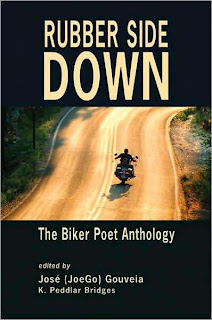
Rubber Side Down Edited By Jose Gouveia

Jose “JoeGo” Gouveia’s Rubber Side Down: The Biker Poet Anthology is one of the best contemporary poetry anthologies on the market. These poems will appeal to not only deep thinkers, but also readers looking for detailed aesthetics. While most of us will never know what it’s like to be hounded by cops, some of these poems will allow readers to live the biker life vicariously.

Bikers tend to be like brothers, easily accepting of their members no matter what location they find themselves in. These poems signify the lonely road these poets travel, the hardships they face, and the beauty of the road.

“Harley United” (Page 36)
by Richard Vagnarelli

Not to them
Do tortured tones
Of twisted two stroke
Twins appeal;
Racer’s crouch
Grand prix attire
Bright plastic
Wheel to wheel.

Who can deny
The virtues
Of obsession
In a marque,
Symbolic of
The freedom
Sought by those
In dark glasses.

Seated low
In upright posture,
Arms held high,
Feet to the fore,
Proud to live
Astride a legend
Rooted deep
In biker lore.

And in common
With like riders,
Who in the aura
Have delighted,
They remain an
Elite brotherhood,
Alike,
Harley united.

In addition to the poems celebrating brotherhood and connection, some of these poems celebrate famous bikers like Evel Knievel, the evolution of bikes, and women enchanted by the biker life. Some of these poems rhyme, and rhyme well–with an easy rhythm. These poems have a life of their own, and many of them will make you want to read them out loud for emphasis like in “Highway Poets (theme poem)” by K. Peddlar Bridges (page 80) where the lines read: “We’re motorcycle riding/Engine blasting/Line chasing/Gravel chewing/Bug spitting//HIGHWAY . . . POETS!”

Others are simply laugh-out-loud funny, readers should buy a copy simply to read “The Six-Legged Moose.” (I’m purposefully not including this poem in the review to entice you to get this anthology.)

Rubber Side Down is a compilation of witty verse dealing with a number of issues including how bikers deal with aging and the prospect of no longer riding and the freedom of riding and how it makes it difficult to settle back into a “normal” life. Moreover, Rubber Side Down is set up in a format that provides readers with poems and photos of actual bikers in alternating sections, which enables readers to ponder the poems while examining the visual context of these poets’ lives. Each of these biker poets knows poetic style and form and how to break convention without losing their audience, and Rubber Side Down will appeal to more than just bikers and their families.

“WTHEFM” (Page 99)
by: Susie Howard

No, it ain’t a radio station,
but I listen to it like its playing my favorite
moldy oldies, yeah,
I know the words, snap my fingers
to its back beat I can use it,
the rhythm of too many days
turned in or out, a place named
for itself, like “KCUB its a Bear”.

No, it ain’t the style on my FM dial
I heard over there when home was
for away and dry was a dream cause I sat on my helmet
in the hole, my feet turning to sludge in my boots to
keep the same from happening to my ass,
nodding off to the memory of her
soft thighs, the bow from her bra.

No it ain’t the voice from the box,
that bitch, Hot-Jane-Barbarella,
the Stones or little miss
sunshine Hanoi Rose harmonizing
with, “Have decided to
mid-Tet Offensive cease-fire.”
Its all beaucoup okay, G.I.,
tallRoundEyeCharlieScreamingEagle.

No it ain’t the drone of all the
shitty jobs I’ve had, been laid
off from, kicked out of, walked
on since I got back till my best
friend is the guy at the Port Authority turnstile
booth who lets me through
for a warm night on the benches,
so long as I move now and then.

No it ain’t the sweet sing song of
my kids, scared of me at night when they tried to
climb in my bed but
I freaked out, ready to kill, with
demons before me where my kids
should have been, cause she took
them to hide which was right.

No it ain’t the buzz in my brain
when I hear, the 60’s–
remember when Little Anthony was Imperial,
when my best friend checks in for methadone treatment,
(after forty years, it ain’t
no treatment), when they say,
“Son, we’ve got PTSD”.

No it ain’t a radio station.
When it doubt, you got to dance.
Its just a backward glance.
A trip from then to now.
A long lost life since Hell.
I’m over the comments.
What The Fuck Moments.
Wanna make a request?

Rubber Side Down packs a punch and made me want to get that ape hanger I’ve always talked about and go for a ride.

Want to go for a ride with these bikers? Here’s your chance; I’m offering to buy one copy of Rubber Side Down for one commenter. (Yes, this is international)

1. For one entry, comment in the form of a poem (no, it doesn’t have to be great; or I might have mercy on you and count your comment as an entry even if it isn’t in poem form.) about why you want to read this anthology.

2. Follow this blog or if you are a follower tell me in the comments.

3. Spread the word about the giveaway on your blog, Twitter, Facebook, etc. and leave a comment here with a link.

Deadline is May 15, 2009, 11:59 PM EST

***THIS GIVEAWAY IS NOW CLOSED***

Also Reviewed By:
Minds Alive on the Shelves

***Giveaway Reminders***

A giveaway of The Mechanics of Falling by Catherine Brady, here; Deadline is May 1 11:59 PM EST

5 Joanna Scott, author of Follow Me, books giveaway, here; Deadline May 4, 11:59 PM EST.

Giveaway for Eleanor Bluestein’s Tea & Other Ayama Na Tales short story collection, here; Deadline is May 6, 2009, 11:59 PM EST.

Calling All Poetry Book Reviewers ***Sticky Post***

This is a ***Sticky Post***

Do any of you bloggers read poetry books and review them?

How often do you review them?

Or do you want to review poetry collections?

I’ve been thinking about making a list and posting it somewhere on this blog to collect the site names and contact information of bloggers interested in reviewing poetry books.

If you want to be on this list, please email me your URL, name, and preferred contact information.

Asian American Writers

In response to May’s designation as Asian Heritage Month, C.O.R.A. Diversity Roll Call is asking participants to discussion their favorite Asian or Asian American writers and their works.

Regular readers should remember my numerous posts about Arlene Ang, but here’s a roundup of those posts here. I know that she lives in Italy, but her family is from the Philippines and she’s a poet. Poets need more face time in my humble opinion. So here it is, a bit about the Philippines I found on Wikipedia:

Manila is the capital of this Southeast Asian nation, which is officially called the Republic of the Philippines and consists of more than 7,000 islands. More than 90 million people live in this nation, which is a former Spanish colony. While the main religion on the islands has been Roman Catholicism (one of only 2 nations in Asia where Catholicism dominates), there are many other religions represented including Buddhism, Hinduism, and Islam. Check this link for some ecology information.

Check out Arlene’s poem in 42opus, It Could’ve Been a Centerfold and A Setting Sun. Or her five poems in Identity Theory.

Check out these current giveaways:

A giveaway of The Mechanics of Falling by Catherine Brady, here; Deadline is May 1 11:59 PM EST

5 Joanna Scott, author of Follow Me, books giveaway, here; Deadline May 4, 11:59 PM EST.

Giveaway for Eleanor Bluestein’s Tea & Other Ayama Na Tales short story collection, here; Deadline is May 6, 2009, 11:59 PM EST.

Interview With Poet Hadara Bar-Nadav

I’ve been working on a interview project with Deborah at 32 Poems magazine, and she kindly allowed me to interview past contributors to the magazine. We will be posting the interviews throughout the coming months, and our ninth interview posted on Deborah’s Poetry Blog of 32 Poems on April 20. I’m going to provide you with a snippet from the interview, but if you want to read the entire interview, I’ll provide you a link for that as well. For now, let me introduce to you 32 Poems contributor, Hadara Bar-Nadav.

ALARM PLEASURES INTO HUM
Published in Verse 23.1-3 (2006).

Mutiny awakens me,
the kingdom buzzing with saws,
all the fetishes abloom

which means a rubbing away until
blood or speech, each
to his own bright unraveling.

Red lives here, a nest
of nerves and twigs.
Doors unhinge and the roof

speckled with stars:
holes, navels, scars.

I have no floor,
no caviar, no mints.

I am humble as a tooth
and hunger.

And you are the messenger
without bell or tongue.

You are the messenger.

Come. Come.

1. Most writers will read inspirational/how-to manuals, take workshops, or belong to writing groups. Did you subscribe to any of these aids and if so which did you find most helpful? Please feel free to name any “writing” books you enjoyed most (i.e. Bird by Bird by Anne Lamott).

Books of poetry and art have been my best teachers, along with studying music. Jazz was my first teacher, I believe. Though I had written poetry since I was a child, it was when I was a teenager and started listening to jazz that I really started to study language, to think about its rhythms and sounds, and to wonder what I could do with language, how far I could push it.

I didn’t have an active writing community until I went to graduate school at the University of Nebraska-Lincoln. Now that I live in Kansas City, I meet informally with a few poets and we discuss each other’s work. I also email poems to friends for feedback, if needed.

As for books on craft, I like Tony Hoagland’s Real Sofistikashun, which I use in my poetry workshops. Hoagland is smart, has a sense of humor, and doesn’t take himself too seriously.

2. When writing poetry, prose, essays, and other works do you listen to music, do you have a particular playlist for each genre you work in or does the playlist stay the same? What are the top 5 songs on that playlist? If you don’t listen to music while writing, do you have any other routines or habits?

Generally, I don’t listen to music when I read or write. It’s too distracting. However, PJ Harvey, Beck, and the soundtrack to The Royal Tennenbaums have all figured into my manuscripts. The rise and fall and various intensities of PJ Harvey’s Is This Desire helped me come up with the final configuration of my first book, A Glass of Milk to Kiss Goodnight.

3. Do you have any favorite foods or foods that you find keep you inspired? What are the ways in which you pump yourself up to keep writing and overcome writer’s block?

Chocolate. And Jersey pizza, bagels, and cannolis, which I miss now that I live in the Midwest.

As far as keeping myself pumped up, when I’m not writing, I revise. When I’m not revising, I send out. Or I read, or go to a museum, or get art books from the library. I’m not sure chocolate helps me do any of these things, but I like it. A lot.

About the Poet:

Hadara Bar-Nadav’s book of poetry A Glass of Milk to Kiss Goodnight (Margie/Intuit House, 2007) won the Margie Book Prize. Recent publications appear or are forthcoming in Beloit Poetry Journal, Colorado Review, Denver Quarterly, The Iowa Review, The Kenyon Review, Ploughshares, Prairie Schooner, TriQuarterly, Verse, and other journals. She is an Assistant Professor of English at the University of Missouri-Kansas City. Of Israeli and Czechoslovakian descent, she currently lives in Kansas City with her husband Scott George Beattie, a furniture maker and visual artist.

Want to find out what Hadara’s writing space looks like? Find out what she’s working on now, her obsessions, and much more. Check out the rest of my interview with Hadara here. Please feel free to comment on the 32 Poems blog and Savvy Verse & Wit.