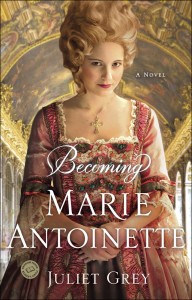
 Becoming Marie Antoinette by Juliet Grey was released earlier this month by Ballantine Books, a division of Random House. The novel has been on a blog tour through TLC Book Tours this month, so check out some great reviews. I’ll be reviewing this later in the fall, but I have a treat for my readers today. Juliet Grey has graciously offered to write about her research process for her novel and what made her fall in love with Marie Antoinette.
Without further ado, please welcome Juliet Grey.
I fell in love with Marie Antoinette (and Louis) while I was researching their marriage for a work of nonfiction; and the more I read about them (at least a dozen biographies by scholars who often present conflicting opinions not only of events but of personalities), the more it became apparent that the monarchs have truly been misrepresented and misinterpreted by historians. They say history is written by the winners, and Marie Antoinette and Louis were the two greatest victims of the French Revolution.
What sparked BECOMING MARIE ANTOINETTE specifically is how little has been told about her childhood years and the incredible makeover she had to endure at the hands of a small army of experts before she was judged acceptable marriage material, while the clock was ticking and a vitally strategic international alliance hung in the balance. The preadolescent Marie Antoinette was worked over by a hairdresser who reconfigured her hairline so that her forehead would not appear to prominent; a dentist who realigned her teeth with orthodontia, a pair of actors who became her dialect coaches for her pronunciation of French; a notable dancing master who taught her the “Versailles Glide,” the walk that was unique to the women of the Bourbon court; and a gentle cleric who came to tutor her in academics. My novel also shows just how much the young Austrian archduchess Maria Antonia was a political pawn, moved about the European chessboard by her mother, the formidable Hapsburg empress Maria Theresa, and King Louis XV of France.
Most of the events depicted in BECOMING MARIE ANTOINETTE and in the next two novels in the trilogy are based on the historical record. I may be one of the few novelists to include a fairly extensive bibliography at the back of her book (which only begins to reflect the scope of my research), but I wanted readers to know that I did my homework, and then some. At times I felt like a literary anthropologist. For example, I went so far as to hunt down the names and backgrounds of the actual figures who aided in Marie Antoinette’s physical metamorphosis, transforming her hairline, her teeth, her gait, and her speech—and then her mind—into a package that the French sovereign Louis XV would deem acceptable dauphine material. In some cases, even the dialogue in the novels (and in particular the correspondence I used in the novels) reflect the actual words that were spoken or written. We are fortunate in that the Eighteenth Century was an age of great letter writers and memoirists. Nearly everyone kept a journal back then.
All that said, although we know that certain things happened historically, as a novelist I have the freedom to imagine what was really going on in the room at the time and in the characters’ heads. We don’t always know how a given thing occurred, just that it did. I have a golden rule of historical fiction writing, which is: that if an incident could have happened, then it’s fair game to include it in a novel. For my own taste, I prefer not to wildly re-imagine historical events in my books. For one thing, fans of historical fiction (and I’m one as well) tend to be well versed in the history of their favorite time period and they get pulled out of the narrative when an author includes a scene that strains credulity or plays too loosey-goosey with the historical record. I’m also a professional actress and part of my training is to be able to get under a character’s skin and inside their head to imagine how they think and feel and what prompts them to act as they do and say the things they say. This sort of emotional analysis stands me in good stead as an author because it’s another way of digging into the psyche of a historical personage to reach a perspective from that taken by scholars and biographers.
I have had a lot of fun letting some of the actual historical figures speak for themselves. Die-hard Marie Antoinette aficionados may recognize some of the quotes, not just from her, but in the mouths of other characters in the books. And in the second novel in the trilogy, DAYS OF SPLENDOR, DAYS OF SORROW, which will be published in 2012, readers will meet some real doozies—the colorful and scandalous players involved in the notorious Affair of the Diamond Necklace. Nearly all of them published their own self-serving memoirs and the records of their trial testimony is extant as well, so there has been a wealth of ore for a novelist to mine.
And something that we just get a glimmer of in BECOMING MARIE ANTOINETTE will glow hotter and brighter as the trilogy progresses—the controversial relationship between the queen and the Swedish mercenary, Count Axel von Fersen. For decades scholars have debated whether their romantic friendship ever became something more; between the scholar’s sleuthing and the artist’s imagining herself inside their heads, hearts, and minds, I believe I have discovered the answer.
Thanks, Juliet, for sharing your love of Marie Antoinette and your research.
To win a copy of Grey’s Becoming Marie Antoinette, you must be a U.S. resident or have a U.S. resident who can accept the package for you.
1. Leave a comment about why you are interested in grey’s book.
2. Spread the word about the giveaway and leave a link to your blog post, Facebook, or Twitter announcement.
3. Follow the blog and let me know for a third entry.
Deadline is Aug. 24, 2011, at 11:59 PM EST.


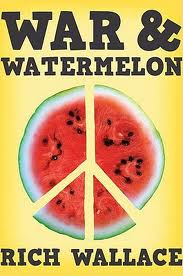


 As you probably know, to become an internationally best-selling author, you need to sell three books. This is not an easy task, but once you’ve managed to rack up these three sales, the rest is more or less a done deal.


 I have a tiny pink laptop on which I do my easy, practical writing – email, Facebook posts and the like – but when the going gets tough, I bring out the big guns. Up in my writer’s studio in the attic of my house, I do all of my novel-writing on a double quad-core Mac Pro, complete with 24-inch screen and an ergonomic, split-style Kinesis keyboard.
 I know, you’re thinking, “How much power do you need to run Word?” It’s true. I guess I don’t actually need an octo-core computer, but facing the blank page is intimidating. When I turn on my Mactopus, as I call her, I know I have sheer power backing me up. Then, for more holistic support, I keep a bottle of lavender room spray on my desk, which I always use to keep me focused and calm. To my left is a statue of Kuan Yin, peeking over my shoulder to help guide my process. All around the walls of my attic are bookcases, filled with books by wonderful authors like Margaret Atwood and Maxine Hong Kingston.
 The notes also have more practical reminders, like, “Don’t check email!” and “Do the big stuff first!” The rest of my enormous desk is piled high with books, papers and items that have to do with my next book. Right now, I’m looking at a pair of professional Latin ballroom dance shoes because my next novel is set in the ballroom dance world. Next to them is a stack of baby naming books, which I used to choose names for my characters. By the way, if you ever want to give the person you’re dating a heart attack, just start leafing through your baby name books.
 The entire right side of my desk is taken up by a folder system for all of my foreign book contracts and correspondence. My debut novel, Girl in Translation, is being published in 15 countries so at a glance, I can see the Italian promotional pamphlet lying on top of the Swedish book, a set of Dutch tissues with the cover of the book printed on top, a lovely note from my UK publisher sticking out from in between a few very official letters about accounting from my German publisher that I don’t understand at all. Oh, and I have three extremely furry cats who all think it’s the funniest thing in the world to lie across my keyboard while I’m trying to type.



 About the Author: