Quantcast

Welcome to the 2012 National Poetry Month Blog Tour & Giveaway

Welcome to the 2012 National Poetry Month Blog Tour.

This will be a sticky post through the end of the month of April, so please scroll further down for today’s post.

If you’ve decided to hop on the blog tour, please grab the button above and link back to the tour. Here’s the current schedule for the tour.

Please place your full post links in the Mr. Linky below so that others can celebrate poetry with you and Billy Collins.

Also, if you’re interested in trying a book of poetry, leave a comment and you’ll be entered to win one copy from a donated stash of poetry from poets and publishers.

1. Three Women: A Poetic Triptych and Selected Poems by Emma Eden Ramos
2. Real Courage by Michael Meyerhofer (9 copies)
3. The Auroras (ARC) by David St. John

4. Trembling Pillow Press Journals

Don’t forget to add your permalink.

Tribute to Adrienne Rich

When an influential poet passes out of this world and into the next, all plans are set aside to pay tribute. In this case, Adrienne Rich — one of the most influential feminists and poets of her time — died on March 27 at the age of 82.

She has been compared to Betty Friedan, who wrote The Feminine Mystique, by the New York Times and others. Beth Kephart has even been touched by Rich’s poetry, including one of my favorites in her post honoring her. She has been decried and praised for her brash poetry against war and the political world, and she once famously said that she could not accept the National Medal of Arts from the Clinton Administration because “I could not accept such an award from President Clinton or this White House because the very meaning of art, as I understand it, is incompatible with the cynical politics of this administration. [Art] means nothing if it simply decorates the dinner table of the power which holds it hostage.”

Tonight No Poetry Will Serve from Poets.org

Saw you walking barefoot
taking a long look
at the new moon's eyelid

later spread
sleep-fallen, naked in your dark hair
asleep but not oblivious
of the unslept unsleeping
elsewhere

Tonight I think
no poetry
will serve

Syntax of rendition:

verb pilots the plane
adverb modifies action

verb force-feeds noun
submerges the subject
noun is choking
verb    disgraced    goes on doing

now diagram the sentence
Poet Adrienne Rich

From her hometown in Baltimore, Md., Rich created an unconventional life for herself as a mother, wife, poet, and activist, who often focused her energy on “outing” the oppression of women and lesbians and who modified the traditional cadence of free verse poetry. Whether she was a lesbian or not is irrelevant to her contributions to the antiwar and feminist movements as well as her poetic contributions that often were confessional and shocking. She strove to change the world through poetry and the power of the written word, even if she acknowledged herself that poetry could not do it alone. Though what some would consider a well-decorated poet from awards and fellowships, etc., I would almost say that she never felt she deserved them alone, but wanted to share them with all women and those that strive to make deep-rooted change in our society.

I’ll leave you with a portion of one of her poems from The Penguin Anthology of 20th Century American Poetry edited by Rita Dove.

A Valediction Forbidding Morning (page 296)

My swirling wants.  Your frozen lips.
The grammar turned and attacked me.
Themes, written under duress.
Emptiness of the notations.

They gave me a drug that slowed the healing of wounds.

Please take a moment to reflect on the power of poetry and seek out Adrienne Rich’s words to celebrate change and passion.

Call for Poetry Book Donations & Looking for Tour Hosts

National Poetry Month 2012 is nearly upon us, with less than two months to go.  I’ve got a few great bloggers willing to talk about poetry and to host reviews and guest posts in April, but I’ve still got some open spots on the schedule.  Won’t you help me fill them in?

I’ve got a few guest posts coming in from poets that need blog tour hosts for them.  Just drop me an email if you want one and what day you want to host.

Also, if you’re a poet or a publisher of poetry, I’m looking for short guest posts from you about poetry for some fellow bloggers who want to join the tour but don’t feel they want to review a book.  I’m looking to help them out with a guest post form you.  Please email me with your ideas at savvyverseandwit AT gmail

Finally, anyone who would love to share the love of poetry through some giveaways in April, please sign up to donate books, poetry workshop classes, poetry journals, literary magazines, and any other poetry-related items.  Send me an email to savvyverseandwit AT gmail with your donations and if you prefer I run the giveaway or you’d like to run it yourself.

OK, that’s it.  I hope everyone can help out.  See you for the big tour in April.

Poetry Readers and Writers

National Poetry Month 2012National Poetry Month 2012 is in April and I’m looking for guest posts from poetry readers and tour hosts for these guest posts. I want to fill out all of April early and be able to direct readers across the blogosphere for some great poetry discussion and celebration.

Not only will you be part of a tour involving poetry collections, poet interviews, guest posts from poetry readers, and maybe even just some great poems and discussion, you also get my new snazzy button — and I can’t believe I made it myself from a photo my hubby took at the National Arboretum.   OK, that’s a lame reason to join the blog tour.

I’m hoping to put together some great giveaways for everyone who participates either as a commenter or as a blog tour host/guest blogger.

I hope that even if you don’t want to participate you’ll spread the word.  I want to fill up every day in April.  Dates will be a first come, first serve basis, and I’ll be posting the participating blogs on the schedule below as I hear from people.

Won’t you join me in celebrating poetry?

Sunday, April 1 — Savvy Verse & Wit’s Kickoff of the blog tour
Monday, April 2 — Sara from Wordy Evidence of the Fact
Tuesday, April 3 — Jill from Rhapsody in Books will talk about Cole Porter
Wednesday, April 4 — Anna from Diary of an Eccentric, WWI Poetry Anthology
Thursday, April 5 — Audra from Unabridged Chick
Friday, April 6 — Michael Meyerhofer from Trouble With Hammers
and My Friend Amy hosts Sweta Vikram’s Guest Post

Saturday, April 7 — Dar from Peeking Between the Pages
Sunday, April 8 — Patty from Books, Thoughts and A Few Adventures…
Monday, April 9 — Naida from the Bookworm
Tuesday, April 10 — Kathy from Bermudaonion, tentatively THE WATCH THAT ENDS THE NIGHT by Allan Wolf
Wednesday, April 11 — Jeanne from Necromancy Never Pays, who will discuss litany poems and then show and discuss Richard Siken’s “Litany in Which Certain Things Are Crossed Out”
Thursday, April 12 — Julie from Read Handed will talk about 2010 Cider Press Book Award winning collection Play Button by Liz Robbins
Friday, April 13 — Melanie from The Indextrious Reader on superstitions and poetry
Saturday, April 14 — Cecelia from Adventures of Cecelia Bedelia
Sunday, April 15 — Ana from Things Mean a Lot
Monday, April 16 — Cassandra from Indie Reader Houston
Tuesday, April 17 — Ti from Book Chatter
Wednesday, April 18 — The Girl from Diary of an Eccentric will focus on Robert Frost
Thursday, April 19 — Pam from Bookalicious
Friday, April 20 — Tabatha of Tabatha Yeatts: The Opposite of Indifference
Saturday, April 21 — Megan from Solid Quarter
Sunday, April 22 — Nicole Luongo from Bare Your Naked Truth at Peeking Between the Pages.
Monday, April 23 —  Adrienne Odasso from Seer of Ghosts and Weaver of Stories
Tuesday, April 24 — Arisa White from Arisa White
Wednesday, April 25 — Craig from Mr. Watson
Thursday, April 26 — Wallace from Unputdownables will focus on Edna St. Vincent Millay and Dorothy Parker
Friday, April 27 — Wendy from Caribousmom will host Poet Michael Meyerhofer and his guest post on self-publishing
Saturday, April 28 — David from Wordcoaster who will showcase bird poetry.
Sunday, April 29 — Sidne from Sidne, The Reading Socialite who will discuss Love and/or Life
Monday, April 30 — Travis Laurence Naught on how Jack Kerouac and Jim Morrison (maybe even Allen Ginsberg) formed his writing style

Thanks, everyone.

Big Thank You . . .

I wanted to take a moment to thank everyone who participated and commented during National Poetry Month. The blog tour was not as well organized this year given I’ve had a few life changes in recent months, but overall, everyone who participated did a great job and made me smile with each comment and contribution.

As a thank you, I’ve extended two poetry-related giveaways until mid-May. One is US/Canada only, the other is international.

Please feel free to check out the giveaways and spread the word:

******L.A. and Dog Years and I Can Be the One EP by Luke Rathborne; Deadline May 14 (US/Canada)

******Choose 1 of 5 poetry books to win; Deadline May 14 (Global)

You must enter through the links provided, NOT on this post.

The Poets Laureate Anthology Edited by Elizabeth Hun Schmidt

The Library of Congress recently collaborated with Elizabeth Hun Schmidt to collect a select group of poems from the 43 U.S. Poets Laureate in The Poets Laureate Anthology, which lays out the poems in reverse chronological order (click for a list of the poets laureate) from the current laureate W.S. Merwin through the first poet laureate Joseph Auslander.  The table of contents also points out that poems in brackets listed for each laureate are considered their signature poems.  The collection contains a foreword by former poet laureate Billy Collins and an introduction by the editor, Elizabeth Hun Schmidt.

In the foreword, Billy Collins reveals the ceremony or lack thereof that comes with the office of U.S. Poet Laureate, noting that there is no formal naming ceremony, simply a phone call from the Librarian of Congress who selects the latest laureate.  The post does come with an office in the Jefferson Building, but each laureate approaches the appointment differently, though former laureate Howard Nemerov explained that the laureate spends more time explaining the duties he or she performs than actually accomplishing much.

Elizabeth Hun Schmidt’s introduction discusses the placement of the poet laureate’s office in a remote wing of the Library of Congress near the rooms used by U.S. House teenage pages, “You might think our country wants to both flaunt and to hide the fact that the only official job in the arts in the United States is for a poet” (page xiv of The Poets Laureate Anthology, published by W.W. Norton in association with the Library of Congress).  The office of Poet Laureate actually receives mail, and appointed laureates often travel the country exposing new people and communities to poetry, but only Robert Frost was asked to read at a presidential inauguration.

It is clear that some laureates were more active than others, engaging the community either through “brown-bag lunches,” educational projects, or through Websites and lectures.  Billy Collins is the most well-known for his work on Poetry 180, but Ted Kooser also began a project to garner a wider audience for poetry — American Life in Poetry.  Readers will applaud these poets for their commitment to a wider audience, including students, to erase the wall between readers and poetry.  Other laureates focused more on helping amateur poets hone their craft.  But each approached the office as differently as they tackle their verses, and it is this variety that makes the anthology unique, resembling a history of U.S. poetry.

Collins, like many readers, approached this anthology as a way to familiarize themselves with poetry piece-by-piece, dipping back into it over the course of their lives.  Anthologies are often created with this purpose in mind, and many are crafted to provide a reference for the best selections of a certain genre.  In this case, it’s poetry.  Each anecdotal comment from the laureates and their biographical snippets provide a backdrop for the poems that follow, but which, if any, of these poems were written while the laureates were in office is unclear.  Readers may have found it interesting to see which laureates wrote poems during their tenure and to read those poems for themselves.

Overall, The Poets Laureate Anthology edited by Elizabeth Hun Schmidt is a collection worth adding to anyone’s library shelves.  Whether looking for poems by a particular laureate or searching for a particular poem, the anthology provides a broad look at each poet’s efforts to define their moments, their lives, and humanity.  Reaching into history or dealing in the present, these laureates earned the title and executed the office with aplomb, and this anthology celebrates their accomplishments.  Readers looking to dip into poetry will enjoy this volume as much as those who dive deep into verse on a regular basis because it offers something for everyone.


This is my 9th book for the Fearless Poetry Exploration Reading Challenge.


This is my 15th book for the 2011 New Authors Reading Challenge.


***This is a part of the National Poetry Month 2011 Blog Tour.

This Just In . . . One Time Only . . .

This just in from The Writer’s Center in Bethesda, Maryland:

April 28 and April 29 a free Webcast of the Poetry Out Loud competition will be held live between 9 am and 8pm and 7 pm and 9 pm, respectively.  On April 28, the semifinals with all 53 competitors will be held, with the finals held on April 29.

This is a one-time only event for National Poetry Month and the Webcast cannot be viewed after the events are held.

Please check the events out at this link:  http://www.ustream.tv/channel/poetry-out-loud-finals

If you do listen to some of the poetry, please stop by and let me know what you thought.

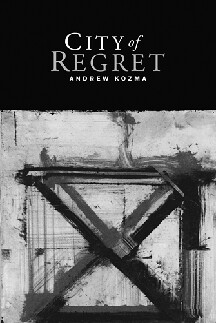
City of Regret by Andrew Kozma

City of Regret by Andrew Kozma is broken into five parts and each section is named for some element of the city — entrances, walls, living spaces, alleys, and exits.  (You can check out my 32 Poems Magazine interview with the poet, here. And please visit Saturday’s Virtual Poetry Circle –link will be live April 30 — for a look at one of his poems).

As a prologue to the collection, Kozma begins with the poem “Dis” (page 1), which is a fictional city in Dante’s The Divine Comedy containing the lower circles of hell.  Like Dante, Kozma goes on a journey through hell, but the poet is traveling through these circles to find his father who has died and with whom he has unfinished business as he says in the final lines:  “When a ravine splits the sky, Earth’s muddy light/unearths my father.  We have much to talk about.//”  This poem sets the tone for the remainder of the collection with its melancholy and mournful tone.

In the first section — entrances — Kozma uses individual poems to explore the various ways people and other beings meet, greet, avoid, and rush toward death.  In “That We May Find Ourselves at Death” (page 8), he echoes the lines of Emily Dickinson, who could not stop for death, when he asks where you go when you are late for death?  He questions how death is confronted when it has already happened and there is no way to turn back the clock.  But in other poems — such as “Night Meeting” (page 6) — the poet evokes violent images of a dead squirrel’s body pulsating with ants to demonstrate not only the sudden impact and violence of death, but the messy aftermath that often follows.  However, death need not always be violent and unexpected, it can come silently . . . gradually like in ” Your Sketch of the Church in Mourning” (page 13):  ” . . . You step with silence,/walking out, and walk slowly.  Navigate the marble floor/softly, or you will not hear the dead/call after you.//”

The poems in the second section — walls — all seem to personify the denial that comes with the stages of grief.  In “Blood Perimeter” (page 25), the narrator speaks of embracing the grief like one would embrace rust, an illustration of how tough it is to come to terms with grief.  In many cases, the poems speak of vanishing moments and people, events that are baffling yet make sense when impermanence of relationships and life are examined and understood.  Kozma uses rhyme and repetition in these poems to ensure the narrator’s meaning is not lost among the vivid images like that of the Acropolis or the hunting dogs.

In the third section — living spaces — the stage of acceptance is discovered beyond the walls of denial, but acceptance is not as tame as the word suggests.  Accepting death means letting go of the person you lose to death and in a way the narrator suggests that you have to rip free from the notion that they are still present by figuratively setting it afire, like in “Quarantine” (page 31).  These living memories and moments of joy and anger with loved ones often resurface during the grieving process, and it is these fragments that will ease the pain of acceptance, but they also become painful.  In “The Butcher” (page 38), accepting the loss and remembering the lost one is like slitting the wrist and letting the blood flow — tortuous but necessary to purge the immediate pain of grief.  Kozma’s images in this section are both violent and jarring, but effective.

In the final sections of the collection — alleys and exits — Kozma’s poems become darker, more melancholy as the loss sets in and becomes consuming.  Whether the darkness in these poems is tied to the narrator’s lack of faith in an afterlife or merely the deep emotional scarring of grief is unclear.  However, there are tinges of hope that death brings about a renewal as the ashes of a cremated body are returned to nature.

Overall, City of Regret by Andrew Kozma is a deeply moving homage to a deceased father and acts as a guide through the journey of grief.  While a different journey than the one taken by Dante in The Divine Comedy, Kozma’s journey does take the poems’ narrator through hell and more.  This collection is deeply evocative and will stay with readers long after the last page is turned.


This is my 8th book for the Fearless Poetry Exploration Reading Challenge.


This is my 14th book for the 2011 New Authors Reading Challenge.


***This is a part of the National Poetry Month 2011 Blog Tour.

Bone Key Elegies by Danielle Sellers

Danielle Sellers’ Bone Key Elegies is a collection of poems published by Main Street Rag Publishing as part of its Editor’s Select Poetry Series.  (You can check out my previous 32 Poems Magazine interview with the poet, here, and one of her poems in the 81st Virtual Poetry Circle).  Unlike eulogies that praise someone upon his or her death, elegies are a lament for the dead and are often mournful.  In this vein, Sellers excels at creating memorable elegies for her sister, a lost family, and happier memories.  However, many of these poems will deceive the reader at first, beginning with scenery or a happy moment in time before turning melancholy.  Sellers’ style echoes the turn of line expected in haiku or the final couplet of Shakespearean sonnets.

However, some poems, like “The Bridge Fishers” (page 16), are less full of despair than the other beginning poems in the collection and more mischievous, especially as the narrator drives away in a boat beneath a bridge where fisherman are waiting for their first bite from the fish, only to have the engine of the boat scare the fish away.  Sellers’ poems are filled with surprises:  some shocking, some full of dark humor, and some violent.  In “Welcome to my Father’s Showroom” (page 26), readers are given a quirky picture of the showroom as a sort of maze through which the father navigates or hides to peer at customers secretly, but in the final lines, ” . . . He watches them.  In case one should step out of/line, a shotgun leans against the metal filing cabinet.  On its shaft,/his hand-print is outlined in dust.” (please check out some sample poems).

What’s surprising is that each poem has its own depth of despair and melancholy, like an elegy is supposed to have, but the depth of that sorrow generally corresponds well to the connection the narrator has with each subject.  Losing a father can be very devastating to a daughter, but is it more or less devastating to a daughter who has seen her father cheat on her mother or leave her mother?  Losing a sister at a very young age can be tragic and life changing, but is it more or less life changing than if you were to lose a sister after having lived half your life with her by your side?  These are just some of the emotional questions tackled by Sellers’ poems, and Bone Key Elegies is an excellent examination of the various levels of melancholy and despair that individuals can experience at different intervals in their lives. It is clear that the poem about the death of a sister sets the tone for the entire collection, a tone that deepens and thins out in a see-saw of emotion.

Through rich language and vivid imagery from the Florida Keys, Sellers’ illustrates not only the brackish nature of woe, but also the desperate fight against that emotion — leaving readers breathless.


This is my 7th book for the Fearless Poetry Exploration Reading Challenge.


This is my 13th book for the 2011 New Authors Reading Challenge.


***This is a part of the National Poetry Month 2011 Blog Tour.

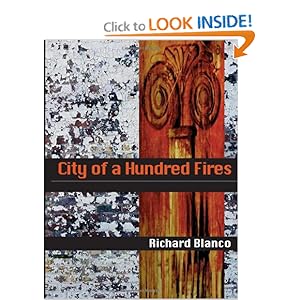
City of a Hundred Fires by Richard Blanco

Richard Blanco‘s City of a Hundred Fires is a collection published by the University of Pittsburgh Press about the Cuban-American experience, which won the 1997 Agnes Lynch Starrett Poetry Prize.  (You can check out one of his poems in the 40th Virtual Poetry Circle and my take on a reading he did at the local Writer’s Center in 2009.)  The collection is broken down into two sections and each poem contains not only English, but also Spanish phrases, which readers may or may not know offhand.  Readers who are bilingual will have little trouble, though those who have a working knowledge of Spanish or don’t will be able to gather what Blanco is getting at from context clues.  Poems are either in traditional short narrative lines or in longer, more paragraph-like lines, but each tells a story, reveals a memory, and explores a bit of the Cuban-American experience.

“Crayons for Elena” on page 13 is one of the most poignant poems in the collection as it uses the box of 64 crayons to illustrate the differences in skin tones and cultures of the people the narrator encounters and the colors that represent elements from the narrator’s own culture, including pinatas and mangoes.  “. . . All these we wore down to/stubs, peeling the paper coating further and further, peeling and sharpening/until eventually we removed the color’s name.  This is for leaving the box in/the back seat of my father’s new copper Malibu, the melted collage, the butter/”  It seems that though these differences confuse the narrator and cause discomfort, eventually, these differences are forgotten and life moves beyond those variations and instead absorbs the similarities, “melting them into a collage.”

Blanco continues to straddle the Cuban culture — kept alive in family traditions such as Quinces balls — and his new home in American culture.  In a way, his traditional family culture seems foreign to the narrator as he assimilates to American traditions of turkey at Thanksgiving and peanut butter and jelly sandwiches.  Unlike the older relatives talked about in the poems, the narrator does not kid himself that he will be returning to Cuba after the revolution; he knows that the dream of returning to the old country is just that — a dream.

At times, however, the narrator does experience moments of nostalgia, in which he remembers family events or moments.  There are other moments in which the voids left by an American culture that does not feel exactly like home are filled with reminders of a culture left behind whether those voids are filled with sake by a Japanese immigrant or by dark rum with lemon for a Cuban-immigrant.

Unlike in part one where the narrator delves into familial memories and the confusion of bridging two cultures, in the second part, the narrator has become more observant of how his home culture is mutilated and warped by the American idea of capitalism to create a caricature of Cuban life and culture, like in “El Jagua Resort” (page 43):  “where Canadians and Italians step out/drunk congas from megaphone instructions –/side-to-side, kick-then-kick, hand-to-hip;/caught in spells of tabaco, dark rum,/brown sugar, and the young mulatas/”  In a way, the little Havana created in America by the narrator’s parents’ generation is fading and being replaced, but the second part also illustrates more historical details of Cuba, the revolution, and other events.

For a slim volume of poems at 74 pages, City of a Hundred Fires by Richard Blanco will knock you on your butt with its passion, anger, and disbelief.  But it also will drag you to your feet as it clings to hope and harmony.  Overall, Blanco has crafted a diverse collection of poems on the Cuban-American experience that delves below the surface struggles of bias and loneliness to the internal struggle of one narrator and how he copes with those struggles and more.

This is my 6th book for the Fearless Poetry Exploration Reading Challenge.


This is my 12th book for the 2011 New Authors Reading Challenge.


***This is a part of the National Poetry Month 2011 Blog Tour.


White Egrets by Derek Walcott

White Egrets by Derek Walcott is a collection of deeply suggestive and blatant poems about the natural cycle of birth, life, and death and coming to terms with the later as friends, lovers, and others pass away leaving the narrator behind on the journey of life.  Each poem uses nature imagery to paint a canvas of emotion as the narrator grapples with grief, joy, and memory.

Walcott’s poems are long and narrative in many cases, which is not a form or style that calls to every reader, but even the most picky reader can easily pick out the cues that will carry them throughout the multiple part poems.

For instance, in the title poem “White Egrets” section one, readers will notice the lines “in the drumming world that dampens your tired eyes/behind two clouding lenses, sunrise, sunset,/” that signal a decline in health.  In the second section, the theme carries on in the lines “into a green thicket of oblivion,/with the rising and setting of a hundred suns/” until it culminates through a series of images and narrations in section four with the lines “and of clouds.  Some friends, the few I have left,/are dying, but the egrets stalk through the rain/as if nothing mortal can affect them, or they lift/”  and finally in section eight, “the egrets soar together in noiseless flight/or tack, like a regatta, the sea-green grass,/they are seraphic souls, as Joseph was.//”  While the poem is dreary in theme, the subject of losing ones friends slowly over time to death, it also carries along elements of immortality and being left behind as a testament to those who have passed before us.

Many of Walcott’s poems are in memory of friends, family, and others as he dedicates poems or portions of poems to them, and each takes on a meditative and reflective state as he explores their relationship and his memories of their time together.  More than just mundane relationships to our friends and family, Walcott paints a picture of humanity’s infinite connections to the past, present, and future in an effort to demonstrate how deeply we are all interconnected.  In poem 46, “catalogue of a vicious talent that severs/itself from every attachment, a bitterness whose/poison is praised for its virulence.  This verse/” Walcott harshly discusses the consequences of severing attachments, which some may actually believe is a preferable way to live.

White Egrets is a collection readers would probably tackle on a poem-by-poem basis, rather than read at once — not because they are too hard to interpret but because they tackle themes and emotions that are heavy and can weigh down the reader or provide him or her with fodder for reflection on his or her own life.  From moments in history such as the debts owed because of the Holocaust to the election of President Obama, the poet reviews moments in history and how they impact individuals.  Overall, White Egrets is a emotional roller coaster ride of longer poems that are meditative, disruptive, and thought-provoking.

This is my 5th book for the Fearless Poetry Exploration Reading Challenge.


This is my 11th book for the 2011 New Authors Reading Challenge.


This review is part of my celebration for National Poetry Month!

Guest Post: The Passion for Poetry: the Writer and the Reader

Today, we have an excellent guest post from Lu at Regular Rumination about generating a passion for poetry among readers from her perspective as a reader and writer of poetry.  I can’t wait for all of us to share our methods for reading and/or writing poetry.  Without further ado, here’s Lu:

“You can’t be a good reader if you don’t have the experience of writing,” is the essential philosophy of one of my literature professors. He has said on a few occasions now that he prefers reading and discussing poetry only with poets. Keep in mind he said this to a classroom full of students who are decidedly not poets, but rather Spanish-language literature students. Now, I’m not always the most attentive student, but this made me stop and really pay attention to what he was saying. This is exactly the kind of alienating idea that I try to work against, constantly. Poetry should be for everyone, not just those who are devoted to studying or writing it. Poetry is a sensual, literary experience for the masses, not for the few.

But what if he has a point? As someone who has studied writing poetry, not just reading it, do I have an advantage or some kind of insight that those who are “just” readers do not?

Don’t worry, I don’t actually think I am better at reading poetry than you are, but I do think there are some differences. I think the best metaphor to describe it is that reading poetry as a poet is like listening to music as a musician. I am no musician, even though I’m currently taking piano lessons again after 10 years, so when I listen to a complex piece of music (read: music with two or more instruments), I generally can’t tell the instruments apart or even what instruments are being played. I can’t tell you why I like the music. There are some things I’m more familiar with, like the piano, and that I can recognize and explain, but everything else? I just listen and enjoy.

When I am reading a poem for the first time, I am often more interested in what the poem sounds like than what it says. So, since I have been taking piano, when I first get a new piece to play, I always play my right hand first, then my left. Finally, after practicing those over and over again, I put them together and practice some more. With a poem, the first thing I “read”  is the sound. Only after I have gotten a grasp on what the author is trying to do with the rhythm, meter, rhyme and other aspects of sound in poetry can the meaning make its way through. Then I put the two together and read it again. That’s why people often say you can’t read a poem only once.

When I write poetry, what I pay more attention to really depends on the poem. Sometimes form comes first, others meaning. But for me, when I am reading and when I am writing, the two often begin as separate things and then come together to form the complete poem. However, I hope that when someone reads the poetry I have written, the two work together seamlessly. My poetry mentor once said to me, “We do all of this hard work as poets just so our readers won’t notice it.”

So how can we apply this to our daily poetry lives? How about getting people passionate about reading and writing poetry? If you are reading this post, you probably already are. I believe that the way we teach poetry makes it seem hard. I don’t think poetry should be hard. It should make you think, it should make you passionate, it should make you happy. Of course, not every poem can do all of those things for you, but introducing people to the wonders of poetry at an early age could get people passionate about poetry again.

Maybe you saw this coming, but I think the best way to get kids passionate about poetry is to get them writing it. There were plenty of things that I didn’t understand about poetry until I actually spent time writing it. Meter, for instance. I have a horrible ear, to this day I still have trouble hearing the meter in poetry. But writing in form, something I never thought I’d be able to do (and trust me, the first time, I did it kicking and screaming), really helped clarify what I was supposed to be hearing and writing.

Of course I disagree with my professor. Not everyone has to be a poet to understand, love or talk about poetry. Not everyone has to have a talent for poetry or writing to enjoy reading it. But there are advantages to studying the process of writing poetry when it comes to reading it, at least there were for me. In the end though, all that really matters, is that people are reading poetry and falling in love with it.

I don’t think everyone has the same reading or writing process that I do, so here’s my parting question to you: what is your poetry reading process like? If you write poetry, how do you incorporate form and meaning? Do you focus on one and then the other? I’m fascinated by both the reading and the writing process, so please, answer away!

Thanks, Lu, for participating in the National Poetry Month Blog Tour! I can’t wait to see what everyone has to say about their reading process.

***Also, don’t forget to check out today’s tour stop at Haiku Love Songs and Read Handed.