Quantcast

Guest Post: Writing Space of Mari Coates, author of The Pelton Papers

Everyone who has read this blog for long enough knows that I love peeking inside writer’s domains. I want to see where their creativity flows and learn about their tips and tricks, as well as what items they cherish. Today, Mari Coates will share with us her writing space and how she got it all arranged, as we celebrate the publication of her novel, The Pelton Papers by She Writes Press.

But first, here’s a little bit about this historical fiction:

A richly imagined novel based on the life of artist Agnes Pelton, whose life tracks the early days of modernism in America. Born into a family ruined by scandal, Agnes becomes part of the lively New York art scene, finding early success in the famous Armory Show of 1913. Fame seems inevitable, but Agnes is burdened by shyness and instead retreats to a contemplative life, first to a Long Island windmill, and then to the California desert. Undefeated by her history—family ruination in the Beecher-Tilton scandal, a shrouded Brooklyn childhood, and a passionate attachment to another woman—she follows her muse to create more than a hundred luminous and deeply spiritual abstract paintings.

Please give Mari Coates a warm welcome and take a peek inside her writing space:

Greetings to all, from my space to yours. These are strange and difficult times, to be sure, but a space of one’s own helps to settle us as writers. We can come home to our writing life in the space we create for it.

Mine? Well, it’s lovely. A room of my very own, as ordered by Virginia. It was about 25 years ago when my wife Gloria and I moved into the house in San Francisco that we rent from her Aunt Rose, our Godmother. Because we needed space for guests and she didn’t mind, Gloria’s room-of-her-own occasionally doubles as the guest room. And because I am a restless writer—much given to getting up and walking around, making tea, etc.—I preferred the first-floor room in the front.

Next step was to borrow a truck and drive to Home Depot, where I bought a piece of plywood—white birch, I think, beautiful! It was four feet wide and eight feet long. I kept the length but had them cut the width to 30 inches. Back home, I sanded it and rubbed it with tung oil. Beautiful! The way the wood came alive! Oh my.

I placed it on an old computer desk from another life and a small file cabinet, and voilà! Next I traded my old, traditional desk to a friend for a set of Ikea desktop drawers. And then I built up the personal. I need a lot of comfort and reassurance when I sit down to write, so I started with a set of New York Library lions, bookends given to me by a wonderful elderly friend of my mother’s, who was widowed by the time I moved to my own NYC apartment, and who enjoyed taking me to programs and events all around the city. Really what I loved was her company—her buoyant spirit, her generosity, her sense of adventure.

The wall I face while writing took a while to arrange, but now I have it as I want it: a paper calendar near the windows (I love the pictures and like being able to see the month laid out) and a pencil drawing of an antique iron my mother used as a doorstop. The drawing was done by my actuary father after my mother’s death and his retirement. To my sister’s and my great surprise, he signed up for art classes at his local community college. I love the detail of this picture, the care, the concern so typical of my dad. Next to it is an ink drawing by a friend from church, Florence Hauser, a now elderly lady who had been an amazing artist in her youth. We had told Florence about my book and that it was about an artist nobody had heard of, and she invited us to her house, which is filled with her own beautiful artwork. What a thrill to see that! And then she allowed us each to choose a drawing. Right below Florence’s piece are a photo of a dear departed friend and a framed Christmas card of Central Park West in snow, shot by my old friend Chuck. Next to that, and placed so I look at it all the time is a gorgeous watercolor by another friend, the artist John Zurier, whose career is flourishing. It was painted in Iceland on one of his first trips there. If you don’t know John’s work, do look him up!
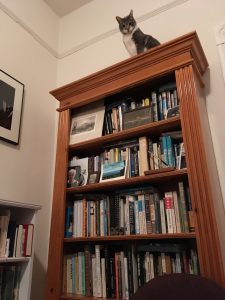
Next to John’s watercolor is an archival photo by Nathan Lerner. He made a light box with two holes at either end and, I believe, another hole for the camera lens. Inside the box are simple wooden dowels, and the movement of light across them thrilled me the first time I saw it and still thrills me today. That elusive mystery of light is one of the links between me and Agnes Pelton, and shows me the moment of creation of a work of art. Our rescue kitty Tomaso loves nothing better than to jump up to the top of this bookcase and watch me work.

On the opposite wall is one of my proudest possessions, the walking stick given to all graduates of the Warren Wilson College MFA Program for Writers. It’s handmade in Asheville, NC from native rhododendron to always keep us connected to the mountains. Warren Wilson is the reason I have a novel to share with the world, and the community of writers it has created keeps me going year after year.

So there you have it. Now, ready, set, WRITE!

Thanks, Mari, for sharing your lovely workspace with us.

We hope that more novels are forthcoming and that Tomaso doesn’t interrupt you too much.

About the Author:

MARI COATES lives in San Francisco, where, before joining University of California Press as a senior editor, she was an arts writer and theater critic. Her stories have been published in the literary journals HLLQ and Eclipse, and she is grateful for residencies at I-Park, Ragdale, and Hypatia-in-the-Woods, which allowed her to develop and complete The Pelton Papers. She holds degrees from Connecticut College and the Warren Wilson MFA Program for Writers.

Said Through Glass by Jona Colson

Source: Purchased
Paperback, 84 pgs.
I am an Amazon Affiliate

Said Through Glass by Jona Colson is a keen observance of ordinary life and how we deal with not only grief, but our feelings of “otherness” even among family. There are several poems in an interview style throughout the collection, which I felt disconnected from.The one “interview” style poem I did enjoy and did feel connected to was “House for Sale,” where readers get a sense of a distracted home buyer who has lost his father and is trying to navigate life after.

However, I really loved Colson’s use of language to demonstrate ailments like arthritis and so much more. In “My Mother’s Hands,” the narrator speaks about his mother’s arthritic hands in a way that makes them beautiful: “Now, her fingers turn and twist against themselves,/like stems of wild roses–reaching out/into delicate air.” And in “Retina,” the narrator talks about the darkness of an eye out of sorts and the joy of being able to finally see again: “And the next day: surgery,/to fasten the retina, like wallpaper, back to the frazzled/optic nerve and satisfy its hunger for impulse/and clear astonishment of light.//” There is so much beauty in this collection.

Honey

It pours from a jar, amber and combed
too thick to understand.

It softens the parched skin
rubbed in small fingerfuls.

It soothes the throat
when we stir it into tea.

At breakfast, it sweetens the morning toast
while we talk of summer --

hopeful as a bee toward a tulip
promising pollen.

In part three, we switch gears in a way with a series of ekphrastic poems after a painting from Diego Velazquez called Las Meninas. When I saw this, I wanted a QR Code, like in Jessica Piazza’s latest collection, This Is Not a Sky, but it’s not necessary as this painting was easy to find online. These poems carry a heaviness that makes it easy to visualize the kids/women in this painting, including the Spanish Infanta Margaret Theresa. In the first poem, Theresa is the central figure and her “hoop skirt” is heavy like her heart later in the poem, signifying the weight of obligation she carries. “Heart-heavy, she rises, oiled and/drowsy, surging on, with no anchor,/only a painting of her, here and there./” Colson breathes new life into the Infanta, and the journey is intriguing as it touches on the royal life lightly.

Said Through Glass by Jona Colson speaks and readers must listen, but more than that they must interact with the lines and stanzas on the page — becoming a second observer. Readers will see through this window unique ways to look at the ordinary — from honey to an orange — and examine loss, grief, and change in a way that is not only sad, but beautiful. This beauty ties the collection to its grief to create an arc of healing.

RATING: QUATRAIN

About the Poet:

Jona Colson is an educator and poet. He graduated from Goucher College with a double Bachelor’s degree in English and Spanish and earned his MFA from American University and a Master’s in Literature/Linguistics from George Mason University. His poems have appeared in The Southern Review, Ploughshares, The Massachusetts Review, and elsewhere. In addition to writing his own poetry, he also translates the Spanish language poetry of Miguel Avero from Montevideo, Uruguay. His translations can be found in Prairie Schooner, Tupelo Quarterly, and Palabras Errantes. He has also published several interviews for The Writer’s Chronicle. He is currently Associate Professor at Montgomery College in Maryland where he teaches English as a second language. He lives in Dupont circle area of Washington, DC. Visit his website at jonacolson.com

Poem: Our Future Will Become the Past of Other Women by Eavan Boland

Today’s poem I share to honor the passing of Eavan Boland, an Irish poet who has recently passed away. I loved her poems. There’s a new documentary about her, that you can read about here.

Please listen below:

Do you have a favorite poem by Boland? Please share in the comments.

Other Voices Other Lives by Grace Cavalieri

Source: Purchased at Gaithersburg Book Festival
Paperback, 250 pgs.
I am an Amazon Affiliate

Other Voices Other Lives by Grace Cavalieri (listen to this interview), poet laureate of Maryland, is part of Alan Squire Publishing’s legacy collections and includes a selection of poems and plays, as well as interviews from her The Poet & the Poem public radio series.

I just had to get my hands on this collection when I was at last year’s Gaithersburg Book Festival and I had the honor of greeting her and escorting her about the local festival before her appearance was required on a panel and at the announcement of our 2019 high school poetry contest winners.

Selection from "Work Is My Secret Lover"

Work
takes the palm of my hand to kiss
in the middle of the night
it holds my wrist lightly and feels the pulse
Work is who you'll find with me
when you tiptoe up the stairs
and hear my footsteps through the shadows

I love that her poems take on a personality of their own and many of them are so different, tackling not only the angst of the writer’s life and the love we have for our work (which can take precedence over other things), but also the voices in which she speaks not for others but with them. From Anna Nicole Smith’s to Mary Wollstonecraft’s voice to poems styled after William Carlos Williams, Cavalieri’s imagination brings a new life to these women’s voices. Even the selections from her plays are lyrical and full of whimsy (in a way). Her persona poems imbue the public perceptions of women with a compassionate eye.

If you listen to her interview, at about 5:06, you’ll hear her read “Moderation,” which is my favorite poem from this collection. It’s deeply moving. A moment where a man knows it is time to pass into another world, and he hopes to never inconvenience anyone with his death. This silent man who doesn’t live outside the lines. Cavalieri displays her keen observations about her father and others, but she also observes herself as an outsider, an observer full of emotion. Other Voices Other Lives by Grace Cavalieri is a deeply emotional journey through her work, and it always rings true. I’ll be seeking out her other collections in the future.

Grace Cavalieri needs no introduction in Maryland as our state Poet Laureate, but damn she is smart, observant, kind, and deliciously cognizant of how to imbue others with humanity through her own compassionate lens.

RATING: Quatrain

About the Poet:

Grace Cavalieri is an Italian American writer and host of the radio program The Poet and the Poem, presented by the Library of Congress through National Public Radio. She is the author of numerous collections of poetry, including Poems: New and Selected (1994), Pinecrest Rest Haven (1998), and Greatest Hits, 1975–2000 (2002). Her collection What I Would Do for Love: Poems in the Voice of Mary Wollstonecraft (2004) was awarded the Patterson Poetry Prize; Water on the Sun (2006) won the Bordighera Poetry Prize. Further collections include Anna Nicole: Poems (2008) and Sounds Like Something I Would Say (2010).

Mailbox Monday #576

Mailbox Monday has become a tradition in the blogging world, and many of us thank Marcia of The Printed Page for creating it.

It now has it’s own blog where book bloggers can link up their own mailbox posts and share which books they bought or which they received for review from publishers, authors, and more.

Leslie, Martha, and I also will share our picks from everyone’s links in the new feature Books that Caught Our Eye. We hope you’ll join us.

Here’s what we received:

Magnolia Table by Joanna Gaines for review.

Following the launch of her #1 New York Times bestselling cookbook, Magnolia Table, and seeing her family’s own sacred dishes being served at other families’ tables across the country, Joanna Gaines gained a deeper commitment to the value of food being shared. This insight inspired Joanna to get back in the kitchen and start from scratch, pushing herself beyond her comfort zone to develop new recipes for her family, and yours, to gather around. Magnolia Table, Volume 2 is filled with 145 new recipes from her own home that she shares with husband Chip and their five kids, and from the couple’s restaurant, Magnolia Table; Silos Baking Co; and new coffee shop, Magnolia Press. From breakfast to dinner, plus breads, soups, and sides, Magnolia Table, Volume 2 gives readers abundant reasons to gather together. The book is beautifully photographed and filled with dishes you’ll want to bring into your own home, including Mushroom-Gruyére Quiche, Pumpkin Cream Cheese Bread, Grilled Bruschetta Chicken, Zucchini-Squash Strata, Chicken-Pecan-Asparagus Casserole, Stuffed Pork Loin, Lemon-Lavender Tart, and Magnolia Press Chocolate Cake.

What did you receive?

Poem Generator Fun: Limerick

I just love a good limerick. This is usually another five line poem, but there’s always a bit of humor — some of the best are bawdy.  All have vivid imagery.

Here’s one from Ogden Nash:

The turtle lives ‘twixt plated decks
Which practically conceal its sex.
I think it clever of the turtle
In such a fix to be so fertile.

I also like this from Edward Lear:

There was a Young Lady whose chin
Resembled the point of a pin:
So she had it made sharp,
And purchased a harp,
And played several tunes with her chin.

Here’s mine from the poem generator:

There once was a man called danny.
He said, “See the lovely hanney!”
It was rather last,
But not enthusiast,
He couldn’t say no to the manni.

Let’s create some limericks! Share what poem you created in the comments.

Sponsor:

Do you need help from a poem writer? Please visit this website to get a poem written by experts.

Book Spine Poetry

Many book bloggers have participated in online memes where we’ve taken photos of our book stacks and our bookshelves. But have you ever wondered if you took some extra care, you could arrange those books’ titles to create your very own poem?

I’d love to see your book spine poems, feel free to tag @SavvyVerseWit on Twitter and use the #bookspinepoetry

Here’s what I came up with:

Girls like us
partial genius
Other voices, other lives
said through glass

What poem did you create?

Erasure Poetry

I’ve always loved blackout poetry, taking an existing text and erasing parts of it to create something new. Erasure poetry enables not only the poet but the reader to see an older work in a new way.

According to the Academy of American Poets, one famous erasure poet, Ronald Johnson, took the form to a new level when he revised the first four books of John Milton’s Paradise Lost.

One of my favorite collections of this type of poetry is from Heather Aimee O’Neill and Jessica Piazza, Obliterations. You can check out my review of that book from 2016.

Here’s Robert Frost’s Nothing Gold Can Stay (with my erasures):

Nature's first green is gold,
Her hardest hue to hold.
Her early leaf's a flower;
But only so an hour.
Then leaf subsides to leaf.
So Eden sank to grief,
So dawn goes down to day.
Nothing gold can stay.

Here’s the clean version:

Nature's first green
hardest to hold
early flower
subsides to leaf.
grief,
goes down
Nothing can stay.

Give it a try and see what you can come up with.

Poem: won’t you celebrate with me by Lucille Clifton

Today’s poem I share is from Lucille Clifton and is a poem about hope and perseverance in times of adversity. You can listen to the poem, here.

won’t you celebrate with me

won't you celebrate with me
what i have shaped into
a kind of life? i had no model.
born in babylon
both nonwhite and woman
what did i see to be except myself?
i made it up
here on this bridge between
starshine and clay,
my one hand holding tight
my other hand; come celebrate
with me that everyday
something has tried to kill me
and has failed.

What poems have you found during our pandemic lockdown?

I Shimmer Sometimes, Too by Porsha Olayiwola

Source: Purchased
Paperback, 96 pgs
I am an Amazon Affiliate

I Shimmer Sometimes, Too by Porsha Olayiwola, who is Boston’s poet laureate, is a collection of hard truths. I first heard about her from this interview, which is a must listen. Her poems are raw and pull no punches, and they shouldn’t. She’s speaking for a very marginalized group of people in our society – queer black women.

Her opening poem brings to the forefront the rawness of our immigration policies in this country and the damage left behind when her father was sent to his homeland and her mother was left in the United States to raise their children. Olayiwola imagines what life would have been like had her father been able to stay in “Had My Parents Not Been Separated After My Father’s Traffic Stop, Arrest, and Deportation From the United States of America.” This serves as a lens through which her life has unfolded – the discrimination that follows her as a black woman who is queer — and her light amidst all of it. Even in the darkest moments of arrest, her poems shimmer with hope and light.

From "Interlude at a Neighborhood Gas Station: 2001"

the music peeled back the air
as the ivory chrysler swerved and jolted
into a spot behind our parked toyota

From modern subjects of finding and losing love, struggling with mental illness, dealing with discrimination at every turn, Olayiwola has a keen eye and slices through the malarkey of our society and reveals the whole truth of life in America. She tackles history and the present with aplomb. My favorite poem is “Unnamed.” Take a listen as she performs the piece in the video below:

Buy this collection today. I Shimmer Sometimes, Too by Porsha Olayiwola will challenge you, force you to look twice at your own behavior and comments, and move into a future where there is a bit more understanding and empathy for others. In a world where compassion is minimal at best, these are the collections that will have use recollecting our humanity.

RATING: Cinquain

About the Poet:

Porsha Olayiwola is a writer, performer, educator and curator who uses afro-futurism and surrealism to examine historical and current issues in the Black, woman, and queer diasporas. She is an Individual World Poetry Slam Champion and is the current poet laureate for the city of Boston