Quantcast

Mailbox Monday #626

Mailbox Monday has become a tradition in the blogging world, and many of us thank Marcia of The Printed Page for creating it.

It now has it’s own blog where book bloggers can link up their own mailbox posts and share which books they bought or which they received for review from publishers, authors, and more.

Leslie, Martha, and I also will share our picks from everyone’s links in the new feature Books that Caught Our Eye. We hope you’ll join us.

Here’s what we received:

Forward: A Memoir by Abby Wambach from Audible.

Abby Wambach has always pushed the limits of what is possible. Named by Time magazine as one of the most influential people of 2015, the iconic soccer player captured the nation’s heart when she led her team to its recent World Cup championship. Admired for her fearlessness and passion, Abby is a vocal advocate for women’s rights and equal opportunity, pushing to translate the success of her team to the real world. She has become a heavily requested speaker to a wide a range of audiences, from college students to executives at Fortune 500 companies.

In Forward, Abby recounts her own decisions, wins, and losses and the pivotal moments that helped her become the world-class athlete and leader she is today. Wambach’s book goes beyond the soccer field to reveal a soulful person grappling with universal questions about how we can live our best lives and become our truest selves. Written with honesty and heart, Forward is an inspiring blueprint for individual growth and a rousing call to action.

Grateful American: A Journey from Self to Service by Gary Sinise, Marcus Brotherton from Audible.

As a kid in suburban Chicago, Gary Sinise was more interested in sports and rock ‘n’ roll than reading or schoolwork. But when he impulsively auditioned for a school production of West Side Story, he found his purpose – or so it seemed.

Within a few years, Gary and a handful of friends created what became one of the most exciting and important new theater companies in America. From its humble beginnings in a suburban Chicago church basement and eventual move into the city, the Steppenwolf Theatre Company launched a series of groundbreaking productions, igniting Gary’s career along with those of John Malkovich, Joan Allen, Gary Cole, Laurie Metcalf, Jeff Perry, John Mahoney, and others. Television and film came calling soon after, and Gary starred in Of Mice and Men (which he also directed) and The Stand before taking the role that would change his life in unforeseeable ways: Lieutenant Dan in the Academy Award-winning Forrest Gump.

The military community’s embrace of the character of the disabled veteran was matched only by the depth of Gary’s realization that America’s defenders had not received all the honor, respect, and gratitude their sacrifices deserve. In the aftermath of the September 11 attacks, this became Gary’s mission. While starring in hits like Apollo 13, Ransom, Truman, George Wallace, CSI:NY, and Criminal Minds: Beyond Borders, Gary has worked tirelessly on behalf of those who serve this country…entertaining more than a half-million troops around the world playing bass guitar with his Lt. Dan Band, raising funds on behalf of veterans, and founding the Gary Sinise Foundation with a mission to serve and honor America’s defenders, veterans, first responders, their families, and those in need.

Becoming the Enchantress by Kristin Kowalski Ferragut, illustrated by Coley Dolmance Ferragut from the publisher, which I’ll likely giveaway when I review Kristin’s book that she signed for me.

Becoming the Enchantress is the story of a transgender parent that faces personal longing for change. Given the acceptance and encouragement of her children, the parent magically transforms from a Wizard into an Enchantress on Halloween night. The story highlights themes of acceptance and the love between child and parent. Becoming the Enchantress is unique in that it is written for children whose parent is the one discovering their dysphoria and seeking reassignment, rather than that of the child or teenager themselves.

Becoming the Enchantress fills a heretofore neglected niche in children’s literature. It conveys the struggle of a parent to find, in this case, her true identity, and the children’s loving acceptance of it. It should prove a useful resource for families with a transgender or non-binary parent.

-W. Luther Jett, retired Special Educator, Montgomery County Public Schools, author of Our Situation and Everyone Disappears

Becoming the Enchantress is a beautiful story about a life-changing transition. It uses imagery that children can understand to discuss a difficult topic. The book details the emotions of someone who is learning how to be their true self. The story shows that while children may not fully understand the issue, they are accepting and are willing to love others for who they are. -Stacy Whipp, M.Ed.

A wonderful story for all ages of unconditional love and acceptance for people! Be true to who you are and love yourself and you will feel completely fulfilled. This story teaches us that no matter what, a person’s heart and soul is what defines them. -Katherine R Stull, LCSW-C

Becoming the Enchantress is a wonderful tale for anyone who has questioned their identity or has loved someone doing so. It treats the delicate subject in the most loving way possible, with gorgeous illustrations, spotlighting the magic that positive self-image and family acceptance can create. – Michelle Zibrat, Art Educator

I am both the parent of a trans child and a therapist that supports transitioning children, teens and adults. I love Becoming the Enchantress as it is a lovely story that explains the need to transition from your sex assigned at birth to your true self. Children will connect both with the Wizard and his family in this story. Using the experience of “trying on” a different persona is a lovely way to introduce the children to the wizard and the concept of transitions. -Theresa Fraser, CYC-P, CPT-S, NSCCT, MA, RP, Trauma and Loss Clinical Specialist

What did you receive?
Virtual Poetry Circle: Lawrence Ferlinghetti

With the return of the Virtual Poetry Circle, I hope that you’ll read the poem or listen. I’ll leave the comments open for discussion, first impressions, emotional reactions. I’d love to hear what you think about today’s poem from Lawrence Ferlinghetti.

Feel free to share poems you are reminded of, favorite lines, and whatever comes to mind when reading this poem.

While I find this very egocentric in that poets can save the world, I do like that he reminds us how powerful words can be.

Haiku

Haiku are short form poetry originally from Japan. The poems contain three phrases that contain a kireji, or “cutting word”, 17 syllables in a 5, 7, 5 pattern, and a kigo, or seasonal reference. Basho is one of the most famous of the haiku writers.

Here’s today’s poem generator for haiku.

Check out what the generator came up with for me:

Jovian, largest
discovery of the moons
the electric lights

I hope these Friday activities are enjoyable.

Imposter Syndrome

I debated on whether I would write this post, but I feel compelled to do so. I’m taking it as my moment to stop feeling like an imposter or to at least remember that I’ve worked really hard on publishing poems in the last few years.

Imposter syndrome is something I’ve had as a writer probably since leaving undergrad. It’s the feeling that I’m not qualified enough and that I’ll be outed as a phony any moment. But I read a recent Harvard Business Review article that has me questioning the problem — perhaps it isn’t just feeling but a problem with the systems that oppress others?

What’s less explored is why imposter syndrome exists in the first place and what role workplace systems play in fostering and exacerbating it in women. We think there’s room to question imposter syndrome as the reason women may be inclined to distrust their success.

The impact of systemic racism, classism, xenophobia, and other biases was categorically absent when the concept of imposter syndrome was developed.

Is that the case with me? I don’t know that it is. I’m not a social scientist.

My new question is: how can I be a fake poet? What would that even look like?

I do have insecurities about the lack of an MFA — a conversation I had recently with a couple poets I know. I’ve sought advice, and I hope that I can internalize it and change my mindset. A lot of my imposter syndrome is internal – I read widely and write poems (not as consistently as I’d like).

I’m also not willing to go into debt to achieve an MFA. I just can’t put my family in that hole when so many depend on me, and for real, it would really just be a formalized way of getting more time to write. But as a major income in my house, carving out that time is hard enough without having to please professors, etc. I’d rather just use the little time I have for creative writing to write!

Is the lack of MFA the only reason I feel like an imposter? Probably not. It also could be because I don’t talk the poet-talk. I don’t speak in metaphor, and I don’t present myself as an academic at all. I may know things, I just don’t talk about them like many writers do.

Am I really an imposter?

No. I write poems. I work hard to refine them. I submit them periodically if not monthly to journals. I am working on a manuscript. I will complete all of these things while working full time and raising a child and caring for other family members. All of these things take time, commitment, and work. I am not an imposter.

Field Study by Chet’la Sebree

Source: Publisher
Paperback, 176 pgs.
I am an Amazon Affiliate

Field Study by Chet’la Sebree reminds me of those scientific notebooks kept by scientists in the field who are observing animals or others as they take notes. Peppered with quotations from bell hooks and many others, Sebree explores Black female identity and sexual desire. The poem is less like a poem than a list of observations and comments on Black identity and female desire.

Black women and girls face additional burdens of protecting the reputations of black boys and men. -- Tressie McMillan Cottom
My secret ... I'm always angry. -- Bruce Banner
 ___________

And why wouldn't I be?

In addition the female desire and the struggle of Black women who love and are attracted to white men, Sebree voices some of the issues she’s found in the Black community — how the community does not address mental health enough.

In my early twenties, I worked on an epistolary series.
I didn't know I wrote a book-length suicide note.
I titled it And If I Die Before I Wake.
A prayer and a promise.
__________

I'm alive; I'm alive; I'm alive.
Cry it with me.
It doesn't always feel like it, but it's a good thing.

Sebree has created a poetry collection in which mental health is entwined with Black female identity, the racial tensions that women feel from all sides, and the responsibility they have to project a sense that they are indeed whole. “No matter how far I go, there is never enough makeup for the bullet hole.” Field Study by Chet’la Sebree, which publishes in June, worries and rationalizes and assesses herself like a scientist. Her observations are keen and deeply probing, and she doesn’t let up on herself. This is a frank look at one woman’s struggle with desire and identity, but it has universal applications to others in all communities — less judgment and more love. Definitely not your typical, confessional poetry collection — it’s much more.

RATING: Quatrain

In the Lateness of the World by Carolyn Forché

Source: Publisher
Paperback, 96 pgs.
I am an Amazon Affiliate

In the Lateness of the World by Carolyn Forché is a tapestry of human history that traverses time and place, and it calls upon the reader to take in the totality of history. This includes the moment of now, as well as all the past moments that make up the “now” and the world as it is and how it was envisioned. Forché has created a collection that looks back on the totality of moments so that we can see everything at once.

From “Water Crisis” to “Report from an Island,” her poems look at the crises humanity faces, losses of clean water, pollution of our seas by plastic, and those who are forced to live in trash piles. “This work is slow,” the narrator of “Report from an Island” says. Time always seems to move slowly and progress can be even slower.

From real-world issues, these poems spin the folklore of individuals. The stories of who we are or were can be lost to the ravages of time. In “The Lost Suitcase,” Forché says, “Here are your books, as if they were burning./Be near now, and wake to tell me who you were.//” Many of her poems build these stories from ash and memory. We walk the streets of a city under siege: “Turning the pages of the book you have lent me of your wounded city,/reading the braille on its walls, walking beneath ghost chestnuts/past fires that turn the bullet-shattered windows bronze,/”

One of my favorite poems is a tribute to the late Larry Heinemann, author of Paco’s Story, (I still miss our FB conversations) and his fellow veterans, Kevin Bowen, Bruce Weigl, Nguyen Ba Chung, “Hue: From a Notebook,” which pays tribute to the past, their present, and their ghosts.

We went down the Perfume River by dragon boat
as far as the pagoda of the three golden Buddhas.

Pray here. You can ask for happiness.
We light joss sticks, send votives downriver in paper sacks,

then have trouble disembarking from the boat.
Our bodies disembark, but our souls remain.

A thousand lanterns drift, a notebook opens in the dark
to a page where moonlight makes a sound.

These soldiers are decades from war now:
pewter-haired, steel haired, a moon caught in plumeria.

We are like the clouds that pass and pass.
What does it matter then if we are not the same as clouds?

There was then the whir of stork wings, and bicycle chains ringing.
It is still now the way the air is still just before the mine explodes.

Once we fired at each other. Now we pass silence back and forth.
On the ten thousand graves, we lay chrysanthemum.

Forché’s poems are powerful in the silent and calm voice she uses to speak about the “lateness” of the world. When we come to the end of a life, who hears those memories, those echoes of the past? Is it in the breeze? Is it in the smell of the flowers? Is it in the books and stories we tell? In the Lateness of the World by Carolyn Forché is our tapestry, and it grows larger each day.

RATING: Quatrain

Mailbox Monday #625

Mailbox Monday has become a tradition in the blogging world, and many of us thank Marcia of The Printed Page for creating it.

It now has it’s own blog where book bloggers can link up their own mailbox posts and share which books they bought or which they received for review from publishers, authors, and more.

Leslie, Martha, and I also will share our picks from everyone’s links in the new feature Books that Caught Our Eye. We hope you’ll join us.

Here’s what we received:

Thresholds and Other Poems by Matt Hohner for review in April.

Matt Hohner’s Thresholds and Other Poems is a poetry of loss, violence, beauty and love. In this collection, Hohner addresses the toll and joy of living, head-on and honestly. Facing rough social and political headwinds blowing at home and abroad, Hohner speaks with full voice against the storm of malevolence that so often seems the norm. In this terror, though, there is a desperate clinging to love, which Hohner returns to simply and elegantly. Perhaps it is in his reaching for solace that Hohner’s poems offer their greatest strength, while promising something more relatable: catharsis. The value of Thresholds and Other Poems is not in the path to peace this collection seeks, but in the pressure release valve it gives the reader from a tumultuous world. Friendship and marriage, the sensual act of eating an oyster, a hike in the woods at dusk—all find celebration in these pages. There is hope in these poems, and you will laugh and smile, too. Thresholds takes us to that frontier at the edge of the darkness, where the light lives.

Becoming the Enchantress by Kristin Kowalski Ferragut, illustrated by Coley Dolmance Ferragut

Becoming the Enchantress is the story of a transgender parent that faces personal longing for change. Given the acceptance and encouragement of her children, the parent magically transforms from a Wizard into an Enchantress on Halloween night. The story highlights themes of acceptance and the love between child and parent. Becoming the Enchantress is unique in that it is written for children whose parent is the one discovering their dysphoria and seeking reassignment, rather than that of the child or teenager themselves.

Becoming the Enchantress fills a heretofore neglected niche in children’s literature. It conveys the struggle of a parent to find, in this case, her true identity, and the children’s loving acceptance of it. It should prove a useful resource for families with a transgender or non-binary parent.

-W. Luther Jett, retired Special Educator, Montgomery County Public Schools, author of Our Situation and Everyone Disappears

Becoming the Enchantress is a beautiful story about a life-changing transition. It uses imagery that children can understand to discuss a difficult topic. The book details the emotions of someone who is learning how to be their true self. The story shows that while children may not fully understand the issue, they are accepting and are willing to love others for who they are. -Stacy Whipp, M.Ed.

A wonderful story for all ages of unconditional love and acceptance for people! Be true to who you are and love yourself and you will feel completely fulfilled. This story teaches us that no matter what, a person’s heart and soul is what defines them. -Katherine R Stull, LCSW-C

Becoming the Enchantress is a wonderful tale for anyone who has questioned their identity or has loved someone doing so. It treats the delicate subject in the most loving way possible, with gorgeous illustrations, spotlighting the magic that positive self-image and family acceptance can create. – Michelle Zibrat, Art Educator

I am both the parent of a trans child and a therapist that supports transitioning children, teens and adults. I love Becoming the Enchantress as it is a lovely story that explains the need to transition from your sex assigned at birth to your true self. Children will connect both with the Wizard and his family in this story. Using the experience of “trying on” a different persona is a lovely way to introduce the children to the wizard and the concept of transitions. -Theresa Fraser, CYC-P, CPT-S, NSCCT, MA, RP, Trauma and Loss Clinical Specialist

What did you receive?

Virtual Poetry Circle: Gwendolyn Brooks

For 2021, I’m experimenting with the Virtual Poetry Circle in which I share a poem and leave the comments open for discussion, first impressions, emotional reactions. I’d love to hear what you think about today’s poem from Gwendolyn Brooks.

Feel free to share poems you are reminded of, favorite lines, and whatever comes to mind when reading this poem.

When I first read this poem, I was struck by the Jazzy tone of it, or what I imagined Jazz to be — improvisational. But the last line still upsets me.

Limericks

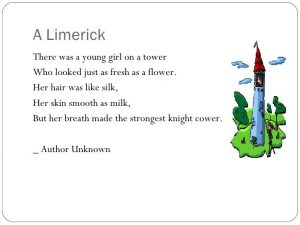
Limericks are often humorous poems, with three long and two short lines with the rhyme scheme aabba. Some times these can be bawdy.

I share with you the Poetry Generator for Limericks.

Here’s mine:

There was a man named Trygg
Who used to dance a jig
But during a break
He made a mistake
What a terrible day for Trygg

There are days when you just need a little bit of fun.

Emerge by Francesca Marais

Source: Poet
Hardcover, 25 pgs.
I am an Amazon Affiliate

Emerge by Francesca Marais is a chapbook about learning to let go of our angst, anxiety to learn to trust our selves to be us without worry. Marais’ water imagery calls to mind the tumultuous waves and stormy seas we can face, but also the gently lapping waves that can cradle us into calm. In “Bookworm,” the comfort of books “We could safely escape/Rattling instability,/Where our safety and fears/Were in our own hands.//” In this image, the poet reminds us that our own hands are where our safety and our fears reside. We may not always be in control of our emotions, but we can be and learn to trust ourselves.

Moving to “Inheritance,” the poet weaves in generational passage of traits from one generation to another and that there is a lineage we pass along without knowing it. “He sees them bloom amidst their agony–/Their ability to prevail, his joy./In the smiles of his children,/He sees the youth he once knew/And how it continues in them–/”

Marais’ poems teach us to breathe, learn how to be calm and observe and live. Emerge by Francesca Marais is a journey and one we all embark on at some point in our lives. Gather your own power from the darkness and the trials of your life, emerge from the ashes.

RATING Quatrain