Quantcast

Mailbox Monday #283

Mailbox Monday, created by Marcia at To Be Continued, formerly The Printed Page, has a permanent home at its own blog.

To check out what everyone has received over the last week, visit the blog and check out the links.  Leave yours too.

Also, each week, Leslie, Vicki, and I will share the Books that Caught Our Eye from everyone’s weekly links.

Here’s what I received:

1.  The Paradise Tree by Elena Maria Vidal for review in October for Historical Fiction Virtual Book Tours.

The year is 1887 in Leeds County, Ontario. The O’Connor clan is gathering to mourn the loss of its patriarch Daniel O’Connor, an Irish immigrant. The story of Daniel and his wife Brigit is one of great hardships, including illness, ill-starred romances, war and political upheavals, as well as undying love and persevering faith. As Daniel is laid to rest, his grandson Fergus receives a piercing insight into what his own calling in life will be.

2. Giggle Poetry Reading Lessons: A Successful Reading-Fluency Program Parents and Teachers Can Use to Dramatically Improve Reading Skills and Scores by Amy Buswell and Bruce Lansky, illustrated by Stephen Carpenter from LibraryThing Early Reviewers.

Many struggling readers are embarrassed to read aloud. They are often intimidated or bored by texts that conventional programs require them to practice. So, instead of catching up, they fall further behind. Currently 67% of American fourth graders can’t read grade-level text. Reading specialist Amy Buswell has spent eight years looking for remediation methods that work. “What is needed,” Buswell explains, “is a program that improves the motivation of struggling readers, because that accounts for 90% of the problem.” Four years ago, Buswell came up with a brainstorm. She knew her best readers enjoyed reading Bruce Lansky’s poetry books for pleasure. The more poems they read, the better their reading got. Why not use Lansky’s kid-tested poems as texts struggling readers could practice on to improve their reading—using six research-based strategies: choral reading, echo reading, paired reading, repeated reading, sustained silent reading and “say it like the character” reading. — This book is the result of that brainstorm and the resulting collaboration between Buswell and Lansky. It gives teachers and parents everything they need to help children improve their reading: -35 kid-tested poems by Bruce Lansky -35 customized reading lessons by Amy Buswell -35 off-the-wall illustrations by Stephen Carpenter -35 sets of zany performance tips by Bruce Lansky …all of which is designed to make the process of reading improvement more like fun than work. Parents will enjoy Lansky’s funny poems and Stephen Carpenter’s delightful illustrations as much as their children.
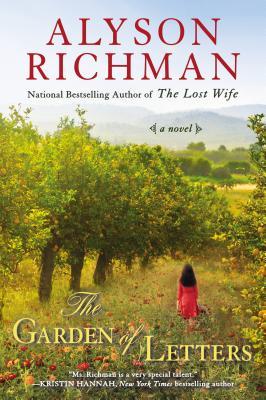
3.  The Garden of Letters by Alyson Richman for review in September.

Portofino, Italy, 1943. A young woman steps off a boat in a scenic coastal village. Although she knows how to disappear in a crowd, Elodie is too terrified to slip by the German officers while carrying her poorly forged identity papers. She is frozen until a man she’s never met before claims to know her. In desperate need of shelter, Elodie follows him back to his home on the cliffs of Portofino.

Only months before, Elodie Bertolotti was a cello prodigy in Verona, unconcerned with world events. But when Mussolini’s Fascist regime strikes her family, Elodie is drawn into the burgeoning resistance movement by Luca, a young and impassioned bookseller. As the occupation looms, she discovers that her unique musical talents, and her courage, have the power to save lives.

4.  In Real Life: Love, Lies, & Identity in the Digital Age by Nev Schulman, a suprise review copy from Grand Central.

Now Nev takes his investigation to the page, providing readers with an essential roadmap to better connect their digital personas with their true selves. Woven throughout with Nev’s personal stories, this book explores relationships in the era of social media. Specifically the book tackles:

-what motivates catfish
-why people fall for catfish
-how one can avoid being deceived
-online accountability
-Nev’s rules for dating
-how to connect authentically with people over the internet
-how to turn an online relationship into a real life relationship, and much, much more.

Nev delves deeply into the complexities of dating in a digital age, and continues the cultural dialogue his show has begun about how we interact with each other through social media versus in person — specifically in relation to millennials, who have never known a world without Facebook.

5.  My Mother’s Secret: A Novel Based on a True Holocaust Story by J.L. Witterick for review in September.

Franciszka and her daughter, Helena, are unlikely heroines. They are simple people who mind their own business and don’t stand out from the crowd. Until 1939, when crisis strikes. The Nazis have invaded Poland and they are starting to persecute the Jews. Providing shelter to a Jew has become a death sentence. And yet, Franciszka and Helena decide to do just that. In their tiny, two-bedroom home in Sokal, Poland, they cleverly hide a Jewish family of two brothers and their wives in their pigsty out back, a Jewish doctor with his wife and son in a makeshift cellar under the kitchen floorboards, and a defecting German soldier in the attic–each group completely unbeknownst to the others. For everyone to survive, Franciszka will have to outsmart her neighbors and the German commanders standing guard right outside her yard.
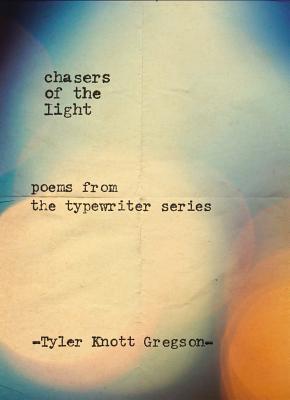
6.  Chasers of the Light by Tyler Knott Gregson for review in September.

One day, while browsing an antique store in Helena, Montana, photographer Tyler Knott Gregson stumbled upon a vintage Remington typewriter for sale. Standing up and using a page from a broken book he was buying for $2, he typed a poem without thinking, without planning, and without the ability to revise anything.

He fell in love.

Three years and almost one thousand poems later, Tyler is now known as the creator of the Typewriter Series: a striking collection of poems typed onto found scraps of paper or created via blackout method. Chasers of the Light features some of his most insightful and beautifully worded pieces of work—poems that illuminate grand gestures and small glimpses, poems that celebrate the beauty of a life spent chasing the light.

7.  Pies & Peril by Janel Gradowski from my friend and the author.  Thank you!  Check out my review.

When Amy Ridley decided to compete in the Kellerton Summer Festival Pie Contest, the last thing she expected was to find the reigning pie queen, Mandy Jo, dead—a raspberry pie smashed on her face! Mandy Jo made fantastic pies, but she accumulated more enemies than baking trophies. But when Amy receives a note threatening her own life, she decides to do some investigating herself.

It seems that half the town has a reason to kill the mean pie queen, and Amy finds herself sifting through a list of suspects that’s longer than her list of recipes. Not to mention playing cupid for her love-shy best friend, fending off a baker intent on finding out her prize-winning culinary secrets, and ducking the deadly attentions of Mandy Jo’s killer. If Amy doesn’t find out who wanted the pie queen dead soon, her own goose may be cooked!

8.  One Hundred Years of Solitude by Gabriel Garcia Marquez from the library sale for 50 cents.

The novel tells the story of the rise and fall of the mythical town of Macondo through the history of the family. It is a rich and brilliant chronicle of life and death, and the tragicomedy of humankind. In the noble, ridiculous, beautiful, and tawdry story of the family, one sees all of humanity, just as in the history, myths, growth, and decay of Macondo, one sees all of Latin America.

Love and lust, war and revolution, riches and poverty, youth and senility — the variety of life, the endlessness of death, the search for peace and truth — these universal themes dominate the novel. Whether he is describing an affair of passion or the voracity of capitalism and the corruption of government.

9.  The Best of Us by Sarah Pekkanen from the library sale for 50 cents.

Following a once-in-a-lifetime invitation, a group of old college friends leap at the chance to bring their husbands for a week’s vacation at a private villa in Jamaica to celebrate a former classmates’ thirty-fifth birthday.
All four women are desperate for a break and this seems like a perfect opportunity. Tina is drowning under the demands of mothering four young children. Allie needs to escape from the shattering news about an illness that runs in her family. Savannah is carrying the secret of her husband’s infidelity. And, finally, there’s Pauline, who spares no expense to throw her husband an unforgettable birthday celebration, hoping it will gloss over the cracks that have already formed in their new marriage.

The week begins idyllically, filled with languorous days and late nights of drinking and laughter. But as a hurricane approaches the island, turmoil builds, forcing each woman to re-evaluate everything she’s known about the others—and herself.

10.  The Best-Loved Poems of Jacqueline Kennedy Onassis with an introduction by Caroline Kennedy from the library sale for $1.

Jacqueline Kennedy Onassis loved literature, especially poetry. Once you can express yourself, she wrote, you can tell the world what you want from it. Now, Caroline Kennedy shares her mothers favorite poems by such renowned authors as William Shakespeare, Emily Dickinson, e.e. cummings, and Robert Frost. The book also includes a poem written by Jacqueline Kennedy and is illustrated with photographs of the Kennedy clan. This is a wonderful volume for reading aloud or by yourself and a meaningful gift or keepsake for Mothers Day.

 

11.  Best-Loved Slow Cooker Recipes from the library sale for $1.

Crock Pot Best Loved Slow Cooker Recipes includes more than 100 recipes for your Crock Pot Slow Cooker. Whether you need to whip up main dish meals, party time appetizers or sweet tooth threats, the Crock Pot slow cooker helps to easy your busy day.


12.  The Winter Guest by Pam Jenoff from Anna at Diary of an Eccentric who had an extra copy.

Life is a constant struggle for the eighteen-year-old Nowak twins as they raise their three younger siblings in rural Poland under the shadow of the Nazi occupation. The constant threat of arrest has made everyone in their village a spy, and turned neighbor against neighbor. Though rugged, independent Helena and pretty, gentle Ruth couldn’t be more different, they are staunch allies in protecting their family from the threats the war brings closer to their doorstep with each passing day.

Then Helena discovers an American paratrooper stranded outside their small mountain village, wounded, but alive. Risking the safety of herself and her family, she hides Sam, a Jew, but Helena’s concern for the American grows into something much deeper. Defying the perils that render a future together all but impossible, Sam and Helena make plans for the family to flee. But Helena is forced to contend with the jealousy her choices have sparked in Ruth, culminating in a singular act of betrayal that endangers them all and setting in motion a chain of events that will reverberate across continents and decades.

What did you receive?
266th Virtual Poetry Circle

Welcome to the 266th Virtual Poetry Circle!

Remember, this is just for fun and is not meant to be stressful.

Keep in mind what Molly Peacock’s book suggested.

Look at a line, a stanza, sentences, and images; describe what you like or don’t like; and offer an opinion. If you missed my review of her book, check it out here.

Today’s poem is from Cornelius Eady, read by Kristen Dupard:

I’m A Fool To Love You

Some folks will tell you the blues is a woman,
Some type of supernatural creature.
My mother would tell you, if she could,
About her life with my father,
A strange and sometimes cruel gentleman.
She would tell you about the choices
A young black woman faces.
Is falling in with some man
A deal with the devil
In blue terms, the tongue we use
When we don’t want nuance
To get in the way,
When we need to talk straight.
My mother chooses my father
After choosing a man
Who was, as we sing it,
Of no account.
This man made my father look good,
That’s how bad it was.
He made my father seem like an island
In the middle of a stormy sea,
He made my father look like a rock.
And is the blues the moment you realize
You exist in a stacked deck,
You look in a mirror at your young face,
The face my sister carries,
And you know it’s the only leverage
You’ve got.
Does this create a hurt that whispers
How you going to do?
Is the blues the moment
You shrug your shoulders
And agree, a girl without money
Is nothing, dust
To be pushed around by any old breeze.
Compared to this,
My father seems, briefly,
To be a fire escape.
This is the way the blues works
Its sorry wonders,
Makes trouble look like
A feather bed,
Makes the wrong man’s kisses 
A healing.

What do you think?

Week 1 of the Stella Bain Read-a-Long

This year at War Through the Generations we’ve been hosting a read-a-long specific to one of the 6 wars we are covering.

As this year marks the 100th anniversary of WWI, we’ve decided to select one of our favorite authors — Anita Shreve — to honor the war.

Stella Bain is our selection for August. Synopsis from GoodReads:

When an American woman, Stella Bain, is found suffering from severe shell shock in an exclusive garden in London, surgeon August Bridge and his wife selflessly agree to take her in.

A gesture of goodwill turns into something more as Bridge quickly develops a clinical interest in his house guest. Stella had been working as a nurse’s aide near the front, but she can’t remember anything prior to four months earlier when she was found wounded on a French battlefield.

In a narrative that takes us from London to America and back again, Shreve has created an engrossing and wrenching tale about love and the meaning of memory, set against the haunting backdrop of a war that destroyed an entire generation.

iscussions will be posted on Friday for the designated chapters. Here’s the reading schedule and discussion dates:

Friday, Aug. 8: Pages 1-70
Friday, Aug. 15: Pages 71-138
Friday, Aug. 22: Pages 139-207
Friday, Aug. 29: Pages 208-end

We hope that you’ll join us for the read-a-long and discussions at War Through the Generations.

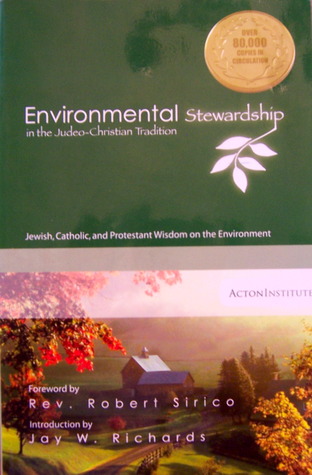
Environmental Stewardship in the Judeo-Christian Tradition foreword by Rev. Robert Sirico, introduction by Jay W. Richards

Source: Borrowed
Paperback, 119 pages
I am an Amazon Affiliate

Environmental Stewardship in the Judeo-Christian Tradition, foreword by Rev. Robert Sirico and introduction by Jay W. Richards, from the Acton Institute explores the religious and textual principles that guide Judaism and Christian faith as they apply to responsible environmental stewardship.  Much of this slim volume focuses on the movement for population control, as well as preserving animal species.  The argument for preserving animals only works in so far as how those animals fit into the overall plan for humans and their needs — they can never take precedence over the needs and benefits of humans, in the simplest of terms.  While all life should be considered worth saving, their argument relies upon a sort of cost benefit analysis in light of religious principles.  For those who are less aware of the nuances of human dominion over nature, this book could provide some insight into the argument that radical environmentalists believe religion espouses humans should not merely consume or take over nature for their own purposes.  This text argues that dominion does not mean humans should merely consume and take what they want, that they should use, shape, and add to nature, not merely consume but to guide it.

“Judaism would never countenance loggers suffering the indignity of joblessness in order not to disturb the nesting habitat of the owl.  When homes for people become dramatically overpriced because of the regulatory costs of providing for the habitat of the kangaroo rat, Jewish tradition also must object.  People need not justify their needs of desires to nature.  They are warned only against destroying things for no good purpose.”  (page 25)

There are some great points about the need for societal change and the absence of a sense of community that seems to pervade many highly populated areas.  There is an argument that greater civility is needed to ensure that highly populated areas are not oppressive.  These elements of the book seem more about morality and religious principles, rather than environmental concerns, such as pollution, biodiversity, and climate change, for example.

“Overpopulation is not a question of numbers or objectively measurable figures such as people per square mile.  Instead, it is a question of whether people feel oppressed by the overwhelming presence of others.  This has more to do with the standards of civility and behavior than with actual population numbers.” (page 19-20)

In an economic perspective, which this book uses alongside its religious one, the benefits nature provides to humans is too often couched with the idea that humans are merely consumers by environmentalists.  Animals should only be saved if they can provide some benefit to humans or their preservation does not interfere with the comfort and growth of the human race.  The idea that there is a middle path is a noble one, but at more than one point in this textual argument, the writers suggest that one side or another must be taken in order for a solution to be found and that there is no middle ground.  Much of this analysis is based on old data regarding climate change and some other issues, and a lot of the arguments stem from the arguments of the most radical environmentalist paradigms.

“Hence, the good steward does not allow the resources entrusted to him to lie fallow or to fail to produce their proper fruit.  Not does he destroy them irrevocably.  Rather, he uses them, develops them, and, to the best of his ability, strives to realize their increase so that he may enjoy his livelihood and provide for the good of his family and his descendants.”  (page 39-40)

Environmental Stewardship in the Judeo-Christian Tradition, foreword by Rev. Robert Sirico and introduction by Jay W. Richards, from the Acton Institute provides an interesting basis for discussion about environmental issues and how the religiously faithful can participate in discussions to find solutions to real problems while remaining true to their faith.  However, there is a lot of faith placed in the goodness of man to do the right thing.  As with any religious-based doctrines, there are some ideas that may bristle readers, particularly with regard to what is viewed as “government” programs aimed at population control (i.e. Planned Parenthood in this example).

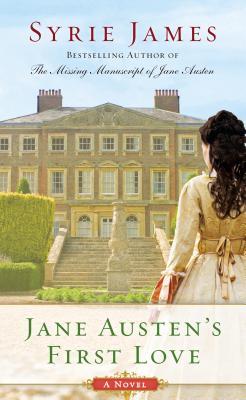
Jane Austen’s First Love by Syrie James

Source: NetGalley
Paperback, 400 pages
On Amazon and on Kobo

Jane Austen’s First Love by Syrie James takes readers back into Jane Austen’s teen years, between the time she is a young girl free to play and the time she comes out and becomes a woman.  While her sister Cassandra and she share everything and every confidence, there are some tender emotions that are too new and sacred to share right away — that of a first love.  Jane Austen is 15 when she is given an unprecedented opportunity to attend a ball and a month of festivities in Kent to celebrate her brother Edward’s nuptials before she comes out to society.  Things are not all that they seem to a young girl who longs to be out with her sister and share in all the activities Cassandra does.  James paints a picture of Austen that is lively and young, as she enthusiastically takes on challenges before her — to prove herself not only to others but to herself — and enjoys every event set before her.

“My anticipation of the expected visitors was shared by Louisa, Charles, and Brook Edward, who kept running to the window to ascertain if they could perceive a hint of an impending arrival.”  (ARC)

Jane is ever the observer of human nature, actions, and character, even at the young age of 15, but even though she observes carefully, her interpretations are not always as accurate as she presumes them to be.  Meeting the lively and enigmatic Edward Taylor, Jane is besotted as any young girl would be who finds someone she admires in looks and in intelligence.  But he also challenges her outlook on society and its traditions, as well as her own role in that society.  James has created a complex relationship that could have happened in real life, and perhaps helped to shape Austen’s views on society, love, and more.

“We are a living part of history!” cried Edward Taylor.  “We are making history this very moment.” (ARC)

James weaves in not only the facts of Kent, her real brother’s marriage to Elizabeth Bridges, and many other characters, but the events and paraphrased lines of Austen’s very own novels.  James cannot be praised enough for her ingenuity and dedication to the spirit of Austen and her novels.  She pays tribute to a young Jane in the best way possible.  Jane Austen’s First Love by Syrie James is the author’s best novel yet, and a must read for anyone who loves historical fiction, Jane Austen, or coming of age stories.  This is a definite contender for the 2014 Best Reads List.

About the Author:

Syrie James, hailed by the Los Angeles Magazine as the queen of nineteenth century re-imaginings, is the bestselling author of eight critically acclaimed novels, including The Missing Manuscript of Jane Austen, The Lost Memoirs of Jane Austen, The Secret Diaries of Charlotte Bronte, Nocturne, Dracula My Love, Forbidden, and The Harrison Duet: SONGBIRD and PROPOSITIONS. Her books have been translated into eighteen foreign languages.

In addition to her work as a novelist, Syrie is a screenwriter, a member of the Writers Guild of America, and a life member of the Jane Austen Society of North America. An admitted Anglophile, she loves romance and all things 19th Century. To learn more about Syrie, visit her online at www.syriejames.com, Follow Syrie on Facebook.

Montana in A Minor by Elaine Russell

Source: Elaine Russell, the author
Paperback, 170 pages
On Amazon and on Kobo

Montana in A Minor by Elaine Russell is a young adult novel about Emily Lopez, a virtuoso cellist player and nearly 17, whose confidence has been shaken by a poor showing at a Julliard audition.  Emily loses herself in her music normally, but since that fateful audition, she’s having a hard time focusing, especially when her summer plans fall through with her father, who is a famous conductor on a whirlwind European tour.  Rather than spend time with her father learning the Camille Saint-Saëns composed his Cello Concerto No. 1 in A minor, Op. 33, Emily is packed off to Montana with her mother, brother Adrian, and step-father, as they spend time with her step-father’s dad who is having some health issues.

“My progress on the opening passage is practically nonexistent.  Mrs. Stanislavsky always tells me it’s a matter of perseverance, breaking the score into small segments and tackling each section without thinking about the rest.  Only this concerto is so difficult, I might have to become a contortionist or grow a couple of extra hands to actually play it.”  (page 9-10)

Out in the country her OCD symptoms do not abate, despite the calmer setting.  The pressure from her father is still with her, she has to be the best to make the cut at the competition in order to gain early acceptance into Julliard.  But she’s spent her spring semester in school earning credits for teaching disadvantage kids how to play music, and she’s waffling about whether Julliard and world tours are her future.  While on the ranch, she loosens up little by little, playing poker with Jake, her step-father’s dad, in the evening and riding with ranch hand, Breck in the afternoons.

Her time on the ranch is full of beautiful passages and frenzied moments, just like the concerto, but until she can learn to break free of her anxieties, she won’t be able to master the score and grab her own future by the reins. Montana in A Minor by Elaine Russell melds music, emotion, and psychological elements in an engaging coming of age story.

About the Author:

Elaine Russell graduated with a BA in History at University of California, Davis, and an MA in Economics at California State University Sacramento. She worked as a Resource Economist/Environmental Consultant for 22 years before beginning to write fiction for adults and children. She became inspired and actively involved with the Hmong immigrant community after meeting Hmong children in her son’s school in Sacramento and reading Anne Fadiman’s The Spirit Catches You and You Fall Down. Since then she has been to Laos many times to research her book and as a member of the nongovernment organization Legacies of War.

Mailbox Monday #282

Mailbox Monday, created by Marcia at To Be Continued, formerly The Printed Page, has a permanent home at its own blog.

To check out what everyone has received over the last week, visit the blog and check out the links.  Leave yours too.

Also, each week, Leslie, Vicki, and I will share the Books that Caught Our Eye from everyone’s weekly links.

Here’s what I received:

1.  My Drunk Kitchen: A Guide to Eating, Drinking, and Going With Your Gut by Hannah Hart for review from It Books.

One day, sad cubicle dweller and otherwise bored New York transplant Hannah Hart decided, as a joke, to make a fake cooking show for her friend back in California. She turned on the camera, pulled out some bread and cheese, and then, as one does, started drinking. (Doesn’t everyone cook with a spoon in one hand and a bottle of wine in the other?) The video went viral and an online sensation was born.

My Drunk Kitchen includes recipes, stories, full color photos, and drawings to inspire your own culinary adventures in tipsy cooking. It is also a showcase for Hannah Hart’s great comedic voice. Hannah offers key drink recommendations, cooking tips (like, remember to turn the oven off when you go to bed) and shares never-before-seen recipes.

2.  Jane Austen’s First Love by Syrie James for review on Aug. 6.

Fifteen-year-old Jane Austen dreams of three things: doing something useful, writing something worthy, and falling madly in love. When she visits her brother in Kent to celebrate his engagement, she meets wealthy, devilishly handsome Edward Taylor—a fascinating young man who is truly worthy of her affections. Jane knows a match between her and Edward is unlikely, but every moment she spends with him makes her heart race—and he seems to return her interest. Much to her displeasure, however, there is another seeking his attention.

What did you receive?

265th Virtual Poetry Circle

Welcome to the 265th Virtual Poetry Circle!

Remember, this is just for fun and is not meant to be stressful.

Keep in mind what Molly Peacock’s book suggested.

Look at a line, a stanza, sentences, and images; describe what you like or don’t like; and offer an opinion. If you missed my review of her book, check it out here.

Today’s poem is from Robert Hayden, as read by Youssef Biaz:

Those Winter Sundays

Sundays too my father got up early
and put his clothes on in the blueblack cold,
then with cracked hands that ached
from labor in the weekday weather made
banked fires blaze. No one ever thanked him.

I’d wake and hear the cold splintering, breaking.
When the rooms were warm, he’d call,
and slowly I would rise and dress,
fearing the chronic angers of that house,

Speaking indifferently to him,
who had driven out the cold
and polished my good shoes as well.
What did I know, what did I know
of love’s austere and lonely offices?

What do you think?

Read-a-Long of Anita Shreve’s Stella Bain

This year at War Through the Generations we’ve been hosting a read-a-long specific to one of the 6 wars we are covering.

As this year marks the 100th anniversary of WWI, we’ve decided to select one of our favorite authors — Anita Shreve — to honor the war.

Stella Bain is our selection for August.  Synopsis from GoodReads:

When an American woman, Stella Bain, is found suffering from severe shell shock in an exclusive garden in London, surgeon August Bridge and his wife selflessly agree to take her in.

A gesture of goodwill turns into something more as Bridge quickly develops a clinical interest in his house guest. Stella had been working as a nurse’s aide near the front, but she can’t remember anything prior to four months earlier when she was found wounded on a French battlefield.

In a narrative that takes us from London to America and back again, Shreve has created an engrossing and wrenching tale about love and the meaning of memory, set against the haunting backdrop of a war that destroyed an entire generation.

Discussions will be posted on Friday for the designated chapters.  Here’s the reading schedule and discussion dates:

  • Friday, Aug. 8: Pages 1-70
  • Friday, Aug. 15: Pages 71-138
  • Friday, Aug. 22: Pages 139-207
  • Friday, Aug. 29: Pages 208-end

We hope that you’ll join us for the read-a-long and discussions at War Through the Generations.

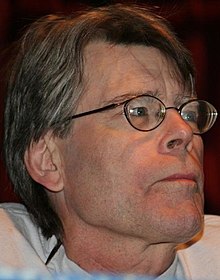
The Regulators by Richard Bachman (a.k.a. Stephen King)

Source: Public Library
Hardcover, 466 pages
On Amazon and on Kobo

The Regulators by Richard Bachman, a.k.a. Stephen King, is like stepping onto the set of The Twilight Zone, from aliens and horrifying mutant animals to shootouts at the Ponderosa and/or O.K. Corral.  Something is not right with this idyllic town of Wentworth, Ohio, and its residents on Poplar Street.  With a cast of characters ranging from a cheating wife to an alcoholic husband and father, King packs in a wide-ranging cast that also includes a Vietnam veteran turned kid’s author and an ex-cop thrown off the force for allegedly being on the take.  There are the twin teen boys and their girlfriends and the local paper boy with big dreams for his baseball career, but there is something seedy underneath this neighborhood and things are about to go haywire.

King always sets the reader up with a typical neighborhood minding its own business and sometimes it’s in the height of summer when dreams are the biggest and relaxation is high on the priority list.  But with these settings, atmospheres, and scenes in place, readers know that things are about to take a turn for the worse, and when they start turning, they begin spiraling down a rabbit hole.

“Peter rose to his feet like an old clockwork toy with rust in its gears.  His eyeballs jiggled in the silver dreamlight from the TV.” (page 256)

What would the world look like through an autistic boy’s eyes, and how could that world be twisted in the hands of a being with no conscience?  Seth Garin is that autistic boy and his world has become even more like a prison than before when he merely had trouble communicating with his family, but soon he learns that the prison he finds himself in could also lead to his freedom.  King packs so many characters into this novel, illustrating depravity and hysteria on any number of levels, but what’s engaging are the scenes where Seth’s favorite characters come to life and take to the streets.  The devastation they bring with them, on the other hand, is harrowing and graphic.

King’s narration shifts point of view on many occasions, making it hard for the reader to hold onto the sequential story, but in many ways this may have been purposeful — to give the reader the same sense of timelessness that the characters endure.  The Regulators by Richard Bachman, a.k.a. Stephen King, is like a comic book and western sprung to life, but only if it were run by a madman director bent on killing everything and absorbing all of its energy.

About the Author/Pen Name (source: Wikipedia):

King states that adopting the nom de plume Bachman was also an attempt to make sense out of his career and try to answer the question of whether his success was due to talent or luck. He says he deliberately released the Bachman novels with as little marketing presence as possible and did his best to “load the dice against” Bachman. King concludes that he has yet to find an answer to the “talent versus luck” question, as he felt he was outed as Bachman too early to know.