Quantcast

The Haunted Library: The Ghost Backstage by Dori Hillestad Butler

Source: Purchased
Paperback, 128 pgs.
I am an Amazon Affiliate

The Haunted Library: The Ghost Backstage by Dori Hillestad Butler, illustrated by Aurore Damant, is a solid third book in this series in which Kaz is beginning to take lessons from Beckett about different ghost skills, including how to pick up solid objects. He’s not doing very well with his lessons, but Beckett insists that he learn. When Claire provides Kaz with an opportunity to escape his grueling lessons, he jumps at the chance.

One of Claire’s classmates saw a ghost during play rehearsals for Jack and the Beanstalk. Kaz isn’t thrilled with all of the noise at Claire’s elementary school or the rush of kids everywhere, but he soon finds a way to navigate without having solids pass through him and making him feel all weird. Kaz easily eavesdrops on conversations and reports back to Claire, but he seems to forget that her classmates will find it odd that she’s talking to herself all the time.

My daughter loves guessing who the ghost might be in each of these books, whether it’s someone in Kaz’s lost family or a classmate. But one thing is for sure, Kaz is growing stronger as a ghost every book, and we can’t wait to see what new ghostly skills he picks up along the way.

The Haunted Library: The Ghost Backstage by Dori Hillestad Butler, illustrated by Aurore Damant, is a solid mystery with a fun cast of characters. As this is set in the school for the most part, we rarely seek Beckett and Kosmo, the ghost dog. We missed them, but it was good to see Kaz get inspired to take action to help a kid being made fun of by others. We’ll definitely be reading more of these.

RATING: Quatrain

Guest Post: Novels Are Where Ideas Are Born by Vali Benson

Today’s guest is Vali Benson, author of Blood and Silver, who is hear to talk about her creative writing process as a debut novelist and how she got started on her book. As always, let’s take a look at what the book is about.

Book Synopsis:
What is a twelve year old girl to do when she finds herself in the silver boom town of Tombstone, Arizona, in 1880, and her only home is a brothel and her only parent is a drug-addicted mother? If she is Carissa Beaumont, she outsmarts the evil madam and figures a way out.

After tricking the madam, Miss Lucille, into summoning a doctor for her mother, Lisette, she discovers that Miss Lucille has been drugging her. She and the kind doctor make a plan to try to save Lisette by dosing her down on the drug.

Doctor Henderson tells Carissa that the only source for the drug is a Chinese immigrant named China Mary, who lives in Hoptown, at the other end of Tombstone. Carissa has no choice but to go to the powerful woman for help. Many say that China Mary is the one who really controls Tombstone.

China Mary admires Carissa’s brave spirit, and uses her influence to get her a job at the new Grand Hotel, which will free Carissa from her many duties at Miss Lucille’s. She will work along with Mary’s twelve year old niece, Mai-Lin. The two girls become fast friends.

Then, disaster strikes, and the two girls must work together to stay alive.

With a host of colorful characters and meticulous attention to period detail, Blood and Silver is a story of the best and worst of human nature, the passion for survival and the beauty of true friendship.

Period dramas are always interesting, and this one has a lot of dark parts, but also a friendship that I hope survives. Without further ado, please welcome Vali Benson:

Hello! My name is Vali Benson and I just published my first novel. It has been a work in progress for over fifty years. Ever since I can remember, I have had a book in my hand. As a lifelong reader, I often thought, “I could do better than that”. So I decided to do something about it. It still feels funny to say that I am a published author. People have asked me to explain the writing process but I can’t. I don’t think there is a right way or wrong way to write a book. But I do know what works for me.

The first step is to come up with an idea. It must be something that interests you, or that you feel strongly about. No point in picking a subject that you know nothing about. You would have to do far too much research and it still would not sound like you know your subject.

Once when I had severe writers block, a great teacher told me, “Write about what’s in your own backyard.” I took her advice and turned in an award winning essay. That was the inspiration in writing my book; a young adult historical fiction novel called Blood and Silver. The story takes place in Tombstone, Arizona. For thirty years, I have lived in Tucson, Arizona. Tombstone is only forty five minutes down the road, practically in my backyard.

I have been to Tombstone countless times. People are fascinated with Tombstone (not so much after they visit!). Tombstone is not like other “Wild West” tourist towns, like Deadwood or Dodge City. Tombstone has only two blocks of “downtown”. People walk on the original boardwalk (with some repairs) along the main thoroughfare, Allen Street, which was, until
recently, a dirt road.

The population of Tombstone today sits at about thirteen hundred. On the weekends, many of the residents dress up in western garb – as cowboys, sheriffs, frontier gamblers, proper matrons and saloon girls. At first glance, it seems as though this may be a retirement community designated for extras of John Ford films.

However, Tombstone does have one enduring claim to fame – the shoot out at the O.K. Corral. It is called “the most famous thirty seconds in the history of the American west”. The legendary incident is a gunfight that occurred in 1881. The shoot out involved Doc Holiday, Wyatt Earp and two Earp brothers against a gang of outlaws called the Cowboys. Three men
were killed, all of them Cowboys. The Earps and Doc Holiday were already famous in the old west. The gunfight made them infamous.

The real reason people remember Tombstone is because of its enduring place in pop culture due to the twenty or so movies made about the fight. People show up from far and wide and pay a $10 admission fee to look at a dusty, dirty lot behind a run-down barn. At the actual site, people look at mannequins standing where their real life versions stood during that fateful afternoon 139 years ago.

Once I knew the reality of Tombstone today, I wondered how it could have become so famous. I knew about the silver mines, of course, but I had no idea how massive the output was. The profits were mind-boggling. Millionaires were made overnight. The silver created civilization where there was none. At the end of 1877, one hundred inhabitants had found their way to the mines of Tombstone. In 1884, it was a bustling city of fourteen thousand residents. The term “boomtown” was never so appropriate.

Tombstone was the largest city between St. Louis and San Francisco in 1884, with over 150 businesses, including 100 saloons, and a thriving red light district. Apparently this arid little tourist trap, only forty five miles from my hometown, was more important than I thought! This information began to spin my inquisitive wheels. I began to wonder what it would have been like to live in this obscure place in 1880. The first step was complete; I had a premise that sparked my interest. Now, it was time for the part of the writing process that gives life to the story, research.

It is all about the research. One needs to look in unusual places, not just the top three Google hits. I love sourcing museums, libraries, newspaper archives, and even historical homes. Don’t rely on your computer only. Everyone can get that information. Not only is it not original, it is not interesting. One tip that I would like to emphasize to a burgeoning writer of historical fiction is to seek out the primary sources whenever possible. If you can work from the original source, it falls on you to interpret the story. This allows you to not have to depend on someone else’s version of the truth.

As a writer of historical fiction, historical accuracy is the most important component of the piece to me. It is even more pivotal than the narrative. I cannot tell you how many times I have quit reading a book that claims to be factual because the information and events are incorrect. It really annoys me! It is also important to realize that research is never ending because you can’t ever learn everything there is to know. At some point, you just have to make up your mind that you have enough to craft the story you want to write. Then start writing! I begin writing using my research as a reference and don’t worry if I have a fully formed concept. I believe in the Jodi Picoult approach, “You can always edit a bad page. You can’t edit a blank page”.

Many writers believe in outlines as a method of organizing and categorizing their research. Outlines don’t work for me. I tend to be too specific. I end up writing the whole story in my outline. What works best for me is to simply write. Just start, and see where it takes you. I flesh out the characters first and I let them take me where they want to go. I often go back and change them, but that’s the beauty of writing. You can do whatever you want with your people, just be sure you wind it up so that it makes sense.

This is why research is so important, because if I can understand the times in which my characters live, I will shape their circumstances and attitudes into the narrative.

As far as my writing habits are concerned, I don’t have many. I just do it. I know that many professional writers say the best method is to treat writing like a regular job with set start and stop times. I’ve tried this and it never feels right. For one thing, when I get on a creative roll, it is nearly impossible for me to stop. Conversely, I cannot force an idea. When I don’t feel like it’s happening, I walk away. I commit a lot of time thinking about my characters. When
inspiration strikes, I will sit down with my glass of sweet iced tea and see how my characters handle the new twist. I know that strong coffee is the traditional nectar of the working writer, but I need my sweet tea. The sweeter the better I say!

When is your story finished? It is finished when you think it is. Before you begin, you will know where you will end up. If you don’t, don’t start. You need to have an idea where you are going. Trust your characters to get you there.

With Blood and Silver, I put my characters through a lot and felt I told the story that I wanted to tell. After all, I need them to rest up for the sequel.

About the Author:

Vali Benson started and sold two successful businesses before she decided to pursue her real passion of writing. She published several articles in a variety of periodicals, including History Magazine before she decided to try her hand at fiction.
In April of 2020, Vali published her first novel, “Blood and Silver”. That same month, she was also made a member of the Western Writers of America.
Vali grew up in the Midwest. She now lives in Tucson with her husband, two sons and two grandchildren.

Mailbox Monday #580

Mailbox Monday has become a tradition in the blogging world, and many of us thank Marcia of The Printed Page for creating it.

It now has it’s own blog where book bloggers can link up their own mailbox posts and share which books they bought or which they received for review from publishers, authors, and more.

Leslie, Martha, and I also will share our picks from everyone’s links in the new feature Books that Caught Our Eye. We hope you’ll join us.

Here’s what we received:

Day of the Border Guards by Katherine E. Young, which I purchased.

Finalist: 2014 Miller Williams Poetry Prize

Day of the Border Guards, the debut collection from Katherine E. Young, is set entirely in Russia and the countries of the former Soviet Union. The ghosts of Russian writers Pushkin, Mandelstam, Tsvetayeva, and many others wander through these poems, making tea, fighting with their relatives, cursing faithless lovers. Bulgakov’s heroine Margarita describes meeting the Master; Lermontov’s grandmother worries that the young poet is wasting his life. Lady Macbeth is alive and well and living in post-Soviet Georgia. Enemies stalk the margins: hostile warlords, informants, the secret police. A man falls through the ice into a ruptured hot-water pipe, nuclear reactors melt down, an airplane lands on Red Square. Perestroika arrives and departs, like other fashions. A marriage falters. The phone rings in the middle of the night in a Siberian hotel. The corpse of a gypsy king boards a plane for Moscow.

Young, who also translates Russian poetry and prose, has lived and worked in Russia and the Soviet Union off and on since 1981: not surprisingly, then, these poems—originally published in The Carolina Quarterly, The Iowa Review, and The Massachusetts Review, among others—willfully skip across borders of language, culture, and literary tradition, exploring Russian and North American poetic traditions and celebrating both.

In Search of Warm Breathing Things by Katherine Gekker, which I purchased.

“Is anything common? “ Katherine Gekker asks in her debut collection, In Search of Warm Breathing Things. The answer, in these richly detailed poems, is no. Gekker is a keen observer, able to “unlock the beauty hidden” in the ordinary. An iridescent grackle becomes a symbol of hope, “collarbones shimmer like wings.” Weaving images of the natural world with glimpses of a struggling marriage, Gekker portrays life in all its emotional complexity. “Two bees are fighting or courting — I can’t tell which,” she writes in “…to Cast a Shadow Again.”  Yet there are moments of joy, the promise of transformation.  “My shift billows, diaphanous…. I can seduce anyone tonight beneath fronds slicing like blades.”

— Ellen Bass

In these pages, Katherine Gekker tackles the emotional truths with “passion, a rutting need to run” line by line, poem by poem. With formal dexterity, an eye for language, and a rueful shake of the head at the human capacity for hope in the face of heartache, the poems of In Search of Warm Breathing Things mark a promising debut.

— Gerry LaFemina, author of The Story of Ash

Katherine Gekker has such a deft and musical touch with language that the most profound and aching moments in this book may catch you by surprise. Then you realize you are in the hands of a master of balance. No matter how dark the material here, the author’s wise and lyrical voice is a kind of assurance, a precious reminder that the beauty all around us is worth celebrating, even as it falls away.

— Rose Solari, author of The Last Girl and A Secret Woman

Beautiful & Full of Monsters by Courtney LeBlanc, which I purchased.

Love isn’t always pretty, yet most of us choose to remain constant in its pursuit. These poems unwrap the mythos of romance with the clairvoyance of a writer who knows the best and worst of relationships inside and out. LeBlanc dares to honestly show us how even when the best of intentions fail, we can always find beauty if we stay true to the monsters in ourselves.

The Sting of It by AJ Odasso, which I purchased.

Poetry. LGBTQIA Studies. THE STING OF IT is cradled in classical form and bubbles with luscious language from a bygone era. Fans of Spenser and Donne will find comfort here. But this formal order only just restrains the chaos from Odasso’s own body and past. Their explosive and candid revelations make us aware of our beautiful, mortal grit. Odasso’s ferocious imagery within measured verse reminds us that life is mysterious, painful, and fantastic.

What did you receive?

Good Bones by Maggie Smith

Source: Purchased
Paperback, 114 pgs.
I am an Amazon Affiliate

Good Bones by Maggie Smith, called “Official Poem of 2016” by Public Radio International, is a gorgeous collection of poems about the transformations that happens in motherhood and how despite the innate need to protect our children, there is no way that mothers can protect children from everything bad in the world. The collection opens with “Weep Up,” in which a young child is crying for the world to awaken — even the birds. This is the reader’s awakening to the life of a mother — connection, a weariness, a protectiveness. In “Sky,” the narrator tries to answer a child’s curiosity about the blueness and expanse of the sky, and in so doing, the narrator envelops us and the child in a comforting embrace: “Think of sky not as blue, not as over,/but as the invisible surround, a soft suit/you wear close to the skin.”

A hawk often glides through the poems, watching the child, guiding the child, and looking out for the child and others as it walks and moves through life. One of my favorite lines is from “The Hawk,” “her notes,//rising easily to him the way an echo/homes to the voice that calls it.//” Smith is a master at describing the indescribable. “Rough Air,” for example, is like “a cat’s tongue/as if the air itself were textured,/as if we could feel its sandpaper/licking our skin.”

One of the most widely shared poem in this collection is “Good Bones”:

Good Bones

Life is short, though I keep this from my children.
Life is short, and I’ve shortened mine
in a thousand delicious, ill-advised ways,
a thousand deliciously ill-advised ways
I’ll keep from my children. The world is at least
fifty percent terrible, and that’s a conservative
estimate, though I keep this from my children.
For every bird there is a stone thrown at a bird.
For every loved child, a child broken, bagged,
sunk in a lake. Life is short and the world
is at least half terrible, and for every kind
stranger, there is one who would break you,
though I keep this from my children. I am trying
to sell them the world. Any decent realtor,
walking you through a real shithole, chirps on
about good bones: This place could be beautiful,
right? You could make this place beautiful.

Imagine how many times as parents we try to tell our children to be nice to others, to give way to others, to see the beauty in the pollution around us, to see the happiness in the darkness, and how to avoid the reality they can see with their own eyes. Are we all realtors, trying to sell them a dump to live in and provide them with false hope that they can change it? This collection is all of the emotions of parenting rolled up into one — the angst, the fear, the worry, the sadness at this is the world they are given, and our desperation to protect them from it.

From At Your Age I Wore a Darkness

several sizes too big. It hung on me
like a mother's dress. Even now,

as we speak, I am stitching
a darkness you'll need to unravel,

unraveling another you'll need
to restitch. What can I give you

that you can keep? Once you asked,
Does the sky stop? It doesn't stop,

it just stops being one thing
and starts being another.

Good Bones by Maggie Smith reminds us that while we are that protective hawk watching our children and protecting them from harm, we also can only watch them from afar as they learn to navigate the world on their own. Inevitably, they will fall … they will skin their knees, but we can provide them with the “good bones” they need to protect themselves and journey through the darkness they will eventually find in their lives.

RATING: Cinquain

About the Poet:

Maggie Smith is the author of three books of poetry: Good Bones (Tupelo Press, 2017); The Well Speaks of Its Own Poison (2015); and Lamp of the Body (Red Hen Press, 2005). Smith is also the author of three prizewinning chapbooks. Her poems are widely published and anthologized, appearing in Best American Poetry, the New York Times, The New Yorker, Tin House, POETRY, The Paris Review, Ploughshares, and elsewhere. In 2016 her poem “Good Bones” went viral internationally and has been translated into nearly a dozen languages. Public Radio International called it “the official poem of 2016.” Her new book, Keep Moving: Notes on Loss, Creativity, and Change, a collection of essays and quotes, is forthcoming in October 2020 from One Signal/Simon & Schuster.

2020 Gaithersburg Book Festival Poetry Contest Winners!

Thank you to everyone who entered the Gaithersburg Book Festival High School Poetry Contest!

There were some fantastic poems.  Thank you to Shout Mouse and our first round readers. Thanks to Elizabeth Lund, our final judge and her director/producer who helped us put together an official announcement for our first, second, and third place winners, as well as our Fan Favorite.

Congratulations to all of the winners and this year’s fan favorite.

COVID-19 Choices: Virtual Events

As many of you know, I had been working on the poetry contest for the Gaithersburg Book Festival, which was scheduled for May 16. Sadly, COVID-19 changed all that and many of the spectacular events and discussions leading up to it, as well as the festival, had to be cancelled.

The Festival team, like many others, worked together to create a virtual program for our Festival attendees online. While the program has us socially distant in our homes and watching online, many of the great authors we wanted to see are still talking to us, sharing their books, and so much more.

Please do click on the banner and check out the programming. Or head on over to the Gaithersburg Book Festival YouTube Channel.

Here’s a run down of the program during the weekend, and special stuff happens every weekend:

Featured Programming Over Four Consecutive Weeks, Saturday, May 16 – Sunday, June 14.

  • TGIF Live! One live author presentation, streamed to the GBF YouTube channel each Friday evening at 5:30 pm
  • Saturday Night Premiere  A YouTube video watch party with the author in attendance, each Saturday night at 7 pm
  • Sunday Morning Kids  One children’s author presentation streamed to the GBF YouTube channel each Sunday morning at 11 am  
  • Wednesday Workshops  Writing workshops featuring a variety of topics offered each Wednesday morning and afternoon. Spaces limited. Registration required.

This weekend’s events are not to be missed:

Weekend of 5/22-5/24

Friday, 5/22

TGIF LIVE! at 5:30 pm with Louis Bayard – “Courting Mr. Lincoln.”  Bayard writes about the brilliant, melancholic future president and the two people who knew him best: his confidant, Joshua Speed, and the spirited young debutante Mary Todd. In conversation with author Jennifer Bort Yacovissi

Saturday, 5/23

Saturday Night Premiere at 7 pm with Jonathan Karl  – “Front Row at the Trump Show.” As the Chief White House Correspondent and Chief Washington Correspondent for ABC News and the President of the White House Correspondents Association (2019-2020), Jonathan Karl delivers essential new reporting and surprising insights. He’s known and covered Donald Trump longer than any other White House reporter. In conversation with author and journalist Susan Page.

Sunday, 5/24

Sunday Morning Kids at 11 am, LIVE with Adam Gidwitz – “Unicorn Rescue Society #5: The Madre de Aguas of Cuba.”  In Cuba, it is believed that a mysterious water serpent–the Madre de aguas–is responsible for providing and protecting the fresh water of the island. But the serpent is missing, and a drought has gripped the island. Uchenna, Elliot, and Professor Fauna fly to Cuba and endeavor to rescue the Madre de aguas.

POETRY ALREADY AVAILABLE: (Bonus Author Presentations)

I hope that you’ll check out the great content. We know this isn’t the same as bringing the community to one place for an entire day of literature and connection, but in these times, this is how we continue to share.

Mailbox Monday #579

Mailbox Monday has become a tradition in the blogging world, and many of us thank Marcia of The Printed Page for creating it.

It now has it’s own blog where book bloggers can link up their own mailbox posts and share which books they bought or which they received for review from publishers, authors, and more.

Leslie, Martha, and I also will share our picks from everyone’s links in the new feature Books that Caught Our Eye. We hope you’ll join us.

Here’s what we received:

If It Bleeds by Stephen King from my mom for Mother’s Day.

The novella is a form King has returned to over and over again in the course of his amazing career, and many have been made into iconic films, including “The Body” (Stand By Me) and “Rita Hayworth and Shawshank Redemption” (Shawshank Redemption). Like Four Past Midnight, Different Seasons, and most recently Full Dark, No Stars, If It Bleeds is a uniquely satisfying collection of longer short fiction by an incomparably gifted writer.

Good Bones by Maggie Smith, which I purchased.

Featuring “Good Bones,” which has made a difference to so many people around the globe — called “Official Poem of 2016” by Public Radio InternationalMaggie Smith writes out of the experience of motherhood, inspired by watching her own children read the world like a book they’ve just opened, knowing nothing of the characters or plot. These poems stare down darkness while cultivating and sustaining possibility and addressing a larger world.


Lantern Puzzle by Ye Chun, which I purchased.

Winner of The Berkshire Prize for First or Second Book, chosen by D. A. PowellEntranced by time and location and the body’s longings, this is a book of self-translation. Each poem has gone through a transmigration process, as the poet negotiates between her native Chinese and her adopted English, attempting to condense, distill, and expand seeing and understanding.


The Cowherd’s Son by Rajiv Mohabir, which I purchased.

Poetry. LGBTQIA Studies. Winner of the Kundiman Poetry Prize. Rajiv Mohabir uses his queer and mixed- caste identities as grace notes to charm alienation into silence. Mohabir’s inheritance of myths, folk tales, and multilingual translations make a palimpsest of histories that bleed into one another. A descendant of indentureship survivors, the poet- narrator creates an allegorical chronicle of dislocations and relocations, linking India, Guyana, Trinidad, New York, Orlando, Toronto, and Honolulu, combining the amplitude of mythology with direct witness and sensual reckoning, all the while seeking joy in testimony.

Night, Fish, and Charlie Parker by Phan Nhien Hao, translated by Linh Dinh, which I purchased.

The work of exiled poet Phan Nhien Hao, although he is not permitted to publish in his native Vietnam, is exceptionally well known there. Swaying between poems of the immigrant experience and poems that recollect his homeland’s trauma after the war, his strong, sometimes surreal voice is always intoxicating.

Chaos Theories by Elizabeth Hazen for review from the poet.

The poems in Elizabeth Hazen’s debut collection, Chaos Theories, spring from a unique collusion of science and art in one poet’s heart and mind. In these often elegiac poems, Hazen explores many forms of love — between children, parents, siblings, friends, and lovers. In powerful poetic language and structure, loss is explored, and survival becomes another form of understanding, a way of seeing ourselves and others not as guilty or innocent, good or bad, but as complex, sometimes thwarted beings who are always striving for more wisdom, more empathy, more light. Hazen’s language is elegant, her point of view unflinching, her voice mature and warm.

What did you receive?

Magnolia Table, Volume 2: A Collection of Recipes for Gathering by Joanna Gaines

Source: Publisher
Hardcover, 352 pgs.
I am an Amazon affiliate

Magnolia Table (Vol. 2): A Collection of Recipes for Gathering by Joanna Gaines is the second volume of recipes from Gaines, and this one was more thought out and planned than her previous volume, according to the introduction. Her previous volume focused on family favorites that she makes all the time, while this one chronicles her journey to learn about new foods, ingredients, and more. I really loved the substitutions chart because that will help me a great deal when I don’t have certain ingredients. I never know what to substitute. There are some great full-color photos in the book, but given the pandemic, there are some things that I couldn’t do at all, especially recipes requiring yeast (this has been non-existent for months).

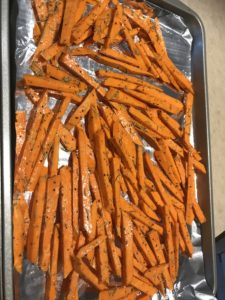
The first recipe I tried was for Roasted Rosemary Sweet Potatoes. We had just gotten some delivered from the local farmer’s market, so I was eager to try this recipe. One drawback is that there were not pictures for this recipe, but we assumed that Gaines cut the potatoes into french fry form, which is what we went with. It was pretty easy to follow, though for my family, I would definitely cut back on some of the rosemary and black pepper — several people said it was too spicy (my daughter included). The other thing I found was that 40 minutes was too long at 450 degrees. My over charred some of these fries, so I think next time I’ll just cook them for 30 minutes or keep a closer eye on them. But they still were tasty.

Gaines recommends serving these with Rib Eye Steaks, but we didn’t have any of that. We had meatloaf with beans.

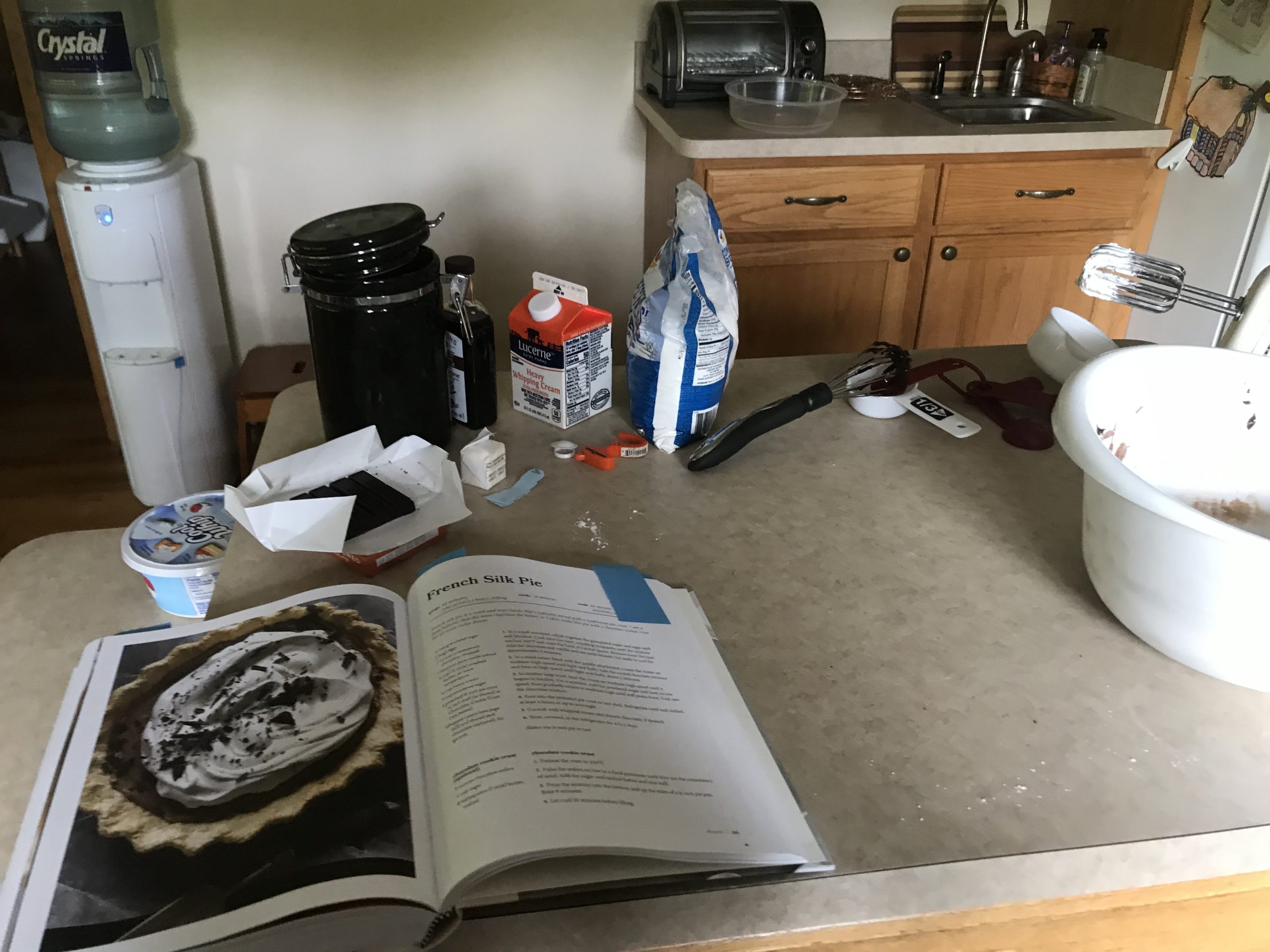
The next recipe I tried was for French Silk Pie, which had some really easy to follow steps. I really enjoyed this recipe and will be making it again, since it was a big hit even if there was a problem with my crust. I think pre-made crust is best for me. This recipe does have a full-color picture that helped me determine if my ingredients were working together as they should.

Everyone ignored the terrible crust and said the pie itself was delicious. I really enjoyed making this one, and I’ll be happy to make it again. I already have plans to try making it with a graham cracker crust.

While I didn’t get to make the pizzas I wanted to because of the lack of yeast, I plan to make those when things are more available in the stores. Some of the recipes in this book, however, we probably won’t make unless my kiddo and mom become more adventurous in their eating. I do want to check out the first volume of recipes in the first book, because I suspect those recipes will be better for my family.

Magnolia Table (Vol. 2): A Collection of Recipes for Gathering by Joanna Gaines is a good cookbook with a ton of information for budding chefs at home. While not everything suited my family’s taste, I’m sure that it will be a big hit with others. I do wish there were more pictures in the cookbook, but that’s because I love full-page photos of food. It helps me see how delicious it will look when I’m done cooking.

RATING: Quatrain

Turn It Up! A Pitch Perfect History of Music That Rocked the World

Source: Publisher
Hardcover, 192 pgs.
I am an Amazon Affiliate

From National Geographic Kids, Turn It Up! A Pitch Perfect History of Music That Rocked the World, is a collection of fun music facts in a condensed format with colorful photographs and more. I enjoyed the parts about sound waves, and rhythm (which I don’t have) and harmony versus melody as a way of introducing music fundamentals to kids. My daughter was amazed that the earliest instrument was 40,000 years ago and was a flute made of bone. She was a bit creeped out by that knowledge, but she did find the other early instruments inside the book interesting. She already knows a little bit about the types of notes, thanks to Yunique Music School.

The most fascinating parts of this book for me were there tidbits about the actual musicians, like how Niccolo Paganini had sold his soul to the Devil in order to play so well every time he appeared before an audience while on the road. I enjoyed learning about Antonin Dvorak, one of my favorite composers, and the influence of America and Native Americans in his work — which makes absolute sense when you listen to his New World Symphony. I also learned something I didn’t know about one of my mom’s favorites, Glenn Miller, who apparently vanished while fighting in WWII. Cab Calloway is a figure I vaguely recall seeing as child and probably on Sesame Street, but I just loved his energy as a kid, and I had no idea that he used cartoon characters as part of his shows.

From National Geographic Kids, Turn It Up! A Pitch Perfect History of Music That Rocked the World, is chock full of information about musical composers, instruments, and the evolution of music, but it also has so much about recent musicians toward the end. It seems like it is heavy on new artists, which is probably because of the younger audience, but it is good to see how these younger artists are being remembered now, rather than years and years into the future.

RATING: Quatrain

Guest Post: Blue People or Hoax by Isla Morely, author of The Last Blue

Today’s guest is Isla Morely, the author of The Last Blue, who found a family portrait on the internet that she thought had to be a hoax. The picture was of a family, five of whom were blue. Has to be a hoax, right?

She’s going to talk about her researching journey and her book. I hope you enjoy this tale.

Book Synopsis:

A luminous narrative inspired by the fascinating real case of “the Blue People of Kentucky” that probes questions of identity, love, and family.

In 1937, there are recesses in Appalachia no outsiders have ever explored. Two government-sponsored documentarians from Cincinnati, Ohio—a writer and photographer—are dispatched to penetrate this wilderness and record what they find for President Roosevelt’s Works Progress Administration. For photographer Clay Havens, the assignment is his last chance to reboot his flagging career. So when he and his journalist partner are warned away from the remote Spooklight Holler outside of town, they set off eagerly in search of a headline story.

What they see will haunt Clay into his old age: Jubilee Buford, a woman whose skin is a shocking and unmistakable shade of blue. From this happenstance meeting between a woman isolated from society and persecuted her whole life, and a man accustomed to keeping himself at lens distance from others, comes a mesmerizing story in which the dark shades of betrayal, prejudice, fear, and guilt, are refracted along with the incandescent hues of passion and courage.

Panning across the rich rural aesthetic of eastern Kentucky, The Last Blue is a captivating love story and an intimate portrait of what it is like to be truly one of a kind.

Please give Isla Morely a warm welcome.

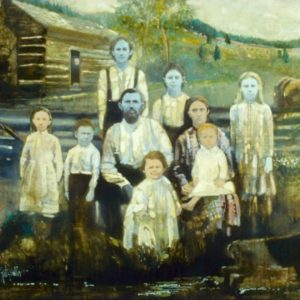
“Hoax!” I thought. On my screen was a grainy, old-fashioned portrait of a family of nine people, five of whom were blue. Who believes anything on the internet these days? Had I not been so intent on avoiding the edits I was supposed to have completed on my current novel, I might have closed my laptop and returned to my manuscript, but instead, I took the bait. Click.

No, not hoax at all. The article featured a family who lived more 100 years ago in the wilderness of eastern Kentucky, not too far from Hardburly, who came to be known as “the blue people of Troublesome Creek” and who inspired my latest novel, The Last Blue. Yes, they were unmistakably and shockingly blue. The color of a bruised plum, according to some eye-witness accounts. I expected many to have written about it, but as I started to research, I found very little except a four-page article written by Cathy Trost, published in a now-defunct Science journal in 1982. Few knew about the blue people, arguably one of the most fascinating medical cases of all time.

The real-life account begins with Martin Fugate, a French orphan who immigrated to the United States and settled in Kentucky in 1820. He married and started a family, and soon starting having children who were born blue. Large families were typical in those days, and the Fugates, along with three or four other families, clustered in isolation from the rest of the world until those who were blue were not too uncommon.

From Cathy Trost’s account, blue people kept to themselves. Read between the lines and you get a sense of the stigmatizing, prejudice and social avoidance these families must have faced. Trost describes how a renowned hematologist from Lexington came to the area to investigate rumors of blue people, giving chase after spotting a blue person only to get to the top of the hill and discover they’d disappeared. Having given up, the doctor was preparing to return to the city when two blue people snuck into the local clinic. Keeping to the shadows of the hallway, the couple wanted his help. “You could tell how much it bothered them to be blue,” the doctor said, reporting the emotional pain he saw in their faces.

What especially caught my attention was a brief description near the end of the article about a man purportedly married to “the bluest woman who ever lived.” Though she had died many years prior, he refused to live anywhere but the log cabin he had built for her with his own hands, a stone’s throw from her grave. When asked about his wife’s peculiar coloring, he refused to acknowledge she’d been blue. If love is colorblind, surely this was a fine example. Instantly, I knew I would write a love story that explored the meaning of identity, belonging and what it is to be truly one of a kind, an undertaking that took me five years.

Besides investigating the medical condition and whether or not there were cures and treatments, I had to do a lot of research into the Great Depression. The deepest hollers of eastern Kentucky were also largely unexplored until roads were built in the hills, and though the region had been made famous by Daniel Boone and the Hatfields and McCoys, it had been plagued by stereotypes of mountain men, snake handlers and hillbillies. To this day, many stereotypes persist. The last thing I wanted to do was perpetuate those falsehoods.

Thanks to the contributions made by hundreds of writers and photographers employed by Roosevelt’s Works Progress Administration in the Thirties, there is a trove of photographs, field notes, and audio recordings that bring to life a bygone era. But photographs tell only so much of the story, and often they too serve an agenda. What was left then for me to do but to dip the bucket of individual experience and corporate wisdom into the deep well of imagination? The Last Blue, entirely fiction, is the result I hope rings utterly true.

Can you believe it? Very fascinating, and I bet the novel is too.

You can view the book trailer below:

About the Author:

Isla Morley grew up in South Africa during apartheid, the child of a British father and fourth-generation South African mother. During the country’s State of Emergency, she graduated from Nelson Mandela University in Port Elizabeth with a degree in English Literature.

By 1994 she was one of the youngest magazine editors in South Africa, but left career, country and kin when she married an American and moved to California. For more than a decade she pursued a career in non-profit work, focusing on the needs of women and children.

Her debut novel, Come Sunday, won the Janet Heidinger Prize for fiction and was a finalist for the Commonwealth Prize. It has been translated into seven languages. Her novel, Above was an IndieNext Pick, a Best Buzz Book and a Publishers Weekly Best New Book. The Last Blue is her third novel.

She has lived in some of the most culturally diverse places of the world, including Johannesburg, London and Honolulu. Now in Los Angeles, she shares a home with her husband, daughter, three cats and five tortoises. Follow her on Facebook.

Mailbox Monday #578

Mailbox Monday has become a tradition in the blogging world, and many of us thank Marcia of The Printed Page for creating it.

It now has it’s own blog where book bloggers can link up their own mailbox posts and share which books they bought or which they received for review from publishers, authors, and more.

Leslie, Martha, and I also will share our picks from everyone’s links in the new feature Books that Caught Our Eye. We hope you’ll join us.

Here’s what we received:

We’re All Not the Same But We’re Still Family by Theresa Fraser and Eric E.W. Fraser, for review.

This story was written for adoptive families to explore the benefits of adoption openness. The main character, Deshaun, loves his family but always wondered about his biological family. Does he look like them? Did they love him? With the support of his adoptive parents, Deshaun gets to meet his biological family. They develop an ongoing relationship, so Deshaun feels more stable in his adoptive family, but also develops a comfortable relationship with his birth family. Deshaun and his family are reminded (as we all are) that family can include biological, adopted, foster and kin members.
After reading this book, a child and their family will be able to:

  • Discuss feelings about adoption
  • Imagine what openness might mean for them
  • Acknowledge similarities and differences among family members
  • Discuss if an expanded sense of family is possible for their circumstances

Hiking the Grand Mesa by Kyle Torke, illustrated by Barbara Torke, for review.

Join Coover, Conrad and their mighty dog, Clementine, as they explore one of the most unique landscapes in southern Colorado–the Grand Mesa! Their grandma takes them to the Dobies, a series of steep hills made from adobe clay that formed as the nearby volcanoes, now extinct, eroded. At first, Coover feels a little sad and lonely, but as he is introduced to the rich wildlife–from woodpeckers to toads, cattails and sunflowers–he feels stronger and more confident. As both boys tramp through their imaginative journey, the vivid history and beautiful scenery awaken them to a new world full of possibility and friendship. By the end of the day, everyone is happily exhausted and ready for the next adventure!

And You Can Love Me by Sherry Quan Lee for review.

And You Can Love Me is a story for everyone who loves someone with ASD (autism spectrum disorder). It is the fictional story of Ethan, a nonverbal autistic child, based on the author’s observations and experiences with her grandson. The bounce of a ball is not only a metaphor, but also how the author imagines that the child is releasing his innermost physical and emotional challenges. It is a love story that can be recognized by parents, caregivers and teachers; a story that embraces Ethan, a nonverbal child, who may never/or not yet be able to write his own story, yet he lives it every day and tells it by his actions and by bouncing a ball — any ball, any size, any color.

Emma Lou: the Yorkie Poo by Kim Larkins for review.

Meet Emma Lou, the Yorkie Poo – a little dog with big worries. She loves playing with her best friend, Pearl, but Pearl doesn’t always pay attention to Emma Lou’s worries. With the help of some new friends, Caleb the Calico cat, Patrick the pig and Gigi the ginormous giraffe, Emma Lou and Pearl begin to learn a new technique to calm their minds and bodies. Parents, educators, counselors – and especially children – can benefit from Emma Lou and her friends’ curious adventure to a mindful experience.

Amanda’s Fall by Kelly Bouldin Darmofal for review.

Amanda’s Fall, with charming illustrations by Bijan Samaddar, depicts an event common in schools today. Young Amanda gets a concussion after falling and hitting her head during recess. While she can hear people talking, she cannot respond. Amanda is taken to a doctor for evaluation. Wisely, her parents ask for a prognosis, which in Amanda’s case, is a good one. Author Kelly Darmofal offers readers her third book on TBI (Traumatic Brain Injury), encouraging parents and caretakers to alert schools and, hopefully, doctors when any child is concussed; side effects can then be ameliorated.

Float: A Guide to Letting Go by Aimee L. Ruland, Illustrated by Carl R. Anderson for review.

Float: A Guide to Letting Go seeks to encourage children to process their emotions gently and in a way that allows them purposeful ownership of what they think and how they feel. It will aid them in identifying the root of their feelings, help them to examine their reactions to emotions and decide for themselves what they may be ready to release. The thoughtful use of color and symbols, and the guided practice of breathwork, encourages listeners to maintain a broad focus as they become more grounded and aware. The playful rhyme dances with listeners as they grow on their journey to the present, where they are beautifully set free.

Please Explain ‘Time Out’ to Me! by Laurie Zelinger and Fred Zelinger for review.

Time out is a dignified and effective method of discipline, endorsed by the American Academy of Pediatrics and the American Psychological Association. This book, written by parenting experts, explains the time out process and provides step-by-step instructions for its proper and effective use. Please Explain Time Out To Me is two books in one: an engaging story with colorful illustrations and a parent section which describes the time out process in detail, as well as the advantages and pitfalls of other methods of discipline.

The Great Upending by Beth Kephart, which I purchased and is autographed by the author after her lovely virtual book launch with Main Point Books and the Radnor Memorial Library.

Twelve-year-old Sara and her brother Hawk are told that they are not to bother the man—The Mister—who just moved into the silo apartment on their farm. It doesn’t matter that they know nothing about him and they think they ought to know something. It doesn’t matter that he’s always riding that unicycle around. Mama told them no way, no how are they to bother The Mister unless they want to be in a mess of trouble.

Trouble is the last thing Sara and her brother need. Sara’s got a condition, you see. Marfan syndrome. And that Marfan syndrome is causing her heart to have problems, the kind of problems that require surgery. But the family already has problems: The drought has dried up their crops and their funds, which means they can’t afford any more problems, let alone a surgery to fix those problems. Sara can feel the weight of her family’s worry, and the weight of her time running out, but what can a pair of kids do?

Well, it all starts with…bothering The Mister.

What did you receive?

Excerpt & Giveaway: Outmatched by Jayne Bamber

Today’s guest is Jayne Bamber and her new book, Outmatched, which is a mash up of Mansfield Park and Sense & Sensibility. New alliances are formed in this novel, and there are elements of self-discovery, redemption, and conspiracy.

Before we get to today’s post, check out the book synopsis below:

When Sir Thomas Bertram returns home to Mansfield after his year in Antigua, he expects respite from his many troubles, in the bosom of his family. Instead he is met with blackmail, collusion, and the ominous threat of scandal.

When Mrs. Margaret Dashwood takes her daughters from Norland to Barton Park, she carries with her a secret hope that they might someday return, though she is not yet ready to pay the price for it.

A mutual connection bent on manipulation and revenge sets the stage for heartbreak, intrigue, and plenty of surprises as the worlds of Sense & Sensibility and Mansfield Park collide. Alliances shift along the way as familiar characters, bound by family ties, descend on Norland Park. There everyone has their own agenda, and constant peril looms as a large party of relations all scheme to outwit, out-maneuver, and outmatch their opponents.

Please welcome, Jayne Bamber:

Hello, readers! It is a pleasure to be welcomed here at Savvy Verse & Wit. It is Release Day for my fifth novel, Outmatched, a fusion of Mansfield Park and Sense & Sensibility, and I am particularly excited about the excerpt I am sharing today!

I have never wanted to admit how very much I like Mary Crawford, but I am sure readers will detect it over the course of the story. She has all the wit and sparkle of Elizabeth Bennet, though with sharper edges to be sure, but I cannot think her indefensible. She cares for her roguish brother, perhaps to a fault, but I am willing to argue her loyalty does her some credit. I cannot completely fault her in her dealings with Edmund Bertram, either – she knows what she wants, and bristles at the prospect of having to compromise. In truth, I think it brave of her, and quite right – she knows she does not wish to be a parson’s wife, and no community would be served by the parson’s wife not fulfilling the obligations of her position begrudgingly. Even at the end, when Tom is very ill, perhaps she ought not to speak as she does, but come on, we were all thinking it!

If my attempt at vindication has not entirely put you off, I do hope you will enjoy this little glimpse at my rendition of Mary Crawford. This scene takes place a few days after the large cast of characters converges at Norland, with one fairly logical friendship for Mary, and another that, though far from obvious, hold some promise….

***

Edmund was not amongst them in the drawing room, but Mary was determined neither to notice nor mind his absence; she played her harp for herself, and for her new friend Marianne. After a few minutes it was not such an effort. She had always loved playing, loved the feelings of peaceful pride that came with willing the strings to do her bidding. She played a piece she knew by heart and closed her eyes, shutting out her audience to lose herself in the music.

The effect might have been too engrossing, for when she opened her eyes at the end of her song, she was almost startled at the applause from more than a dozen people.

Marianne, who had been most insistent on the use of Christian names, rushed toward Mary at once. “Come, you must play a duet with me at the pianoforte,” she cried. She caught Mary by the hand and led her to the instrument, where she assaulted Mary with a tremendous quantity of sheet music to look over. The conversation in the room started up as Mary looked over the music; with so many people, it was all just a strange, euphoric buzzing in her ears.

All this had transpired within but a moment of Mary’s song, and she was still nearly in a trance from the emotion of her performance. This tranquility was now abruptly cut through by the voice of Mrs. Jennings, an old widow who had shown a peculiar obsession with the Dashwood sisters, and a delightful degree of conversational indiscretion.

“Colonel Brandon,” she cried, and every head in the room turned toward the doorway.

Mary felt the sheet music she was holding fall through her fingers, and looked down, watching the handful of papers slowly float toward the carpet until they were strewn at her feet, and then her head snapped back up. Had she conjured this man into existence with her silliness before?

Beside Mary, Marianne let out a low squeak, and behind the cover of the pianoforte Mr. Willoughby, looking rather startled himself, placed his hand atop Marianne’s.

Mary could not take her eyes off the handsome newcomer, and felt instinctively that he had been watching her for some time. John Dashwood was beside him, and now led the colonel into the room. “Yes, well, sisters, here is your friend from Devonshire come to call. What a fine thing for you girls! I have invited him to stay and dine with us.”

Mary glanced over at Marianne with some astonishment. How could the girl have an acquaintance such as this and not spoken of it during their fanciful conversation before? She looked back at Colonel Brandon, savoring the expression upon his countenance, pensive and enigmatic, sorrowful and yet hopeful – and such intelligence about the eyes. What a man! He made his introductions to those of their party he did not know, and spoke to the other Dashwoods – but now he was coming toward them.

Marianne moved away from Mr. Willoughby and linked her arm through Mary’s, as Mary continued to wonder why her friend could look so unhappy to see such a man as this seeking them out. He was on the wrong

side of five-and-thirty, perhaps an ill thing for a girl so young, and yet he wore his silvery hair so well. His stride was graceful, the curl of his lips almost outrageously sensual, his attire very fine but not ostentatious, and his voice, when he spoke, was deep and sonorous. 

“Miss Marianne, I hope you are well.”

“I am.” Marianne forced a smile. “I have just been getting better acquainted with my new friend, Miss Mary Crawford. She and her brother accompanied my Bertram cousins to Norland.”

“And what a lovely destination,” said the colonel. He bowed to Mary, and she dropped into a curtsey, keeping her head low enough to conceal her blush. She suddenly recollected the sheet music scattered about her, and dropped to the floor to gather it back up. Colonel Brandon must have seen her acting quite the fool, and she was heartily embarrassed for it. 

The colonel instantly mirrored her gesture, and began to assist her, but this only heightened Mary’s mortification. She focused on not letting her hands tremble, and wondered what had come over her to be so affected by this great pillar of masculinity. “I am afraid I took you all by surprise,” he said softly.

“Indeed, I had grown rather lost in the music, and was not thinking at all – what a silly mess I have made.” Mary gathered the last of the sheet music and stood. She handed the pages off to Marianne as the colonel did the same; Marianne received the rumpled sheets with a nervous laugh. 

“Yes, I saw,” Colonel Brandon replied. “That is, I came in at the end of your performance – I did not wish to interrupt what was so delightful to so many, including myself. I hope to hear you play with Miss Marianne, if that is your intention.”

Seeming to recall Marianne, the colonel returned his attention to her with an odd look about him. “I happened to be in the area – I have been in Sussex since leaving you all last week. When I realized Norland was so near, I thought it right to pay my respects, and I have heard such praise from all your family of the place.”

“Pray, what brings you to the area?” Mr. Willoughby smiled at the colonel, but Mary sensed something hollow in it – something strange indeed. 

They were to receive no answer, for Mrs. Jennings was bustling over to them. “Well, Colonel Brandon, what a to-do! Are we not a large and cozy party here? But what a perfect addition you make! I hope you mean to stay amongst us!”

The colonel looked uneasy, though Mary supposed such a reaction must be perfectly rational. “Mr. Dashwood has invited me to stay the night and dine with you all.”

“Very good, very good,” Mrs. Jennings cried, even as Marianne and Mr. Willoughby exchanged a look betraying the opposite sentiment entirely. “It is the finest house I have ever seen, I am sure – but you must stay more than a night! We are all snug and easy here, and you will not want to be going away so soon.”

The colonel smiled wistfully, and Mary was intrigued by what dolorous sentiments might engender such an expression. “I have no doubt you get on very well. The house is most impressive – Mr. Dashwood was so kind as to show me about the public rooms. You were all out of the house when I arrived, and I had no wish to interrupt your excursion. But one night must be enough, for urgent business calls me away again tomorrow.”

“Impossible,” Mrs. Jennings cried. “Surely not the same great matter that drew you from Delaford the day of our poor picnic!”

The colonel’s lips tightened. “It is a matter that requires my immediate attention,” he said firmly. “Indeed, Mr. Willoughby, as it involves a mutual acquaintance of ours, perhaps I might speak privately with you. At once.”

Mr. Willoughby grew very pale indeed, but had not time to reply before Mrs. Jennings cut him off. “What mutual acquaintance? Oh, dear me – not Lady Allen! La, but she is so very old – I do hope she is quite well!”

He bowed again. “Mrs. Jennings, Miss Crawford. Miss Marianne. I hope we shall speak later.” Mary was inclined to agree as she watched him lead Mr. Willoughby from the room, but had little time to ruminate on the matter before Marianne latched onto her.

“Forgive me, Mrs. Jennings, but I think my cousin Maria is calling for a game of whist. I do not mean to play myself, though I know you favor the game. Mary, might we take a turn about the room?”

Mrs. Jennings laughed and fixed them with a knowing look. “Well, keep your secrets – I am sure I know them all already, or very soon shall!” At that she turned her attention to the card party that was forming, and Marianne hastened to draw Mary in the opposite direction.

“Oh, Mary,” Marianne whispered as soon as they had walked some distance. “I am sure I should have fainted dead away!” Mary arched an eyebrow and smiled – no little resemblance to her own feelings indeed! And yet she was, more than anything else, recovered enough from the oddly flustering encounter as to be intensely curious.

“Why should you do such a thing? Surely you prefer your Mr. Willoughby to the colonel, even if he is so very handsome.”

“Colonel Brandon, handsome?” Marianne laughed. “Surely you mean to tease me worse than Mrs. Jennings.”

“Certainly not! If I ever did such a thing as that you should be obliged to lock me up.”

Thank you, Jayne, for sharing this excerpt with us.  We hope you’ll all check out your own copy and enter the giveaway.

ENTER THE GIVEAWAY!