Source: Caitlin Hamilton Marketing & Publicity
Paperback, 122 pgs.
I am an Amazon Affiliate
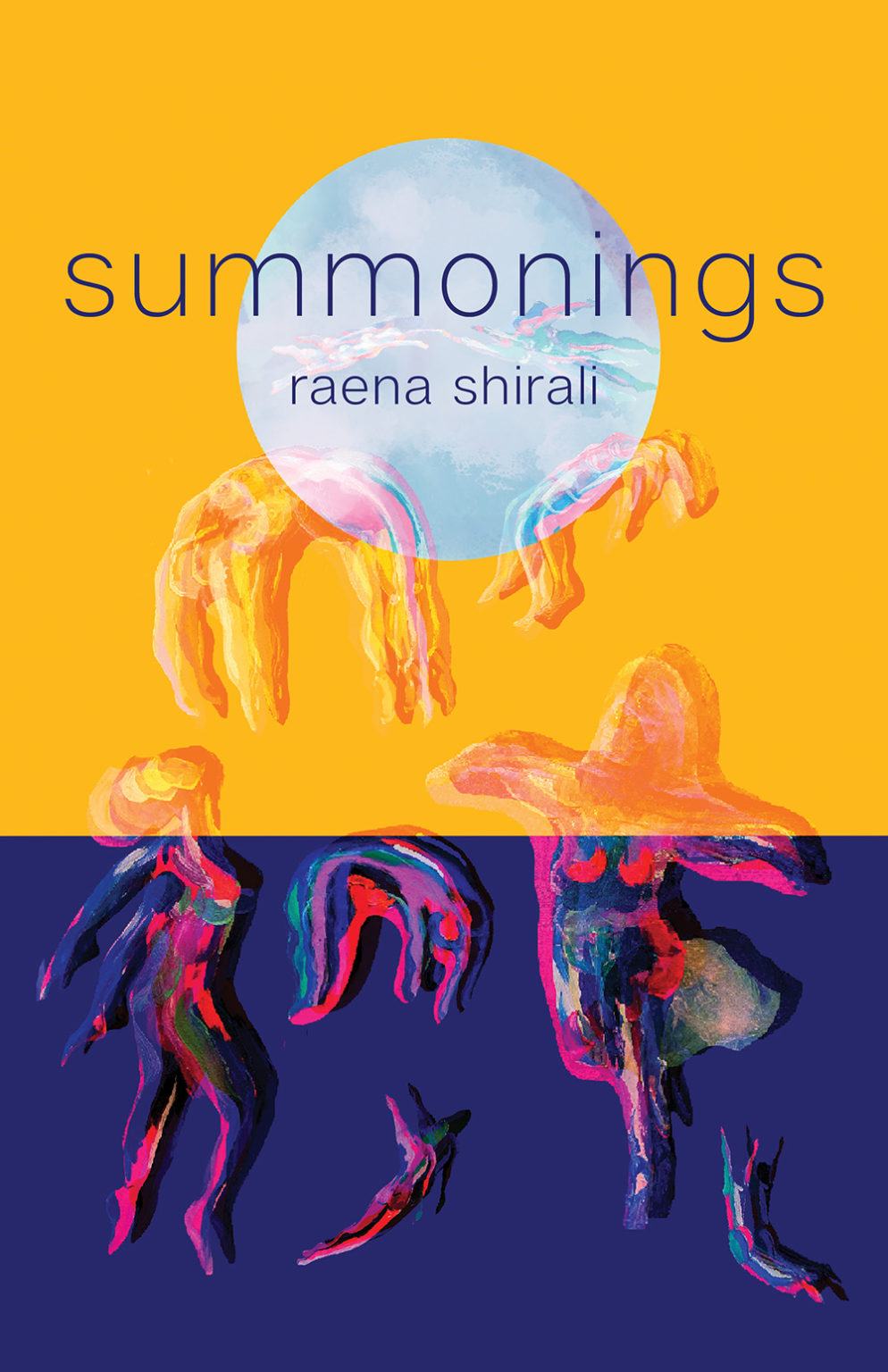
Summonings by Raena Shirali is an urgent calling of female personas in an effort to highlight the continued practice of daayan (witch) hunting in India. But even as Shirali conjures the spirits of these women, she is also summoning her own power as a westernized Indian woman to empathize and call attention to this practice and the unfair targeting of women.
As she points out in the foreword, “India is the world’s most dangerous country for women … The only Western nation in the top 10 was the United States…”
Shirali is fully aware that as a westernized Indian woman there is “distance/between self & subject.” (“on projection,” pg. 12) Her poems aim to bring these women into full-bodied poems based on what she knows about these “witches,” but it is hard to be a spirit without the lens of one’s own culture and upbringing. This mirrors her poem “ojha : rituals” where she questions what “truth” is, especially when it becomes subjective.
These poems are multi-layered and the longer you sit with these lines and images, the more you realize these stories are a conjuring of female power from ancestors and modern women who face oppression. Even as there is a reach for feminine power, there’s also a self-hatred Shirali struggles with: “i was shit & wanted/to be shit. & then i swallowed pretense. swallowed/countries” (“at first, trying to reach those accused” pg. 27) and in “summoning : retreat” (pg. 31) “digging in/the old-world soil/for common root.”
Shirali offers a “different way to look at the same/old face.” (“daayan gets her name” pg. 35) In summoning the spirits of these women, these so-called witches, she’s rewriting the narrative to include their truth, not just the stories that have been told about them. Her poems are when “the earth began to shift”(“daayan & the mountains : ii pg. 58-9). Summonings by Raena Shirali is asking us to reexamine who gets to ask, who answers, and who tells the story.
RATING: Quatrain
About the Poet:
Raena Shirali is the author of two collections of poetry. Her first book, GILT (YesYes Books, 2017), won the 2018 Milt Kessler Poetry Book Award, and her second, summonings (Black Lawrence Press, 2022), won the 2021 Hudson Prize. Winner of a Pushcart Prize & a former Philip Roth Resident at Bucknell University, Shirali is also the recipient of prizes and honors from VIDA, Gulf Coast, Boston Review, & Cosmonauts Avenue. Formerly a Co-Editor-in-Chief of Muzzle Magazine, Shirali now serves as Faculty Advisor for Folio—a literary magazine dedicated to publishing works by undergraduate students at the national level. She holds an MFA in Poetry from The Ohio State University and is an Assistant Professor of English at Holy Family University. The Indian American poet was raised in Charleston, South Carolina, and now lives in Philadelphia.