Quantcast

Interview: Harrison Demchick on Changes in Publishing

Harrison Demchick of Bancroft Press in Baltimore, Md., agreed to be interviewed about publishing and editing, his current job and his new adventures.

His new Really Good Editing business is up and running for writers looking for a personal touch from an editor — the Website will be up soon.  Until then, you can check out his work through the icon and link to his Facebook page.  Also, feel free to email (reallygoodediting AT gmail DOT com) him if you are interested in his editorial services.

Without further ado, here’s our interview:

1.  Tell us a little bit about your publishing work and how you got started with the small press, Bancroft Press.

I started out at Bancroft Press as an intern in the summer of 2005. I was heading into my senior semester at Oberlin College and looking to get some editorial experience, and I couldn’t have found a better place. By the end of the summer, I was working on book-to-film adaptation and editing novels, and when I graduated in December, I knew Bancroft Press, and more broadly the publishing industry, was where I wanted to be.

I am extraordinarily proud of the work I’ve done at Bancroft. I’ve been lucky enough to edit all sorts of novels for all sorts of readers, most of which have been well-received, and I’ve had opportunity after opportunity to hone my skills as an editor. I can’t forget that I’m one of the lucky ones—I’ve been in a position to do what I love since the day I graduated. And I’ve learned a lot in the process.

2.  How has the publishing industry changed and what fears/concerns has it raised for you on a personal and professional level?

It’s difficult to tell sometimes where the publishing industry has changed and where it’s only my perspective that’s changed. Other times, there’s no doubt. My time in the industry has happened to correlate with the rise of the eBook, which has had a drastic effect on the industry. Every publishing house is struggling to adapt, and Bancroft Press is no different.

The way I see it is this: There have never been more ways for a writer to get his work out there. eBooks make self-publishing incredibly easy, and for a very select few, incredibly profitable. And the simultaneous rise of social media means there have also never been more ways to generate free publicity. But on the flip side, that means the industry has never been so crowded. The majority of eBooks, which don’t require the filter of publisher or editor, are inevitably going to be terrible. The new status quo doesn’t make things easier. It makes them harder.

I am very nervous about an industry that seems increasingly focused on marketing over quality. To create a hit book, more than a great product, you need a great campaign that makes optimal use of social media, and the right combination of print books and eBooks. As someone who has edited a number of books that have been genuinely terrific, it’s extremely frustrating to fight that marketing battle. Authors are told now that they need to spend two years building up their audience before their book ever comes out. That shouldn’t be. Authors should simply be able to write great books and have them succeed because they’re great.

But that’s not the way it works anymore. Maybe it never worked that way. But I’ve seen marketing become a greater and greater part of my job, and it’s not what I want to do. I don’t want to see the publishing industry reward popularity over creativity. Perhaps more than any other business, this is supposed to be a meritocracy.

Naïve? Definitely. But that’s how I feel.

3.  Rather than begin a freelance editing business, why not transition the publishing house to e-books?  Or is that also a consideration; if so, what challenges have you found in that transition process?

I don’t think going eBook-exclusive is the way to go. Understanding of the print book market is one of the critical advantages traditional publishers still have, and for all the upheaval and transformation, I don’t believe print books are dying. They’re just reaching a new equilibrium. That said, I’ve certainly been working hard these last couple years to help Bancroft Press adjust to the new reality. Figuring out new media has been a major challenge, especially seeing as we’re not natural marketers here at Bancroft. We’re book people.

Launching Really Good Editing simultaneously is far more of a personal decision. The part of this job I truly love is editing, and working with writers to make their work as wonderful as it can possibly be. Marketing is nothing but stress for me, but editing? Editing is pure meditation.

I wanted a job that would remove me from the parts of the job and the industry I don’t care for and zero in on what I really want to be doing. And that’s not to say starting a new business doesn’t also require marketing. Why, I’m marketing right now! And that’s also not to say that I don’t help my clients think about how to market their books. But primarily, I’m focused on the editing in a way I can’t be at Bancroft.

4.  What makes your freelance business, Really Good Editing, different from your competitors?  Is it lower rates, personal attention, something more?

I like to say that I write the longest and most detailed editorial letters known to man. Actually, this is probably true, but it also points to the distinction, which is that I’m a complete developmental editor. I don’t fix spelling and grammar and add the right punctuation—or, well, I do, but that’s not the main thing I do. I examine character, logic, and story. I diagnose what isn’t working in a manuscript, determine why it isn’t working, and explain to the author how it can work.

My goal is to teach an author how to make her work better. I don’t think most editors do that. I don’t think most editors know how. One of the most common responses I get from the authors I work with is that I haven’t just made their manuscripts better. I’ve made them better writers.

So, definitely, personal attention is a part of it. But I think the primary distinction is that I’m really, really good at this. I’m different because I’m the best. That sounds really egotistical. But it’s true.

5.  Has the decision to provide editing services been influenced by what some have noted as a lack of editing for some of the books coming out of the larger publishing houses?

It has not, but it’s definitely true that the major publishers no longer engage in real, in-depth editing. Some indie publishers like Bancroft Press still edit, but you go to Penguin and it’s probably not the case. They want the manuscripts they receive to be pretty much ready to go before they take them on.

So while it’s not a motivation for me that the big publishers behave this way, the fact that they do certainly suggests that writers need to invest in editors like me before they submit their manuscripts for publication.

6.  Do you think publishing books has become too much like a business and less about the art of writing and creating memorable tales and poignant stories about the human condition and society?

Absolutely. One hundred percent. I don’t know that stories need to be poignant and focused on the human condition necessarily—I’m not of the opinion that all fiction should be “literary fiction,” versus entertainment or genre fiction—but they should absolutely be stories that come from the author.

I hear about certain publishing houses where ideas come from the marketing department and are bandied about by editors before a writer is assigned to the job. That scares the hell out of me. And these books end up being insanely popular, yet they could not be more artificial.

Writing—fiction especially—is an art. And if the publishing houses that actually have the money and marketing might would use their strength for great books, and not just obviously popular books, I think we’d have a far healthier publishing industry.

7.  What are some of your personal obsessions or favorite reads from this year?

I’m rarely reading something new and popular. My bookshelf is filled with various books from various eras I haven’t gotten around to yet, and because so much of my job is reading, I so rarely do. I’ve just gotten back from vacation, during which I finally got some reading done. I read about half of Thomas Harris’s Red Dragon before losing it (darn it), then read Eoin Colfer’s continuation of Douglas Adams’s Hitchhiker’s Guide to the Galaxy series, And Another Thing . . ., and finally started Stephen King’s The Shining, which I’ve always been curious about. (So far, it’s fantastic.)

As for personal obsessions, I’ve just spent Saturday at the Baltimore Comic-Con digging through thousands of comics searching for Spider-Man guest appearances. Does that count?

Thanks, Harrison, for answering my questions and for sharing your experiences.
This is a stop on The Literary Road Trip since Harrison works for a local publisher.

Interview With Poet David Mason

Poet Dave Mason

This week an interview with Poet David Mason posted on 32 Poems, and he was a pleasure to interview because he’s one of the only poets I can remember interviewing that is involved in writing operas and other librettos for plays. 

Please check out a part of the interview below, and give him a warm welcome.

How would you introduce yourself to a crowded room eager to hang on your every word? Are you just a poet, what else should people know about you?

I would recite a poem by someone else. Mother Goose, for example. Then I would recite another poem by someone else. Auden or MacNeice or Dickinson, perhaps. I might ask the audience to repeat a poem after me, to join in the recitation. I wouldn’t say much of anything about myself unless I was asked in a question and answer session.

Poetry is often considered elitist or inaccessible by mainstream readers. Do poets have an obligation to dispel that myth and how do you think it could be accomplished?

Poets don’t have any obligation to do anything. Nor do readers. It’s a free country. I like a certain level of access in a poem, but I also love a whiff of mystery, a sense that the inexpressible has been cracked open or exposed to me in some way. I wouldn’t want to dispel any myths. Myths are there to cast a spell, not to be dispelled.

Please describe your writing space and how it would differ from your ideal writing space.

I’ve never had any trouble writing anywhere I’ve been in the world. I did until recently have a lovely office that used to be an artist’s studio, with north light and brick floors–a beautiful room. Now I live in a tiny cabin, 380 square feet in the shadow of Pike’s Peak, and it serves just as well. People who need the perfect space in which to write are sissies. Your brain is where you write. It’s portable.

What current projects are you working on and would you like to share some details with the readers? The most exciting work involves my collaboration with composer Lori Laitman. Our first opera, The Scarlet Letter, will have its professional premiere at Opera Colorado in Denver in 2013. My libretto will be published as a book in 2012. Our oratorio, Vedem, premiered in Seattle last year and is now out on CD from Naxos. And we’re at work on an opera based on my verse novel, Ludlow. Also, I seem to be writing a lot of love poetry lately. The dam has burst.

Check out a sample of his poetry:

SEA SALT

Light dazzles from the grass
over the carnal dune.
This too shall come to pass,
but will it happen soon?
A kite nods to its string.
A cloud is happening

above the tripping waves,
joined by another cloud.
They are a crowd that moves.
The sky becomes a shroud
cut by a blade of sun.
There’s nothing to be done.

The soul, if there’s a soul
moves out to what it loves,
whatever makes it whole.
The sea stands still and moves,
denoting nothing new,
deliberating now.

The days are made of hours,
hours of instances,
and none of them are ours.
The sand blows through the fences.
Light darkens on the grass.
This too shall come to pass.

–first published in The Times Literary Supplement

Thanks, David, for answering my questions.  For the rest of the interview, visit 32 Poems.

About the Poet:

David Mason’s books include The Country I Remember, Arrivals and the verse novel, Ludlow. His book of essays, The Poetry of Life and the Life of Poetry, appeared in 2000, and a second volume of essays has appeared from the University of Michigan Press. Author of a libretto for Lori Laitman’s opera of The Scarlet Letter, Mason won the Thatcher Hoffman Smith Creativity in Motion Prize for the development of a new libretto. He teachers at The Colorado College and serves as Poet Laureate of Colorado.

An Interview With Poet Rachel Zucker

Poet Rachel Zucker

This week at the Poetry Blog of 32 Poems Magazine my interview with poet Rachel Zucker was posted. She’s a contributor to the magazine and was a delight to interview.  I really enjoyed her comment about no one really being “just a poet.”

First, let me tantalize you with a bit from the interview, and then you can go on over and check the rest out for yourself.

Without further ado, here’s the interview.

How would you introduce yourself to a crowded room eager to hang on your every word? Are you just a poet, what else should people know about you?

Is anyone “just a poet”? I don’t know anyone like that. I’m also a professor and teach at NYU. I’m also a doula (labor support assistant). I’m studying to become a Childbirth Educator (so I can teach birthing classes to pregnant couples). I’m a mother of three sons. I’m a devoted wife to my husband, Josh Goren. I’m always starting new projects and hobbies. For example, I just started a blog, where I post one sentence descriptions every day. I also write prose. Is there a room where a crowd hangs on my every word? I guess, maybe a room full of students who are there for extra credit . . .

Do you have any obsessions that you would like to share?

I have many obsessions. I wish I had more time to watch television. I really love television but don’t watch at all now. I want to watch the new Game of Thrones mini series. My husband has read me all the books — thousands of pages — we have 200 pages left in the last book.

Most writers will read inspirational/how-to manuals, take workshops, or belong to writing groups. Did you subscribe to any of these aids and if so which did you find most helpful? Please feel free to name any “writing” books you enjoyed most (i.e. Bird by Bird by Anne Lamott).

I recently posted a list of books that was most useful to me on 32 poems blog. None of these are writing manuals but all of them functioned as how-tos. I started a writing group many years ago — a peer group — and the group stayed together (with members coming and going) for almost 10 years. It was tremendously helpful to have that group, post MFA. I met Arielle Greenberg that way! And worked with these great writers. I stopped wanting the group because I was mostly writing prose. Now I miss it. But I have my correspondence with my dear poet friends: Arielle, DA Powell, Laurel Snyder, Sarah Manguso, Sarah Vap, Wayne Koestenbaum, David Trinidad, Matthew Zapruder–just to name a few who have given me invaluable feedback on my work and supported me in my writing.

I think I read a lot of books that are really thinly veiled “how to” live books and these help me write. I read memoirs and parenting books and cook books.

Do you have any favorite foods or foods that you find keep you inspired? What are the ways in which you pump yourself up to keep writing and overcome writer’s block?

I really love coffee but have had to stop drinking it all together. I have really debilitating insomnia and the caffeine makes it worse. I feel really sorry for myself about giving up coffee. I’m sitting here mentally smelling it and just feeling sad.

Check out some of her poetry or prose.  Here’s a poem I found on Poets.org from her:

Hey Allen Ginsberg Where Have You Gone and What Would You Think of My Drugs?
by Rachel Zucker
A mouse went to see his mother. When his car broke down he bought a bike.
When the bike wore out he bought skates. When the skates wore down he ran.
He ran until his sneakers wore through. Then he walked. He walked and
walked, almost walked his feet through so he bought new ones. His mother was
happy to see him and said, “what nice new feet you have on.”
—paraphrase of a story in Mouse Tails by Arnold Lobel

hey, listen, a bad thing happened to
my friend's marriage, can't tell you
only can tell my own story which
so far isn't so bad:

"Dad" and I stay married.  so far.
so good.  so so.

But it felt undoable. This lucky life
every day, every day. every. day.

(all the poetry books the goddamn same
until one guys gets up and stuns the audience)

Then, Joe Wenderoth, not by a long shot
sober says, I promised my wife I wouldn't fuck
anyone, to no one in particular and reads a poem
about how Jesus has no penis.

Meanwhile, the psychiatrist, attractive in a fatherly
way, says libido question mark.

And your libido?
like a father, but not like mine, or my sons'—

"fix it."

My friend's almost written
a good novel by which I mean finished
which means I'd like to light myself
on fire, on fire
with envy, this isn't "desire"
not what the Dr. meant
by libido?
                        I hope—

not, it's just chemical:
            jealousy. boredom. lethargy.

Books with prominent seraphs: their feet feet feet I am
marching to the same be—

other

than the neuronic slave I thought anxiety made me
do it, made me get up and carry forth, sally
the children to school the poems dragged
by little hands on their little seraphs
to the page my marriage sustained, remaining
energy: project #1, project #2, broken
fixtures, summer plans, demand met, request
granted, bunny noodles with and without cheesy
at the same time, and the night time I insomnia
these hours penning invisible letters—

            till it stopped.

doc said: it's a syndrome.        you've got it,
                                      classic.

it's chemical,
mental

circuitry we've got a fix for this
classic, I'm saying I can

make it better.

Everything was the same, then,
but better.

At night I slept.
In the morning got up.

Kids to school, husband still a fool-
hardy spirit makes
me pick a monday morning fight, snipe! I'll pay for that
later I'm still a pain in the
elbow from writing prose those shift+hold+letter,
I'm still me less sleepy, crazy, I suppose
less crazy-jealous just
ha-ha now at Jesus' no penis his
amazed at the other poet's kickass
friend's novel I dream instead about
the government makes me put stickers
on my driver's license of family members
who are Jews, and mine all are.  Can they get us
all? I escape with a beautiful light-haired man,
blue-eyed day trader, gentile. 

gentle, gentle, mind encased in its blood-brain barrier from the harsh skull sleep, sleep and sleepy wake and want to sleep and sleep a steep dosage— 

            "—chemical?"

in my dreams now every man's mine, no-
problem, perhaps my mind's a little plastic,
malleable, not so fatal now 

the dose is engineered like that new genetic watercress
to turn from green to red when planted over buried
mines, nitrogen dioxide makes for early autumn
red marks the spot where I must
watch my step, up one half-step-dose specific—

            The psychiatrist's lived in NY so long
            he's of ambiguous religious—
            everyone's Jewish sometimes—
            writes: "up the dosage."

now, when I'm late I just shrug it's my new improved style missed the train? I tug the two boys single file the platform a safe aisle between disasters, blithely I step, step, step-lively carefully, wisely. I sing silly ditties play I spy something pretty grey-brown-metal-filthy for a little city fun. Just one way to enjoy life's trials, mile after mile, lucky to have such dependable feet. you see, the rodents don't frighten I'm calm as can be expected to recover left to my one devivces I was twice as fast getting everywhere but where did that get me but there, that inevitable location more waiting, the rats there scurry, scurry, a furry till the next train comes

"up the dosage."

Brown a first-cut brisket in hot Dutch oven
after dusting with paprika.  Remove.  Sauté
thickly sliced onions and add wine. (Sweet
is better, lasts forever, never need a new bottle).
Put the meat on onions, cover with tomato-sauce-
onion-soup-mix mixture, cover. Back in a low
oven many hours.

The house smells like meat.
My hair smells like meat. 

I'm a light unto the nation.

I'm trying
to get out of Egypt.
This year,
I'll  be better.

Joseph makes sense of the big man's dreams, is saved,
saves his brothers those jealous boys who sold him
sold them all as slaves. Seven years of plenty.  Seven
years of famine.  He insomnias the nights counting up
grains, storing, planning, for what? They say throw
the small boys in the river (and mothers do so). Smite
the sons (and fathers do it.) God says take off your shoes,
this holy ground this pitiful, incombustible bush.

Is God chemical?
Enzymatic of our great need to chaos?

We're unforgivable.
People of the salted
cheeks.  Slap, turn, slap.

To be chosen
is to be
unforgiving/ unforgiv-
en, always chosen:
be better.

The Zuckers are a long line of obsessives. 

This served them well in war time saw it
coming in time that unseeable thing they
hoarded they ferried, schemed, paced, got the hell
out figured out at night, insomnia, how to visa—

now, if it happens again, I won't be
ready

I'm "better."

The husband, a country club Jew from Denver, American
intelligentsia will have to carry me out and he's no big
man and I'm not a small girl how fast

can the doctor switch the refugee gene back on?

How fast can I get worse?  Smart again and worse?

Better to be alive than better.  

            "...listen:" says the doctor, "sleeping isn't death.
            All children unlearn this fear you got confused
            thought thinking was the same as spinning—"
            Writes: "up the dosage."
            don't think.  this refugee thing part
            of a syndrome fear of medication of being better...

Truth is, the anti-obsessional medicine works
wonders and drags me through life's course...

About this time of year but years ago the priests spread
rumors of blood libel. Jews huddled in basements accused
of using Christian babes' blood to make unleavened bread.

signs and wonders.
Christ rises.

Blood and body and babes.
Basements and briskets
and bread of afflictions.

I am calm now with my pounds of meat
made and frozen, my party schedule, my pills
of liberation, my gentile dream-boy, American
passport, my grey haired-psychiatrist, my blue-
eyed son, my brown-eyed son, my poems on their
pretty little fleet-feet, my big shot friends, olive-skinned
husband, my right elbow on fire: fire inside deep in the nerve
from too much carrying and word-mongering, smithery, bearing
and tensing choosing to be better to live this real life this better orbit this Jack

Kerouac never loved you like you wanted.
Blake.
Buddha.
Only Jesus and that's his shtick,
he loves

everyone: smile! that's it,
for the camera, blood pressure
normal, better, you're a poster child
for signs and wonders what a little chemistry
does for the brain, blood, thought, hey,

did you know that Pharaoh actually wanted
to let them go?  those multitude Jews
but God hardened Pharaoh's heart against them [Jews]
to prove his prowess show his signs, wonders, outstretched
hand, until the dosage was a perfect ten and then
some, sea closing up around those little chariots
the men and horses while women on the far shore shook
their tambourines.  And then what?  Forty years to get the smell
of slavery off them. 

Because of this. Bloody Nile. My story one of
the lucky.  Escape hatch even from my own
obsess—

            I am here because of this.
Because of what my ancestors did for me to tell this
story of the outstretched hand what it did for me this
marked door and behind this red-marked door, around
a corner a blue-eyed boy waits to love me up with his
leavened bread, his slim body, professional detachment,
medical advancements, forgive me my father's mother's
father was the last in a long line of Rabbis—again! with this? This
rhapsody of affliction and escape, the mind bobbing along
in its watery safe. Be like everyone. Else. Indistinguishable but
better than the other nations but that's what got us into this, Allen,
no one writes these long-ass poems anymore.  Now we're
better, all better.  All Christian.  Kind.

Please check out the rest of the interview on 32 Poems Blog.

Interview With Eileen Clymer Schwab & Giveaway

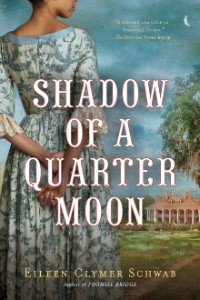
Today, I’d like to welcome Eileen Clymer Schwab, author of Shadow of a Quarter Moon.  The novel is set pre-U.S. Civil War and is a tale of romance, high racial tensions, and plantation life.  According to the publisher’s synopsis, “In 1839 North Carolina, Jacy has been raised in privilege as the daughter of a plantation owner. But when her father suddenly dies, her cold, unfeeling mother, Claudia, schemes to marry Jacy off to a well-positioned but lecherous suitor.  In a fit of fury over Jacy’s protests, Claudia calls her a ‘foolish, infernal quadroon’—and reveals that Jacy is the offspring of a dalliance between her father and a slave. Furthermore, her biological mother and brother are still slaves on the plantation. After these revelations, Jacy’s sense of who she is and where she belongs in the world is destroyed and, starts to see herself and the South with fresh eyes.”

Please welcome Eileen Clymer Schwab, and stay tuned for the giveaway:

1. What about the Civil War time period captured your attention enough to write a novel?

The years preceding the Civil War were so pivotal in American history, yet there is not a lot of adult fiction set in this time period. I suspect this is because it is not a time our nation is proud of, or wishes to reminisce over. We hide it from sight like an ugly scar. However, in keeping the door closed on this period, we miss the chance to honor and marvel at the incredible acts of courage and daring deeds that were the genesis of social change in the United States.

The Underground Railroad is the perfect example of the best of America within the worst of America. I am intrigued by this transitional period in history and find inspiration in the courage of those who sought freedom, as well as the spirit of joined purpose developed with those who provided aid during their journey.

2. Beyond the romantic aspect of your novel, SHADOW OF A QUARTER MOON, how much of the novel is about the racial tensions during the period and the issues that led up to the civil war?

Issues of slavery are central to the story, as is the Underground Railroad. In SHADOW OF A QUARTER MOON, an unimaginable secret changes the course of Jacy Lane’s life; not once, but twice. First, when it is hidden from her, and then when it is revealed. As the daughter of a plantation owner, Jacy has been raised in privilege until she discovers that she is the offspring of a dalliance between her father and a slave.

Amid the shock and complexities of her mixed heritage, Jacy is simply a woman longing for love, happiness, and a sense of wholeness; however the 1800s are not a simple time and Jacy begins a treacherous journey of denial and self-discovery that is fraught with danger and life-altering choices. She soon discovers that what she chases is as elusive as the secret network she hopes can save them.

3. When writing poetry, prose, essays, and other works do you listen to music, do you have a particular playlist for each genre you work in or does the playlist stay the same? What are the top 5 songs on that playlist? If you don’t listen to music while writing, do you have any other routines or habits?

I am a music lover, but I generally do not listen to music while writing because it might prevent me from “hearing” my characters. The process is different for every writer, but I am most creative when my mind is quiet. Scenes come alive visually in my mind and I hear the dialogue of my characters, not aloud, but like the voice of inner thought. But that’s not to say that music has not had a major impact on my work.

The spirit of my first novel, PROMISE BRIDGE was inspired the beautiful song, “Love Can Build a Bridge” performed by the country duo, The Judds. So much so, that they are mentioned in my Acknowledgments at the front of the book and again in my Author’s Notes. Often, as I prepared to write or contemplate a scene, listening to Love Can Build a Bridge helped plug me into the emotion of the scene.

4. How do you stay fit and healthy as a writer?

Nothing invigorates and centers me as much as a quiet walk. No iPods, no phone calls… just me and my dog, Sophie. Starting my day with a well-paced walk is good for my mind as well as my body. As I’ve mentioned earlier, I am most creative when my mind is quiet, so it’s not unusual for me to sort out a scene or capture the ideal turn of a phrase for a snippet of dialogue during my morning stroll. I don’t force the process. I simply let it percolate.

Sometimes, I let it all go and enjoy the birds and scenery around me, but more often than not, my mind comes alive and readies me for my time at the keyboard. I’m never without a pen and pad in the event ideas begin rushing at me. Of course the physical aspect is no less important. I’m out and moving which is a essential for someone who spends most of her day in front of a computer.

5. Most writers will read inspirational/how-to manuals, take workshops, or belong to writing groups. Did you subscribe to any of these aids and if so which did you find most helpful? Please feel free to name any “writing” books you enjoyed most (i.e. Bird by Bird by Anne Lamott).

This question makes me smile because I’ve done it all; books, classes, conferences, etc. Each was valuable its own way. First and foremost, these tools and activities brought me together with other writers. People who worked hard to learn their craft, hone their skills, and dared to take on the challenge of getting published. Writers write because we must. It’s like breathing; it’s a natural part of our being. We write whether we’re published or not. We write when there’s no guarantee that another soul will ever read as much as one word of what we’ve poured our hearts and souls into. Sharing that journey with others of like mind reminds us we are not alone. It assures us it is not impossible and gives us a network of support and encouragement.

6. What current projects are you working on and would you like to share some details with the readers?

I’m very excited about my next project which is set in the post-Civil War South. It was a very volatile period, particularly after the assassination of Abraham Lincoln. About a third of the novel is written and the entire story has been plotted. I have paused momentarily to complete some research.

I love the research phase because it’s a process of discovery – not just of historical facts, but of tendencies, beliefs, and nuances of the time. Through research, I become better acquainted with my characters and the world around them. Quite often the surprises discovered during research can shift plot lines and shape characters in unexpected ways. Combining research with imagination is the most creative part of the process, and for me, the most exhilarating.

Thanks so much Eileen for answering my questions.  These all sound like great novels.

To enter for 1 copy of Shadow of a Quarter Moon for a U.S./Canada reader:

1.  Leave a comment about what books you’ve read set during the U.S. Civil War or which you plan to read for this year’s War Through The Generations reading challenge.

2.  Facebook, Blog, or Tweet the giveaway for a second entry by leaving a link in the comments.

3.  For a third entry, please follow Eileen on Twitter and/or Facebook and leave a comment telling her you did so with your “handle.”

4.  Follow this blog and let me know in the comments (if you follow already, let me know)

Deadline is July 22, 2011, at 11:59PM EST.

***If you are a participant in the War Through the Generations Reading Challenge for the U.S. Civil War, you have another chance to win the book, here. 

Even if you are not in the challenge, please do check out Schwab’s guest post on writing about the U.S. Civil War.

Interview with C. Ray Nagin

C. Ray Nagin presided over New Orleans as the mayor in 2008 during one of the most harrowing times of the city’s history.  Hurricane Katrina had hit the city in 2005, and much of the media coverage decried the inactivity of the Bush Administration.  For Nagin’s part, he did urge residents to prepare for the storm and evacuate, before issuing an evacuation order in the evening of Saturday, August 27, 2005.  With less than 24 hours before the storm was expected to hit, the city was ordered to evacuate.  Following the devastating storm, he heavily criticized aid efforts from the state and federal governments.

Now, Nagin has written a book, Katrina’s Secrets:  Storms After the Storm, about his experiences during the storm and afterward.  Today, I’ve got an exclusive interview with the former mayor about his experiences and his book.

1.  Katrina’s Secrets: Storms After the Storm is your account of what happened during the cleanup and recovery (which is still ongoing) in the Gulf area after one of the most devastating storms in recent memory. Why was it important to you to write this book? And how do you hope it will be received by the public?

As I was getting out of office in May of 2010, I was not planning to write a book, but started to assemble my personal library of my eight years in office. As I looked back over the Katrina time frame I was amazed at how amazing the story was and at how much was still not told. In fact at one point if you Googled Katrina you would get millions of search results. Unfortunately, a significant amount of this did not accurately reflect our experiences. So I decided to give readers a unique insider’s perspective on this historic, catastrophic event. My hope is the public will be open to hearing another side of this story.

2. Since much of the recovery process is still not finished, what have you done to raise awareness about the struggles that have continued since Katrina hit? Do you have plans to provide any of the proceeds from the sale of your book to charities working to help the people of New Orleans recover?

I travel around the country and around the world telling this Katrina story. I have also done TV, radio and other media interviews to keep awareness at a good level. My plans are to donate a portion of the proceeds from this book sales to help senior citizens and children who are still struggling from this disaster as well as other disasters throughout the country. I am in the process of setting up a foundation for this specific purpose.

3. What have you learned from your experiences with the before, during, and after events of Katrina; how have they shaped who you are today; and what lessons will you apply into the future?

The biggest lesson I learned is the best planning may not be good enough when a historic, catastrophic disaster occurs. I also learned that politics, race and class can affect disaster response and recovery. This Katrina experience helped my team to put together one of the best evacuation plans in the country where we successfully evacuated our entire city during Hurricane Gustav. In fact, for Hurricane Katrina we got 95 to 96% of the people in the city out of harm’s way before the storm hit. Unfortunately, it was not 100% and some suffered. I have also led a U.S. Conference of Mayor’s task force that put together a white paper with specific changes to the federal laws that govern disasters. A unanimous resolution of support was passed by the organization and the document was used to lobby Congress.

4. When writing Katrina’s Secrets: Storms After the Storm, did you find it difficult to stay on track and how much would you say was edited out? Is there anything important that is not in the book that should have been included?

The story is so complicated and rich that it was a challenge to write. I had a great team of two other people who worked with me on research and fact checking as I did the final writings. We also taped key people who were directly involved to ensure accuracy. I would estimate that 25% was edited out as the original manuscript was quite lengthy. This book covers right before Katrina hit and the extremely intense 30 days right after. The second book in this series will cover the recovery period, five years after until the end of 2010.

5. Was this a solo writing process or did you have input from others who were there at the time of Katrina? How long did it take you to write?

As mentioned above I had a team with two other people assisting me with this project. In addition, as part of the self-publishing process with CreateSpace I purchased additional professional editing services. This project took about one year to complete.

6. Was it difficult to find a publisher? Could you tell us a little bit about the process?

I spoke to several traditional agents who were working with various publishers. There was definitely good interest in this project since Katrina was so high profile. My hesitation was the pushes to either further sensationalize or tone down major sections depending on who I talked to. I was also uncomfortable that once I turned my manuscript over to the publisher that they would have final say on how the book ultimately ended up in print. I decided to self publish my first book to ensure that my voice and story would survive.

7. Speaking of the future, what are your future plans? Any recent projects you’d like to talk about?

I plan to focus the majority of my time over the next couple of months promoting my book. In addition, I will continue on the speaking circuit as this should complement book sales. My other initiatives are emergency preparedness planning and working on green energy entrepreneurial projects centered on solar and LED lights. I just got back from the Chez Republic regarding flood protection and have trips scheduled to Belgium, Australia and Puerto Rico for emergency preparedness lectures.

Katrina’s Secrets: Storms After the Storm can be purchased from my Website, amazon.com, kindles, I-books, Nooks, Sony, etc.

Thanks, C. Ray Nagin, for answering my questions, and I wish you luck with your endeavors.

Interview With Poet Stephen Cushman

Poet Stephen Cushman

Poet Stephen Cushman

This week at the Poetry Blog of 32 Poems Magazine my interview with poet Stephen Cushman was posted. He’s a contributor to the magazine and was a delight to interview. His answers are very short and to the point, but I’m intrigued by those who play Frisbee golf.

First, let me tantalize you with a bit from the interview, and then you can go on over and check the rest out for yourself.

Without further ado, here’s the interview.

How would you introduce yourself to a crowded room eager to hang on your every word? Are you just a poet? What else should people know about you?

People should know I play a mean game of Frisbee golf, am fluent in Maineglish (ayuh), am told I can make anything naughty with the lift of one eyebrow, and am the go-to person for old school drinking songs.

Do you see spoken word, performance, or written poetry as more powerful or powerful in different ways and why? Also, do you believe that writing can be an equalizer to help humanity become more tolerant or collaborative? Why or why not?

If I am elected Miss America, I vow to work for world peace, mostly on the written page, although I’m happy to perform or do spoken word, if I can wear my overalls. Poetry is 4,300 years old; if it could help humanity become more tolerant and collaborative, it would have done so by now. And perhaps it has. Who knows? If it weren’t for poetry, we might be even worse than we are.

In terms of friendships, have your friendships changed since you began focusing on writing? Are there more writers among your friends or have your relationships remained the same?

As a writer I fly least turbulently below the radar. Luckily, therefore, my friendships are not related to or dependent on my writing life.

How do you stay fit and healthy as a writer?

I’m currently co-editing the new edition of the Princeton Encyclopedia of Poetry and Poetics, so hoisting the page proofs of that around keep me pretty buff.

He also included a poem, originally published in 32 Poems, for readers to check out:

Supposing Him to Be the Gardener

Supposing this to be the sun
And this to be the rain,
Supposing clouds to be caviar
And wind to be champagne,
How can one tell divinity
From a tree turned red
Or Do not hold me from what else
Its leaves might well have said?

About the Poet:

Stephen Cushman is Robert C. Taylor Professor of English at the University of Virginia. He has published four collections of poetry, Riffraff (LSU, 2011), Heart Island (David Robert Books, 2006), Cussing Lesson (LSU, 2002), and Blue Pajamas (LSU, 1998). He is also the author of Bloody Promenade: Reflections on a Civil War Battle (University Press of Virginia, 1999) and two books of criticism, Fictions of Form in American Poetry (Princeton University Press, 1993) and William Carlos Williams and the Meanings of Measure (Yale University Press, 1985).

Also find him at Public Poetry, The Writer’s Almanac, Drunken Boat, interLitQ.org, The Cortland Review, University of Virginia Department of English, Amazon.com, and Archipelago.

Please check out the rest of the interview on 32 Poems Blog.

Interview With C.C. Humphreys, Author of Vlad: The Last Confession

If you’re like me and have loved reading vampire novels for as long as you can remember and then discovered that one of the most notorious vampires in the genre, Dracula, was based on a real person, you’d want to read about that person — Vlad the Impaler.

C.C. Humphreys satisfied my curiosity in his novel, Vlad: The Last Confession, about the infamous Wallachian and made me even more curious about the 15th Century.  I got so absorbed in this story; there were times when “Wiggles,” my daughter, was starting to fuss and I just wanted to ignore her.  I did not want to be pulled out of this story.  If you haven’t read my review or entered the giveaway, you better hurry it ends July 1 (it’s open internationally as well).

Today, I’ve got a treat!  C.C. Humphreys was kind enough to answer some questions, and I’m going to share those with you.  Don’t hesitate to let us know what you think.

1. What inspired you to tackle Dracula in Vlad: The Last Confession?

It was strange. It was not something I’d ever considered. Then I made the mistake of getting drunk with my editor in London. We started analyzing historical fiction, what worked, what was most successful. It seemed that books about real people always did well. But everyone had been done. Then he suggested Dracula and I scoffed. Had to have been done! But it hadn’t and that intrigued – so famous a name? Why? I discovered fast – there was a horror story there and I don’t do horror. But then I discovered the real story behind the propaganda. And I was off and running. Summed up in the phrase: ‘Trust nothing that you’ve heard.’

2. How is your book about Dracula different than the others available on the market?

Well, its not about a vampire. Its about the real Dracula – Vlad, Prince of Wallachia. Vlad the Impaler. Vlad the tyrant and the hero. The lover and the murderer.

3. A number of your books seem to fall into the historical fiction category. What is the allure of this genre for you and when did you first realize that it was a genre you wanted to write?

I have always loved history. It was one of the signs at the crossroads for me at 18 years old. Go to university and read History. Go to Drama School. I chose the latter. But when I came to write novels, I always knew they would be like the stuff I read as a boy, but with an adult slant. Wild adventures, great characters, exciting lives and events.

4. As an actor and fight choreographer, how different is the solitude of writing in comparison?

Quite different. I have always enjoyed both. I seem to have a split personality – on the one hand gregarious and liking company, on the other needing to spend long stretches of time alone. That’s why its fun to still do both, though writing is my main thrust now.

5. Please share a few of your obsessions (i.e. chocolate, bungee jumping, etc.).

Obsessions? I like beer. A lot. But I can’t drink too much because I have to get up early to write. I love the water, swimming, snorkelling and, especially, body surfing. Give me a wave and I’ll wait for my beer!

6. What are some favorite books and/or authors that you wish would get more recognition or a larger readership?

I think anything by Rosemary Sutcliff. People only really know ‘The Eagle of the Ninth’ but all her stuff is superb.

7. Most writers will read inspirational/how-to manuals, take workshops, or belong to writing groups. Did you subscribe to any of these aids and if so which did you find most helpful? Please feel free to name any “writing” books you enjoyed most (i.e. Bird by Bird by Anne Lamott).

I am afraid I didn’t. I just sort of jumped in. But a book that got me going just before I wrote my first play was ‘Writing, the Natural Way’.

8. What current projects are you working on and would you like to share some details with the readers?

I have just completed the follow up to ‘Vlad’. Its called ‘A Place Called Armageddon’ and is about the fall of Constantinople in 1453. That’s out in the UK in July, Canada in August, and the US sometime in 2012. Meantime, I am about a third of the way through the first draft of my next historical which is set in London 1599-1601 and is about Shakespeare, the Globe… and one very special swordsman.

Thanks to C.C. Humphreys for answering my questions.

I’m glad to hear there will be a new novel dealing with the fall of Constantinople, since it was a big part of Vlad’s story. I adore Shakespeare, so his next historical novel will be another one on my radar. How about you?

An Interview With Poet Casey Thayer

Poet Casey Thayer

This week at the Poetry Blog of 32 Poems Magazine my interview with poet Casey Thayer was posted. He’s a contributor to the magazine and was a delight to interview. I’m especially impressed with his answer to the elitist myth about poetry, since I feel the same way about the issue.

First, let me tantalize you with a bit from the interview, and then you can go on over and check the rest out for yourself.

Without further ado, here’s the interview.

Do you see spoken word, performance, or written poetry as more powerful or powerful in different ways and why? Also, do you believe that writing can be an equalizer to help humanity become more tolerant or collaborative? Why or why not?

This sure is a question with very large implications, and I don’t necessarily want to dive into the print versus spoken word debate, but I will say that poetry adapts much more easily to performance than other written forms—it was, after all, historically an aural form—and I do think that spoken word can delight in ways written forms can’t. For me, however, this adaptability doesn’t necessarily mean that poetry is better or more accessible when performed. Personally, when I hear a poem in performance that catches my ear, I need to see it on the page. This could very well be a shortcoming in my ability to stay attentive or process spoken poetry, but I can’t escape the page. The page, that tactile experience of holding a book, allows me to sit with the work, to mull it over at my own pace. That reflection time is what initially drew me to poetry. I don’t find this same satisfaction with spoken word poetry.

At the same time, it might be pointless to evaluate them by the same measure: I classify them as different forms that simply strike different chords. If I’m trying to engage young readers, I forego Ashbery for Taylor Mali. If I’m curling up on my couch, I reach for Sandra Beasley’s new collection instead of queuing up Youtube clips of Saul Williams. I see performance poetry as walking a middle ground between print poetry and hip-hop freestyle and improvisation. It satisfies my need to be engaged visuals and audibly, but it doesn’t replace my desire to see poetry on the page.

To answer your second question, one of the arts’ most-enduring benefits is its ability to foster tolerance, to expand one’s perspectives, and to encourage reflection and non-linear thinking. We hear the ignorance and apathy of younger generations continually bemoaned, but there perhaps has never been a time in our history where more younger people can engage with art: computer programs have opened the door to self-recorded CDs, design programs to DIY chapbooks, Youtube to greater recognition for independent films, the internet to vloggers and the rise of Justin Bieber. As for bringing artists together, I think mash-ups and the popularity of bands like The Hood Internet and GirlTalk (among many other groups) illustrate that we’re hungry for collaboration.

Most writers will read inspirational/how-to manuals, take workshops, or belong to writing groups. Did you subscribe to any of these aids and if so which did you find most helpful? Please feel free to name any “writing” books you enjoyed most (i.e. Bird by Bird by Anne Lamott).

For me, inspiration comes less from any rhetorical text or how-to manual and more from collections of poetry, though I did find Triggering Town very influential in forming my aesthetic and Bird by Bird served as a good introduction to the world of writing. When I feel directionless, I will pick up a collection of poems, searching for techniques I can steal. I don’t feel any of Harold Bloom’s “anxiety of influence.” Jude Nutter’s Pictures of the Afterlife is especially inspirational, as is Cecily Parks’ Field Folly Snow. Jack Gilbert never fails to inspire, and Sandra Beasley’s work (especially her recent collection I Was the Jukebox) spawned so many poems that I should probably send her a bottle of wine.

As for writing groups, I have trouble joining them. It’s not that I don’t want to commit myself to the work of others or to help them improve (I am a teacher, after all). However, it’s difficult to know whether all the effort of fully giving oneself to a poem in workshop will be appreciated. One time, years back, I responded to a batch of poems sent to me by an old friend with copious commentary, suggestions, praise, and constructive criticism. I suggested readings, enclosed in the manila envelope poems, and photocopies from essays. I never heard back. It was such a deflating process, to give so much of myself and to have that dedication ignored, that perhaps I’ve been guarding myself from that disappointment ever since.

Poetry is often considered elitist or inaccessible by mainstream readers. Do poets have an obligation to dispel that myth and how do you think it could be accomplished?

Poets, just like any writers or communicators, have an obligation to their readers. Unless a poet has developed her craft, obscuration frequently reads as a lack of control. Young poets (and here I’m talking more about undergraduate writers than young professional writers) too often hide behind the John Ashbery defense—if he doesn’t make sense, I don’t have to. He even says in his book Other Traditions: “Unfortunately, I’m not very good at ‘explaining’ my work… I am unable to do so because I feel that my poetry is the explanation. The explanation of what? Of my thought, whatever that is. As I see it, my thought is both poetry and the attempt to explain that poetry; the two cannot be disentangled.” I find that young writers point to this same defense, though Ashbery has already staked that territory. Young poets need to find their own.

All that said, although there are examples of unnecessary obscuration in poetry, this cry of elitist and inaccessibility is often not due to faults in poems but in the inability or unwillingness of readers to engage with poetry. I do think that poets should and should be able to demand more of their readers. Readers simply are underdeveloped critically; they have not been given the tools to appreciate poetry. The way to solve this, in my opinion, is to stress the teaching of poetry by those who know how to crack open a poem for students. In my creative writing courses, I have student boldly proclaim their hatred for poetry, yet when I take them slowly through “To His Coy Mistress,” they sit amazed that way back in the 17th century, boys were trying to pull the same tricks they do now: “C’mon, we’ll be dead soon, so let’s quick have some sex.” The key is to take poetry slowly, to analyze and fully understand each line before moving on to the next. With the short-attention spans bred by twitter, aggregating blogs, etc., teachers may find it very difficult to slow students down. But this meticulousness is necessary in understanding and cultivating an appreciation of poetry.

He also included a poem for readers to check out:

Aubade

Leaving Hotel Skandia in the grey dawn’s growl

of car horns and red light district litanies—

Oh little boy, you run an ache through my bones.

We trade our hands for luggage, haul off

what I’m carrying home: a bag of salt licorice,

a list of useless Danish words—My ham

is frozen and Spot me. I have nothing

for moments when grief comes heavily

like a mouthful of peanut butter and sticks

in my throat the whole way down.

I choke out an order for two train tickets,

lights flicking off at Tivoli, the terminal

hunkering over us as the clock tower

calls out the hour and keeps on counting.

When I tell you, The stars like your hipbones

shine, and, If you sing, you mold me like

a pastry in my crude translation, I misspeak.

I mean to say that love is hard when we

have only our hands to help. The train car

filled with passengers asleep on one another,

winds its way through tunnels to the airport.

The morning nearer now, we press our lips

together. Where we open, we close.

The city like a book covered in words.

About the Poet:

Casey Thayer completed an MFA at Northern Michigan University and has published poetry in Hayden’s Ferry Review, Hunger Mountain, Ninth Letter, and elsewhere. New poems are forthcoming in American Poetry Review, North American Review, and Devil’s Lake. Currently, he is an Assistant Professor of English at the University of Wisconsin-Rock County.

Please check out the rest of the interview on 32 Poems Blog.

Interview With Poet Jennifer C. Wolfe

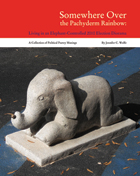
I recently reviewed Somewhere Over the Pachyderm Rainbow: Living in an Elephant-Controlled 2010 Election Diorama by Jennifer C. Wolfe this week.  And I’ve had the delightful opportunity to ask the poet some questions about her collection and how it came to be.

Please welcome Jennifer:

1.  First, do you consider yourself a Democrat and how far do you lean to the left?  If not, what is your party affiliation and why?

I do not consider myself a Democrat.  I am officially registered as an “Independent” voter.  I do lean a bit left of center in some political areas, while a bit right of center on others.  I enjoy my official designation as an Independent, because I do not want to be tied down to any one party or party outlook.


2.  How long did it take you to amass this amount of poetry for a collection about the 2010 elections and the world it created in the United States?

It took me about three months to amass the amount of poetry for this collection; and the better part of a year, to bring it to print publishing fruition.  Whenever I needed to find new material, all I had to do was to either turn on CNN or FOX NEWS and soon my blood was boiling and my computer keyboard was frenetically being typed upon.

3.  Did you intend for these poems to read more like a diatribe against Republicans only or did you have a larger goal in mind?  And do you think you achieved your goal?

I primarily wanted the poems to read like a satirical diatribe against GOP dominance and arrogance, post Election 2010.  I also wanted it to have the larger goal of focusing scrutiny on every GOP platform and party officials I feel strongly about, including the Republicans’ meddling stepchild, the Tea Party.  The (so-called) “Grand Old Party” is not so grand; and I wanted this aspect to come through.  I do think I achieved my goal; although some readers might mistake some of my satirical material for straight criticism.


4.  How long have you considered yourself a poet and do your poems’ subjects always center on politics?  If so, what keeps you interested in politics to write about it consistently, especially given the apparent apathy inherent in American society with regard to elections?

I have always written poetry; however, I have considered myself a serious poet since 2008, when I earned my very first poetry credential—a poem “If” included within the Century College, White Bear Lake, MN literary magazine, Student Lounge.  I have had three political poetry eBooks published with BlazeVox Books, New York: Kick the Stones: Everyday Hegemony, Empire, and Disillusionment, October, 2008; Yukon Rumination: Great Fun for All in the Land of Sarah Palin’s Joe Sixpack Alaska, June, 2009; and Healing, Optimism, and Polarization, February, 2010, in addition to Somewhere Over the Pachyderm Rainbow: Living in an Elephant-Controlled 2010 Election Diorama.

What keeps me interested in consistently writing about politics is the fact that I feel I have something important to say.  My goal is to dissuade the apathy in American society with regard to elections.  That and to present political opinions that are from my heart.  I also have written non-political poetry, addressing everyday life scenarios.

5.  When writing poetry, prose, essays, and other works do you listen to music, do you have a particular playlist for each genre you work in or does the playlist stay the same? What are the top 5 songs on that playlist? If you don’t listen to music while writing, do you have any other routines or habits?

I do sometimes listen to music when I write, and when I do, the playlist is often as eclectic as the writing being undertaken.  I am mainly a rock, alternative rock, and heavy metal listener; and songs from all of these musical realms come into play.  I also listen to varied cable news TV channels, when I write on politics—searching for that tidbit of information or a concentrated story that will focus my thoughts.


6.  Do you see spoken word, performance, or written poetry as more powerful or powerful in different ways and why? Also, do you believe that writing can be an equalizer to help humanity become more tolerant or collaborative? Why or why not?

I see spoken word, performance, and written poetry as equally powerful mediums, in different ways.  Spoken word has a tremendous “go with the moment” mentality and it inspires with its often contagious enthusiasm.  Performance hones an individual’s poetry reading skills in a ways that make the words on the page come alive; while written poetry helps to define and clarify poetic aspirations in a private setting between the reader and the poetry being read.  I do believe writing can serve as an equalizer to help humanity become more tolerant and/or collaborative, because when an individual reads a story or a poem which becomes profound to them; it can often alter their mindset or attitude.


7.  What current projects are you working on and would you like to share some details with the readers?

Currently, I am working on a fictional novel entitled Far Beyond Driven that is part of a trilogy centering on a primary antagonist who works in intelligence.  The last book in the trilogy, The Five Words, was completed first and is currently being represented by Ms. Tracy Brennan of Trace Literary Agency.  The Five Words centers upon five friends and a five worded Internet prank gone awry to Homeland Security, told primarily in flashback by one of the friends who is testifying before a U.S. Senate Select Committee, looking into DHS civil liberties abuses.  Far Beyond Driven is the second book of the trilogy, as I work my way backward to the first novel, Fade Into Black.  All three novels tell the story of intelligence operative, Mark Graham and his psychological descent (spawned by personal tragedy) into an abusive monster, with too much U.S. “War on Terror” power in his hands.  All three works will be represented by Trace Literary Agency.  In addition, I also have completed an everyday life poetry manuscript, Reach for the Words, and am mulling the concept for a new non-political poetry manuscript, The Pain Behind the Smile.

Thanks, Jennifer, for answering my questions and for a highly discussable collection.

I would like to point out that Pantera, a heavy metal band, had an album called Far Beyond Driven; Perhaps she was inspired by their music one day when she was writing.

An Interview With Poet Hope Snyder

Poet Hope Snyder

This week at the Poetry Blog of 32 Poems Magazine my interview with poet Hope Snyder was posted. She’s a contributor to the magazine and was a delight to interview.  I’m especially impressed with her answer about what writing manuals and workshops have helped her most.

First, let me tantalize you with a bit from the interview, and then you can go on over and check the rest out for yourself.

Without further ado, here’s the interview.

Most writers will read inspirational/how-to manuals, take workshops, or belong to writing groups. Did you subscribe to any of these aids and if so which did you find most helpful? Please feel free to name any “writing” books you enjoyed most (i.e. Bird by Bird by Anne Lamott).

I do not belong to any writing groups, but I have attended workshops at the Bread Loaf Writers’ Conference, The Gettysburg Review’s Conference for Writers, and the Latino Writers’ Conference in New Mexico. Workshops at Gettysburg and Bread Loaf were helpful. I’ve also taken a couple of workshops with Stanley Plumly at The Writers’ Center in Bethesda. These were very beneficial.

When writing poetry, prose, essays, and other works do you listen to music, do you have a particular playlist for each genre you work in or does the playlist stay the same? What are the top 5 songs on that playlist? If you don’t listen to music while writing, do you have any other routines or habits?

Even though I think I should listen to music while I’m writing, I don’t always do it. That is something I would like to change. I think music can be very helpful while writing. In the past, I’ve listened to classical, Latin American, Spanish, and Italian music. Among my favorites, Beethoven’s 7th symphony, a Spanish singer named Rosana, the sound track for the film “Frida.”

How do you stay fit and healthy as a writer?

I try to walk or engage in some sort of exercise every day. Most days I walk 30 to 40 minutes. This year I joined a gym. I’m seriously considering hiring a personal trainer.

She also included a poem for readers to check out:

In The Changing Light

At first he believed she would be back, and that he would open the door.

In the meantime, he kept his job, adopted a dog without a tail,

soaked in the hot tub, and lounged on the couch they had bought

on sale. “Custom made,” the sales woman had explained

stroking the velvet. In the afternoon light, it shimmered

like silver. After four years, the other woman

has learned to cook rosemary chicken and threatens

to fill his days and his bed. She goes through the house,

gathers sweaters, pictures, and paintings. Now there will be

room for her pills and her make-up. With a drink and Barry White

on the stereo, he rests on the couch in the changing light. In his hand,

the pearl earring he found while re-arranging the cushions last night.

–Published in The Gettysburg Review (Summer, 2009)

About the Poet:

Born in Bogotá, Colombia, Hope Maxwell Snyder received an MA in Latin American Literature from Johns Hopkins and a Ph.D. in Spanish Medieval Literature from the University of Manchester. Her poetry has appeared in Alehouse Press, The Comstock Review, The Gettysburg Review, International Poetry Review, OCHO, Redactions: Poetry & Poetics, and other journals. Hope has been the recipient of scholarships to attend Western Michigan University’s program in Prague, and the Bread Loaf Writers’ Conference. Hope has also been awarded poetry fellowships for The Gettysburg Review’s Conference for Writers and the Peter Taylor Fellowship in Poetry at The Kenyon Review’s Conference. She is the founder and director of the Sotto Voce Poetry Festival in Shepherdstown, West Virginia.

Please check out the rest of the interview on 32 Poems Blog.

Interview With Poet Amy Pence, Part 2 & Giveaway

The Decadent Lovely, which I reviewed and is published by Main Street Rag, is a collection that strives to uncover the love beneath the grime, and Amy Pence‘s style ranges from the straight narrative to the more abstract.  If you missed part one of my interview with her, please head on over to learn more about her, the collection, and her obsessions.

Without further ado, we’ll take a look at her thoughts on writing, poetry’s accessibility, and more.

Do you see spoken word, performance, or written poetry as more powerful or powerful in different ways and why? Also, do you believe that writing can be an equalizer to help humanity become more tolerant or collaborative? Why or why not?

Poetry is powerful in various ways and there’s a flavor for everyone, thankfully. For me, it’s the difference between poetry as a public performance with a strong social message and poetry as a private experience with the page about the interior event. I am personally most moved by the poem as artifact, as an involution of word, form, and sound. That was my first experience with poetry and the kind of poetry I am moved to write. I like familiarizing my students with poets and performance artists like Daniel Beaty and Patricia Smith to show and celebrate their successes, but the challenge as a teacher these days is to show that an Emily Dickinson poem (for instance) is not precious or flowery—it is a complex sonic creation that briefly but deeply can show us what it is to be human.

Poetry is often considered elitist or inaccessible by mainstream readers. Do poets have an obligation to dispel that myth and how do you think it could be accomplished?

I don’t think we have an obligation to dispel it (and it’s not always a myth). As I said, I like to bring my younger students into the world of poetry’s richness that they may have thought of as stuffy or inaccessible. Last night in class we lingered over Wallace Stevens’s “Thirteen Ways of Looking at Blackbird,” putting meaning aside to revel in the language and the modernist disjunctions. I don’t know if I inspired much rigorous thinking, but I try to do my small part in encouraging art appreciation as a value. It’s unfortunate that the word “elitist” has obscured what art can enact in the human.

Most writers will read inspirational/how-to manuals, take workshops, or belong to writing groups. Did you subscribe to any of these aids and if so which did you find most helpful? Please feel free to name any “writing” books you enjoyed most (i.e. Bird by Bird by Anne Lamott).

I mentioned leading a workshop, and beginning about a decade ago, I’ve met with a small group off and on in Atlanta (hats off to Kiki, Gelia, Marianne, Sam, Sandi & Sunny). I like to set up themes and then we read relevant texts, write in-class, and workshop their poems. They know that they are teaching me as much as I “teach” them, yet they have the grace and generosity to pay me (hardly seems right). Two stellar writing books I return to again and again: Jane Hirshfield’s Nine Gates: Entering the Mind of Poetry and Writing Poetry: Creative and Critical Approaches by Chad Davidson and Gregory Fraser (amazing poets and generous friends who teach here in Carrollton at the University of West Georgia).

In terms of friendships, have your friendships changed since you began focusing on writing? Are there more writers among your friends or have your relationships remained the same?

I have two very close friends from graduate school (fiction writer Sue Stauffacher and poet Val Martinez) who are writers and I know—even with our ups and downs—we will always be friends. And I’ve met so many wonderful writers at conferences, writing residencies and here in Carrollton. But it’s not a prerequisite, and the writers that I know typically don’t “talk” writing. I have to say I like Facebook for the way I’ve reconnected with friends from my MFA program in graduate school (University of Arizona) and to see what a vast network of poets are posting (but then, it’s very distracting). Their little obsessions and conundrums sometimes crop up, and I find that interesting. I admire so many writers and enjoyed interviewing Barbara Kingsolver, Li-Young Lee, and Paul Guest (published in past issues of Poets & Writers). I hope to do more because I learn so much from the process.

Please describe your writing space and how it would differ from your ideal writing space.

I’m extremely lucky to have my ideal writing space that I couldn’t have dreamed of a decade ago. But I dreamed it, and my husband sacrificed some beloved trees so we could add my writing space to his house when we married. I write in front of a large window that overlooks a hard wood forest of thousands of acres of rolling hills and creeks. I have a courtyard planted with my favorite flora (the fauna are the 2 dogs, 3 cats, and a dwarf bunny) in all seasons. My writing studio has windows on all four walls. Needless to say, I’d just sit here and write or just gaze into the distance if I could. But there’s that thing called a paycheck to pay for this fine mess.

What current projects are you working on and would you like to share some details with the readers?

That Emily Dickinson novel, as mentioned earlier. It may take a lifetime. I’m not sure whose.

Thanks, Amy, for answering my questions.

For the giveaway, I have 1 copy for a US/Canada reader:

To Enter, comment on this post with either a question for Amy or something you enjoyed about the interview.

For a second entry, spread the word about the interview on Twitter, your blog, and Facebook, and leave a link in the comments.

For a third chance to win, enter on yesterday’s interview.

Deadline June 22, 2011, at 11:59PM EST

Interview With Poet Amy Pence, Part 1 & Giveaway

Amy Pence, the author of The Decadent Lovely — which is published by Main Street Rag and which I reviewed last week — is a poet, fiction writer, essayist, and teacher.  She graduated from Denison University and from the University of Arizona with an MFA.  In addition to The Decadent Lovely, she has authored a chapbook, Skin’s Dark Night (2River Press), and her poetry, essays, and fiction have appeared in a number of literary journals and magazines.

Part one of our interview will introduce her more fully and explore why she chose certain text excerpts for her collection.  Part two of the interview will be available tomorrow, June 7, so stay tuned for that.

How would you introduce yourself to a crowded room eager to hang on your every word? Are you just a poet, what else should people know about you?

If there is a crowded room eager to hang onto my every word, I must be an impostor, channeling Jane Fonda or Roshi Joan Halifax (either would be cool), or I’m having a nightmare.  I do teach (no surprise: college English), but often not to a crowded room.  I think I’m good at leading small workshops and I’ve done so with a wonderful group in the Atlanta area over the years.  (More on that later).  I’m a mom to a fifteen-year-old, who is quite amazing…To talk more about myself in answer to this question reminds me of Don Draper in the episode of Mad Men when he tries to side-step the question (I’m from the Midwest; we don’t talk about these things) and then he comes off like an asshole in the article!

What was it about “Learning From Las Vegas” and “The Art of Loving” that prompted you to include excerpts from them in The Decadent Lovely?

Thank you for this question.  That The Decadent Lovely is my first published collection came as a surprise (it’s really my third poetry manuscript).  But for many years I’ve appreciated and reread the dense and interesting language and mulled over the preposterous premise of Learning from Las Vegas. Should architecture really look like Las Vegas casinos?  Let’s hope not.  I also knew that one day I would write a book about the one vaguely interesting thing about me: that I grew up in the New Orleans French Quarter and Las Vegas.  I didn’t know that the poems would come out as a kind of necessity during my mother’s illness with lung cancer and her death about eight months later.  The book, I realized, framed the poems.  While cleaning her house, I came across The Art of Loving and her marginalia in the book (when she wrote the notes and underlined the book I will never know).  I read it eight months after her death and it was frustrating and sad and an act of discovery.  I could mourn her and celebrate her and be angry with her and well, love her, as I wrote the last poem in the book.  When I completed it—in my courtyard garden—a hummingbird—meaningful to my mother and me—hovered close to my face.  Thanks, mom, I said to that little whirring thing.

Do you have any obsessions that you would like to share?

Well, see, I’ve already mentioned Emily Dickinson (because I’m obsessed!) and I’ve written a couple of essays, many ED-inspired poems and am working on a novel about her. She’s obsession-material for me and many, many others, as I’ve found. I tend to burrow into a person’s life story; I used to read bios on film stars such as Bette Davis and Louise Brooks because there’s such a public/personal split that I find fascinating. Currently, I am very into Jane Fonda. Other obsessions seem to just crop up in my poems and well, we don’t really want to ferret those out, do we?

How do you stay fit and healthy as a writer?

I run, but there are so many triathletes and marathoners out there that my 5k to 10k jaunts sound paltry—I run fast to get it over with.

Do you have any favorite foods or foods that you find keep you inspired? What are the ways in which you pump yourself up to keep writing and overcome writer’s block?

I seldom have writer’s block because of my writing space (see the next answer), but I suffer from writer’s distraction (see previous answer). Puttering around in the garden and house can be fruitful or just a time suck. Often I have to turn the internet off or I’ve ended up web-surfing so far away from my original search that it’s head-spinning (huh? how did I get here?). In terms of pumping myself up and a quasi-food that keeps me inspired: copious amounts of coffee with cream. I’m ashamed to say how much—except to use the word “copious.”

When writing poetry, prose, essays, and other works do you listen to music, do you have a particular playlist for each genre you work in or does the playlist stay the same? What are the top 5 songs on that playlist? If you don’t listen to music while writing, do you have any other routines or habits?

Right now I’m listening to the Philip Glass Radio on Pandora. Chamber music (with lots of cellos) is also good. I have to be wary of Philip Glass though—I’ll be writing and suddenly I feel like Nicole Kidman wearing her Virginia Woolf nose in The Hours. And then it’s all stream-of-consciousness. (Just kidding).

Thanks for answering these questions, Amy. You’ll have to come back tomorrow to hear what Amy says about poetry’s “elitism,” friendships, writing spaces, and her current projects.

For the giveaway, I have 1 copy for a US/Canada reader:

To Enter, comment on this post with either a question for Amy or something you enjoyed about the interview.

For a second entry, blog, tweet, or Facebook this interview and leave a link in the comments.

For a third chance to win, enter on tomorrow’s interview (link is not live until June 7).

Deadline June 22, 2011, at 11:59PM EST