Quantcast

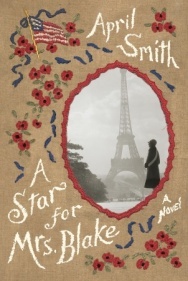
A Star for Mrs. Blake by April Smith

Source: TLC Book Tours and Random House
Hardcover, 352 pages
I am an Amazon Affiliate

A Star for Mrs. Blake by April Smith is set in the 1930s when the United States was sending the mothers of soldiers overseas to France to the cemeteries where their children had been buried after WWI.  Smith bases her novel on the diary of Colonel Thomas Hammond, who began his career in the military with one of the pilgrimages of the Gold Star Mothers, and he appears as a young principled officer seeking to live up to his family’s illustrious military history.  As these mothers make their journey across the Atlantic to pay respect to their lost sons, Hammond is unaware how much the journey will affect him and these women.  Smith builds the story from a small island town in Maine where Cora Blake struggles alongside her neighbors to make ends meet as the United States wallows in Depression to the deepest emotional hum a human being can experience at a foreign graveside in a country that is still rebuilding after war.

“He was in grave number 72, identified by his dog tags, which were apparently nailed to a stake.  The second card asked that she state her relationship to the deceased and answer yes or no to the question: ‘Do you desire that the remains be brought to the United States?'” (page 15 ARC)

Cora Blake is a young widow, who also has lost her son to a war in Europe, but she’s just beginning to breathe and learn that there could be happiness around the corner with Linwood Moody, a recently widowed soil scientist.  Mrs. McConnell is an Irish-American who knows the struggle of working for the wealthier classes, while Minnie is a Russian-Jewish immigrant who has seen discrimination first hand.  Mrs. Russell is a woman who has been struggling with mental breakdowns for much of her married life, but is determined to see where her son died.  Just as determined as Mrs. Russell, railroad-heir Mrs. Olsen is seeking some form of closure from this trip.  Smith shines in her characterization of these mothers, showing how they are bonded over grief, but also that class distinction and experience can still separate them.  It’s a novel about the struggles for equality that still threatened to separate every American — immigrant or not — but how the great tragedy of war made no such distinctions when taking their sons.

“Cora’s world had expanded so rapidly, but not from the vista.  She remembered what Selma told her in the women’s waiting room in Boston.  ‘You got a lot to learn.’” (page 89)

Smith’s research into the time period, the Gold Star Mother’s tours, and the war itself — including the artillery and tactics used — shines through in the story, the plot, the characters, and the emotional roller coaster these women find themselves on.  Once in France, these women are swept along with military precision, but even the military is not prepared for the will of a mother’s love and her defiance against being told what will placate them the easiest.  They are here for the full experience, they want the truth of their sons’ sacrifices and will accept nothing less.  Along the way, they are treated to the best France has to offer, the eccentricities of Paris artists, the bigotry of Europeans who see Americans as arrogant, and the mysterious ways in which injured soldiers and American reporters, like Griffin Reed, cope.

A Star for Mrs. Blake by April Smith is stunning without being overwrought with emotion, weaving the lives of these women and their children into reader’s minds and souls.  In reflective prose, Smith deftly handles the grief of these women, the tension between grief and duty, and the peace that comes from knowing their loved ones are at rest.  From the cutting edge of facial reconstruction to the remnants of war that could still be found in the weeds of Verdun, Smith has crafted a novel that breathes life into history, ensuring that we never forget the past.

To win a copy of this book, you must be a U.S. resident, age 18 and over.  Leave a comment below by Feb. 14, 2014, at 11:59PM EST.  

4th book (WWI) for the 2014 War Challenge With a Twist.


7th book for 2014 New Author Challenge.


4th book for 2014 European Reading Challenge; this is set in France.


4th book for 2014 Historical Fiction Reading Challenge.

Brady Needs a Nightlight by Brian Barlics

Source: TLC Book Tours and Black Rose Writing
Paperback, 32 pages
I am an Amazon Affiliate

Brady Needs a Nightlight by Brian Barlics, illustrated by Gregor B. Jones, is a children’s book for ages three and up.  The cartoon-like illustrations by Gregory B. Jones are cute and the colors are vivid and bright.  They allow readers to get a complete picture of Brady’s world and what he dreams most about.  Barlics gets it right with the rhyming and the use of poetic stanzas as a way to capture young readers’ attentions.  The author clearly thinks with a youngster’s mind as they fear the unknown or things they don’t understand.  Things that make noise and shadows in the night can be frightening for children at any young age, which is why many request night lights and other comforts in bed.  Barlics has crafted a story to help kids understand that there’s nothing to fear and that it’s okay to go to sleep at night.

The story is creative and ironic at the same time, since the bat is clearly a creature that thrives in the night and he improvises by finding something that can light up his evening.  My daughter is just starting to be afraid of the dark as she gets closer to age three, but she has her star-light turtle and her glow worm to make her night better too.  Young kids can easily follow along in the story and even relate to Brady’s trials and fears.  Brady Needs a Nightlight by Brian Barlics is a cute story with a good message that can help parents appease the fears of their young readers in a fun and creative way.

About the Author:

Brian was born and raised in New Jersey and currently lives in Northern California. He is a Pediatrician with a strong love for children and is dedicated to their health and well-being. He believes not only in the physical health of children but also in the enrichment of their minds and building of their character. He is a strong advocate of the well-supported idea that reading to your child encourages a strong parent-child bond, promotes literacy, and helps them tap into their seemingly endless imaginations. He has recently started a new venture as an author of children’s books. His award-winning book “Brady Needs a Nightlight” is now available and might become your child’s favorite bedtime story!

Connect with Brian on Facebook.

Brady Needs a Nightlight is a Mom’s Choice Awards Silver Honoree!

If you want to win a copy of Brady Needs a Nightlight by Brian Barlics, please leave a comment below by Jan. 13, 2014, at 11:59 p.m.  U.S. and Canadian residential addresses only.

1st book for the 2014 New Authors Challenge.

Guest Post & Giveaway: Mulling Over It – Writing Platform 21 by T. R. Patrick

Platform 21 by T.R. Patrick is the first book in the Beyond the Veil science fiction series.  Today, T.R. Patrick, who received the “Best Debut Author of 2013” award from the Bookworm Best Awards, will share a little bit about the creation of his book.  And there’s a giveaway.

Here’s a little bit about the book:

Luke’s life is about to take a dangerous turn. But first he has to die.

In the year 2052, high school sophomore Luke Gibson considers himself an average teenager in a world on the brink of monumental change. Joining his parents and sister, Laura, at the first World Energy Initiative Conference, he is among thousands gathered in a Denver arena to celebrate free renewable energy when a massive earthquake strikes killing everyone in the stadium. The last thing Luke sees before his death is a girl reaching out to him—a stranger whose face he remembers from his dreams.

The end, however, is not the end. Suddenly, inexplicably, Luke is back home in Ohio and everything is different. His sister is gone, the victim in an unsolved homicide years before. Angela, his mysterious dream girl, is here also, and the only person besides Luke who recalls the previous reality. And now their determination to uncover the truth about Laura’s murder and their transformed world is making them targets—forced to flee for their lives from a nameless shadow organization and a government seeking vengeance for an unthinkable act of terror—as they stand on the threshold of a dark conspiracy that threatens all humankind.

Please give Patrick a warm welcome:

Have you ever been so frustrated about something, you needed to find a creative outlet to just get it all out? Writing Platform 21 was a bit like that for me. There are so many things going on in the world, it’s often easier to put it in the back of our minds and just focus on the little things. For whatever reason, I couldn’t do that. There is so much wrong with the world, I wanted to do something – anything to inject a voice a reason into the discussion.

Platform 21 was born from that frustration. The original concept of the book was something so simple, I almost feel a little embarrassed when I think about it. But when I started writing it, things just wouldn’t line up. I knew I was writing one thing, but the story wanted me to write something different. For the first time as a writer, I decided I was going to let the story tell itself. I would simply become the dude lucky enough to be able to write it down. That once embarrassing concept is nothing but a distant memory. It was an idea I’m glad never truly raised to the surface. Instead, I found a world in the shadow of an inexplicable veil that separates humankind from the truth.

If there is one thing constant about each and every one of us, it is the desire for the truth. We’ve seen throughout history how those in power distort and twist the truth. There is a constant struggle for it and humanity has grappled with it since the beginning of time. I believe every one of us desires to do good. We want to see our neighbors succeed as well. Every time a terrible event inflicts harm upon us and our neighbors, there are always good people willing to rise from the ashes and make things right. However, when it comes to the big picture – people just don’t know where the fire is. Some of us feel the fire is simply too big to put out.

So, I set off to write a book about this struggle. Set in a world where every conspiracy theory is real, Luke Gibson and Angela Morgan set off on a journey to discover the truth about Luke’s slain sister. This search for justice is much like our search for the reason why terrible things happen in this world. Luke and Angela’s search for the truth makes them targets of some very powerful enemies. Amidst all the conspiracy, and the lies, they discover anyone could be an enemy. Learning that even people who desire good could work against them, they begin to realize how misled the world has become.

This theme follows Luke throughout his adventure. I’m writing ‘The Vorago Initiative’ (The Sequel to Platform 21) right now, and I find myself thinking about all of those who think they are fighting for truth, or for what’s right – only to discover they’ve been misled all along. How can you discern the truth if you’ve been lied to since the day you were born? What if you don’t like the truth? Is it worth pulling back the veil if it means revealing a world that is nothing like what you once thought? Some would even end up fighting to protect the veil, to continue living the lie because they’ve become comfortable with it. Those who are willing to fight for the truth have their own demons to deal with. Just how much is an individual willing to sacrifice for it? How much would you sacrifice?

It’s difficult to discuss these things without demonstrating what is truly at stake when a person gets close to the truth in a world filled with conspiracy. The general themes of Platform 21 are quite dark, and a very gritty picture is painted. I didn’t want to hide the truth, or pull my punches as an author. It’s simply not fair to the reader when an author hides just how wicked the world can be at times. I stayed hauntingly close to the historical events discussed in the book, all while showing the reader two characters who would stop at nothing to overcome the adversity they faced.

Writing about these themes is tough. I had to write more than my fair share of difficult imagery and depressing moments. There were times I spent many hours staring at a blank screen, afraid to start writing because I knew where it would take me. This is the obstacle I’ve set out to challenge, and with Platform 21, I think I managed to show the brutal truth about our past, present, and potential future.

But you know what? The world ain’t all that bad. The love story in Platform 21 was one of the most enjoyable parts of the writing. Some of my self-proclaimed ‘crowning achievements’ in the book weren’t the fast paced action scenes, or the twists. To me, the book shined because of the characters and how they interacted with each other. There were some extremely tricky topics discussed in Platform 21. I had to imagine how a person would react in the face of one of the most despicable and deplorable acts a person could commit. How would that event change the character, and the existing relationships he or she already had? These were some very tough questions and it isn’t easy, or in my opinion even possible, to just outline this kind of complicated character development. This was the hardest part of the writing, but it was also the most rewarding.

Writing Platform 21 was a challenge. It was the hardest book I ever set out to write. It was also the best book I’ve ever written, which is why I decided to publish it. Having penned two other books, I know what it’s like to write something and realize it isn’t your best. With Platform 21, it just came to me. There isn’t any other way of putting it. I’m the luckiest guy ever! Why this story chose me to share it with the world, I’m not sure. It has been a wonderful joy, and I can’t wait to see where the series takes me next.

About the Author:

Author Timothy R. Patrick, born in 1985, started writing when he was only nine, delivering his first short story to his Mom for her birthday. Since then, writing has been an incredible passion. Every chance he could write, he took it. He even scratched out a few stories in Naval Boot Camp at Great Lakes, Illinois.

Tim spent four years in the Navy achieving the rank of Petty Officer 2nd class. He served three years aboard USS Chosin and was deployed twice in support of the Global War on Terror, and Iraqi Freedom. However, he would always be remembered as the guy who sat in the corner of the mess decks writing a book he would never release. He said it wasn’t good enough.

After his time in the Navy, Tim became a Test Engineer working for companies like Scientific Research Corporation and Hewlett Packard. During this phase of his life he moved to Charleston, South Carolina where he bought a home and tried to settle into the American Dream. But Tim wasn’t content with that, he wanted to do something more than work the 9 to 5. So, he tried his hand at politics and ran for Dorchester County Council as an Independent. They said he was too young and verbose. After losing the election, he decided to try his hand at writing instead.

Today, Timothy Patrick is the author of, Platform 21 – the first installment of the “Beyond the Veil” series. Platform 21 is a novel set in the near future which follows a young man on a journey to solve his sister’s murder in the midst of global conspiracy. His current project is, The Vorago Initiative – which picks up right where Platform 21 left off.

ENTER THE GIVEAWAY BELOW:

a Rafflecopter giveaway

Interview with Marianne Harden, Author of Malicious Mischief and Giveaway

Malicious Mischief by Marianne Harden is the first in the Rylie Keyes mystery series.

Today, Harden is visiting my readers to talk about her path to publication, and there’s a giveaway.

But first, here’s a little bit about the book:

Is it strange to have the unemployment office on speed dial? Not for twenty-four-year-old college dropout Rylie Keyes. Her current job at a small retirement home is worlds more important than all her past gigs, though: if she loses this job, she won’t be able to stop the forced sale of her grandfather’s home, a house that has been in the family for ages. However, to keep her job she must figure out the truth behind the death of a senior citizen who was found murdered while in her care. Explain that one, Miss Keyes.

The victim was thought to be a penniless man with a silly grudge against Rylie. However, his enemies will do whatever it takes to keep their part in his murder secret.

Forced to dust off the PI training she needs to keep hidden from her ex-detective grandfather, Rylie must juggle the attentions of two sexy police officers who both excite and fluster her. And as she trudges through the case, she has no idea that along the way she might win, or lose, a little piece of her heart.

Please also check out the book trailer:

Without further ado, here’s the interview with Harden on her path to publication:

How long have you been writing?

I’ve been writing one genre or another on and off since late 1999 or early 2000. Or was it early 1999? I dunno. The same estrogen that gave me breasts and wider hips is robbing my brain of memory thanks to menopause. What was the question again? Oh yeah, the amount of time I’ve been writing. It’s been years and years and years.

Why did you start writing?

The sweet smell of success, the mind-boggling wealth, the respect of publishers, thousands upon thousands of happy readers—hahahaha—then I woke up.

Is there a favorite place you like to write?

My fourth-floor office overlooking Mt. Rainier. I know the view by heart. It’s imprinted on my brain; that is until menopause strips me of it. Damn dwindling estrogen.

What moves you to write?

I’m not much for confrontations, though the abovementioned menopause is changing that a bit. Oh, hello, testosterone. What injustice do you wish to rant about today? This shift in my disposition has been both freeing and disturbing at the same time. However, my M.O has not changed that much. I am peace loving, but many in the world are aggressive. And the aggressors, they are winning. So I write about them, exposing what I believe is wrong, unfair or nasty, and I do so with humor, always with humor because to do otherwise would be too painful.

Are you published?

Yes, with Entangled Publishing.

How did you sell your book to your publisher, directly or via an agent.

Publishing is more backbreaking and lonelier than it looks. I knew I didn’t want to go it alone, so when I finished Malicious Mischief in 2009, I sent out over two hundred queries, but the rejections were quick and numerous. I gave up for a year. A chance to live in Europe distracted me and filled my time, managing to pull me away from writing altogether. Then in 2011, and at the insistence of a friend, I queried again, sending out only two this time. Both hit. I signed with my agent in February of 2011. I’ve never looked back. We’re a team.

How long did it take you to write, sell and release your book?

Malicious Mischief took nine months to write, ten months to sell, and twenty-two months to release due to changes when Entangled Publishing integrated with Macmillan Publishing.

Describe your worst rejection letter.

That’s easy. I remember the letter well and the undue accusation. The agent sent me an email accusing me of submitting to him twice, saying I changed the title of the book to try to slip it past him. He said he didn’t like my story the first time and didn’t like it now.

Describe your best rejection letter.

Another easy one. She called me from New York. She was very kind, and I sensed she wanted to give me better news. Her voice was apologetic, hesitant, and solemn. She paused before she spoke, lingering over her words. She said she thought long and hard over her decision not to offer representation. She felt the mystery market was currently too tight for debut authors.

What is the most difficult part of the publishing industry?

Marketing. Marketing. Marketing. It’s overly time consuming.

What advice would you give to new writers starting out?

Don’t do it. There I said it. This business is brutal. However, take note of the next question.

If you could do anything differently, what would it be?

Steer clear of cynics and naysayers.

About the Author:

Marianne Harden loves a good laugh. So much so, she cannot stop humor from spilling into her books. Over the years she has backpacked through the wilds of Australia, explored the exotics of Asia, soaked up the sun in the Caribbean, and delighted in the historic riches of Europe. Her goals in life are simple: do more good than harm and someday master the do-not-mess-with-me look. She divides her time between Switzerland and Washington State where she lives with her husband and two children. Please visit her Website, Twitter, and Facebook.

Giveaway (Nook HD, US Only) Rafflecopter Code:

a Rafflecopter giveaway

Guest Post: On Writing The Intangibles by Monte Dutton

The Intangibles by Monte Dutton is set in the late 1960s in a small South Carolina town just as the public schools are being integrated.  Black students from Mossy Springs High School are now going to attend the all-white Fairmont High, further ramping up tensions.  Reese Knighton is hired to coach the team and find common ground with Willie Spurgeon, the former successful coach from Mossy Springs.  The high school football team must put aside their differences at a time when the world seems to be unraveling.

Today, Dutton is going to provide some insight on his inspiration and journey in writing the book.  Please give him a warm welcome.  Also, there’s a giveaway!

Years ago, when writing about baseball was part of my job, I used to say that there is only one way to keep score, and that is the way that works for you. I’ve come to believe that it applies to writing fiction.

I taught myself to play guitar, and I taught myself to write fiction. Many sports fans have asked me how they could become a writer over the years. My answer – “The best way to learn how to write is to read” – often seems to disappoint them. Everyone wants a gimmick.

Here’s how I wrote The Intangibles. I started out with a vague idea of what I wanted to write. I then wrote a vague outline and conjured up general attributes to ascribe to the main characters. I’m sort of a seat-of-the-pants guy. I started writing – working my way toward the ending – and at the end of each chapter, I added layers of detail to the outline, as much as a reference tool – I didn’t want a green Buick in Chapter Five to morph into a yellow Mercury in Chapter Eleven – as a means of evaluating how it was all moving along. This haphazard method of mine involves a good bit of time between chapters to think about where I just went and am next going. This is my “mulling time,” which I consider at least as important as the writing time.

The second draft is basically one of economizing, where I discover that the manuscript has plenty of material that, while entertaining, doesn’t happen to move the story along. This was a lesson that The Audacity of Dope imparted, but, suffice it to say, it’s hard.

The third draft is where the story is set but the writing needs polishing. I try to turn a few phrases I left straight before.

The challenge of The Intangibles was to go from a simple story – all the characters revolve around the adventures of Riley Mansfield and Melissa Franklin in Audacity – to a complex one. The Intangibles has what motion-picture fans would refer to as an ensemble cast. It was a new challenge for me.

The Intangibles was also more personal. I’m not sure if there really is a central character, but if it’s Frankie Hoskins, it’s one created out of my own childhood experiences. Frankie’s not I, but he’s a lot like me. I was thinking about lots of real people when I wrote the book, but it’s a long way from being just a story where the names were changed to protect the innocent. Many characters are entirely made up in that I didn’t actually know anyone like them growing up.

One amusing aspect of The Audacity of Dope was hearing from readers who were just sure Riley, or Melissa, was based on them, when, in fact, their mention marked the first time it occurred to me. I thought about lots of real people in The Intangibles, but none of the characters was drawn fully on that basis.

About the Author:

Monte Dutton lives in Clinton, South Carolina. In high school, he played football for a state championship team, then attended Furman University, Greenville, S.C., graduating in 1980, B.A., cum laude, political science/history.

He spent 20 years (1993-2012)wriing about NASCAR for several publications. He was named Writer of the Year by the Eastern Motorsports Press Association (Frank Blunk Award) in 2003 and Writer of the Year by the National Motorsports Press Association (George Cunningham Award) in 2008. His NASCAR writing was syndicated by King Feature Syndicate in the form of a weekly page, “NASCAR This Week” for 17 years.

Monte Dutton is also the author of Pride of Clinton, a history of high school football in his hometown, 1986; At Speed, 2000 (Potomac Books); Rebel with a Cause: A Season with NASCAR’s Tony Stewart, 2001 (Potomac Books); Jeff Gordon: The Racer, 2001 (Thomas Nelson); Postcards from Pit Road, 2003 (Potomac Books); Haul A** and Turn Left, 2005 (Warner Books), True to the Roots: Americana Music Revealed, 2006. (Bison Books); and is an Editor/Contributor of Taking Stock: Life in NASCAR’s Fast Lane, 2004 (Potomac Books).

The Audacity of Dope, 2011 (Neverland Publishing) was his first novel, and Neverland recently published his second, The Intangibles. Another, Crazy by Natural Causes, is in the works.

Visit the author’s website, Facebook, and Twitter.


TO ENTER THE GIVEAWAY
U.S. entrants only, please.

a Rafflecopter giveaway

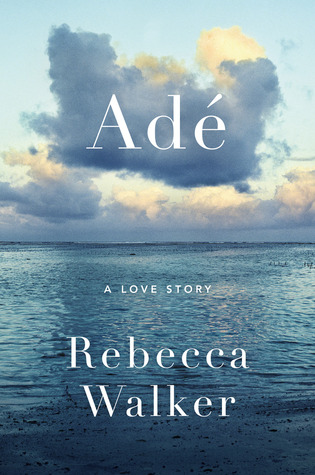
Adé: A Love Story by Rebecca Walker

Source: TLC Book Tours and New Harvest
Hardcover, 128 pages
I am an Amazon Affiliate

Adé: A Love Story by Rebecca Walker reads like a memoir, but it is fiction.  A young, American woman who has felt unmoored since her parents’ divorce, even at an Ivy League school until she falls into the web of Miriam, a free-spirited twenty-something whose eager to lose herself in the passions of others, particularly by having sex with men.  At the end of the school year, she and Miriam decide to see the “real” Africa and Middle East, traveling first to Egypt and slowly moving into more southern territories.  While Walker’s novella is considered a love story, it is far from overtly romantic, and it is more a search for identity, an identity that is strong and unwavering.  This nineteen-year-old, who later becomes known as Farida, is searching, always searching and consciously taking note of her place in the world.

“I was nineteen years old to Miriam’s twenty-one.  I felt raw and unfinished, where she seemed complete and self-assured.  I was a child of divorce and felt like I came from a thousand places — each one holding a little piece of me, and I drifted among them with no way to gather them up.  Miriam was from just one place, Miami, and more specifically, the moneyed enclave of Coconut Grove.” (page 4)

As they are touring Egypt, both young women are searching for something more authentic in their experience, rather than the tourist traps of Cairo and Giza, where Walker’s prose refers to tourists as flies around a plate of food.  Just from these early moments and descriptions, the reader can garner a sense that Farida is still searching for a home, a place where she not only feels worthy but safe and loved.  These tourist traps are not what she has come for her, with her “copper-colored” skin and “brown eyes the shape of almonds.”  As the narrative shifts away from Farida and Miriam’s experiences and becomes more focused on Farida’s alone, the reader gets a sense that something has shifted in the narrative — something more serious has come.

Even after she meets Adé, a Swahili Muslim from the Kenyan island of Lamu, Farida has succumbed to the feeling of belonging in these nations’ she’s visited, with their small villages and welcoming people.  Their romance is slow, and yet fast.  They begin with meetings at night after he works and walks throughout the town, then things heat up even faster after she reveals her passion for him.  Although this relationship blooms quickly and breaks her away from the past she’s known in America, her sensibilities have never strayed too far outside those democratic principles, and it is those principles that sets her apart in a world she’s come to think of as her own. Adé: A Love Story by Rebecca Walker is not a traditional story of love between a man and a woman, but of finding the love that can lift you up, complete you, and make you stronger even in the most adverse circumstances — and there are plenty of those here as the Persian Gulf War begins in the background.

About the Author:

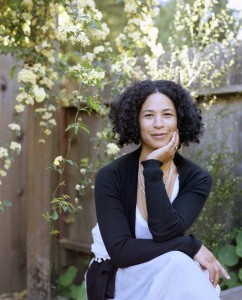
Rebecca Walker is the author of the best-selling memoirs Black, White and Jewish and Baby Love, and editor of the anthology Black Cool. She is also the editor of the anthologies To Be Real, What Makes a Man, and One Big Happy Family. Her writing has appeared in Bookforum,  Newsweek, Glamour, Marie Claire, The Washington Post, Vibe, and Interview, among many other publications, and she blogs regularly for The Root. For more information, please visit her Website and follow her on Twitter.


ENTER to win 1 copy of Rebecca Walker’s Adé: A Love Story by leaving a comment below by Nov. 18, 2013, at 11:59 p.m.

This is my 77th book for the 2013 New Authors Challenge.

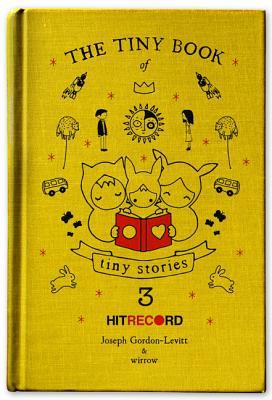
The Tiny Book of Tiny Stories: Vol. 3 by Joseph Gordon-Levitt

Source: It Books
Hardcover, 128 pages
I am an Amazon Affiliate

The Tiny Book of Tiny Stories: Vol. 3 by Joseph Gordon-Levitt is a collection of stories from 82 contributors out of the 35,905 contributions to the Tiny Stories collaboration on hitrecord.org — and the profits from the sale of the book will be split among the 82 contributors, which include writers and artists, and the Website.  Some of these stories are so small, they consist of just one sentence, while others are several sentences.  All of them are accompanied by an image, which is an interpretation of the words on the page or vice versa.  Some images and stories together will make readers laugh, but most of these stories are guaranteed to generate at least a smile.  Here are a few of my favorites:

10654259013_324cbc72a9_n10654026895_2caf4cc8a3

There are very few images with color, but those that do have color, do so for a purpose relevant to the story they portray.  The book is clearly a winner, especially for those that have very little time to read or even look at art — this book combines both, and there are some talented artists in these pages with varied imaginations.  The Tiny Book of Tiny Stories: Vol. 3 by Joseph Gordon-Levitt is a great diversion when there is little time between appointments or tasks.

About the Author:

HitRECord founder and director Joseph Gordon-Levitt’s acting career has managed to garner a massive popular appeal while maintaining a widely respected artistic integrity. He recently starred in Christopher Nolan’s Academy Award-nominated Inception and received Golden Globe, Independent Spirit and People’s Choice award nominations for his performance in (500) Days of Summer. Currently earning rave reviews for his performance in 50/50, also starring Seth Rogen, his upcoming films include David Koepp actioner Premium Rush and Rian Johnson’s sci-fi thriller Looper, with Bruce Willis.

Winners

I’ve been remiss in congratulating some winners, here’s the latest batch:


Lisa Gardner Beach Back Winner was Carolyn, who said, “I like to read suspense novels and thrillers.”


The winner of Lauren Yanofsky Hates the Holocaust by Leanne Lieberman was Anita Yancey, who said, “It sounds like a great story, and I’m glad there is some humor in it. I would love to read the book and find out what decision Lauren makes.”


And to the winner of Beth Kephart’s Handling the Truth, Ellie!  She said, “Goodness, this is fascinating. I would write about my family so that further generations could benefit from the knowledge.”

Interview with Beth Kephart, author of Handling the Truth, & Giveaway

It has been several weeks since I posted my review of Beth Kephart’s August release, Handling the Truth: On the Writing of Memoir, but that doesn’t mean I haven’t been thinking about those wise words.  My review of the book heaped on the praise, and I think that I’ve merely joined a widening group of reviewers who are in love with this writing reference/memoir — from other bloggers like Florinda and Patty to her former student, Stephanie Trott, the New York Journal of Books, and Booklist.  And let’s not forget the elite list the book landed on in O Magazine, alongside another of my favorites, Stephen King.

Kephart is on the touring circuit for her book and she’s made a splash with the launch event at the Free Library of Philadelphia to a discussion on WHYY; both of which you can listen to via podcast.

In addition to all of this talk about her book and her extremely busy schedule, she took a few minutes between the end of her corporate work and her dinner to answer some interview questions about her book and about writing memoir. I’m forever grateful.  Please give her a warm welcome:

Do you recommend changing friend/family names in memoir? By the same token, should an author consider a pen name when writing memoir? Why or why not?

Although I try never to say never, I advocate against changing names. It is a slippery slope. A name changes, a detail changes, a scene changes, a year changes, and then…we have fiction. Yes, I recognize the importance of protecting others. But if the story is so dicey that people will be upset if their real names are used, should you be telling the story? For truly, at the end of the day—name changed or not changed—the person who is being written about is going to recognize herself/himself. And so, most likely, will the neighbor.

In the book, you talk about asking your students to take photos and then write about something in the background, rather than the foreground. Should students apply this to their own memoir writing by not writing about the first most obvious memory or issue they think of and seek the memories or ideas just at the periphery?

A great question. I believe that we often write our very best when we don’t take the straight on path toward a story. Approach the memoir from multiple angles. Value the oblique. Dwell in the unexpected tangent. See what happens.

As a follow-up to that question, how would you advise a student who also dabbles in photography, but prefers to fill the frame with their chosen subject (i.e. a niece’s face, a tree, et. al.) so that nothing, if just a bit of sky is visible in the background?

Well, there you go. Another great question. But, Serena, even with a macro lens there is something just beyond the image’s true focus. There is something unintentional, in other words. What is it? Why is it there?

When you began your writing of memoirs, what types of fears did you suppress in order to send out that first manuscript? Did you think it was polished enough and how did you know? Was it a different type of fear because it was memoir and more personal, rather than separateness that fiction affords sometimes or do you find that the anxieties are similar?

I was a completely naïve first-time writer, with no connections, no expectations, no real sense of the writing life. Remember, this was the pre-blogging era. This was me—a full-time mother and freelance business writer with no writing friends, no book groups, no teacher until I went to Spoleto on a family vacation and met Rosellen Brown and Reginald Gibbons. I did not know what I was in for, and so I meandered toward dangers I did not even foresee. I believed I’d written a story that only a handful of friends might read. When Television came knocking, Radio, Prizes, Off Broadway (I capitalize, for I grew to fear these things), I was both unprepared and anxious (and to most things I also said no). I’ve written history, poetry, fable, and young adult literature since. There are anxieties bound up in every genre.

What vulnerabilities do you see showcased in memoir that are not observed in poetry or fiction?

The best memoirs are born of absolute vulnerability. It is the writer saying not, This happened to me, but, This happened to me and I need to know what it means. The search for meaning is the human being at her most vulnerable. We search for meaning in fiction and poetry, too. All good writing comes from this raw place.

What poets/poems or fiction have taught you techniques or styles that would work well in memoir? Please feel free to share any examples.

I could go on and on in answer to this question. But, simply: Gerald Stern, the poet, teaches what the conversational sounds like, even within the space of a monologuing poem. Michael Ondaatje and Alice McDermott teach the power of honesty, no matter the form. I never think about technique. I think about impact.

Finally, what would you have done for a career had you not taught and written books?

Well, I smile, for I guess I am living that career. I’ve had my own business since I was twenty-five, writing annual reports, histories, books, and employee magazines/newsletters for companies and not-for-profits. It consumes upwards of eighty hours each week. Writing and teaching are what I do on the side.

What are your thoughts on memoirs — the writing and reading of them?

If you want to learn more, there’s also this great interview Kephart does with herself. And this interview with Priscilla Gilman and another chance to win the book.

For one lucky reader interested in writing memoir or otherwise, please comment about what your memoir would be and why.

You’ll be entered to win a copy of Beth Kephart’s Handling the Truth.

This giveaway is international. Deadline to enter is Aug. 30, 2013 at 11:59 PM EST.

Guest Post & Giveaway: Leanne Lieberman Talks About Author Fan Letters, Books

Lauren Yanofsky Hates the Holocaust by Leanne Lieberman is about a young woman who is caught up in typical teenage drama, but it’s more than that and told with humor.  According to Amazon’s description, “Lauren Yanofsky doesn’t want to be Jewish anymore. Her father, a noted Holocaust historian, keeps giving her Holocaust memoirs to read, and her mother doesn’t understand why Lauren hates the idea of Jewish youth camps and family vacations to Holocaust memorials. But when Lauren sees some of her friends—including Jesse, a cute boy she likes—playing Nazi war games, she is faced with a terrible choice: betray her friends or betray her heritage.”

Today, I’ve got a giveaway and guest post to share with you from the author, Leanne Lieberman.  Please give her a warm welcome.

When I finish a book I love I often think, I must write a letter to compliment the author. However, by the time I sit down to write the letter, I’ve forgotten what I want to say, or I wonder if the author actually cares what I think. Most of the time, I’m just too busy.

To date, I have only written one fan letter. When I was eight I wrote to Sydney Taylor, the author of the “All-of-A-Kind-Family” series. The books were the first chapter books I read on my own. I was delighted with the tales of a Jewish family of five girls growing up on the lower east side of Manhattan at the turn of the last century. The stories describe the girls going to the library, shopping at the market for the Sabbath, saving their penny allowance for a birthday present for their Papa, and helping their Mama clean the front room. At the end of the five books the girls’ Mama is pregnant with another child. I couldn’t believe the author would leave readers in such suspense and not write another book. When my mother suggested I write Sydney Taylor a letter, I was fascinated by the idea that authors were real people you could write to. I remember leaving the dinner table and rushing to my room to find pen and paper. I needed to know if the baby would be a girl or a boy. Was Taylor going to write another book?

I received a letter back a few months later from Ralph Taylor, Sydney Taylor’s husband. He explained that Sydney had passed away, but that the baby was in fact a boy as Taylor’s All-of-A Kind-Series was based on Sydney’s own family. I treasured that letter. I remember showing it to my teacher and the school librarian and gluing it into my Little Twin Stars diary. I even wrote Ralph Taylor a second letter with a picture of my family tree, assuming he would be as interested in my family as I was in his wife’s.

I didn’t think about Sydney Taylor or the All-of-Kind-Family Books for many years until I published my first novel, Gravity about an orthodox Jewish girl who falls in love with another girl in 2008. The novel was reviewed positively by the American Jewish library, and named a Sydney Taylor Notable Book for Teens. Of all the reviews of my books, having my name linked with Sydney Taylor’s gave me the most pleasure. It allowed me to imagine people reading my books the way I had read Taylor’s works: absorbed in her world. It made me feel like an author, the way I had first dreamed of becoming a writer when I read Taylor’s books as a child.

Since publishing Gravity I have pulled my old copies of All-of-A-Kind- Family out of the dusty box at my parents’ house and started reading them to my two sons. Like me, they are delighted to read about children celebrating Passover and other Jewish holidays the way they do. They are also fascinated by the descriptions of Manhattan Jewish life from a long time ago. At the same time I started reading Taylor’s books to my kids I received an email with the subject: “Are you the same Leanne Lieberman?” The same as whom, I wondered. The email was from June Cummins, a professor of children’s literature at the State University of San Diego. Cummins wrote that she had read Gravity and liked it. She also explained that she was writing a biography of Sydney Taylor and had been going through Taylor’s fan letters. She had found a letter from someone named Leanne Lieberman written in 1983. Was I that same Leanne?

Goose bumps ran down my forearms. I had written to Sydney Taylor when I was eight, which was 1983, and as far as I knew, I was the only Leanne Lieberman. Through subsequent emails with Cummins I learned that Taylor, the middle child of five girls, wrote the All-Of-A-Kind-Family stories for her daughter Jo who was an only child. Cummins was staying with Jo at the time, and offered her regards. Cummins had also met Jerry, Jo’s uncle, who was the unborn child at the end of the series that I had originally wanted to know about. Knowing that the All-of-A-Kind Family was based on real people, people who were still alive, made me feel an even greater kinship to the stories. Even though Sydney Taylor had never received my letter, I was part of her story as she was part of mine.

Eventually Cummins offered to send me a copy of my original letter. My writing in 1983 was more legible that it is now, although my spelling has improved. “Dear Sydney,” I wrote, “I have an important question for you.” I have none of the trepidation that the author will be too busy or think my questions unimportant. I cherish the memory of what I was like at eight: curious, obsessed with stories, full of my own childish self-importance, and my overwhelming secret desire to write my own stories. Despite the eighty plus years between Taylor’s books and my own life, I saw myself reflected in Taylor’s stories. Her characters lose their library books, get their ears pierced, celebrate Shabbat, and dream of being on the stage, all things I experienced. My own books also deal with the Jewish experience, but because I write for teens, they explore more difficult questions: how to be gay and Jewish, what to think about the Israeli occupation of Palestine, and in my recently released book, Lauren Yanofsky Hates The Holocaust, how to deal with anti-Semitism and the legacy of the Holocaust. I like to imagine that somewhere there is a young girl reading my books, feeling them resonate in her life, and dreaming of the books she will write too.

Do you write fan letters to authors?

author photoAbout the Author:

Leanne Lieberman is the author of three YA books: Gravity (a Sydney Taylor Notable Book), The Book of Trees and Lauren Yanofsky Hates The Holocaust. She also writes adult fiction and is working on a collection of linked short stories entitled, Open Your Heart. Leanne is a graduate of The University of Windsor’s MA in in Creative Writing. Originally from Vancouver BC, Leanne now lives in Kingston ON with her husband and two sons.

To enter to win a copy, you must be 18 and older and living in the U.S. or Canada. Please leave a comment below with an email. Deadline to enter is 11:59 pm EST Aug. 8, 2013.

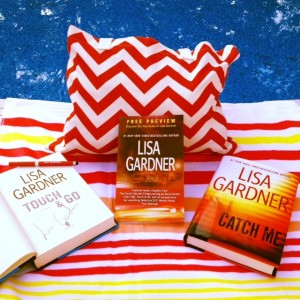
Giveaway: Lisa Gardner Beach Bag

LisaGardnerbeachbag
Lisa Gardner is one of my mother’s favorite authors, and in this great giveaway, one lucky reader, age 18 and over living in the United States, could win the following:

  • A Briscoe Designs Beach Bag
  • Beach Towel
  • Signed copies of Catch Me and Touch & Go
  • Lisa Gardner Pen
  • Summer Reading Sampler with previews of Maggie’s Man, MacNamara’s Woman, Brandon’s Bride and Fear Nothing

Charlene Grant believes she is going to die. For the past few years, her childhood friends have been murdered one by one. Same day. Same time. Now she’s the last of her friends alive, and she’s counting down the final four days of her life until January 21. Charlene doesn’t plan on going down without a fight. She has taken up boxing, shooting, and running. She also wants Boston’s top homicide detective, D. D. Warren, to handle the investigation. But as D.D. delves deeper into the case, she starts to question the woman’s story. Instinct tells her that Charlene may not be in any danger at all. If that’s true, the woman must have a secret—one so terrifying that it alone could be the greatest threat of all.

This is my family: Vanished without a trace…

Justin and Libby Denbe have the kind of life that looks good in the pages of a glossy magazine. A beautiful fifteen-year old daughter, Ashlyn. A gorgeous brownstone on a tree-lined street in Boston’s elite Back Bay neighborhood. A great marriage, admired by friends and family. A perfect life. This is what I know: Pain has a flavor… When investigator Tessa Leoni arrives at the crime scene in the Denbes’ home, she finds scuff marks on the floor and Taser confetti in the foyer. The family appears to have been abducted, with only a pile of their most personal possessions remaining behind. No witnesses, no ransom demands, no motive. Just an entire family, vanished without a trace. This is what I fear: The worst is yet to come…

About the Author:

LISA GARDNER is the #1 New York Times bestselling author of fifteen previous novels, including her most recent, Touch & Go. Her Detective D. D. Warren novels include Catch Me, Love You More, and The Neighbor, which won the International Thriller of the Year Award. She lives with her family in New England.

To enter, leave a comment below with what you like to read at the beach. Deadline to enter is July 27, 2013, at 11:59 p.m.

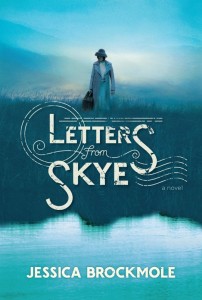
Letters From Skye by Jessica Brockmole

Source: TLC Book Tours and Random House
Hardcover, 304 pages
I am an Amazon Affiliate

Letters from Skye by Jessica Brockmole, an epistolary novel that straddles two World Wars, is about falling in love, finding your soul mate, and poetry.  Elspeth Dunn, a Scottish poet on the Isle of Skye, lives a rather cloistered life on her island but one of her books makes its way across the Atlantic to a young man in Illinois, David Graham, who writes her a fan letter.  Over the course of several years beginning when WWI breaks out in Europe, Elspeth and David begin a correspondence that takes on a life of its own.

“It’s the war talking.  I know; I’ve seen it.  They head off, invincible, feeling as if the future is a golden pool before them, ready to dive into.  And then something happens — a bomb, a sprained wrist, a bullet that whizzes by too close for comfort — and suddenly they are grabbing for whatever they can hold on to.  That golden pool, it swirls around them, and they worry they might drown if they’re not careful.  They hold tight and make whatever promise comes to mind.  You can’t believe anything said in wartime.  Emotions are as fleeting as a quiet night.”  (page 33 ARC)

While David is in America struggling through college and hoping to subvert his father’s plans for medical school, Elspeth is busy writing poetry and becoming even more entrenched in the lines her muse is offering.  Her relationship with her brother Finlay is the closest she has, but war does change things.  The more her muse speaks, the more she’s pulled away from the life she’s always known and the more she is challenged to face her fears — including her fear of water.

Through Elspeth and David’s correspondence the wider impact of war is experienced, complete with the tension of the home front as wives and families wait for their loved ones.  But at the same time, the lives of women are broadening as they are able to enter into jobs once thought of as men’s work.  The feminist leanings of Elspeth are clearly front and center in some of her correspondence with David, but it never deters him in his pursuit of her.  The moral high ground has no place in this romantic jaunt across Scotland, London, and France as a young woman and man succumb to their emotional connection on the page.

Letters from Skye by Jessica Brockmole weaves Elspeth and David’s story with that of Margaret, Elspeth’s daughter, and her search for the past.  Margaret has never met her father, and her mother remains close-lipped about her past and her daughter’s father.  But when WWII begins to break out, all of the old transgressions and emotional upheaval of Elspeth’s past resurfaces, threatening to leave her unmoored once again.  But Margaret’s life is far from pristine when it comes to the tentacles of war as her fiance flies for the RAF.  Brockmole’s letters are frank, honest, and engaging as these relationships unfold and enfold, creating a family history that will be hard to forget.  And yes, there is a poem included!

About the Author:

Jessica Brockmole spent several years living in Scotland, where she knew too well the challenges in maintaining relationships from a distance. She plotted her first novel on a long drive from the Isle of Skye to Edinburgh. She now lives in Indiana with her husband and two children.

To learn more about Jessica and her work, visit her Website.

To WIN a copy of this book, leave a comment by July 19, 2013, at 11:59 PM EST; You must be a U.S. resident 18 years and older.

This is my 44th book for the 2013 New Authors Challenge.