Quantcast

Nexxt Leena Angled Bookshelf Review

CSN Stores has a wide variety of bookshelves and other products, and I have purchased shelves with them before and loved them.  Recently, I was offered a bookshelf for review.  My husband selected the Nexxt Leena Angled Bookshelf.  When the first box arrived, the vertical pieces were cracked during shipment, so I had to request a replacement box.

The second box came, and my husband was thrilled he could finally put this shelf together.  The directions were very sparse with very little explanation of which pieces went where on the vertical pieces or which way it should be assembled.  Unfortunately, while putting this shelving unit together following these directions, the vertical pieces couldn’t handle the pressure and cracked once again.

Upon calling CSN’s customer service in the evening about this unit, I was told to call when the warehouse was open to have them check to make sure the directions were written correctly?!  I’m not sure how that would have helped or how they would have determined that the directions were wrong.  The next day, they offered to send me yet another box.
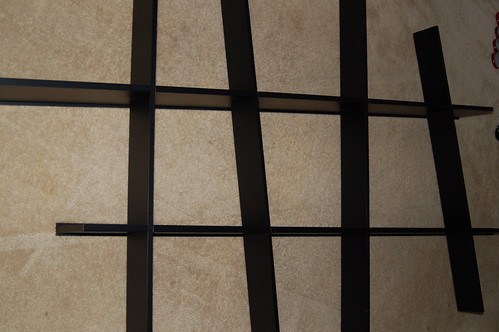
It came later than the 2 days promised, but I took the afternoon to assemble it myself.  I measured each shelf and measured each section bisected by the vertical pieces to make sure the horizontal shelves were in the correct locations after taking the time to deduce that the crazy scribbled numbers in the directions of the fully assembled piece were those measurements.  I put the shelf together and waited for my husband to bring home his electric drill.
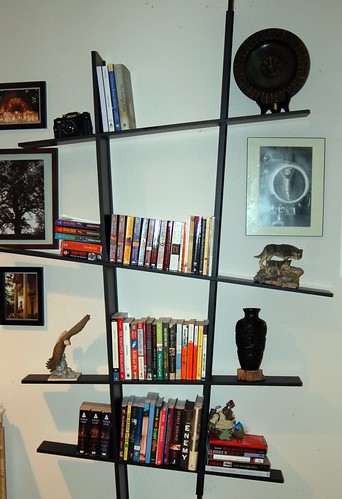
After much frustration and angst over this shelf, we finally got it together and struggled to put it up on the wall.  We noticed that the placement for the wall anchors on the direction sheet were incorrect, and we had to shift around the anchors a few times to get the shelf to sit right on the wall.  I got to put some great books on the shelves.

These shelves are very full now, and it does look nice, but I doubt we’d buy this shelf again after all that trouble.
Ratings Poll Results

Looks like my readers are as on the fence as I am about whether I should include ratings in my reviews or not.

The votes were tied 13 in favor and 13 against.

So for now, I think I’ll stick with the end of year ratings breakdown.  Thanks for all of your input.

What do you think ratings do for reviews?  Do you use them and why?

55th Virtual Poetry Circle

Welcome to the 55th Virtual Circle!

Remember, this is just for fun and is not meant to be stressful.

Keep in mind what Molly Peacock’s books suggested. Look at a line, a stanza, sentences, and images; describe what you like or don’t like; and offer an opinion. If you missed my review of her book, check it out here.

Let’s return to some classic poetry from John Dryden:

Why Should a Foolish Marriage Vow

Why should a foolish marriage vow,
  Which long ago was made,
Oblige us to each other now
  When passion is decay'd?
We loved, and we loved, as long as we could,
  Till our love was loved out in us both:
But our marriage is dead, when the pleasure is fled:
  'Twas pleasure first made it an oath.

If I have pleasures for a friend,
  And farther love in store,
What wrong has he whose joys did end,
  And who could give no more?
'Tis a madness that he should be jealous of me,
Or that I should bar him of another:
For all we can gain is to give our selves pain,
When neither can hinder the other.

Let me know your thoughts, ideas, feelings, impressions. Let’s have a great discussion…pick a line, pick an image, pick a sentence.

I’ve you missed the other Virtual Poetry Circles. It’s never too late to join the discussion.

A Hundred Feet Over Hell by Jim Hooper

Jim Hooper‘s A Hundred Feet Over Hell is a true account of the 220th Reconnaissance Airplane Company, with which his brother Bill served as one of the Myth Makers flying single-engine Cessnas that were extremely vulnerable to artillery and other ground fire.  These men were charged with flying over hot zones and locating the enemy for bombers, giving precise coordinates for dropping bombs and napalm.

“Rather than sharing our joy at his return, Bill was angry.  Not because of the crippling wound received in an unpopular war — he accepted that as part of what he had signed on for.  The anger came from being here.  In a demonstration of uncompromising loyalty over logic, it was, he believed, a betrayal of the warrior family he’d left behind.”  (Page xi)

Hooper has captured the essence of these men and their time in Vietnam from their crazy stunts to the moments when they feared for their lives.  Through alternating points of view the stories unfold quickly as one man feeds off and expands on the story being told by their friend and colleague.  Readers will meet characters like Doc Clement and Charlie Finch, but these men are not characters, but real human beings who lived through the harsh realities of war.

“Bill Hooper:  . . . I can’t remember more of that day, save weeping in the privacy of my room.  Perhaps the saddest thing of all was that I would learn to be unemotional about killing, eventually joining others who were very good at it.”  (Page 23)

Hooper pulls no punches in the organization of this book and doesn’t seem to modify the military language these men used on a regular basis; some examples include VC for Viet Cong and DMZ for demilitarized zone, which is clearly a misnomer, to the lesser known terms DASC for Direct Air Support Control Center and Kit Carson scout for those former Viet Cong recruited to assist with counterintelligence.  Readers of military history and fiction are likely to understand many of these acronyms and terms easily, but others may have to refer to the provided glossary.  However, once they get a grip on the terminology, readers will plunge into the narrative easily, getting to know each of the soldiers and how they coped with the war.

A Hundred Feet Over Hell by Jim Hooper will remind readers of those in-the-field journalistic interviews with soldiers and those documentaries where one soldier begins a story only to be continued by another soldier, providing a deeper impact.  Each man shares their fears, their triumphs, and their more embarrassing moments.  One of the best books about the Vietnam War, not about infantry.

Please check out this book trailer to see what these men flew over enemy territory without armor or weapons.

A Hundred Feet Over Hell

Please also check out these great photos.

About the Author:

After graduating with a degree in Slavic Studies from the University of South Florida, Jim Hooper worked as a documentary research-writer for WFLA-TV in Tampa, with weekends set aside as a skydiving instructor and team captain. He gave up television after three years to devote himself full time to jumping out of airplanes, logging over 3000 freefalls and building the world’s premier skydiving center in Zephyrhills, Florida. His thirst for adventure unfulfilled, he sold the business in 1984 to realize a long-held dream of being a war correspondent and author, making his home in England and setting off for Africa.

I want to thank Lisa Roe at Online Publicist and the author Jim Hooper for sending me a copy of A Hundred Feet Over Hell for review.

This is my 39th book for the 2010 New Authors Reading Challenge.

This is my 7th book for the 2010 Vietnam War Reading Challenge.

eBooks Mess With Poetic Intent

eBooks continue to receive a lot of press, particularly when James Patterson becomes the first to sell more than 1 million ebooks and Kindle ebooks have outsold hardcovers.  But are ebooks the best option for all genres and will they translate into sales for short stories and poetry.

One poet — Billy Collins — has taken issue with ebooks.  The recent translation of his book, Ballistics, into an ebook was a disaster.  In one poem, a word was pushed onto a new line, creating a four-line stanza rather than the three-line stanza of the original poem.  According to a recent Associated Press story, ebook distributors and publishers cannot guarantee that the integrity of poems will be maintained once in electronic form.  Large indentations and other styles will likely lose their integrity in ebook form, creating new poems that are different than the poet envisioned or than the originally published poem.  These changes do not only apply to new poems, but also for the poems of older, dead poets.  Think of what [raise the shade] by e.e. cummings would look like in an ebook.

Collins says, “The critical difference between prose and poetry is that prose is kind of like water and will become the shape of any vessel you pour it into to. Poetry is like a piece of sculpture and can easily break.”  He’s right, and there are many other poets who are wary of providing their books electronically, even though it would behoove them to do so if they hope to sell more books.

Poets by and large do not earn a lot from their work, but the integrity of each poem is highest in their thoughts and actions when they produce, read, and sell those poems to the public.  However, poetry is available electronically across the Internet from online literary journals to other resources.  The question is how long will it take ebook publishers to get the poems right, especially when other online poetry magazines are ensuring the integrity of poems.

Paco’s Story Readalong Week 3

This is week 3 of the Paco’s Story read-a-long, and the third set of discussion questions were posted on Wednesday, July 21 for Chapter 5.

If you missed the first round and second round of questions, check them out.  You also can check out my previous post for section 1 and section 2.

Paco’s Story takes a new turn with the narrator showing us how well Paco is acclimating to his new life in Boone.  He’s the dishwasher at the Texas Lunch, but his work is not all that keeps him moving.  His dreams are ripe with danger and disturbing dreams.  The narrator’s identity becomes clearer in this chapter, and the ghosts of Paco’s past are identified.

Paco seems to take to the work at the diner because it provides a routine with very clear parameters, much like those in the military.  But once asleep, Paco is at the mercy of his past and the ghosts that still haunt him.  While he hasn’t outwardly asked why he was the only one that survived the massacre, it is clear that he wonders, though in his dreams he actively keeps his head down to make sure a different outcome does not occur.

The complexity of Paco’s character shines in this chapter — his hold on the past and the tug of the here-and-now, his ease with fellow soldiers before the massacre, and his ability to become robotic and get tasks done.  However, he is still paralyzed, as paralyzed as he was in the jungles of Vietnam, unable to share the darkest moments of his life and of the war.  They are too fresh, too real.

Even if you aren’t participating in the Vietnam War Reading Challenge, we hope that you will join us for the Paco’s Story read-a-long.  Until next week.

Winners!

Out of 20 entrants, random.org selected #3

Colleen (Books in the City), who said:

“My Mom is from Ireland and I spent many childhood summers on the West Coast of Ireland in Co. Mayo – would definitely go back there and see family and friends – I never go back to Ireland without going to Mayo.  But I went to Kerry for the first time last summer and was captivated – I definitely want to go back there!”

Congrats and Happy Reading!

And since only 3 people entered the 50th Virtual Poetry Circle giveaway, they each get a book!  One of you will get a surprise thanks to random.org, since there were 4 books up for grabs.  Congrats to the following:

Anna from Diary of an Eccentric

J.T. Oldfield from Bibliofreak

Jill from Rhapsody in Books

Mailbox Monday #90

In case you haven’t been by The Printed Page lately, Marcia has decided to step down from hosting Mailbox Monday, but she’s created a fantastic blog tour for Mailbox Monday with new hosts each month through 2011.

I’ll be hosting the meme in 2011, and I’m excited.  I hope you’ll consider throwing your name in the hat and join the fun.

Marcia at The Printed Page and Kristi of The Story Siren both sponsor memes in which bloggers share what books they’ve received in the past week.  I’m going to continue calling these Mailbox Mondays, but The Story Siren also has In My Mailbox.  Just be warned that these posts can increase your TBR piles and wish lists.

Be prepared for your TBR to explode after reading these posts.

Here’s what I received:

1.  To Kill a Mockingbird by Harper Lee from Harper for review as part of the 50th anniversary.

2.  Murder at Mansfield Park by Lynn Shepherd from Shelf Awareness.

3.  The Reversal by Michael Connelly from Miriam at Hachette for review.

What did you receive in your mailbox?

Unincorporated Persons in the Late Honda Dynasty by Tony Hoagland
As part of the Graywolf Press — one of my favorite small presses that publishes poetry and fiction — Spotlight on Small Presses (click on the badge at the bottom of the post for the tour stops), I chose a poetry book to review, which I picked up at the 2010 Book Expo America.

Unincorporated Persons in the Late Honda Dynasty by Tony Hoagland is his first collection of poems in 10 years, according to the Graywolf representative at the expo.  The collection features poems that call into question the realities of the modern world from our dating rituals to our trips to the mall food court.

In “Big Grab,” Hoagland suggests language is taking on meanings that are less than they are.  “The Big Grab,/so the concept of Big is quietly modified/to mean More Or Less Large, or Only Slightly/Less Big than Before.// Confucius said this would happen –/that language would be hijacked and twisted/”  (page 5).  This collection not only tackles the language changes our society faces and what those changes mean, but it also looks carefully at the world of celebrity in “Poor Britney Spears.”

Expensive Hotel (page 24)

When the middle-class black family in the carpeted hall
passes the immigrant housekeeper from Belize, oh
that is an interesting moment.  One pair of eyes is lowered.

That’s how you know you are part
of a master race — where someone
humbles themselves without even having to be asked.

And in the moment trembling
from the stress of its creation,
we feel the illness underneath our skin —

the unquenchable wish to be thought well of
wilting and dying a little
while trying to squeeze by

the cart piled high with fresh towels and sheets,
small bars of soap and bottles
of bright green shampoo,

which are provided for guests to steal.

Hoagland’s crisp language and vivid imagery is deftly weaved with philosophical and societal questions we all should be answering or at least asking.  Has modern society twisted our culture into something worthwhile or is it something that should be tossed in the trash as a bad experiment.  However, there are moments of humor and deep sarcasm throughout the volume that offset one another to make readers ponder what the poet really desires from the modern world.  Readers will come away from the collection with a new focus on examining society and their part in it –whether they decide to continue assimilating is up to them.  Unincorporated Persons in the Late Honda Dynasty is a thought-provoking collection that urges readers to be unique and to think outside the box.

This is my 9th book for the Clover Bee & Reverie Poetry Challenge.

This is my 38th book for the 2010 New Authors Reading Challenge.

54th Virtual Poetry Circle

Welcome to the 54th Virtual Poetry Circle.

Remember, this is just for fun and is not meant to be stressful.

Keep in mind what Molly Peacock’s books suggested. Look at a line, a stanza, sentences, and images; describe what you like or don’t like; and offer an opinion. If you missed my review of her book, check it out here.

Today, we return to contemporary poets with Martha Collins from her latest book, Blue Front.

lynch

not as in pin, the kind that keeps the wheels
turning, and not the strip of land that marks
the border between two fields. unrelated
to link, as in chain, or by extension whatever
connects one part to another, and therefore
not a measure of chain, which in any
case is less than the span of a hand hold-
ing the reins, the rope, the hoe, or taking
something like justice into itself, as when
a captain turned judge and gave it his name.
that was before it lost its balance and crossed
the border, the massed body of undoers
claiming connection, relation, an intimate
right to the prized parts, to the body undone.

Let me know your thoughts, ideas, feelings, impressions. Let’s have a great discussion…pick a line, pick an image, pick a sentence.

I’ve you missed the other Virtual Poetry Circles. It’s never too late to join the discussion.

Also, don’t forget the 50th Virtual Poetry Circle giveaway for participants; it ends today!