Quantcast

Short Story Friday #3

Short Story Friday has been revamped for 2015, and I’ll be sharing snippets from my own fiction pieces, mostly short stories.  In addition to the new business, Poetic Book Tours, I’ll be writing and submitting more of my own fiction and poetry this year.

I hope you’ll offer your thoughts on this story that is currently in progress.

Here are the first and second parts posted in previous weeks.  Without further ado, I’d love to hear your thoughts on this girl and what you think is going on:

I’m Lythia, by the way, and this is my journal of Transcendence.  I’ve lived seventeen years with this blinking issue, but I’ve never let it stop me.  I’m what the others call a kiss-face because I get good grades in school, volunteer to help the third-raters in the suburbs, and generally make nice with the school’s interface.

There must be adults in charge of it somewhere, but no one has ever seen them — you know, face-to-face.

While I’m not wildly popular, very few students pull pranks on me.  My mother says this is a good thing, but I disagree.  I think it means I’m excluded.

Please feel free to share your thoughts on this snippet and let me know what you think.
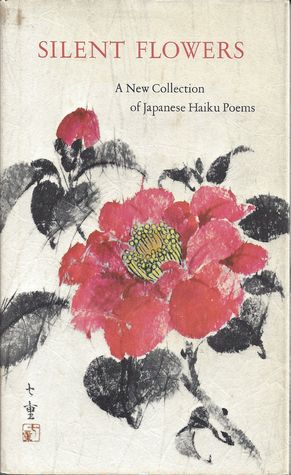
Silent Flowers edited by Dorothy Price, illustrated by Nanae Ito

Source: Library sale
Hardcover, about 40 pgs
I am an Amazon Affiliate

Silent Flowers: A New Collection of Japanese Haiku Poems edited by Dorothy Price, illustrated by Nanae Ito, is gorgeously illustrated and focuses on a lot of traditional haiku poets and their poems, which focus on the seasons, nature, and humans in nature.  There are about three haiku per page, English translations only from the likes of Basho, Buson, and Issa.

“Sacred music at night;
Into the bonfires
Flutter the tinted leaves.” — Issa

I was reminded reading the introduction to this book of Suey’s comment about defining poetry or what a proper definition would be.  Price mentions in the introduction that Wordsworth, another poet, defined poetry as “emotion recollected in tranquility.”  I’m not sure that helps much.  What I’ve loved about haiku is its ability to recognize something unexpected in nature and describe it in a way that illustrates something of the spiritual. I’ve written some horrible haiku but I still love the form and I think its one of the easiest to learn and teach, even if the poems are no where near as good as the old masters.

“The moon in the water;
Broken and broken again,
Still it is there.” — Choshu

A haiku by Basho about a butterfly is accompanied by a wonderful depiction of the butterfly among the orchids, and it is seamlessly incorporated with the poem on the page.   Silent Flowers: A New Collection of Japanese Haiku Poems edited by Dorothy Price, illustrated by Nanae Ito, won me over with not only its beautiful imagery in verse, but also its gorgeous, black and white illustrations.

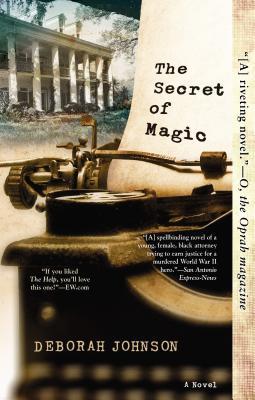
The Secret of Magic by Deborah Johnson

Source: Penguin Random House
Paperback, 416 pgs
I’m an Amazon Affiliate

The Secret of Magic by Deborah Johnson is a phenomenal look at the racial prejudices that continue to hold tight in Mississippi, Alabama, and elsewhere, even after then end of WWII when black soldiers fought bravely against the Nazis.  Joe Howard Wilson is returning home as a decorated hero after losing not only men in his unit, but one of his good friends, L.C.  He’s musing on his visit with his father, Willie Willie, who taught him so much and worked with their white employer, Judge Calhoun, to ensure he was educated enough to get out and make something of himself.

Gotcha!

Joe Howard Wilson jerked and his hands went straight to his face, and then to his body, for his gun.  Groping. Feeling. Saying his prayers.  Checking to make sure that he was awake and what had happened in that forest in Italy, all the killing was over.  Checking to make sure it wasn’t happening now.”  (page 1)

Joe is a young man still coping with the loss of friends, only to find that the prejudices he dealt with growing up are still present and an additional pressure he has little patience for after serving for his country overseas.  When Regina Robichard, a young attorney still waiting to hear if she passed the New York bar, is called down to investigate the death of a WWII veteran a year later, she finds that the south is not as black and white as she expects it to be.  She’s sent south with a mission from Thurgood Marshall of the NAACP to investigate the matter.  Regina, the daughter of a relatively famous black female activist, is idealistic and tentative in her approach to those she encounters, particularly M.P. Calhoun, who wrote her favorite book — The Secret of Magic.

“The air in the depot smelled just like everything Southern he remembered.  Even inside, no matter where you were, there was always a hint of the earth and the things that died on it.  You could not get away from the scent of things, from the richness of them, if you had lived, like he had lived, so near to the ground.”  (page 8)

Through a neatly woven narrative, Johnson creates a tapestry of the south that depicts not only the racial prejudices present in the south that are held onto tightly even after WWII, but also the deep connections between the whites and blacks within the small community of Revere, Mississippi.  Like all relationships, at first blush racial prejudice is hatred of the other, but looking deeper Johnson demonstrates that there is a love underneath the comments of “mine” and “our” used by whites in reference to blacks in the community.  Revere is a town that is in transition whether it likes it or not, and in many ways, the change is too quick for some and not quick enough for others — especially those like Peach Mottley who see Regina as the catalyst they need.

The Secret of Magic by Deborah Johnson is gorgeously told, and it is riveting from the first page.  Readers will develop an instant connection with not only Joe Howard Wilson and Regina Robichard, but with the other major and minor characters as they continue to navigate the social constructs that are the same and yet changing.  The fairy tales that peek around the realities of the South provide hope of a new world, but they also are endangered by those who wish to halt change in its tracks.

I haven’t been this blown away by a book in a long while, and this one is a must read and a definite contender for the Best of 2015 list.

About the Author:

Deborah Johnson was born below the Mason-Dixon Line, in Missouri, but grew up in Omaha, Nebraska.  After college, she lived in San Francisco and then for many years in Rome, Italy where she worked as a translator and editor of doctoral theses and at Vatican Radio.  Deborah Johnson is the author of The Air Between Us, which received the Mississippi Library Association Award for fiction.  She now lives in Columbus, Mississippi, and is working on her next novel.  Check out her Website.


The Princess Panda Tea Party by Jewel Kats, Illustrated by Richa Kinra

Source: Loving Healing Press
Paperback, 52 pages
I am an Amazon Affiliate

The Princess Panda Tea Party: A Cerebral Palsy Fairy Tale by Jewel Kats, Illustrated by Richa Kinra, is a fairy tale in which a stuffed panda comes to life to help young Michelle find the self-confidence within to achieve her goals and brush off the insults and meanness of the other girls in the orphanage.  The illustrations will remind older readers of the pictures that once accompanied our own fairy tales.  Rather than have the typical beauty and able-bodied young girl as the protagonist, Kats has a smart protagonist with cerebral palsy.  Josephine is the mean girl in this tale, and Princess Panda is the fairy godmother.

“Panda Bear Princess patted the beautiful horse.  The pink pads of her stuffed paw tapped at his sides twice.  Just like that, magical wings appeared.”  (page 20)

Michelle merely needs more self-confidence.  While she is different and has many physical challenges, she comes to realize that there is more to her than what is on the surface.  The toy she’s been longing for at the Salvation Army store, which she finally has the money to purchase, is ready to help in any way she can.  While the story text is a little long, my little reader who is only three was riveted by the magical story and the pictures as I read to her.  She loved how Michelle found the strength, with the help of Princess Panda, to practice and achieve her goals despite her physical limitations.  One of her favorite parts of the story was the beautiful Princess Panda and her magical powers — no surprise there.

The Princess Panda Tea Party: A Cerebral Palsy Fairy Tale by Jewel Kats, Illustrated by Richa Kinra, is a story about overcoming challenges, and while there is no explanation of what cerebral palsy is or how it occurs, the book can become a stepping stone for parents and kids to learn about the disease.  Parents should be prepared to answer questions about Michelle and her disease and to teach their own children that making fun of those who are different is not only mean but also makes them look bad in the eyes of others.

About the Author:

Once a teen runaway, Jewel Kats is now a two-time Mom’s Choice Award winner. For six years, Jewel penned a syndicated teen advice column for Scripps Howard News Service (USA) and The Halifax Chronicle Herald. She gained this position through The Young People’s Press. She’s won $20,000 in scholarships from Global Television Network, and women’s book publisher: Harlequin Enterprises. Jewel also interned in the TV studio of Entertainment Tonight Canada. Her books have been featured in Ability Magazine (USA) twice. She’s authored eight books-five are about disabilities. The Museum of disABILITY History celebrated her work with a two-day event. Jewel has appeared as an international magazine cover story four times! Recently, her work was featured in an in-depth article published in “The Toronto Star”. Jewel’s work has also appeared as an evening news segment on WKBW-TV and on the pages of “The Buffalo News”.

Mailbox Monday #306

Mailbox Monday, created by Marcia at To Be Continued, formerly The Printed Page, has a permanent home at its own blog.

To check out what everyone has received over the last week, visit the blog and check out the links.  Leave yours too.

Also, each week, Leslie, Vicki, and I will share the Books that Caught Our Eye from everyone’s weekly links.

Here’s what I received:

1.  Bullied Kids Speak Out by Jodee Blanco from Anna.

Have you ever felt alone, as if no one understands what you’re going through, and that no matter how hard you try, you’re scared things may never get better? Do you wish your classmates would give you a break? I felt that way often in school. I was bullied and excluded for the same reason maybe you or someone you know has been–simply for being different. There were days when all I wanted was to stay in my room. Back then, I would have given almost anything to meet the kids you’re going to meet here.

2. Vessel by Parneshia Jones, a surprise from Milkweed Editions.

The imagination of a girl, the retelling of family stories, and the unfolding of a rich and often painful history: Parneshia Jones’ debut collection explores the intersections of these elements of experience with refreshing candor and metaphorical purpose. A child of the South speaking in the rhythms of Chicago, Jones knits “a human quilt” with herself at the center. She relates everything from the awkward trip to Marshall Fields with her mother to buy her first bra to the late whiskey-infused nights of her father’s world. In the South, “lard sizzles a sermon from the stove”; in Chicago, we feast on an “opera of peppers and pimento.” Jones intertwines the stories of her own family with those of historical Black figures, including Marvin Gaye and Josephine Baker. Affectionate, dynamic, and uncommonly observant, these poems mine the richness of history to create a map of identity and influence.

What did you receive?

289th Virtual Poetry Circle

Welcome to the 289th Virtual Poetry Circle!

Remember, this is just for fun and is not meant to be stressful.

Keep in mind what Molly Peacock’s book suggested.

Look at a line, a stanza, sentences, and images; describe what you like or don’t like; and offer an opinion. If you missed my review of her book, check it out here.

Today’s poem is from Donald Hall, recited by Russell Heitmann:

Poem With One Fact

“At pet stores in Detroit, you can buy
frozen rats
for seventy-five cents apiece, to feed
your pet boa constrictor”
back home in Grosse Pointe,
or in Grosse Pointe Park,

while the free nation of rats
in Detroit emerges
from alleys behind pet shops, from cellars
and junked cars, and gathers
to flow at twilight
like a river the color of pavement,

and crawls over bedrooms and groceries
and through broken
school windows to eat the crayon
from drawings of rats—
and no one in Detroit understands
how rats are delicious in Dearborn.

If only we could communicate, if only
the boa constrictors of Southfield
would slither down I-94,
turn north on the Lodge Expressway,
and head for Eighth Street, to eat
out for a change. Instead, tomorrow,

a man from Birmingham enters
a pet shop in Detroit
to buy a frozen German shepherd
for six dollars and fifty cents
to feed his pet cheetah,
guarding the compound at home.

Oh, they arrive all day, in their
locked cars, buying
schoolyards, bridges, buses,
churches, and Ethnic Festivals;
they buy a frozen Texaco station
for eighty-four dollars and fifty cents

to feed to an imported London taxi
in Huntington Woods;
they buy Tiger Stadium,
frozen, to feed to the Little League
in Grosse Ile. They bring everything
home, frozen solid

as pig iron, to the six-car garages
of Harper Woods, Grosse Pointe Woods,
Farmington, Grosse Pointe
Farms, Troy, and Grosse Arbor—
and they ingest
everything, and fall asleep, and lie

coiled in the sun, while the city
thaws in the stomach and slides
to the small intestine, where enzymes
break down molecules of protein
to amino acids, which enter
the cold bloodstream.

What do you think?

Short Story Friday #2

Short Story Friday has been revamped for 2015, and I’ll be sharing snippets from my own fiction pieces, mostly short stories.  In addition to the new business, Poetic Book Tours, I’ll be writing and submitting more of my own fiction and poetry this year.

I hope you’ll offer your thoughts on this story that is currently in progress.

If you missed the first part posted last week, check it out here.

Finn would be the one I’d flirt with, but even though he’s new here, he already knows about my condition.  That’s the high school grapevine for you.  No way he’ll let me rely on it as flirting now.  Besides, the blinking is too rapid.

He’s still sweet.  He holds open doors for all the girls, even me.  It reminds me of those books on my mother’s bookshelves.  Men held doors for ladies and helped them into their seats at dinner, an idea as antiquated as my mother’s bookshelves.

All of my materials in school are digital and holograms teach us our lessons, making even human teachers obsolete.  I guess it helped reduce student-teacher violence to zero.  That’s something.

Please feel free to share your thoughts on this snippet and let me know what you think.
War’s Trophies by Henry Morant

Source: Author Henry Morant
Paperback, 246 pgs
I am an Amazon Affiliate

War’s Trophies by Henry Morant is a tumble in the jungles of Vietnam, Seattle, and in the minds of Vietnam War veterans dealing with latent post-traumatic stress.  Lieutenant Jeremy Hall is a new man on Captain Stephan Wozniak’s unit in Vietnam, and the captain is none too pleased about it.  As part of an intelligence unit, Hall realizes that these missions are not always sanctioned and that what happens on these missions are kept hush-hush for more than one reason.  Through a series of chapters that alternate from 1986 and 1966, Morant takes readers on a journey into the fog of war; he fleshes out the corruption, killing, and the only brand of justice that can be found on the battlefield and parallels it to the cutthroat business of the newsroom.

“Today’s talent lacks sophistication.  There was class to this one.  Kids and punks today think a drive-by with an ejaculation from their Uzi or a sawed-off is a big deal.  They don’t take the time to learn how to do someone by hand.  Even the mob has had to import pizza men from Sicily to get any style.  Someone with a sense of craftsmanship, pride in their work.  Besides, there isn’t anyone around here smart enough I’ve run into who could break into the federal courthouse the way this phantom did and do a kill.”  (page 18)

Although both of these men have left Vietnam’s jungles far behind, what happened in the heat of battle has stuck with them over the last 2o years and refused to let go.  These men must prepare to do battle once again in the concrete jungle, and just like Vietnam, there are many casualties — some of them innocent.  Morant’s characters are complex in their emotions and while Hall and Wozniak are similar in build they are foils for one another, which makes their imminent squaring off all the more dramatic.

War’s Trophies by Henry Morant is a wild ride into the darker side of war and its effects on the soldiers who fight them — do they succumb to corruption and greed at all costs or do they cow to the pressure of the mission and commit unnecessary murder.  How strong can a soldier remain under the constant barrage of bullets, bombs, and fear?  Morant has written a thriller that will keep readers turning the pages.

About the Author:

Henry Morant has been a soldier, sailor and mountain climber and still seeks adventure in the Salish Sea and along the waters of the east coast of the United States. He often can be found at the Schooner’s Wharf bar in Key West, on a sailboat or in a kayak or rower. His first book is War’s Trophies, a thriller based on murder and robbery during an intelligence mission during the Vietnam war and two former army officers’ cat-and-mouse battle for deadly revenge that begins in Vietnam and resolves 20 years later in Seattle.


After the War Is Over by Jennifer Robson

Source: HarperCollins
Paperback,
I am an Amazon Affiliate

After the War Is Over by Jennifer Robson follows closely on the heels of Somewhere in France (which I read in 2014) and takes a wide look at how the world look after WWI.  Charlotte Brown, friend to Lilly Neville-Ashford in the first book, sees first hand the results of war at home, as veterans are denied pensions and their families are forced to scrape by on what little work is still available for women.  Through alternating chapters between the time after WWI and when she first found work after completing university with the Neville-Ashford family and befriended not only Lilly, her student, but also her brother, Edward, readers are taken through England as it prospered and as it sustained heavy losses because of the war.  The losses are not just physical, but emotional and psychological for the men returning from war, as well as their families.  There are monetary losses and there are losses of freedom — in the sense that women lose their jobs to returning men and men lose many of their physical abilities during the war and must adapt to a new reality.

“Women always put themselves last.  Either it was the mothers she visited in the slums of Scottie Road who only ate after their husbands and children had had their fill, or it was the women from Huskisson Street who, after cleaning and cooking for days, were left with the rag end of the delicacies, with scarcely a slice of cake to share between them.” (page 145)

Even though this is considered a follow up to the first book, Robson offers enough background about the first book that this could be read as a standalone without any problems.  The main focus here is the aftermath of war, the changes for both men and women in a new world, and Charlotte’s ability to cope with her new reality and still strive to improve the world around her, even in small ways.  Readers who enjoy social change and movements will be swept up in the struggles of these families, just as Charlotte is.  Charity is looked on as a handout by many, but Charlotte’s push to have society lend a helping hand to each neighbor on their own is just what this society needs.  Rather than compete or judge others in the neighborhood, she insists on compassion.

Robson’s characters are dynamic, and Charlotte is strong willed and motivated in her efforts.  When she meets a personal challenge she does take a step back, but she soon realizes that the best medicine is to tackle it head on.  When Lilly and Robbie re-enter the picture, so does Edward, and this stirs up feelings in Charlotte that she hadn’t addressed and is still unwilling to admit to even herself.  There’s even a great Jane Austenesque moment in this one that Robson mimics so well.

After the War Is Over by Jennifer Robson is a sweeping novel about life after the war because the immediate casualties of war are not the only tolls countries, communities, and families will be expected to take.  Charlotte is a forthright, strong woman in a changing world, but she’s well aware that change cannot happen on its own or at the hands of one woman.  She needs help, as we all do, and to generate change is to work together.

About the Author:

Jennifer Robson first learned about the Great War from her father, acclaimed historian Stuart Robson, and later served as an official guide at the Canadian National War Memorial at Vimy Ridge, France. A former copy editor, she holds a doctorate in British economic and social history from the University of Oxford. She lives in Toronto, Canada, with her husband and young children.  Connect with the author on Facebook.

Enzo Races in the Rain! by Garth Stein, Illustrated by R.W. Alley

Source: Purchased
Hardcover, 40 pgs
I am an Amazon Affiliate

Enzo Races in the Rain! by Garth Stein introduces children to a younger Enzo of The Art of Racing in the Rain fame.  R.W. Alley’s illustrations will make young readers easily identify with Enzo, with his open face and enthusiasm for the outdoors, running, and exploring.  Reading this book aloud to a young girl and an aging grandmother, it was good to see them both smile, and whether they were both smiling at Enzo or one another, it did not matter because in that moment, they were sharing the joy of Stein’s writing.

Living on a farm, Enzo is surrounded by animals and people, and the cars that whiz by on the road. What’s frustrating for this pup is that he not only doesn’t have a name, but that he also is not understood by humans.  It is not until he meets a young girl, Zoe, and finds his place with her family that Enzo begins to learn what it means to be home.

Enzo is a curious and fun pup, who is bound to get into a little bit of trouble, even when he finally has a family and a home.  Enzo Races in the Rain! by Garth Stein, illustrated by R.W. Alley, well illustrated and told, packing a twofold punch for young readers, showing them what it means to have a family who will always love and miss you and a home that you can always return to as long as you remember the way.

About the Author:

Garth Stein is the author of four novels: the New York Times bestselling gothic/historical/coming-of-age/ghost story, “A Sudden Light“; the internationally bestselling “The Art of Racing in the Rain“; the PNBA Book Award winner, “How Evan Broke His Head and Other Secrets“; and the magically realistic “Raven Stole the Moon.” He is also the author of the stage play “Brother Jones.” He has a dog, he’s raced a few cars, climbed a bunch of really tall trees, made a few documentary films, and he lives in Seattle with his family. He’s co-founder of Seattle7Writers.org, a non-profit collective of 74 Northwest authors working together to energize the reading and writing public.

About the Illustrator:

R.W. Alley has illustrated more than one hundred children’s books, including the popular Paddington Bear books by Michael Bond.

In 2010, he received a Theodor Seuss Geisel Honor Award for Pearl and Wagner One Funny Day by Kate McMullan. In 2008, There’s a Wolf at the Door by Zoë B. Alley was selected as a Washington Post Best Book of the Year.