Quantcast

Mailbox Monday #368

Mailbox Monday, created by Marcia at To Be Continued, formerly The Printed Page, has a permanent home at its own blog.

To check out what everyone has received over the last week, visit the blog and check out the links.  Leave yours too.

Also, each week, Leslie, Vicki, and I will share the Books that Caught Our Eye from everyone’s weekly links.

Here’s what I received:

Online Marketing for Busy Authors: A Step-by-Step Guide by Fauzia Burke for review from FSB Associates.

If You Want People to Read Your Book, Writing It Is Only the Beginning

There has truly never been a better time to be an author. For the first time, authors have direct access to the public via the Internet and can create a community eagerly awaiting their book. But where do new authors start? How do they sort through the dizzying range of online options? Where should they spend their time online and what should they be doing?
Enter Fauzia Burke, a digital book marketing pioneer and friend of overwhelmed writers everywhere. She takes authors step-by-step through the process of identifying their unique personal brand, defining their audience, clarifying their aspirations and goals, and setting priorities. She offers advice on designing a successful website, building a mailing list of superfans, blogging, creating an engagement strategy for social media, and more. By following Burke’s expert advice, authors can conquer the Internet and still get their next manuscript in on time.

What did you receive?
350th Virtual Poetry Circle

Welcome to the 350th Virtual Poetry Circle!

Remember, this is just for fun and is not meant to be stressful.

Keep in mind what Molly Peacock’s book suggested.

Look at a line, a stanza, sentences, and images; describe what you like or don’t like; and offer an opinion. If you missed my review of her book, check it out here.

Today’s poem is from Sara Teasdale, read by Ghizela Rowe:

Spring in War-Time

I feel the spring far off, far off,
    The faint, far scent of bud and leaf—
Oh, how can spring take heart to come
    To a world in grief,
    Deep grief?
 
The sun turns north, the days grow long,
    Later the evening star grows bright—
How can the daylight linger on
    For men to fight,
    Still fight?
 
The grass is waking in the ground,
    Soon it will rise and blow in waves—
How can it have the heart to sway
    Over the graves,
    New graves?
 
Under the boughs where lovers walked
    The apple-blooms will shed their breath—
But what of all the lovers now
    Parted by Death,
    Grey Death?

What are your thoughts?

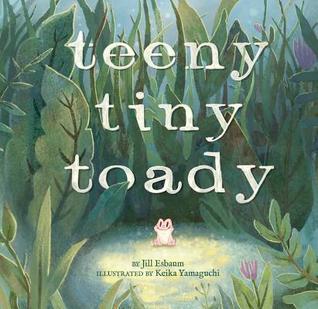
Teeny Tiny Toady by Jill Esbaum, illustrated by Keika Yamaguchi

Source: Sterling Children’s Books
Hardcover, 40 pgs.
I am an Amazon Affiliate

Teeny Tiny Toady by Jill Esbaum, illustrated by Keika Yamaguchi, is about using your own strengths to solve problems and not comparing yourself to others.  Teeny Tiny Toady is a baby sister to seven brothers, but when their mother is taken by hunters in the swamp, her suggestions are often ignored or usurped by one of her brothers.  Told in rhyming verse, teeny tiny toady follows her bigger brothers into the swamp to rescue their mom.  As they try to push the bucket, they can’t get it to tip over, even with Teeny’s help.  Teeny suggests the climb up and pull out their mother, but her brothers end up falling into the bucket too.  It’s up to Teeny to save the day.

After sobbing and wallowing in self-pity about her inability to push over the bucket or climb to the top on her own, Teeny devises a plan that will save them all.  My daughter and I have read this book several times, and she loves it every time.  We’re happy to see that Teeny is strong even with seven older brothers.  She’s smart and savvy.

Teeny Tiny Toady by Jill Esbaum, illustrated by Keika Yamaguchi, is adorably illustrated, and Teeny is the cutest toad ever.  She’s passionate and plucky, and even when her brothers ignore her, Teeny never gives up.  This picture book sends all the right messages to young kids about believing in themselves and taking a stand.

Rating: Cinquain

Hush Hush by Laura Lippman (audio)

Source: Public Library
Audiobook, 9 CDs
I am an Amazon Affiliate

Hush Hush by Laura Lippman, narrated by Jan Maxwell, is the 12th book in the Tess Monaghan series, but it’s not necessary to read these books in order.

As a new mother, Monaghan, a private detective, struggles with her ability to parent well, and she’s often her harshest critic.  Her concerns about her own parenting skills are the backdrop to the case she’s working involving the “baby killer” Melisandre Harris Dawes, who left her two-month-old daughter locked in a car while she sat nearby on the shores of the Patapsco River. She was found not guilty by reason of criminal insanity, but when she’s back from a stint abroad to avoid the press and tries to reconnect with her two daughters and film a reunion documentary, the process is much harder than she expects, especially as her ex-husband strives to keep her out of their lives.

Baltimore comes alive in this novel, as Lippman is careful to supply readers with both the good and bad elements of the city. As Monaghan struggles with her new role as a mother and to pay the bills, she and her partner Sandy Sanchez have little choice by to take up her mentor and close friend Tyner Gray’s offer to assess Melisandre’s security needs. In the midst of this, people end up dying, and the finger starts pointing at her client.  Jan Maxwell is an excellent narrator, particularly when she has to narrate the dialogue for a very manipulative and closed off woman.

Hush Hush by Laura Lippman, narrated by Jan Maxwell, was a twisted tale that will have mothers everywhere praising their own parenting abilities in comparison to Melisandre.  Monaghan, like most new mothers, must juggle new responsibilities with their jobs, but at least her partner provides some help, as do her parents and daycare.  She’s a brilliant woman who struggles to do it all, but in many ways, the book is a cautionary tale.  Mothers should not have to do it all, and they should be able to ask for help and rely on others.

RATING: Quatrain

About the Author:

Laura Lippman was a reporter for twenty years, including twelve years at The (Baltimore) Sun. She began writing novels while working fulltime and published seven books about “accidental PI” Tess Monaghan before leaving daily journalism in 2001. Her work has been awarded the Edgar ®, the Anthony, the Agatha, the Shamus, the Nero Wolfe, Gumshoe and Barry awards. She also has been nominated for other prizes in the crime fiction field, including the Hammett and the Macavity. She was the first-ever recipient of the Mayor’s Prize for Literary Excellence and the first genre writer recognized as Author of the Year by the Maryland Library Association.

Ms. Lippman grew up in Baltimore and attended city schools through ninth grade. After graduating from Wilde Lake High School in Columbia, Md., Ms. Lippman attended Northwestern University’s Medill School of Journalism. Her other newspaper jobs included the Waco Tribune-Herald and the San Antonio Light.

Ms. Lippman returned to Baltimore in 1989 and has lived there since. She is the daughter of Theo Lippman Jr., a Sun editorial writer who retired in 1995 but continues to freelance for several newspapers, and Madeline Mabry Lippman, a former Baltimore City school librarian. Her sister, Susan, is a local bookseller.

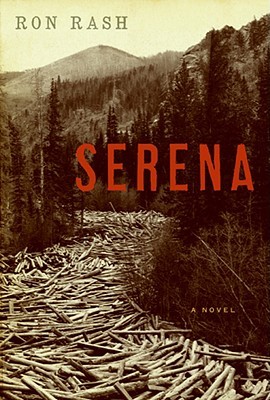
Serena by Ron Rash (audio)

Source: Public Library
Audiobook, 10 CDs
I am an Amazon Affiliate

The Pembertons hack their timber empire out of the North Carolina mountain wilderness in Serena by Ron Rash, narrated by Phil Gigante. Serena and George meet in Boston, and their instant connection and passion drive them to flout the calls for a National Park System in 1929 to create the Great Smoky Mountains National Park.  They effectively take action to buy up more and more land to prevent its creation.  Serena is seen by her husband and the workers as a shrewd businesswoman capable of making deals and expanding the business.  Serena and George are connected in business, love, and obsession, but when George begins to look on something else as more important, a woman scorned can be hard to appease.

Gigante’s narration is superb, even as he narrates the female characters.  His voice never takes on a ridiculous tenor as he takes on the persona of Serena and George’s former paramour.  In a world where deals are made over bourbon and cigars, a woman is not expected to be wiser than them.  When Serena takes things too far, George has to make a decision, which could put him at odds with his strong-willed, wild wife.  Serena has few redeeming aspects, and in fact readers may even fear her as many of the other characters do.  She’s an imposing presence, even when she is not front and center in the action.

Serena by Ron Rash, narrated by Phil Gigante, is a tale of ambition in a time when the Great Depression has taken a deep hold on the country, and it extrapolates how easily business tycoons can manipulate deals and people to get what they want.

Rating: Quatrain

About the Author:

Ron Rash is the author of the 2009 PEN/Faulkner Finalist and New York Times bestselling novel, Serena, in addition to three other prizewinning novels, One Foot in Eden, Saints at the River, and The World Made Straight; three collections of poems; and four collections of stories, among them Burning Bright, which won the 2010 Frank O’Connor International Short Story Award, and Chemistry and Other Stories, which was a finalist for the 2007 PEN/Faulkner Award. Twice the recipient of the O.Henry Prize, he teaches at Western Carolina University.

2016 National Poetry Month Blog Tour

April is National Poetry Month in the United States.

Even though I think people should read poetry every day or at least more often than once per month, April has been the focal point for poetry activities since National Poetry Month was created by the Academy of American Poets in 1996.  It’s hard to believe the event has been happening for 20 years.

This year, I’m hoping that I can get some wonderful blogs to participate in the 2016 blog tour for poetry. I would love to get some great new interviews, reviews, poetry readings, innovative poetry activities, and some visual artists interested in sharing some poetic renderings.

If you’re interested in signing up for the tour, feel free to leave a link in the Linky and comment about what you want to host in April.

Stop back here in April for some fun interactive poetry activities.

Tentative schedule:

April 1: Rhapsody in Books (What is Poetry and What Role Does It Perform?)
April 7: I’m Lost in Books (poetry jumpstarting her creativity in high school)
April 14: Fig and Thistle (Andrea Hollander event)
April 15: Tabatha Yeatts
April 16: Suko’s Notebook (poetry collection review)
April 18: Peeking Between the Pages (poetry collection review)
April 19: Necromancy Never Pays
April 23: Bookgirl’s Nightstand
April 25: Diary of an Eccentric (poetry collection review)

***New***

Here’s your 2016 NPM Blog Tour Button!

NPMBlogTour2016

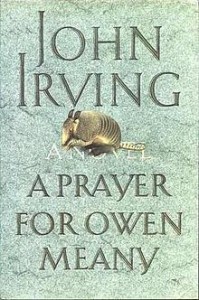
Guest Review: A Prayer for Owen Meany by John Irving

Today’s guest review as part of the United States of Books is from H. C. Newton at The Irresponsible Reader

PrayerForOwenMeany★ ★ ★ ★

[Marilyn Monroe] was just like our whole country — not quite young anymore, but not old either; a little breathless, very beautiful, maybe a little stupid, maybe a lot smarter than she seemed, and she was looking for something . . . She was never quite happy, she was always a little overweight. She was just like our whole country.

I’m not sure why I picked that quotation from this book, but there’s something that appealed to me about it (even if I don’t necessarily agree). You’ll note that there are both upper and lower case letters there — Owen Meany’s dialogue is always given to us in all caps. Which is annoying (it’s supposed to be), and difficult to read in extended speeches (Owen’s voice is hard to listen to), and makes you wish he’d shut up (duplicating the experience of most people who heard him).

A medical explanation for this is given, eventually. But the only explanation that Owen needs is that God gave him his voice. The same for his diminutive stature (about 5′ 0″ as an adult)
— God made him that way, for His own reason.

But I’m getting ahead of myself — John Irving’s probably best known for The World According to Garp, which was one of the bigger disappointments of my college reading, so I wasn’t really looking forward to spending more time with him. You add in the fact that this is a 500+ page book with only nine chapters, and it’s downright intimidating. I’m not going to say that you shouldn’t be intimidated and that it’s a pretty easy read — it’s a challenge, it’s frequently a slog — but in the end, it’s rewarding.

When the book starts, Johnny Wheelwright (the narrator) doesn’t seem particularly fond of Owen Meany — in fact, you get the impression that he’s just one of those kids he happens to know, and he’s not that happy about it. But before long, it’s clear that he and Owen are really close — even though (because?) Owen’s responsible for the greatest tragedy of Johnny’s childhood.

John finds himself as an observer to Owen’s life, as his defender, his advocate, his way to the greater world. While Owen is constantly trying to help his friend — help him to achieve, help him to think, help him to believe. It’s a great friendship — and without the other, each was diminished. Owen less so, but in important ways.

The narrative is rambling — John starts to tell us about something, the plot moves forward a bit, but then he goes back in history to give context. Sometimes weeks, sometimes years and far more detail than you think is necessary. Eventually, you see that this is sort of the approach that the overall narrative is taking — John has something he needs to tell the reader, but he doesn’t want to. So he tells you many other things, anecdotes, vignettes, details you don’t need — anything to delay what he wants to say. He does get to it. And by that time, you’re not sure you want him to.

The story is told from the perspective of forty-something John, now a teacher at a Private School in Toronto — he spends his days reading the news about the United States, and ranting (or trying not to) to anyone near him about what President Reagan is doing. I’m not sure why we spend so much time dwelling on him in the present, we don’t need it — it adds almost nothing to the narrative. If anything, I think it might lessen the impact of the rest. The adult John telling the story about his childhood, about Owen, about their growing up together, and so on is essential — we need his perspective, his distance. What we don’t need is to hear John’s rants about Reagan, the poor reading/study habits of teenage girls.

I’m not sure that I get a whole lot of understanding of New Hampshire from this book — Owen’s family working in the granite industry doesn’t tell us much, New Hampshire is The Granite State — everyone who survived 4th grade knows that. If anything, Irving was wanting to talk about America — as an ideal, and as something that falls short of that ideal. Monroe was one example, John Kennedy’s moral failings another, Vietnam a recurring theme, and, of course, the Iran-Contra Scandal. Each of these, as either a representative individual, or representative act, demonstrates how far (in John’s/Owen’s view, at least) the United States has fallen short of the ideals it should strive for — if not achieve.

Ultimately, when I enjoyed this book, it felt like it was in spite of what I was reading. But I laughed, I cared, I kept reading — and then when I was finished, I appreciated the work as a whole, and felt a lot more affection for it than I expected. It’s hard to explain, but I liked this one and heartily recommend it.

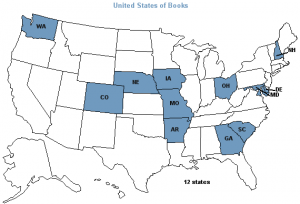
New Hampshire

Mailbox Monday #367

Mailbox Monday, created by Marcia at To Be Continued, formerly The Printed Page, has a permanent home at its own blog.

To check out what everyone has received over the last week, visit the blog and check out the links.  Leave yours too.

Also, each week, Leslie, Vicki, and I will share the Books that Caught Our Eye from everyone’s weekly links.

Here’s what I received:

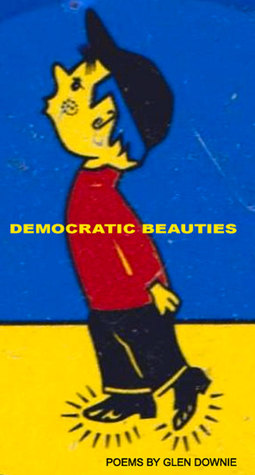
Democratic Beauties by Glen Downie from Tightrope Books for review.

The latest collection of poetry by award-winning author, Glen Downie, confronts and attempts to decode various commercial artifacts of the twentieth century through the forms of prose poem commentaries and found poems. Democratic Beauties responds to these artifacts from the perspective of our current day, as well as puzzles out what their producers may have intended with them. In so doing, the book touches on a range of issues, including technological change, gender roles, notions of happiness and a society that cannot sustain itself without ever-increasing consumption.

Teeny Tiny Toady by Jill Esbaum, illustrated by Keika Yamaguchi, from Sterling Children’s Books for review.

When a giant hand scoops up her mama and puts her in a pail, a terrified tiny toad named Teeny hops faster than she ever did in her life. “Mama’s stuck inside a bucket! Help me get her out!” she begs her big, clumsy brothers. “Don’t you worry, kid. We’ll save her!” they promise, bumbling and stumbling and jumbling out the door. But as the boys rush headlong to the rescue, pushing their little sister aside, it becomes clear: brawn isn’t always better than brains—and the smallest of the family may just be the smartest one of all.  Written in lilting verse.

What did you receive?

349th Virtual Poetry Circle

Welcome to the 349th Virtual Poetry Circle!

Remember, this is just for fun and is not meant to be stressful.

Keep in mind what Molly Peacock’s book suggested.

Look at a line, a stanza, sentences, and images; describe what you like or don’t like; and offer an opinion. If you missed my review of her book, check it out here.

Today’s poem is from D.H. Lawrence:

The Enkindled Spring

This spring as it comes bursts up in bonfires green,
Wild puffing of emerald trees, and flame-filled bushes,
Thorn-blossom lifting in wreaths of smoke between
Where the wood fumes up and the watery, flickering rushes.

I am amazed at this spring, this conflagration
Of green fires lit on the soil of the earth, this blaze
Of growing, and sparks that puff in wild gyration,
Faces of people streaming across my gaze.

And I, what fountain of fire am I among
This leaping combustion of spring? My spirit is tossed
About like a shadow buffeted in the throng
Of flames, a shadow that's gone astray, and is lost.

What are your thoughts?

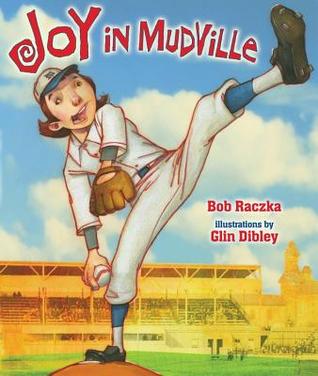
Joy in Mudville by Bob Raczka, illustrated by Glin Dibley

Source: Public Library
Hardcover, 32 pgs.
I am an Amazon Affiliate

Joy in Mudville by Bob Raczka, illustrated by Glin Dibley, is a wonderful book about empowering girls to think outside the normal roles of princess and dancer.  Joy is a pitcher for the local baseball team, but she’s an untried rookie.  What happens when the team needs her will surprise young and old readers, as well as the team’s fans.

Joy shows the fans and the team that she’s not only good at baseball, but also other sports.  Jump shots, pump fakes, and more, as she takes the mound by storm.  She has the other team scratching their heads, but none of her moves are considered illegal.  The illustrations are wonderful, and she gets her own baseball card just like the team’s slugger Mighty Casey.

Joy in Mudville by Bob Raczka, illustrated by Glin Dibley, is wonderfully illustrated and tells a great story of courage and originality.  Young girls will be inspired by Joy’s bravery and her ability as an athlete.

Rating: Cinquain

About the Author:

Bob Raczka loved to draw, especially dinosaurs, cars and airplanes, as a boy. He spent a lot of time making paper airplanes and model rockets. He studied art in college, which came in quite handy while writing a series of art appreciation books, Bob Raczka’s Art Adventures. He also studied advertising, a creative field in which he worked in for more than 25 years. Bob also discovered how much he loved poetry and began writing his own. His message for today’s kids is to make stuff!”