Quantcast

Peter Schilling’s Writing Space

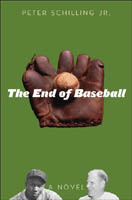
Peter Schilling Jr.‘s The End of Baseball is his debut novel, new in paperback this month.  Set in 1944 during World War II and at a time when African-American baseball players were being integrated into the major leagues, the novel follows young Bill Veeck Jr.‘s foray into baseball team ownership and the obstacles he must overcome to use black players in the Philadelphia Athletics to get to the World Series.

I haven’t had a chance to review the book yet, but Schilling was gracious enough to provide a guest post about his writing space.  And I know how much you love these sneak peeks.  Please welcome Peter Schilling.
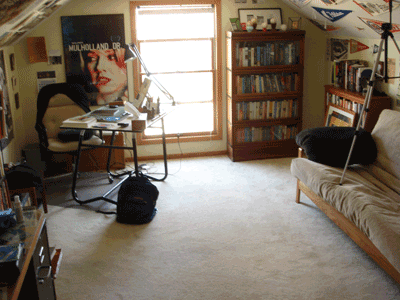
I work upstairs in my old, 1923 brick house. The upstairs attic was finished sometime probably in the 1980s, and has carpeting, as opposed to the rest of the place, which sports hardwood floors. The attic, or factory as I like to call it, is the perfect writing space. It’s the length of the house, its insulated from noise (so I can work even when someone’s downstairs watching television), has its own bathroom, futon, and all the space I need for all my clutter.  It is very quiet up here, which I enjoy. You can see down the block from my window and feel the house shake when a train goes by.

As you can see, I write on a white drafting table. I like the slight incline on the surface, and I like the way the surface reflects the light from the outside. Things stand out on that surface–my tchotchke’s, icons, photos, and notes. I have a piece of cloth in the center that I use to write on, which my father made and on which he used to perform slight-of-hand magic.
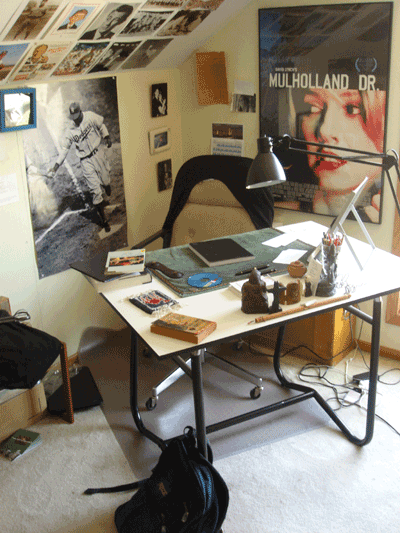
I write my first drafts in longhand, using a Mont Blanc fountain pen a friend gave me, in black journals. Then I pull out my MacBook and transcribe. Surrounding my desk, and in arm’s reach (it’s hard to get in and out), I have a dictionary, thesaurus, the Complete Film Dictionary (I’m writing a screenplay), other books for research, pen cartridges, journals, note cards, and, on the walls, various items that interest or inspire: a current tide calendar from where my wife and I honeymooned, photos of people I admire (Jackie Robinson, Bill Veeck, Alfred E. Neuman, Robert Mitchum, Mark Fidrych, my father, etc.) And a big poster of “Mulholland Dr.“, because I’m in awe of that movie.

The rest of the space is filled with eight bookshelves, filled with baseball books, novels and pulpy paperbacks, poetry, film biographies, comic books, you name it. There’s old train maps from the Milwaukee Line, vintage baseball pennants (Tigers, Brooklyn Dodgers, Philadelphia Athletics), movie posters (Marty, Sullivan’s Travels, The Third Man), and even graffiti I wrote to try and remember the vocabulary of the Navy for my first novel (for instance, in giant scrawl is written “This is a HATCH” by a door).

Now and again I head out to the University of Minnesota’s Wilson Library to get out of the place (which at times feels like I’m in my own head), or to Bob’s 33 Cafe just for a change of pace.This is the space where I spend most of my life, a good six to eight hours a day from about seven in the morning to around three in the afternoon. Everything in here connects to the people and places I’m writing about–the books have inspired certain characters, or I’ve grabbed one or two and tried to figure out how another author managed to structure plot, etc. Surrounding myself with the work of these artists is fun, exciting, and very inspirational. It makes me feel like a part of this world, and it informs all my writing.

Thanks, Peter, for showing us your writing space.  Stay tuned for my review of The End of Baseball.

About the Author:

Peter Schilling has been a sportswriter, film critic, and freelance writer for over seven years, in addition to writing novels, graphic novels, plays and screenplays.  Check out his author appearances.

FTC Disclosure: Clicking on title and image links will lead you to my Amazon Affiliate page; No purchase necessary, though appreciated.

© 2010, Serena Agusto-Cox of Savvy Verse & Wit. All Rights Reserved. If you’re reading this on a site other than Savvy Verse & Wit or Serena’s Feed, be aware that this post has been stolen and is used without permission.
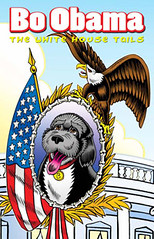
Bo Obama: The White House Tails by Paul Salamof and Keith Tucker

Bo Obama:  The White House Tails is written by Paul J. Salamoff and drawn by Emmy Award-winning Disney and Warner Brothers artist Keith Tucker for Bluewater Productions‘ line of graphic novels for young readers.  The 40-page graphic novel reads more like a comic book, with Bo Obama taking kids back in time to visit previous White House pets and to witness some of the history of the presidential residence.

Bo is a Portuguese Water Dog, who is the perfect dog for those with allergies.  Not only does Bo know a lot about himself and his breed, but he also knows a great deal about the White House’s former residents.  The illustrations of Bo are clear and vivid, making the Obama’s dog leap to life in this graphic novel.

“People in Portugal speak Portuguese, but I can only bark in English.” (Page 10)
From elephants in the White House to the origin of the presidential residence’s name, Bo takes readers on a journey through the present and the past.  Kids, probably between ages 8 and 12, will enjoy this book the most because the words will be easier for them to grasp with little help from parents.  In some instances, readers may want to learn more about the animals or historical figures they meet.  Learning history through the eyes of a dog has never been more entertaining. Bo Obama:  The White House Tails is moderately priced at $6.99.

This book is my 16th book for the 2010 New Authors Challenge.

FTC Disclosure: Thanks to Bluewater Productions for sending me a free copy for review.  Clicking on title and image links will lead you to my Amazon Affiliate page; No purchase necessary, though appreciated.

© 2010, Serena Agusto-Cox of Savvy Verse & Wit. All Rights Reserved. If you’re reading this on a site other than Savvy Verse & Wit or Serena’s Feed, be aware that this post has been stolen and is used without permission.

Mailbox Monday #73

You knew that the slow weeks couldn’t last.  I went to the Split This Rock Poetry Festival (Check out my review of the festival),  and let me tell you that’s only part of the reason that the mailbox is so full this week.

Marcia at The Printed Page and Kristi of The Story Siren both sponsor memes in which bloggers share what books they’ve received in the past week.  I’m going to continue calling these Mailbox Mondays, but The Story Siren also has In My Mailbox.

Here’s what I received:

1.  The Last Train From Hiroshima by Charles Pellegrino, which I purchased after learning that there is controversy surrounding the source material Pellegrino used for his account of the atomic bombing.  The publisher has halted publication.  I’m all about controversy.

2.  A Hundred Feet Over Hell by Jim Hooper, which is for review from Lisa Roe at the Online Publicist.

3.  Fireworks over Toccoa by Jeffrey Stepakoff, which I received for review from St. Martin’s Press.

4.  Waiting Wives by Donna Moreau, which I purchased after reading Tina Says’ review as part of the Vietnam War Reading Challenge.

5.  The End of Baseball by Peter Schilling Jr., which I received for review from Kaye Publicity for review.

6.  Another World Instead: The Poems of William Stafford, which I received from the editor of the collection Fred Marchant, a former professor, fellow poet, and friend.  He graciously signed this for me at Split This Rock Poetry Festival.

7.  The Looking House by Fred Marchant, which I will review in April as part of my National Poetry Month tour with other bloggers; I hope you’ll consider joining us.  He also signed this one for me as well.

8.  Green is the Orator by Sarah Gridley, which I purchased at Busboys & Poets while at the Split This Rock Poetry Festival, though I failed to find her later on and have her sign it.

9.  The Last Communist Virgin by Wang Ping, which I purchased at the Split This Rock Poetry Festival and is a collection of short stories.

10.  The Baghdad Blues by Sinan Antoon, which I also purchased at the festival after hearing a number of panelists praise his work.

11.  Bo Obama: The White House Tails by Paul Salamof and Keith Tucker is a review copy from Bluewater Productions.

12.  Female Force by Neal Bailey, Ryan Howe, and Joshua Labello which was included with Bo Obama — I’m assuming as a bonus book.

13.  Female Force:  Barbara Walters by Robert Schnakenberg, which was also include with Bo Obama — I’m assuming it is a second bonus book.

OK, I think that’s it!  What did you get in your mailbox?

FTC Disclosure: Clicking on title and image links will lead you to my Amazon Affiliate page; No purchase necessary, though appreciated.

© 2010, Serena Agusto-Cox of Savvy Verse & Wit. All Rights Reserved. If you’re reading this on a site other than Savvy Verse & Wit or Serena’s Feed, be aware that this post has been stolen and is used without permission.

Winner of Almost Home

Out of 43 entrants, Random.org selected #18

vslavetopassionv

Congrats and thanks to all who entered!

© 2010, Serena Agusto-Cox of Savvy Verse & Wit. All Rights Reserved. If you’re reading this on a site other than Savvy Verse & Wit or Serena’s Feed, be aware that this post has been stolen and is used without permission.

2010 Split This Rock Poetry Festival WrapUp

The 2010 Split This Rock Poetry Festival in Washington, D.C., is a biennial event and is in its second year.  I was able to attend this year, and travel to a part of D.C. that is in transition and that I haven’t been to in a long while — the home of Ben’s Chili Bowl on U St.

March 10 was mainly an exercise in registration for me, but March 11 — the second day of the festival — was a whirlwind.  If you want to check out the crazy schedule, it is here.  This year, I didn’t make it to any of the evening readings, but I think at the next one, I will make a concerted effort to do so.

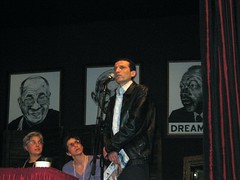
My first event was The Peace Shelves: Essential Books and Poems for the 21st Century, which was moderated by Fred Marchant, my former professor, fellow poet, and friend.  I’m going to age myself, but it has been about a decade since I last saw Fred.  The panel was fantastic, covering a wide range of topics dealing with the term “peace” — a term that is “static” in nature, which is why activists have to use terms like “peace-making” etc.  I took a little bit of video of Fred’s portion of the program, check it out:  (Sorry, for the horizontal nature of this vertical video)

The second panel I attended, The War is Not Over: Writing About Iraq and the Case of the Mutanabbi Street Coalition talked about a bombing event in Iraq that has blurred with many others for me and ended with a surprise for everyone — a survivor of the Mutanabbi Street bombing was in the audience and came forward during the discussion period to talk about the time before, the time during, and the time following the bombing.

Despite his rough English, the significance of Mutanabbi Street for the Iraqi people as a place of commerce and intellectual discourse shined through.  It is mostly known for its book stalls and its booksellers.  He talked about how even though street names were changed in many areas under Saddam Hussein’s reign, the streets named for poets and other writers remained the same.  The bombing created a “crisis of culture” according to the panelists.  The audience member — forgive me, I didn’t get his name down — said that the process of rebuilding Mutanabbi St. continues and is amazing to witness.

While eating lunch at Busboys & Poets with Fred and a few of his colleagues, Karen of WordWorks and Marty — who volunteered to shuttle participants of the festival from various events — a film festival began, combining poetry and video.  Some of the videos were abstract, while others were vivid in their use of images, music, and words.

The highlight of the first full day of the festival was how the poets came together to create a cento poem — a poem composed from lines of poems from other poets.  Rather than talk about it, I took a short video of some of the contributing poets, so you could hear them:

If you want to read the poem and see what line (from one of Fred Marchant‘s poems) I contributed, go to the Website (mine begins. . . “Today we shall. . . “)

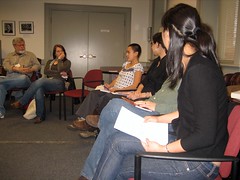
March 12, my second full day of the event was a gray day, full of rain, but I attended a great morning panel — Warriors Writing: Teaching Creative Writing to War Veterans — after learning that Lovella Calica, another friend of Fred’s and founder of Warrior Writers, would be a panelist.  Wow!  That’s the first word that comes to mind after learning how well crafted these creative writing workshops are for veterans and how they are held in a variety of settings with a variety of facilitators.  From Lovella who had ties to the veteran community before beginning her workshop project and a New York University graduate Lauren McClung, who started workshops as part of a fellowship to George Kovach, an editor and publisher of Consequences and Vietnam Vet, the panel touched upon the need to create safety in the workshop space for veterans exorcising their “demons.”

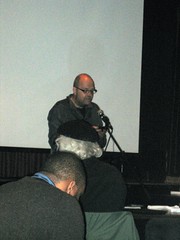
The second panel I caught was Documentary Poetics with Martha Collins (another colleague of Fred’s), Mark Nowak, and Philip Metres.  From using newspapers and other documentary evidence to provide substance and anchors to a poem to using photographs and video, each poet discussed why they choose to use their source material and how it creates an alternative history for readers.  Nowak, unfortunately, had a technical malfunction with his presentation and we were unable to see the images he planned to present.

The four days of the festival were full of energy and enthusiasm, but as one who has been outside the poetry circle for some time, I felt on the fringe of the discussions during downtime.  I’m not a very social person in many instances, especially in crowds of strangers.  I liked the energy these poets have when it comes to their convictions and opinions, but I often find that many of these events are for people who already know one another to reconnect and chat within their own groups.  I did step out of my box a bit and chat with a few other poets that seemed on the fringe like I was.  One attendee traveled all the way from Tennessee for the event!  The power of poetry continues to reach out into the community, which is a positive sign that poetry is reviving.

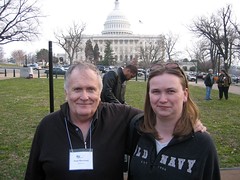
Finally, here’s a photo of me with Fred Marchant.

© 2010, Serena Agusto-Cox of Savvy Verse & Wit. All Rights Reserved. If you’re reading this on a site other than Savvy Verse & Wit or Serena’s Feed, be aware that this post has been stolen and is used without permission.

36th Virtual Poetry Circle

Wow have I been busy with the Split This Rock Poetry Festival in Washington, D.C.  I’m going to the festival a little bit later this morning, just so I can get up this week’s Virtual Poetry Circle.

And since, I’ve been immersed in contemporary poets and poems of witness, I thought I would share with you a poet from the festival for the 36th Virtual Poetry Circle.

Remember, this is just for fun and is not meant to be stressful.

Keep in mind what Molly Peacock’s books suggested. Look at a line, a stanza, sentences, and images; describe what you like or don’t like; and offer an opinion. If you missed my review of her book, check it out here.

Today’s contemporary poem is from Sinan Antoon‘s The Baghdad Blues:

A Photograph (Of an Iraqi boy on the front page of the New York Times) (Page 41)

he sat
at the edge of the truck
(eight or nine years old?)
surrounded by his family:
his father,
mother,
and five siblings
were asleep
his head was buried
in his hands
all the clouds of the world
were waiting
on the threshold of his eyes
the tall man wiped off the sweat
and started digging
the seventh grave.

Let me know your thoughts, ideas, feelings, impressions. Let’s have a great discussion…pick a line, pick an image, pick a sentence.

I’ve you missed the other Virtual Poetry Circles, check them out here. It’s never too late to join the discussion.

FTC Disclosure: Clicking on title links or images will bring you to my Amazon Affiliate page; No purchase necessary.

© 2010, Serena Agusto-Cox of Savvy Verse & Wit. All Rights Reserved. If you’re reading this on a site other than Savvy Verse & Wit or Serena’s Feed, be aware that this post has been stolen and is used without permission.

The Wives of Henry Oades by Johanna Moran

Johanna Moran’s The Wives of Henry Oades begins with the journey of a young family to New Zealand from England, but once on foreign soil, the family is met with tragedy.  Henry Oades leaves New Zealand for a new life in America where he becomes a farmer and rebuilds his life.  The story is based upon a 19th century court case involving a man with two wives, according to Moran’s Website.
“Henry introduced the children, clapping a proud hand to John’s shoulder, prying six-year-old Josephine from Margaret’s leg.  Margaret turned back to the watery haze that was her parents, spreading her feet for balance, her pretty going-away shoes pinching.  She’d been told the river was calm.”  (Page 5)

Moran’s story is unique and even more intriguing because it has a basis in fact, but in many ways the writing is stilted and it is difficult for readers to picture the settings in detail.  Additionally, there are some details that could be excluded in favor of speeding up the plot, which drags for the first 75 pages.

Margaret is a prim woman from a proper English family, who is thrown into a colony where not everyone is as well-bred as she is.  There’s a period of adjustment for the Oades family, but even that adjustment is just the beginning.  With much of the point of view focused on Margaret, the sudden shift to Henry’s viewpoint once Margaret and the kids disappear from his life is a bit jarring.  Readers could find that they are not as well connected with Henry and that he is not as developed as Margaret’s character.  This stumbling block can take a while to overcome, but then readers are thrust into another story, that of Nancy Foreland, a recently windowed, pregnant woman.

Despite these drawbacks, the struggle of Margaret and Nancy to adapt to a new situation in which they both find themselves as the wives of Henry Oades will keep readers turning the pages.  Overall, The Wives of Henry Oades by Johanna Moran is a detailed account of one family’s immigration journey and an exploration of what it truly means to be a family.


To win a copy of The Wives of Henry Oades by Johanna Moran (US/Canada):

1.  Leave a comment on this post about what court case you’ve found fascinating.
2.  Blog, tweet, Facebook, or otherwise spread the word about the giveaway and leave me a link in the comments.

Deadline March 18, 2010, at 11:59PM EST

About the Author:

Johanna Moran comes from a long line of writers and lawyers. She lives on the west coast of Florida with her husband, John. The Wives of Henry Oades is her first novel.

Check out her Website.

This book is my 15th book for the 2010 New Authors Challenge, and thus signifies my completion of the challenge, though I could be reading more new-to-me authors throughout the year.

If you are interested in the rest of the TLC Book Tour for The Wives of Henry Oades, check them out.

The Writing Space of Nafisa Haji, Author of The Writing on my Forehead

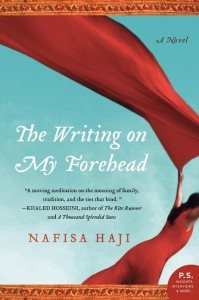
I recently reviewed Nafisa Haji’s The Writing on my Forehead (click for my review).  Haji was gracious enough to take time out of her busy schedule to share with us a sneak peek into her writing space and writing life.

Please give her a warm welcome.

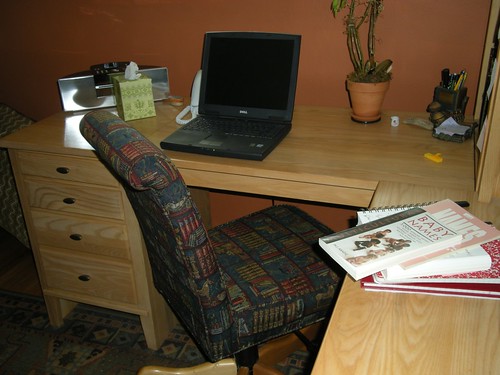
Cultivating a space for my writing was the first step on the journey to take myself seriously as a writer—something I had to do before anyone else could. 

Buying a desk that would be mine alone, not something I shared with my partner or anyone else, was important.  I remember brushing aside feelings of guilt at the expense.  It was the intention, the promise that I was making to myself, that was the real point of that investment.

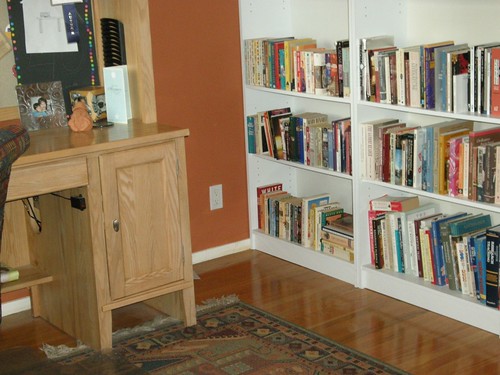
Part of being a writer is reaping the fruit of what comes from having been a reader.  When I sit to write at my desk, behind me are shelves lined with the books not aesthetically worthy of display in the living room— the paperback classics and pulp fiction that I devoured as a teenager, the assigned college reading that left a mark, as well as some books I’ve never read but have kept, the ones that survive the purging I indulge in when I’m in procrastination mode, or when the shelves look like they can no longer hold their burden of past indulgences and good intentions for the future. 

The walls in the current incarnation of my space are a copper color—“pennies from heaven” was the name on the paint chip, a lovely fragment of poetry and music that caught my eye and inner ear and made me think of the people whose job it is to give tempting, marketable names to the stuff we brush on our walls as the background of our indoor lives.

Always at hand are baby name books, my favorite a book of multicultural names that is well-worn from handling.  Also, a couple of dictionaries, a thesaurus, several books of quotations, and a stack of nonfiction related to historical events that may have touched the lives of the people currently living in my head.  

There’s a window, but the blinds rarely go up, the slats slanted to let in light, but not enough to see out.  

The point of this room, whose only other use is for my daily meditation, is to go within, to get away from the distraction of the view outside.

My laptop and what I type into it are sacred, never subject to the social viruses that get passed around on the Internet.  I have to leave the room to connect to the web of the wider world, to check email and verify facts.

In the drawers at my side are files of stuff that I keep for no good reason—one, especially treasured, filled with rejection letters, painful to read when received, that I have learned to savor as gifts over time.

This is my space—one I am grateful to have had the time to occupy, glad for what has come out of it in the past, and eager to discover what grows here in the future.  

Thanks, Nafisa, for sharing your sacred space with us.

Writing Spaces and Other Forms of Solitary Confinement by Jamie Ford

If you’ll recall, I recently reviewed Jamie Ford’s Hotel on the Corner of Bitter and Sweet (click for my review).  Ford was gracious enough to take time out of his busy schedule to share with us a sneak peek into his writing space and writing life, along with some great shots of his dogs.

You know I love dogs, so this was a real treat to see that his dogs act like Charlee does when I’m on the computer.

I hope you enjoy today’s guest post.  Please welcome Jamie Ford.

I have a lovely home office, with a door and a lock. Which my children still happily ignore, despite telling them that when I’m writing they should only interrupt if the house is on fire or if someone requires stitches. Who knew that rides to the mall, and “I can’t find my iPod headphones,” would rival such emergencies? Nevertheless, this is where I get a lot of work done. 

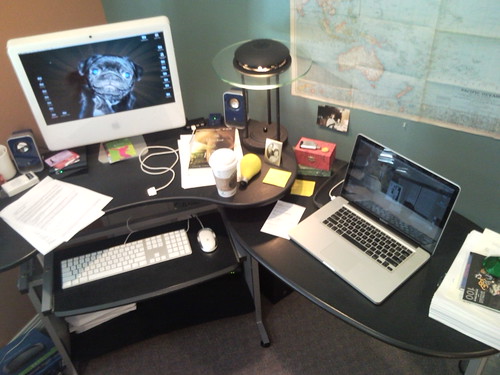
The Desk. My neighbor is a chiropractor and has been steering me in the direction of something more ergonomic for months, but old habits (and writing desks) are hard to break. And yes, I’m a Mac guy. I bought an iMac, thinking the ginormous screen would be easier on the eyes, but still gravitate to my trusty MacBook Pro. Scattered about my desk are a Jenga-like tower of galleys I’ve promised to read, my new manuscript (tentatively titled Whispers of a Thunder God), my current itinerary, a photo of my parents, and an assortment of iTunes gift cards and desktop statuary made by my kids. The map is of the North Pacific, circa 1943.  

The Shelf. Actually, shelves. My office is filled with assorted knickknacks. Daruma dolls—you color one eye when you make a wish or set a goal and color in the other upon completion. I have two, you can guess what they’re for. I have a small urn with some of my father’s ashes—a morbid little paperweight (thanks dad), a snuff tin, used by my grandmother who actually chewed the stuff, and my gloves from when I used to compete in karate tournaments, with a tarnished silver medal. 

The Floor. My carpet is usually covered with an assortment of barely animate objects—my dogs, which are easily mistaken for throw rugs. There’s a doggie bed in the corner, but they still prefer the floor. They’re great to bounce ideas off of and they always let me know when the UPS man arrives. 

That’s my space in a nutshell. I’ve tried writing at the library, or the local coffee pub, or in the back yard on a sunny afternoon, but I love being surrounded by my notes and maps and such. Plus I don’t have to chase them all over the lawn when the wind blows.

Thanks, Jamie, for taking the time to share with us a sneak peek inside your writing space.

The Writing on my Forehead by Nafisa Haji

Nafisa Haji‘s The Writing on my Forehead transports readers into another culture and the struggles that members find themselves in as the world around them evolves, causing clashes between modernity and the past.  Told from the point of view of Saira, readers are taken on a very personal journey into the past, uncovering the deep secrets of Saira’s grandmother and grandfather as well as her own parents.  The dynamic between Saira and her sister is only partially shown, with the point of view of Ameena silent.  From fate to choices, each character must follow their path to the end — no matter what it holds for them.

“I close my eyes and imagine the touch of my mother’s hand on my forehead, smoothing away the residue of childhood nightmares.  Her finger moves across my forehead, tracing letters and words of prayer that I never understood, never wanted to understand, her mouth whispering in nearly silent accompaniment.  Now, waking from the nightmare that has become routine — bathed in sweat, breathing hard, resigned to the sleeplessness that will follow — I remember her soothing touch and appreciate it with an intensity that I never felt when she was alive.”  (Page 1)

Saira grows into an independent woman who is running from her culture and tradition to find herself grasping for it in the darkest moments of her life.  As an American with a strong Pakistani-Indian heritage and a mother reminiscent of Mrs. Bennet in Pride & Prejudice, it is no wonder that she rebels against tradition and culture to become a traveling journalist.
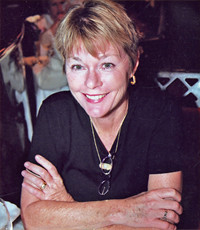
“I shudder, now, to think of how my mother, trying hard and failing to be subtle, got the word of my availability — accompanied, I learned later, by a full-size, glossy headshot — out on the proverbial ‘street’ where desi families gathered and speculated, assessed and collated young people into the ‘happily ever after’ that getting married was supposed to promise.”  (Page 191)

Haji’s prose is eloquent and engages not only the readers’ sensibilities and emotions, but their inquisitive nature as family secrets are unraveled.  Saira is a complex character who searches for a center, an axis on which she can revolve and become grounded.  While she is connected to family, like Mohsin and Big Nanima, throughout her life because they are in effect the outsiders of a culture she rejects, she continues to struggle with her other relations — her sister, Ameena, her mother and her father — because they represent to her a culture she finds limiting.  The Writing on my Forehead provides a variety of topics for discussion from political imperialism and its consequences to the tension between the modern world and tradition and the modern dilemmas facing adolescents striking out on their own to the loss of family — making this an excellent book club selection that will inspire debate and introspection.

About the Author: (From her Website; Photo Credit: Robert Stewart)

Nafisa Haji was born and mostly raised in Los Angeles—mostly, because there were years also spent in Chicago, Karachi, Manila, and London. Her family migrated from Bombay to Karachi in 1947 during Partition, when the Indian Subcontinent was divided into two states.  Nafisa studied American history at the University of California at Berkeley, taught elementary school in downtown Los Angeles for seven years in a bilingual Spanish program (she speaks Spanish fluently), and earned a doctorate in education from the University of California at Los Angeles.   She started writing short stories at first, which then developed into an idea for a novel. She now lives in northern California with her husband and son and is currently working on her second novel. Nafisa maintains close ties in Pakistan, traveling there regularly to visit family.

This is my 2nd book for the 2010 South Asian Author Challenge.

This is my 14th book for the 2010 New Authors Challenge.

If you are interested in the rest of The Writing on my Forehead blog tour, please check out TLC Book Tours.

Mailbox Monday #72

Another slow week here in books, though I am waiting on a few books from publishers and authors.  I’m glad things are slowing down, but I really an looking forward to a number of books.

Marcia at The Printed Page and Kristi of The Story Siren both sponsor memes in which bloggers share what books they’ve received in the past week.  I’m going to continue calling these Mailbox Mondays, but The Story Siren also has In My Mailbox.

Here’s what I received:

1.  How to Live on Bread and Music by Jennifer K. Sweeney, which I received from the Academy of American Poets.  The book won the James Laughlin Award.

What did you get in your mailbox?

FTC Disclosure: Clicking on title and image links will lead you to my Amazon Affiliate page; No purchase necessary, though appreciated.

Looking for Sponsors

As you all know, I work on a per article basis as the D.C. Literature Examiner.  Not only do they have a referral program (Thanks, Marie, for signing up), but they now have a sponsorship program for local examiners. 

Anyone interested in sponsoring me?  If you are, just visit the site and follow the instructions.  Once you sign up, you get a 300 X 250 ad space on my site.  What could you use the space for?  Advertising products, services, your blog, your blog events, and more.  Prices start at $29 and you can upload your own JPG or Gif advertisement or create one from the templates available in a wide variety of categories.

I’m sure you want to know what I get out of the deal.  My pay rate increases for sponsored articles about local events, authors, and books, which will make it easier for me to get to more local events and provide even more content for subscribers and all of you.

***

Thanks for reading this blog post, though traditionally I don’t talk business and advertising here.  I hope you’ve been enjoying the recent content at the blog and D.C. Literature Examiner.  I’m sure Anna would love a sponsor too for her Baltimore Literature Examiner page as well, but she’s too shy to ask.