Quantcast

Marlene by C. W. Gortner

Source: TLC Book Tours
Paperback, 432 pgs.
I am an Amazon Affiliate

Marlene by C.W. Gortner is a glittering historical novel of the famed actress Marlene Dietrich who defies her mother to become an actress after she realizes she will never become a famed violinist as her mother expected. Oblivious to her sexual appeal and to the rumors at the academy in Weimer where she studies violin with a private tutor, Marlene believes she has improved her talent, until her tutor divulges why he forged her grades. Rather than do her duty like her sister would have done, Marlene takes a different approach to this realization, seeing it as an opportunity to escape from under her mother’s strict rules.

“The first time I fell in love, I was twelve years old.” (pg. 3)

Her cloistered life with her mother and sister could not shield her from the theater or life in the limelight, as her uncle held events in his home with local actresses, writers, and others. She was drawn like a moth to the flame, and she could do little to stop herself from taking the path that lay before her — no matter the consequences, disapproval, or hardships. For all her unconventional behavior and antics, she was a woman of conviction and an iron will to achieve her goals. She survives WWI and WWII but not without permanent scars, but her strong character helps her survive even Hollywood and her critics.

“Few took him seriously — in fact, most scoffed at his diatribes — but his party had gained momentum, winning twelve parliamentary seats in the recent elections. His followers wore distinctive swastika-emblazoned armbands, marching down the boulevards and handing out crude pamphlets on corners, extolling a rabid nationalistic agenda that I found contemptible.” (pg. 170)

Marlene by C.W. Gortner will not disappoint fans of Gortner’s previous works, which also have exalted the profiles of other strong and unconventional women throughout history. He is their champion. Marlene is strong and unconventional, but her eccentricities shine through in Gortner’s novel, illuminating her complexities as a woman in a new country making a career and a woman who still believes that Germany is her home even if the Nazi’s rendered it asunder.

RATING: Quatrain

For more information about the book, check out Harper Collins’ website.

Other Reviews:

About the Author:

C.W. Gortner is the author of The Last Queen, The Confessions of Catherine de Medici and The Tudor Secret. He holds an MFA in Writing with an emphasis in Renaissance Studies from the New College of California.

In his extensive travels to research his books, he has danced a galliard in a Tudor great hall and experienced life in a Spanish castle. His novels have garnered international praise and been translated into thirteen languages to date. He is also a dedicated advocate for animal rights and environmental issues.

He’s currently at work on his fourth novel for Ballantine Books, about the early years of Lucrezia Borgia, as well as the third novel in his Tudor series,The Elizabeth I Spymaster Chronicles (US) or Elizabeth’s Spymaster (UK).

Half-Spanish by birth, C.W. lives in Northern California.  Visit him on Facebook and Twitter.

Save

Holiday Shopping Guide 2016

I would hope that you are nearly done shopping for family and friends, but in case you haven’t found that perfect bookish gift just yet, I have a few goodies for you to consider.

Dogs and Their People. “It is just a delightful and fun book. There are recipes for dog biscuits and more. It has the funniest pictures of pooches around, and the stories in these pages are endearing. They even brought to mind some of my own dog stories. From the pictures to the stories and the checklists and recipes, this book is a must have for any dog lover.” — from my review.

For history buffs and those that want to learn more about the Civil Rights movement from a personal perspective, I highly recommend John Lewis’s trilogy, March. “The trilogy would complement any course on the civil rights movement, offering a first-hand account of the violence and hatred that permeated much of the south. It also stands as a testament to the power of love and peaceful protect in large numbers. Lewis’ books could make excellent book club selections.” — from my reviews.

When you want breath-taking photography, you cannot go wrong with Photographs from the Edge: A Master Photographer’s Insights on Capturing an Extraordinary World by Art Wolfe, Rob Sheppard. “It is a book that everyone will want to have in hardcover to cherish Wolfe’s art — to hold it, to view it up close, and to reach inside and experience the world through his eyes.” — from my review.

There are a number of other books I would also recommend, so if you’re looking for something specific, please do let me know and I’d be happy to offer some recommendations. And if you have recommendations for me, please do leave those in the comments below.

March: Book Three by John Lewis, Andrew Aydin, Nate Powell

Source: Purchased
Paperback, 246 pgs.
I am an Amazon Affiliate

March: Book Three by John Lewis, Andrew Aydin, and artist Nate Powell is the third graphic memoir in the trilogy of John Lewis’ time in the 1960s Civil Rights Movement. Lewis has had a number of close calls throughout the movement, and he has lost a number of friends and colleagues to the violence. And although he does have moments in which he breaks down emotionally, his faith in a nonviolent movement remains strong and propels him through some tough times and disagreements with his fellow Student Nonviolent Coordinating Committee (SNCC) members and leaders.

One of the most ironic parts of the book recounts events at the 1964 Republican National Conventions in which Nelson Rockefeller warned the party of Lincoln that it needed to stand up against a growing subversive influence of conservative extremists, who were becoming a “radical, well-financed, and highly disciplined minority” within the party. Given the current state of our government and the path it is headed toward, these statements seem to have been ignored by the Republican party as far back as 1964.

The final book concludes with the march from Selma to Montgomery, Ala., and the signing of the Voting Rights Act in 1965. Lewis and many of those in the movement, young and old, knew that there were different tactics that could have been used to achieve their goals, but they strove to maintain respect and work within the confines of the system to have their voices heard. There were others who did other things, but the focus of these books has been on the power of a people standing together no matter their personal differences or their different philosophies to achieve something for the greater good. In many ways, the movement itself symbolizes the freedom America stands for.

March: Book Three by John Lewis, Andrew Aydin, and artist Nate Powell is gripping, emotional, and inspiring. It should broaden the appeal of history to younger generations — those who have not had to march in the streets. It stands as a testament to all the lives lost during the movement and the good that came be achieved when we come together as a people — as Americans — no matter our color, religion, or beliefs. Struggle continues, but together we can overcome anything.

RATING: Cinquain

Other Reviews:

About the Author:

John Robert Lewis is the U.S. Representative for Georgia’s 5th congressional district, serving since 1987 and is the dean of the Georgia congressional delegation. He was a leader in the American Civil Rights Movement and chairman of the Student Nonviolent Coordinating Committee (SNCC), playing a key role in the struggle to end segregation. He is a member of the Democratic Party and is one of the most liberal legislators.

March: Book Two by John Lewis, Andrew Aydin, Nate Powell

Source: Purchased
Paperback, 189 pgs.
I am an Amazon Affiliate

***If you missed my review for March: Book One, this review could contain spoilers.***

March: Book Two by John Lewis, Andrew Aydin, and artist Nate Powell is the second part of John Lewis’ graphic memoir that shifts from the Civil Rights movement in 1960-63 to 2009 when President Barack Obama is inaugurated — the first black President of the United States. The backdrop helps to frame the entire movement and its struggle — a struggle that continues to this day as discrimination continues, though in more camouflaged ways.

Lewis pulls no punches in this one, and as part of a civil disobedience movement that adheres to a philosophy of nonviolence in protest, he faces beatings, arrests, and more. One stroke of luck most likely saved his very life, though many of his other colleagues were either killed or harmed most profoundly. Powell’s artistry is sharp and detailed. This only adds to the dark events that face these young black men and women, and their white colleagues. Espousing love in the midst of violent actions by others takes great resolve and will power, though there are some who falter.

March: Book Two by John Lewis, Andrew Aydin, and illustrated by Nate Powell would complement any course on the civil rights movement, offering a first-hand account of the violence and hatred that permeated much of the south. It also stands as a testament to the power of love and peaceful protect in large numbers. Lewis’ books could make excellent book club selections.

RATING: Cinquain

Other Reviews:

March: Book One

About the Author

John Robert Lewis is the U.S. Representative for Georgia’s 5th congressional district, serving since 1987 and is the dean of the Georgia congressional delegation. He was a leader in the American Civil Rights Movement and chairman of the Student Nonviolent Coordinating Committee (SNCC), playing a key role in the struggle to end segregation. He is a member of the Democratic Party and is one of the most liberal legislators.

Guest Review: Jim the Boy by Tony Earley

This week takes us to North Carolina. Entertainment Weekly says – “A boy named Jim come of age during the depression in a secluded North Carolina hamlet where the state’s history looms large and maps of the Confederacy still hang in his classroom.”

Review by Laura of 125Pages

Jim the Boy by Tony Earley is a sweet tale of a young man that begins on his 10th birthday and ends on his 11th. Jim Glass has a mother and three uncles that raise him in tiny Aliceville, North Carolina. Jim is an ordinary boy, obsessed with baseball, fascinated with the train that comes through the town, and palling around with his friend Penn. His father died just before he was born and he relies on his uncles for his manly needs and his mother for love and comfort.

It was very interesting to me how the location played almost a separate character. Earley ensured that the landscape was detailed and well described.

The closer they drew to the mountain, the more uneven the land became. White outcroppings of quartz began to spill from the red banks along the side of the road. The road pitched up and down over short, steep hills, on the sides of which clung upland farms. Corn and sweet potatoes and small, cash patches of tobacco and cotton grew in terraced fields that carefully followed the contours of the hills.

Jim is a character that is simple and sweet. He feels deeply and is not afraid to show his emotions. I particularly enjoyed the internal dialogue he had while trying to figure out what to say to a boy stricken with polio. The vivid descriptions and picture of a small, mostly idyllic, town made me enjoy the book more than I thought I would. This was a quick read and while I enjoyed it, I will not read the second in the series as it did not suck me in enough.

Favorite lines – Once Amos died, Jim’s father would become as ancient and faceless as a man in the Bible, a man walking away until he is finally impossible to see. Once Amos was gone, Jim would be alone in the world in a way he had never been alone before.

Mailbox Monday #405

Mailbox Monday, created by Marcia at To Be Continued, formerly The Printed Page, has a permanent home at its own blog.

To check out what everyone has received over the last week, visit the blog and check out the links. Leave yours too.

Also, each week, Leslie, Vicki, and I will share the Books that Caught Our Eye from everyone’s weekly links.

Here’s what I received:

The Secret Life of Lilykins by Max Goodman, illustrated by Erik Mace, for review.

On the surface, Lilykins lives the life of a typical house cat. But Lilykins has another life – a secret life – that transports her to a world of incredible adventures. “The Secret Life of Lilykins” is a story filled with animals, adventure and absurdity. But at its core, it’s a story about the power of imagination.

Doctor Who Psychology: A Madman with a Box by Travis Langley and Katy Manning, a surprise from Sterling Publishing.

If a person could travel eternally through space and time, how would this power affect him, psychologically and emotionally? In a fun and accessible way, Doctor Who Psychology explores this question through an analysis of the longest-running sci-fi TV series of all time. This fascinating in-depth academic study, edited by Travis Langley, contains 20 essays delving into the psychology behind the time-traveling Doctor in his many iterations, as well as his companions and his foes.

The Women in the Castle by Jessica Shattuck from Diary of an Eccentric.

Set at the end of World War II, in a crumbling Bavarian castle that once played host to all of German high society, a powerful and propulsive story of three widows whose lives and fates become intertwined—an affecting, shocking, and ultimately redemptive novel from the author of the New York Times Notable Book The Hazards of Good Breeding

Amid the ashes of Nazi Germany’s defeat, Marianne von Lingenfels returns to the once grand castle of her husband’s ancestors, an imposing stone fortress now fallen into ruin following years of war. The widow of a resistor murdered in the failed July, 20, 1944, plot to assassinate Adolf Hitler, Marianne plans to uphold the promise she made to her husband’s brave conspirators: to find and protect their wives, her fellow resistance widows.

First, Marianne rescues six-year-old Martin, the son of her dearest childhood friend, from a Nazi reeducation home. Together, they make their way across the smoldering wreckage of their homeland to Berlin, where Martin’s mother, the beautiful and naïve Benita, has fallen into the hands of occupying Red Army soldiers. Then she locates Ania, another resistor’s wife, and her two boys, now refugees languishing in one of the many camps that house the millions displaced by the war.

As Marianne assembles this makeshift family from the ruins of her husband’s resistance movement, she is certain their shared pain and circumstances will hold them together. But she quickly discovers that the black-and-white, highly principled world of her privileged past has become infinitely more complicated, filled with secrets and dark passions that threaten to tear them apart. Eventually, all three women must come to terms with the choices that have defined their lives before, during, and after the war—each with their own unique share of challenges.

What did you receive?

387th Virtual Poetry Circle

Welcome to the 387th Virtual Poetry Circle!

Remember, this is just for fun and is not meant to be stressful.

Keep in mind what Molly Peacock’s book suggested.

Look at a line, a stanza, sentences, and images; describe what you like or don’t like; and offer an opinion. If you missed my review of her book, check it out here.

Today’s poem is from Jorie Graham:

Prayer

Over a dock railing, I watch the minnows, thousands, swirl   
themselves, each a minuscule muscle, but also, without the   
way to create current, making of their unison (turning, re-
                                                                      infolding,
entering and exiting their own unison in unison) making of themselves a   
visual current, one that cannot freight or sway by   
minutest fractions the water’s downdrafts and upswirls, the   
dockside cycles of finally-arriving boat-wakes, there where   
they hit deeper resistance, water that seems to burst into   
itself (it has those layers), a real current though mostly   
invisible sending into the visible (minnows) arrowing
                                    motion that forces change—
this is freedom. This is the force of faith. Nobody gets   
what they want. Never again are you the same. The longing
is to be pure. What you get is to be changed. More and more by
each glistening minute, through which infinity threads itself,   
also oblivion, of course, the aftershocks of something   
at sea. Here, hands full of sand, letting it sift through   
in the wind, I look in and say take this, this is   
what I have saved, take this, hurry. And if I listen   
now? Listen, I was not saying anything. It was only   
something I did. I could not choose words. I am free to go.   
I cannot of course come back. Not to this. Never.   
It is a ghost posed on my lips. Here: never.

What do you think?

Animal Adventures: Sharks

Source: publicist
Hardcover, 40 pgs.
I am an Amazon Affiliate

Animal Adventures: Sharks by Cynthia Stierle is a box full of undersea wonder, with 6 plastic sharks, 20 fact cards about different species, a diorama to create, and four 3D puzzles. This was another activity that my daughter snatched up the minute it came and opened it right away. The box is eye-catching and full of sharks and other activities. Stickers complete the package.

We worked on the diorama of coral and other life together as she wasn’t sure how to get them to stand up in the cardboard base. Other than that, she put together the 3D sharks herself and set about telling her own sea stories with the diorama once we’d finished.

sharkadventure

She did ask about some of the sharks and I read some of the information on the cards to her. We enjoyed Animal Adventures: Sharks by Cynthia Stierle. We’ll likely get back to playing and learning soon.

RATING: Cinquain

March: Book One by John Lewis, Andrew Aydin, and artist Nate Powell

Source: Purchased
Paperback, 128 pgs.
I am an Amazon Affiliate

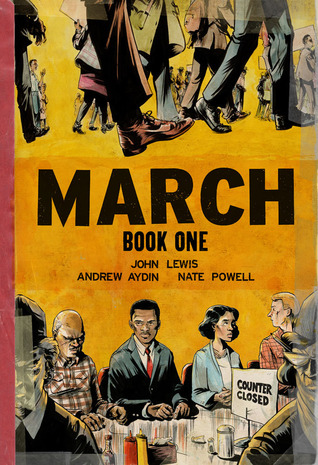
March: Book One by John Lewis, Andrew Aydin, and artist Nate Powell, won the National Book Award and the Robert F. Kennedy Book Award – Special Recognition. This graphic memoir blends the appeal of graphic novels with the history lived by one of our greatest civil rights movement members and leaders. Lewis tells his story through flashbacks and stories told to others, mirroring the oral tradition of many who have come before us. Each story offers a compelling narrative of life at the beginning of the movement and the drive to overcome a system meant to oppress.

Lewis is not just retelling his past to offer a lesson for the future, but he’s providing a framework for those in today’s society looking for ways to improve America for themselves and others. He sees chickens not as objects, but as individuals with their own emotions and goals. Lewis then has to confront his lack of emotional attachment when chickens are available for purchase and he does not have to care for them as he did on the farm. In many ways, this is how we view strangers — while we know they are individuals and human, we are distant from them because we fail to interact with them and get to know them — to build connections.

He talks of kindness and a need to help others learn to connect with one another and to become kinder. Lewis, however, never glosses over the violence or the hatred he experienced and the chances he took. Powell’s artistry is vivid even in black-and-white and readers will see the fear pour off in sweat. They will face the ugliness of hatred manifest in beatings and more.  March: Book One by John Lewis, Andrew Aydin, and artist Nate Powell is a graphic memoir and more — it is history, it is humanity, and it is a powerful reminder of how far we’ve come and how far we have stepped backward.

RATING: Cinquain

About the Author:

John Robert Lewis is the U.S. Representative for Georgia’s 5th congressional district, serving since 1987 and is the dean of the Georgia congressional delegation. He was a leader in the American Civil Rights Movement and chairman of the Student Nonviolent Coordinating Committee (SNCC), playing a key role in the struggle to end segregation. He is a member of the Democratic Party and is one of the most liberal legislators.

Reached by Ally Condie (audio)

Source: Public Library
Audio, 11 CDs
I am an Amazon Affiliate

**If you missed my first review, this one could contain spoilers for Matched or the second review for Crossed.**

Reached by Ally Condie, narrated by Kate Simses, Jack Riccobono, and Matt Burns, reveals so many things that were forgotten by the characters or that other characters they meet along the way reveal to them. The backstory is here in the third book about the Society and the Rising, and all of the factions that are outside the two main struggling societies. Cassia continues to find her way through the darkness with Ky (who may not always be at her side), and Xander faces his own struggles as the plague ravages the population, even those inoculated with the vaccine provided by the Rising.

As a medic, he sees the stillness take hold of his friends and colleagues and the fear in their eyes. He is dutiful and eager to follow those he believes in. Cassia wants to find an end to the suffering; she’s looking for a way to inoculate the Society and the Rising with beauty. She finds it in the Gallery where people come to share their art and poems and songs. Like many things in these controlled societies, the beauty and originality is snuffed out. Ky, on the other hand, still tries to stay below the radar. The only one he believes in is Cassia.

This triangle of characters and their love for one another — though different for all of them — is heartening as they tackle the nearly impossible with only their faith in each other to guide them. Although there are moments of repetition when Cassia begins to regain some of her memories long after she was forced to take a red pill to forget, it is in line with the world Condie has created. The narrators are well matched with their characters, though Xander’s point of view is less robotic in this book compared to the last. The dialogue for him as improved.

Reached by Ally Condie, narrated by Kate Simses, Jack Riccobono, and Matt Burns, is a series of books that requires patience with the world and tension building. Readers will be satisfied with its conclusion as these societies tackle a mutated plague together and come out the other side eager to rebuild and collaborate with one another (even if only tentatively).

RATING: Quatrain

About the Author:

Ally Condie is a former high school English teacher who lives with her husband, three sons and one daughter outside of Salt Lake City, Utah. She loves reading, running, eating, and listening to her husband play guitar.

A Lowcountry Christmas by Mary Alice Monroe

Source: publicist
Hardcover, 384 pgs.
I am an Amazon Affiliate

A Lowcountry Christmas by Mary Alice Monroe — which is the 5th book in a series but can be read as a standalone novel — is set in McClellanville, S.C., a small town with a very tight-knit community.  The McClellan family has lived there for generations, but when the shrimp industry dries up forcing Captain Alistair to give up his boat and find odd jobs to make ends meet, the family is faced with tough choices. Miller is 10-years-old and he has little concept of his family’s finances. He goes to school, misses his brother who is at war, and wants a puppy for Christmas. Jenny, his mother, has better news for her family when she learns her oldest son, Taylor, is coming home.

“You might not believe me, but the desert and the ocean are similar. They’re both immense in a way that defies comprehension. I’ve ridden in a Humvee across miles of endless sand under a merciless sun and sailed a shrimp boat on the dark sea when the dawn broke across the horizon, and in both places I felt the vastness. It made me feel small and insignificant. Isolated and alone. Both desert and sea are unforgiving terrain and don’t tolerate fools.” (pg. 10-1)

Monroe’s prose is meditative as it alternates from Miller, Jenny, and Taylor’s points of view. The coming home of Taylor is much anticipated by Jenny, and while Miller is thrilled, he’s still longing for the pup his father has said they cannot afford. Post-traumatic stress disorder (PTSD), however, soon becomes the storm cloud that further darkens the McClellan’s door. The story would only be partly told without all three points of view, as Monroe provides a broader view of how PTSD affects not only the patient but also the family around them.

“He might have been hurt by a bomb, but he made this house like a minefield for the rest of us.” (pg. 158)

A Lowcountry Christmas by Mary Alice Monroe is a heartwarming story about how to heal after trauma and how important family support can be for those with PTSD.

RATING: Quatrain

About the Author:

New York Times bestselling author Mary Alice Monroe found her true calling in environmental fiction when she moved to coastal South Carolina. Already a successful author, she was captivated by the beauty and fragility of her new home. Her experiences living in the midst of a habitat that was quickly changing gave her a strong and important focus for her books.

Mary Alice Monroe writes richly textured books that delve into the complexities of interpersonal relationships and the parallels between the land and life. Monroe’s novels are published worldwide. She has achieved many lists, including the New York Times, USA Today and SIBA. She has received numerous awards, including several Readers’ Choice Awards.

Mailbox Monday #404

Mailbox Monday, created by Marcia at To Be Continued, formerly The Printed Page, has a permanent home at its own blog.

To check out what everyone has received over the last week, visit the blog and check out the links. Leave yours too.

Also, each week, Leslie, Vicki, and I will share the Books that Caught Our Eye from everyone’s weekly links.

Here’s what I received:

March, Vol. 1-3 by John Lewis, Andrew Aydin, Nate Powell, which I purchased.

Congressman John Lewis (GA-5) is an American icon, one of the key figures of the civil rights movement. His commitment to justice and nonviolence has taken him from an Alabama sharecropper’s farm to the halls of Congress, from a segregated schoolroom to the 1963 March on Washington, and from receiving beatings from state troopers to receiving the Medal of Freedom from the first African-American president.

The Performance of Becoming Human by Daniel Borzutzky, which I purchased.

Winner of the 2016 National Book Award in Poetry. Daniel Borzutzky’s new collection of poetry, The Performance of Becoming Human, draws hemispheric connections between the US and Latin America, specifically touching upon issues relating to border and immigration policies, economic disparity, political violence, and the disturbing rhetoric of capitalism and bureaucracies. To become human is to navigate these borders, including those of institutions, the realities of over- and under-development, and the economies of privatization, in which humans endure state-sanctioned and systemic abuses. Borzutzky, whose writing Eileen Myles has described as “violent, perverse, and tender” in its portrayal of “American and global horror,” adds another chapter to a growing and important compilation of work that asks what it means to a be both a unitedstatesian and a globalized subject whose body is “shared between the earth, the state, and the bank.”

The Sympathizer by Viet Thanh Nguyen, which I purchased.

The winner of the 2016 Pulitzer Prize for Fiction, as well as five other awards, The Sympathizer is the breakthrough novel of the year. With the pace and suspense of a thriller and prose that has been compared to Graham Greene and Saul Bellow, The Sympathizer is a sweeping epic of love and betrayal. The narrator, a communist double agent, is a “man of two minds,” a half-French, half-Vietnamese army captain who arranges to come to America after the Fall of Saigon, and while building a new life with other Vietnamese refugees in Los Angeles is secretly reporting back to his communist superiors in Vietnam. The Sympathizer is a blistering exploration of identity and America, a gripping espionage novel, and a powerful story of love and friendship.

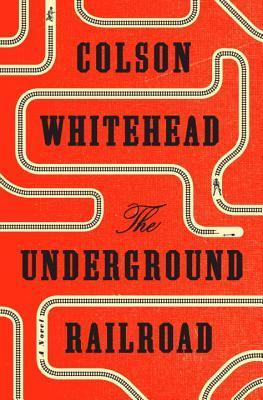
The Underground Railroad by Colson Whitehead, which I purchased.

Cora is a slave on a cotton plantation in Georgia. Life is hellish for all the slaves but especially bad for Cora; an outcast even among her fellow Africans, she is coming into womanhood – where even greater pain awaits. When Caesar, a recent arrival from Virginia, tells her about the Underground Railroad, they decide to take a terrifying risk and escape. Matters do not go as planned and, though they manage to find a station and head north, they are being hunted.

In Whitehead’s ingenious conception, the Underground Railroad is no mere metaphor – engineers and conductors operate a secret network of tracks and tunnels beneath the Southern soil. Cora and Caesar’s first stop is South Carolina, in a city that initially seems like a haven – but the city’s placid surface masks an insidious scheme designed for its black denizens. Even worse: Ridgeway, the relentless slave catcher, is close on their heels. Forced to flee again, Cora embarks on a harrowing flight, state by state, seeking true freedom.

As Whitehead brilliantly re-creates the unique terrors for black people in the pre-Civil War era, his narrative seamlessly weaves the saga of America from the brutal importation of Africans to the unfulfilled promises of the present day. The Underground Railroad is at once a kinetic adventure tale of one woman’s ferocious will to escape the horrors of bondage and a shattering, powerful meditation on the history we all share.

The Many Lives of Fitzwilliam Darcy by Beau North and Brooke West, a giveaway win.

After Elizabeth Bennet rejects his marriage proposal, Fitzwilliam Darcy finds himself in the most unusual of circumstances. At first believing the extraordinary turn of events has granted him an inexplicable boon, he is eager to put the humiliating proposal behind him.

He soon discovers that he is trapped in the same waking dream with no end in sight and no possible escape. All that he holds dear—his name, his home, his love—remains ever out of reach. How will he find his way back to his normal life? Will one mistake haunt the rest of his days? It will take all of his fortitude to weather the storms of his strange new fate, and all of his courage to grasp the promise of his future.

What did you receive?