Quantcast

Interview With Poet Hadara Bar-Nadav

I’ve been working on a interview project with Deborah at 32 Poems magazine, and she kindly allowed me to interview past contributors to the magazine. We will be posting the interviews throughout the coming months, and our ninth interview posted on Deborah’s Poetry Blog of 32 Poems on April 20. I’m going to provide you with a snippet from the interview, but if you want to read the entire interview, I’ll provide you a link for that as well. For now, let me introduce to you 32 Poems contributor, Hadara Bar-Nadav.

ALARM PLEASURES INTO HUM
Published in Verse 23.1-3 (2006).

Mutiny awakens me,
the kingdom buzzing with saws,
all the fetishes abloom

which means a rubbing away until
blood or speech, each
to his own bright unraveling.

Red lives here, a nest
of nerves and twigs.
Doors unhinge and the roof

speckled with stars:
holes, navels, scars.

I have no floor,
no caviar, no mints.

I am humble as a tooth
and hunger.

And you are the messenger
without bell or tongue.

You are the messenger.

Come. Come.

1. Most writers will read inspirational/how-to manuals, take workshops, or belong to writing groups. Did you subscribe to any of these aids and if so which did you find most helpful? Please feel free to name any “writing” books you enjoyed most (i.e. Bird by Bird by Anne Lamott).

Books of poetry and art have been my best teachers, along with studying music. Jazz was my first teacher, I believe. Though I had written poetry since I was a child, it was when I was a teenager and started listening to jazz that I really started to study language, to think about its rhythms and sounds, and to wonder what I could do with language, how far I could push it.

I didn’t have an active writing community until I went to graduate school at the University of Nebraska-Lincoln. Now that I live in Kansas City, I meet informally with a few poets and we discuss each other’s work. I also email poems to friends for feedback, if needed.

As for books on craft, I like Tony Hoagland’s Real Sofistikashun, which I use in my poetry workshops. Hoagland is smart, has a sense of humor, and doesn’t take himself too seriously.

2. When writing poetry, prose, essays, and other works do you listen to music, do you have a particular playlist for each genre you work in or does the playlist stay the same? What are the top 5 songs on that playlist? If you don’t listen to music while writing, do you have any other routines or habits?

Generally, I don’t listen to music when I read or write. It’s too distracting. However, PJ Harvey, Beck, and the soundtrack to The Royal Tennenbaums have all figured into my manuscripts. The rise and fall and various intensities of PJ Harvey’s Is This Desire helped me come up with the final configuration of my first book, A Glass of Milk to Kiss Goodnight.

3. Do you have any favorite foods or foods that you find keep you inspired? What are the ways in which you pump yourself up to keep writing and overcome writer’s block?

Chocolate. And Jersey pizza, bagels, and cannolis, which I miss now that I live in the Midwest.

As far as keeping myself pumped up, when I’m not writing, I revise. When I’m not revising, I send out. Or I read, or go to a museum, or get art books from the library. I’m not sure chocolate helps me do any of these things, but I like it. A lot.

About the Poet:

Hadara Bar-Nadav’s book of poetry A Glass of Milk to Kiss Goodnight (Margie/Intuit House, 2007) won the Margie Book Prize. Recent publications appear or are forthcoming in Beloit Poetry Journal, Colorado Review, Denver Quarterly, The Iowa Review, The Kenyon Review, Ploughshares, Prairie Schooner, TriQuarterly, Verse, and other journals. She is an Assistant Professor of English at the University of Missouri-Kansas City. Of Israeli and Czechoslovakian descent, she currently lives in Kansas City with her husband Scott George Beattie, a furniture maker and visual artist.

Want to find out what Hadara’s writing space looks like? Find out what she’s working on now, her obsessions, and much more. Check out the rest of my interview with Hadara here. Please feel free to comment on the 32 Poems blog and Savvy Verse & Wit.

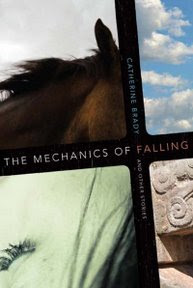
The Mechanics of Falling by Catherine Brady

Welcome to the TLC Book Tour for The Mechanics of Falling and Other Stories by Catherine Brady. You’re in for a real treat today, not only a review, but also an interview and giveaway for my U.S. readers.

They came back inside to find Owen still at the table, a shot glass engulfed by his long, broad-tipped fingers. He was older than the others, his face taut and creased, so tall that he had to slouch in his chair to keep his knees from banging the table. He claimed he was the only black man within a radius of ten miles. What am I doing here? he said. I can’t walk through the campgrounds alone at night. (“Looking for a Female Tenet,” Page 7)

Catherine Brady’s had a lot of practice writing short stories, and it shines through in The Mechanics of Falling & Other Stories. In “Slender Little Thing,” Brady modifies a poetic form, known as Pantoum, in which the second and fourth lines of the first stanza are repeated as the first and third lines of the next stanza. The Pantoum is a variation of the Villanelle, in which the first and third lines in a three line stanza poem are repeated as a refrain alternately throughout the poem. Here’s an example of a Pantoum and an example of a Villanelle. Poets interested in form will enjoy this story because it uses a version of these forms to hammer home the heart of the story where a mother, Cerise, struggles with her lot in life as a nanny to richer parents and as a nurse assistant in a nursing home while trying to raise her daughter, Sophie, to be more than she is.

“The Dazzling World” packs a punch when Judith and Cam are robbed at gunpoint in a foreign country on their way to meet Judith’s sister at her archaeological dig site. Not only does this story immerse readers in a foreign nation, it also leads them on a journey of discovery, almost rediscovery for Judith.

While these stories are each around 20-30 pages each, the characters are complex and on the verge or dealing with a perspective shattering event. Many of these characters are somber, and more than complacent–resigned–until an event jars them awake to look at their world through different eyes.

She pulled a compact from the purse that still hung open on her arm, angling the mirror to examine her hair, reaching up to snag unruly strands. Of the beautiful, fluttering girl, only this artlessness remained. (“Scissors, Paper, Rock,” Page 85)

Settings in this volume of short stories are varied; the characters share common traits, but lead different kinds of lives–two young waitresses trying to pay for college and find themselves, a horse rancher and his roommate’s game of relationship chess, a mother trying to raise her daughter successfully and send her off to college, a couple whose relationship is disintegrating, and many more. Readers will enjoy the surface of these stories as well as their deeper meanings beneath the layers of protective skin. Brady’s prose is captivating and thought provoking all in just a few lines, and she easily fuses poetic lines and techniques into her narratives. (I should have asked her if she writes poetry.)

I want to thank Catherine Brady for her time in answering my questions about her writing. Check out the giveaway details after the interview. Without further ado, here are her answers:

1. I noticed on your website that you’ve published a number of successful short story collections. What is it about your execution of the genre that you think has made it so successful and do you have plans to expand into novel writing?

I feel lucky to have published three collections and for my work to be included in Best American Short Stories. I have a little bit of trouble defining success. If I were fully satisfied by any of my stories, I could quit and take it easy. I think you keep writing because you haven’t achieved all your ambitions for your work. The short story is such a challenging form that there’s plenty left for me to shoot for, and I really, really love the form. I could probably do a better job of defining what I am aiming for than guessing whether I’m successful or not.

I believe a good story satisfies any reader in the most basic way—you care about the characters and their fate. Art always opens a door for any reader, so if you like the plot, or connect with the characters, or enjoy the language, or even dissect every sentence, the story should reward you for whatever effort you are willing to make (and reward you more for more effort). The kind of story I hope to write is one that asks the reader to do some of the imagining and promises to engage her heart as well as her mind.

I am working on a novel right now, and I’ve really been enjoying the writing, which has never been true when I’ve attempted a novel before. So maybe someday I’ll have a novel.

2. Do you find publicizing your short story collections is more challenging that it would be to market a novel? Why?

Yes. It’s more difficult to promote stories. People assume they’re going to be literary and obscure and more difficult than a novel, and nobody really expects you to sell very many copies. It’s much easier to label a novel as being about a specific subject, and what people most enjoy about novels is the chance to get really intimate with a character. A book of stories keeps moving you on to a new set of characters and then another new set. BUT . . . each story should offer you the sudden, deep knowledge of another person that you experience in life when you’re thrown together with someone in a crisis. Which is a different kind of satisfaction.

3. Would you like to share some of your obsessions and how they keep you motivated or inspired?

In a story collection, you’re often writing about people whose lives have unexpected things in common. You get to explore how different people might be dealing with similar or related predicaments, and for me, the best thing about this is that each story poses its own truth, and each truth is partial. I’m obsessed with “yes, but” kinds of questions.

I’m also really motivated to write because you don’t know what will happen once you really get to work. You might think the story is headed in a particular direction, but nine times out of ten, surprises crop up. I often anticipate a story is going to end at a certain point, and I’ll be writing away when all of a sudden, much sooner than I’d expected, the ending just leaps up and declares itself. I’m also obsessed with grammar—prim pince-nez correctness but also the way that you can use sentence structure to build out a story, to make it more three-dimensional. I have strong personal feelings about punctuation, I like to pile up things in a long list, I hate semi-colons—you get the idea. Writing is something of a fetish. But it’s also a craft, and I want to get better at making a beautiful object. Musical sentences. Surprising images. Intricate little tricks that a reader might never notice, but I’ll know that they are there. So, for example, in The Mechanics of Falling and Other Stories, there are images of boxes and containers in nearly all the stories, which makes sense for a collection that’s concerned with how people are held in place in their lives, when that feels like safety and when it feels like a trap. I like knowing that there is this “below the radar” connection among the different stories.

4. If you could choose your favorite story from The Mechanics of Falling and Other Stories, what would it be and why?

I probably have a few favorites. I’m partial to “Slender Little Thing,” because it has a form that uses repetition in ways that aren’t supposed to be used in stories. I like to break rules once in a while, and this is also a story that means a lot to me personally. The main character is someone whose life can seem really hemmed in if you take a certain view of her, and one of the reasons I wanted to use repetition was to get that perspective on the page, so that I could then try to counter it. Let the reader see what’s wearingly repetitive and also what can’t be accounted for by a simple summing up of her life.

I also like “Dazzling World” and “Looking for Female Tenet.” I like “Wicked Stepmother” at least in part because some people have mentioned they didn’t much like the main character, and you always defend the child who’s being criticized by someone else.

5. Please describe your writing space and how it differs (if at all) from your ideal writing space.

I like the space that I’m working in. My home office opens on to our tiny back yard so I’ve got great light and I can look out at our garden. I’ve crammed in as many books as will fit, and I have a great big desk so that I can make a mess when I’m working and scatter papers all over. I really need to have my favorite books close by—when I get stuck, I just open a book of Pablo Neruda’s poems or Alice Munro’s story so I can remember that anything is possible, that a sentence might lead anywhere. It also helps to bow several times before Chekhov’s collected stories.

About the Author (From Brady’s Website):

Catherine Brady’s most recent collection, The Mechanics of Falling & Other Stories, was published in 2009. Her second short story collection, Curled in the Bed of Love, was the co-winner of the 2002 Flannery O’Connor Award for Short Fiction and a finalist for the 2003 Binghamton John Gardner Fiction Book Award. Brady’s first collection of short stories, The End of the Class War, was a finalist for the 2000 Western States Book Award in Fiction. Her stories have been included in Best American Short Stories 2004 and numerous anthologies and journals. Click Here to Read more about Catherine. Read some excerpts, here. Check out Catherine Brady’s list of appearances and her other tour stops with TLC Book Tours.

***Giveaway Details (Only for U.S. Residents)***

Catherine Brady has offered 1 copy of The Mechanics of Falling and Other Stories to one of my U.S.-based readers.

1. Leave a comment on this post about the review or interview and you receive one entry.

2. Blog or spread the word about this giveaway and leave a comment here with a link.

Deadline is May 1, 2009, 11:59 PM EST.

THIS GIVEAWAY IS NOW CLOSED!

***My Other Giveaways***

Don’t forget to enter the Keeper of Light and Dust giveaway, here and here. Deadline is April 28 at 11:59 PM EST.

There’s a giveaway for 5 copies of Girls in Trucks by Katie Crouch, here; deadline is April 29, 2009, 11:59 PM EST.

Interview with Natasha Mostert, Author of Keeper of Light and Dust

Today is the kickoff for the Natasha Mostert tour of Keeper of Light and Dust, which I offered to review at the request of Sheri at A Novel Menagerie. I want to welcome Natasha Mostert to Savvy Verse & Wit and to thank her for taking time out of her busy schedule to answer a few questions. Readers, you are in for a real treat.

Without further ado, here’s Natasha:

1. Have you always been interested in writing fantasy/science fiction novels? And what about the genre draws you to it?

I like building worlds, which is probably what attracts me to fantasy. However, even though I write about concepts that are considered quite fey, I make sure to embed these ideas into a realistic narrative. I did the same with Keeper of Light and Dust. The book is set in the world of martial arts and very often in martial arts fiction, characters will manage all kinds of incredible physical and mental feats: run up perpendicular walls, float above the ground while engaging in mystical sword play, mesmerize their opponents with a single stare. I did not want to go that route. My characters are real people – in fact, they are composites of fighters I know. I’m their biggest fan — for almost seven years I’ve been following these men and women from fight to fight. I know the problems and injuries they face when training. I know what it smells like in a fighter’s dojo! I understand the rivalries and camaraderie of their world and I hope I have managed to portray this environment accurately. There are of course, mystical elements in Keeper, and my heroine is in possession of a pretty cool skill, but I work very hard not to turn my characters into super heroes.

As for the science bit: well, my novels are idea-driven. With me it always starts with an idea and then I build the book around it. Usually, what happens is that I’ll read a work of nonfiction, which will kick my imagination into overdrive. Before I wrote Keeper I happened to read – quite by chance – a book about light emissions inside the human body. I never knew that all of us carry tiny fugitive pulses of light inside of us and the idea was so mind-blowing that I immediately knew I wanted to use it in my story. And so I created the character of my villain – a biophotonic expert who has cracked the secret of how to steal the light and vital energy from his victims and make it his own.

Many fantasy writers like to use recurring characters and themes. It is important to me not to repeat myself. Each of my books, I hope, is unique in its own right. It would be far easier to write sequels and keep to the same formula, but I would find that boring and I like to challenge myself and my readers. I think I’m lucky in that the people who like my work are the kind of readers who are adventurous and who are willing to follow me when I enter uncharted territory.

2. I noticed on your Website that one of your future goals is to write poetry. What has kept you from realizing this goal? Have you worked your way toward meeting this goal yet?

Poets are the Zen masters of the writing world. When you write a poem every word counts and there is no room for fat or flab. That kind of discipline is daunting to a writer of prose! I’ve written poetry for my eyes only and maybe one day I’ll find the courage to send it on to my editor. But it is not only lack of courage that keeps me from pursuing this dream, it also lack of time and the demands of having to make a living. My days are so filled with fiction writing and promotion that I hardly have time for anything else. Writing poetry is time consuming. Time – sadly – is the one thing I don’t have.

(I can completely relate to the time-consuming aspect of poetry she discusses here, but I also wouldn’t mind checking out her poetry. Wouldn’t it be vivid and fantastic?!)

3. In keeping with the poetry theme (since it is National Poetry Month here in the U.S.), have you kept up with any contemporary poets and could you name some of your favorites? If you haven’t, please name some of the less contemporary poets you enjoy.

My favourite poets are Philip Larkin and e.e cummings. Pablo Neruda is wonderful, I’m just sad I have to read him in translation. I love the Metaphysical poets – Donne, Marvell, Herbert – and in my first book, Midnight Side, their poetry forms a leitmotiv throughout the narrative. My native language is Afrikaans and my favourite Afrikaans poet – probably my favourite poet, period – is a man by the name of NP Van Wyk Louw. His poetry is stunning.

4. Do you listen to music while writing? What would be your top five songs on a playlist for Keeper of Light and Dust?

Yes, I do listen to music when I write. Music is oxygen. My addiction to music is probably due to the fact that I grew up in a home where music was all-important. My mother is a voice coach for opera singers and when I think back to my childhood, all my memories seem to be set to music. The house was always alive with it.

A playlist for Keeper of Light and Dust? Let’s see:

As this book is a fusion of Oriental mysticism (chi) and cutting-edge Western science (biophotonics), the perfect theme song for this book would be the song Alive by Chinese singer, Sa Ding Ding. Her songs are an intriguing blend of Western and Asian traditions. For those readers unfamiliar with her work, may I suggest that they treat themselves and take a look at the dramatised YouTube video of this song. Just type in Sa Ding Ding and you’ll get to it. (I think this is the link to the video she refers to.)

Keeper is also a story about fighters! These guys live in a gritty world and their training is tough. My song for them would be the theme song from Halo2. Also, that old Rocky classic, Robert Tepper’s song, No Easy Way Out. This last one is maybe just a tad cheesy, but it works!

My heroine, Mia Lockhart, is a healer and a person whose life is steeped in mysticism. I can imagine her listening to Loreena McKennitt’s music: songs such as The Mummer’s Dance or All Soul’s Night. And then there is Tori Amos’s Strange Little Girl, which would be perfect for Mia! Mia’s parents died tragically and there is an undercurrent of sadness to her life.. I can imagine Concerto for Oboe in D Minor: Il Adagio as being the soundtrack.

As for my villain, Adrian Ashton, he is obsessed with finding the secret to living forever, and therefore Alphaville’s Forever Young would be his anthem.

5. If you could pick any other profession, in any time period, what would you choose and why?

Oh, I want to be James Bond! Or at least, the female equivalent. Intrigue, adventure, spying, glamorous locations. Why? Well, I spend my days staring at my computer screen in desperation, snacking obsessively and talking to myself in the mirror. I think this explains it.

6. Please describe your writing space and whether you would consider it your ideal writing space. (Feel free to include a photo or two for the readers, some readers really get a kick out of visuals) Also, what’s the centerpiece of your writing space?

Virginia Woolf famously said that a woman needs a room of her own if she is to write fiction. For me, that is pretty essential as well, and I’m so lucky that I have an office with a stout door I can close.

On a good day my office looks whimsical (I hope), on a bad day it looks like the playground of someone who needs serious help: stacks of paper and printouts, photographs, boxing paraphernalia, sagging pin boards with too many newspaper and magazine clippings, objects d’art made by my godchildren, CDs, many, many little bottles of hand sanitizers (neurotic, don’t tell me, I know) and books, books, books.

The centerpiece is definitely my boxer’s speedball! It has pride of place and whenever I become spaced out from too much writing or find my creativity blocked, it only takes a few minutes of tapping out a rhythm on the ball to get me going again.

As an added treat, Natasha sent along this photo of herself and her friends:

Thanks, Natasha. What great answers! Dear readers, check out my review of her latest book, Keeper of Light and Dust, tomorrow, April 21, and an international giveaway.

***Giveaway Reminder***

Don’t forget to enter The Traitor’s Wife giveaway, here and here.

Interview With Susan Higginbotham, author of The Traitor’s Wife

Hello. I would like to welcome Susan Higginbotham, author of The Traitor’s Wife, which I reviewed here, to Savvy Verse & Wit.

She was kind enough to take some time out of her schedule to answer some great writing questions. Please give her a warm welcome.

1. How would you introduce yourself to a crowded room with audience members eager to hang on your every word? What would you disclose? What would you keep secret? and why?

Well, if it’s a secret, I wouldn’t tell it here, would I? I’m not a let-it-all-hang-out person, so I’d probably talk about my books and/or the history behind them and crack a few jokes.

The most successful speech I ever made was in law school when as an exercise to get us used to arguing in front of a jury, the professor had us get up and tell a story about ourselves. I told my classmates about the time I had gone to my college library to study for my biology exam and the man sitting in the seat near me exposed himself, which was a bit too much biology for me. My classmates loved it.

2. Do you have any writing routines or habits?

I try to write pretty diligently once the family goes to bed, and I have my writing space all to myself. It’s hard to avoid the temptation to surf the Internet instead of staring at a blank monitor, but I’m getting more disciplined.

3. Do you have any obsessions that you would like to share?

Aside from medieval history, I’m passionate about Coca-Cola, Barbie dolls, old graveyards, Mini-Coopers (I don’t own one, but I love to admire their sheer cuteness), checking my Amazon ranking, and finding new ways to waste my time on the Internet. (Don’t we all have this problem? I know I do.)

4. Most writers will read inspirational/how-to manuals, take workshops, or belong to writing groups. Did you subscribe to any of these aids and if so which did you find most helpful? Please feel free to name any “writing” books you enjoyed most (i.e. Bird by Bird by Anne Lamott).

I used to read Writer’s Digest and The Writer every month when I was in my teens and twenties—which was a couple of decades ago–but I finally stopped. I think after a while the advice just started getting repetitive. I began to concentrate more on reading novels and noting what techniques worked for me as a reader and what didn’t work—I found that helped me as a writer immensely.

5. When writing The Traitor’s Wife, did you have a specific list of songs that you listened to; if so what would be the top 5? Or if you could choose a list of five songs to represent your work, what would they be?

I don’t listen to music while I write; I find it too distracting, but I did find that I tended to associate certain songs with The Traitor’s Wife. I’m going to be lazy and give you a link to the interview Julie K. Rose did for me, where I listed five songs back when the writing process was fresher in my mind.

Now that I have an iPod like the rest of the civilized world, if I was asked this question with regard to my current work in progress, I could answer in a flash! Back then I was at the mercy of whatever was playing on the radio.

6. In terms of friendships, have your friendships changed since you began focusing on writing? Are there more writers among your friends or have your relationships remained the same?

My core relationships have pretty much stayed the same, but I’ve met some great folks online, writers and readers alike, through my novel. It is nice to have other writers to whine to. (AMEN!)

7. How do you stay fit and healthy as a writer?

I don’t have any of the epic bad habits associated with writing—no booze, no drugs, no cigarettes. It’s awfully tempting when I’ve had a good writing spell to reward myself with a nosh, however—writing can be very dangerous that way. I try to work out once a week, at least in theory, and the dog and I take a nightly walk together. Thank goodness he’s not a cat or I’d never get any exercise. (I’ve now got a new-to-me word for Wondrous Words Wednesday; can you guess what it is?)

8. Do you have any favorite foods or foods that you find keep you inspired? What are the ways in which you pump yourself up to keep writing and overcome writer’s block?

I have an extremely limited diet, with Coca-Cola and pork being the main staples. I’m picky; it’s a family legend.

Having a blog is a great way to avoid writer’s block. If I’m not working on my novel, I can at least find something to blog about, even if it’s just doing a meme.

9. Please describe your writing space and how it would differ from your ideal writing space.

Ideally, I would have a book-lined study in a city brownstone with the soothing noise of traffic outside my window. (I would enjoy this writing space as well)

In reality, I have a corner of the kitchen of my small suburban home in which to write, with no doors to close against the noise from the rest of the house. Because of that, I do most of my writing when the rest of the family is sleeping.

10. What current projects are you working on and would you like to share some details with the readers?

I just finished the first draft of my third novel, which is set during the Wars of the Roses. It bucks a trend in that it’s not particularly sympathetic toward Richard III. It’s narrated by Henry Stafford, the Duke of Buckingham, and his wife, Katherine Woodville, sister to Queen Elizabeth Woodville. It’s been quite fun to write, and I’ve gotten into some great (mostly friendly) arguments during the process.

Thanks for the interview! I loved these questions, once I got into the swing of them.

Thank you, Susan, for answering these unusual questions. What did you think of Susan and her answers?

***Giveaway***

I have 3 copies for U.S./Canada residents available from Sourcebooks and 1 copy, my gently used ARC, for an international recipient.

1. Please leave a comment here on my review about your favorite historical novel for 1 entry.

2. For a second entry, come back tomorrow and leave a comment on my interview with Susan Higginbotham.

3. Spread the word about the giveaway and leave a link on this post for a third entry.

***Remember to leave your email address and indicate if you are international in your comments***

Deadline is April 22 at 5PM

Interview With Jill Mansell, Author of An Offer You Can’t Refuse


I want to provide a warm welcome to Jill Mansell, who is stopping by Savvy Verse & Wit as part of her tour with Sourcebooks. I had an opportunity to interview her, and she was gracious enough to answer a few questions. If you missed my review of An Offer You Can’t Refuse, check it out.

1. On average from the first word on the page to publication, how long was the process? What tips could you offer aspiring authors about the process?

I spent a while finding my genre, but once I’d decided to write the kind of books I liked to read myself – contemporary women’s fiction with drama and humour – it was fairly straightforward. I was working full time in a hospital and had a hectic social life, so writing was confined to an hour or two whenever I could squeeze it in. It took me two years to write the whole book, about 160,000 words. It was rejected by the first agent I sent it to, who said that too much happened in it. The second agent turned it down, saying that not enough happened in it! The third agent phoned me up and told me she loved the book and knew she could sell it. That was one of the happiest moments of my life and twenty years later she is still my agent.

Tips for writers – experiment with different writing styles until you find the one that suits you best. I’ve tried so many times to write in the first person, but it just doesn’t work for me and I’ve now accepted that I am a third-person writer. Experiment with genres too. I tried to write straight romance but found I couldn’t keep the comedy out of my novels, which was why they were rejected time and time again. My biggest tip is to use a time-line when plotting out your novel. This keeps characters and events under control and stops you getting to the end of the book then realising you’ve left some vital aspect or character out!

2. Most writers will read inspirational/how-to manuals, take workshops, or belong to writing groups. Did you subscribe to any of these aids and if so which did you find most helpful? Please feel free to name any “writing” books you enjoyed most (i.e. Bird by Bird by Anne Lamott).

Gosh, I can’t now remember the names of all the how-to-write books I devoured – most of them, probably! We’re always searching for the one that will answer the unanswerable questions, aren’t we? And cast its magic spell! But I attended a local evening class in creative writing and loved it, especially for the camaraderie and the sheer relief of finally meeting other people who had the same urge to write that I did. This was in the days before the internet so I’d never known any other writers before that. We supported each other when the rejection slips arrived and celebrated each other’s successes. Twenty-odd years later, several of us are still in touch and we meet for lunch. Four of us are now published novelists.


3. How do you stay fit and healthy as a writer?

Fit and healthy? Yikes! I’m lucky in that I don’t do much at all but so far I seem to be surviving. I eat a lot of junk while I’m writing (by hand, with my Harley Davidson fountain pen, in big writing pads.) I sit on my sofa with my feet up on the coffee table and the TV on (for research purposes.) I joined a gym a couple of years ago but never found it enjoyable and ended up making more and more elaborate excuses as to why I couldn’t get there.

4. Do you have any obsessions that you would like to share?

Writing obsessions? Or general ones like: Can’t eat two biscuits, it has to be three? OK, I plan my books initially in beautiful leather-bound decorative notebooks and my handwriting while I’m doing this is completely different to my normal handwriting. I don’t plan the whole book in advance, just a certain amount, enough to start the ball rolling. I have several beautiful fountain pens I use for my novels. My mum used to type my books for me and now my daughter is doing it. (Not out of love, I hasten to add. I have to pay her.) I can’t compose fiction onto a screen – it has to flow out of the end of the pen for me. I write the story first and divide it up into chapters afterwards. Oh, and there’s still nothing lovelier than starting a fat, pristine, brand new writing pad!

5. Please describe your writing space and how it would differ from your ideal writing space.

I write in our living room when I have the house to myself. Big room, red painted walls, French windows leading out onto the garden with sports fields beyond, so I can hear the sports being played while I’m working. If the kids are home from school they banish me upstairs to the bedroom, which is also rather beautiful. There, I sit up in bed to work and have an uninterrupted view of the sportsmen playing soccer, tennis, and cricket in the sports fields over our fence. It’s a tough job, this writing business.

What kind of view would I choose if I could have anything? Exactly the same, but with snow-capped mountains in the distance. I love mountains but sadly we don’t have any in this corner of England. A surfing beach would be pretty cool too. With plenty of fit surfers. Could you arrange that for me? Thanks so much!

6. What current projects are you working on and would you like to share some details with the readers?

I’ve had twenty books published here in the United Kingdom, but I’m just starting out in the United States. The next one to come out over in America is one of my absolute favourites – it’s called Miranda’s Big Mistake and has made more readers laugh and cry than almost any of the others. (I do love making people cry!) Set in London, England, this book features a hairdresser, a journalist who passes himself off as a street beggar, and the world’s most irresistible racing driver. Miranda’s Big Mistake will be in stores in June!

So this has been me. I do hope you’ll look out for my book, An Offer You Can’t Refuse. If you enjoy sparky, feel-good fiction, give my work a try. Fingers crossed, you might like it. I do hope so!

Thanks again, Jill, for stopping by Savvy Verse & Wit, and sharing your thoughts with us about your writing process and obsessions. Good Luck with your U.S. publications.

***Giveaway***

Sourcebooks has offered 1 copy of Jill Mansell’s An Offer You Can’t Refuse to one lucky U.S. or Canadian reader.

All you have to do is comment on this post with something other than “pick me” or “enter me.”

If you missed the review, you can leave a comment there for another entry.

Deadline is April 11, Midnight EST.

Interview With Poet Dan Albergotti

Things to Do in the Belly of the Whale

by Dan Albergotti

Measure the walls. Count the ribs. Notch the long days.
Look up for blue sky through the spout. Make small fires
with the broken hulls of fishing boats. Practice smoke signals.
Call old friends, and listen for echoes of distant voices.
Organize your calendar. Dream of the beach. Look each way
for the dim glow of light. Work on your reports. Review
each of your life’s ten million choices. Endure moments
of self-loathing. Find the evidence of those before you.
Destroy it. Try to be very quiet, and listen for the sound
of gears and moving water. Listen for the sound of your heart.
Be thankful that you are here, swallowed with all hope,
where you can rest and wait. Be nostalgic. Think of all
the things you did and could have done. Remember
treading water in the center of the still night sea, your toes
pointing again and again down, down into the black depths.

“Things to Do in the Belly of the Whale” by Dan Albergotti from The Boatloads.© BOA Editions, Ltd., 2008.

I’ve been working on a interview project with Deborah at 32 Poems magazine, and she kindly allowed me to interview past contributors to the magazine. We will be posting the interviews throughout the coming months, and our eighth interview posted on Deborah’s Poetry Blog of 32 Poems on March 31. I’m going to provide you with a snippet from the interview, but if you want to read the entire interview, I’ll provide you a link for that as well. For now, let me introduce to you 32 Poems contributor, Dan Albergotti :

1. Not only are you a contributor to 32 Poems, you are a professor of English at Coastal Carolina University and have a full-length collection of poems published called The Boatloads. You also have an MFA in Creative Writing and a PhD in Literature. Do you think poets have an easier time getting published with higher credentials? Why or Why not? Also of your “hats,” which do you find most difficult to wear and why?

Over the years, I’ve occasionally heard this suspicion that having a good cover letter can get you “in” at magazines and presses. I just don’t buy it. Only the work matters to editors. And if a lot of people being published have degrees in creative writing, isn’t there a rival hypothesis to the idea that the degree “got them in”? Doesn’t it make sense that someone who committed two-to-four years of his of her life to study writing at a post-graduate level might just have developed abilities to the point that he or she is writing poems worthy of being published?

I do wear a lot of hats, and it’s difficult in the sense that it stretches my economy of time very thin. But I’m lucky in that every hat I wear–as writer, teacher, editor–is wonderful, so it’s hard to apply the word “difficult” to any of it. I’m blessed, really.

2. Do you have any obsessions that you would like to share?

This will be my “J” response: Joy Division, Jack Gilbert, John Keats, Joss Whedon, Jeff Mangum (of Neutral Milk Hotel). I might be obsessed with the tenth letter of the alphabet.

3. When writing poetry, prose, essays, and other works do you listen to music, do you have a particular playlist for each genre you work in or does the playlist stay the same? What are the top 5 songs on that playlist? If you don’t listen to music while writing, do you have any other routines or habits?

I don’t really have any routines or playlists, but I love your question, and since you opened the door with your invitation of a “top five,” I will seize the opportunity to list my five favorite albums of all time, if for no other reason than to promote them to other people:

The Clash, London Calling

Radiohead, OK Computer

R.E.M., Murmur

Joy Division, Closer

Neutral Milk Hotel, In the Aeroplane over the Sea

While these aren’t necessarily playing when I’m writing, they are all albums that I find inspiring. I remember that great moment at the 2008 Oscars when Glen Hansard, at the end of his acceptance speech for best original song, exhorted the millions watching to “Make art, make art, make art!” When I listen to these five albums, I want to make art in any way I can. And that’s always a good feeling.

4. What current projects are you working on and would you like to share some details with the readers?

Lately I’ve been writing in form a good bit, which is something I haven’t done in a while (all the poems in The Boatloads are free verse). But I’ve been writing new free verse poems as well. I have a very general idea of the shape that my second full-length manuscript will take based on the kinds of poems I’ve been writing. I don’t have a systematic project to fill a collection, and I tend to avoid such thoughts of larger structures when writing poems. So I’m afraid I have little more detail to provide than “I’m writing poems.”

About the Poet:

Dan Albergotti is the author of The Boatloads (BOA Editions, 2008), selected by Edward Hirsch as the winner of the 2007 A. Poulin, Jr. Poetry Prize. His poems have appeared in The Cincinnati Review, Shenandoah, The Southern Review, The Virginia Quarterly Review, and other journals. In 2008, his poem “What They’re Doing” was selected for Pushcart Prize XXXIII: Best of the Small Presses. A graduate of the MFA program at UNC Greensboro and former poetry editor of The Greensboro Review, Albergotti currently teaches creative writing and literature courses and edits the online journal Waccamaw at Coastal Carolina University in Conway, South Carolina.

Want to find out what Dan’s writing space looks like? Find out what he’s working on now, his obsessions, and much more. Check out the rest of my interview with Dan here. Please feel free to comment on the 32 Poems blog and Savvy Verse & Wit.

Also, check out this interview with Dan on How a Poem Happens.

Interview With Poet Jehanne Dubrow

From the Fever-World
By Jehanne Dubrow

In the fever-world, my dearest,

our hands aren’t clean

for very long, the brambles

biting in our palms,

deep thorns across our life lines–

here, even the shrub

surrendering fruit to the picker

resents the sacrifice and wants

its juices given back in blood.

if you are hungry, starve yourself.

Make a desert of your thirst.

Don’t fall asleep

Here, my dearest,

there’s only wilderness where fields

should be, only the blackberries

concealing knives,

cherries pitted with buckshot

to choke the unsuspecting throat,

and peaches whose centers hold

dark stones of cyanide.

– first appeared in The Barn Owl Review

I’ve been working on a interview project with Deborah at 32 Poems magazine, and she kindly allowed me to interview past contributors to the magazine. We will be posting the interviews throughout the coming months, and our seventh interview posted on Deborah’s Poetry Blog of 32 Poems on March 13. I’m going to provide you with a snippet from the interview, but if you want to read the entire interview, I’ll provide you a link for that as well. For now, let me introduce to you 32 Poems contributor, Jehanne Dubrow :

1. How would you introduce yourself to a crowded room eager to hang on your every word? Are you just a poet, what else should people know about you?

I suppose one of the most interesting things about me is my nomadic childhood. I was born in a little town in Northern Italy and grew up in Yugoslavia, Zaire, Poland, Belgium, Austria, and the United States. Oh, and when I twenty-years-old, I played a gangrenous valley girl in the movie An American Werewolf in Paris (sadly, I ended up on the cutting room floor). I still remember my line: “Claude’s parties are wack!!!”

2. Do you see spoken word, performance, or written poetry as more powerful or powerful in different ways and why? Also, do you believe that writing can be an equalizer to help humanity become more tolerant or collaborative? Why or why not?

For me, written poetry has the emotional force expected of spoken word and performance poetry, while also having a life on the page. I haven’t seen evidence that writing makes us more tolerant or collaborative. Writers tend to be a critical bunch—our craft depends on having a sharp eye and a small sliver of ice in the heart.

3. Do you have any obsessions that you would like to share?

I have an odd mix of obsessions, half scholarly and half not-so-much: Holocaust studies, American Jewish literature, my dog Argos, midcentury modern design, and Hermes scarves.

4. Poetry is often considered elitist or inaccessible by mainstream readers. Do poets have an obligation to dispel that myth and how do you think it could be accomplished?

Nowhere else in the world do people worry or complain about the elitism of poetry. When Americans complain that poetry is elitist, what they’re really addressing is the strong strain of anti-intellectualism in this country. Americans don’t like to feel stupid, and poetry often makes them feel stupid. I don’t think poetry needs to become less elitist; I think we need to do a better job teaching students how to read poems or, for that matter, how to look at paintings, how to listen to operas, how to watch ballets.

From the Spring Issue of 32 Poems by Jehanne Dubrow:

FRAGMENT FROM A NONEXISTENT YIDDISH POET
Ida Lewin (1906-1938)
AlwaysWinter, Poland

2.

Each year, the chill creeps in
By June, our eaves sharp
with iron icicles, our windows
rattling like teeth against the cold
AlwaysWinter we call this town
because the ground won’t thaw,
no matter how we press skin
to skin, make a fire from
this friction we call love.
Thistles remain needles, each blade
of grass a blade that slices
to our soles AlwaysWinter
we say to justify the frozen places
everywhere—the constant
the wind, the tundra buried
deep inside our bones

Want to find out what Jehanne’s writing space looks like? What music she listens to while she writes? Find out what she’s working on now, her obsessions, and much more. Check out the rest of my interview with Jehanne here. Please feel free to comment on the 32 Poems blog and Savvy Verse & Wit.

Jehanne Dubrow’s Bio:

Jehanne Dubrow’s work has appeared in Shenandoah, Poetry Northwest, Gulf Coast, and Prairie Schooner. She is the author of the poetry collection, The Hardship Post, winner of the Three Candles Press First Book Prize (2009), and a chapbook, The Promised Bride (Finishing Line 2007). A second collection, From the Fever-World, won the Washington Writers’ Publishing House Award and will be published in 2009. Her third poetry collection, Stateside, will be released by Northwestern University Press in 2010.

***GIVEAWAY REMINDER***

I also have two copies of Diana Raab‘s My Muse Undresses Me and one copy of Dear Anaïs: My Life in Poems for You. Deadline is March 18 at 5PM EST.

One gently used ARC of Reading by Lightning by Joan Thomas; Deadline is March 20 at Midnight EST.

Interview With Poet Andrea Defoe

I’ve been working on a interview project with Deborah at 32 Poems magazine, and she kindly allowed me to interview past contributors to the magazine. We will be posting the interviews throughout the coming months, and our seventh interview posted on Deborah’s Poetry Blog of 32 Poems on March 10.

I’m going to provide you with a snippet from the interview, but if you want to read the entire interview, I’ll provide you a link for that as well.

Previously published in Rattle:

“FOR A PIANO ABANDONED IN THE BREADBASKET

Perhaps it was too heavy
for the horses to haul it all the way west
or something else just mattered more.
Maybe someone was jealous
of how the girl played it
as if sweet little veeries were flying out her fingertips:
Snow White of the new frontier.
Maybe she hated it, but probably
it was her favorite thing and alone
nights nothing to smother the hollering
silence she rocked herself and thought
of her piano gathering snow, envisioned
the prairie rodents caching their food
between its wires, elk nosing the keys
in a song so random they could only
think of it like thunder. Maybe some Indian
had found it and grasped its beauty, hauled
it home to pay his dowry. But in the best
of these dreams she was sleeping and the piano’s
legs came to life–this didn’t frighten her,
she’d always known her piano was alive–
and worked its sunken heels out of the soil,
began to march then trot in the path
of the last wheels to pass this way
till one wind-rattled night she’d hear
a peculiar tap and find it there in the dark,
waiting for her to make it sing.

For now, let me introduce to you 32 Poems contributor, Andrea Defoe:

1. You are a contributor to 32 Poems, but what else can you tell us about yourself and your writing life? What do you find difficult about your writing practices?

I’m a stay-at-home parent and presently work from a high traffic area of the house, sharing computer time with my husband and three kids. The most difficult aspect for me is finding time to write when there are few distractions (I choose the word “few,” as there is always some). Functioning as a writer with ADHD is challenging for me, as well — particularly when it comes to reading. I have a lot of books that I’ve begun to read, but relatively few that I’ve been able to finish. A great appeal of poetry is that I can pick up a volume of it, open to any page and read a while without that Ugh! Yet another thing I couldn’t finish… feeling.

2. Do you see spoken word, performance, or written poetry as more powerful or powerful in different ways and why? Also, do you believe that writing can be an equalizer to help humanity become more tolerant or collaborative? Why or why not?

My greatest preference is to go somewhere quiet and be alone with a collection. I fixate heavily on individual lines and phrasings — often walking away, returning, and rereading several times before I finally feel ready to appreciate a poem as a whole package. When the poem is simply read to me in a straight stretch, I feel deprived of that — and at times it feels like an imposition, being told how to hear a poem. I’m of the mindset that a poem belongs to its reader. Having said that, some people give fabulous readings that truly do lend a strong voice to their work, so I can’t say this is how it is all of the time.

“Writing” is such an encompassing word. Even if it’s narrowed to mean simply “poetry” I do think the potential for impact is still huge. Elizabeth Alexander’s recent reading at President Obama’s inauguration springs most readily to my mind. The reading itself sapped the luster out of a good poem, but the discussion it inspired, the attention turned to poetry, were positive things.

3. Do you have any obsessions that you would like to share?

I do have an incredibly studly gray cat I call Sir Otter Von Klaus, but I prefer to keep him to myself.

Want to find out what Andrea’s writing space looks like? What music she listens to while she writes? Find out what she’s working on now, her obsessions, and much more. Check out the rest of my interview with Andrea here. Please feel free to comment on the 32 Poems blog and Savvy Verse & Wit.

Poet Bio:

Andrea Defoe lives with her husband, three children and several pets on the Red Cliff Indian Reservation in Wisconsin. Her poems have appeared in various literary journals, most recently Margie, New American Writing, Now Culture and 32 Poems. In addition to writing she enjoys drawing and painting, but is quite bad at both.

***GIVEAWAY REMINDER***

I have two copies up for grabs of Sharon Lathan’s Mr. & Mrs. Darcy: Two Shall Become One; the giveaway is international and the deadline is March 14 at Midnight EST.

I also have two copies of Diana Raab‘s My Muse Undresses Me and one copy of Dear Anaïs: My Life in Poems for You. Deadline is March 18 at 5PM EST.

One gently used ARC of Reading by Lightning by Joan Thomas; Deadline is March 20 at Midnight EST.

Interview with Poet Diana Raab

I’d like to welcome poet Diana Raab to Savvy Verse & Wit. Yesterday, I reviewed her poetry collection, Dear Anaïs: My Life in Poems for You. You can read my review of her collection, here.

Please welcome Diana:

1. Do you see spoken word, performance, or written poetry as more powerful or powerful in different ways and why? Also, do you believe that writing can be an equalizer to help humanity become more tolerant or collaborative? Why or why not?

I find all forms of poetry powerful—spoken word, performance and written poetry. Poetry nurtures the soul and expresses core emotions and for this reason it can serve as an equalizer to help us all become more tolerant. This is particularly true for what I call “accessible poetry,” or poetry that reaches out with words that the reader can understand, feel or touch.

2. Do you have any obsessions that you would like to share?

My obsession is writing and getting my words out into the universe. I spend at least ten hours a day in my office, either creating or marketing my work. My other passion is reading. I suppose there is a fine line between having an obsession and a passion. For me, writing and reading wear both of these hats.

3. Most writers will read inspirational/how-to manuals, take workshops, or belong to writing groups. Did you subscribe to any of these aids and if so which did you find most helpful? Please feel free to name any “writing” books you enjoyed most (i.e. Bird by Bird by Anne Lamott).

I have been writing since the age of ten, so it would be impossible to list all the books and resources which have inspired me as a writer.

In the 1980s and 1990s, I attended many writing conferences and workshops. There was something contagious about being around other writers producing work. Both The University of Iowa’s Summer Writing Program and AWP have sparked a great deal of interest for me. These days I teach at the conferences and even as a teacher it is inspiring.

As a journaling advocate, I have found that reading the journals of Anaïs Nin helped me find my own voice. This is the main reason I have decided to dedicate this latest book of poems to her.

4. Poetry is often considered elitist or inaccessible by mainstream readers. Do poets have an obligation to dispel that myth and how do you think it could be accomplished?

I think the idea of poetry being elitist and inaccessible is an old concept. Much of contemporary poetry is accessible. I believe that the former poet laureate of the United States, Billy Collins, is greatly responsible for this change. He brought poetry 180 into the schools. His accessible poetry has inspired many people, including myself, to write poetry.

5. When writing poetry, prose, essays, and other works do you listen to music? Do you have a particular playlist for each genre you work in or does the playlist stay the same? What are the top 5 songs on that playlist? If you don’t listen to music while writing, do you have any other routines or habits?

The decision to listen to music while writing depends upon my mood. Sometimes I need music, other times, any bit of noise irks me. If I do listen to music, I might listen to the words of Leonard Cohen and also some instrumental music such as new age music geared towards productivity and concentration.

My writing habit entails working on a few projects at the same time, often times in different genres. I enjoy the variety and find that each genre feeds off the other. However, if I have an impending deadline, I am able to focus and wrap up a project if I either put a ‘Do Not Disturb,’ sign on my door or just go away to an undisclosed place for a writing retreat.

6. In terms of friendships, have your friendships changed since you began focusing on writing? Are there more writers among your friends or have your relationships remained the same?

This is difficult to answer, since I have always written. I have a mix of literary and non-literary friends.

7. How do you stay fit and healthy as a writer?

I work out at the gym with a trainer three times a week. I try to walk every day with my dog anywhere from 30-60 minutes. I also do restorative yoga once a week and meditate every day. All these activities help me focus on my work.

8. Do you have any favorite foods or foods that you find keep you inspired? What are the ways in which you pump yourself up to keep writing and overcome writer’s block?

I do not believe in writer’s block. It’s just an excuse not to write. I think that those who keep journals rarely experience writer’s block. If I am not feeling creative, I will just free-write in my journal and usually something interesting will come of it. Sometimes I read the words of my favorite writers to inspire me. I also often read the journals of Anaïs Nin because both her sensibilities and voice seem to resonate with me.

9. Please describe your writing space and how it would differ from your ideal writing space.

I have a writing studio which is my favorite room in the house. In taking Virginia Woolf’s advice quite seriously, I have found a room with a view overlooking the mountains of southern California. I use a laptop on my desk and there are many bookshelves behind my desk with my favorite books, most of them autographed. I have a painting by Edward Hopper hanging on the wall opposite my desk.

Other framed items include the book jacket of my memoir, Regina’s Closet: Finding My Grandmother’s Secret Journal, and a quote by Mark Twain which says, “The difference between the almost right word and the right word, is really large matter—it’s the difference between the lightening bug and the lightening.” I am a lover of quotations and over the years, I have collected many favorite ones.

10. What current projects are you working on and would you like to share some details with the readers?

I have just finishing editing an anthology I compiled called Writers and Their Notebooks. It is forthcoming by the University of South Carolina Press in February 2010. I am very excited about this collection. It includes essays written by well-published writers who used journals in their practice, such as Dorianne Laux, Sue Grafton, John DuFresne, Kim Stafford, Ilan Stavans, Michelle Wildgen. The preface was written by Phillip Lopate.

I am also working on another poetry collection and a memoir.

11. I’ve noticed reading some of your initial poems that there is an ironic sense near the end of these verses. Was this sense of irony intentional? Like in “Jones Beach” where the mother is an environmentalist and yet serves her children cookies that are appetite suppressants.

Yes. My poems just come out of me in one fell-swoop. They are not premeditated or calculated.

12. Anaïs Nin was a diarist and your poems seem to be like diary entries as well. Did all of these poems come immediately following your in-depth reading of her work or did they evolve over time? Would you consider Dear Anaïs representative of all of your work or do you craft a variety of poem forms and types?

All of my poems were born on the pages of my journal. I create best with pen in hand. I devoted this latest collection to Nin because reading her journals helped me find my voice. I am a narrative poet and yes, my latest book of poetry is a fair representation of my work. I will be experimenting with other forms, but this is representative of my work at this point in time.

Thank you Diane for taking the time out of your busy schedule to answer my questions. I wish you luck with your latest projects and look forward to seeing your latest projects in print.

And now, for the giveaway information: (3 Winners)

Diana has graciously offered one copy of Dear Anaïs: My Life in Poems for You and 2 copies of her chapbook My Muse Undresses Me.

1. Leave a comment about what inspired you to give this collection a try on my review post, here.

2. Comment on this interview with something other than “pick me” or “enter me.”

Deadline is March 18, 5PM EST.

Randomizer.org will select the three winners; the first number selected will win Dear Anaïs: My Life in Poems for You.

Interview With Poet Mary Biddinger

Originally published at La Fovea

MY UPPER PENINSULA
by: Mary Biddinger

We were all suffering from a kind of incandescence.
Would rather fling all the freshly-baked rolls
down the stairs than face the accuser.
I wondered if I was moldering. My mother
didn’t even recognize the ravioli that I edged
with my spinner. I’d filled it with scraps of cloth
anyway. All the girls in my class had hair like Journey
and mouths the slashes of red a wolf leaves behind.
Save me, oh god of direct and swift evacuations.
Some day I would be lecturing a class of students
or getting tangled in the horizontal blinds
in the middle of an emphatic statement. Nobody
there to wield the tin snips. My pack of girls only
a trigger on a night at the county fair, the reek
of funnel cakes scissoring long-sleeve blouses
into the ratty tanks we’d stash in our purses for later.
There was something dangerous under our skin.
I ask my class agai
n to mark up this draft of the globe.
They’ve never been drunk in Nice and vomiting across
multiple electrified rails. In a dream, the double that is more
authentic than the original walks down a street with me.
We stagger in unison. We’ve both had to begin the dessert
again from scratch, not being able to resist a swift punch
to the center of the springform pan. We’d both rather
surrender all of the wooden coins before anyone asks.
Is there anything more exhilarating than a good wait
in damp clothing, or the moment you open your mouth
and realize you know the language after all, you can call
off the dogs or invent the numbers for the payphone,

and the man who shows you to your room won’t leave out
a tour of the aluminum shower down the hall.
He whispers you can both fit in there. He’ll write down
every stranger who leaves a card at the front desk.

I’ve been working on a interview project with Deborah at 32 Poems magazine, and she kindly allowed me to interview past contributors to the magazine. We will be posting the interviews throughout the coming months, and our sixth interview posted on Deborah’s Poetry Blog of 32 Poems on March 3.

I’m going to provide you with a snippet from the interview, but if you want to read the entire interview, I’ll provide you a link for that as well.

For now, let me introduce to you 32 Poems contributor, Mary Biddinger:

1. Not only are you a contributor to 32 Poems, you also founded Barn Owl Review. What “hat” do you find most difficult to wear and why?

As a kid I loved the Dr. Seuss book The 500 Hats of Bartholomew Cubbins. Little did I know that it would be a literal representation of my future. I’m a poet, an editor of Barn Owl Review and the Akron Series in Poetry, and a writing program administrator moving into the directorship of a large, consortial MFA program (the Northeast Ohio Master of Fine Arts in Creative Writing Program, or NEOMFA). Outside that, I’m a mother and homeowner, a book club facilitator and a photographer of random Rust Belt detritus. I’m a person who rarely knows what day it is, but who plans what to cook for dinner a week in advance.

The only conflict between hats seems to be the administrative hat versus the artistic hat. They don’t want to stay on at the same time. The administrative hat wants to cover up the artistic hat. The artistic hat tells me to lie on the floor of my office and think about poems, while the administrative hat tells me to run down the hall and start ransacking the filing cabinet. Thankfully, the editorial hat doesn’t conflict with any of the other hats. It’s sort of the best of both worlds for me.

2. Poetry is often considered elitist or inaccessible by mainstream readers. Do poets have an obligation to dispel that myth and how do you think it could be accomplished?

I remind my students that poetry predates literacy, and that it belongs to all of us. I’ve found that today’s young people (school-agers) are more open to poetry than they were in the past. I think it’s the convergence of freestyle and academic poetry that creates the rift, though it really doesn’t have to be a rift. I try to keep my own poems out of the realm of the allusive and grounded in the everyday. If you’ve seen rebar before, you can “get it.”

3. How do you stay fit and healthy as a writer?

I work out at the gym about four days a week. I lift weights, run on the treadmill, attack the elliptical. I’m naturally an antsy person, and sitting at a desk doesn’t suit me for long periods of time. Working out gives me some balance. Otherwise, I try to eat healthy all of the time. No sweets, lots of protein, fruit, veg. There were times in my life where I existed only on pasta, and now I avoid it. I have a penchant for Basmati rice.

I used to get sick a lot, but so far 2009 has treated me well. I believe in the power of citrus. I drink too much coffee and diet coke, but hope that my good habits outweigh the bad.

4. What current projects are you working on and would you like to share some details with the readers?

My follow up to Prairie Fever, currently titled Hot Corners, is just starting to circulate to some publishers. This book contains a series of persona poems on a fictional reinvention of Saint Monica, patron of wives in bad marriages, among other things. Hot Corners includes non-Monica poems as well, and you can find poems from the book in current or forthcoming issues of Gulf Coast, Fifth Wednesday Journal, The Laurel Review, Memorious, Ninth Letter, North American Review, /nor, Third Coast, and many other journals.

The poem that’s forthcoming in 32 Poems, “The Velvet Arms,” is part of a new series that explores the urban transient hotel as a locus of everyday desire and transgression. The poems aren’t cemented in any particular timeframe, and slide between the 1940’s rooming house and the contemporary SRO (single room occupancy). I was inspired to write this series thanks to an apartment building I lived in for many years when I was in Chicago. It was an old vaudeville-era hotel, and I kept thinking of how I wasn’t so different from the people who had inhabited it before me. A number of the poems from this series, including “The Velvet Arms,” are written in exactly twenty lines of blank verse.

Beyond that series, which may be more of a chapbook that a book-length collection, I am working on a new manuscript that begins where Hot Corners ends. It’s coming together organically, rather than as a premeditated project. I’m not sure where it will go, but I can promise that there will be dirty snow, trembling baguettes, a terrifying carousel pony, and a watermelon tied up in a tree.

Want to find out what Mary’s writing space looks like? What music she listens to while she writes? Find out what she’s working on now, her obsessions, and much more. Check out the rest of my interview with Mary here. Please feel free to comment on the 32 Poems blog and Savvy Verse & Wit.

Mary Biddinger Bio:

Mary Biddinger was born in Fremont, California, in 1974. She grew up in Illinois and Michigan, and attended the University of Michigan (BA in English and Creative Writing), Bowling Green State University (MFA in poetry), and the University of Illinois at Chicago (Ph.D. in English, Program for Writers). She is currently an Assistant Professor at the University of Akron and NEOMFA: Northeast Ohio Master of Fine Arts program, which she will begin directing in the summer of 2009.

***Current Giveaways for the Carnival are here, here, and here. The Kingmaking has one international ARC available and 3 copies for U.S. and Canada residents (no P.O. Boxes). Drood is U.S. and Canada residents (No. P.O. boxes) only.***

Interview with Helen Hollick, Author of The Kingmaking

I’d like to welcome Helen Hollick to Savvy Verse & Wit! If you missed my review of The Kingmaking, which will be published by Sourcebooks this month, check out my review here.

Without further ado, here’s my interview with Helen:


1. What inspired you to write The Kingmaking? Was it a subject you were familiar with before you began writing?

Until I became interested in Arthur I was a science fiction fan – in the years when Star Wars first came out!

I was bored by history at school. Lessons were given by a teacher who read from a book – I say read, she actually droned. I remember nothing of those “lessons” at all. The only lesson I enjoyed was English. Mrs Llewellyn brought passion to the classroom. She encouraged my writing and showed me how to make my essays so much better. I would so like to say thank you, but this was 1968 – a long time ago.

After leaving school I became a library assistant. There, I re-discovered Rosemary Sutcliff’s wonderful novels set in Roman Britain – Eagle of the Ninth, Frontier Wolf, Mark of the Horse Lord etc, and then Mary Stewart’s Hollow Hills Trilogy, and thus I discovered Arthur.

I had never enjoyed the Arthurian Knights of the Round Table stories. I could not accept that King Arthur could be so incompetent. He become King, married, then disappeared in search of the Holy Grail thereby abandoning his Kingdom. Surely he would have foreseen the affair between Lancelot and Guinevere? Nor could I tolerate Lancelot and those other goody-goody knights, so those tales were of no interest to me.

Mary Stewart’s novels, however, made Arthur seem real. They included an author’s note in which she stated that if Arthur had existed he would have been a post-Roman war lord, not a Medieval knight clanking around in armour. I liked the idea and read as much about this more interesting version of Arthur as I could. I was hooked.


2. On average from the first word on the page to publication, how long was the process? What tips could you offer aspiring authors about the process?

For the original publication of The Kingmaking here in the UK? Ten years!

Tips – oh there are so many! Write what is in your heart and stop saying “One day I will write my book.”

Just get on with it!

I have a useful article on my website: “Discovering the Diamond” your readers are most welcome to make use of anything they find interesting.

Please note that I mention “cowboy” self publishers. In the UK this refers to a company up to no good, but I understand in the USA ‘cowboy’ means the opposite. The differences of expressions between the UK and USA is so fascinating!

3. Most writers will read inspirational/how-to manuals, take workshops, or belong to writing groups. Did you subscribe to any of these aids and if so which did you find most helpful? Please feel free to name any “writing” books you enjoyed most (i.e. Bird by Bird by Anne Lamott)

My good friend, author Sharon Kay Penman gave me a few tips when I first started out – not to use long “run on” sentences for instance. But no, I have not had any training, I suppose I am a natural writer.

I did go to a writer’s group once, years ago, in the days before I was published:

I had not written anything for my “One day I will write a novel” project for several months. I had managed several hundred thousand words (of what eventually became The Kingmaking) but I tumbled into writer’s block. Partly I think, this was because of an extreme lack of confidence. What on earth was I doing wasting my time scribbling all this drivel?

I heard about the writer’s group and went along. To my horror there were half a dozen women and their objective was to use the group as a therapy session. They all had various problems and wanted to “write them out of their systems.” I was too shy to get up and walk out, so sat there cringing as last week’s writing was discussed (“My husband/boyfriend/lover does not understand me”)

Then we were given a sheet of A4 paper and told to write what was in our hearts for fifteen minutes.

I was there because I had writer’s block – I hadn’t a single word in my head. After five minutes I realised I had to write something, even if I only put individual words. So I wrote down the first word that came into my head. Then another, and another. Then I wrote the word “battle”, then “sword” – and before I knew it I was writing a battle scene.

At the end of the fifteen minutes we were told to stop writing. I didn’t even look up, I just asked for more paper and told then to carry on without me.

That exercise ended up as the first chapter of Pendragon’s Banner.

As for useful books – well there is my Discovering the Diamond. Or I found Stephen King’s On Writing very interesting – and entertaining.

4. A great deal of writing advice suggests that amateur writers focus on what they know or read the genre you plan to write. Does this advice hold true for you? How so (i.e. what authors do you read)?

I know I am getting on a bit age wise (I am almost 56) but I am not old enough to remember the Dark Ages, so I know nothing of the subject personally, nor have I ever fought in a battle or know how to handle a sword. J

That has not stopped me writing about the period though!

If you research your subject matter you will not necessarily need to read novels of the same genre – however, you will need to read well written books.

I research my facts and read, read, read. Reading feeds the imagination. A starved imagination is an empty imagination. Fill it up to the extent that it has to spill a load of it out again!

I do, however, include things I do know about. For instance, in The Kingmaking there is quite a bit about horses – a subject I am familiar with. And whatever the period or the genre, people are people. Things happened the same then as they do now (although without the TV, cell phones or automobiles!) Messages are received that have shattering consequences, loved ones fall ill, people got food poisoning … had affairs, fell in love, out of love. Babies got born, babies died… adapt your everyday experiences into your story. That is what will give your characters reality – that is what will bring your story to life.

I tend to read what I am interested in. With writing taking up so much of my time I find reading difficult to fit in, so I feel very cheated if a book does not give me the enjoyment it should. Sad to say, if I am not hooked by the third chapter I give up. Reading time is too precious to waste on something I am not enjoying. I mentioned Rosemary Sutcliff and Mary Stewart, Sharon Penman is a guaranteed good historical read, and Elizabeth Chadwick. But I also enjoy Ian M. Banks, Dick Francis, James L. Nelson, Winston Graham (the Poldark series), C.S Forrester, Patrick O’Brian… P.G. Wodehouse. Lindsey Davis, Agatha Christie, Colin Dexter.

I’m afraid this question is rather like asking how long is a piece of string!

5. When you wrote The Kingmaking, did you have a particular routine or habit? For instance did you have music playing to inspire you? If so, what would be the top five on your playlist for The Kingmaking?

Yes, I often listen to music, but I’m afraid I can not remember what it was now (I wrote The Kingmaking over a long period, and some while ago.) I usually prefer instrumental, not songs, as I find I tend listen to the words, which is distracting. My all time favorite is Mike Oldfield.

Presently I am writing the third in my adventure/fantasy pirate based series for adults (Sea Witch, Pirate Code and the one I’m writing, Bring It Close) For background music I listen to Enigma, the soundtrack of Last of the Mohicans and Master and Commander – and Mike Oldfield (Songs of Distant Earth and Tubular Bells III – wonderful!) My apologies if these are UK based, not USA.


6. In terms of friendships, have your friendships changed since you began focusing on writing? Are there more writers among your friends or have your relationships remained the same?

Yes, my friends have changed since I was first published – but that was sixteen years ago, so I suppose that is to be expected.

My best friend, Hazel, sadly died nine years ago – I had known her since 1969, when I first started work. I still miss her very much.

I do have several authors as friends – Sharon Penman and Elizabeth Chadwick I have already mentioned, but I’ll not divulge any others as it is a little bit like name dropping. Except to say the maritime author James L. Nelson is a very good friend. He very kindly edits all the sailing detail for my sea-faring novels (see below)

Two of my good friends have taken the plunge, written their novels and become published. Raven Dane and Jo Field. While one of my dearest long term friends is now my webmaster. He keeps a very stern eye on my website.

I am privileged to have met so many wonderful people through my books. Two ladies came to interview me about Shadow if the King when it was first published here in the UK – we have remained very firm friends ever since, in fact we spent Christmas together – and a good time was had by all. I am also very fortunate to have met many eager new writers who have taken the plunge and decided to self publish. I support the Nottingham New Writers Group. Although I do not live near Nottingham – the Chair of the group asked for my support a few years ago and I was delighted to give it. The group has gone from strength to strength, producing good, quality, novels. Good for them!

And finally my best friends are my husband and my daughter. The amazing thing is, that after all these years they still do not complain about dinners I have forgotten to cook, undusted shelves, un-weeded gardens, un-ironed clothes. Nor do they mind me being grumpy when a chapter does not work as I want it to, or the fact that they often do not see me for days on end as I am entrenched in my office. Hmm, maybe that is why they tolerate me?


7. How do you stay fit and healthy as a writer?

Excuse me while I roll on the floor laughing! One big problem I have discovered: sitting on a chair all day tends to broaden one’s beam end!

Seriously, I have a hip condition – I am waiting for hip replacement surgery, so walking is often painful, especially the sort of walking you need for exercise, and I do tend to pick at food while writing. Most of my body seems to be heading southward at a rate of knots.

I would say to any writer, though, do not spend hours at a time at your computer keyboard – and make sure you have a comfortable chair, and a table/desk set at the correct height. Injuries to wrist, neck, shoulders and back are all too common – and are preventable. I frequently walk away from my desk to make a cup of tea, feed the birds in the garden, let the dog out etc.

8. Do you have any favorite foods or foods that you find keep you inspired? What are the ways in which you pump yourself up to keep writing and overcome writer’s block?

Chocolate. Enough said.

9. Do you have any obsessions that you would like to share?


Hmm. I can not write in the mornings – I am not a morning person. I often write into the early hours though (as I write this it is almost 1 a.m. ) I remember finishing Pendragon’s Banner at 4 a.m.

I often talk to my main characters. I “feel” them standing behind my right shoulder, usually nagging me. Some scenes in the Pendragon’s Banner Trilogy wrote themselves, almost as if Arthur was telling me what happened. Mind you, he would clear off when it became obvious I was stuck for ideas on how to get him out of the mess he had got himself into. Me? A demented scribbler? No…!

I often have a few scented candles burning on my windowsill by my desk at night, they look so pretty and are relaxing. By day, in the summer, when the sun moves round the light reflects on a few old CD discs that are also on the sill as “mats” beneath the candle holders. They send rainbow reflections dancing over the ceiling. Lovely!

I also have to hear a clock ticking.


10. Please describe your writing space and how it would differ from your ideal writing space.

My ideal would be to have a room with windows facing in two different directions. One would overlook the sea, the other fields and trees where our horses graze – or perhaps the stable yard so I could see them looking over their stable doors. There would be a blazing log fire in winter, a comfy chair to curl up in and bookshelves with all my beloved books all my treasures gathering dust, (as they do now.)

One can always dream.

My actual “office” is quite nice though. My desk is at right angles to the window, which looks out onto the patio, the fish pond and lots of trees. I live on the edge of the London suburban sprawl, but the little piece of privacy that is my garden is an oasis of peace and quiet.

I have tall ships and pirate pictures on my walls. So, I am sad to say, I spend a lot of time drooling over Johnny Depp as Jack Sparrow.

11. What current projects are you working on and would you like to share some details with the readers?

I am writing the third of my pirate Sea Witch Series (hence the pictures) called Bring It Close. Although this series is not “serious” fiction, as in my other novels – these are adventure/fantasy stories ( a sailor’s yarn!) for adults, and they are as well written and as well researched. I am now a very good armchair sailor!

I wanted to write something that was for fun, and to have a totally made up character. Writing historical fiction is all very well, but we know the ending – what happened to Arthur, or King Harold II. I wanted to write some stories that were just that – stories. My main character, Captain Jesamiah Acorne is completely mine. I imagined every bit about him – what he looks like, sounds like. His past, his present, his future is all within the scope of my creation. Only a few historical events are included – the ones of my choosing. For instance, in the present storyline Jesamiah is in trouble (again) but this time it is with the infamous pirate Blackbeard. I am having such fun writing these adventures.

I am also involved in making a proposed movie – 1066. I am co-scriptwriter. I was approached because of my novel Harold the King – the story of the Battle of Hastings. All we need is the funding, and yes, if (when) it gets made, it will be released in the USA.

I have excerpts of all my novels on my website and if you click on the Sea Witch cover, you will come across an article on how I thought up the idea for writing Sea Witch – and how I “met” my Jesamiah.

My one realisation, Jesamiah and Arthur are very alike in character. And funnily enough, I fell in love with both of them.

Did I mention something above about being a demented scribbler…?

Thanks, Helen, for taking time out of your busy schedule to answer a few questions.

Want to win a copy of The Kingmaking? Here’s your chance. Want additional entries, leave a comment on this post and you get a second entry.

Want to see what everyone else on the blog tour is saying, check them out here:

http://harrietdevine.typepad.com/harriet_devines_blog/2009/02/the-kingmaking.html 2/20
http://lazyhabits.wordpress.com/2009/02/20/the-kingmaking/ 2/21 and interview 2/27
http://carpelibrisreviews.com/the-kingmaking-by-helen-hollick-book-tour-giveaway/ 2/23
http://www.historicalnovels.info/Kingmaking.html 2/23
http://www.bibliophilemusings.com/2009/02/review-interview-kingmaking-by-helen.html 2/23
http://lilly-readingextravaganza.blogspot.com/2009/02/kingmaking-by-helen-hollick.html 2/23 and guest blog 2/25
http://chikune.com/blog/?p=488 2/24
http://booksaremyonlyfriends.blogspot.com/ 2/25
http://peekingbetweenthepages.blogspot.com/ 2/26 and guest blog 2/27
http://webereading.blogspot.com/ 2/26
http://www.caramellunacy.blogspot.com 2/26
http://bookthoughtsbylisa.blogspot.com/ 3/1
http://jennifersrandommusings.wordpress.com/ 3/1
http://rhireading.blogspot.com/ 3/1
http://passagestothepast.blogspot.com/ 3/2
http://thetometraveller.blogspot.com/ 3/2
http://steventill.com/ 3/2
http://savvyverseandwit.blogspot.com / 3/2 and interview 3/3
http://www.carlanayland.blogspot.com/
http://readersrespite.blogspot.com/ 3/3 and interview on 3/5
http://libraryqueue.blogspot.com/ 3/4
http://thebookworm07.blogspot.com/ 3/4
http://www.myfriendamysblog.com/ 3/5
http://samsbookblog.blogspot.com 3/5
http://goodbooksbrightside.blogspot.com/ 3/5

***Current giveaway of Dan Simmons’ Drood. Check it out, here.***

Interview with Poet Barbara Orton

I’ve been working on a interview project with Deborah at 32 Poems magazine, and she kindly allowed me to interview past contributors to the magazine. We will be posting the interviews throughout the coming months, and our fifth interview posted on Deborah’s Poetry Blog of 32 Poems on Feb. 24.

I’m going to provide you with a snippet from the interview, but if you want to read the entire interview, I’ll provide you a link for that as well.

For now, let me introduce to you 32 Poems contributor, Barbara Orton:

1. You are a contributor to 32 Poems. What do you find most challenging about your writing practices and why? Would you have any advice to amateur poets?

Even though I’ve written for publication for 18 years, my writing practice is still erratic. I admire those writers who get up and write for an hour or two every morning, but I’ve never been one of them. In a productive year, I might finish ten or fifteen publishable poems; in a dry year, maybe one or two.

Right now, my biggest challenge is balancing my writing with my academic schedule. A year ago, I moved away from Washington, D.C., where I worked as a freelance editor, to enroll in the PhD program in English at Tufts. I love being a graduate student, but it sucks away my time and energy in a way that editing never did.

My advice to a beginning poet would be to find or create an ongoing writing group, and to take classes whenever you can. The criticism, friendship, and support can be invaluable, and so can the regular deadlines.

2. Do you see spoken word, performance, or written poetry as more powerful or powerful in different ways and why? Also, do you believe that writing can be an equalizer to help humanity become more tolerant or collaborative? Why or why not?

I don’t feel qualified to comment on spoken word or performance poetry because my exposure to it has been limited, and, honestly, what I’ve encountered hasn’t been very much to my taste. I don’t mean to dismiss its value or interest to other people; I just don’t think I can make a judgment on its importance. I do enjoy reading my own poems out loud, though, and listening to other poets read their work.

I’d like to believe that writing can help people become more tolerant, and possibly more collaborative, but I don’t necessarily aspire to that in my own work. I just try to write good poems–emotionally powerful, formally successful, surprising. I love lyric poetry, but I don’t think it’s the genre I’d choose if I were trying to make the world a better place.

3. Most writers will read inspirational/how-to manuals, take workshops, or belong to writing groups. Did you subscribe to any of these aids and if so which did you find most helpful? Please feel free to name any “writing” books you enjoyed most (i.e. Bird by Bird by Anne Lamott).

I always write more and better when I’m in a workshop. Over the past few years, I’ve taken classes at the Writer’s Center in Bethesda, Md., and I’m still in touch with the ongoing poetry group that developed out of one of those classes five years ago. I’ve also taken summer workshops at the Fine Arts Work Center in Provincetown, Massachusetts.

About the Poet:

Barbara J. Orton’s poems appear in four anthologies, The New Young American Poets (Southern Illinois University Press), New Voices (Academy of American Poets), Under the Rock Umbrella (Mercer University Press), and In Our Own Words: A Generation Defining Itself, Volume 7 (MW Enterprises). Her work also appears in journals including Ploughshares, Pleiades, and (most recently) The Yale Review, and in a Web chapbook published by The Literary Review and Web del Sol . She is currently seeking a publisher for her first two book manuscripts, Stealing the Silver and What I Did Instead of Love. She can be reached at [email protected].

Want to find out what Barbara’s writing space looks like? What music she listens to while she writes? Find out what she’s working on now, her obsessions, and much more. Check out the rest of my interview with Barbara here. Please feel free to comment on the 32 Poems blog and Savvy Verse & Wit.