Quantcast

Dreams of Joy by Lisa See

More than a follow-up to Shanghai Girls (my review), Dreams of Joy by Lisa See is about sisterly love, loyalty, and adolescence.  Readers will see in Joy, Pearl’s daughter, the headstrong young woman that many parents see in their daughters — they know everything and cannot be told anything they don’t already know and understand.  However, what do young adults do when the times get rough in many cases?  They run.  Joy is no exception, but in her case, she not only runs from home when family secrets are revealed, but she runs to a nation she has never lived in and that is under the iron fist of communism and at the whims of Chairman Mao.  Pearl heads to China after her daughter, in a country that tortured her and abandoned her when her family needed help most.

“Yes, I’ve escaped the blaming eyes of my mother and the reproachful eyes of my aunt, but I can’t escape myself.  The only things I can do to save myself are pull the weeds in the fields, let my emotions for Tao envelop me, and obey what Z.G. tells me to do with a paintbrush, pencil, charcoal, or pastel.”  (page 87)

Set in late 1950s to early 1960s China, Joy brings us on a journey through China in her quest to rediscover herself and find her biological father, while her mother searches for her and evades deportation, imprisonment, and other punishments for her capitalist ties and bourgeois thoughts and actions.  See has taken these characters from China to America, shown us how Pearl and her sister May adapted and became American in Shanghai Girls, and in Dreams of Joy she has expanded their world and struggles, demonstrating how returning to the homeland is fraught with danger and has essentially left Pearl and Joy country-less.  To enter China, they must renounce their U.S. ties, which were hard to win and maintain when Pearl and May arrived as immigrants.

“Four months later, I’m on the deck watching Shanghai come into view.  A week ago, I stepped off a plane in Hong Kong and was enveloped by odors I hadn’t smelled in that particular combination in years.  Now, as I wait to disembark, I breathe in the scents of home — the oil- and sewage-infused water, rice being cooked on a passing sampan, rotting fish moldering on the dock, vegetables grown upriver wilting in the heat and humidity.”  (page 56)

While much of the story is focused on Joy and her first experiences with her biological father Z.G. and homeland China, Pearl’s arrival complicates the story as she and Z.G. are presented as Joy’s parents but are not married and do not share a bed. For Pearl, her journey is not only to reclaim her daughter, but also one of reconciliation with the past, which ultimately leads to the redemption she has longed for.  She returns to Shanghai to find the city in shambles and less vibrant than when she left it, but her home remains and she begins anew as she patiently waits for her daughter’s return to Shanghai from the countryside and to her open arms.

“The village, the fields, and the canteen begin to look like movie sets — just facades.  The people around me seem fake too, putting on their smiling face and shouting slogans about things they don’t believe.  Everyone still pretends to be open, welcoming, and enthusiastic about the Great Leap Forward, but there’s a furtiveness to them that reminds me of rats slinking along the edges of walls.”  (page 260)

What’s fantastic about this novel is not only the deep examination of what love is in its many forms, but what strong bonds a mother and daughter have regardless if the mother is biological or not.  There is a lot to discuss in this novel for book clubs and the like, particularly as See shows the deeply hypocritical slogans and actions of the Maoist regime and its campaigns to “out produce” imperialist nations like Britain and the United States in the Great Leap Forward, while at the same time maintaining its ties with capitalist nations through Hong Kong (which during this time was owned by Britain) and several fairs in Canton.

Dreams of Joy by Lisa See is one of the best books of 2011, and readers will be dragged kicking and screaming into a dark past filled with hypocrisy, corruption, and famine that makes the journey even harder for Pearl, Joy, and their family.  There are moments of joy, resolution, and sadness that will touch readers deeply.  A cultural melting pot of characters that delves deep below the surface of political beliefs and preconceptions to the core of what happiness and reunification with family really means.  Although many Chinese see their homeland and culture as tied to Mao’s liberation, it is clear that deep down their ties to family are at the core of their decisions and actions.  The circle closes around Pearl, May, Z.G., and Joy to make the dreams of bliss a reality for them all.

About the Author:

Lisa See is the New York Times bestselling author of Peony in Love, Snow Flower and the Secret Fan, Flower Net (an Edgar Award nominee), The Interior, and Dragon Bones, as well as the critically acclaimed memoir On Gold Mountain. The Organization of Chinese American Women named her the 2001 National Woman of the Year.  She lives in Los Angeles, California.

Please check out her Website and my interviewed Lisa See, here.  Please also check out the discussion guide for Dreams of Joy.

The Giveaway for my ARC of Dreams of Joy (international):

1.  Leave a comment about which Lisa See novel is your favorite or why you want to read Dreams of Joy.

2.  Tweet, Facebook, or blog about the giveaway and leave a link in the comments for a second entry.

Deadline is June 22, 2011, at 11:59PM EST


This is my 14th book for the 2011 Wish I’d Read That Challenge.   I’ve wanted to read this since I finished Shanghai Girls last year.

Interview With Poet Amy Pence, Part 2 & Giveaway

The Decadent Lovely, which I reviewed and is published by Main Street Rag, is a collection that strives to uncover the love beneath the grime, and Amy Pence‘s style ranges from the straight narrative to the more abstract.  If you missed part one of my interview with her, please head on over to learn more about her, the collection, and her obsessions.

Without further ado, we’ll take a look at her thoughts on writing, poetry’s accessibility, and more.

Do you see spoken word, performance, or written poetry as more powerful or powerful in different ways and why? Also, do you believe that writing can be an equalizer to help humanity become more tolerant or collaborative? Why or why not?

Poetry is powerful in various ways and there’s a flavor for everyone, thankfully. For me, it’s the difference between poetry as a public performance with a strong social message and poetry as a private experience with the page about the interior event. I am personally most moved by the poem as artifact, as an involution of word, form, and sound. That was my first experience with poetry and the kind of poetry I am moved to write. I like familiarizing my students with poets and performance artists like Daniel Beaty and Patricia Smith to show and celebrate their successes, but the challenge as a teacher these days is to show that an Emily Dickinson poem (for instance) is not precious or flowery—it is a complex sonic creation that briefly but deeply can show us what it is to be human.

Poetry is often considered elitist or inaccessible by mainstream readers. Do poets have an obligation to dispel that myth and how do you think it could be accomplished?

I don’t think we have an obligation to dispel it (and it’s not always a myth). As I said, I like to bring my younger students into the world of poetry’s richness that they may have thought of as stuffy or inaccessible. Last night in class we lingered over Wallace Stevens’s “Thirteen Ways of Looking at Blackbird,” putting meaning aside to revel in the language and the modernist disjunctions. I don’t know if I inspired much rigorous thinking, but I try to do my small part in encouraging art appreciation as a value. It’s unfortunate that the word “elitist” has obscured what art can enact in the human.

Most writers will read inspirational/how-to manuals, take workshops, or belong to writing groups. Did you subscribe to any of these aids and if so which did you find most helpful? Please feel free to name any “writing” books you enjoyed most (i.e. Bird by Bird by Anne Lamott).

I mentioned leading a workshop, and beginning about a decade ago, I’ve met with a small group off and on in Atlanta (hats off to Kiki, Gelia, Marianne, Sam, Sandi & Sunny). I like to set up themes and then we read relevant texts, write in-class, and workshop their poems. They know that they are teaching me as much as I “teach” them, yet they have the grace and generosity to pay me (hardly seems right). Two stellar writing books I return to again and again: Jane Hirshfield’s Nine Gates: Entering the Mind of Poetry and Writing Poetry: Creative and Critical Approaches by Chad Davidson and Gregory Fraser (amazing poets and generous friends who teach here in Carrollton at the University of West Georgia).

In terms of friendships, have your friendships changed since you began focusing on writing? Are there more writers among your friends or have your relationships remained the same?

I have two very close friends from graduate school (fiction writer Sue Stauffacher and poet Val Martinez) who are writers and I know—even with our ups and downs—we will always be friends. And I’ve met so many wonderful writers at conferences, writing residencies and here in Carrollton. But it’s not a prerequisite, and the writers that I know typically don’t “talk” writing. I have to say I like Facebook for the way I’ve reconnected with friends from my MFA program in graduate school (University of Arizona) and to see what a vast network of poets are posting (but then, it’s very distracting). Their little obsessions and conundrums sometimes crop up, and I find that interesting. I admire so many writers and enjoyed interviewing Barbara Kingsolver, Li-Young Lee, and Paul Guest (published in past issues of Poets & Writers). I hope to do more because I learn so much from the process.

Please describe your writing space and how it would differ from your ideal writing space.

I’m extremely lucky to have my ideal writing space that I couldn’t have dreamed of a decade ago. But I dreamed it, and my husband sacrificed some beloved trees so we could add my writing space to his house when we married. I write in front of a large window that overlooks a hard wood forest of thousands of acres of rolling hills and creeks. I have a courtyard planted with my favorite flora (the fauna are the 2 dogs, 3 cats, and a dwarf bunny) in all seasons. My writing studio has windows on all four walls. Needless to say, I’d just sit here and write or just gaze into the distance if I could. But there’s that thing called a paycheck to pay for this fine mess.

What current projects are you working on and would you like to share some details with the readers?

That Emily Dickinson novel, as mentioned earlier. It may take a lifetime. I’m not sure whose.

Thanks, Amy, for answering my questions.

For the giveaway, I have 1 copy for a US/Canada reader:

To Enter, comment on this post with either a question for Amy or something you enjoyed about the interview.

For a second entry, spread the word about the interview on Twitter, your blog, and Facebook, and leave a link in the comments.

For a third chance to win, enter on yesterday’s interview.

Deadline June 22, 2011, at 11:59PM EST

Interview With Poet Amy Pence, Part 1 & Giveaway

Amy Pence, the author of The Decadent Lovely — which is published by Main Street Rag and which I reviewed last week — is a poet, fiction writer, essayist, and teacher.  She graduated from Denison University and from the University of Arizona with an MFA.  In addition to The Decadent Lovely, she has authored a chapbook, Skin’s Dark Night (2River Press), and her poetry, essays, and fiction have appeared in a number of literary journals and magazines.

Part one of our interview will introduce her more fully and explore why she chose certain text excerpts for her collection.  Part two of the interview will be available tomorrow, June 7, so stay tuned for that.

How would you introduce yourself to a crowded room eager to hang on your every word? Are you just a poet, what else should people know about you?

If there is a crowded room eager to hang onto my every word, I must be an impostor, channeling Jane Fonda or Roshi Joan Halifax (either would be cool), or I’m having a nightmare.  I do teach (no surprise: college English), but often not to a crowded room.  I think I’m good at leading small workshops and I’ve done so with a wonderful group in the Atlanta area over the years.  (More on that later).  I’m a mom to a fifteen-year-old, who is quite amazing…To talk more about myself in answer to this question reminds me of Don Draper in the episode of Mad Men when he tries to side-step the question (I’m from the Midwest; we don’t talk about these things) and then he comes off like an asshole in the article!

What was it about “Learning From Las Vegas” and “The Art of Loving” that prompted you to include excerpts from them in The Decadent Lovely?

Thank you for this question.  That The Decadent Lovely is my first published collection came as a surprise (it’s really my third poetry manuscript).  But for many years I’ve appreciated and reread the dense and interesting language and mulled over the preposterous premise of Learning from Las Vegas. Should architecture really look like Las Vegas casinos?  Let’s hope not.  I also knew that one day I would write a book about the one vaguely interesting thing about me: that I grew up in the New Orleans French Quarter and Las Vegas.  I didn’t know that the poems would come out as a kind of necessity during my mother’s illness with lung cancer and her death about eight months later.  The book, I realized, framed the poems.  While cleaning her house, I came across The Art of Loving and her marginalia in the book (when she wrote the notes and underlined the book I will never know).  I read it eight months after her death and it was frustrating and sad and an act of discovery.  I could mourn her and celebrate her and be angry with her and well, love her, as I wrote the last poem in the book.  When I completed it—in my courtyard garden—a hummingbird—meaningful to my mother and me—hovered close to my face.  Thanks, mom, I said to that little whirring thing.

Do you have any obsessions that you would like to share?

Well, see, I’ve already mentioned Emily Dickinson (because I’m obsessed!) and I’ve written a couple of essays, many ED-inspired poems and am working on a novel about her. She’s obsession-material for me and many, many others, as I’ve found. I tend to burrow into a person’s life story; I used to read bios on film stars such as Bette Davis and Louise Brooks because there’s such a public/personal split that I find fascinating. Currently, I am very into Jane Fonda. Other obsessions seem to just crop up in my poems and well, we don’t really want to ferret those out, do we?

How do you stay fit and healthy as a writer?

I run, but there are so many triathletes and marathoners out there that my 5k to 10k jaunts sound paltry—I run fast to get it over with.

Do you have any favorite foods or foods that you find keep you inspired? What are the ways in which you pump yourself up to keep writing and overcome writer’s block?

I seldom have writer’s block because of my writing space (see the next answer), but I suffer from writer’s distraction (see previous answer). Puttering around in the garden and house can be fruitful or just a time suck. Often I have to turn the internet off or I’ve ended up web-surfing so far away from my original search that it’s head-spinning (huh? how did I get here?). In terms of pumping myself up and a quasi-food that keeps me inspired: copious amounts of coffee with cream. I’m ashamed to say how much—except to use the word “copious.”

When writing poetry, prose, essays, and other works do you listen to music, do you have a particular playlist for each genre you work in or does the playlist stay the same? What are the top 5 songs on that playlist? If you don’t listen to music while writing, do you have any other routines or habits?

Right now I’m listening to the Philip Glass Radio on Pandora. Chamber music (with lots of cellos) is also good. I have to be wary of Philip Glass though—I’ll be writing and suddenly I feel like Nicole Kidman wearing her Virginia Woolf nose in The Hours. And then it’s all stream-of-consciousness. (Just kidding).

Thanks for answering these questions, Amy. You’ll have to come back tomorrow to hear what Amy says about poetry’s “elitism,” friendships, writing spaces, and her current projects.

For the giveaway, I have 1 copy for a US/Canada reader:

To Enter, comment on this post with either a question for Amy or something you enjoyed about the interview.

For a second entry, blog, tweet, or Facebook this interview and leave a link in the comments.

For a third chance to win, enter on tomorrow’s interview (link is not live until June 7).

Deadline June 22, 2011, at 11:59PM EST

Guest Post & Giveaway: Bruce Littlefield’s Writing Space

Normally, I’m not a children’s book reviewer, but there are those occasions when a kid’s book will grab my attention, especially if it has a good message and includes dogs.  I’m a sucker for a good dog book; must be the dog owner in me.

I recently read and reviewed Bruce Littlefield’s The Bedtime Book for Dogs, which he wasn’t kidding when he titled it because dogs do understand the book and will often beg for treats or a trip outside if you are reading it to your little one.  Wiggles and I have read this book a number of times, and she loves the colorful illustrations by Paul S. Heath.  Check out my review if you missed it.

Today, however, we have a special treat . . . a glimpse into the writing space of Bruce Littlefield:

My summer writing perch is on my front porch swing with the Esopus Creek running behind me.  Growing up in South Carolina, my grandparents had a huge southern porch.  I’d sit out there with my notebook and sip her sweet ice tea and dream up my stories. Edgewater Farm, my house in the Catskills of NY, used to be a bungalow colony (think Dirty Dancing) and I like to write here.  It’s got a lot of creative vibe.

Thanks, Bruce, for sharing your writing space with us and let’s hope it continues to inspire you.

Now for the giveaway:  I have 1 copy of the book for a US/Canada winner.

1.  Leave a comment on this post about your favorite children’s book you remember reading or that you’ve read to your child.

2.  Spread the word about the giveaway via Twitter, Facebook, etc., and leave a link for a second entry.

Deadline is June 20, 2011, 11:59PM EST

National Poetry Month Winners . . .

It’s time to announce the winners of the National Poetry Month giveaways.
First up is the winner of L.A. and the Dog Years / I Can Be One split-EP by Luke Rathborne.  My husband selected a random winner, #4 Brittany Gale.  Congrats!

The second giveaway was for one book of poetry that I reviewed over the course of April and entrants had a choice of five books:

1. The Poets Laureate Anthology edited by Elizabeth Hun Schmidt
2. City of Regret by Andrew Kozma
3. Bone Key Elegies by Danielle Sellers

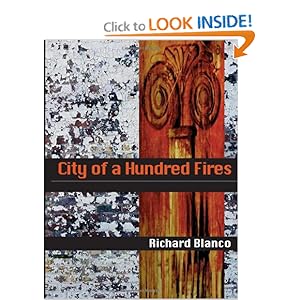
4. City of a Hundred Fires by Richard Blanco
5. White Egrets by Derek Walcott

My husband again selected a random winner, #3 avalonne83, who selected City of a Hundred Fires by Richard Blanco


Civil War Challenge Participants’ Giveaway

For those participating in the U.S. Civil War Reading Challenge, we’ve got a giveaway going on for those interested in participating in the August Read-a-Long of Enemy Women by Paulette Jiles.

There are 2 copies up for grabs and the giveaway is international. So what are you waiting for? Go on over and enter.

Some Winners . . .

The winners of The Eighth Scroll by Dr. Laurence B. Brown were chosen at random by my husband after a couple of tries not to pick myself or the author who commented on the interview post.  The winners are:

for the physical copy:  #13 Margie, who said, “Looks like a fascinating book! Thanks for the giveaway and interview.”

for the digital audio download:  #3 Nana, who said, “Interesting interview. Answers made me laugh. Yes, I agree. Sometimes you do your own thing somewhere and unbeknownst to you, someone might be doing a ‘similar’ and definitely one would be judged to have imitated the other. It’s a question of timing. In research, as you know, we call it Publish or Perish (POP).”

Congrats to the winners.

Big Thank You . . .

I wanted to take a moment to thank everyone who participated and commented during National Poetry Month. The blog tour was not as well organized this year given I’ve had a few life changes in recent months, but overall, everyone who participated did a great job and made me smile with each comment and contribution.

As a thank you, I’ve extended two poetry-related giveaways until mid-May. One is US/Canada only, the other is international.

Please feel free to check out the giveaways and spread the word:

******L.A. and Dog Years and I Can Be the One EP by Luke Rathborne; Deadline May 14 (US/Canada)

******Choose 1 of 5 poetry books to win; Deadline May 14 (Global)

You must enter through the links provided, NOT on this post.

95th Virtual Poetry Circle & Giveaway

Welcome to the 95th Virtual Poetry Circle!

Remember, this is just for fun and is not meant to be stressful.

Keep in mind what Molly Peacock’s books suggested. Look at a line, a stanza, sentences, and images; describe what you like or don’t like; and offer an opinion. If you missed my review of her book, check it out here.

Also, sign up for the 2011 Fearless Poetry Reading Challenge because its simple; you only need to read 1 book of poetry.  Please contribute to the 2011 Indie Lit Award Poetry Suggestions and check out the National Poetry Month Blog Tour.

For today’s poem, we’re going to look at Andrew Kozma’s “Agoraphobia” from City of Regret, which I reviewed this week:

Agoraphobia

Look up and a nutshell carves itself into the sky,
wormholes draining light
like a car dripping oil.  Under this coffee-shop roof,

surrounded by glass and the pop
of empty air, concrete is quicksand.
But your hand lies there

like a painted anchor, a string of fishhooks
dulled with wear,
a twin I cannot name, a gag,

a one-way mirror, a mannequin
on a thin lattice of steel, a trellis
for thorns, a cupped nest,

there, on your side of the table, prepared.
A mug steams between us
like a wall merging with air.

Let me know your thoughts, ideas, feelings, impressions. Let’s have a great discussion…pick a line, pick an image, pick a sentence.

I’ve you missed the other Virtual Poetry Circles. It’s never too late to join the discussion.

***For the giveaway, I’m offering one of the poetry books I’ve reviewed during National Poetry Month up for grabs.  The winner can choose from the following books (click the links for my reviews):

1. The Poets Laureate Anthology edited by Elizabeth Hun Schmidt
2. City of Regret by Andrew Kozma
3. Bone Key Elegies by Danielle Sellers
4. City of a Hundred Fires by Richard Blanco
5. White Egrets by Derek Walcott

To enter leave a comment about why you would choose one of those books if you win the giveaway.

Deadline is May 14, 2011, at 11:59 PM EST; This giveaway is international.

Winner of Forgetting English

Random.org selected #5 out of 13 entrants in the Forgetting English by Midge Raymond giveaway.

The winner is Julie of Read Handed, who said:  “I love the title of this collection. I enjoy reading short stories so I will have to check this out. One of my favorite collections of short stories is Coronado by Dennis Lehane. He is so well known for his novels (many of which have been adapted into movies) that his short stories are often overlooked, which is a shame.”

Congrats to Julie.  I hope you enjoy the book.

National Poetry Month Giveaway: L.A. by Luke Rathborne

Luke Rathborne is a musician and poet reminiscent of another poet/musician I know.  First I’d like you to check out this video of his single “Dog Years,” as performed at Three Clubs, Hollywood, California:

I hope you enjoyed the music because I’ve got an approved MP3 download of “You Let Me In” for you. All you have to do is use the following password once you get to the site: letmeinLR

And you know that as a poet, I can’t just post about Luke’s songs or videos, especially when its National Poetry Month. I’ve got an excerpt of one of his poems, “The Cowboy Song,” but please check out a full poem, “Calypso,” from Luke on Saturday during the Virtual Poetry Circle.

From The Cowboy Song by Luke Rathborne

Cut me free,
Cut me free of the sun,
Sand, dirt
tail-whip
feel the wind
have a dream of that far off place
out on the lake,
don’t need to tell you where . . .

Now that you’ve been properly introduced, don’t you think Luke’s poetry and music is something you should have? Well, you are in luck because in honor of National Poetry Month, he’s offering my US/Canada readers a chance to win 1 signed copy of L.A. (his poetry) and a limited vinyl press of his music.

To Enter:

1. Leave a comment on this post about who you think Luke Rathborne sounds most like when he sings or what you think of his poetry.

2. Blog, Tweet, Facebook, etc. the giveaway, leave a link, and receive a second entry.

Deadline April 30, 2011 May 14, 2011, at 11:59PM EST.

About Luke Rathborne (from Paul Gargano):

Luke Rathborne writes songs about life, and life is rarely simple, neat and easy.

On his Dog Years / I Can Be One split-EP, the singer-songwriter defies today’s cookie cutter flavors, preferring to hold true to his artistic vision – a vision that embraces the zen of Leonard Cohen and the weathered tone of Bob Dylan, basking both in a heady aura of dialed-down pop exuberance.

“Hopefully, people will see the difference in the music here,” says the 23 year-old troubadour of his ambitious release. “They are two groups of songs that belong with each other, but not necessarily together. As an artist, you really have to think about the way you’re putting a record together, and it’s got to be done in a way that interests people – if you think, in your gut, that you’re just going to smash songs together and call them a record . . . that’s just material, that’s not a record.”

Dog Years embraces Rathborne’s more pop aesthetic – not shiny, happy pop, but effervescent, melancholic pop. The title track offers a cynical poke to not letting the ‘dog years’ pass you by, and If you hear a bit of Dylan in the New Yorker’s tone, you aren’t mistaken. He also cites a lot of ‘60s and ‘70s music like the Kinks and the Beatles as impacting those early tracks, written as a teenager in Maine.

The material from the second set was penned following Rathborne’s move to New York City after high school. . . . “The second EP is more of a reaction to living in New York, and it’s a lot more personal and minimal,” he says. “It’s like battery acid – people are really freaked and don’t know what to do with it.”

You can connect with Luke Rathborne on Facebook, MySpace, and Twitter, and you can check out his music on iTunes and on his Website.

***Please also stop by the next National Poetry Month Blog Tour stop at Diary of an Eccentric and Read Handed.

Giveaway: Eighth Scroll by Dr. Laurence Brown

The Gatekeepers Post would like to sponsor a giveaway of Dr. Laurence B. Brown’s Eighth Scroll for my readers.

Up for grabs is 1 physical copy of the novel for my US/Canada readers and 1 digital download of the audiobook version.

To Enter:

1.  Leave a comment on the interview with the author.

2.  Blog, Tweet, Facebook the giveaway for a second entry.

Deadline is April 30, 2011, at 11:59 PM EST