Quantcast

232nd Virtual Poetry Circle

Welcome to the 232nd Virtual Poetry Circle!

Remember, this is just for fun and is not meant to be stressful.

Keep in mind what Molly Peacock’s books suggested. Look at a line, a stanza, sentences, and images; describe what you like or don’t like; and offer an opinion. If you missed my review of her book, check it out here.

Also, sign up for the 2013 Dive Into Poetry Challenge because its simple; you only need to read 1 book of poetry. Check out the stops on the 2013 National Poetry Month Blog Tour and the 2012 National Poetry Month Blog Tour.

Today’s poem is from Stephen Burt’s Belmont:

The People on the Bus

We have had our lives.
The reservoir visible
In the window beside our elbows, and the willow
Branches trailing at our stop
Are the nature we leave
Behind us gladly, since it has no place

For all we have recently learned: that sex
Is temporary, help
Ours to hand down now, and materials science
Not the only kind. We thank
Calm, careful Minerva, goddess
Of adults, who for so many years took us

To school: her voice the timbre of fretless bass,
Her eyes the color of pencil lead, she taught
Us how to behave in order to have our rewards
In twenty years. We have them, and if we wish
Too often, this fall, to have led another life
We do not mean that we would give up ours:

Though we stand in a row and sway
Before an obstructed view, we are able to find
Initials outlined in the crosshatched trees,
And pebbles—calculi—around our ponds
And cherish them; we like to watch the roads
Along which the perennial pollen sifts down

As finely as ever, making a soft powder
Of brass amid the troughs in softball fields.
Our skills are finally in demand.
If you mock us, Pan,
In whom we also believe, do it
As gently as you can.

What do you think?

In Honor of the 12 Remaining Days Until Christmas

christmastreeChristmas is fast approaching here in this house.  We’ve finally decorated the tree with its lights, tinsel, and bulbs, and got the candles in the windows and the stockings above the fireplace.  There aren’t many gifts under the tree this year, but that doesn’t mean I don’t want to share gifts with all of you.

Now through Christmas Eve, I’m going to post on the Savvy Verse & Wit Facebook page one book from the Best of List for 12 days.

I’ll try to post the each book on the Best of List in the afternoon for everyone on the Facebook page and after the holidays, I’ll post the full list here on the blog.

Have a happy holiday everyone, no matter what you celebrate.

Interview with Marianne Harden, Author of Malicious Mischief and Giveaway

Malicious Mischief by Marianne Harden is the first in the Rylie Keyes mystery series.

Today, Harden is visiting my readers to talk about her path to publication, and there’s a giveaway.

But first, here’s a little bit about the book:

Is it strange to have the unemployment office on speed dial? Not for twenty-four-year-old college dropout Rylie Keyes. Her current job at a small retirement home is worlds more important than all her past gigs, though: if she loses this job, she won’t be able to stop the forced sale of her grandfather’s home, a house that has been in the family for ages. However, to keep her job she must figure out the truth behind the death of a senior citizen who was found murdered while in her care. Explain that one, Miss Keyes.

The victim was thought to be a penniless man with a silly grudge against Rylie. However, his enemies will do whatever it takes to keep their part in his murder secret.

Forced to dust off the PI training she needs to keep hidden from her ex-detective grandfather, Rylie must juggle the attentions of two sexy police officers who both excite and fluster her. And as she trudges through the case, she has no idea that along the way she might win, or lose, a little piece of her heart.

Please also check out the book trailer:

Without further ado, here’s the interview with Harden on her path to publication:

How long have you been writing?

I’ve been writing one genre or another on and off since late 1999 or early 2000. Or was it early 1999? I dunno. The same estrogen that gave me breasts and wider hips is robbing my brain of memory thanks to menopause. What was the question again? Oh yeah, the amount of time I’ve been writing. It’s been years and years and years.

Why did you start writing?

The sweet smell of success, the mind-boggling wealth, the respect of publishers, thousands upon thousands of happy readers—hahahaha—then I woke up.

Is there a favorite place you like to write?

My fourth-floor office overlooking Mt. Rainier. I know the view by heart. It’s imprinted on my brain; that is until menopause strips me of it. Damn dwindling estrogen.

What moves you to write?

I’m not much for confrontations, though the abovementioned menopause is changing that a bit. Oh, hello, testosterone. What injustice do you wish to rant about today? This shift in my disposition has been both freeing and disturbing at the same time. However, my M.O has not changed that much. I am peace loving, but many in the world are aggressive. And the aggressors, they are winning. So I write about them, exposing what I believe is wrong, unfair or nasty, and I do so with humor, always with humor because to do otherwise would be too painful.

Are you published?

Yes, with Entangled Publishing.

How did you sell your book to your publisher, directly or via an agent.

Publishing is more backbreaking and lonelier than it looks. I knew I didn’t want to go it alone, so when I finished Malicious Mischief in 2009, I sent out over two hundred queries, but the rejections were quick and numerous. I gave up for a year. A chance to live in Europe distracted me and filled my time, managing to pull me away from writing altogether. Then in 2011, and at the insistence of a friend, I queried again, sending out only two this time. Both hit. I signed with my agent in February of 2011. I’ve never looked back. We’re a team.

How long did it take you to write, sell and release your book?

Malicious Mischief took nine months to write, ten months to sell, and twenty-two months to release due to changes when Entangled Publishing integrated with Macmillan Publishing.

Describe your worst rejection letter.

That’s easy. I remember the letter well and the undue accusation. The agent sent me an email accusing me of submitting to him twice, saying I changed the title of the book to try to slip it past him. He said he didn’t like my story the first time and didn’t like it now.

Describe your best rejection letter.

Another easy one. She called me from New York. She was very kind, and I sensed she wanted to give me better news. Her voice was apologetic, hesitant, and solemn. She paused before she spoke, lingering over her words. She said she thought long and hard over her decision not to offer representation. She felt the mystery market was currently too tight for debut authors.

What is the most difficult part of the publishing industry?

Marketing. Marketing. Marketing. It’s overly time consuming.

What advice would you give to new writers starting out?

Don’t do it. There I said it. This business is brutal. However, take note of the next question.

If you could do anything differently, what would it be?

Steer clear of cynics and naysayers.

About the Author:

Marianne Harden loves a good laugh. So much so, she cannot stop humor from spilling into her books. Over the years she has backpacked through the wilds of Australia, explored the exotics of Asia, soaked up the sun in the Caribbean, and delighted in the historic riches of Europe. Her goals in life are simple: do more good than harm and someday master the do-not-mess-with-me look. She divides her time between Switzerland and Washington State where she lives with her husband and two children. Please visit her Website, Twitter, and Facebook.

Giveaway (Nook HD, US Only) Rafflecopter Code:

a Rafflecopter giveaway

Guest Post: On Writing The Intangibles by Monte Dutton

The Intangibles by Monte Dutton is set in the late 1960s in a small South Carolina town just as the public schools are being integrated.  Black students from Mossy Springs High School are now going to attend the all-white Fairmont High, further ramping up tensions.  Reese Knighton is hired to coach the team and find common ground with Willie Spurgeon, the former successful coach from Mossy Springs.  The high school football team must put aside their differences at a time when the world seems to be unraveling.

Today, Dutton is going to provide some insight on his inspiration and journey in writing the book.  Please give him a warm welcome.  Also, there’s a giveaway!

Years ago, when writing about baseball was part of my job, I used to say that there is only one way to keep score, and that is the way that works for you. I’ve come to believe that it applies to writing fiction.

I taught myself to play guitar, and I taught myself to write fiction. Many sports fans have asked me how they could become a writer over the years. My answer – “The best way to learn how to write is to read” – often seems to disappoint them. Everyone wants a gimmick.

Here’s how I wrote The Intangibles. I started out with a vague idea of what I wanted to write. I then wrote a vague outline and conjured up general attributes to ascribe to the main characters. I’m sort of a seat-of-the-pants guy. I started writing – working my way toward the ending – and at the end of each chapter, I added layers of detail to the outline, as much as a reference tool – I didn’t want a green Buick in Chapter Five to morph into a yellow Mercury in Chapter Eleven – as a means of evaluating how it was all moving along. This haphazard method of mine involves a good bit of time between chapters to think about where I just went and am next going. This is my “mulling time,” which I consider at least as important as the writing time.

The second draft is basically one of economizing, where I discover that the manuscript has plenty of material that, while entertaining, doesn’t happen to move the story along. This was a lesson that The Audacity of Dope imparted, but, suffice it to say, it’s hard.

The third draft is where the story is set but the writing needs polishing. I try to turn a few phrases I left straight before.

The challenge of The Intangibles was to go from a simple story – all the characters revolve around the adventures of Riley Mansfield and Melissa Franklin in Audacity – to a complex one. The Intangibles has what motion-picture fans would refer to as an ensemble cast. It was a new challenge for me.

The Intangibles was also more personal. I’m not sure if there really is a central character, but if it’s Frankie Hoskins, it’s one created out of my own childhood experiences. Frankie’s not I, but he’s a lot like me. I was thinking about lots of real people when I wrote the book, but it’s a long way from being just a story where the names were changed to protect the innocent. Many characters are entirely made up in that I didn’t actually know anyone like them growing up.

One amusing aspect of The Audacity of Dope was hearing from readers who were just sure Riley, or Melissa, was based on them, when, in fact, their mention marked the first time it occurred to me. I thought about lots of real people in The Intangibles, but none of the characters was drawn fully on that basis.

About the Author:

Monte Dutton lives in Clinton, South Carolina. In high school, he played football for a state championship team, then attended Furman University, Greenville, S.C., graduating in 1980, B.A., cum laude, political science/history.

He spent 20 years (1993-2012)wriing about NASCAR for several publications. He was named Writer of the Year by the Eastern Motorsports Press Association (Frank Blunk Award) in 2003 and Writer of the Year by the National Motorsports Press Association (George Cunningham Award) in 2008. His NASCAR writing was syndicated by King Feature Syndicate in the form of a weekly page, “NASCAR This Week” for 17 years.

Monte Dutton is also the author of Pride of Clinton, a history of high school football in his hometown, 1986; At Speed, 2000 (Potomac Books); Rebel with a Cause: A Season with NASCAR’s Tony Stewart, 2001 (Potomac Books); Jeff Gordon: The Racer, 2001 (Thomas Nelson); Postcards from Pit Road, 2003 (Potomac Books); Haul A** and Turn Left, 2005 (Warner Books), True to the Roots: Americana Music Revealed, 2006. (Bison Books); and is an Editor/Contributor of Taking Stock: Life in NASCAR’s Fast Lane, 2004 (Potomac Books).

The Audacity of Dope, 2011 (Neverland Publishing) was his first novel, and Neverland recently published his second, The Intangibles. Another, Crazy by Natural Causes, is in the works.

Visit the author’s website, Facebook, and Twitter.


TO ENTER THE GIVEAWAY
U.S. entrants only, please.

a Rafflecopter giveaway

Guest Post: Visions of the Moon by Erica Goss

Erica Goss, the poet who wrote Wild Place, continues to keep us up to date on her 12 Moons project with vocal talents of Nic S. and the musical talents of Kathy McTavish. We’ll be sure to keep everyone in the look on this collaborative project. Check out the first guest post, her Writing Down the Moon guest post, her Voice of the Moon guest post, and the Music of the Moon guest post.

Please gave Erica a warm welcome.

complex flavors:
bark mulch, oyster shell,
lime, charcoal,
stone releasing
the sun’s warmth
at night.

        from “Strawberry Moon” by Erica Goss

As I wrote in the first blog post for 12 Moons, the video artist Swoon envisioned this project, put the artistic team together, and created the twelve videos using my poems, Nic S.’s voice, and Kathy McTavish’s music. Swoon is a video-quilter, turning poetry, voice, music and images into haunting and beautiful experiences. From the tentative beginnings of this project, which began with two poems I sent him in a “what do you think” email, he imagined a series of twelve videos based on those and ten more poems, each one titled after a traditional name for the full moon.

Swoon’s video poems have been described as dream-like, full of flickering images, color, and sound. They don’t tell stories chronologically; like dreams, they deliver an experience that’s difficult to describe. As Swoon himself says, “Videos should not just show what’s going on in the poem – as in, the poem mentions a leaf falling and sure enough, you see a leaf falling. I want something that takes more imagination.” (You can read an interview with Swoon in my column at Connotation Press.

I asked Swoon about his inspiration for what became 12 Moons.

“You sent me those two poems, ‘Strawberry Moon’ and ‘Snow Moon,’ and mentioned it was going to be a series. I had just done Circle and was looking for another bigger project. I immediately saw a ‘calendar of video poems.’”

Each of the videos is both separate and linked. How did you find the common thread that connects them?

“For me the common thread is your voice in those poems. So when you read them or hear them read out loud by Nic, they all connect by the choice of words, their rhythm…all different but all from the same source. When you watch and listen to the videos, that connection is made stronger because of Kathy’s sounds. I also made visual links between them, small blips from one video appear in the next one.”

12 Moons is a linked work, like your film Circle. Do you anticipate making longer films in the future?

“I would love to. I have this idea for a more ‘regular’ short film, with a regular storyline and characters, but with all of the dialog coming from poetry. It’s going to take time and money to make that, and as we speak, I don’t have enough of both to do so now.”

Can you describe why certain poems attract you as a filmmaker?

“No. I just follow my gut. It can be the poem as a whole, a certain phrase, a word, the rhythm and music of the poem … the title even. When I read (or rather listen, because I prefer to hear poetry) and I get images, it takes me places. It’s a good poem for me. The overall ‘music of the poem’ must appeal. It’s hard to put a finger on – it’s a gut feeling.”

When I watch your videos, I often feel that you make the unseen visible. Is that a deliberate decision you make?

“Yes and no. I look for underlying thoughts in a poem (very often my own thoughts, I guess – my projections) and try to give the video visual hints of that. Not even visualize those thoughts literally, but more of a hint, an atmosphere. I try and combine that with the actual lines or words of the poem.”

Your work respects the poetry. It never uses a poem as a vehicle for visual expression. How do you achieve the balance of image, sound and word?

“Trial and error. I begin, create, mix and hope for the best. Sometimes it works, very often it doesn’t and I try again. But even when it doesn’t, it might still be a good video for another reason, or for something else. It’s like a John Cage quote I recently read: ‘Nothing is a mistake. There’s no win and no fail, there’s only make.’ I think I like to work by those lines.”

Here is the trailer for 12 Moons:

12 Moons (teaser) from Marc Neys (aka Swoon) on Vimeo.

12 Moons is an artwork combining poetry, voice, music and video. Twelve poems written by Erica Goss form the narrative. The poems move through a year of full moons, reflecting the hidden influence of the moon on one person’s life. Kathy McTavish’s original music adds complexity to Nic S.’s intense and compelling narration, framed by Swoon’s precise editing of sound and image, which creates a miniature universe for each poem within the context of the project.

12 Moons will appear beginning January 2014 at Atticus Review.

Here are links to the artists involved in 12 Moons:

  • Swoon’s website
  • Kathy McTavish’s website
  • Erica Goss’s website
  • Erica Goss’s column on video poetry.

How excited are you to get your hands on this project?

Save

Mailbox Monday #248

Mailbox Monday (click the icon to check out the new blog) has gone on tour since Marcia at To Be Continued, formerly The Printed Page passed the torch.  November’s host is Rose City Reader.

***Just a note to say that a poll about what the community wants to do about hosting Mailbox Monday’s meme is on the Mailbox Monday blog. Go Vote.***

The meme allows bloggers to share what books they receive in the mail or through other means over the past week.

Just be warned that these posts can increase your TBR piles and wish lists.

Here’s what I received:

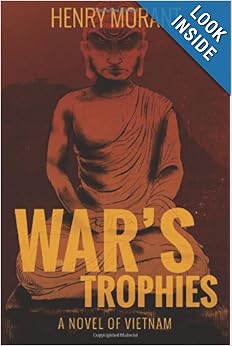
1.  War’s Trophies by Henry Morant from the author for review.

Murder and robbery on a seemingly routine intelligence mission in Vietnam cause a young army officer to exact his own revenge on a band of Viet Cong turncoats and his own senior officer. The lieutenant then settles into the relatively quiet life of a Seattle editor–until the senior officer is released from prison after 20 years and unleashes his own nightmarish game of copycat revenge killings on the editor’s friends and colleagues. Meanwhile, the police suspect the editor is the Seattle serial killer. The two ex-officers wage a deadly cat-and-mouse battle to determine which one will become the war’s last trophy.

2. Chasing Utopia: A Hybrid by Nikki Giovanni for review from William Morrow.

The poetry of Nikki Giovanni has spurred movements and inspired songs, turned hearts and informed generations. She’s been hailed as a healer and a national treasure. But if her reputation is writ large upon the national stage, her heart resides in the everyday where family and lovers gather, friends commune, and those no longer with us are remembered.

And at every gathering there is food, food as sustenance, food as aphrodisiac, food as memory. A pot of beans are flavored with her mother’s sighs, this sigh part cardamom, that one the essence of clove; a lover requests a banquet as an affirmation of ongoing passion; an homage is paid to the most time-honored appetizer, soup.

What did you receive?

231st Virtual Poetry Circle

Welcome to the 231st Virtual Poetry Circle!

Remember, this is just for fun and is not meant to be stressful.

Keep in mind what Molly Peacock’s books suggested. Look at a line, a stanza, sentences, and images; describe what you like or don’t like; and offer an opinion. If you missed my review of her book, check it out here.

Also, sign up for the 2013 Dive Into Poetry Challenge because its simple; you only need to read 1 book of poetry. Check out the stops on the 2013 National Poetry Month Blog Tour and the 2012 National Poetry Month Blog Tour.

Today’s poem is from Steven Schneider’s Prairie Air Show

Chanukah Lights Tonight

Our annual prairie Chanukah party—   
latkes, kugel, cherry blintzes.   
Friends arrive from nearby towns   
and dance the twist to “Chanukah Lights Tonight,”   
spin like a dreidel to a klezmer hit.   

The candles flicker in the window.   
Outside, ponderosa pines are tied in red bows.   
If you squint,   
the neighbors’ Christmas lights   
look like the Omaha skyline.   

The smell of oil is in the air.   
We drift off to childhood   
where we spent our gelt   
on baseball cards and matinees,   
cream sodas and potato knishes.   

No delis in our neighborhood,   
only the wind howling over the crushed corn stalks.   
Inside, we try to sweep the darkness out,   
waiting for the Messiah to knock,   
wanting to know if he can join the party.

What do you think?

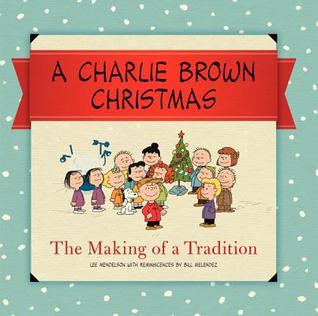
A Charlie Brown Christmas: The Making of a Tradition by Charles M. Schulz

Source: It Books, Harper Collins
Hardcover, 192 pages
I am an Amazon Affiliate

A Charlie Brown Christmas: The Making of a Tradition by Charles M. Schulz is an in-depth look at how the television special, A Charlie Brown Christmas, was conceived and made.  With the collaborative efforts of Charles M. Schulz, Lee Mendelson, and Bill Melendez, the cartoon special was put together in under four months from the green light to make it to the actual production film was screened.  It finally aired in December 1965, and for nearly 50 years, the special has been an American tradition in households across the United States.

“‘We realized that Charlie Brown’s voice had to be “blah”; Lucy’s had to be assertive and even crabby; Linus’s would have to combine intelligence with childlike simplicity, as he was someone who cherished his thumb and blanker,'” said Lee Mendelson. (Page 19)

Readers will love learning about what Schulz wanted to include in the special, and how he insisted that his characters be brought to life by children rather than adult actors acting like children.  Despite having felt that they’d accomplished what they set out to do with the special, they began to get nervous when the executives were less than enthusiastic about the final product and when the screening was met with silence and a handshake.  But once the review from the screener appeared in the newspaper, the team realized the special was more successful than expected.

“This sense of alienation, personified in Charlie Brown, is one of the deeply personal yet universally shared feelings that Charles Schulz infused into each of the Peanuts characters.  With simplicity and wit he pioneered new ground in comics with characters that reflect all the insecurity, anxiety, and joy of being human.” (page 37)

A Charlie Brown Christmas: The Making of a Tradition by Charles M. Schulz is a unique look at the behind the scenes making of not only the special, but also of how Schulz created his characters and worked with others.  The book not only includes reflections from his partners on the project, but also some of the storyboards, the music sheets, and production notes, as well as the complete script for the special.

About the Cartoonist:

Charles M. Schulz, nicknamed Sparky, was an American cartoonist, best known for the comic strip Peanuts. He is widely regarded as one of the most influential cartoonists of all time, cited as a major influence by many later cartoonists.

Robert Plant: A Life by Paul Rees

Sources: It Books, HarperCollins
Hardcover, 368 pages
I am an Amazon Affiliate

Robert Plant: A Life by Paul Rees is an unauthorized biography of one of Led Zeppelin‘s front men — the one some called a golden god.  Beginning with his early years in grade school, Plant was not destined to be the straight arrow his father wanted him to be.  His antics started as a young adolescent stealing small instruments from well-known musicians that visited local clubs.  He was initially influenced by the sway of Elvis, miming his records on the sofa with a hairbrush for a microphone.  But Rees also provides a background on the region and its hardships, which shaped his father and his older family members.  The hardships the family faced also shaped their attitudes toward a young man finding his love of music and barreling headlong into it.

Rees prose is engaging, like an old friends talking to one another, and the smattering of quotes from friends and family about the events that shaped not only Plant, but also the band, make readers feel like their watching a documentary unfold.  And like most documentaries with producers close to the subject, some of the more sordid details of drug use and sex are muted — though a salacious tale about the band and its members has likely been done before and does not need to be repeated.  Rees has a greater focus on the music Plant created in a series of defunct bands, his poor luck with bands when he started out, and his wild success as the lead singer of Led Zeppelin.

“He had felt fear gnawing away at him.  The dread of how he might appear to all the thousands out there in the dark.  Here he was, a man in his sixtieth year, desiring to roll back time and recapture all the wonders of youth.  Did that, would that, make him seem a fool? In those long minutes with himself he had looking in the mirror and asked over and over if he really could be all that he had once been; if it were truly possible for him to take his voice back up to the peaks it had once scaled.  He had so many questions but no answers.” (page 1)

As a young husband, he’d made a pact with his bride that if he had not made it by his twentieth birthday in a successful band, he’d give it up to support his family.  It was just before he was set to find a real job that he was asked to join Jimmy Page to create Led Zeppelin.  Plant soon finds himself separating his personalities in two directions — the devoted family man and the consummate rock star.  Several tragedies and the weight of drugs and violence lead to the band’s demise and Plant’s moving onward — creating more music.

Robert Plant: A Life by Paul Rees leaves analysis of the personalities behind and merely relies on outside sources, interviews, and other insights from those who were there to give shape to a tumultuous time of a rock star.  But beyond that, the biography offers up a human look at a rock god, though one with a limited view.  Readers will feel like its rehashed and glosses over the real man in favor of critiquing the music.  It seems like his early beginnings in music, Plant’s career after Zeppelin was up and down, but he never seemed to lose his love of music.  Just wish there was more fresh research.

About the Author:

Paul Rees has written about music for more than twenty years. In that time he has interviewed everyone from Paul McCartney, Bruce Springsteen, and Madonna to Bono, Take That, and AC/DC. His work has appeared in many publications, including the Sunday Times Culture, the Telegraph, the Independent, and the Evening Standard. He was also editor of two of the UK’s most successful and long-standing music publications, Q and Kerrang!, for a total of twelve years.

This is my 80th book for the 2013 New Authors Challenge.

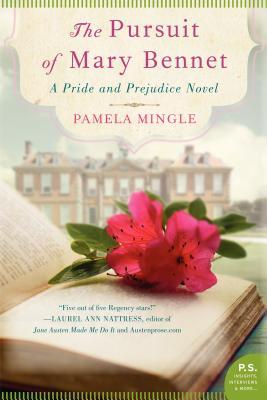
The Pursuit of Mary Bennet by Pamela Mingle

Source: William Morrow and TLC Book Tours
Paperback, 240 pages
I am an Amazon Affiliate

The Pursuit of Mary Bennet by Pamela Mingle is what could be considered a sequel Jane Austen’s Pride & Prejudice, but rather than focus on Elizabeth and Jane Bennet as the heroines, Mingle chooses the more pious and somewhat ridiculous sister Mary.  Mary Bennet has been the butt of the family’s jokes and jibes for much of her childhood, and for the most part Lydia and Kitty Bennet treat her in much the same way even though she is in her early twenties and has clearly changed.  Rather than sing to the detriment of society’s ears, she’s content with refining her pianoforte playing, leaving singing to others who are more gifted.  She once sat idly by and took the criticisms of her siblings and parents and held those resentments inside, but now she’s more inclined to speak her mind, while not being overly rude.  She’s a more matured woman, though still unsure of her feelings and her place in the family.

“I’d always believed I would remain a spinster.  I would disappoint as a wife.  I had not the easy compliance, the ability to defer to a husband, and worst of all, I lacked beauty, conduct, and, at times, even common sense.  But Jane said I had changed.  Truly, I valued her opinion above that of anyone else.”  (page 85)

Told from Mary’s point of view, readers are given an inside look into her growth as a young woman and a sister.  Rather than admonishing her sisters for their poor behavior aloud and in public, she’s taken to more tactful advice.  She’s a more well-rounded woman, though still naive when it comes to marriage, romance, and the bond between men and women.  While readers will enjoy this more evolved Mary and getting a glimpse into the lives of their favorite Bennets — Jane and Lizzy — the parallels between Lizzy and Darcy’s love story is reflected in Mary’s romance.  The close parallels from the quick prejudices and anger over easily explained moments lack an imagination one would expect, especially in this tale.  However, given Mary’s limited contact with men at Longbourn, it does stand to reason she would be unsure how to respond to male attentions.  Readers may have wanted a more inventive romance with trials different from those of Darcy and Lizzy.

The Pursuit of Mary Bennet by Pamela Mingle is a solid novel in the same vein as Austen’s work, and breathing life into the stern and bookish Mary is tough to pull off, but Mingle’s Mary is believable.  She’s a young woman of principle, and given her sisters’ love matches, it is no wonder that she would want to settle for nothing less.

About the Author:

Pamela Mingle is the author of Kissing Shakespeare, a time-travel romance for young adults set in Elizabethan England. She is a member of the Society of Children’s Book Writers and Illustrators, Pikes Peak Writers, Romance Writers of America, and the Jane Austen Society of North America.

Find out more about Pamela at her website, connect with her on Facebook, and follow her on Twitter.

This is my 79th book for the 2013 New Authors Challenge.