Quantcast

Interview of Me by Monica of Monniblog

I was hopping through my Google Reader a few days ago and stumbled upon a fantastic idea, interviewing other bloggers as a meme. Monica’s questions–asked by Ruth— and answers can be found here.

I offered to be Monica’s guinea pig, and she sent me five questions to answer. So here is Monica’s interview with me.

1. Why did you call your blog “Savvy Verse & Wit”?

I toyed with a lot of different names for my blog. I wanted the blog name to signify its content, which I hoped would be writing, reading, and a bit of humor. I always loved verse as a poet and I love the word Savvy, so all that was left was Wit. It is really not that great of a story to tell. Kind of lame, right?!

2. You read and review a lot of books, but what was the first book you fell in love with as a kid?

The first book I fell in love with as a kid was The Cat in the Hat by Dr. Seuss, but it was a short time later that I fell in love with Shel Silverstein’s A Light in the Attic, Where the Sidewalk Ends, and The Giving Tree. Those were my favorite books as a kid, but I graduated from those on my own to Hamlet and King Lear on my own before I read them in school. It was a short time later that I discovered Jane Austen’s Pride and Prejudice and Emily Bronte’s Wuthering Heights.

3. If you could live anywhere in the world (money not an issue) where would it be and why?

This is a loaded question because there are a ton of places I would love to live. I think that I’m a bit of a nomad. There are three places I would love to live if I had the money. Number one on the list is Boston, downtown, in a penthouse apartment with my hubby and my fluffy Keeshond. Number two on that list is Terceira, Azores because that’s where some of my family lives, though I don’t speak Portuguese fluently. I think that would be something to remedy before moving there. Third on the list is somewhere in Ireland, probably somewhere rural. I just love the scenery of the Irish countryside and would love to soak that in. I guess I was only to pick one…never said I like to follow the rules.

4. Where do you see yourself in 10 years?

In 10 years, I haven’t got a clue. I would like to say that I would have a few published books of poetry, but one completed manuscript would be fantastic. I’d like to also think I would be in Boston, living there with the hubby and fluffy Keeshond. Perhaps one kid, but you never know what life brings. I try to live my life one moment at a time and make the most of it.

5. You have joined a lot of book challenges, and hosted too… what is it that interests you about reading challenges?

Reading challenges help me focus on areas that I want to read and keep me reading even when I really want to just sit and watch television, mindlessly. The worlds created by books are far more enriching and worth spending the time on. I love the feeling of accomplishment I get when I finally finish challenges. I’ve only joined 2 challenges, officially completing one of them. The second challenge I had to switch out some books to complete it on time. The WWII challenge is one of my favorites, and I am happy to cohost it with Anna at Diary of an Eccentric. I look forward to examining this time period in depth through nonfiction works and fiction works. I can’t wait to unveil the 2010 challenge; it’s another of my favorite time periods, and it was controversial and still may be.

For those of you who might want to be interviewed, here are the directions:

  • Leave me a comment saying, “Interview me.”
  • I will respond by emailing you five questions. (I get to pick the questions).
  • You will update your blog with the answers to the questions.
  • You will include this explanation and an offer to interview someone else in the same post.
  • When others comment asking to be interviewed, you will ask them five questions.


Writing Goal Week #4
:

I forgot to tell you that progress did not occur last week on the poem at all! I’m disappointed in myself once again, but perhaps this struggle to get back into the writing habit will spout new ideas.

Anyway, the goal remains the same this week to finish the poem I began.
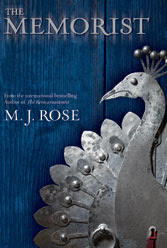
The Memorist by M.J. Rose

I received the The Memorist by M.J. Rose as part of a TLC Book Tour. Please stay tuned for my interview with M.J. Rose after my review.

The Memorist is the second in a series of books about reincarnation, lost memory tools, and the struggle of Meer Logan to find herself through her past. Her father had struggled to help Meer recall her past-life memories to the surface, but she found her life bearable only when she avoided the triggers that called those memories to the surface. Readers also will find the historical bits about the Nazis and their experiments undertaken in Vienna disturbing.

M.J. Rose’s narrative technique easily transports readers to Vienna, the home of Ludwig von Beethoven, and to Vienna in the past when Beethoven lived and taught in the city. She carefully weaves a suspenseful tale to find a lost memory tool once in the possession of Beethoven. Meer not only struggles with the surfacing memories, but with whom she should trust of her father’s friends and how deeply she should not only confide in them but lean on them when the memories flood her mind.

“Margaux’s lovely home was filled with cleaver and important people, fine food and charming music. It was all a patina. The threads that held the partygoers’ polite masks in place were fragile. Everyone in Vienna had an agenda and a plan for how the reapportionment of Europe would work best for them now that Napoleon was in exile. . . . So even here tonight, at what purported to be a totally social gathering, nothing was as it seemed.” (Page 226)

This paragraph illustrates the facades built up around her father, her long-time confidant Malachai, and her father’s sorrowful, new friend Sebastian. The face they present to one another does not represent reality; her father hides many things from her, just as she prepares speeches she believes he wants to hear. While this story is a thriller reminiscent of The Da Vinci Code, it is much more. It illuminates the relationship between Meer and her father and the secrets that lie beneath.

“‘Yes, behind the facades of these elegant buildings are ugly secrets and dirty shadows. . . .'” (Page 297)

Readers will enjoy the shifting perspectives from chapter to chapter and the subplot that lurks beneath the surface, which could change everything for the main characters and Vienna. Music, art, and mystery are the order of the day in The Memorist, and they are woven together beautifully.

“Lifting the plastic cover over the keys she put her fingers on the yellowed ivory and began. The piano had obviously been kept tuned and she was surprised at how differently this two-hundred-year-old instrument played from the ones she was used to. There was more power and feel to its sound, less control, less sustaining power and it seemed she could do more with its loudness and softness.” (Page 252)

Meer underestimates her abilities, and readers will love the evolution of her character. The only drawback in the novel for readers may be the repetition of several descriptive lines as Meer enters her past memories–“a metallic taste fills her mouth.” Aside from this minor annoyance, which quickly fades into the background after several chapters, this novel is action-packed, thrilling, and absorbing. M.J. Rose has done her research and created a believable world in which reincarnation is a viable theory that can be put into action through the recovery and use of various tools.

Check out The Memorist Reading Guide and an excerpt from the book.

Without further ado, here’s my interview with M.J. Rose:

1. When writing The Memorist did you listen to music? If you had to chose five songs that coordinated with The Memorist what would they be and why?

All of Beethoven’s symphonies because he is part of the book and the music of Doug Scofield because he wrote two songs for the book.


2.
Do you have any obsessions that you would like to share?


I love visiting museums, reading, walking our dog in any and all parks, and the ocean.


3.
Most writers will read inspirational/how-to manuals, take workshops, or belong to writing groups. Did you subscribe to any of these aids and if so which did you find most helpful? Please feel free to name any “writing” books you enjoyed most (i.e. Bird by Bird by Anne Lamott).


Definitely not Bird by Bird. 🙂 I might the only writer who couldn’t even finish that book. Not knocking it – just not my cup of tea. What helps me is keeping a journal of my character’s life, and reading and rereading great books that I’ve loved over the years, plus I read John Gardner’s The Art of Fiction once a year.

This is one area M.J. Rose and I disagree. Check out my review of The Art of Fiction.


4.
A great deal of writing advice suggests that amateur writers focus on what they know or read the genre you plan to write. Does this advice hold true for you? How so (i.e., what authors do you read)?

I read too many to mention – but I love Paul Auster and Steve Berry and Lisa Tucker and Alice Hoffman and Daniel Silva and Daphne Du Maurier and F. Scott Fitzgerald and Laurie King and Louis Bayard and on and on and on … and from that list you can see I don’t agree on reading in the genre you want to write exclusively at all. I don’t really believe in genres – I believe in good books – genres are what publishers do to books to figure out what to buy and where to put it in the store.

5. Do you have any favorite food or foods that you find keep you inspired? What are the ways in which you pump yourself up to keep writing and overcome writer’s block?


I think writers block comes from not knowing your character and writing too soon in the process. I don’t think you should just sit down and write every day. I think you need to get inside your story and the people who inhabit its world however you need to do that – for me it requires swimming a lot and a lot of long walks where I focus on the characters for hours a time.

Foods, no. I drink green tea while I’m working but I don’t nibble at the computer:) Just when I’m done.


6.
Please describe your writing space and how it would differ from your ideal writing space.


I have trained myself to write anywhere so my writing space is my laptop wherever it needs to be. And as long as my dog is nearby, it’s ideal.

About the Author (From her Website):

M.J. Rose, is the international bestselling author of 10 novels; Lip Service, In Fidelity, Flesh Tones, Sheet Music, Lying in Bed, The Halo Effect, The Delilah Complex, The Venus Fix, The Reincarnationist, and The Memorist.

Rose is also the co-author with Angela Adair Hoy of How to Publish and Promote Online, and with Doug Clegg of Buzz Your Book.

She is a founding member and board member of International Thriller Writers and the founder of the first marketing company for authors: AuthorBuzz.com. She runs two popular blogs; Buzz, Balls & Hype and Backstory.

Mailbox Monday #14

Mailbox Monday is sponsored by Marcia at The Printed Page. I can’t believe that I’ve stuck with this meme this long. I am happy that I have, and that I get to share all of my fantastic book news with everyone. As you might have guessed, I have a tour stop tomorrow, so here is my Mailbox Monday a day early!

Here’s what found its way into my mailbox in the past week:


1. Drood by Dan Simmons, which I received from Hatchette Group for an upcoming tour in February. I’m looking forward to this book, even though it is over 700 pages.


2. Galway Bay by Mary Pat Kelly; I also received this from Hatchette Group. The tour is in March on St. Patrick’s Day, one of my favorite holidays. I cannot wait to read this Irish saga.

3. The Best American Essays by Susan Orlean and Robert Atwan; I received this through the generosity of Lisa at Books Lists Life.


4. Dear Anais: My Life in Poems for You by Diana M. Raab; the author was kind enough to send me her book of poems for review. Look for this review in February.


5. The Fourth Hand by John Irving; I snagged this one from Heather at Book Addiction. She was kind enough to send it to me.

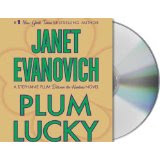
Plum Lucky by Janet Evanovich

Audio books make the commute fly by on most occasions and Janet Evanovich‘s Plum Lucky, a Between-the-Numbers novel, is no exception. My husband and I seem to be hooked on these Between-the Numbers novels because they are humorous, ridiculous in some instances, and fast-paced.

Stephanie Plum and Diesel are back on the hunt, but not for Sandy Claws this time–Snuggy O’Connor who thinks he’s a leprechaun. This little person not only thinks he’s a leprechaun, but that he can disappear from sight on a whim to steal from mobsters and others. Oh, he also thinks he can talk to animals, like horses.

This reader would have snorted coffee through her nose if she were drinking any when Snuggy talks to a doberman at a mobster’s home and the dog convinces him to merely take his clothes off to disappear in front of everyone’s eyes. Can you say the emperor’s new clothes?

Grandma Mazur returns and finds a bag of money on the sidewalk, which happens to be stolen from a mobster by Snuggy. Grandma doesn’t know, heads off to Atlantic City, and is in gambler’s paradise before disaster strikes and she’s kidnapped by a mobster, Delvina. Snuggy wants to pay off Delvina to get his horse, Doug, back from the mobster and Stephanie and Diesel must team up with Snuggy to recoup the gambled money and pay off Delvina to get Grandma back.

From the snarky comments between Stephanie, Snuggy, Diesel, Grandma Mazur, Lula, and Connie to the details of Atlantic City and Daffy’s casino, Evanovich paints a vivid scene with an eclectic cast of characters. Ranger even makes an appearance in this one, along with Morelli.

This made the commute fly by, and I am looking forward to the next Between-the Numbers novel on audio.

Also Reviewed By:
The Movieholic & Bibliophile

Poet Andrea Hollander Budy Interview

I’ve been working on a interview project with Deborah at 32 Poems magazine, and she kindly allowed me to interview past contributors to the magazine. We will be posting the interviews throughout the coming months, and our first interview posted on Deborah’s Poetry Blog of 32 Poems on Jan. 21.

I’m going to provide you with a snippet from the interview, but if you want to read the entire interview, I’ll provide you a link for that as well.

For now, let me introduce to you 32 Poems contributor, Andrea Hollander Budy:

1. Not only are you a contributor to 32 Poems, but you also are a teacher and attend quite a number of conferences. What “hat” would you consider the most challenging to wear and why?

Yes, not only do I write, but guide others both as the Writer-in-Residence at Lyon College and, during the summers, at a variety of writers’ conferences. I also work one-on-one as a long-distance writing tutor (via the mail and telephone). But at all times I wear the same “hat,” because even when I teach others, I do so as a colleague who has enough experience with the craft of creating poems that I can provide insight into the process and help my students or tutees grow stronger as writers and revisers of their own work. Creating one’s own poems is indeed a continual challenge. But whether I am teaching others about this challenge or facing my own blank page, the important point is to enable myself and others to do the best work through continual devotion to doing the work in the first place.

2. Do you have any obsessions that you would like to share?

It’s the writing itself that reveals my deeper obsessions to me. If I am obsessed with anything, it’s with the process of writing itself, with the joy of making discoveries through writing, and with the pleasures of learning through reading the work of others, as well.

3. I noticed that much of your poetry has been categorized as conversational in tone. Do you believe that to be an accurate depiction. Why or why not? Has this always been the style you’ve used?

I have always tried to write as clearly as possible in language that is free of decoration. A poem is already by its nature a dense enterprise — relatively few words attempt to engage readers and provide a compelling experience — and while I don’t wish to write simplistic poems, I do want readers to easily enter a poem and to discover there something valuable not only the first time they read or hear it, but for them to want to enter the poem again and again and to be ushered more deeply into it each time.

About the Poet:

Born in Berlin, Germany, of American parents, raised in Colorado, Texas, New York, and New Jersey, and educated at Boston University and the University of Colorado, Andrea Hollander Budy is the author of three full-length poetry collections: Woman in the Painting, The Other Life, and House Without a Dreamer, which won the Nicholas Roerich Poetry Prize. Other honors include the D. H. Lawrence Fellowship, a Pushcart Prize for prose memoir, the Runes Poetry Award, two poetry fellowships the National Endowment for the Arts, and two from the Arkansas Arts Council. Most recently Budy received the 2008 Subiaco Award for Literary Merit for Excellence in the Writing and Teaching of Poetry.

Want to find out what Andrea’s writing space looks like? What music she listens to while she writes? How she stays fit? and much more? Check out the rest of my interview with Andrea here.

Interview with Phyllis Schieber, Author of The Sinner’s Guide to Confession

I want to welcome Phyllis Schieber, author of The Sinner’s Guide to Confession, to Savvy Verse & Wit. If you missed my review of her novel, check it out here. There’s also a chance to win her novel at the bottom of my review.

Without further ado, here’s my interview with Phyllis:

1. Most writers will read inspirational/how-to manuals, take workshops, or belong to writing groups. Did you subscribe to any of these aids and if so which did you find most helpful? Please feel free to name any “writing” books you enjoyed most (i.e. Bird by Bird by Anne Lamott).

I think writing groups are great. I studied writing with the late Hayes Jacobs at The New School for Social Research. In fact, I wrote Willing Spirits, my novel that will be re-released in paperback this coming March, in Hayes’s class. I took several writing classes with him and then applied to his seminar. I remained in that seminar for almost ten years.

I used Elizabeth Benedict’s The Joy of Writing Sex when I was working on The Sinner’s Guide to Confession. I’ve read many books about writing, such as Writing Fiction by R.V Cassill, Fiction Writer’s Handbook by Hallie and Whit Burnett, A Writer’s Life by Annie Dillard, On Writing by Eudora Welty, and I loved Bird by Bird by Anne Lamott.

These are some great books for writers to check out. Many of us have read Bird by Bird by Anne Lamott, but I would love to pick up some of these other fiction writing handbooks. Thanks for the recommendations, Phyllis.

2. A great deal of writing advice suggests that amateur writers focus on what they know or read the genre you plan to write. Does this advice hold true for you? How so (i.e. what authors do you read)?

I was an English major in college, so I’ve read all the classics, of course. I also have an M.A. in Literature, so I’ve covered a lot of ground. I love Carol Shields, Fay Weldon, Shirley Hazzard, Alison Lurie, Anne Tyler, Alice Hoffman, Dorothy Allison and Jane Smiley. I seem to be drawn to women writers. I have read and loved Richard Yates, the short stories of Gabriel Garcia Marquez and Yasunari Kawabata. I love different works for different reasons.

3. With Sinner’s Guide to Confession, did you have a playlist that you used while writing to keep you inspired? And if so, what are the top 5 songs on that list? If you don’t listen to music while writing, do you have any other routines or habits?

I do listen to music when I write, bit it’s typically classical. It doesn’t distract me. I can listen to the same CD all day. In fact, I can listen to it all week or all month. I just push replay. I like Bach and Mozart. But I also love the soundtrack to the movie Frida and the soundtrack to The Piano. I listen to Andrea Bocelli because his voice is so sweet. And sometimes I’m in the mood for Otmar Liebert, an amazing guitarist. I also listen to opera as well. My son is studying voice with the intent to be an opera singer, so I am trying to hone my taste and knowledge of opera.

I tend to have opera or classical music on when writing poetry. It seems to inspire me, though I prefer Dvorak. I do love Bocelli’s voice.

4. In terms of friendships, have your friendships changed since you began focusing on writing? Are there more writers among your friends or have your relationships remained the same?

I dedicated The Sinner’s Guide to Confession to “Everyone who asked.” It was sort of a jab at the people who never ask me about my writing and a tribute to those who do. I have a few friends who are writers, not many. Most of my friends are not writers. However, I have some really good friends who never ask about my work. That amazes me. I think it’s because they don’t know what to ask. They don’t understand that you ask about writing the same way you would ask about any job. “So, how’s your work going?” That’s all it takes. I’ve more or less trained my closest friends to ask me about my work the same way I would ask about their jobs. I think those relationships have grown. Two of the four people who read for me are not writers, and their insights and criticisms are extremely helpful.

I wonder if non-writer friends are afraid that writing is too personal to ask about or that they feel writing is just a hobby? An interesting question.

5. How do you stay fit and healthy as a writer?

I don’t. I try to, but I struggle. I am just getting back to yoga. I have a stationary bike that I do get up and use when I am writing for a long stretch. I’ll do ten minutes on the bike. I like to put my legs up against the wall periodically and stretch out. Yoga is the best exercise for me. I also take twenty minute naps at intervals. I just stretch out on the floor in my office, and I’m out. I love those naps.

6. Do you have any favorite foods or foods that you find keep you inspired? What are the ways in which you pump yourself up to keep writing and overcome writer’s block?

Perseverance is the only way to overcome writer’s block. If you wait for the muse to sit on your shoulder, you’re in trouble. I find that the more I write, the less I have writer’s block. Food doesn’t inspire me. I like to eat because it tastes good. I like coffee when I write and tea and soup, but only if it’s homemade. That’s easy to eat while I’m working. Otherwise, I’ll take a break and have something.

7. Please describe your writing space and how it would differ from your ideal writing space.

I’m happy with my writing space. We converted half the garage into an office for me. It’s quite nice with floor to ceiling built-in bookcases, lots of framed posters and photographs on the wall. I have an old armoire that I use as a storage unit. I have a nice big chair for reading, an old desk and a great Herman Miller chair. It’s a nice office, very comfortable. I have one window, but I usually keep the shade drawn because I am too easily distracted. In my other house, my office was in a space in a converted attic, really high up. I liked that a lot too.

Thanks to Phyllis for joining us. I wish her well with her latest novel and her future projects.

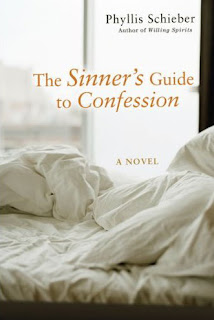
The Sinner’s Guide to Confession by Phyllis Schieber

Nikki Leigh contacted me about hosting Phyllis Schieber and her novel, The Sinner’s Guide to Confession, and I was pleased to do so. Stay tuned for information about how you can win your own copy of The Sinner’s Guide to Confession.

The novel is follows longtime friends Kaye and Barbara, who are now in their fifties. Kaye and Barbara soon make friends with Ellen, who is several years younger, but their friendship solidifies and becomes close-knit. The three women are inseparable, but each nurtures a secret.

The alternating narrators for the chapters keeps the reader guessing as to when the friends will break down all of the walls between them and share their deepest secrets. From a romance novelist hiding her alternate career as an erotica writer to a married woman having a long-term, passionate affair. Readers will appreciate the perspective Justine, Barbara’s daughter, provides to Kaye and Barbara’s relationship. The friendship between these women is long standing and much of the story focuses on their relationships with one another as well as their relationships with the men in their lives. The novel may be considered an older woman’s chicklit book, but it has more substance.

Of the three women, Ellen’s story was the most heart-wrenching and deeply moving. Readers learn early on about Ellen’s secret, but as her chapters unfold, the devastation of one decision she makes early on in her life has significant impact on how her life unfolds. Ellen’s decision establishes her reactions and interactions with others, her husband, and her friends. It’s amazing how a decision not completely in her control molded her into the woman readers see in the beginning pages of this novel. Ellen is afraid of making decisions, hides behind the confidence brought by her false eyelashes, and holds deep grudges against her parents.

The intricate relationships between these characters are intense, and the relationships with each family member provides a realistic glimpse into the dynamics of family. Each member plays a specific role in how the family operates, and these women are central to those families.

About the Author Phyllis Schieber:

The first great irony of my life was that I was born in a Catholic hospital. My parents, survivors of the Holocaust, had settled in the South Bronx among other new immigrants. In the mid-fifties, my family moved to Washington Heights. The area offered scenic views of the Hudson River and the Palisades, as well as access to Fort Tryon Park and the mysteries of the Cloisters. I graduated from George Washington High School. I graduated from high school at sixteen, went on to Bronx Community College, transferred to and graduated from Herbert H. Lehman College with a B.A. in English and a New York State license to teach English. I earned my M.A. in Literature from New York University and later my M.S. as a developmental specialist from Yeshiva University. I have worked as a high school English teacher and as a learning disabilities specialist. My first novel , Strictly Personal, for young adults, was published by Fawcett-Juniper. Willing Spirits was published by William Morrow. My most recent novel, The Sinner’s Guide to Confession, was released by Berkley Putnam. In March 2009, Berkley Putnam will issue the first paperback publication of Willing Spirits.

Giveaway Details:

Win A Free Book from Phyllis Schieber – Its very easy to be entered in a drawing for a FREE book by Phyllis Schieber.

Post comments on any blogs during the virtual tour and you will have a chance to win a book from Phyllis.

One random person will win – but we are also asking visitors to share a secret and one secret will also win a free book. As a bonus the blog owner that hosted the winning comments will also win a book.

Share some interesting stories and questions with Phyllis Schieber during her tour – and have a chance to win a book.

Schieber’s Virtual Tour Stops

Reading Guide for Sinner’s Guide to Confession

***Also stop by Tomorrow, Jan. 21, for my interview with Phyllis Schieber***

Mailbox Monday #13

Welcome to another Mailbox Monday, sponsored by Marcia at The Printed Page. This is where bloggers will share what goodies came in their mailboxes the previous week.

Here’s what made its way to me:

1. Katie Brown Celebrates

2. Gold Dust on His Shirt by Irene Howard, which finally arrived from Minibook Expo; my cover is brown and gold.

What did you get in your mailbox this week?

Breathing Out the Ghost Winners & Writing Progress

Thanks to all who entered the Breathing Out the Ghost by Kirk Curnutt giveaway. I wish I had more copies of this fantastic book for you all.

However, with 44 entrants and only 3 copies available, it was up to randomizer.org to select the winners.

The winners are:

1. Literary Feline (Wendy) at Musings of a Bookish Kitty

2. Tanabata

3. Debbie of Wrighty’s Reads

Writing Goal Recap for Week #2:

A much better week for poetry writing than the previous week. I didn’t finish a whole poem, but I have honed a first stanza! I think I’m happy with it now, so it’s time for stanza two. In honor of this progress, we have a concrete Week #3 goal.

Writing Goal, Week #3:

I will finish the poem that I started! Move on from stanza one and finish out the entire poem.

Have a great Memorial Day and check back tomorrow for Mailbox Monday!

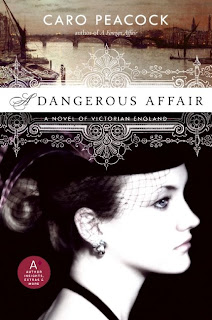
A Dangerous Affair by Caro Peacock

Caro Peacock’s A Dangerous Affair: A Novel of Victorian England is an advanced reader’s copy I received through the HarperCollins First Look program and will be published by HarperCollins’ Avon imprint on Jan. 27, 2009 in the United States or early February 2009 in the United Kingdom.

A Dangerous Affair is the sequel to A Foreign Affair and picks up with Liberty Lane right after the passing of her father. Her brother is away working with the East India Trading Company, and Liberty is left to earn her way in London as a music tutor. Her meager wages allow her to share lodgings with Mrs. Martley and she takes solace in riding her horse, Rancie, a gift from her father before his death. She has a network of friends who loved her father and have opted to care for her as well in his absence. David Suter is one of those friends and he composes music and leads orchestras at local theaters for a living.

This novel is set in London during the Victorian period, though the actions and language in the novel are more modern than a typical novel of this period. Despite this one drawback, readers will be easily sucked into the story as Liberty seeks to free the wrongly accused after a not-so-well-liked dancer, Columbine, is murdered backstage. From the prominent Mr. Disraeli to Amos Legge who works in the livery, the cast of characters in this novel aid Liberty in her quest to save David Suter’s friend even at the expense of her own pride.

The Old Bailey and a number of other prominent landmarks make it easy for readers to discern where they are in London as Liberty adorns her Sherlock Holmes’ deerstalker to track down the real killer of Columbine. This is an entertaining read with a variety of twists and turns.

Also reviewed by:

Jen’s Book Thoughts

***Remember***

3 copies of Breathing Out the Ghost by Kirk Curnutt are up for grabs here. The deadline for this international contest is Jan. 17.

Breathing Out the Ghost by Kirk Curnutt

I received Kirk Curnutt‘s Breathing Out the Ghost for a TLC Book Tour. Kirk also graciously agreed to answer a few questions and giveaway 3 copies of his book to 3 lucky winners anywhere in the world! Stay tuned for the interview and giveaway details.

How would you react if you lost a child? What is the appropriate reaction for a parent who has lost a child? These are the questions tackled in Breathing Out the Ghost. Moving on after a child has disappeared or has been murdered is unimaginable, but life does move on; but how it moves on is up to the family impacted by these tragedies.

“From inside the cab of the combine, Pete watched the reels of the header bat down row after row of soybeans. As the stalks fell backwards, their stems snipped clean by a line of saw teeth on the header’s bottom cutter bar, the bean pods scratched against the metal of the machinery, making the sound of a whisking broom on carpet.” (page 244)

This passage signifies how both Sis and Pete Pruitt and Colin and Kimm St. Claire tackle their grief and pick up the remnants of their lives. The process of rebuilding is a series of fits and starts and restarts; it’s not pretty and it’s never complete. Like the stalks cut down in this passage, lives are halted and lives are skinned raw. While Sis and Pete continue with their lives as best as possible and become a source of selfless comfort for others hit by tragedy in their town, Kimm is left to her own devices when her husband Colin, who calls himself a modern Ahab of the highway, sets out on a journey to find their lost son, A.J. Both stories are separate and connected, but only begin to intersect when St. Claire finds Sis Pruitt at a local fair where she and her group, Parents of Murdered Children, share their photo quilt.

Curnutt doesn’t bob and weave around the anguish these families feel, but he does ensure that each member of these families expresses sorrow and loss in their own way. He’s masterful at creating believable characters, even complex players like Robert Heim, who chose to leave behind his family to save St. Claire from himself.

However, this novel is more than a look at loss, it gauges the inability of control over life and what we as individuals do with that realization. The inability to control life is most evident in St. Claire’s actions, but it peeks out from behind Sis’ veil of normalcy as well. When Sis works with her community members to provide food for volunteers searching for a lost boy, she loses herself in the kitchen conversation, almost fooling herself into believing she’s normal. It’s only when she expresses herself and her memories of her dead daughter, Patty, that she realizes normalcy is not hers.

Through masterful language and description, Curnutt paints a vivid Midwest landscape in which these characters languish in grief and yet flourish in it. From Michigan to Indiana, readers will picture the asphalt highway that becomes St. Claire’s home, office, and escape and the Pruitt’s farm that provides them with order in a town where they feel they have been branded by the murder of their daughter.

One of the best passages in this book is found on page 219, where St. Claire is recording his thoughts on cassette tape for his lost son:

“When I see myself I don’t see anything organic, anything original. I steal my aphorisms from outside sources. My actions pantomime the exploits of others. I’m all imitation, a gloss of a citation. Somewhere along the line I began compiling myself from the excerpts of better men.”

Many of these characters are looking for ways to fill the holes inside them left by loss. And this novel is not just about the loss of loved ones; it is a novel about losing oneself in that loss, allowing it to swallow you whole. The introduction of Sis’ grandmother, Ethel, who has dementia, is a nice addition to the cast. Not only has she experienced the loss of loved ones, but also her own memories and sense of self. However, she is less tortured by that loss, as she is not bound by time lines or turning points that she would like to have a chance to do over. Regret and a lack of control over life can sometimes be more powerful than actual loss. While there are some graphic details involving sexual predator Dickie-Bird, St. Claire’s mythical white whale, this novel is an insightful look at grief, family, and perseverance.

Here’s my short interview with Kirk regarding his writing and advice for amateur writers.
Click on his photo to check out his Website.

1. Writers tend to be drawn to a particular genre and style. What would you consider your style? What genre are you most drawn to when writing and when reading? How do the genres you are drawn to when reading and writing differ or are they the same?

I like to think of myself as a lyrical writer. I’m very much influenced by F. Scott Fitzgerald in terms of colors and textures. I also like the way he described emotions. A lot of his stuff is romantic in that it stops just short of sentimentality, and I find myself drawn to that border too. So I like writing with a density to it: Toni Morrison, for example. And Moby-Dick is a biggie for me. I love to get lost in “The Whiteness of the Whale” chapter. I’m not a big fan of stripped-down prose and simple sentences, despite the fact that in my other life I’m a Hemingway scholar. Hemingway is great for aspiring writer because you can learn a lot about how to write landscape.


Because I teach, I read a wide range of books, though mostly 19th and 20th century American novels. I suppose I’m drawn to sadder books these days, but only because I find the characters a bit more complex than in comedy. A lot of humor anymore is satirical, meaning the dramatis personae tend to be stereotypes of predictable behavior. This gets particularly irksome in gender comedies. One of my favorite contemporary writers is Thomas Sanchez, who did a great book about Key West called Mile Zero about twenty years ago. His writing tends to be over the top. I also like Andre DuBois II―you can tell he cares about his characters. I try to balance out the more literary stuff with crime books, too. I’m a huge noir fan, and I read all the Hard Case Crime paperbacks when they come out, though I enjoy some more than others. Noir is tricky to do because it’s so stylized―it can come off a little too jokey if the characters aren’t compelling.

2. Most writers will read inspirational/how-to manuals, take workshops, or belong to writing groups. Did you subscribe to any of these aids and if so which did you find most helpful? Please feel free to name any “writing” books you enjoyed most (i.e. Bird by Bird by Anne Lamott)


I think you can learn practical steps from manuals and workshops, but really, a lot of development depends upon being an honest observer of your own strengths and weaknesses. I took several writing workshops when I was in my twenties, but I didn’t particularly find them helpful because people were too competitive and there was a lot of posturing instead of work.


I have a small circle of fellow writers who share their work in progress, and it’s the best thing in the world because we’re mutually supportive. We can call each other on deficiencies without hurting each other’s feelings. I also tend to read a lot of literary criticism and narrative theory for ideas and techniques. I loved James Wood’s How Fiction Works, even though I disagree with a lot of his orthodoxies.


3. There is a great deal of poetic prose in your novel, Breathing Out the Ghost. Have you written poetry or have you considered it? Why or Why not?


No, I’ve never tried poetry, in part, I think, because I’m too attached to plot. I do love poetic prose, however, and I think a writer should test the limits of language. That’s part of the reason that I love folks like Melville, Fitzgerald, Faulkner, and Morrison, as different as they all are. I read and teach modernist poetry regularly―I love Hilda Doolittle, for example―and it’s taught me a lot about imagery and symbolism. What a dash of poetry can bring to the prose is simply greater sensuousness. So much of the world feels flat and simplified today; we’ve gotten a bit of a tin ear when it comes to metaphor. So the poetic part is just there to challenge myself to appreciate the richness we tend to overlook.


4. A great deal of writing advice suggests that amateur writers focus on what they know or read the genre you plan to write. Does this advice hold true for you? How so (i.e. what authors do you read)?


I think the “write what you know” dictum is the worst thing that ever happened to writing. It’s been bad for two reasons: it’s encouraged people to believe that personal experience is the only font of knowledge that’s worth exploring, and, as a result, it has discouraged people from learning new things. To me a far better philosophy would be, “If you want to write about something you don’t know, go out and learn it.” And the reality is that professional writers do this on a daily basis.


In my own case, I knew zilch about farming except for some embarrassing memories about how useless I was when I was a child and I would try to help my grandparents milk and harvest. I wanted to know the language of combines and hogs, however, so I went out and educated myself, both by visiting farms and reading books. I’m fortunate that I have a very tolerant uncle who entertains a lot of my stupid questions.


The other downside of only writing what you know is that writers tend to create characters that are only variations of themselves. As much as I love Hemingway and Fitzgerald, they and their generation are to blame for this tendency. At its most reductive, the idea gets boiled down to the notion that men can’t create convincing female characters and that women have the same problem with men. I think what actually happens is that sometimes we as writers don’t extend our characters the courtesy of empathy: we create them as foils whose behavior is the axe we want to grind.


Take the two spouses in Ghost, for example. It was very important to me that readers be able to identify with the dilemmas of both Pete Pruitt and Kim St. Claire as much as the narrative sympathies encourage them to care about Sis and Colin respectively. In essence, I wanted the audience to see the lack of generosity in my main characters’ resentments toward their families, because otherwise all I would have is an unemotional husband and an unfaithful wife. Motives are more complex. I guess the key word is empathy: I think challenging yourself to write about people who aren’t you is both artistically and ethically beneficial. It teaches you a bit of humility about your own opinions, and it allows you to feel for the things other people have suffered without pity or condescension.


5. If you were to create a playlist for your novel, what are the top five songs on that list?


This is a great question! I actually had a group of songs I would play as I was writing. Music is great inspiration because it’s such a different medium and it’s a productive challenge to try to translate its effect into words. The top songs would include:


a) “Yer Blues” by the Beatles. From The White Album, of course. I actually imagined Colin St. Claire listening to this song in the opening chapter, if only because I have memories of listening to it when I was in my very early teens. The Beatles may have been my first earphone album―you know, the kind of record that you end up spending heaps of time listening to in your own little world. Years later I read a quote from Eric Clapton talking about how hard it was for him to take this song seriously because it was so intense it seemed like a parody of the blues. I mean, the lyrics are way over the top: Yes I’m lonely / Wanna die.… etc. etc. Whatever John Lennon’s feelings for it were― and I don’t think he really cared for it―”Yer Blues” has always struck me as that kind of primal scream that’s as much about showing off one’s desperation as it is actually experiencing it. In that way, it seemed to capture for me the solipsism of Colin St. Claire’s quest for his lost son. Here is a version from the Rolling Stones’ Rock ‘n’ Roll Circus: http://www.youtube.com/watch?v=LAjdRHzH4M8


I just love the Beatles! I have to go out and find this song…perhaps the next time I’m at my parents. My dad has the White Album on LP!


b) “You R Loved” by Victoria Williams. This is a great bit of horn-tinged gospel that’s always embodied for me generosity and redemption. Victoria is often depicted as a sort of hippie kook, but there’s a deeply caring side to her music that makes me think of the word healing. I love the chorus: Jesus walked on the water / He turned the water into wine / He went down to the drunkards / To tell them everything is fine / You R loved, You R loved, You R loved. This is the song St. Claire’s daughter would sing to her father. http://www.youtube.com/watch?v=Go4D_sht00Y


c) “Little Bird” by the Beach Boys. Yes, the Beach Boys. I’m the world’s biggest BB nerd. There’s a real dark side to their late-60s music that only folks who can see past “Surfin’ U.S.A.” are aware of. This song, which appears on their extremely weird 1968 LP Friends, was the first song Dennis Wilson wrote. He later went on to make one of the best albums of the seventies, Pacific Ocean Blue. It would probably upset his fans to know this was the song I had in mind for the villain of Ghost, Dickie-Bird Johnson. “Little Bird” is often described as a gentle, child-like song, but to me it was always creepy. I mean, it was written while Dennis was hanging out with Charles Manson. It doesn’t get creepier than that. http://www.youtube.com/watch?v=1BLyXRPl1aE

I have to interject here that I would think that writing a song while hanging out with Charles Manson would indeed be very creepy!


d) “Every Grain of Sand” by Bob Dylan. Not really well-known, but a beautiful song about humility that appeared in the early eighties at the end of his Christian phrase. I snipped a couple of lines for dialogue here and there in the book. http://www.youtube.com/watch?v=lueCTMdAfrw


e) “If I Should Fall Behind” by Bruce Springsteen. To my thinking, a great love song for people who’ve been together long enough to be disappointed and yet forgiving. I played this over and over while I was writing the scenes between Sis and Pete. There are several versions of this song; it’s been recorded by everybody from Dion (doo-wop) to Linda Ronstadt (jazz). My favorite is the version Springsteen did with the E Street Band c. 2000. Each member of the group takes turns singing a verse, even Clarence Clemmons. It’s a really effective arrangement―way better than the 1992 original. Now everyone dreams of a love lasting and true / But you and I know what this world can do―that’s my favorite line. http://www.youtube.com/watch?v=qSAevK9__3k&feature=related


6. In terms of friendships, have your friendships changed since you began focusing on writing? Are there more writers among your friends or have your relationships remained the same?


I’m pretty good at compartmentalizing, so my friendships really haven’t changed in the years I’ve been trying to write seriously. I do have four or five really close friends who are in this game, but the majority of my friends have their own interests. Some are painters, some mechanics, some farmers, some Air Force lieutenants, some bartenders. I think it’s healthy to have a wide circle of folks who aren’t writers. You learn more by hanging out with people who aren’t like you because they know things you don’t. Friends are great sources of knowledge.

I also agree that having friends who aren’t writers is a benefit!


7. Please describe your writing space and how it would differ from your ideal writing space.


I have what’s called a “hidden room” in my house. It’s basically a half-attic that’s been converted into a spare bedroom. I use it for an office. I keep it pretty stark: a little computer table, bookshelves, and a table to hold my coffee cup. I’m usually up in it by five so I can write before work. For years I had a laptop and worked anywhere I could: sometimes at Panera’s or Barnes and Noble, sometimes in my room, sometimes in the car. What’s most important is that you keep up your schedule by being able to write wherever you’re at. Life is going to conspire to mess with your schedule, so you have to adapt.


Thanks so much for these questions! Thank you, Kirk, for graciously taking the time to answer my questions.

About the Author:

Kirk Curnutt is the author of eleven books of fiction and criticism, including the forthcoming thriller Dixie Noir (Fall 2009); Coffee with Hemingway (2007), an entry in Duncan Baird’s series of imaginary conversations with great historical figures: and the story collection, Baby, Let’s Make a Baby (2003).

Breathing Out the Ghost was named Best Fiction in the Indiana Center for the Book’s 2008 Best Books of Indiana Competition. It also won a bronze IPPY from the Independent Publishers Association and was a finalist for ForeWord Magazine’s Book of the Year Awards. Curnutt’s other awards include three consecutive Hackney Awards for short-story writing (2004-2006) and the gold medal in nonfiction in the 2008 William Faulkner-William Wisdom Creative Writing Competition sponsored by the Pirate’s Alley Faulkner Society.

A passionate devotee of all things F. Scott Fitzgerald, he is vice-president of the F. Scott Fitzgerald Society and a board member of the Scott and Zelda Fitzgerald Museum in Montgomery, Alabama.

Now for the giveaway information: (Don’t forget to leave me an email or working blog profile)

1. One entry for a comment left on this post regarding why you want to read Breathing out the Ghost.

2. A second entry if you blog about or mention this contest in your sidebar, don’t forget to come back here and leave me a link.

3. A third entry if you comment on a previous or subsequent tour stop and leave me a link to the post you commented on.

Deadline for entries is Jan. 17 at Midnight EST

Here are the other TLC Book Tour Stops:

Monday, January 5th: Diary of an Eccentric

Tuesday, January 6th: Ramya’s Bookshelf Review and Guest Post

Wednesday, January 7th: The Sleepy Reader and Guest Post

Thursday, January 8th: Crime Ne.ws, formerly Trenchcoat Chronicles

Monday, January 12th: Savvy Verse and Wit

Tuesday, January 13th: Educating Petunia

Wednesday, January 14th: Michele- Only One ‘L’

Thursday, January 15th: Book Nut

Friday, January 16th: Anniegirl1138

Monday, January 19th: Caribou’s Mom

Tuesday, January 20th: Lost in Lima, Ohio

Wednesday, January 21st: A Novel Menagerie

Monday, January 26th: Catootes

Wednesday, January 28th: Bloody Hell, it’s a Book Barrage!

Thursday, February 12th: She is Too Fond of Books

Mailbox Monday #12, Writing Goal #2


Mailbox Monday on Sunday has returned. Mailbox Monday is sponsored by Marcia at The Printed Page. I only received one book in the mail this week, which is a fine departure from the last several weeks.

From Danielle at Sourcebooks, I received:

1. Two Shall Become One: Mr. & Mrs. Fitzwilliam Darcy by Sharon Lathan

Writing Goal Week 1:

Apparently last week was not the week to start my writing goals. I was sick as a dog with some kind of flu or cold. I spent a lot more time sleeping and less time reading and writing.

This time I failed to meet my writing goal, though I do have a poem idea running around in my head.

Writing Goal Week #2:

I will repeat my goal from last week and accomplish it this week. I am determined. I cannot tell you how disappointed I am in myself. Here are the goals:

a. write one poem
b. write 5 pages for my novel
c. or rework my short story that I had shelved over the last few months.

Stop back tomorrow for my TLC Book Tour stop with Kirk Curnutt‘s Breathing Out the Ghost.