Remember when I urged you all to head over to Literary License to vote in a poll about the influence of literary blogs on your book purchases, well the results are in.
Book Reviewing Blogs matter greatly.
Check out the results here.
Literature and Poetry Reviews, Home of the Virtual Poetry Circle
Remember when I urged you all to head over to Literary License to vote in a poll about the influence of literary blogs on your book purchases, well the results are in.
Book Reviewing Blogs matter greatly.
Check out the results here.
Happy Valentine’s Day!
Thanks to all the entrants into the Clearing the Shelves giveaway! I’m happy to send these great books along to readers who will enjoy them. Randomizer.org helped select the winners for the giveaway.
Out of 19 entrants for The Memorist, Randomizer.org selected #19, which was TrayMona
Out of 16 entrants for The Sinner’s Guide to Confession, Randomizer.org selected #3, which was Wrighty of Wrighty’s Reads
Out of 22 entrants for Plum Lovin’, Randomizer.org selected #1 and #20, which were Becky of My Thoughts…Your Thoughts and Liane
Out of 25 entrants for Plum Lucky, Randomizer.org selected #22, which was Judy of Us Old Folks
I’ve sent everyone an email seeking their snail mail addresses, please send them along quickly so I can get the books in mail.
 I first saw Arlene Ang’s poetry in Pedestal Magazine, and then I saw that she became a guest editor of the magazine. I started reading her blog–Journal Writing and Other Ways to Talk to Myself–soon after, lurking about backstage and reading.
I also discovered she has her own Website where she posts some of her poetry, and offers links to her recent publications. Check out Agoraphobia published in The Chimera and The Itch on My Scalp Means published by Poetry Ireland. These are two of my favorites.
Suffice to say, Arlene and I have been chatting over email for some time and exchanging flowers on Facebook, having a grand old time. I figured since I was reviewing books, why not her chapbook, “Secret Love Poems,” and her new joint book with Valerie Fox “Bundles of Letters Including A, V, and Epsilon.” Arlene was kind enough to send me both books for review. Stay tuned for those reviews.
That brings me to today’s post, a partial interview with Arlene about her chapbook “Secret Love Poems” and her editorial position at Pedestal Magazine. Without further ado, I welcome Arlene to Savvy Verse & Wit.
Thanks Arlene. We’re going to have a great time getting to know you and your work. Thanks for taking time out of your busy, busy schedule to answer questions for Savvy Verse & Wit. Stay tuned dear readers, there is more of Arlene to come.

This week’s Weekly Geeks is about judging a book by its cover.
Here are the rules:
Pick a book–any book, really–and search out multiple book cover images for that book. They could span a decade or two (or more)…Or they could span several countries. Which cover is your favorite? Which one is your least favorite? Which one best ‘captures’ what the book is about?
For this week’s challenge, I chose The Phantom of the Opera by Gaston Leroux:


None of these covers match the copy I have, but these are the only ones I could find. I really love the one with the wax seal which captures the letters the opera ghost writes to the opera house managers. I like the old world feel of this cover.
The final cover is the one most like the musical by Andrew Lloyd Webber, but I’m not sure it captures the novel that well. I don’t really have a least favorite book cover among these.
What do you think?
***Don’t forget to enter my Clearing the Shelves giveaway***
 If you could be any fictional character who would it be and why?
I’ve thought long and hard about this one, and are you ready for my unconventional answer? Ok, its really a character that everyone should have predicted by now. In spite of her prejudices and faults, I would love to be Elizabeth Bennet. Why? Because she has the love of her father, the kinship of her sisters, her family, and Charlotte.

She’s also feisty, witty, and plain spoken. She doesn’t give a darn about convention, and is willing to risk it all for love. That’s who I would love to be. Independent, dependable, Lizzy!
Now, if I felt I had more leeway and I could be anyone or anything, I would have chosen differently.

How about this one?
I know I could have selected whomever I wanted, but the truth is I couldn’t just pick one. I love Lestat from Anne Rice’s Vampire Chronicles. He’s another witty character who flies in the face of convention to get what he wants. I love the passion. The desire to get it all.
What about you? Which fictional character would you choose?
***Don’t forget to enter my Clearing the Shelves giveaway. ***
 I was peeking through my bookshelves and discovered that I have been remiss in the giveaway department.
I have a bunch of books that I will giveaway in honor of Valentine’s Day, though none of them are particularly “love” oriented.
1. Plum Lucky by Janet Evanovich, check out my review.
2. The Memorist by M.J. Rose, check out my review.
3. The Sinner’s Guide to Confession by Phyllis Schieber, here’s my review. This one is gently used.
4. 2 Copies of Plum Lovin’ by Janet Evanovich, the review for this is forthcoming. We’ve been listening to the audiobook of this one.
How to Enter: (Make sure you leave and email so I can contact you if you win. Don’t forget to tell me which book you want most.)
1. Leave a comment on this post about your favorite Valentine’s Day ritual.
2. Blog or feature this giveaway on your blog in a sidebar to receive a second entry (don’t forget to come back and leave a comment with a link)
3. If someone sees this giveaway on your blog, tell them to drop your name and you both get an additional entry.
***Looks like I forgot a Deadline! How about February 13th by 5PM EST***
 I’ve been working on a interview project with Deborah at 32 Poems magazine, and she kindly allowed me to interview past contributors to the magazine. We will be posting the interviews throughout the coming months, and our third interview posted on Deborah’s Poetry Blog of 32 Poems on Feb. 9.
I’m going to provide you with a snippet from the interview, but if you want to read the entire interview, I’ll provide you a link for that as well.
For now, let me introduce to you 32 Poems contributor, Bernadette Geyer:
1. Not only are you a contributor to 32 Poems, but you also have a chapbook of poems published, your own website and your own blog. What “hat” would you consider the most challenging to fulfill and why?
Before “retiring” to become a stay-at-home mother, I worked in public relations. So to me, the website and blog are fairly easy for me to keep up with when I think of them as marketing tools for my writing. The most difficult hat for me to fulfill is being a “writing parent” — it is challenging to find the emotional/psychic space I need to really get into the poem — or article-making frame of mind. I usually cannot create if she is awake and in the house. But I have developed some internal ways of keeping a “creative train of thought” active in my head even when I am doing something completely different.
2. What prompted you to start a blog? How active are you as a blogger? And what types of posts does your blog focus on? Also, do you believe a blog is essential to marketing your work or is the Web site more useful for that purpose?
I started my blog a long time ago, back even before I had “retired” from my full-time PR job. I think it was originally a way of engaging my mind by blogging about the poetic process during my lunch breaks. But I wasn’t a very active blogger. Even now I don’t consider myself very “active.” My posts tend towards the short side – thoughts on poems, references to interesting articles I read, news on my own writing, upcoming readings, or random tidbits I just feel like sharing. I do think a blog is an essential part of a writer marketing his/her work. A web site is a great tool, but very impersonal. I think readers find blogs give them a more personal relationship with a writer than just checking out a static web site. Blogs are great ways of building or broadening an audience for your work.
4. Most writers will read inspirational/how-to manuals, take workshops, or belong to writing groups. Did you subscribe to any of these aids and if so which did you find most helpful? Please feel free to name any “writing” books you enjoyed most (i.e. Bird by Bird by Anne Lamott)
I have done all of the above over the past 10-15 years that I’ve been writing. Lately I find “how-to” books to be not very useful in inspiring my work. Exercises are sometimes useful if I just want to get the pen moving (In the Palm of Your Hand by Steve Kowit and The Practice of Poetry ed. by Robin Behn & Chase Twichell, in particular). I find articles, essays and books on poetics to be more inspirational to me in thinking about how I approach my own poems. American Poetry Observed (edited by Joe David Bellamy) was a book I recommend as a collection of poets discussing their own poetics.
I also enjoy and find useful the essays and articles in The Writer’s Chronicle. I don’t have a post-graduate degree in writing, so I try to read everything I can to educate myself. Workshops are not very useful to me anymore except that I have a few good friends who I trust to read my work and provide comments.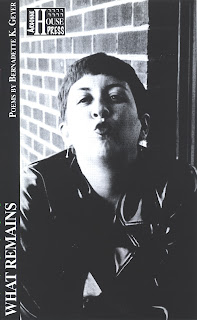
I’ve tried forming a writing group among local writing moms, but it’s been hard to keep a regular meeting pattern. I do teach poetry workshops in public elementary schools, and have found Kenneth Koch’s Making Your Own Days and Rose, Where Did You Get That Red? to be very good reminders of how fun it can (and should) be to write for the love of words and language.
Check out Bernadette’s collection of poems, What Remains.
Want to find out what Bernadette’s writing space looks like? What music she listens to while she writes? Find out what she’s working on now, her obsessions, and much more. Check out the rest of my interview with Bernadette here. Please feel free to comment on the 32 Poems blog and Savvy Verse & Wit.
***Here’s Bernadette’s recently published poem from 32 Poems, here, “Thumbelina’s Mother Speaks: To the Toad’s Mother.”
***Check out The Bookword Game poll on Suey’s Blog***
 I want to welcome Stephen Alan Saft to Savvy Verse & Wit. He was kind enough to answer some questions about his poetry and writing inspiration. If you’ve missed my review of his latest book, City Above the Sea, click on the title. Without further ado, here’s my interview with Stephen:
1. In your biography, it states that you have written essays, novels, plays, and poetry. Has any particular genre presented a challenge for you? How so?
All genres have presented a challenge for me at various times. Right now I am trying to write a sequel to my epic poem “Murdoch McLoon And His Windmill Boat” (also published in 2008) and have gotten bogged down in the storyline or plot of the new project. Such is the challenge to the poet who gets inspired to attempt to write narrative poetry. You don’t just worry about how you are going to say what it is you want to say at the moment. You worry about the sequence of events or plot of the piece, and you worry about the characters in the piece, their lives and motives.
Yes, I do. I am not inspired to write rhyming poetry at the moment, but that could change in the blinking of an eye. When I was writing rhyming poetry before, I was also into writing music using one of music composition software packages. Rhyming and music are strongly linked in my mind. I am debating with myself if I want to go through the effort of getting back into music and all that that entails. Recently I sang as part of a choir in a concert, and I must admit that that got me thinking about music again and how much I enjoy it.
I am driven by two very strong motives. One is to understand the human condition, which is to say where I stand in the continuum of discovery that should be basic to the way we live our lives and to share that understanding with others. I believe that if I am successful at sharing what I have discovered with others, we all gain in wisdom. My second motive—and I admit that the two motives are linked—is altruistic in nature. I am committed to doing good. I want to make the world a better place. This effort begins in the psyche. If we are clear headed, we have a chance to act in such a way to make the world a better place.
I have very high expectations for poetry and art including music and literature in general. Poetry at its best helps us attain clarity—both the writing and the reading. I would say that all the arts to some extent give us this capability.
Some poems are written very quickly, and I don’t do much revising. Other poems end up being long-term commitments. I’m coming back to them periodically and making changes here and there—even if it is just a case of changing one word.
I have many obsessions, but the one closest to my creative work is my obsession with perfection. I am a perfectionist to a fault, and I often give myself no peace because of it. Of late, I have learned to put my current work aside with the expectation of coming back to it later when I am starting to experience diminishing returns. Another issue I have been wrestling with throughout my life is fear of rejection. Of late I’ve gotten more relaxed about the problem of rejection. Earlier it was a major impediment for me and helps explain why so much of my work has been so slow to see the light of day, that is, publication.
I compose on computer, but I also carry a pocket-size notebook. My poems often begin as images or ideas jotted down in the notebook, but they are always completed on computer. I believe that next to the achievement of writing itself the computer—and here I am referring to the specific achievement of word processing—is a reality that even surpasses the printing press. The concept of the Internet must also be understood as part and parcel of this phenomenon.
Given what I just said, you would expect to find a lot of computers in my house, and you would, but only two of the four are truly functional anymore. I am fortunate that we have a fairly roomy house in the country, and I can use a large part of the lower level for a work space. If I do get involved with music again, I’ll compose in this space as well.
I feel very fortunate to have so much space. Previously I lived in a small one-bedroom apartment in a high rise condominium in Arlington, Va. We had an impressive view from our balcony including some of downtown Washington DC, but what we didn’t have was much living space. Before that, we lived in a townhouse in Fairfax, and it was there that I composed the music for my rhyming poems.
I love music, and my tastes are wide ranging. Recently I became a subscriber to the Sirius satellite music system. I thought that Sirius might bring me back to the classical genres, but instead I find that I’m spending far more time with their more pop-music channels, such as their 1940s channel than I would have ever guessed.
The great achievement of the music of the 1940s is that it is far more open ended, that is, less constricted, than the music of other, especially later eras. In the course of a 10 to 15 minute set one can hear a ballad by a great crooner like Bing Crosby or Fran Sinatra accompanied by a symphonic orchestra, then an energetic jazz arrangement of a Broadway show piece, perhaps played by Louie Armstrong or Duke Ellington or Count Bassie and friends, followed by a big band rendition from the likes of Glenn Miller or Artie Shaw or the Dorseys, followed by a funny, even silly presentation by something like the Spike Jones Orchestra. What variety! We have nothing like that anymore.
As for naming my five favorite songs, I couldn’t possibly do it. I’ve been immersed in far too many styles of music and loved too many compositions in each to do that.
Yes, I do believe that the Beat poets were more influential than the poets of today, but I need to add that I do see a resurgence. Poetry comes and goes in popularity. and I do think that it is coming back. How much poetry comes back will be the result of the actions of two different groups—the writers of poetry and the readers of poetry. I hope I can be forgiven for sounding more than a little self serving, but I do think that the fact that writers of poetry are willing to tackle long forms like narrative poetry is one very healthy sign. Now will the readers of poetry including those who attend poetry performances be willing to support the longer forms? We will see.
I was recently able to purchase Seamus Heaney’s “Beowulf” at a local Walden Books store in Winston-Salem, North Carolina. I take that as a very good omen. Wow, you mean you can tell stories in poetry? Yes, you can! And those stories can be full of action, full adventure, full of emotion? Yes, they can! In fact, our oldest stories including the stories of the Bible and the epic sagas are poetic, that is, metrical in nature, and full of colorful imagery. Yes, yes, yes, poetry is coming back!
Now having said what I said, I need to quickly add that I still write short, lyrical, philosophical poems. I am not totally preoccupied with story telling through poetry. I still write the short stuff too.

I have done all of the above including scribbling on buses. Lately I have been able to use the key hours of the day, which for me are the hours after breakfast and before lunch, for writing. What a welcome change! Previously I had to sandwich my writing into days taken up with the demands of full-time jobs.
I have been a member of one writers group in my life. This was during my early years of residency in the Washington area, where I moved in 1978. Earlier, in college, I took one course with a favorite professor that provided an opportunity to share my writing with others. Both experiences were useful, but they could have been far more useful had I not been so sensitive about criticism and so sensitive about the idea of exposing my inner thoughts to others. I was terribly thin skinned during these periods of my life, and this hypersensitivity was to make me far less effective in getting my work out in the world than I should have been.
I would recommend both approaches—courses and writers groups–to people trying to get started as writers and trying to move their lives along as writers. If you have problems with hypersensitivity to criticism, as I did, you need to be working on that as a separate impediment to success. So what if so-and-so thinks something in a current work of yours could have been done better. Maybe so-and-so is right. Give some thought to the criticism and how you might alter your work accordingly.
If you think so-and-so’s problem is that he is just not in sync with your philosophy of how poetry should be written, then you’ve got to learn to walk away from his criticism. Summon up the courage in yourself to stick with your convictions—with your vision–and move on. To your own self be true.
I am filled with ideas for future projects. For example, as I alluded earlier, I have begun work on a sequel to “Murdoch McLoon And His Windmill Boat,” my epic or mock epic story poem. The sequel also involves the use of technology to solve a problem facing us. Now I need a surge of energy to move the project forward. I also want to continue to write short poems, poems of self discovery. And I might even try fiction again. Never give up! Never quit! That is what I keep reminding myself.
I try to read my work as often as possible at the once-a-month Spoken Word gathering in Floyd, Virginia. Other opportunities for readings have been brought to my attention, and I hope to be able to participate in some of these events as well as soon as possible.
Thanks again, Stephen, for answering my questions. City Above the Sea is one volume of poetry that should be on everyone’s shelves.
 This is my first Monday Movie Review, which is sponsored by Sheri at A Novel Menagerie.
Movie: Wuthering Heights
Starring: Tom Hardy as Heathcliff
Charlotte Riley as Catherine Earnshaw
Genre: Romance, Drama, Classic
The movie version of Emily Bronte’s classic Wuthering Heights may confuse viewers who recently read the book or have the book committed to memory. I distinctly remember the narrator, Lockwood, in the book, and was rightly confused when the movie began at the ending of the book when Heathcliff attempts to force Catherine Linton (Edgar Linton and Catherine Earnshaw’s daughter) to marry Linton (Healthcliff and Isabella Linton’s son).
**Flashback**
Unlike the book, Heathcliff has a softer side, which only turns darker when Catherine’s brother, Hindley, takes over the estate after the death of Mr. Earnshaw. Hindley was vicious to Heathcliff as a child when his father brought the gypsy home. Rumors circulate that Heathcliff is Mr. Earnshaw’s illegitimate son, and Hindley wants to restore his family’s reputation. The relationship between Catherine and Heathcliff grows exponentially from when they were children, and through a sped up storyline and camera effects, their adult-like relationship and wild demeanors are revealed–romping on the moors, becoming intimate, and continuing to engage in childish pursuits of spying on the neighboring Lintons.
What’s missing from this movie adaption is the searing hatred Heathcliff exudes on his fellow man and particularly on Hindley. Eventually this hatred and darkness also descends on Catherine after she marries Edgar Linton. More than just Heathcliff’s edges are softened in this adaption. He’s kinder to Isabella, Catherine, and the subsequent children. Heathcliff’s ending is much more sedate than the downward spiral in the novel. Catherine also is a much softer, more lovable character in this adaption. She could be just as harsh as Healthcliff at times. The ending also is more hopeful.
Staying true to the novel may not have been the aim of this movie adaption. I’ll rate it 3 out of 5 bags of popcorn because the actors were well selected, the storyline was gripping, and the scenes were gorgeous.


Also Reviewed By:
Book-A-Rama
Age 30+ . . . A Lifetime of Books
***In Other News***
Check out Jess McCann, Author of You Lost Him at Hello (my review), on Good Morning America, Feb. 13! On Jess’s Website you can watch her recent appearance on Fox Morning News!
 Welcome to another edition of Mailbox Monday, which as you know by now is sponsored by Marcia at The Printed Page.
It was a slow week, and I only received one book in my mailbox. Hard to believe, I know, but it’s true.
Mainline to the Heart and Other Poems by Clive Matson; This book will be released in March 2009.
What did you get in your mailbox?
The Writing Goal Update for this week is not good. I made no progress on the poem, nor any of the other ongoing projects I have. However, I did uncover some writing I stashed away in a variety of notebooks months ago and had misplaced.
So, for Writing Goal Week #6:
I have plans to work on one of the writing projects I’ve unearthed from the piles of books I’ve organized or the one I have previously been working on.
However, there is that possibility that fiction will find its way to my pen this week.
Sorry for the open-ended goal this week, but it’s been hectic.
Have a great week everyone!
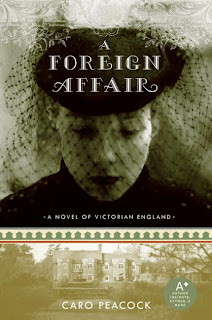 After reading A Dangerous Affair by Caro Peacock for the HarperCollins First Look Program and the adventures of Liberty Lane, I decided to pick up the first in the series to see how Liberty’s exploits began. Check out my review of A Dangerous Affair here. A Foreign Affair by Caro Peacock is set in England and France prior to the ascension of Queen Victoria to the throne of England. Liberty Lane is staying with family when she receives word from her father that he will be returning home from Paris shortly. Rather than wait for him to return, she runs off to Dover to meet him, but she soon learns of his death.
Liberty’s impetuous nature leads her into dark alleys, a morgue, carriages with duplicitous men, and a household full of secrets as she attempts to uncover the truth behind her father’s death. She refuses to accept the news that he died in a dual, and she is enlisted by men of influence to spy on the Mandeville household while feigning to be a governess.
Caro Peacock has a way with description. Readers will be thrust into cramped spaces with large, round scary men, like in the passage below:
“The man who called himself Harry Trumper had arranged things so that he and I were sitting side by side with our backs to the horses, the other man facing us with a whole seat to himself. As my sight cleared, I could see that he needed it. It was not so much that he was corpulent–though indeed he was that–more that his unweildy body spread out like a great toad’s, with not enough in the way of bone or sinew to control his bulk” (Page 39)
Readers will enjoy how Liberty’s relationship in this novel develops into more of a friendship in the second novel, rather than the fatherly relationship we see in A Foreign Affair. Liberty is a Victorian Age Nancy Drew, led by her impetuous and curious nature to solve mysteries. Peacock’s use of language unfolds the intricate relationships between the characters and the mysteries in this novel.

About the Author:
Caro Peacock grew up in a farmhouse that‚ for most of her childhood‚ contained half a dozen brothers‚ sisters and cousins‚ twice as many cats and dogs‚ no central heating and one bathroom that stopped working every time the spring that supplied it silted up. This possibly bred the habit of curling up in a quiet place with a book and‚ later‚ a passion for travel that led to a rather disrupted education. Somewhere along the line‚ she acquired a great interest in Victorian history − which she considers a much misunderstood period − and particularly the part played in it by independently−minded women.
Also Reviewed By:
A Girl Walks Into a Bookstore
***Don’t forget to check out my latest Poet Interview with Eric Pankey***